
A—
Departure of Jason (306–16)
The episode concludes when Jason leaves his home and goes off to Pagasae. Apollonius compares him to the youthful god Apollo as he passes through the crowds at one of his sanctuaries:
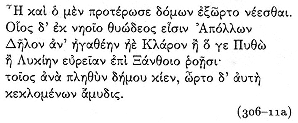
He spoke, and then hastened to depart from the house.
As Apollo goes from his temple, redolent of incense,
through sacred Delos, or Clarus, or Pytho,
or wide Lycia at the streams of the river Xanthus,
just like this he proceeded through the crowds of the city, and the
shouting of those bidding him farewell grew loud.
[23] One should note that this reference, like that to the speech of Achilles to Priam, was first observed by the scholiast ad 1.304. Modern commentators have also observed the borrowing: cf. Mooney, Ardizzoni, and Campbell ad 1.304, Vian 64 n. 1, and Fränkel p. 62 n. 93. It may not be coincidental that in this last reference to a Homeric passage referring to Hector's death Apollonius looks to the same Iliadic scene that initiated the series of connected allusions (see above, Argo. 1.261–64 »Il. 24.160–68).
As he proceeds toward the beach, the young Apollinian male is approached by Iphias—the aged priestess of Apollo's sister, Artemis—whom he leaves behind without notice:
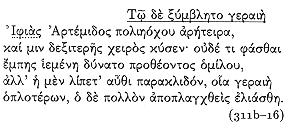
An old woman met him ,

and she kissed his right hand. But she was not able to say anything,
however much she wanted, because the crowd kept moving forward.
So she was left there on the side of the road, just like an old woman
by the younger generation, as he moved on and into the distance.
As I have observed above, this brief encounter summarizes the thematic oppositions of the episode: male–female, young–old,[24] optimistic–pessimistic.[25] The Iliadic passage that Apollonius is imitating here reveals yet another inversion between text and subtext:[26]

The old man met them ,

The words used to describe the encounter of an enthusiastic Jason with the old Iphias (female) recall the moment that the elderly
[24] The scholiast ad 1.307 noted that the point of comparison between Jason and Apollo was youth.
[25] Jason appears to be so full of high spirits and completely wrapped in his thoughts of the adventure before him that he does not even notice the elderly priestess; his optimism, seen in his speech and parallel with the optimistic prognosis of the men of Iolcus (240b–60), is reflected in his godlike demeanor. Accordingly, one would associate Iphias with the pessimistic reactions of the other women of the episode, Alcimede (278–94) and the women of Iolcus (247–60).
[26] Cf. Ardizzoni ad 311, Campbell ad 1.311–12.
Nestor (male) met the wounded Greek leaders at a low point in their struggle near the beginning of Iliad 14. A more important difference exists between the two passages than that of gender. Whereas the Greek heroes give evidence of their great respect for the older Nestor, Jason does not even sense the presence of the old priestess, who is abandoned, the poet tells us, just like an old woman by the younger generation. As such, Jason is different from the Homeric heroes: he is too focused on himself and his expedition to take notice of the elderly priestess. In this self-absorption he resembles his parents.
At this point it is possible to make sense of the various threads of this complex set of subtexts. Apollonius compares Æson to Priam as he lamented the death of his son. Priam, on the one hand, shrugged off the paralyzing effects of his grief and went courageously to Achilles' tent to ransom Hector's body. Æson never moves. We are led to believe by the poet's silence that he remained seated, luxuriating in an enervating self-pity. The poet describes Alcimede in terms recalling Andromache. In the passages alluded to, Andromache's fear is that Hector's death will result in the literal enslavement of herself and her son. Alcimede, however, expresses fear not for personal, but for a kind of social enslavement. Up to this time, Apollonius informs the audience, Alcimede derived her status from her son:





Jason too suffers in comparison with his models. Achilles showed respect for the old and grief-stricken Priam as he thought of his own father; Hector left Andromache and Astyanax to go off to battle only after revealing his great love for them (cf. Il. 6.450–81); Priam, despite the danger of his mission, went off in the night to the enemy camp to bring back Hector's body accompanied only by an old man like himself; finally, the Greek heroes all showed great respect for the elderly Nestor. Jason, on the other hand, who begins his expedition with confidence, accompanied by the finest crew in all Greece, evinces little respect or love for his elderly parents or the old priestess. He says nothing to Æson. His reply to his tearful mother is brief, cold, and overly logical;[28] and his lack of response to the aged Iphias trying to speak to him appears insensitive or even callous. In short, Jason shows none of the sensitivities toward his elders and loved ones that characterized his Homeric models. These responses not only anticipate his emotionless and ungrateful farewell to Hypsipyle (1.900–909) as well as his unenthusiastic protection of Medea on his return to Greece (cf. 4.66–97, 338–410, 1031–67, and 1161–69);[29] they also look beyond the scope of the poem to Jason's future abandonment of Medea so brilliantly captured by Euripides.[30]
The series of related Homeric passages to which Apollonius makes reference exerts a profound impression on our reading of the episode and on our understanding of Jason's character. This rather involved contaminatio of diverse elements from both the Iliad and Odyssey having to do, directly or indirectly, with Hector's death, and how he and his family came to terms with it, gives
[28] Cf. Fränkel ad 1.295–305, contra Stössl (supra n. 3) 26 and Vian 13, who believe that Jason had to respond to his mother's frantic lamentation with firmness.
[29] See Beye 81–82. Garson (supra n. 17) 5–6, who finds Alcimede's lament hollow and Jason's response unheroic, also observed that Apollonius later on has Medea, in her plea to Jason not to desert her (4.368–69), recall the celebrated words of Andromache to Hector in which she reminds Hector that he is her father, mother, and brother as well as husband (Il. 6.429–30); cf. Vian (3) 162 ad 369.
[30] On the association of Iphias with Medea as priestesses of Artemis, see the recent article by D. P. Nelis, "Iphias: Apollonius Rhodius, Argonautica 1.311–16," CQ 41 (1991) 96–105.
us a valuable insight into the effect that Jason's departure has on his family and himself. The Argonautic figures clearly suffer in comparison. In particular, we see that even from the beginning of his heroic career, Jason lacks the respect and concern for those who both love and need him. As such, he is the antithesis of Hector, who was the quintessential

