
Chapter Five—
Wordsworth as Paterfamilias:
The Later Poetry and Life
Wordsworth wants the cheering society of women.
The Diary of Henry Crabb Robinson, 22 May 1837
It was sympathy he wanted, to be assured of his genius, first of all, and then to be taken within the circle of life, warmed and soothed, to have his senses restored to him, his barrenness made fertile, and all the rooms of his house made full of life.
Virginia Woolf, To the Lighthouse,1927
Isabella Fenwick was no blind worshipper.… She found no obsequiousness at Rydal Mount. Coming from Greta Hall, where Kate and Bertha Southey ministered silently to their dazed father, she considered 'the storms that sometimes visited the Mount … more healthful and invigorating than such calms.'
Frederika Beatty, William Wordsworth of Rydal Mount, 1939
In his late writings Wordsworth endorses an ideology of womanhood that limits women's achievement by emphasizing "womanly virtues" associated with home and hearth. Even more than the contemporary women poets he often disparaged, Wordsworth was by this time a poet of domesticity, whose identity was linked both to the Lakes in general and to his home, Rydal Mount, in particular (see figures 4 and 5). The image of Wordsworth and his friends picnicking at Coniston in the two-part Prelude strangely presages the world of Rydal Mount, a cultivated and well situated "manor house." By the late 1820s and 1830s, the time
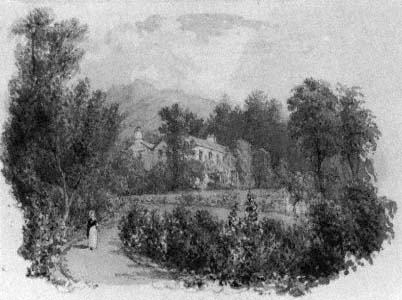
Figure 4.
Rydal Mount. Watercolor by William Westall from Dora Wordsworth's
Book. 1831. By permission of the Wordsworth Trust, Dove Cottage, Grasmere,
England.
of Wordsworth's greatest popularity, he had become associated with the house, where he received the hundreds of visitors who came to pay homage. In this chapter I will consider what it means for Wordsworth to be a poet of domesticity and what roles his daughter Dora and other women play in the world of Rydal Mount. We should also bear in mind that Wordsworth was writing for a proto-Victorian audience, not for some remote posterity.
The prevailing modern critical view of Wordsworth as a visionary and sublime poet has excluded most of his poetry after the Great Decade from serious discussion. In his conclusion to "Wordsworth at St. Bees: Scandals, Sisterhoods, and Wordsworth's Later Poetry," first published in 1985, Peter Manning eloquently calls for new readings of the later Wordsworth that consider the poetry for what it is rather than what it is not.[1] Manning refers to Hartley Coleridge's assessment of Wordsworth, which I have also taken as a starting point. Responding to the well-received Yarrow Revisited (1835), Hartley Coleridge remarks:
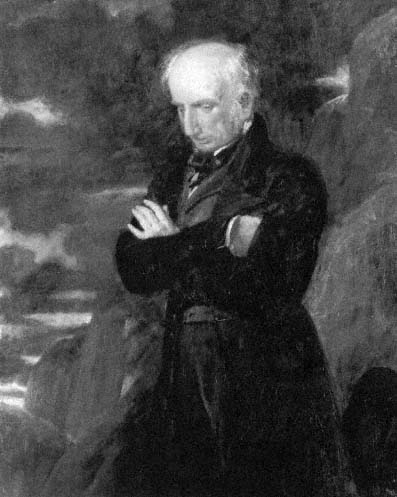
Figure 5.
Wordsworth on Helvellyn. Painting by Benjamin Robert Haydon. 1842. By
permission of the National Portrait Gallery, London.
I think I perceive in Wordsworth's last volume a decided inclination to the playful, the elegant, and the beautiful; with an almost studied exclusion of the profound feeling and severe thought which characterised the offspring of his middle age.… they are perfect, perhaps more perfect, in their kind than any of their predecessors: but the kind is less intense, and therefore, incapable of that unique excellence which the disciples adore…. I am delighted … to
see such freshness and loveliness of imagination, in a man upon whom old age has descended not without its attendant trials and sorrows.[2]
Hartley Coleridge does not see only the playfulness and beauty of Wordsworth's later poetry: his picture of the man refutes the myth Wordsworthian decline, although it confirms that changes have occurred. Playful and fresh are words rarely used to describe Wordsworth's later poetry, but I have found much to corroborate Hartley Coleridge's judgment.
While Peter Manning has written about the later poetry, several other recent commentators have written about Wordsworth as poet in his later years or in relation to other poets of the 1830s. But they do so without reading the poetry in detail. Marlon Ross, for instance, contrasts Wordsworth as a poet of domesticity with Felicia Hemans, proposing in The Contours of Masculine Desire that a passage from An Evening Walk (1793) describing a rooster captures "every element of Wordsworthian domesticity with uncanny inclusiveness": "This domestic scene is not a community of shared desire, but a hierarchy of emotion with all attention focused on the 'monarch.' The 'sister-wives' may be seen as equal not only in their sharing of a common space, but also in their equal adoration of the male monarch" (310). While there are no doubt some elements of truth in this description, Wordsworthian domesticity contains more complexities than this portrait indicates—and Wordsworth's attitudes certainly changed and developed. Furthermore, the women of the household admired William, but they did not all approach him with a reverent tone: Sara Hutchinson's wry sense of humor extended to her brother-in-law; Dora lovingly teased her father as "trumpery old Daddy brisk & fat & well & busy verse making as possible";[3] Mary Wordsworth sometimes refused to take dictation if her husband got too gloomy. Perhaps Sara Hutchinson's early note to De Quincey about The Convention of Cintra gives a sense of what I mean. On 5 May 1809 she takes a lightly satirical attitude toward Wordsworth's fears of publishing politically controversial material. Following William's serious worry about "Prosecution in any of the courts of law" (MY 1:329), Sara adds: "We females shall be sorry to find that the pamphlet is not published for we have not the least fear of Newgate—if there was but a garden to walk in we think we should do very nicely—and Gaol in the country would be quite pleasant" (MY 1:330). Sara's letter suggests a sense of female solidarity: she speaks collectively for the women in the family, assuming their unity and identity.[4] There is also sly humor in her portrayal of women's home life as consistent with prison.
Furthermore, although Wordsworth's literary work occupied the center of the household, Wordsworth did not take for granted the help he received. In a letter home from a tour with Crabb Robinson (5 July 1837), Wordsworth writes:
Dearest Mary, when I have felt how harshly I often demeaned myself to you, my inestimable fellow-labourer, while correcting the last Edition of my poems, I often pray to God that He would grant us both life, that I may make some amends to you for that, and all my unworthiness. But you know into what an irritable state this timed and overstrained labour often puts my nerves. My impatience was ungovernable as I thought then, but I now feel that it ought to have been governed. You have forgiven me I know, as you did then, and perhaps that somehow troubles me the more. I say nothing of this to you, dear Dora, though you also have some reason to complain.
(LY: 3:423–24)
As we know, Wordsworth was a relentless reviser who depended on members of his household to help him carry out the work. This letter reveals both what Wordsworth could be like to live and work with, as well as his ability to criticize his behavior as household tyrant. When Crabb Robinson reported to the poet that De Quincey had said that Wordsworth had a better wife than he deserved, Wordsworth, reportedly, fully agreed.[5]
Wordsworth poignantly—and typically—feels the need of home and family most strongly when he is away from Rydal Mount. In a much more petulantly humorous mood, he complains in his next letter that the bachelor Robinson "has no home to go to but chambers, and wishes to stay abroad, at least to linger abroad, which I, having the blessing of a home, do not. Again, he takes delight in loitering about towns, gossiping, and attending reading-rooms, and going to coffee houses; and at table d'hôtes, etc., gabbling German, or any other tongue, all which places and practices are my abomination" (LY 3:426, 17 July 1837). For his part, Robinson tells other friends that he could not play the proper feminine role to keep Wordsworth happy on the tour, although he tried.[6]
Kurt Heinzelman adopts the term "cult of domesticity" in his discussion of the Wordsworths' transition from the Grasmere years, when commodity production was attached to the home, to a "cultic valorizing of the household" after production has been separated from the home (R & F, 53). Heinzelman locates this shift in the Wordsworths during the Rydal Mount years, but he focuses on "the Wordsworth household before it became codified and acquired its Victorian interiors—before that
is, the radical Wordsworthian mythos … became enmeshed in what historically may be called a 'cult of domesticity.'"[7]
To build on Heinzelman's analysis, I will consider the ethos of Rydal Mount. Although Wordsworth never owned the property,[8] Rydal Mount was both a home and a symbol of home for the Wordsworths from 1813 until the end of their lives. We can to a certain extent reconstruct this home by reading the poetry and letters of the period and by reading what friends such as Crabb Robinson, Isabella Fenwick, and Hartley Coleridge say about the Wordsworths' lives. While the world that developed at Rydal Mount may be called a cult of domesticity and while Wordsworth certainly saw "womanly virtues" as closely associated with home and family, the division of the domestic sphere from the public sphere was not absolute. The home was the vantage point from which the Wordsworths made sense of the larger world. And during these years, Wordsworth worked at home and took an active part in the education both of his own children and of the children of the village. A later tradition developed in which the local children visited Rydal Mount each year on Wordsworth's birthday for a party—a gesture that suggests feudal noblesse oblige rather than bourgeois interiority.[9] It seems, then, that the world of Rydal Mount brought together an odd mix of attitudes and traditions, some reflecting and some diverging from the larger culture.
I would argue that the Wordsworths' household at Rydal Mount has more in common with the middle-class homes that Davidoff and Hall describe in Family Fortunes as typical before middle-class men began to establish the family away from their place of work.[10] As long as the business is attached to the home, the spheres intersect. Also, M. Jeanne Peterson argues that although there was no ideology of equality of men and women in upper-middle-class Victorian marriages, women and men were nonetheless coworkers and cocontributors to a single career. They shared work and affection, and the middle-class wife had tremendous influence on the development of her husband's career.[11] When William refers to Mary as his "inestimable fellow-labourer" he means it, despite the tradition that sees Wordsworth as more akin to Woolf's egotistical Mr. Ramsay.
Dora: "For she was one I Loved Exceedingly"
The Wordsworths' only surviving daughter, Dora, who was born in 1804 at Dove Cottage and died in 1847 at Rydal Mount, plays a central role in Wordsworth's life and poetry after the Grasmere years. Wordsworth
wrote several poems about Dora, and in his later years he was influenced by her in his representation of women in poems such as "The Triad" and "The Egyptian Maid." Eventually Dora tried to compensate for the loss of two of Wordsworth's closest female supporters: Dorothy Wordsworth, whose mental and physical decline began in 1829, and Sara Hutchinson, who died in 1835. Perhaps, too, Dora's burden and her sense of her own duty were greater because she was the only daughter: Catharine had died at the age of four, and Caroline was never a part of the family circle—indeed, there is no indication in family letters or journals that Wordsworth's English children even knew of their French sister.
Family letters refer to the personalities of all of William and Mary's children. Dora (christened Dorothy after her aunt) is regarded as the wild and wayward one in her early years. She is the subject of much discussion, as well as an attempt by her elders to "subdue" her behavior. The elder Dorothy refers to her niece in several letters, in revealing ways:
Dorothy improves in mildness and her countenance becomes more engaging, but she is not so richly endowed with a gracious nature as her Brother—perhaps it is that she is more lively, and we see indeed that her waywardness is greatly subdued. She is at times very beautiful, and elegance and wildness are mingled in her appearance more than I ever saw in any child.
(MY 1:377, to Jane Marshall, 19 November 1809)
Dorothy is a delightful girl—clever, entertaining, and lively—indeed so very lively that it is impossible for her to satisfy the activity of her spirit without a little naughtiness at times—a waywardness of fancy rather than of temper.
(MY 1:389, to Lady Beaumont, 28 February 1810)
Dorothy's temper is very obstinate by fits, and at such times nothing but rigourous confinement can subdue her. She is not to be moved by feelings, and the misfortune is that the more indulgence or pleasure she has, the more unmanageable she is.
(MY 2:246, to Catherine Clarkson, 15 August 1815)
In each of these letters to female friends Dorothy Wordsworth reveals an attitude shared by other members of the family regarding feminine behavior: Dora's spirit must be tamed, an ironic conclusion from the wild-eyed sister of "Tintern Abbey." Dorothy Wordsworth seems confident that her female friends will concur with her assessment of Dora and her attempts to shape her niece into a more appropriate form for a girl. Dora was finally sent away to school in order to mold her character.
The Wordsworths want a subdued Dora, not an idle or frivolous girl. Dorothy comments to the writer Maria Jane Jewsbury that Dora's "poor head has been submitted to a French Hairdresser!—This does vex me—I cannot condone the notion of seeing her decked (nay not decked—depressed) by big curls—and Bows and Giraffe Wires" (LY 1:608, 21 May 1828). Despite the French hairdresser, the Wordsworths' program was apparently successful up to a point, for Dora's contemporaries paint a picture of daughterly devotion to the exclusion of personal desires. In praising the literary talent evident in the travel journal describing Spain and Portugal which Dora published just before her death in 1847, Dora's contemporary Sara Coleridge observed that "The Rydal Mount career frustrated a real talent."[12] And in 1830 Hartley wrote to Derwent Coleridge that "Dora, as sweet a creature as ever breath'd, suffers sadly from debility. I have my suspicions that she would be a healthier matron than she is a Virgin, but strong indeed must be the love that could induce her to leave her father, whom she almost adores and who quite doats upon her."[13] Without much real regret, Mary Wordsworth also writes to Edward Quillinan (25 November 1828) that Dora "has threatened to be a German student, but Colds and Poetry—for she is now her Father's amanuensis—if they go on at their present pace, will leave no time for aught else" (LY 1:666). Instead of considering her own talent or life apart, Dora channeled her intelligence and good humor into Rydal Mount, until her marriage in 1841 at the age of thirty-seven. Sara Coleridge's term "the Rydal Mount career" is quite revealing, for the role of daughter of the Mount was a demanding job. But "career" must be ironic.
According to all accounts, Dora Wordsworth fulfilled the role of the poet's daughter to perfection until the late 1830s, when she herself was in her thirties. The crisis occurred when Dora (whose health had been fragile since her early twenties) made known her desire to marry Edward Quillinan, a long-time family friend, a widower, and a Catholic. Until this tension arose, it seems that there had never been a major conflict between Dora and her parents—or any conflict at all since her early days of temper tantrums. Indeed, the reason this conflict was so painful to all involved was that there was great love and devotion on both sides, as observers such as Hartley Coleridge recognized. But Dora wanted her own life, and, as we shall see in the next chapter, underwent much grief in order to get it.
Although Wordsworth wrote several poems about Dora, beginning with the beautiful tribute "Address to My Infant Daughter," he wrote
very little new poetry specifically about her in much later years. But Dora remained a presence in her father's life to the end and influenced his revisions. Wordsworth wrote the "Address to My Infant Daughter" when the child was a month old in 1804 and published it in 1815, but he did not add the name "Dora" to the end of the title until 1849, in a poignant memorial to Dora two years after her death.
In this poem Wordsworth sets up the comparison between baby Dora, "Frail, feeble, Monthling!" (16), and the moon:
Even now—to solemnise thy helpless state,
And to enliven in the mind's regard
Thy passive beauty—parallels have risen,
Resemblances, or contrasts, that connect,
Within the region of a father's thoughts,
Thee and thy mate and sister of the sky.
And first;—thy sinless progress, through a world
By sorrow darkened and by care disturbed,
Apt likeness bears to hers, through gathered clouds
Moving untouched in silver purity,
And cheering oft-times their reluctant gloom.
Fair are ye both, and both are free from stain:
But thou, how leisurely thou fill'st thy horn
With brightness! leaving her to post along,
And range about, disquieted in change,
And still impatient of the shape she wears.
Once up, once down the hill, one journey, Babe,
That will suffice thee; and it seems that now
Thou hast foreknowledge that such task is thine;
Thou travellest so contentedly, and sleep'st
In such a heedless peace. Alas! full soon
Hath this conception, grateful to behold,
Changed countenance, like an object sullied o'er
By breathing mist; and thine appears to be
A mournful labour, while to her is given
Hope, and renovation without end.
(PW 2:40–65)
Dora's life becomes an allegorical journey through clouded skies. The poet thinks of the moon in constant cyclical change, at leisure to fill its horn with brightness. In contrast, the infant babe makes her journey through life once, and the poet's recognition of this difference leads him to despair of human happiness. He develops the metaphor of clouding over to suggest that the happy comparison between child and star is now darkened. Significantly, the female child's life is seen as "mournful labour" (suggesting childbirth) as opposed to eternal hope and rebirth.
The human child seems at best a poor stepsister of her mate in the sky.
But the father's gloomy thoughts are themselves renovated when he looks again upon his smiling infant:
—That smile forbids the thought; for on thy face
Smiles are beginning, like the beams of dawn,
To shoot and circulate; smiles have there been seen;—
Tranquil assurances that Heaven supports
The feeble motions of thy life, and cheers
Thy loneliness: or shall those smiles be called
Feelers of love, put forth as if to explore
This untried world, and to prepare thy way
Through a strait passage intricate and dim?
Such are they; and the same are tokens, signs,
Which, when the appointed season hath arrived,
Joy, as her holiest language, shall adopt;
And Reason's godlike Power be proud to own.
(66-end)
The father responds to the child's smiles—he meets the child halfway and revises his gloomy thoughts. The smile, which to the speaker suggests the divine presence, also becomes an emblem of the child's desire to move into the world with the hope of finding love. Perhaps when Keats praised Wordsworth for thinking into the human heart and exploring the dark passages of life (Letters of John Keats, 95, 3 May 1818), he was thinking of this poem as well as more celebrated ones such as "Tintern Abbey." Certainly, Wordsworth reveals here, as he does in The Prelude, that he is a remarkably astute observer of human psychology and of the bonds established in infancy between the subject and the world.
The child, in other words, has an instinctive desire to love and be loved, just as earlier in the poem the speaker had identified "Mother's love, / Nor less than mother's love in other breasts" (28–29) as "in the main, a joyless tie / Of naked instinct, wound about the heart" (37–38). This is interesting not just because of the recognition of instinctual ties, but also because the speaker wants to extend "Mother's love" to "other breasts," in this case to the father. So close is the bond that he feels with his infant daughter that he must search beyond the region of the father's thoughts and into the mother's heart. Perhaps the poet imagines what his own mother felt for him. Like the shepherd Michael, the father feels the need to nurture, to provide "female service," rocking the infant's "cradle, as with a woman's gentle hand" ("Michael," 54, 58). I do not see this in either case as an attempt to appropriate the feminine in a negative sense, but, rather, as an understanding of bonds that are not
customarily recognized in men. Wordsworth represents the father as having an affinity with nurturing and care but often being deprived of it by custom and convention. Maternal images give Wordsworth a way to express the intensity of a father's love.
We could say the same for Coleridge's representation of himself in "Frost at Midnight": he offers a seemingly maternal love and blessing to baby Hartley, gently rocking his cradle. But criticism has been kinder—or at least different—to Coleridge, acknowledging feminine virtues as a part of his personality, whereas Wordsworth emerges as the most masculine of men, the promoter of the egotistical sublime. But in Wordsworth's meditation on the infant Dora we see him searching for ways to imagine the life ahead of her and to express the intensity of his own love.
The allusion to "heaven's eternal year" in line 15 of "To 0My Infant Daughter, Dora" places Wordsworth's intimate apostrophe to Dora in the context of Dryden's elegy "To the Pious Memory of the Accomplisht Young Lady Mrs. Anne Killigrew," whom Dryden addresses:
Cease thy Celestial Song a little space;
(Thou wilt have Time enough for Hymns Divine,
Since Heav'ns Eternal Year is thine.)[14]
Wordsworth asks:
But what is time? What outward glory? Neither
A measure is of Thee, whose claims extend
Through "heaven's eternal year."
(13–15
The conscious allusion to Anne Killigrew and her untimely death, marked by quotes in Wordsworth's line, seems to signal Wordsworth's brooding over mortality and his constant fear of loss. Seeing his baby as a frail monthling, Wordsworth has a premonition of death, of the ever-present threat that is realized in his lament for little Catharine, "Surprized by Joy."
In contrast to the involved love and tense imaginings of "Address to My Infant Daughter," we recall the detachment and abstraction of "It is a Beauteous Evening," where the speaker does not attempt to imagine the older child's life but tries instead to find a way to reconcile her to his absence. Instead of a father who thinks of himself as nurturer and protector, the father makes the child's heavenly Father into an androgynous protector. In the sonnet Caroline is addressed as a "Dear Child,"
but in the later poem the child is clearly identified as his daughter. And, as if to strengthen the bond and express the inexpressible loss, the infant becomes "Dora" in 1849 and for all time. For whatever reason—lingering guilt, weakly formed bonds, sense of impropriety—Caroline enters Wordsworth's poetry obliquely, while Dora's presence in his life is acknowledged and celebrated.
With Dora, Wordsworth shows a possessiveness not evident in his earlier relationships with women or with his other children. Wordsworth both depends on Dora and expects her to depend on him. Wordsworth's perception of this emerges in a poem he wrote in 1816, when Dora was almost twelve. The poem, number 24 in the Poems of Sentiment and Reflection, begins with this quote from Milton's Samson Agonistes: "A little onward lend thy guiding hand / To these dark steps, a little further on!" This poem arises from Wordsworth's fear that blindness would result from an inflammation of the eyes he had long suffered. Family letters are filled with allusions to Wordsworth's condition, which at times prevented him from reading and made strong light painful to him; he wore "green shades" long before it was chic to do so. In quoting from Samson, Wordsworth alludes to Samson's blindness and his need for a guiding hand, as well as to Milton's own condition. In dramatizing the father's plea to his daughter while alluding to blindness, Wordsworth also conjures King Lear.
In his poem Wordsworth claims that he is not yet "among those who lean / Upon a living staff, with borrowed sight" (9–10), although he fears such dependency:
—O my Antigone, beloved child!
Should that day come—but hark! the birds salute
The cheerful dawn, brightening for me the east …
(11–13)
Later Wordsworth changed the line to "O my own Dora, my beloved child!" He made this change in the manuscript by 1845 (according to Carl Ketcham, Cornell edition, 223), I believe, not primarily because he had second thoughts about alluding to Antigone leading Oedipus (although that is a chilling image), but because he once again felt compelled to reaffirm his closeness to Dora. He revised the poem, which had obliquely alluded to Dora at almost twelve, to confirm his intense love for her and her influence on his poetry and life. In 1816, when the poem was composed, Wordsworth cannot even follow through on the thought that the day might come when he would require complete care: he cuts
off the thought with "but hark!" in much the way he cuts off his despairing thoughts in "Tintern Abbey" with an abrupt syntactic shift.
Once the speaker cuts off the thought, he turns to focus on himself as Dora's guide through life. He turns literally and metaphorically to the light:
For me, thy natural Leader, once again
Impatient to conduct thee, not as erst
A tottering Infant, with compliant stoop
From flower to flower supported; but to curb
Thy nymph-like step swift-bounding o'er the lawn,
Along the loose rocks, or the slippery verge
Of foaming torrents.—From thy orisons
Come forth; and, while the morning air is yet
Transparent as the soul of innocent youth,
Let me, thy happy Guide, now point the way,
And now precede thee, winding to and fro,
Till we by perseverance gain the top
Of some smooth ridge, whose brink precipitous
Kindles intense desire for powers withheld
From this corporeal frame; whereon who stands
Is seized with strong incitement to push forth
His arms, as swimmers use, and plunge—dread thought!
For pastime plunge—into the "abrupt abyss,"
Where Ravens spread their plumy vans, at ease!
(14–32)
Wordsworth displaces his feeling of being endangered from himself to Dora, on "the slippery verge." He calls Dora forth from her "orisons" to join him on a dangerous journey. Geoffrey Hartman offers an oedipal reading of these lines, in which the father displaces his incest wish by imaginatively consigning Dora (Ophelia-like) to a nunnery in the next stanza.[15] Certainly the language is suggestive—the speaker wants to fly from the cliff, to push forth, to plunge into the abyss. These images allude to Satan in Paradise Lost, who asks:
… whom shall we send
In search of this new world, whom shall we find
Sufficient? who shall tempt with wand'ring feet
The dark unbottom'd infinite Abyss
And through the palpable obscure find out
His uncouth way, or spread his aery flight
Upborne with indefatigable wings
Over the vast abrupt, ere he arrive
The happy Isle …
(2:402–10)
But in Wordsworth's poem the speaker, of course, consciously rejects this "uncouth" challenge to fly into the abyss. Even in thought this is a rash and sublime gesture, contrary to the paternal guidance the poet praises earlier in the stanza. Paternal love curbs this desire.
Instead, the speaker opts for what he regards as a safer journey "Through woods and spacious forests" (34) to observe the stately work of nature:
… we such schools
Of reverential awe will chiefly seek
In the still summer noon, while beams of light;
Reposing here, and in the aisles beyond
Traceably gliding through the dusk, recall
To mind the living presences of nuns;
A gentle, pensive, white-robed sisterhood,
Whose saintly radiance mitigates the gloom
Of those terrestrial fabrics, where they serve,
To Christ, the Sun of Righteousness, espoused.
(39–48)
Not only, as Hartman argues, is the incest wish displaced by the image of the nuns, but the sublime landscape of "dark unbottom'd infinite Abyss" is transformed into an imaginative landscape of stillness and soft, reposing light: a scene of the beautiful. But though the scene is beautiful the associations are troubling, because the nymph-like steps of the daughter are spiritualized, almost out of existence. And as we have seen in other circumstances, Wordsworth associates women with spirituality as a way to resolve difficult tensions in his attitude toward them, as in "It is a Beauteous Evening." Now Wordsworth resolves the tension between Dora as an autonomous person on the verge of discovering her sexuality and a dutiful daughter who will be curbed and conducted by the father who thinks of her (at least by indirect association) as belonging to "A gentle, pensive, white-robed sisterhood." Even the syntax, which places emphasis on the father's desire "To curb" rather than on what his child is now that she is no longer a tottering infant, supports the father's wish. Paradoxically, the speaker also seems to curb his own desire in the "saintly radiance" of the imagery, turning his nymph into a nun, to paraphrase Barbara Johnson.[16]
Having spiritualized his Antigone, the speaker imagines a landscape that they might inhabit, inspired by passages of "holy writ" (50):
Passage lies
Through you to heights more glorious still, and shades
More awful, where, this Darling of my care,
Advancing with me hand in hand, may learn
To calm the affections, elevate the soul,
And consecrate our lives to truth and love.
(52-end)
Now the speaker can imagine entering such a landscape without fear, with a daughter who is transformed into an Eve-like soulmate. Through all his revisions, Wordsworth keeps the echo of the penultimate line of Paradise Lost, "They hand in hand with wand'ring steps and slow," as if to underscore both the new beginning and the allusion to Eve. Once purified of the nymph-like associations, Dora can become his Eve, his partner, as they face the world "hand in hand." (Interestingly, in the "glad preamble" to The Prelude, the speaker had faced the world alone: "The earth is all before me.") Although this transformation of daughter into helpmate is troubling, for Wordsworth it reconciles the problem of guidance, since both are taught "To calm the affections." The poem thus closes with an allusion to another Miltonic passage, more subtly placed in the text than the pre-text from Samson Agonistes in this scene of daughterly instruction.
In addition to the Miltonic, Shakespearean, and classical allusions, the poem recalls Milton's daughters and the various eighteenth- and nineteenth-century interpretations of their fate, from their representation in Blake's Milton to the painting of the Bard and his daughters by Fuseli to Dorothea Brooke in Middlemarch fashioning herself as the supremely dutiful daughter that Milton apparently never had. Dora seems to have been a much more willing companion and scribe than Milton's daughters, following a pattern of daughterly service that began early in her life.
Wordsworth's love for Dora had always been strong, as evidenced by his "Address to My Infant Daughter" and by the loving comments of family members. His love for Dora was no doubt intensified in 1812 by the loss of Catharine. In the sonnet written after Catharine's death, Wordsworth expresses his grief and her continuing presence in his mind:
Surprized by joy—impatient as the Wind
I turned to share the transport—Oh! with whom
But Thee, deep buried in the silent tomb,
That spot which no vicissitude can find.
(PW 3:1–4)
Wordsworth's anxious love for Dora is best understood in the context of his constant memory of loss and fear of losing once again. The
poet reveals this preoccupation in the first sonnet of part 3 of Ecclesiastical Sketches (1822):[17]
I saw the figure of a lovely Maid
Seated alone beneath a darksome tree,
Whose fondly-overhanging canopy
Set off her brightness with a pleasing shade.
No Spirit was she: that my heart betrayed,
For she was one I loved exceedingly;
But while I gazed in tender reverie
(Or was it sleep that with my Fancy played?)
The bright corporeal presence—form and face—
Remaining still distinct grew thin and rare,
Like sunny mist;—at length the golden hair,
Shape, limbs, and heavenly features, keeping pace
Each with the other in a lingering race
Of dissolution, melted into air.
Wordsworth explains in his note to Isabella Fenwick (PW 3:568–69) that he composed this sonnet while on the road from Grasmere to Ambleside, in recollection of a dream he had about Dora. In the sonnet Wordsworth expresses both his fear of losing her "bright corporeal presence" and his sense of just how fragile that presence is. Preoccupied with the fearful premonition of loss, this sonnet seems to be a descendant of the earlier Lucy poems, in particular "Strange fits of passion." But Lucy has grown up now; the poet imagines her loss from a father's point of view. And the poet's expression is more direct: while in the latest version of "Strange fits of passion" we are left with the human premonition, "If Lucy should be dead," in the sonnet the "lovely Maid" does melt into air.
The opening image of the "lovely Maid" sitting under the canopy of a huge tree suggests the father's protective fears for his daughter. But the image also recalls Blake's pictorial representation of guardianship in the Songs of Innocence and of Experience, where the shade of a massive tree can be both protective and stifling. Without making the sinister implications of guardianship apparent, Wordsworth fears that even his great protectiveness and exceeding love will not be enough to preserve Dora. Although his motives are mixed with genuine love, Wordsworth wants to control Dora's life by keeping her with him, even before she begins to show alarming signs of bad health.
Wordsworth's references to nuns from "Nuns Fret Not" through "A Little Onward" are generally positive. But when faced with a real convent in Bruges while traveling with Dora and Coleridge in the summer
of 1828, Wordsworth responds differently. Wordsworth and Dora are saddened by the life of confinement; in reminiscing to Isabella Fenwick, Wordsworth commented of "Incident at Bruges" that "Dora and I, while taking a walk along a retired part of the town, heard the voice as here described, and were afterwards informed that it was a Convent in which were many English. We were both much touched, I might say affected, and Dora moved as appears in the verses" (PW 3:468). In her travel journal from the 1828 tour Dora confirms her father's recollection. She reveals that "On entering Bruges all my giddy & joyous feelings fled. I was deeply impressed by the solemn grandeur which pervades her streets—deserted, yet not decayed, regular in the beautiful irregularity" (Dove Cottage Manuscript 110, Saturday, 21 June).
In "Incident at Bruges" the speaker describes walking down the street with his companion when they hear the sound of a harp and a beautiful English voice coming from a convent tower. It is dusk and the travelers seem to hear nothing but the sound and to see nothing but the imposing tower against the backdrop of the setting sun. Wordsworth willingly shares this experience with his companion, using the plural "we" rather than the "I" so frequent in earlier poems. The travelers imagine that the nun, probably an Englishwoman, is unaware of the beauty of the evening: "if the glory reached the Nun, / 'Twas through an iron grate" (22–23). The speaker continues to muse:
Not always is the heart unwise,
Nor pity idly born,
If even a passing Stranger sighs
For them who do not mourn.
Sad is thy doom, self-solaced dove,
Captive, whoe'er thou be!
Oh! what is beauty, what is love,
And opening life to thee?
Such feeling pressed upon my soul,
A feeling sanctifiedl
By one soft trickling tear that stole
From the Maiden at my side;
Less tribute could she pay than this,
Borne gaily o'er the sea,
Fresh from the beauty and the bliss
Of English liberty?
(25–40)
Here the speaker idealizes both the nun and the "Maiden." Wordsworth apparently perceived Dora's chastened spirits on entering and walking
through Bruges and contrasted her usual gaiety with her feeling for the nun's confinement. Wordsworth's "self-solaced dove" is like Tennyson's Lady of Shalott before she sees Lancelot. Knowing the difficulties that will arise in Dora's "opening life," I read this poem also as a sad prophecy of Dora's own future when she tries to find a way out of her tower.
Perhaps Wordsworth felt assured of Dora's happiness in 1828, so that there was no uneasiness in his allusions. Dora was twenty-four at the time and may not have yet felt troubled by her relationship with her father. Most of her existing letters—both published and those in manuscript at the Wordsworth Library—date from a few years later than this scene. It seems from Dora's letters of the early 1830s that she did feel pressure from several areas: she felt the need to help even more in the household and in the extended family now that her aunt Dorothy was in decline; her developing relationship with Edward Quillinan was not easy; most of her close women friends were marrying and she felt abandoned. She tells Maria Jane Jewsbury in December 1831 that "When you are gone I have but one friend left me, Edith [Southey], & she too only hangs by a thread as her Lover may come for her any day so you must forgive my lamenting over your happiness."[18] But in his poetry and letters Wordsworth focuses, not on this Dora, but on an idealized Dora, the perfect daughter for whom he can be the perfect father.
One story gleaned from Wordsworth's later letters reveals the happiness, dedication, and playfulness of his love for Dora—with no hint of the darker side. This tone is typical of Wordsworth's comments about Dora; her anxieties are not reflected in his letters. In writing to William Rowan Hamilton in 1830, when Dora was twenty-six, Wordsworth describes a trip he made alone on Dora's pony from the Lakes to Cambridge, so that she could have her pony while she was visiting her relatives at Cambridge. Wordsworth dramatizes himself as a knight in shining armor (of sorts) on a sacred quest—perhaps more like Don Quixote than a straightforward knight. I quote at length because the letter is so revealing:
So late as the 5th of November, I will tell you where I was; a solitary equestrian entering the romantic little town of Ashford-in-the-Waters, on the edge of the wolds of Derbyshire, at the close of day, when guns were beginning to be let off and squibs to be fired on every side, so that I thought it prudent to dismount and lead my horse through the place, and so on to Bakewell, two miles farther. You must know how I happened to be riding through these wild regions. It was my wish that Dora should have the benefit of her pony while at Cambridge, and very valiantly and economically I determined, unused as I am to horsemanship, to ride the creature myself. I … reached the end of
my journey safe and sound—not, however, without encountering two days of tempestuous rain. Thirty-seven miles did I ride in one day through the worst of these storms.
(LY 2:353)
Wordsworth both embellishes and mocks his own chivalry, but he also reveals the depths of his love and concern for this daughter. Like his romance "The Egyptian Maid," the tone of this letter is at the same time light and serious.
Wordsworth's dependency on and possessiveness of Dora intensified as Dora became a young woman. In 1826, when Dora was twenty-two, Wordsworth received a request from a young man who wanted to marry her. His response is telling:
The opinion, or rather judgment, of my daughter must have been little influenced by what she has been in the habit of hearing from me since her childhood, if she could see the matter in a different light. I therefore beg that the same reserve and delicacy which have done you so much honor may be preserved; and that she may not be called to think upon the subject, and I cannot but express the hope that you will let it pass away from your mind.
(LY 1:424)
And, for all we know, pass away it did. Wordsworth assumes that Dora will think in the same way, but he does not wish to test the assumption.
Because Wordsworth looks at Dora in relation to his own desires as a father and not as a young woman with different aspirations, he sees her in conventional and idealized ways. For instance, he writes in 1826, "My Daughter, Dora by name, is now installed in my House in the office of regular tea maker, why cannot you come and swell the chorus of praises she draws forth for her performance of that important part of feminine duty?" (LY 1:474). Although the tone is playful and the language happily inflated, the passage introduces what will become a powerful Victorian cliché: the domestic angel stationed before the urn dispensing cups of tea and charm. But this is not to dismiss the image as insignificant: Wordsworth thinks of Dora and other women as providers of the domestic calm upon which his happiness is founded.
Womanly Virtues: "The Triad"
Wordsworth could and did recognize unconventional qualities in women, but he indicates that a woman's intellectual or artistic talent should be under the control of her feminine, domestic identity. For instance, Jeffrey Robinson analyzes Wordsworth's "strangely proprietary
attitude" toward a sixteen-year-old poetic prodigy, Emmie Fisher,[19] and quotes the following letter:
I have said little or nothing to her about literature, being so much more anxious to impress her with the paramount importance of womanly virtues, and acquiring those Domestic habits which may make [her?] useful in a station however humble. Her mother, I fear, has more worldly ambition than I wish her Daughter to partake; who is, I believe, at present entirely free from it.
(Ly 4:235, 30 August 1841)
The worldly ambition that fired young William Wordsworth and other bards is off-limits to a woman; for her the possibility of a poetic vocation is out of the question. Women of all classes must be "useful." The women of the Wordsworth household recapitulate this view to an extent. Dorothy Wordsworth comments of Maria Jane Jewsbury: "She has remarkable talents—a quickness of mind that is astonishing, and notwithstanding she has had a sickly infant to nurse and has bestowed this care upon the rest of her Brothers & Sisters, she is an authoress" (LY 1:435, 1 April 1826). Like her brother, Dorothy Wordsworth values Maria Jane Jewsbury for her feminine devotion, but she also recognizes her remarkable achievement of authorship in spite of her devotion to her family. Whereas Dorothy appreciates the difficulties Jewsbury has overcome, William's view resembles that of Robert Southey, the Wordsworths' neighbor and Poet Laureate of England, who gave Charlotte Brontë that infamous bit of advice: "Literature cannot be the business of a woman's life, and it ought not to be. The more she is engaged in her proper duties, the less leisure will she have for it, even as an accomplishment and recreation."[20]
Nowhere are Wordsworth's conventional views of "feminine duty"—especially for daughters—more evident than in a poem entitled "The Triad," composed in 1828 and published in The Keepsake, a popular gift annual for the Christmas season. Here Wordsworth dramatizes his persona as paterfamilias, not as visionary poet. The speaker imagines a heroic youth from "Olympian clime" (in a kind of latter-day judgment of Paris) who returns to earth to select a wife from among the "Phantasms" of three young women, later identified by Wordsworth as Edith Southey, Dora Wordsworth, and Sara Coleridge, daughters of the three poets. Although there are dramatic possibilities in the idea, Wordsworth does not imagine the material dramatically. Instead, he uses the fiction of the Olympian youth to paint portraits of the three young women as ideals of womanhood presented from a male point of view. We glimpse
no bodies, only modest blushes and feminine ringlets: beauty and delicacy framed by the poet's gaze. These portraits are distinct from each other, but, as Sara Coleridge herself was to note, "There is no truth in the poem as a whole, although bits and pieces of truth, glazed and magnified, are embodied in it" (PW 2:522).
The speaker presents each of the women to the youth as a potential wife, addressing the first (Edith Southey) as such:
"O Lady, worthy of earth's proudest throne!
Nor less, by excellence of nature, fit
Beside an unambitious hearth to sit
Domestic queen, where grandeur is unknown;
What living man could fear
The worst of Fortune's malice, wert Thou near,
Humbling that lily-stem, thy sceptre meek,
That its fair flowers may from his cheek
Brush the too happy tear?"
(PW 2:52–60)
Edith Southey becomes a domestic queen presiding over her hearth with a gentleness and sympathy that could comfort any man. She is a lady in the senses of both the chivalric past and the pre-Victorian present. No matter what happens, this woman will provide domestic calm and refuge, happy in that she is as unambitious as her hearth. Idealized Dora (whom Wordsworth can think of as a potential wife only in poetry) "bears the stringed lute of old romance, / That cheered the trellised arbour's privacy, / And soothed war-wearied knights in raftered hall" (101–3). Wordsworth imagines Dora as the servant of man, inhabiting the world of romance to soothe and comfort. Dora's guiding virtue is the "self-forgetfulness" (160) appropriate to a devoted wife. Dora as a young woman who performs her "feminine duty" at Rydal Mount fulfills Wordsworth's belief that a woman's accomplishment is best contained within domestic life. Finally, Sara, the most intellectually accomplished of the three, is praised not so much because of as in spite of her learning. When considering the bookish Sara, the youth is urged not to "dread the depth of meditative eye" (193), implying that there is a woman's heart there, too. Even Sara's intelligence and learning must fit into the context of a woman's domestic life.[21]
Wordsworth as a paternal matchmaker not only confirms the dominant gender ideology, but he also adopts the conventional method for defining and constructing women from a male perspective that objectifies through idealization. As in the portrait of Jemima Quillinan, de-
scribed in "Lines Suggested by a Portrait from the Pencil of F. Stone" (from Yarrow Revisited), Wordsworth finds "emblematic purity" (PW 4:122, line 12) in these images of women. As Sara Coleridge noted, the portraits are both "glazed" and "magnified." Presumably she means that the poet glosses over many imperfections before he magnifies his images of perfection. "Glazed" may also suggest that the women are made artificial like pottery or painting—given an unnatural lustre for the purposes of display. Sara Coleridge gently resists being turned into a chaste art object: her comments give a voice to the "mute Phantoms" (212) imagined by the poet.
But Wordsworth does not give the women a voice in "The Triad"; he simply places them and their accomplishments in a world where they are defined in terms of their relationships with men who determine their destinies. He recognizes that they have artistic and intellectual abilities, but these abilities must be channeled into home and family—in Southey's words, into "proper … business of a woman's life." Most significantly, Wordsworth idealizes his own daughter as a typical early nineteenth-century woman; the narrator curbs and controls any other desires she might have.
Gender Play in "The Egyptian Maid"
"The Egyptian Maid; or the Romance of the Water Lily," published in Yarrow Revisited, brings into focus Wordsworth's attitude toward women in the later poetry. It also raises related questions of genre and gender, since he terms his only Arthurian poem a romance and places at its center a female character, Nina, the Lady of the Lake. Dora Wordsworth seems to be the presiding genius of this poem. Wordsworth wrote "The Egyptian Maid" quickly and happily in 1828, after several nonproductive months. Family letters reveal that during its composition the poet was unusually free from the ailments that generally plagued his attempts at writing. Mary Wordsworth reports to Edward Quillinan, "Wm … has within the last 8 days composed a Poem (for the next Keepsake) of about 300 lines without let or hindrance from one uneasy feeling either of head or stomach" (LY 1:665, 25 November 1828); and in the same letter Wordsworth himself adds that "The Poem Mrs W—mentions is a sort of Romance—with no more solid foundation than the word—water lily but dont mention it—it rose out of my mind like an exhalation" (667). Although the literary source of this "exhalation" is Milton's description of Pandemonium in the first book of Paradise Lost
("Out of the earth a Fabric huge / Rose like an Exhalation," 710–11), Wordsworth does not recall the sublime context of the Miltonic scene. Rather, Wordsworth associates the genre of romance with ease and playfulness: the genre seems to provide both the space for a fantasy of female power and a way to contain that power so that it does not become a threat. Wordsworth embraces the magic of romance that he had rejected twenty years earlier in The White Doe of Rylstone, but he dismisses any serious implications. Significantly, Wordsworth revises his earlier stance in terms of both genre and gender.
On the same day that the Wordsworths wrote to Quillinan, William wrote a letter to George Huntly Gordon, in which he connects his romance directly with Dora:
Our employments are odd enough here; my Daughter is at this moment, in my sight, finishing a picture of a Dragon—and I have just concluded a kind of romance with as much magic in it as would serve for half a Dozen—but I prefer poems to Dragons for my aerial journey. I hope you will be pleased with this poem of 360 verses when you see it—it rose from my brain, without let or hindrance, like a vapour.
(LY 1:663)
Here the "exhalation" becomes "vapour," but Wordsworth continues to emphasize the lightness and ease of composition. He also identifies his poem as a romance in a qualified way (the "sort of" becomes "kind of"), as if not wanting to claim too much for this 360-line poem. He draws a connection between Dora and his romance: both father and daughter, metaphorically speaking, are dragon-makers, creators of pictures and plots in which aerial journeys and magical transformations are possible. Dora inspires her father, accustomed to making his own life the matter of his song, to write his first Arthurian romance. Dora, indeed, inspires both the magic of romance and Wordsworth's wish to contain and domesticate the feminine power and mystery associated with it.
Wordsworth judges "The Egyptian Maid" to be a strange poem, but he seems to have been liberated by the Arthurian fantasy. As Mary Wordsworth reveals, this poem was first destined for The Keepsake along with "The Triad," although it was not actually published until 1835. Wordsworth's letters reveal that he became quite absorbed in the poem, but this does not preclude the possibility that he also shaped it for the Keepsake audience—casual readers of embellished gift books. This is a far cry from the nervous author of The White Doe devising a theory of reception around his fears of publication. Now Wordsworth resents that he has to consider publishing in a keepsake simply because he is offered a tempting amount. He writes to a publisher, Samuel Carter Hall
(5 June ?1835): "You are perhaps aware that the Annuals with their ornaments, have destroyed the Sale of several Poems which—till that Invention of some evil Spirit (a German one I believe) was transplanted to this Country—brought substantial profit to their Authors, [and] were regarded as Standard works…. Competition, the Idol of the Political economists, in fact ruins every thing" (LY 3:55–56). Resentful of his own contributions to this "Idol," Wordsworth would have much preferred to control the profits and presentation of his own "Standard works."[22] Perhaps the crowning irony is that Wordsworth used the money he received from The Keepsake to finance his 1828 tour (LY 1:64n).
"The Egyptian Maid," nonetheless, is one of Wordsworth's concessions to the popular market. In seeming to write an airy and insubstantial romance, Wordsworth may have felt safely removed from his private life and his conflicted age, and thus the poem would be suitable for casual drawing-room consumption. But despite its lightness, Wordsworth's poem presents anxious and ineffective fathers. And in this work written for the most conventional kind of publication, Wordsworth surprises us with unconventional gender roles: bumbling men and strong women.
In "The Egyptian Maid" Wordsworth takes his characters' names from Malory, but he creates his own narrative of the ship, The Water Lily, carrying an Egyptian maid to Arthur's court. Since this poem is not as well known today as it was in the 1830s, some plot summary may be necessary. Merlin wrecks the ship because he envies its beauty and independence, but Nina, whose role remains unacknowledged, brings about a happy resolution of events. The main text of "The Egyptian Maid" falls into three episodes: Merlin's jealousy of and destruction of the ship, Nina's instructions to Merlin and the rescue of the Egyptian maid, and the awakening of the maid by Galahad at Arthur's court. This main text is followed by the pious angels' song, an orthodox commentary on the main narrative.
"The Egyptian Maid" begins with Merlin "pac[ing] the Cornish sands" as he spots a ship coming into view. Merlin is pleased with the sight, even more pleased as the vision becomes clear:
Upon this winged Shape so fair
Sage Merlin gazed with admiration:
Her lineaments, thought he, surpass
Aught that was ever shown in magic glass;
Was ever built with patient care;
Or, at a touch, produced by happiest transformation.
(PW 3:12–17)
While it is conventional to depict ships as feminine, Wordsworth here emphasizes gender. Utterly beautiful in "Shape" and "lineaments," the ship becomes the object of Merlin's insistent gaze. For a while Merlin is satisfied to gaze in admiration, but he eventually becomes jealous of this autonomous creation and wants to control it: "'My art shall tame her pride—'" (28). The pride Merlin attributes to the ship is an affront to his power. A conflict develops in which Merlin calls up a storm. The ship "wantonly [laves] / Her sides, the Wizard's craft confounding" (43–44), but finally Merlin succeeds in destroying her: "The storm has stripped her of her leaves; / The Lily floats no longer!—She hath perished" (53–54). Wordsworth depicts Merlin's action as a kind of sexual transgression, in which the ship is "stripped" and destroyed.
Throughout these stanzas, the narrator describes the ship as a beautiful creature, seemingly unaware of the danger she is in. In the manuscript, the lines "[Merlin] cast / An altered look upon the advancing Stranger" (24–25) had been "Full soon a sullen look he cast / Upon the bright unconscious Stranger." Wordsworth's use of "wantonly" in line 43 could suggest a lascivious or flirtatious quality, but it seems more likely to express the sportiveness of the "for ever fresh and young" (46) ship. In the dynamics of this scene the ship is more a victim of Merlin's "freakish will" (23) than a conscious enticer of his gaze.
Following this description, the narrator turns to the reader in an attempt to control the response to the episode:
Grieve for her, she deserves no less;
So like, yet so unlike, a living Creature!
No heart had she, no busy brain;
Though loved, she could not love again;
Though pitied, feel her own distress;
Nor aught that troubles us, the fools of Nature.
(55–60)
By reminding us that the ship is not a living creature, the narrator paradoxically reinforces the episode as representing a human drama. Such a fate, the lines imply, can befall one who loves and feels.
In this opening episode the female remains powerless, prey to male destruction: both the ship and the maid are victims and no more. But Wordsworth soon subverts any sense of Merlin's invincibility. Merlin flees back into his cave, "repentant all too late" (69), sulking like a naughty boy who has gotten what he wants and still is not happy. Merlin's will dissolves before Nina, who descends upon him to explain the
consequences of his caprice. The scene is comic in its reversal of expectations: the powerful sorcerer remains silent as the Lady of the Lake chastises, explains, and instructs. Nina explains that the ship with the emblematic lily flower—"a sign of heathen power" (75)—was carrying a young princess who would renounce her heathen faith and marry a Christian from Arthur's court. While Nina goes off to find the sleeping beauty, Merlin pores over his books in search of a way to awaken her.
When Merlin brings the princess to Caerleon in a car pulled by swans, he accepts no responsibility for her fate. He simply explains to the court that she was the victim of a shipwreck. Indeed, he implicitly takes the credit for the rescue and suggests that it is he who will be able to wake the princess from her death-like sleep ("I, whose skill / Wafted her hither," 244–45). In reality, Nina is the power behind Merlin's posturing.
Nina controls the final moment when Galahad's touch awakens the princess. Although Galahad seems to be responsible, the narrator reveals that Nina has manipulated the denouement:
For late, as near a murmuring stream
He rested 'mid an arbour green and shady,
Nina, the good Enchantress, shed
A light around his mossy bed;
And, at her call, a waking dream
Prefigured to his sense the Egyptian Lady.
(301–6)
This passage evokes images of paradise—specifically, two scenes from Paradise Lost: Adam's dream (8:452–90), which Keats likens to the imagination (37, letter to Bailey, 22 November 1817), and Satan's disruption of Eve's sleep (5:28–95). Nina's prefigurative vision is all to the good here and leads directly to Galahad's success. Like the Adam of Keats's interpretation, Galahad awakens and finds truth; the princess awakens to a recreated paradise with the swans singing "Like sinless snakes in Eden's happy land" (323).
Arthur, unaware either of Merlin's guilt or of Nina's role, praises "God and Heaven's pure Queen" (342) for the happy union of the princess and Galahad. Arthur's orthodox Christian response foreshadows the eight-stanza angels' song that concludes the poem. But as the opening stanzas of that conclusion reveal, the angels' song adds a moralistic and judgmental commentary:
Who shrinks not from alliance
Of evil with good Powers
To God proclaims defiance,
And mocks whom he adores.
A Ship to Christ devoted
From the Land of Nile did go;
Alas! the bright Ship floated,
An Idol at her prow.
By magic domination,
The Heaven-permitted vent
Of purblind mortal passion,
Was wrought her punishment.
(355–66)
These lines misread the narrative, placing a narrowly moralistic interpretation on what had been a much more open and generous story. The stanzas are reminiscent of the glosses added to The Rime of the Ancient Mariner, which function less to clarify than to complicate. The angels see the ship as a mockery of God, because the "Idol" at her prow marks an unholy alliance with the Christian mission of the ship. The angels claim that Merlin was allowed to vent his "purblind mortal passion," by which means the ship "Was wrought her punishment" for carrying the Idol.
The contradictions of the angels' song, with its ambiguous and contorted syntax, bring the unresolved tensions in Wordsworth's supposedly carefree fantasy to the foreground. While it is true that the poem presents an easy dichotomy between heathen East and Christian West in the main narrative, the ship and the lotus carved on the prow are in fact represented in a much more positive way through Nina's eyes as she searches for the princess in the wrecked ship:
Soon did the gentle Nina reach
That Isle without a house or haven;
Landing, she found not what she sought,
Nor saw of wreck or ruin aught
But a carved Lotus cast upon the beach
By the fierce walves, a flower in marble graven.
Sad relique, but how fair the while!
For gently each from each retreating
With backward curve, the leaves revealed
The bosom half, and half concealed,
Of a Divinity, that seemed to smile
On Nina, as she passed, with hopeful greeting.
(121–32)
The goddess represented by the lotus is benevolent, certainly not the threatening idol described by the angels. Nina herself had explained that "a Goddess with a Lily flower" (76) was an emblem "Of joy immortal and of pure affection" (78).
Furthermore, in his note preceding the published poem, Wordsworth claims that "the Lotus, with the bust of the Goddess appearing to rise out of the full-blown flower, was suggested by the beautiful work of ancient art, once included among the Townley Marbles, and now in the British Museum" (PW 3:232). Wordsworth writes in the spirit of Keats standing before a Grecian urn, and not as a moralistic censor of pagan art. Add to that Wordsworth's love of the lotus or water lily, recorded by Isabella Fenwick: "This plant has been my delight from my boyhood, as I have seen it floating on the lake" (PW 3:502), and the angels' condemnation of the image of the lotus becomes even more suspect.
The angels' song is subtly connected to the politics of gender. In "The Egyptian Maid" Wordsworth evokes the kind of female power that Nina Auerbach identifies in Woman and the Demon— a "self-transforming power surging beneath apparent victimization"—for while he creates the passive sleeping beauty he sets another woman at the heart of her awakening.[23] But Wordsworth is careful to identify Nina with virtue and benevolence, not with the sexually charged demonism that Auerbach finds in other sources. Nina rescues the sleeping "Damsel" (141) and carries her to Merlin for the journey to Caerleon. Heaven praises her action: "Thou hast achieved, fair Dame! what none / Less pure in spirit could have done" (153–54). But in the third part of the narrative Wordsworth deflects attention from Nina's powers, instead focusing on the awakening princess, who speaks not a word, and concluding with the angels' song.
Nina orchestrates the resolution, while men—particularly fathers and kings—prove ineffective. Arthur laments for the princess and her father, who has surrendered his daughter to Arthur's court as a reward for Arthur's freeing his realm from invaders. The poem centers on Arthur's lament for the maid, "Is this her piety's reward?" (214). Arthur feels responsible because of the vow he has made to her father, and he imagines the father's response:
"Rich robes are fretted by the moth;
Towers, temples, fall by stroke of thunder;
Will that, or deeper thoughts, abate
A Father's sorrow for her fate?
He will repent him of his troth;
His brain will burn, his stout heart split asunder.["]
(217–22)
Arthur remains as helpless to save the princess as was the ocean to save the ship: "But Ocean under magic heaves, / And cannot spare the Thing he cherished" (49–50). Like Tennyson's Arthur, Wordsworth's king is well-meaning and avuncular, but not in control.
Merlin, however, demonstrates a type of male power that seems both to fascinate and to repel Wordsworth. Just as Merlin observes the female ship, so does the poet-persona in Wordsworth's earlier sonnet "With Ships the sea was sprinkled far and nigh" (1807; PW 3:18):
A goodly Vessel did I then espy
Come like a giant from a haven broad;
And lustily along the bay she strode,
Her tackling rich, and of apparel high.
The Ship was nought to me, nor I to her,
Yet I pursued her with a Lover's look.
In a letter written to Lady Beaumont about this sonnet, Wordsworth explains the way the mind of the perceiver focuses on this one ship out of the mass of ships at sea, follows the ship, and then lets it go (MY 1:145–51). What Wordsworth and later critics of the sonnet have not noted is the metaphorical structure in which the poet-persona is a lover pursuing this impressive feminine object, who strides "lustily along the bay." On the metapoetic level this is a Petrarchan love sonnet about the poetic process—the male poet identifies the object of his desire but his gaze cannot hold her in place: "She will brook / No tarrying." The poet's control is limited, and the object exists in the poem as a fleeing presence. She has not been tamed.[24]
In "The Egyptian Maid," the object's beauty and independence threaten Merlin's sovereignty, so he exerts his will over her. In attempting to appropriate the ship, he destroys it through his transgression. While the poet-persona of the sonnet merely records Merlin's failure to hold the object, in fact Merlin betrays the potentially destructive power of the artist's gaze, in much the same way that in many of his poems Browning reveals what Carol T. Christ has called the "transgressive impulse" of the male artist.[25]
From his earliest poems, Wordsworth recognized the dangers of the desire for appropriation. Ambivalence about the psychic costs of conquest and domination, for instance, appears in "Nutting" (1798), a poem about transgressive male power often cited in feminist readings of Wordsworth.[26] We recall that in "Nutting" the "sweet mood" (39) abruptly ends:
… Then up I rose,
And dragged to earth both branch and bough, with crash
And merciless ravage: and the shady nook
Of hazels, and the green and mossy bower,
Deformed and sullied, patiently gave up
Their quiet being …
(43–48)
In "Nutting" the boy "sall[ies] forth" (5) as an invader of the bower of romance, a questing hero disturbed by a recognition of his own power into a discovery of otherness. Considering the violence of this action and imagery, it is no wonder that Wordsworth did not include this poem in The Prelude, the narrative of his life, even though thematically it fits with the boat-stealing episode as a haunting transgression.
What distinguishes Merlin in "The Egyptian Maid" from other transgressors is that Wordsworth makes him a comic character who creates mischief and then sulks back into his cave. The drama of "Nutting" is transformed in "The Egyptian Maid" by debunking humor, a transformation that resembles the difference between Laodamia as imagined by Virgil, on the one hand, and by Ovid, on the other. Wordsworth also counters Merlin's transgression with Nina's restorations. Although all would be chaos without Nina, her role is concealed to preserve the illusion of male power. Wordsworth, then, writes a poem that upholds the pieties of his time but also reveals how the masculine world is secretly held together by women. What a remarkable poem for the poet of Rydal Mount to imagine: a powerful and competent woman bringing order to the mess caused by sulking magicians and ineffectual kings. Perhaps this is Wordsworth's oblique way of coming to terms with the women who have created his household and made his poetic career possible. And perhaps, too, Wordsworth knew it: the playfulness of the poem allows him to let down his guard as he praises not masculine power but the feminine beauty embodied by the lotus and the princess. And not just beauty and delicacy, but strength. I also see a kind of self-deprecating humor in "The Egyptian Maid" that reminds us of the poet laughing himself to scorn at the end of "Resolution and Independence." The playfulness, however, masks a serious concern with the roles of father and daughter.
But the poem succeeded with readers who saw it as a simple male-centered romance, with no regard for the role of Nina. One reviewer enthusiastically proclaimed that "The lady revives, and the knight is blest," concluding that after reading "The Egyptian Maid" he could say that
"The days of chivalry are not yet gone, while such poems are produced." In this review from Fraser's Magazine 11 (June 1835), the poem becomes a simple tale of Merlin's ingenuity and Arthur's chivalry: a perfect patriarchal fantasy.
Household Wordsworth
Despite the emphasis of the Fraser's reviewer, women, of course, played a major role in Wordsworth's poetry, in its reception, and in his daily life. And Wordsworth helped to cultivate a new attitude toward poetry both in the way he presented himself and in the way he was viewed by others in the 1820s and 1830s. Although Wordsworth did become popular with men at Cambridge in the 1820s, he himself sensed that his real popularity was with women, especially in the 1830s. In a letter of 1836, for instance, Wordsworth claims that "The ladies appear to be my chief admirers, and whatever the creatures may think of me I appear in the absence and default of others to be grown into popularity" (LY 3:241). Interestingly, Wordsworth seems to see himself filling the gap that literary history has seen him occupying between the deaths of Byron and Scott and the ascendancy of Tennyson. He also credits his popularity to women readers here and in another letter of 1836, in which he says, "My admirers are greatly increased among the female sex" (244).
Women writers and readers of the period confirm Wordsworth's view. Felicia Hemans, arguably the most popular poet of the 1820s and 1830s, especially in America, saw Wordsworth as a poet of domesticity.[27] In her tribute "To Wordsworth" she situates the poet
… by some hearth where happy faces meet,
When night hath hushed the woods, with all their birds,
There, from some gentle voice, that lay were sweet
As antique music, linked with household words;
While in pleased murmurs woman's lip might move,
And the raised eye of childhood shine in love.[28]
Hemans's Wordsworth is not the Romantic conqueror of our mythology, not the solitary poet of the egotistical sublime, but the poet of household affections, of family and hearth. Hemans praises Wordsworth for the very qualities for which she was admired. Although Wordsworth did not award his rival uncritical admiration, he did see himself in the 1830s in the same way Felicia Hemans and Maria Jane Jewsbury saw him: as a poet who celebrated domesticity and sought to find his way into the
hearts of his countrymen (and women) through his poetry.
In the 1830s Wordsworth wants to reconfirm an image of himself as having always been the British poet of household affections. He takes indignant exception to Henry F. Chorley's unauthorized biography of himself in The Authors of England for claiming that he had written "fierce" poems in his youth that he had been forced to disavow. Wordsworth writes to his publisher Moxon that "Miss Martineau I am told has said that my poems are in the hearts of the American People. That is the place I would fain occupy among the People of these Islands" (LY 3:519). Typically, Wordsworth sees himself in terms of Britain and British literature. Hemans could have the Americans, who "in their present state of intellectual culture" would find her more useful than his "more powerful productions" (LY 3:139n). Although Wordsworth sees himself in the role of household poet, he will not allow his reputation to become completely feminized, and he still uses the charged language of the Preface to Lyrical Ballads and the "Essay, Supplementary" of 1815.
Male writers and readers confirm this view of Wordsworth as a poet of home and hearth. In an interesting anecdote, Tennyson's biographer Robert Martin describes Tennyson and Edward FitzGerald on a visit to the Lake District, home of the poet whom Tennyson called the "dear old fellow" and FitzGerald "the Daddy."[29] Their nicknames for Wordsworth reveal the extent to which he was regarded as a paterfamilias of English poetry by its new practitioners, whether with Tennyson's admiration or FitzGerald's mixed feelings about Wordsworth's alleged solemnity. While visiting the Lakes, Tennyson was rereading much of Wordsworth and reading the new volume Yarrow Revisited, which, according to Martin, reached Ambleside while Tennyson was still there (202). Tennyson also wrote his most Wordsworthian poem, "Dora," in 1835, a poem based on Mary Russell Mitford's story "Dora Creswell" from Our Village (1828) and overlaid with a good bit of the Wordsworthian pastoral "Michael." The Wordsworth whom Tennyson imitated in "Dora" was a poet of home and hearth—but a home and hearth associated with a rural England that was vanishing even in 1800, as the plot of "Michael" makes clear. To Tennyson, Wordsworth seemed to be the primary example of a male poet who was reinscribing the affections in poetry—and locating woman's place within that domestic sphere.
Putting Tennyson's "Dora" and Wordsworth's "Egyptian Maid" side by side, we can see that "Dora" is much more "Wordsworthian" than Wordsworth's own poem is. Consider, for instance, these lines, so reminiscent of the language and tone of "Michael":
Then there came a day
When Allan called his son, and said, 'My son:
I married late, but I would wish to see
My grandchild on my knees before I die:
And I have set my heart upon a match.
Now therefore look to Dora; she is well
To look to; thrifty too beyond her age.'
(8–14)
Wordsworth is reputed to have told Tennyson that he had been trying all his life to write a pastoral like "Dora." In fact, Wordsworth had succeeded in such poems as "Michael" and "The Brothers," both of which derive their grandeur from a stark biblical style and simple syntax, a style that Tennyson consciously copied in "Dora" and one so unlike that of his better-known lyrics and narratives. Ironically, "The Egyptian Maid," with its Arthurian trappings and musical rhythm, seems closer to Tennyson's early poems, with which Wordsworth was familiar.[30] What links all of these poems is a concern with fathers and their relationships to their children, as well as an attraction to (and a standing back from) women. Both "Dora" and "The Egyptian Maid" describe a world in which women mediate disputes and bring families together, but get very little outward credit for their actions.
Both the older pastoral "Michael" and the new poems in Yarrow Revisited, which included "The Egyptian Maid" and "The Triad," reinforced for readers of the 1830s the view of Wordsworth as poet who celebrated the home as uniting the authority of the father (even questionable fathers like Wordsworth's Arthur and his earlier Michael) with the moral strength (and sometimes unacknowledged power) of the mother. "The Egyptian Maid," despite its fantastic setting and events and its chivalric manners, reinscribes these homey values onto romance. Like the ideal Victorian home, it both celebrates and controls a powerful feminine presence—not just passive maidens but powerful women.
From his earliest poetry, as we have seen, Wordsworth had revealed a tendency to the monologic and to male definitions of female experience. In "Tintern Abbey" Wordsworth looks into his sister's "wild eyes" and sees a reflection of himself and his history. In her article on the ideology of womanhood in the nineteenth century, Judith Newton identifies a shift from 1798 to 1850, from Wordsworth's "Tintern Abbey" to Arnold's "The Buried Life," from the representation of woman as mirror for man to woman as man's refuge from the world.[31] Newton need not have gone to Arnold to articulate this change. Perhaps Wordsworth
imagines himself as one of those war-wearied knights that Dora soothes in "The Triad," not wearied, perhaps, by direct participation in the world of commerce and manufacturing (although his ventures into popular publishing brought him close to that world), but needing support at a time when he felt increasingly at odds with the "progress" of his society. Rydal Mount became a haven from such forces. Whereas in "Tintern Abbey" William cannot see Dorothy's otherness through the lens of his egotism, in his later poetry Wordsworth is faced with an otherness that he shapes to his own desires, an otherness of passive Egyptian maids and secretly empowered goddesses who work for the good of men.
Wordsworth's view of women in his later poetry harmonizes with his increasingly formal and ceremonial attitude.[32] He is more concerned with the outward, often pictorial manifestations of tradition than he was earlier: he stations Dora before the tea urn and crowns Edith Southey queen of her hearth. Furthermore, religious orthodoxy converges with the ideology of women's piety. Woman's place is as set as the rituals of baptism, communion, and marriage in the Ecclesiastical Sketches. In his emphasis on custom and ceremony (but not in his emphasis on religious orthodoxy) Wordsworth anticipates Yeats's "A Prayer for My Daughter": "And may her bridegroom bring her to a house / Where all's accustomed, ceremonious" (73–74).[33] At Rydal Mount, custom and ceremony could and did flourish, with Wordsworth as paterfamilias and various women playing their allotted supporting roles in the romance of their household.