
The Mission of Juan Bautista Ayerbe
In Burguera's absence a new defender came forward. Juan Bautista Ayerbe Irastorza was the secretary of the small town of Urnieta, forty kilometers northeast of Ezkioga. There his brother Juan José was the parish priest. Previously, while town secretary of Segura, Ayerbe had rescued the municipal archive and published a book of local history. In August 1919 he visited Limpias and he wrote about those visions in national newspapers.[50]
J. B. Ayerbe (ca. 1865-1957), Hijos ilustres de Segura, and El Siglo Futuro, 23 August 1919, and El Debate, 20 July 1921. Another brother, Felipe, and two brothers of his wife were priests.
From his enormous output of mimeographed, dittoed, and typewritten semi-public letters and leaflets, it seems Ayerbe started circulating news of the Ezkioga visions in December 1932. He was led to believe in his own divine mission by Patxi.
On Saturday, the third of this month of December [1932], the seer Francisco Goicoechea went up the apparition mountain at four in the afternoon. During his ecstasy, which lasted about forty minutes, he received four messages. The third of these was for a J. B. A., who lived near San Sebastiÿn, who thereby satisfied a wish made to the Holy Virgin on the same day at ten in the morning without contact with the seer. The message has a close connection with these notes.[51]
Ayerbe, "Maravillosas apariciones," AC 1 [p. 6], and Boué, 126-127. From private collections of Ezkioga material I have made a consolidated archive (labeled AC) of original or photocopied documents written or recopied by Ayerbe, consisting of over 450 different items; this is a fraction of his output.
It took courage and commitment to defend this cause when many seers were in the mental hospital and Burguera himself was just out of jail.
A visiting expert helped confirm Ayerbe's belief in the visions. In mid-December 1932 Father Thomas Matyschok, "Professor of Psychic Sciences" from Germany, told him that the ecstasies of Conchita Mateos of Beasain were supernatural. That month Ayerbe wrote his first pamphlet, "The Marvelous
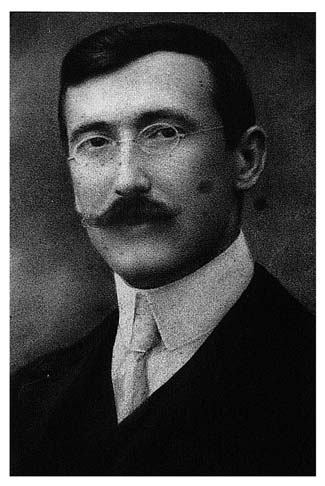
Juan Bautista Ayerbe, ca. 1930. Courtesy Matilde Ayerbe
Apparitions of the Most Holy Virgin in Ezkioga," and distributed two hundred dittoed copies in January.
Conchita Mateos was the twelve-year-old daughter of a worker in a Beasain factory. Ayerbe wrote, "She is the seer with whom I have most contact and whom I like the best because of her angelic manner and a prudence truly unusual in a girl her age." She was the youngest seer sent to the insane asylum. The real-estate agent Tomás Imaz took down some of her vision messages in December 1932 and subsequently Ayerbe went weekly to visions in her house in Beasain. About twenty persons generally attended these visions. She also had them in Ayerbe's house in Urnieta, where the Virgin showed a special partiality for Ayerbe's family. Ayerbe also distributed the vision messages of Luis Irurzun of Navarra, Esperanza Aranda, an older woman who then had most of her visions in San Sebastián, and others to believers in Terrassa, Barcelona, Madrid, and San Sebastián.[52]
Ayerbe to Cardús, 24 October 1933; I have Ayerbe's versions of about eighty sessions with Conchita from 10 December 1932 until 15 March 1942. He circulated messages from at least eighteen different seers.
His children grew up in a house where the presence of rapt visionaries was normal. According to his son Daniel, Ayerbe was devoted to anyone who was a believer. "He would not leave you alone, bringing you one thing after another until he overwhelmed you. But if you did not take an interest, you were public enemy number one." As Ayerbe wrote García Cascón, "I cannot disguise my sincere love for all who share my fervor for the apparitions. Maybe it is because there are so few of us or because we are so persecuted…. Is it because we imitate to some extent the first Christians of the catacombs?"[53]
Daniel Ayerbe, Irun, 13 June 1984, p. 1; J. B. Ayerbe to García Cascón, 22 March 1934, AC 416.
In spite of his "obsessive," "fanatical" (the words are his son's) activity in favor of the visions, an activity that lasted the rest of his life, Ayerbe never took sides among the seers or the leaders and was relatively modest. He did not want to threaten the careers of his brothers, so he usually remained just inside the limits of what might bring a public rebuke from the diocese. Because of the priests in his family, however, he was able to get away with more than others. He did not have a personal agenda for the visions, like Rigné, or a political one, like Carmen Medina; he was simply a scribe. Although he was an Integrist, his involvement in the visions stemmed from an interest in the politics not of Spain but of heaven—the broader designs that God held out for humanity. He wanted Ezkioga, as he had wanted Limpias, to be the Spanish Lourdes, but this time he went deeper and circulated messages about chastisements and Antichrists.
Ayerbe kept in touch with Pedro Balda, town secretary of Iraneta (Navarra), who served as the seer Luis Irurzun's scribe. In the rural north town secretaries were professionals with typewriters and time to use them. As the representatives of literate bureaucracy in rural villages, Ayerbe and Balda provided the seers with some local credibility. But their influence in the wider society was slight. On that level people like Medina, Burguera, and Rigné had more impact.
Away from Ezkioga in the winter and spring of 1933, Burguera worried about bad news he heard about the seers. From March 25 to 27 he accompanied a small group to Lourdes. At the grotto he felt that the Virgin confirmed his mission again. For when he asked the Virgin through a female seer in his group whether they might stay longer, the Virgin purportedly answered, "Tell the Padre that his duty is to go at once to Ezquioga, and when he has the Ezquioga matter all fixed up as at Lourdes, then he may come here."[54]
B 280. On the return trip from Lourdes the seer heard the Virgin explain that she wore colored robes in France because France received her better: "When Spain knows how to answer my call, I will show myself in Spain more splendidly than in France ... and work more miracles than in France."
Burguera no doubt knew that in mid-March 1933 one of the teenage seers had given birth to a child. Believers explained away the pregnancy by rape and dignified the birth by claiming it occurred without pain during a vision. But for the general public the pregnancy was a disgrace that affected the apparitions as a whole.[55]
For the pregnancy, Ducrot, VU, 23 August 1933, p. 1332; R 47, 95; and EE, April-May 1936, p. 2. Sexual immorality during the night visions was already an issue in the summer of 1931. Amundarain in his note of July 28 referred to "atrevidos desahogos nocturnos"; see also Masmelene, EZ, 15 July 1931; E. G., "En torno a los sucesos"; Millán, ELB, 9-10 September 1931: "una joven señorita ... recrimina a un señor que se aprovecha del lugar y del momento explorándola descaradamente"; Romero, "Communicado"; and Txindor, ED, 22 March 1932.
The scandal, which roused the many people in the region who had become skeptical, showed up in the broadsides of verses which are a Basque tradition. In October and November 1931 both the famous bertsolari (oral versifiers) José Manuel Lujanbio Retegi ("Txirrita") and his relative from OrdiziaPatxi Erauskin Errota, had published verses in praise of the seers Ramona and Patxi. Now José Urdanpilleta responded with two sheets. No doubt the most effective was the unsigned, scurrilous "The Great Miracle of the Virgin of Ezquioga," in which he identified by village two girls who had become pregnant and one boy who, he said, was a licentious as a ram and had even corrupted two nuns. Urdanpilleta had at least one public verse debate on the subject with Txirrita, and old-timers still remember lines from the argument. The Albiztur enthusiast Luistar published verses in support of the seers in 1931; but Laburu persuaded him to change his mind and in 1933 he published a long verse sequence against the seers. For Luistar and Urdanpilleta the great issue was immorality Txirrita had claimed the visions were true because they led to conversion; these poets claimed the visions were false because they led to sin.[56]
For verses about the visions, see below in bibliography Emika, Erauskin Errota, Lujanbio Retegi, Luistar, Urdanpilleta, and Zavala, Txirrita and Erauskin, 87-95. Verse 8 of Urdanpilleta, Berso Berriak, reads: "Euzkaldun neska gastiak / favores aditu / gauza biar bezela / nai det esplikatu / gaurko nere etsanak / goguan ondo artu / mariak beretsat lagun / garbiyak nai ditu" (All Basque girls / please listen / I want to explain this / properly / pay good attention / to what I have to say: / Mary wants for herself / clean friends). In 1984 Pedro Manuel Larrain of Alkiza remembered part of the verse debate in Zarautz (personal communication, Kepa Fernández de Larrinoa).
Prior to clearing up the scandals, Burguera had to recover his dignity. He attempted to do so in a four-page printed encomium signed by Ayerbe. It called for serious study of the Ezkioga visions and presented Burguera as "extraordinarily expert in the theological and ascetic-mystic matters so necessary for clarifying and resolving the apparitions … very well known by the intellectual elite of the Catholic world … armed with stunning erudition and perspicacity … with an apostolic zeal and an iron will." It described the Studium Catholicum, listed Burguera's published and unpublished works, and reproduced the entry for Burguera in the main Spanish encyclopedia ("a wise theologian").[57]
Ayerbe, Las Apariciones, obviously required Burguera's collaboration. The diocese privately complained to Ayerbe, who withdrew the leaflet. Burguera came to consider him a careless amateur who, although "active and zealous," did not know how to tell good spirits from bad ones (B 20-21).
The scandals, following the attacks by the church and the Republic, convinced Burguera that he had to do some serious "weeding" of the seers. His perplexity because some seers refused him their vision messages grew to a conviction that the devil was at work. After a month taking counsel with the Virgin in the visions of Ciordia, Benita, Aranda, and Garmendia, Burguera called a general meeting of seers. There he tried to rein in those who had taken advantage of their special status to lead freer lives. He told the girls who had found lodgings in order to be close to the vision site to go home, and he forbade seers to go on any more excursions.
Burguera claimed that some of the seers disobeyed him and started a "schism" because they did not want to give up their newfound liberty. In fact, any unity was in his own mind. He himself wrote that by this time there were three kinds of seers, the docile and obedient ones (obedient to him, that is), the untutored and credulous ones (by which I think he refers to the more rural, less classy or attractive seers, including those who spoke only Basque and trusted other, Basque-speaking leaders like Tomás Imaz and Juan Bautista Ayerbe), and the crafty and proud ones (he meant in particular Ramona and Patxi), who enjoyed the limelight and let no one direct them. As he began to do his weeding, the seers he rejected came out openly against him.[58]
B 280-82, 409, 711.
By now Burguera made no move without divine authority from trusted visionaries. He first tested the seers in vision by burning them on the hand with
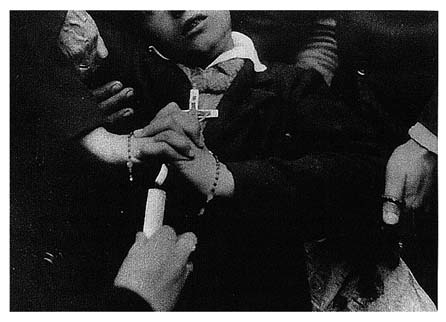
Padre Burguera, probably, tests with a candle a boy seer in vision, mid-1933 (detail). Photo by
Raymond de Rigné, all right reserved. Courtesy Arxiu Salvador Cardús i Florensa, Terrassa
the flame of a candle. Those passed who did not react and felt no pain after the vision. For him this did not mean automatically that the visions were divine, but it did mean that the seers were worthy of further study.[59]
B 83-84, 282 n. 5. At Lourdes in 1858 Dr. Dozous had watched a candle flame in contact with Bernadette's hand, and doctors tested Patxi this way in 1931. Burguera's detractors argued against the test, citing I. Lenain, "Les Événements de Beauraing," Nouvelle revue téologique de Louvain (April 1933): 327-356.
When he tested Esperanza Aranda on 5 May 1933 in San Sebastián, two believing priests were witnesses. The flame burned "skin, flesh, and cartilage, causing a blister and a wound." Aranda did not react and her pulse remained steady. Lorenzo Jayo was present when Burguera tested his mother, María Recalde, at Ezkioga and remembers vividly the fat in her finger melting and a wound forming. A French writer saw the badly burned hand of José Garmendia. Rigné photographed Burguera burning with a candle the clasped hands of a boy in trance. In Albiztur he did the tests in the home of the parish priest. By July 14 sixteen seers had passed; others took the test later.[60]Aranda, B 711; Lorenzo Jayo, Durango, December 1984, p. 6; for Garmendia's burned hand, Boué, 116; photograph in VU, 23 August 1933, p. 1329; for Albiztur, the witness Juan Celaya, Albiztur, 6 June 1984, p. 26; sixteen tested, B 690; Luis Irurzun, San Sebastián, 5 April 1983, p. 17, took the test later.
These tests coincided with a new diocesan offensive. Starting in May 1933, less than a month after his return to Vitoria, Bishop Múgica instructed parish priests to obtain signed statements from the prominent seers, including Benita, Evarista, Ramona, and Gloria Viñals. The seers should retract their visions and vow not to go to the hillside. Benita signed that she would not go but added that she did so on the Virgin's instruction. She continued to have visions at home and when her parish priest found out and she refused to declare her visions diabolical
or illusory, he excluded her from the church. Accompanied by prominent Bilbao believers, her parents went to the bishop to protest, but Múgica went a step further and denied the child all the sacraments. Most other seers agreed to suspend their trips to the site, but few if any retracted the visions.
The combined pressure from Burguera to prove some visions "false" and from the bishop to force seers to retract the visions sent many seers into a kind of tailspin. They desperately sought divine messages that would please Burguera and affirm his authority. Garmendia, for instance, told him that the Virgin had said that all seers should obey Burguera and that whenever she had a message for Burguera, she would appear to Garmendia as long as necessary.[61]
B 638, 24 May 1933.
By the end of May Burguera's most trusted seers began to help by specifying the number of "true" seers who remained. Then, supposedly repeating what the Virgin told them, they began to finger the false ones. Pilar Ciordia declared that Conchita Mateos's visions were diabolical and that others should not go to the house. Burguera broke the bad news to the family, and Conchita agreed to a fire test. She passed and delivered a message: Burguera did well to test seers and those who disobeyed were not true seers. But Burguera nevertheless excluded her because of others he trusted more.[62]
AC 296, 1 June 1933.
The accusing continued, as in a witch-hunt. On June 3 Benita heard the Virgin say that Burguera should remove all reference to Patxi from the book because of the things he made up ("sus mixtificaciones"). Two days later Benita learned from the Virgin that of nine true seers only four would remain. The three others she had in mind would have been Evarista, whose visions she was explicitly confirming, Pilar Ciordia, who came from Pamplona to stay at her house from time to time, and her friend María Recalde. These four gradually eliminated others. On June 29 Burguera informed the Bilbao supporter Sebastián López de Lerena that his protégée Gloria Viñals was no longer a true seer. Burguera based this judgment on a vision by Evarista in Irun. On the same day Evarista and Garmendia declared that Burguera should remove from the book those who did not obey him.[63]
B 493-494, 565, 636, 727; López de Lerena to Burguera, 26 July 1933, private collection.
Seers had more spectacular visions under the stress of denouncing their friends. On July 14 Burguera and others watched an eight-hour Passion trance of Pilar and Evarista. The seers had announced the event twelve days in advance; lying on the floor they described the devil in the form of a great serpent encircling and strangling them. As they went through the motions of the Passion and were attacked by twelve devils (whose tortures with giant needles must have been reminiscent of Burguera's tests), they narrated their experience through a running dialogue with the Virgin. The Virgin took part in the crucifying. The ordeal was a sign for the upcoming chastisement of the sinful people in "packed theaters and movie houses and crowded beaches" who did not believe the apparitions. The Virgin was most bitter about the disobedient ex-seers who had once believed but then after falling into evil company abandoned her. But Pilar and Evarista were
obedient. "No Mother, we wish to be very good. Rather than stop seeing thee, we prefer a thousand deaths."[64]
B 689-693.
The core seers heard the Virgin say where to print the book and warned Burguera not to open certain letters, for the diocese wanted to pack him off to Valencia. Burguera was present in Navarra when Evarista in Basque and Pilar in Spanish both claimed to see eight devils drag the vicar general (yet again) to hell.[65]
For publication of Burguera's book, Benita, 3 and 5 June 1933, B 493-494; for letters, Evarista Galdós, 24 May 1933, B 726; Evarista and Pilar visions, Navarra (Uharte-Arakil), 7 July 1933, B 753, and López de Lerena to Burguera, 26 July. Pedro Balda was at the Uharte-Arakil sessions and warned Echeguren (Alkotz, 7 June 1984, pp. 1-2).
Burguera also felt the pressure, for the seers confirmed that the devil was out to stop him. Benita Aguirre, who had taken refuge with believers in Girona when denied Communion in Legazpi, wrote that in a vision she had seen him writing his book with good angels on one side and bad angels on the other. She and Evarista had seen a false Ezkioga book held by the devil, whom Evarista saw disguised as Gemma Galgani. Because the devil might interfere with his revisions, Burguera had to check his proofs and arguments with seers.[66]
Benita, 20 July 1933, B 500, and AC 21, p. 2; Benita and Evarista, 9 May 1933, B 685-686, 725; book content, Garmendia, 28 June 1933, B 639.
On 16 July 1933 Burguera, Garmendia, and Baudilio Sedano were in the hallway of the Hotel Urola in Zumarraga on their way to lunch. An uncouth man came in and warned Burguera he should "stop persecuting at Ezkioga." Burguera told the hotel owner to call the police because of the threat, but the man had disappeared (mysteriously, Burguera thought). The man could well have been a relative or follower of one of the seers whom Burguera was busy repudiating, but Burguera was convinced that he had seen the devil in human form, something María Recalde confirmed in a vision two days later.[67]
B 232-233.
The conflict between Burguera's seers and those he excluded came to a head a week later when on the apparition hillside Benita Aguirre's father read a warning from the Virgin that those who disobeyed Padre Burguera would suffer terrible divine punishment. The rumor was out that Burguera had asked as a special grace that only the seers who cooperated with him could see the Virgin. That would have simplified his job of discernment considerably. The first to react was Rigné, who on July 25 printed an open letter warning the seers that priests in rebellion against the church were misleading them. Instead, he said that they should consider Bishop Múgica Christ's representative and pray that he change his mind. The true history of the apparitions, he wrote, could only come from a canonical inquiry. Rigné was convinced that the seers who refused to obey Burguera were the most trustworthy.[68]
Given Rigné's lifelong delight in flaunting bishops, this attack on Burguera was a low blow; R 112-114, with Pilar Ciordia's retort.
Sebastián López de Lerena, an electrical engineer from Bizkaia who was perhaps the most balanced and realistic of the opinion leaders among the believers, wrote a stinging letter to Burguera denouncing his errors, his self-appointed authority over the seers, his improper trials by fire, not approved by theologians, and his attempt to blackmail seers into giving him their vision messages for his book under threat of declaring them nonseers. Above all López de Lerena charged that Burguera had unwittingly suggested many of the visions. He blamed the padre for dividing believers when more than ever they needed to stand together. These attacks increased Burguera's testiness. In the ensuing days
he had a falling out with José Garmendia. Two weeks later Pilar Ciordia told him that he had just avoided an ambush on his way from Zumarraga to Benita's house.[69]
López de Lerena to Burguera, 26 July 1933; for ambush, B 699. Burguera said mass covertly in Benita's house (Victoria Aguirre, Legazpi, 6 February 1986).