
2—
The Solstice and the Human Body:
"Io son venuto al punto de la rota"
Although there is no sure indication of the order in which the rime petrose were written, it seems likely that "Io son venuto al punto de la rota" was the first, since it sets forth the situation and terms that govern the rest of them; but it may of course have been written later.[1] "Io son venuto" is perhaps the most immediately impressive of the petrose with its grandiose description of winter and its expression of the speaker's passionate opposition to the cold. It places the entire series of the petrose in relation with a well-known set of topics that goes back at least as far as Virgil's description of the peace of night and the turmoil of the despairing Dido—the tension between the impassioned lover and the rest of nature.[2] Of all the petrose, "Io son venuto" offers the fullest explicit statement of a central theme of the entire group: the relation of the lover's experience to the cosmos as a whole.
It has always been recognized that "Io son venuto" is an extraordinary poem, and some of its peculiarities have been identified. It has been observed that there is a parallelism among the stanzas (Dante 1949 149–150), that from stanza to stanza there is a descent along the ladder of creation (Renucci 1958 73; see Boyde 1971 296–298). "Io son venuto" is clearly unique in the insistence with which the parallels are carried out; in other cases the comparison with nature either occupies only part of the poem (as in Arnaut's experiments) or else is not developed systematically (as in "De ramis cadunt folia" and Raimbaut). The grandeur and vividness of Dante's descriptions of winter have elicited much admiration, and Fenzi in particular has demonstrated some of the complexity of the speaker's relation to the season, which is not simply a matter of opposition.[3] But the critical tradition has been essentially oblivious to two major aspects of the poem: (1) the presence of a detailed parallelism between the cosmos and the human body and (2) the relation of the astronomical opening to the poetics of the poem, and
thus to its themes at levels deeper than the immediately apparent. These aspects of the poem are very closely related, as we shall see.
Our analysis of "Io son venuto" will have four parts. First we examine the description of winter in the poem, with its highly elaborate parallelisms and symmetries, and, in a preliminary way, the situation of the speaker in relation to the winter. This will lead to a detailed discussion of the powerful opening of the poem, in which we find the striking suggestion that the astronomical position described is significantly related to the configuration of the planets at Dante's birth. We will thus be led to the third major focus of this chapter, the significance of the theme of birth, which is introduced with such apparent casualness in the third line of the poem and which, we shall argue, refers to the birth of Dante's new poetics. In the last section, we shall return to our reading of the poem, with special emphasis on the theme of the human body.
1
As we suggested in the Introduction, in the petrose Dante conceived of the stanza form of the canzone as imitating the motion of the heavens. "Io son venuto al punto de la rota" seems to be the first poem in which he endeavored to embody that principle fully. The study of Book 3 of Seneca's Natural Questions (see Durling 1975) seems to have played a particularly important role in this experiment. The most important points of connection are (1) the acting out of cyclic recurrences, patterned especially on the motion of the heavens, as a principle of literary structure; (2) the idea that the life cycle of the speaker is an instance of the cyclicality governing the cosmos; (3) the prominence given the concept of the inversion of an astrological position; and (4) the parallel between the human body and the earth, extended by Dante to the rest of the cosmos. The first of these principles of course underlies all of the petrose; so also, to a certain extent, do the others, but they are most explicit in "Io son venuto."
We begin with the Senecan theme of the cosmic cycles and with Renucci's observation (1958 73) that the successive stanzas of the poem describe winter in the different realms of nature, mentioned in descending order: the heavens; the atmosphere; birds and animals; plants; earth and water. Thus the poem represents—includes—the cosmos as a whole. The stanzas are rigorously parallel. Each consists of three groups of three lines each (we will call them a, b, c ) devoted to the description
of winter, and a fourth group of four lines (we will call it d ) devoted to the state of the lover; the four parts are parallel from stanza to stanza metrically, syntactically, and thematically.[4] It is not merely that nine lines go to the description of winter; rather, each stanza describes or alludes to one or more cycles proper to the level of nature it describes. Thus (but not exhaustively!):
1 a. the annual cycle of the sun and the daily turning of the sky
b, c. the periods of Venus and Saturn
2 a, b, c. the generation of wind and precipitation
3 a. the seasonal migration of certain birds
b, c. the seasonal apathy of other birds and animals
4a. the seasonal deciduousness of plants
b. evergreens
c. the cycle of generation of plants (flowers)
5 a, b, c. the cyclical movement of waters
In each stanza, furthermore, there is a clearly discernible parallel pattern in the cycles themselves:
1a. Night rises; the sun sets.
b. Venus is veiled and remote.
c. Saturn is strong.
2a. The wind rises,
b. approaches and clouds the sky.
c. Rain and snow fall.
3 a. Migratory birds have flown away.
b. Nonmigratory birds are silent.
c. Other animals are apathetic.
4a. Deciduous foliage has fallen.
b. Evergreen foliage remains.
c. The flowers are dead.
5 a. Earth draws up waters.
b. The road is flooded.
c. The ground freezes.
To take part a first, in 1a there is both a rising and a setting; thereafter rising predominates (except for 4a). In part b, the emphasis is on im-
mobility. In parts 1c and 5c the emphasis is on the increasing immobility of things, but in 2c, 3c, and 4c the motion is downward.
Thus, although Dante has avoided a monotonous identity of pattern, the description of winter in each stanza follows a similar pattern: (a) upward motion; (b) motionlessness or ineffectiveness of what is above; (c) descent. This pattern is that of a half-cycle, closely related to Dante's conception of the "arc of life," which Bruno Nardi showed to be parallel to the presence of the sun above the horizon and its nightly disappearance.[5] it can hardly escape notice that, just as the successive stanzas concern progressively lower realms of nature, so the high and low points of each stanza are lower and lower as we move through the poem. Starting with the heavens, our eye moves in a descending series of half-circles that implies a descending spiral. In view of the explicit theme of the poem, the explanation is not far to seek: the pattern of the parallel stanzas is an imitation of the gradually descending path of the sun as it nears the winter solstice; each day the sun rises a little later and a little farther to the south, crosses the meridian at noon a little lower in the sky, and sets a little earlier and, again, farther to the south.
The last stanza introduces one of the important "scientific" notions we discussed in the Introduction, the idea that when it has been frozen for a sufficiently long time, ice turns to crystal:
la terra fa un suol che par di smalto,
e l'acqua morta si converte in vetro
per la freddura che di fuor la serra . . .
Used of the landscape that surrounds the speaker, which we of course understand to be Italian, probably Florentine, these terms are hyperbolic or metaphorical, for crystal was supposed to be formed in the far north or perhaps in the Alps; but the reference to the doctrine is clear. Common to the passages on the formation of crystal and other stones is the idea that cold is a form of pressure exerted on things: a compound becomes stone when the cold has, as it were, squeezed out all the air (Seneca) or moisture (Albertus); Dante has "la freddura che di fuor la serra." In this context of ideas, the descending spiral of the sun, by which the cold increases, is like the turning of a great press, gradually increasing its enormous pressure to cause the compression and hardening of the waters in the last stanza.[6]
The descent through nature of the five stanzas of the poem thus involves something much more interesting than a static hierarchical rela-
tion or the mechanical following out of a topos. The gradual increase in pressure from stanza to stanza derives from a carefully controlled set of gradations. For instance, the descent through the successive realms of the cosmos, since it is a movement from the outer spheres toward the center, is a movement into ever greater enclosure: the heavens enclose the whole; the atmosphere encloses the earth; the birds live in the air but animals on the ground; and so on. Particularly in the first two stanzas, the idea of enclosure is given great prominence.
Now in describing the effect of winter in successively lower realms, the poem is imitating the pouring down into the sublunary of the influence of the heavenly bodies, especially, as we have seen, that of Capricorn, Saturn, and Mars. This is true both of the sequence of the five stanzas and of the structure of each stanza in itself; for in each stanza what we might call an upper part (a, b, and c ) concerns the heavens or the product of their influence, and a lower part (d ) concerns the lover on whom all these influences are impinging. This is not merely a thematic imitation, as we have seen: the daily rotation of the heavens, which brings the sun closer and closer to solstice as it moves along the ecliptic, is imitated in the repetitive cyclic structure of the upper part of each stanza.
One formal peculiarity of the stanzas is particularly interesting, the relation of the change in subject matter to the diesis, the change of "melody" of the stanza. Formally, the relation of part d, where the state of the lover is introduced, to the rest of the stanza is somewhat anomalous. In the terminology of the De vulgari eloquentia, parts a and b constitute the two pedes of the stanza, consisting of six hendecasyllables rhyming ABC.ABC; parts c and d are the sirma with concatenatio, rhyming CDEeDFF ; all but one line are hendecasyllables (line 10 is a settenario). The anomaly consists in the fact that although the diesis—the major formal division of the stanza—occurs after line 6, it is only in part d, at line 10, that the topic of the speaker's opposition to the rest of nature, which is the major shift in subject matter, is brought in. In other words, there is a dissonance between the formal and the logical organization of the stanza, since one would expect the topic to change at the beginning of the sirma. The winter encroaches, as it were, on the sirma, comes down into it.[7]
This invasion of the sirma by the winter is a formal correlative of the theme of the invasion of the poet's spirit. But part d is introduced by the one settenario in the stanza, and the shortness of that settenario,
along with the fact that it rhymes with the immediately preceding line, and especially the emphasis with which the speaker's solitary opposition to the cold is introduced, give the turn to part d very much the feeling of the diesis, the major turn, of a stanza. The speaker achieves, as it were, only a delayed diesis, or a subdiesis; yet it is a powerful one.[8]
As we said in the Introduction, Dante's new poetics involves a certain self-division. "Io son venuto" is a particularly clear case of this: in the first part of each stanza, in order to represent the forces that seem arrayed against him, the poet must identify himself with them, he must imitate them; and he does so, as one might say, icastically—that is, by means of visual representations—and, equally important, by enacting analogous motions and cycles. Then in each stanza the other pole of the lover's struggle with the season comes into focus.
At the solstice, all things may seem to come to frozen immobility in a way that mirrors the paired impasse between the lover and the lady. But the rigidity of winter is only temporary; further rotation of the heavenly wheel will eventually bring spring. As a matter of fact, as Dante knew, it is in Sagittarius and Capricorn that the sun seems to move fastest along the ecliptic.[9] By symbolically acting out the descent to solstice, the poem seeks to move the lady past the solstice of her rejection, to turn her toward springtime. "Io son venuto" represents the first half of a pattern of descent followed by ascent—katabasis followed by anabasis—that will be more fully explored in "Così nel mio parlar voglio esser aspro."
One of the most important aspects of the poet's opposition to the season is of course his writing of the poem itself. Part d of the first four stanzas and of the congedo represents love as a burden that the lover cannot cast off despite the season:
|
|
Insofar as "Io son venuto" is dominated by the idea of winter, it explores, of the two motions of the heavens (those of the Same and the Other), the effects specifically due to the motion of the Other. Each stanza brings not only the description of the effects of cold as such, but also explicit references to the annual cycle of the sun and the revolutions of the other planets. The motion of the Other is opposed by the motion of the Same, which carries the entire heavens with it and produces the diurnal cycle of day and night. The poem powerfully exploits the juxtaposition of these two principles. For instance, in stanza 1, sunset and the rising of stars are phenomena caused by the diurnal turning of the heavens (i.e., the motion of the Same); the presence of Gemini in the night sky and the positions of Venus and the sun in Capricorn and of Saturn on the Tropic result from the diverse motions of the Other. In stanza 3, the striking reference to the seven gelid stars' also refers to the diurnal motion of the Same.
Particularly interesting is the third stanza, where the independence of the poet's love from the turning of time is contrasted with the silence of birds and animals:
Fuggito è ogne augel che 'l caldo segue
del paese d'Europa, che non perde
le sette stelle gelide unquemai . . .
(27–29)
The migration of birds is contrasted with the fixity of the northern stars, those of the Great Bear, which are never lost, never set, over Europe. Such lesser species as migrant birds may escape the cold, but not the lover: he is fixed. The sphere of the fixed stars, in its daily turning, is kept before us in this reminder that the northern stars (unlike the sun of stanza 1) never set. At the center of the poem, then, we are presented with the fixed axis of the cosmos, just as in the outermost stanzas we see (in stanza 1) the ecliptic and the Tropic and (in stanza 5) the center of the earth, the other extreme.
e li altri han posto a le lor voce triegue
per non sonarle infino al tempo verde
se ciò non fosse per cagion di guai;
e tutti li animali che son gai
di lor natura, son d'amor disciolti,
però che 'l freddo lor spiriti ammorta:
e 'l mio più d'amor porta . . .
(30–36)
The stanza is carefully gradated: from the (evasive) activity of migrant birds, to the silence of the remaining birds, to the extinguishing of the fiery spirit in the other animals. The terms apply, per antithesin, to the poet: the poet's love is not extinguished, his burden is increased; he does not flee but stays with the cold stars; there is no truce (triegua ) for him (cf. guerra in the next stanza). And—most important—he is not silent: that is, he is singing—writing the poem. Thus, the central stanza of the poem correlates love as a burden, the turning of the sky, and the poet's song—contrasted with the (absent) songs of the birds.
Closely following on "e 'l mio più d'amor porta" comes the parallel (it is implicit, but strongly operative nonetheless, and it, too, is based on troubadour tradition)[10] between the poet's song and the blossoming of the world in the springtime:
Passato hanno lor termine le fronde
che trasse fuor la virtù d'Arïete . . .
(40–41)
We have already discussed the correlation of the cycles of this stanza with the larger cycles of the speaker's life (and death). What concerns us here is the contrast/parallel between the birth of the leaves and flowers "che trasse fuor la virtù d'Arïete" and the poem itself; for it is in part the virtù di Capricorno (or of Saturn in Gemini) that is drawing forth the new poetry. The explicit parallel in this stanza is between the foliage and the spina, the thorn of love; equally important is the implicit parallel between the foliage and the poem: the poet is now bringing forth, in this winter, more than the perhaps facile poetics of spring formerly allowed him to do.
The writing of the poem itself, then, is one of the most important forms of the speaker's opposition to the universal cold. Both as lover and as poet he is the same in winter as in the other seasons. As Plato had said, and as the tradition agreed, the principle of identity is superior to
the principle of diversity, is in fact its source. The emphasis on the sameness of the speaker's love identifies him with the superior principle, and stanzas 3 and 4 explicitly refer to the speaker's superiority to time—
ché li dolzi pensier' non mi son tolti
né mi son dati per volta di tempo
(37–38)
and to the possibility of immortality—
per ch'io son fermo di portarla sempre
ch'io sarò in vita, s'io vivesse sempre.
(51–52)
In "Io son venuto," then, the poet's effort to confront the complexities of his nature and to represent them in their cosmic context is a struggle to achieve identification with the Same. Of course, the problem is not simple, for to the extent that the speaker's love is an expression of the influence of Saturn and other planets, it results from the motion of the Other, not that of the Same. Furthermore, passion and sexual desire almost by definition resist the higher principle of identity—rationality.[11] The issue is whether or not a synthesis is possible. But now we must examine the astrology of the poem.
2
The opening of "Io son venuto al punto de la rota" is well known as the first astronomical description in Dante's poetry:
Io son venuto al punto de la rota
che l'orizzonte, quando il sol si corca,
ci partorisce il geminato cielo,
e la stella d'amor ci sta remota
per Io raggio lucente che la 'nforca
sì di traverso che le si fa velo;
e quel pianeta che conforta il gelo
si mostra tutto a noi per lo grand'arco
nel qual ciascun di sette fa poco ombra.
(1–9)
I have come to the point of the wheel where the
horizon gives birth at sunset to the twinned heaven,
and the star of love is kept from us by the sun's ray that
straddles her so transversely that she is veiled;
and that planet that strengthens the frost shows itself
to us entirely, along the great arc where each of the
seven casts little shadow . . .
Since astronomical positions involving three or more planets do not repeat themselves more than once every few hundred years, students of Dante realized early in this century that this description might permit the poem to be dated.[12] Clearly the first three lines mean that when the sun sets, the sign (or constellation) of Gemini rises or becomes visible in the eastern sky. This places the date somewhere near the winter solstice, when the sun enters Capricorn (in Dante's time this occurred around December 14). Venus is said to be remote from us because of being "forked" or "straddled" by the rays of the sun, which must refer to a conjunction of Venus and the sun. One might suppose that the joining of the rays of Venus and the sun would strengthen the star of love, but the power of the sun is determined by the sign of the zodiac it is passing through, and it is midwinter. (Once the sun has set, of course, Venus, too, is below the horizon and so "remota" for this reason, too.)[13]
The "planet that strengthens the frost" is almost certainly Saturn. Whether the moon or Saturn,[14] it would have to be opposite the sun, or nearly so, in order to "show itself entirely to us along the great arc where each of the seven makes little shadow." The "great arc" must be the Tropic of Cancer, for in the winter night sky a planet at or near the Tropic of Cancer is at greatest visibility, rising early in the evening and crossing the meridian at or near its greatest possible angle above the horizon (at the latitude of Florence, a planet on the Tropic crosses the meridian 691/2 degrees above the horizon).[15] Saturn is much more likely than the moon for several reasons. Most important, Dante is surely describing a particularly hard winter with a long period of cold weather, not merely a brief cold spell depending on a phase of the moon. Further, the moon makes the complete circle of the heavens every month, while Saturn, the slowest of the planets, takes almost thirty years to complete its circle around the zodiac, and its positions are therefore much more unusual. The full context of the poem, as we shall see, is full of references to Saturn.
We have, then, Venus and the sun in conjunction in or near Capricorn, and Saturn somewhere near the Tropic of Cancer. The precision of this description is indeed sufficient to date it: only once in Dante's lifetime did such a configuration occur—in December 1296. The exact date of the conjunction of Venus and the sun was December 24. So
much is generally agreed. Actually, the description implies a complete horoscope, and it is surprising that no one seems to have considered the possibility that Dante might have known and had in mind the positions of the other planets. And what exactly was the position of Saturn? Figure 2 shows the positions of all the planets on December 24, 1296, as seen from Florence an hour after sunset.[16]
Several aspects of this configuration strike one immediately. First is the prominence held by Mars along with Saturn. Both in the eastern sky
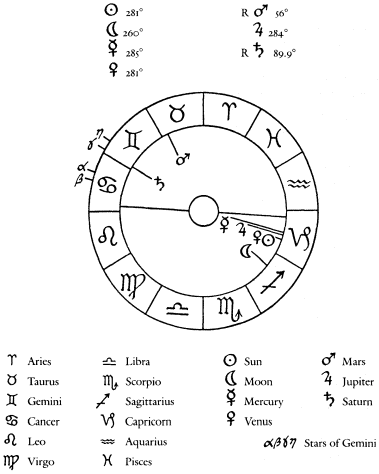
Fig. 2.
Florence, December 24, 1296, 5:30 P.M.
at sunset, they will dominate the sky all night long. The very fact that Mars is in Taurus, a house of Venus, would signify to the astrologically minded a love beset by conflict.[17] Mars in Taurus is closely related to the basic conception of the entire series of the petrose; once alerted by the actual astronomical position, we may notice many references to the god of war. Furthermore, both Saturn and Mars are retrograde, that is, they seem to be moving backward on the ecliptic (toward the west rather than the east),[18] a motion that was thought to weaken the influence of beneficent planets but to be particularly threatening in the case of the malefic Mars and Saturn. One notes, furthermore, that except for Mars and Saturn all the planets, not only the sun and Venus (explicitly placed by the poem), are below the horizon, and their positive influence is therefore seriously weakened.[19] The night belongs entirely to Mars and Saturn. Finally, Jupiter, Mercury, and Venus are closely grouped around the sun, a configuration that in another sign would probably be thought extremely beneficent.
As readers versed in astrology would recognize, stanzas 2–5 of "Io son venuto" refer to events that are not only characteristic of winter but were thought to be due to the influence of Saturn, the father and destroyer of all earthly beings, who presides over the sowing of crops and the reproduction of animals (including man) in his benign phase and determines their senescence and death in his harmful one. As the outermost planet, Saturn sets the limits of all things (cf. termine, line 40). The coldest and slowest of the planets, Saturn is associated with earth, water, and lead; he governs rain (stanza 2) and floods (stanza 5) and is particularly likely to cause both when on the cusp between two signs—as in December 1296. It is this planet's influence that causes human beings to be lustful.[20]
The poem is filled with references to the lore of Saturn's influence on both mind and body. The themes—basic to the poem—of the paradoxical combination in the lover of cold and fire and of his hardness and tenacity of mind are traditionally associated with Saturn.[21] The references to the earth, to flood, to water and air trapped under ground, derive from the lore of melancholic sexuality and the influence of Saturn, for the slow steadiness of Saturn was supposed to influence the strong vital spirits of the melancholic, who were thought to be particularly subject to lust because of the large amount of air combined with blood in their sperm. The related association of orgasm with the eruption of underground waters mixed with vapors, which we find in stanza 5, derives from Aristotelian physiology.[22]
The position of Saturn in Figure 2 requires further comment. It is indeed near the Tropic of Cancer; it has just entered Gemini, Dante's natal sign, on the very day of the conjunction of Venus and the sun. To appreciate how unusual and how meaningful this event may have seemed to Dante, one must consider that the slowness of Saturn means that it lingers for a long time in each sign of the zodiac, but also that once it has left a sign it does not return for almost thirty years. The presence of Saturn in Dante's natal sign was no doubt of great significance in his eyes, and the horoscope of December 24, 1296, on this ground alone, would seem to have a special relation to his natal horoscope. But before turning in this direction, we need to substantiate more fully our claim that Dante's natal horoscope is relevant to "Io son venuto."
First of all, as we have seen, the poem refers directly both to the idea of birth and to what we know Dante claimed was his natal sign, Gemini. Critics seem not to have paid much attention to the odd fact that, although there is no question that the "wheel" of the first line is, among other things, the zodiac, Dante says that he, rather than the sun, has reached the point of the wheel:
Io son venuto al punto de la rota
che l'orizzonte, quando il sol si corca,
ci partorisce il geminato cielo
There is an implicit reference to the traditional notion of the wheel of Fortune, whose iconography portrayed individuals carried on the wheel as if fixed to it,[23] traditionally associated with the turning of the heavens and thus with time. If we take the wheel as referring to the heavens themselves (one of its main references), at which point on the wheel are we to place the speaker? Perhaps near the sun—an important suggestion of the lines, however, is that the horizon is giving birth not only to Gemini, but also in some sense to Dante himself.
It may also seem odd that Dante identifies the season by the sign in or near which night, not the sun, is rising.[24] This is actually one of the keys to the poem as a whole: the reference is inverted. Inversion is a major idea governing the entire poem, which begins with allusion to birth and ends with allusion to death. At another level, the poem ends with the mention of orgasm, which initiates gestation, and in a line that refers to Dante's natal sign, begins with birth, which ends gestation. In embodying cold instead of the warmth that is natural to her youth, the lady is herself one of the most important instances of inversion. But the most explicit reference to the idea appears in the congedo, where the
astrological situation of the winter is imagined as reversed: in the springtime, instead of cold, warmth rains down from all the heavens: but that is the season of Dante's birth.
In the analogy between the year and a human life, the winter solstice would correspond to death. If in the macrocosm Saturn, Mars, and Capricorn cause an unusually severe winter with heavy flooding, for the microcosm of the speaker they might produce a cataclysm. Thus the solstitial inversion, the speaker's resistance to the season, the unnaturalness of a lady stony in youth, the analogy of the year and the life cycle—these themes are parallel to the idea of death as an inversion of birth. Now Saturn, the planet that sets the limits for all things, including the moment of their death, is, as Manilius points out, the planet governing inversions: his locus is the imum coeli because he has been cast down from his former eminence.[25] And of course the feast of Saturn, the Saturnalia, took place just before the winter solstice, as Dante could have known from Macrobius.[26] All the systems of inversion in "Io son venuto," then, including the insistent syntactic inversion, require us to see the astrological situation it describes as an inversion of the situation at Dante's birth.
In considering what idea Dante may have had of his natal horoscope there is naturally a large element of uncertainty. In Paradiso 22, in a passage we will consider in the next section, he says that he was born with the sun in Gemini; according to Boccaccio's testimony, which there is no real reason to doubt, Dante told a Ravenna friend shortly before his death that he had been born in the month of May.[27] It is reasonable to conclude that Dante's birthday fell—or that he supposed (or even pretended) that it fell—between May 14, 1265 (when the sun entered Gemini), and the end of the month.[28] But there is no way of determining more closely on what day or at what time of day he was born.[29] This means that we cannot know the position of the moon or the ascendant, both of which were considered of major significance in any horoscope. We do not know whether Dante knew the actual positions of the planets at his birth (though the combined evidence, we believe, strongly suggests that he did: it was common for well-to-do families to have horoscopes cast for the newborn; or Dante may have cast his own horoscope retrospectively, using such an almanac as the one by Prophatius, which he probably used for the Commedia ).[30]
It might seem otiose to consider the question, except for one further important fact: leaving the moon out of consideration, during the time when the sun was passing through Gemini in May 1265, the positions of
the other planets changed very little because the faster-moving planets, Mercury and Venus, were alternating between direct and retrograde motion (Mercury, for instance, remained for the entire period within the limits of 70.15 and 63.38 degrees longitude).[31] Thus, although the ascendant, and therefore the positions of the planets in the various hour-houses of Dante's natal horoscope, cannot be known, much else can be.
If the theme of astronomical inversion in "Io son venuto" invites us to consider whether December 1296 is an inversion of the position of Dante's natal horoscope, we already know the most conspicuous element of that inversion, the position of the sun: in December 1296, near winter solstice; in May 1265, something more than half a sign away from summer solstice (this is the "altro / dolce tempo novello," when love rains down from all the heavens). The inversion would be more complete if Dante's horoscope were cast for dawn or shortly after (as opposed to sunset in "Io son venuto"). Are there other elements of inversion? We give two charts for the latter part of May, as seen from Florence an hour after sunrise (the hour is chosen for its symmetry with that in "Io son venuto"). The choice of dates is not entirely arbitrary: Dante arrives in Gemini in Paradiso 22; he leaves it in Paradiso 27. We find it plausible that the numbers are significant; in other words, we suspect that Dante's birthday falls on May 22 or 27, or else in between. Figure 3 gives positions for May 22, 1265; Figure 4 for May 27, 1265. We incline toward May 27 as the date Dante knew or supposed to be his birthday,[32] but in any case both charts are offered as examples only.
What is most striking about the configuration in both charts (and this aspect changed virtually not at all during the entire period from May 14 to June 14) is that Saturn is in Gemini, not far from its position in December 1296; but in 1265 it is close to conjunction with the sun, whereas in 1296 it is in opposition to it. It must be stressed that the positions of Saturn recur at large intervals: during Dante's entire lifetime Saturn was in Gemini during only two periods, 1265–67 and 1294–96,[33] a fact that is surely most significant for the interpretation of "Io son venuto." On May 27, 1265 (Figure 4), not only is Saturn close to conjunction with the sun, but it is also in conjunction with Mercury (in Gemini, the night house of Mercury) and in orbal conjunction with Jupiter in Taurus (and Jupiter is close to orbal conjunction with the 1266 position of Venus, if Dante made his Prophatius mistake here), whereas in December 1296 the sun is in a house of Saturn and in
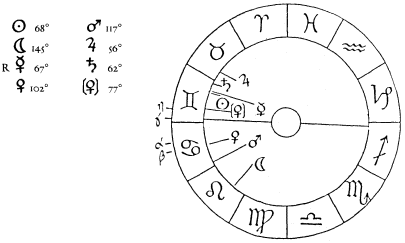
Fig. 3.
Florence, May 22, 1265, 6:15 A.M.
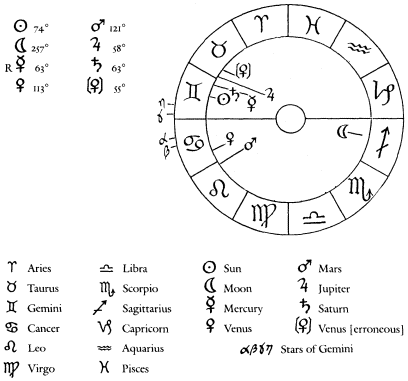
Fig. 4.
Florence, May 27, 1265, 6:00 A.M.
conjunction with Venus, Mercury, and Jupiter, and all four are in opposition to Saturn. In both 1265 charts, the possible harmful influence of Saturn is strongly counteracted by the conjunction (or near conjunction) with a whole group of beneficent planets in strong phases, but in 1296 the beneficent planets are canceled out and the harmful ones unusually strengthened. In the relation between December 1296 and May 1265, then, we find a whole system of astrological inversion involving Saturn, the very planet of inversion;[34] the inversion is especially pronounced if May 27 is taken as the contrast, but it is still very much in evidence on May 22, or indeed on any Gemini chart for 1265.[35] Seen in relation to Dante's natal horoscope, "Io son venuto" represents something much more serious than merely an unusually severe winter. Dante would have been on very firm ground in interpreting December 1296 as extremely threatening for a Gemini of 1265.[36]
The poet's war with the stars is a very real one, then, and we begin to have some insight into the prominence of Mars in the horoscope. It is particularly striking to find that Mars was retrograde[37] in December 1296; the fact provides a major confirmation of the traditional dating of the poem, because the climactic expression of the poet's determination, in stanza 5, unmistakably refers to it: "e io de la mia guerra / non son tomato un passo a retro."[38] There could hardly be a more emphatic way of differentiating the poet from the astrological influences that threaten him: though the very planet of war may turn back—retrograde—with whatever defeat or weakening that event may seem to promise, the lover will not do so. His love does not derive from the turnings of time and will not be defeated by them.
But other important aspects of Dante's natal horoscope have a close relation with the horoscope of December, especially the prominence of both the planet Mercury and his "house," the sign Gemini. Dante probably considered Mercury the "lord" of his horoscope, that is, the most dominant influence, sufficiently so for him to consider himself a "child" of the planet (see Hauber 1916). Since we do not know what he thought his ascendant to be or the position of his moon, we cannot be completely sure,[39] but he clearly ascribed major importance to the influence of Gemini, both in this poem and in Paradiso 22.[40]
Gemini is one of the two houses of Mercury, in which the planet was said to "rejoice"—the other being Virgo.[41] These two signs have the distinction of being the only ones that represent human beings rather than animals or objects. This fact was traditionally interpreted to mean
that the natives of these two signs are particularly suited for the intellectual professions,[42] and the children of Mercury were well known as scholars, writers, and interpreters.[43] As Benvenuto da Imola says, Gemini "facit homines literatos et ingeniosos" ("makes people learned and clever"—cited by Sapegno ad Paradiso 22).
The Twins of Gemini were variously identified in antiquity.[44] In the most common view they are the mythical Castor and Pollux, sons of Leda, the former by Leda's mortal husband, Tyndareus, the latter by Jupiter. As Dante knew, Castor and Pollux were among the deities most popular in ancient Rome and had a close relation to Mars, the patron of Rome's founding; they were thought to appear in battle to help Rome, and their myth is of course inherently warlike.[45] Dante would have found references to them in the works of countless writers.[46] For him, the myth is connected with such major concerns, both moral and poetic, as the duality of human nature, the need for inner struggle, and the problematic of interpretation. In terms of the Commedia, of course, a pair of twins, one of whom gives up part of his immortality to save his mortal brother, is obviously the antitype of the fratricidal twins of the Earthly City (Romulus and Remus, Eteocles and Polynices),[47] children of the baleful influence of Mars.[48]
The astrological importance of Gemini, as well as the importance of Mercury as the patron of learning and literary creation, can be seen in a favorite medieval schoolbook, Martianus Capella's De nuptiis Mercurii et Philologiae, which relates that the seven liberal arts were Mercury's wedding gift to his bride Philologia ("love of learning").[49] The De nuptiis claims a continuity among the arts of language, the knowledge of the cosmos, and the Neoplatonic ascent to the ultimate Truth, a continuity expressed in two allegorical journeys (Mercury's and his bride's) from the world of sense—represented with elaborate cosmological symbolism—to the beyond. Martianus's sprightly book had enormous influence; it furnished the basic outline of the trivium and quadrivium in the schools of the Middle Ages and inspired such allegorical works as Bernard Silvester's Cosmographia and Alain of Lille's De planctu Naturae and Anticlaudianus. Although the astrological as such is veiled in the De nuptiis, it is quite important,[50] and one striking passage clearly alludes to the conjunction of the sun and Mercury in Gemini at dawn (i.e., at the ascendant) in such a way as to suggest a horoscope.[51] The particular appropriateness of Gemini is explained by Bernard Silvester, in his commentary on the De nuptiis,[52] on the basis of an interpretation of the
myth of Castor and Pollux that treats them as representing body and spirit—parallel, in Bernard's view, to the relation between language (Philologia, originally mortal) and reason (Mercury)—thus an instance of the union of opposites in which the cosmic harmony consists.[53] Commenting on a line from the opening hymn to Hymen, "complexuque sacro dissona nexa foves," he writes:
nexa, id est iuncta, complexu, proportione, sacro quia, ad tempus, divinum mortali ut, in eternum, mortale iungatur divino; quod tibi illud de Castore et Polluce apte figurat. Pollux enim "perditio," Castor vero "extremum malum" interpretatur. "Perditio" dicitur spiritus humanus quia sicut semina terre mandata primo moriuntur ut post modum vivant, sic anima corpori iuncta. Corpus autem "extremum malum" dicitur quia, ut super Virgilium diximus, partientibus anime quod est nil inferius humano corpore occurrit. . . . Et Pollux quidem dicitur deus quia est spiritus substantia rationalis et immortalis, Castor mortalis quia corpus substantia hebes et dissolubilis. Deus mortalem mortem recipit ut suam deitatem ei conferat, quia spiritus ad tempus moritur ut corpus in eternum vivat.
(Wetherbee 1972 267–268; Westra 1986 69)
Joined by a sacred bond; that is, united by proportion; for divine is united with mortal in temporal life just as mortal is united with divine in eternity. This is aptly illustrated by the story of Pollux and Castor. For Pollux means "perdition" and Castor "utmost evil." The human spirit is called "perdition" because, just as seeds consigned to the earth first die that they may later come to life, so does the soul when united with the body. And the body is called "utmost evil" because, as I explained in glossing Virgil, those who have classified all existence have encountered nothing lower than body. . . . And Pollux is called a god because spirit is a rational and immortal substance, while Castor is mortal because body is a substance weak and subject to decay. The god undergoes mortal death so as to confer his deity on him; for spirit dies temporally that the body may live eternally.
(Wetherbee 1972 114–115; translation slightly altered)
In another part of his commentary, Bernard again treats the myth as an instance of the reconciliation of divergent principles, identifying Pollux as the contemplative life, Castor the active life (saved from the degradation of pleasure by the other's vision).[54] As we shall see, Dante's treatment of the Twins as a main symbol of human duality, both sides of which must be preserved, is interestingly close to Bernard's.[55]
In strictly astronomical terms, Dante would have found that Gemini
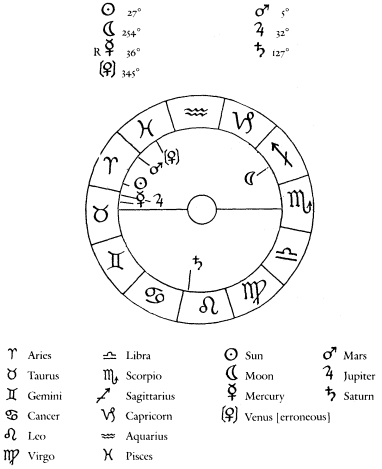
Fig. 5.
Montpellier, April 8, 1300, 6:15 A.M. ( See discussion on p. 364 n. 63. )
possessed a number of peculiarities. As he read in al-Fargani's epitome of Ptolemy's Almagest, of the fifteen brightest stars in the sky, no fewer than four are associated with (i.e., rise and set with) Gemini: Capella, Betelgeuse, Rigel, and, the brightest of all, Sirius.[56] As Martianus Capella, Macrobius, and Calcidius all point out, Gemini is the sign where the sun dwells longest (thirty-two days, as opposed to the average
thirty),[57] and it is the only sign in which there can ordinarily be two successive new moons (as Macrobius puts it, where the moon can be born twice).[58] Manilius observes that three zodiacal signs rise backwards or upside down: the successive signs Taurus, Gemini, and Cancer.[59] The Twins appear feet first above the horizon, a fact with a clear relation to the two major themes of "Io son venuto": inversion (of astrological influences, of negative into positive) and birth.
Another peculiarity of the constellation Gemini is that it lies in the portion of the zodiac that crosses the Milky Way. The Twins' feet, along with the horns of the Bull, extend into one of the most thickly populated parts of the galaxy. On the opposite side, Sagittarius and Scorpio mark the other crossing of the galaxy.[60] These, according to Martianus Capella's Astronomia (8.817), are two of the ten circles one must learn to distinguish in the sky, the others being the colures of the Equinoxes and Tropics; the parallels marking the Arctic, Antarctic, temperate, and tropical zones; and the equator. On a clear night Gemini is a magnificent spectacle, close to the Milky Way and accompanied by the bright stars of Taurus, Orion, and Canis Major. Thus the scene described in the first stanza of "Io son venuto" is one of extraordinary grandeur.
The prominence of Mercury and Gemini in Dante's natal horoscope, then, casts a different light on the prominence of Saturn. As the patron of science and meditation, Saturn can have an exceptionally strong positive influence.[61] The conjunction or near conjunction of Saturn and Mercury in the night house of Mercury (our example shows conjunction, but it is only a guess), of course, would be especially appropriate for a philosophical poet. But it is clear that "Io son venuto al punto de la rota" represents Dante's effort to identify himself with the positive side of Saturn's, Mars's, and Mercury's influence—favoring moral struggle, philosophy and science, and the creation of poetry—as against the dangerous negative side.[62] These aspects of his stars will enable him, he hopes, to confront and master what in both astrological and emotional terms is the most threatening situation of his lifetime, and to make it the occasion of growth and development.[63]
3
The full significance of the topos of birth in "Io son venuto" only emerges when it is viewed in connection with the Commedia, especially the Paradiso. Birth is one of its basic patterns (see below, pages 255–
258). "Io son venuto" is involved in the passage that tells us Dante considered himself a Gemini:
S'io torni mai, lettore, a quel divoto
triunfo per lo quale io piango spesso
le mie peccata e 'l petto mi percuoto,
tu non avresti in tanto tratto e messo
nel foco il dito, in quant'io vidi 'l segno
che segue il Tauro e fui dentro da esso.
O gloriose stelle, o lume pregno
di gran virtù, dal quale io riconosco
tutto, qual che si sia, il mio ingegno,
con voi nasceva e s'ascondeva vosco
quelli ch'è padre d'ogne mortal vita,
quand'io senti' di prima l'aere tosco;
e poi, quando mi fu grazia largita
d'entrar ne l'alta rota che vi gira,
la vostra region mi fu sortita.
A voi divotamente ora sospira
l'anima mia, per acquistar virtute
al passo forte che a sé la tira.
( Paradiso 22.106–123; emphasis added)
In his ascent through the heavenly spheres, Dante reaches the sphere of the fixed stars (to sojourn there for six cantos and perhaps six and a half hours)[64] from the sphere of Saturn—from the planet itself, in fact, whose location has been indicated fairly precisely ("sotto il petto del Leone ardente," Paradiso 21.3; i.e., somewhere near the star Regulus, known as the "heart of the Lion," cor leonis ). But Dante does not tell us to which degree of Gemini he comes, nor which of its stars he may be near.[65]
Dante recognizes, he says, that all of his ingegno comes from these stars:
O gloriose stelle, o lume pregno
di gran virtù, dal quale io riconosco
tutto, qual che si sia, il mio ingegno
Modern commentators sometimes express surprise that Dante attributes so much of his talent to the influence of his stars.[66] We should regard the lines as an important indication of the extent to which Dante regarded his ingegno as something bodily —not intellectual in the strictest sense but involving faculties that both Aquinas and Dante identify as subject
to planetary influences (see Introduction, pp. 43–45) and that were generally agreed to be produced originally under the power of the heavenly bodies—and (a closely related, extremely technical point) as depending on the nature of his sensitive soul as it developed in the womb under the influence of the heavens, before his intellect, properly speaking, was infused.[67]
Since the passage in Paradiso 22 is explicitly about Dante's birth, his use there of such terms as pregno and nasceva has occasioned no surprise. But they deserve attention, even if in both Latin and medieval Italian nasci/nascere for the rising of a star or planet is extremely common. Dante says he owes his ingegno to the " lume pregno/ di gran virtù " of these stars: but in what sense is the light pregnant? Obviously it was pregnant with the ingegno Dante says he owes to it, in that the simple light of each heavenly body in some sense contains the diversity of the forms it imposes on the sublunar.[68] Dante's ingegno , however, is not fully formed at the time of his birth. As Beatrice points out in Purgatorio 30, it was present in him virtualmente , potentially; the seed was planted and must be cultivated. In this sense, then, Dante was himself pregnant with his ingegno until it fully emerged. There is thus a parallel between his condition at birth and the "lume pregno di gran virtù."
The passage draws a further parallel with the sun, which, as we saw in the Introduction, is the most frequently cited instance of a lux simplex virtually containing a multiplicity of forms:
con voi nasceva e s'ascondeva vosco
quelli ch'è padre d'ogne mortal vita.
Dante was being born literally, the sun figuratively. It is of course the combined influence of sun and sign that Dante here recognizes as the source of his ingegno . The term riconosco is significant: in acknowledging that he owes his nature to his stars, Dante gives his stars praise that might seem due to himself. Thus the passage is closely related to the discussion in Paradiso 4 of Plato's doctrine that souls return to their stars after dath:
Quel che Timeo de l'anime argomenta
non è simile a ciò che qui si vede,
Però che, come dice, par che senta.
Dice che l'alma a la sua stella riede,
credendo qualla quindi esser decisa
quando natura per forma la diede;
e forse la sua sentenza è d'altra guisa
che la voce non sona, ed esser puote
con intenzion da non esser derisa.
S'egli intende tornare a queste rote
l'onor de l'influenza e 'l biasmo, forse
in alcun vero il suo arco percuote.
(Paradiso 4.49–60; emphasis added)
Beatrice's clarification here is quite precise: nature, in which the influence of the heavens is predominant, gave the soul to be the form of the body.[69]
An important aspect of the passage is its function as invocation:
A voi divotamente ora sospira
l'anima mia, per acquistar virtute
al passo forte che a sé la tira[70]
—here poetic composition is explicitly said to depend on the influence of the stars. Dante represents himself as sighing—yearning—toward Gemini in order to acquire poetic power, virtute. He would seem to have to open himself to their influence, submit himself to it. Thus the relevance of Dante's invocation is not restricted to its appropriateness to his visiting his natal sign: the sphere of the fixed stars is the first agency of the diversification of God's creative power, since the undifferentiated Primum Mobile, just above it, transmits God's power simply.[71] In the context of this theme, Dante's relation to his natal sign is significant as the one example brought before us of the fact that, since all creation serves man,[72] the diversification of human bodies and ingegni is the single most important function of the sphere of the fixed stars.[73] There Dante meets Adam, the first father of the multitude of men; the meeting with the Apostles, the first fathers of the Church (that is, of spiritual men), reflects the same principle.[74]
The movement to generality of causes that governs the entire cantica involves the clear association of higher causes with higher heavens. In terms of his conception of the cosmos, then, Dante's contemplative ascent to origins is an ascent to more and more general themes, indeed, to the theme of general causality itself, and it requires him to place himself in rapport with higher and higher heavenly bodies—to open himself to their influence. And as he does so he enacts ever fuller metaphors of the poetic process, in particular the one whereby the poet's shaping art is an analog of the workings of the turning heavens.[75]
As the italics are meant to suggest, the entire passage on Gemini from Paradiso 22 is a tissue of allusions to the first stanza of "Io son venuto." Paradiso 22 identifies the sign Gemini with a periphrasis, calling it "il segno / che segue il Tauro" (110–111); so does "Io son venuto," which calls it "il geminato cielo" (3). In Paradiso 22, the metaphor of pregnancy is used of the light of the stars of Gemini ("lume pregno / di gran virtù," 112–113), and that of birth of the sun in Dante's natal sign ("con voi nasceva," 115); in "Io son venuto," the metaphor of birth is used of the rising of Gemini ("l'orizzonte . . . / ci partorisce," 2–3), and that of pregnancy is implicit in the repeated mention of love as a burden (especially evident in the contrast between the parturition of line 3 and the "non disgombra" of line 10). Both, moreover, stress the relation of Gemini and the sun to the horizon. "Io son venuto" opens with Dante's arrival at the point of the wheel; Paradiso 22 twice echoes this idea, first in Dante's arrival in the sign/constellation Gemini ("e fui dentro da esso," 111), then, with a conspicuous verbal echo, in commenting on the arrival ("grazia . . . / d'entrar ne l'alta rota che vi gira," lines 118–119);[76] in both cases (in Paradiso 22 explicitly) the arrival implies the beginning of a new phase of poetic activity, and both associate the poet's birth with the inception of the new phase.[77]
The emphasis on the horizon in both texts requires comment. The term carries a great deal of symbolic weight. As we have seen, a major focus of the problematic of "Io son venuto" is the paradoxical concomitance of embeddedness in nature—subjection to the power of stars and seasons—and superiority to it. This is the specifically human situation—between time and eternity—on which rests the traditional idea of man as horizon between the two, adapted by Dante in the Monarchia to the horizon between incorruptible and corruptible.[78] As we saw in Chapter 1, Dante's treatment of Beatrice in "Donne ch'avete intelletto d'amore," in which he places the stanza on her soul between those on heaven and her body, is an instance of the idea that human beings are the medietas, or nexus of unification, of the entire cosmos, which the metaphor of man as horizon expresses. It is clear not only that the term orizzonte in "Io son venuto" refers at one level to the poet himself, but also that "l'orizzonte . . . ci partorisce il geminato cielo" means that whatever is meant by il geminato cielo is coming into being at the place where the two aspects of his human nature are joined—or, in the terminology ofInferno 12.84, where the two natures are married, "dove le due nature son consorti." But that place is precisely the locus of poetic ingegno.
As Dante's use of the terminology of marriage (consorti ) in Inferno 12
may suggest, the locus of poetic ingegno, the place where the two sides of his nature are joined, is also the locus of his sexuality. The problematics of love and desire on the one hand and of poetic creation on the other are inextricable, after a certain point indistinguishable. Thus, if the topos of birth in "Io son venuto" refers not only to Dante's literal birth but also to the birth of his new poetics, to the coming to maturity of his poetic ingegno, this theme does not in any way diminish the importance of the other themes, least of all that of his literal birth. Far from it, for the new poetics is represented as Dante's response to a situation in which both external and internal causes threaten his life. The difficulty of his love requires him to explore the relation of his bodily nature to the universe that impinges on it; to be adequate to such an exploration, the new poetics requires him to explore the bodily foundation of his talent and his art. The two statements are virtually equivalent. The greatness of the achievement of the petrose, like the greatness of the Commedia, testifies in part to the seriousness of the crisis from which they spring.
Thus the winter of "Io son venuto," which at one level is the enemy of the poet's love and even of his life, at a deeper level is seen as essential to his full maturing. It would seem that Dante saw the relation between his natal horoscope and that of December 1296 as coherent, a fulfillment of the providence that was seeing to the development of his gifts, in part by adversity and testing. There is every reason, then, to take seriously the erotic theme as well. It is no mere pretext; at issue is the possibility of integrating sexual desire with the rest of experience, including the practice of art. The point of departure is optimistic: the petrose rest on the presupposition that the two natures can be married, that love is attainable, that the war between the sexes can be disarmed, that integration of the personality and victory over its negative tendencies are possible, in large part through the mediation of art. In this connection the double tradition about the Twins—as Castor and Pollux, and as Adam and Eve—is particularly interesting. The petrose express the refusal to renounce the specifically sexual nature of the issues. Whatever the solution, it must, to use Dante's phrase in the Monarchia, "sapere utranque naturam."
4
We are now in a position to consider the fact that the successively lower realms of nature through which the eye descends in the course of "Io
son venuto" are parallel to the parts of the human body:[79] the heavens are parallel to the spherical human head; the realm of the atmosphere corresponds to the apparatus of breathing; the spirit of the birds and animals corresponds to the human spirit, which dwells in the breast; and so forth. Not only is this the first of Dante's poems to include an astronomical description; it is also the first in which he adopts the analogy with the human body as a principle of structure.[80] It is a major feature of the new poetics, and clearly integral to Dante's effort to see and represent his situation fully. As is well known, medieval microcosmic tradition produced a proliferation of supposed correspondences between the human body and the world; Dante's knowledge of the traditions was undoubtedly vast, but his use of them was selective. He has nothing like the encyclopedic exploitation of every possible correlation that we find in the work of the remarkable twelfth-century abbess Hildegard of Bingen, for example, though he was undoubtedly familiar with such correspondences as those she drew between the four winds and the four limbs or the four rational powers of the soul (cogitatio, locutio, intentio, gemitus ), between birds and desires, or between the three levels of earth and the three parts of the torso.[81] His use of the analogy is actually closer to Robert Grosseteste's correlation of the head with the heavens, the breast with the air, the belly with the sea, and the feet with the earth.[82] He was familiar with the correlation of the powers of the soul with all the aspects of the sensible world[83] and with the fivefold division of beings, according to which man shares being with the stones, life with the plants, feeling with the animals, intellect with the angels, and has reason as his own distinguishing property.[84] He probably knew Bernard's convenient compendium in the De mundi universitate, describing the creation of man:
Has utique corporis partes de multis singulas, de communibus exceptavit angustas: cerebrum, cor, epar, tria vitae fundamina suscepturas. In minori mundo homine Physis intelligit non errandum, si maioris mundi similitudinem sibi sumpserit in exemplum. In illo subtili mundano corporis apparatu caelum fastigio supereminet altiore. Aer, terra: terra de infimo, aer de medio circumsistunt. De caelo deitas imperat et disponit. Exequuntur iussionem, quae in aere vel in aethere mansistant potestates. Terrena quae subiacent gubernantur. Non secus in homine cautum est, inperaret anima in capite, exequeretur vigor eius constitutus in pectore regerentur partes infimae pube tenus et infra collocatae. Physis igitur, sollers ut erat artifex, cerebrum animae, cor vitae, epar appententiae, futurum destinat fundamentum.[85]
(Bernard Silvester 1876 64)
Therefore these three small parts of the body she [Nature] distinguished from the rest: the brain, the heart, the liver, the three foundations of life. In man, the lesser world, Nature understood that she would not err if she took the likeness of the larger world as a model for it. In that subtle structure of the world's body the heavens rise above the rest with higher roof. Air and earth: earth in the lowest place, air in the middle place, have circular shape. From the heavens the divinity rules and disposes. The powers that dwell in the air or in the aether carry out its commands. The earthly things that are lowest are governed. Just so in man, it should be that the soul in the head should command, that its vigor, established in the breast, should carry out its commands, and those parts located lower—as far as the groin and below—should be ruled. Nature, therefore, skillful artisan that she was, provided the brain as the foundation of the soul, the heart as that of life, the liver as that of desire.
Bernard correlates the heavens with the head, the air with the breast and heart, the earth with liver and abdomen. In the poem that immediately follows this prose description (Bernard Silvester 1876 65–71), he develops the parallels even further, drawing directly and heavily on the Timaeus. First come the five senses, correlated with the elements (sight with fire, the eyes with the sun; hearing with air; smell with corruptior aer; taste with water; touch with earth). Then come three sections each developed to a part of the body: breast, abdomen, and genitals. The breast is the seat of the heart, and it is pyramidally shaped because it houses the vital fire;[86] the lungs surround the heart to ease its heat with moist coolness. The power of the brain is moist, that of the heart fiery. In the abdomen, the liver makes blood, which combines fire, air, and water. Bernard's description of the body ends with the genitals, entrusted with the endless fight to preserve the species:
Saecula ne pereant decisaque cesset origo,
Et repetat primum massa soluta chaos,
Ad genios fetura duos concessit et olim
Commissum geminis fratribus illud opus.
Cum morte invicti pugnant genialibus armis,
Naturam reparant perpetuantque genus.
Non mortale mori, non quod cadit esse caducum,
Non a stirpe hominem deperiisse sinunt.
Militat adversus Lachesin sollersque renodat
Mentula Parcarum fila resecta manu.
Defluit ad renes cerebri regione remissus[87]
Sanguis et albentis spermatis instar habet.
Format et effingit sollers Natura liquorem,
Ut simili genesis ore reducat avos.
Influit ipsa sibi mundi Natura superstes,
Permanet et fluxu pascitur usque suo.
Scilicet ad summam rerum iactura recurrit
Nec semel ut possit saepe perire perit.[88]
Lest the generations perish and the fountain cease, cut off, and the dissolving mass seek chaos again, so that she might continue to give birth she appointed two genii, once and for all gave over that work to twin brothers. They fight unconquered against death with their genial weapons, repair nature, and perpetuate the race. They do not permit what is mortal to die, what falls to pass away, they do not let man die off from his stock. The penis makes war on Lachesis and skillfully knots up again the thread cut by the hand of the Fates. The blood, sent down from the brain, flows down to the loins and appears as white sperm. Skillful Nature forms and fashions that liquid so that what comes into being will have a face similar to its ancestors. Nature, surviving the world, influences [flows into] herself, she remains and is fed with her own flux. For the waste touches even the highest of things, and so that she may not die altogether, she dies frequently.
The point is not, of course, that Dante is following in every detail some scheme of correspondences, whether Bernard's or another. But there is a broad similarity of outline, since both draw on the Timaeus tradition. Just as "Io son venuto" describes a descending spiral in the cosmos, so also it describes one in the body. As the influence of the heavenly bodies affects the rest of nature, so the influence of the head flows down to the rest of the body; we follow it pube tenus et infra, to use Bernard's phrase (stanza 5 does include references to the feet—walking is implied in cammino and passo —correlated with the earth in traditional analogies).[89] And a principal question needs to be raised: namely, what relation is supposed to obtain between this great cosmic parallel to the human body and Dante's own, actual human body, which inhabits this universe and moves through this landscape? The relation is clearly one of tension; but let us examine it more closely.
To begin with stanza 1 here we have what is in some respects the most direct relation between the cosmos and Dante's body, even though it is introduced by the adversative però "nonetheless": in spite of the winter, his mind casts off none of the thoughts of love that burden him, since it is harder than a stone in its fixation on the image of the lady. Now, a first level of meaning, one that recurs throughout the poem, is that in its fixation on the lady his mind is resisting the force of the winter, a season contrary to love. But the matter is more complicated. First, his mind is parallel to the heavens; like the heavens, his head influ-
ences the rest of his body. Second, the lover's tenacious fixation on the image of the lady is related to the lore of the influence of Saturn, the patron of melancholy, obsessive desire, and strong vital powers. In fact, since we have brought the horoscopes of 1296 and 1265 together, we are led to the idea that the lover's ability to maintain his love in the face of the opposition of the entire cosmos derives from the qualities expressed in his natal horoscope.
That his mind is "harder than stone in holding strongly an image of stone" identifies the aspect of the mind referred to as the imagination, or fantasy, a bodily faculty usually, in medieval physiology, thought to be located in the head.[90] The suggestions of this phrase are multiple. It draws on the traditional psychology of love, in which the mind knows external objects because the imagination, as impressionable as wax, takes on their form and presents this form to the intellect. Love is thus a condition in which the imagination is dominated by the image of the beloved.[91] That the imagination should become hard as stone reflects both its taking on the qualities of the beloved and the lore of the influence of Saturn (see above, p. 82).
In stanza 2 the parallel is drawn between wind, cloud, and precipitation on the one hand and sadness and weeping in the human body on the other:
e poi si solve, e cade in bianca falda
di fredda neve ed in noiosa pioggia,
onde 1'aere s'attrista tutta e piagne.[92]
(20–22)
Here the opposition is explicitly confined to Love's not abandoning the speaker, though it is also clear implicitly that the speaker is not weeping. Striking and puzzling is the notion that Love draws his webs "up out of the wind." Whatever else, this clearly means that Love is not actively seeking to catch people in the winter—another version of the idea that love in winter involves opposition to the season.
In stanza 3, the connection with the human breast is not limited to the references to spirit, though that is crucially important. Here, as we have already noticed, occur the most important references to fire in the poem, and unlike Bernard—and the Timaeus tradition in general—Dante does not identify the liver as the seat of passion, but rather the heart, the seat of the vital fire and of spirit:
e tutti li animali che son gai
di lor natura, son d'amor sciolti,
però che 'l freddo lor spirito ammorta:
e 'l mio più d'amor porta.
(33–36)
This is the central stanza of the poem and is clearly meant to stand as an axis of its symmetries. Dante is drawing also on the traditional association of birds with desire and with love song; we have already discussed the importance of this stanza to the theme of the bringing forth of poetry. As compared with Bernard's correlations, Dante's are simpler and less rigid: with the animals we share motion and appetition because of the fiery spirit that dwells in the heart; with plants we share the most basic power of life, that of growth and nourishment, also located in the heart.[93]
When in stanza 4, then, the analogy with plants is drawn, the emphasis is on the power of life. The antithesis between life and death is sharpened, and the evergreens are correlated with the possibility of immortality.
e la crudele spina
però Amor di cor non la mi tragge;
per ch'io son fermo di portarla sempre
ch'io sarò in vita, s'io vivesse sempre.
(49–52)
Juxtaposed with the mention of immortality is the first explicit mention of death:
. . . morta è l'erba . . .
e tanto è la stagion forte ed acerba
c'ha morti li fioretti per le piagge
(42, 46–47)
and we note that morta/morti echoes the less explicit ammorta of the previous stanza. The evergreens are significant because they provide an analog to immortality, explicitly referred to in the last line of the stanza. The laurel, of course, was a familiar emblem of poetic immortality. The thorn of love in the speaker's heart is, as vegetable, related to the category of the stanza, but the bodily correlation seems less insistent here except for the explicit mention of the heart.
As can readily be seen, these three central stanzas are closely related as referring to the breast—lungs (with the respiratory tract) and heart—though in the second and fourth stanzas the analogy with the body is perhaps more elusive than in the more sharply focused first, third, and
fifth stanzas. The fifth stanza in fact is the most explicit of all, as well as the most problematic:
Versan le vene le fummifere acque
per li vapor' che la terra ha nel ventre,
che d'abisso li tira suso in alto;
onde cammino al bel giorno mi piacque
che ora è fatto rivo, e sarà mentre
che durerà del verno il grande assalto;
la terra fa un suol che par di smalto,
e l'acqua morta si converte in vetro
per la freddura che di fuor la serra:
e io de la mia guerra
non son però tornato un passo a retro,
né vo' tornar; ché, se 'l martiro è dolce,
la morte de' passar ogni altro dolce.
(53–65)
Here Dante explicitly draws the parallel between the veins of the human body and those of the earth, between the interior of the earth and the human belly. The parallel governs the entire movement of the stanza, for the "death" of love mentioned in the last line is of course orgasm, a "flooding" or emission parallel to the emissions from the belly of the earth. As we have seen, Bernard uses the metaphor of flowing (fluxus ) to refer to seminal emission, as well as the notion that orgasm is like death; he also, using the terms influit and defluit, associates it with a metaphor of astral influence, since according to the Platonic physiology he is adopting, the seed is marrow that has flowed down the spinal column from the brain (which in turn is correlated with the heavens).[94] How detailed the sexual physiology is in "Io son venuto" may be debated, to be sure, but that the petrifaction in the stanza alludes to tumescence is indisputable.[95] The reference to the speaker's life span in stanza 4 and the mention of the death of love at the end of stanza 5 bring in the idea that orgasm literally shortens life, that the species may be preserved at the expense of the individual life.[96] This involves the possibility of the death of the speaker, which is brought into clear focus in the congedo.
The landscape of stanza 5 is represented as an obstacle to movement. What is the relation of this landscape to the speaker's body, and especially to his desire for the death of love with his beloved? Crucially important here is the notion of the protagonist's continued motion against the backdrop of the winter scene, which functions on at least two levels: if he were to stop in the literal scene, he would die of the cold like the
grass and flowers, or at least be deadened like the animals; if he were to stop in the metaphorical scene, it would be to accept—and rest in—lust and orgasm in their mechanically (astrologically) conditioned, one might say their most brutal, form. But he goes forward in his war, which is thus directed against both the literal winter and the metaphorical winter of dehumanized lust. We must not lose sight of the fact, either, that the death of love yearned for by the speaker is not yet attainable. His love, his goals, and the state of his body are thus emphatically differentiated from the state of the cosmic projection of the human body through which he moves.
As the poet says, the floods and freezings do not make him turn back. Nor, poetically, does he turn back from the theme of orgasm, for he ends the last stanza with it. Thus one of the functions of the fifth stanza is actually to contain and limit the notion of orgasm as the lover's erotic goal:
e io de la mia guerra
non son però tornato un passo a retro,
né vo' tornar; ché, se 'l martiro è dolce,
la morte de' passar ogni altro dolce.
Curiously, the terminology of defeat and death in these lines is turned into the idea and tonality of victory: with Mars retrograde, the lover may seem to go toward defeat, he is enduring the struggle and suffering of a martiro in the present, and he wishes—and fears—the little death of orgasm in the future. But in part because the physiological (and dangerous) aspect of orgasm has been externalized in the first lines of the stanza, the point is really that the poet's spirit will not be subdued by the melting and flowing of orgasm, any more than it has been by the winter. This morte is only orgasm, not death itself, and its sweetness will ultimately derive, not from the natural floodings and emissions, but from the love between the couple, their spirit. It may also be pointed out that the mention of parturition in line 3 of the poem has an obvious relevance to the goal of the lover qua lover. There is the suggestion that his love is procreative in tendency, not merely erotic in the narrow sense; thus the bringing of le fummifere acque into the poem does not imply a giving way to them.
onde cammino al bel giorno mi piacque
che ora è fatto rivo, e sarà mentre
che durerà del verno il grande assalto.
(56–58)
The poet's not turning back when faced with this obstacle is delayed until line 63, but it is assured. The syntax of the first clause of this sentence is worth examining: "onde cammino al bel giorno mi piacque / che ora è fatto rivo." The logically principal idea—"the road is flooded"—has been made subordinate to the qualifier—"(the road, which) pleased me in good weather." Thus considerable emphasis is gained by the strain of the construction (the sense is partly that winter has violated the pleasant landscape) and attention called to the fact that the road still pleases the speaker, he has not turned back. In other words, the positive memory (of il bel giorno ) and the positive hope (of reciprocation) dominate the poet's response to winter in all its meanings—the literal winter, the unnatural coldness of the lady, the stars as potentially lethal, the negative side of his own temperament.
The congedo, however, envisages the possibility that the poet's tenacious love will result in death. He is threatened with petrifaction:
Canzone, or che sarà di me ne l'altro
dolce tempo novello, quando piove
amore in terra da tutti li cieli,
quando per questi geli
amore è solo in me, e non altrove?
Saranne quello ch'è d'un uom di marmo,
se in pargoletta fia per core un marmo.
(66–72)
Taking it at face value, the congedo is deceptively simple: if the lady's heart, in spite of her youth, is still hard in the springtime, then the speaker will be turned to stone. There are several reasons why this should be so. One is that, as the rest of "Io son venuto" insists, it is natural for all nature, and to some extent also for man, to withdraw from love in the cold weather; the entire poem is based on the opposition of the lover's fiery passion to the rest of nature and to the perhaps natural enough resistance of the lady (natural enough in view both of her youth and of the season). But her youth is increasingly nubile, and a pargoletta might be expected to have a tender heart. In the springtime, then, all nature will incite her to love: if that fails, then his case is hopeless.
Another reason is the pattern the poem has set up for the lover, that of antagonism to the season. By the logic of this opposition, unless the lady's response changes drastically, he will be cold in the warm season: if in the winter, when cold rains down from all the heavens, his head rains down love, then in the spring it will rain down a freezing influence.
These two kinds of logic reinforce each other effectively. They correspond to two aspects of the poet's "guerra"—his struggle against the lady's cold refusal and his struggle against the dangers within himself. Although the ending of "Io son venuto" envisages the poet's death if confronted by refusal in the springtime, the next poem, "Al poco giorno e al gran cerchio d'ombra," adopts the theme of the lady's continuing resistance (see especially lines 7–12). Thus the second line of logic has already been transcended in that poem: the poet will survive the spring.
The idea of a stony lady whose influence might turn one to stone is, of course, a reference to the myth of the Medusa[97] that makes this passage even more complex and more threatening. Ovid's account suggests that the Medusa turned its victims precisely to white marble,[98] and several other elements of the myth have particular relevance as well. First, perhaps, is the presence in the story of a mirror, for Perseus was only able to kill the Gorgon by seeing her face reflected in the shield furnished him by Minerva. As Petrarch saw, there is an association in Ovid's text between the victims of the Medusa and the paralyzed immobility of Narcissus, fixated on his reflection (see Durling 1976 29–32). In this context, the suggestion of the last stanza of "Io son venuto," with its mention of flooding and of water turning to glass, includes that of a mirror. The danger referred to in the congedo, then, understood in connection with the Medusa and with Narcissus, would be that of being caught in the one-sidedness of frustrated desire, inevitably selfish and narcissistic, from which (if renunciation is excluded) only the living relation of reciprocity can release one.
The idea of the donna petrosa as potentially a Medusa is, then, a basic idea in the entire sequence of the petrose, although no explicit references are made to the myth itself. The last stanza of the third poem, "Amor, tu vedi ben che questa donna," has a clear parallel with the congedo of "Io son venuto" and must be counted as the other most pointed allusion. In fact, the danger is already suggested in "Io son venuto" by the terminology of stanza 1, where the speaker's mind is said to be "più dura che petra" in its fixation, a clear parallel to the rhyme-word marmo. The suggestion is that the danger of death is as much within him as outside him, as becomes clear in "Così nel mio parlar."
The pattern of anaphora, so emphatic in "Io son venuto," is associated with this mode of ending the stanzas with the repetition of the rhyme-words,[99] which are of course very important in creating the powerful insistence of the poem. They are strategically chosen (in later
chapters we will trace their relation to the rhyme-words of the other poems in the series),[100] and they reflect the most important themes of the poem: the harshness of the lady, as well as her beauty; at the center of the poem, the tension between temporal existence and immortality; and at the closing, the danger of death. Their arrangement is symmetrical:

It is striking that while, as we have said, the poem represents (includes) the cosmos as a whole—and in the congedo the overall pattern of tracing the descending influence of the heavens is repeated, so that the references to the heavens surround (contain) the rest of the poem/cosmos—still, the arrangement of the rhyme-words emphasizes precisely the opposite principle: the largest factors (time, eternity) are enclosed and contained by the threatening petra and marmo at the extremes.[101]
Nevertheless, in the congedo, the love within the speaker is associated with the creative and procreative love that pours into the world in the spring. The congedo is in fact the best gloss on Love's spiderwebs in stanza 2: Love's nets, withdrawn upward in winter, must be the springtime influences mentioned in the congedo. There is an interesting suggestion (which is followed up in the third petrosa ) that Love's nets are a way for Love to draw man upward. But there can be no question that the freezings and floodings of the last stanza represent dangers like the Medusa. Indeed, that is precisely the point of their inclusion: "Io son venuto" and the other petrose steadfastly confront the lady's stoniness, which by that very token cannot objectively be Medusan. "Io son venuto" is built on the premise that all must and can be confronted, and one of the most powerful patterns in the poem is that by which the last stanza fulfills the first: the poem as a whole describes the descent of the influence of the heavens into the lower realms of the cosmos, and as the Twins emerge from below the horizon, so the last stanza brings up into the light the waters of the abyss. In other words, the contemplation of the poet descends through the body, and the unifying action of the poem brings up into poetry themes and feelings usually repressed and excluded from it, including cataclysm in the macrocosm, orgasm in the microcosm.
We argue, then, that the opening of the poem means that the poet
has himself come to the point of the wheel, that is, of the cycle of his own life (not merely of the year), when a new poetics is born, which he calls the geminato cielo. Its birth is the result of the interaction of winter, of the remoteness—difficulty—of his love, and of the dual influence of Saturn, sweeping grandly across the night sky, with his temperament and spirit; it is geminato also because it requires him to understand and represent the dualities in his nature and in the planetary and other influences he feels. Dante's use of the metaphor of birth for the rising of Gemini, then, expresses a particularly rich set of interrelated factors. First, his coming to this new poetic maturity is the fulfillment of the potential ingegno that was planted in him by the stars at his literal birth; second, it requires the bringing out or up, from below, of negativities often kept below the surface, or horizon, of awareness, particularly in poetry; third, it includes the idea that the bringing forth of poems is like giving birth—a major parallel between poetics and procreative sexuality.[102] When we consider the importance in the poem of the parallels between the cosmos and the lover's body, we must say that what is being born here for Dante is the problematic of the human body itself, a major theme and structural principle in both the Commedia and the other petrose.
Dante's use of the periphrasis il geminato cielo instead of the proper term (i Gemelli ) expresses yet another nexus of important ideas, involving the idea of the poem as microcosm: the new poetics—including this particular poem—represents the heavens in its explicit discourse; it also imitates them in its cyclical structure, and it exploits the microcosmic relation of cosmos and human body in a particularly rich and subtle way. The opening of "Io son venuto" thus does represent two heavens: the human head is the twin of the vault of the sky. The heaven of this new poetics, then, is geminato for several reasons in addition to the ones just given. If the literal meaning of the term refers to the influence of the sign Gemini and the planet Mercury, the poet's ingegno reflects this influence in a more than merely generic sense. For his poetry now reflects the dual nature of the Twins and the ambiguous nature of their myth: it confronts the relation of soul and body, or spirit and flesh, and—most important—it confronts negative and potentially violent feelings and strives for the victory of the higher principle. But this victory cannot involve the abandonment of the lower principle: the poet's spirit is to be Pollux to the Castor of his mortal negativities. A different form of the same idea associates himself and the lady with the male and female ver-
sion of the Twins. There can be no victory without integration, and for this reason the poet-lover's intent toward the lady must include that of inducing her to confront and overcome the negativities within herself as well. This theme emerges more and more explicitly in the next two poems and culminates in the violent confrontation of "Così nel mio parlar voglio esser aspro," at the end of which a resolution is represented. But the dangers within the poet are considerable ones, as he well knows. The danger of death recurs in all the poems, becomes in fact more insistent.