
Aftermath of the 1966 Plan
Any evaluation of the 1966 general plan's impact should begin by noting its calculated optimal population ceiling of 3.5 million residents up to the year 1990. That projection bore little relationship to reality, as Leningrad's population had passed that limit by the time the plan was ratified in Moscow, and it continued to increase, gaining by nearly 1 million residents over the next 15 years.[1] This increase, approximately 70 percent attributable to in-migration, contradicted central policies intended to limit population and economic growth in Leningrad, as well as in other major urban centers such as Moscow and Kiev. The objective of such policies was to force a redistribution of rural population to urban centers spaced more or less evenly across the USSR.[2]
Housing plans encountered immediate difficulty, owing to the pressure of unplanned-for population increases. The plan had specified that only 5 percent of the new housing was to be built within the city's traditional boundaries. As already noted, the remaining 95 percent of projected new housing was to be distributed fairly equally among new districts built to the south, north, and northwest of previously developed neighborhoods. Such spatial projections were designed to alleviate population pressures on the old city center.[3]
While the measures for reducing population densities at the city's center were successful,[4] other creative housing programs in the 1966 general plan faced several obstacles from the start. To begin with, housing construction must conform to central standards, a requirement that helps explain the incredibly monotonous cityscape built up across the USSR in recent years. Leningrad planners sought and sometimes received permission to bypass these norms by designating as experimental—and therefore beyond the reach of centralized construction
| ||||||||||||||||||||
norms—major projects such as the one on Vasil'evskii Island mentioned earlier. Local architects wishing to apply higher design standards also confronted locally generated difficulties. For example, the new industrialized prefabricated construction developed by the Leningrad construction industry ultimately accelerated housing construction, but exacted a high aesthetic price.[5]
Competition among enterprises and municipal agencies for control of local housing and services presented additional difficulties for Leningrad planners, as it did elsewhere in the Soviet Union.[6] Ironically, the Leningrad city soviet controls a far greater percentage of consumer services and housing than do municipal authorities in virtually any other Soviet city, so that the city's government developed many of the new residential superblocks erected over the course of the past 15 years.[7] Instead of alleviating problems of social services' control and coordination, however, this jurisdiction only exacerbated the problems, as municipally controlled land was located at the city's outskirts, far from employment sites and existing service centers. For the most part, services have not moved outward from the city center along with residents (see Table 8).
Unsatiated Demand
In the final analysis, the main housing problem was simply the very heavy demand. The pressures of this unsatiated demand led the best planners and architects to drop many of their most creative designs
in favor of efficiency and speed. The resulting emphasis on the pace of construction compounded long-standing difficulties in coordinating the service sector and residential development in a centrally planned economy. New Leningrad districts were served particularly poorly by consumer, health, educational, and recreational facilities.[8] During the mid-1970s, for example, the city ranked tenth among the 21 Soviet million-plus population metropolitan centers and union-republican capitals in the number of doctors available per capita, and ranked last among these same cities in the number of hospital beds per capita.[9] Concern over inadequate services led some local officials to discuss, and to a limited degree to experiment with, various schemes to place responsibility for developing social and commercial services under the same housing and construction agencies that were responsible for building the new districts in the first place.[10] While the results of these various experiments were never released, they apparently had scant impact, at least beyond the immediate neighborhoods involved. Consumer services in Leningrad remained terribly inadequate throughout the first half of the 1980s. Conceivably, this situation will improve once the small-scale cooperative stores legalized in May 1987 take hold.[11] As with several other Gorbachev-era reforms announced as this volume was going to press, such changes were not yet sufficiently developed to discern an impact. In many ways, such policy initiatives were responses to the futile experimentation of the period under examination here.
The continuing absence of services proved both psychologically detrimental and socially disruptive. Crime became acknowledged as a significant problem, especially where cultural amenities were thought to be deficient.[12] Both officials and the populace grew concerned. A major 1981 survey of popular attitudes toward the quality of urban life found that citizens' ratings of local services and general style of life consistently ranked Leningrad last among the five major cities examined (Moscow, Alma-Ata, Baku, Kiev, and Leningrad).[13]
Urban Sprawl
As might be imagined, the sprawling new residential districts also increased the demand for mass transportation. The city's transit system—particularly its subway—continued to expand rapidly (see Map 13), but the improved facilities failed to keep pace with increasing ridership. This state of affairs was due both to the city's continuing population growth and to the location of new housing construction on the city's outskirts. Meanwhile, other forms of transportation, especially the bus system, failed to meet rising demand.[14]
Local Leningrad authorities have been more successful than most Soviet municipalities in enforcing land-use laws, so that any expansion
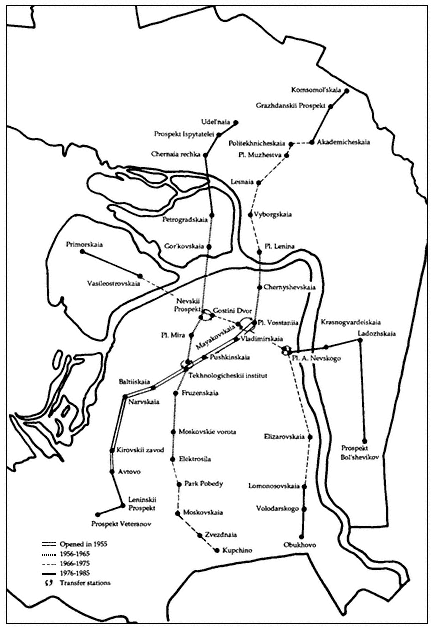
Map 13.
Development of the Leningrad subway, 1955–1985.
of the Leningrad economy came about through more intensive development of already existing facilities, rather than through the construction of new plants.[15] Consequently, employment opportunities were still concentrated in almost precisely the same districts as before 1966, while housing migrated outward. According to one study, the central city population will decline to a half-million residents by the year 2000, while 1.4 million people will be employed by institutions located in the same area.[16] Future city residents will therefore have to travel farther to work, making the commute even longer than the present average of two hours daily.[17] Finally, slow development of service infrastructures in new residential districts required many residents to travel to the city center to shop or meet other obligations.[18]
The pressure on the city's transit system to move people from the periphery into the city center suggests yet another issue: namely, the role of the historic city core in Leningrad's future development.[19] The general plan provided for preservation of the historic center, a goal that has been attained to a remarkable degree. The urban fabric of nineteenth-century Petersburg remains largely intact, helped by the designation of 1,017 structures as architectural monuments, 1,150 as cultural monuments, and 222 as "Lenin Places" to be preserved in honor of the founder of the Soviet state. Few Leningrad planners viewed this marriage of the old city with the new as merely an issue of historic preservation.[20] Instead, discussion of the proper place of the center city in overall regional development also engendered an intense and at times bitter debate over the architectural quality of newer districts.[21]
Environmental Angst
Public concern over the region's natural environment accompanied the concern over Leningrad's man-made environment. The 1966 general plan provided for establishment of a forest-park zone devoted almost exclusively to recreational purposes as well as a suburban greenbelt restricted to carefully controlled development (see Map 13).[22] Both zones have come under tremendous developmental pressure, owing to the region's unpredicted (and therefore unplanned-for) population growth.[23] The inner recreational zone suffers particularly severe strain from overuse by city dwellers who inadvertently tear up fields and forests in pursuit of leisure pleasures. This damage raises questions, for some, of the environmental desirability of maintaining any district solely for recreational purposes.[24]
In addition to general land-use decisions, problems of pollution also must be confronted. Here, as in other industrial societies, solutions are easier to propose than to implement. Many Leningrad municipal officials and industrial managers now appreciate that the nature of pollutants has changed over time, from the biological ones in the pre-
industrial city, through industrial contaminants during the industrial revolution, to the ever more toxic petrochemical pollutants of late-industrial production.[25] In recognition of the problem, local officials at times have supported a variety of coordinated measures that depend on a myriad of institutional actors.[26] Authorities in Moscow and Leningrad have planned to introduce unleaded gasoline at local gas pumps and to launch more aggressive testing programs for automotive exhaust and chimney emissions. Leningrad city planners have recommended removal of the most noxious factories to outlying areas, together with the construction of suburban arterial transportation systems designed to reduce commercial traffic on city streets.[27] Moreover, in 1984, the city undertook preparation of a soil map for a region within a 100-kilometer radius of the city to chart the changing chemical composition of the area's soil, and hence the impact of industrial fallout from the atmosphere.[28] Only a half year later, the city announced a major air-pollution control program.[29]
The paucity of available data prevents us from evaluating the success of these various environmental protection programs. Officially, academic commentators claim that Leningrad's air is less polluted than that of other major Soviet industrial centers. Unofficially, one is told of "black snow" and river water made so warm by chemical pollutants that it will no longer freeze even in the coldest winter. We can hope that the glasnost' (openness) campaign of the Gorbachev administration will make it possible for some meaningful data to be released on the city's air, water, and soil quality. Until such data appear, we must be satisfied to report that various air-pollution control programs are being initiated.
Officials and specialists responsible for protecting Leningrad's environment have voiced concern over the quality of the region's water resources. Local water-pollution control projects have been complicated by the Neva River's relative shallowness and shortness, which limits the natural exchange of stale and fresh water throughout the river and its tributaries. By the end of 1986, local scientists were warning that the region's water resources were threatened by the previously discussed flood-control dam being built across the Gulf of Finland through Kronstadt. According to these reports, the dam would inhibit even further the limited exchange of stale with fresh water that previously had taken place in the river and its tributaries, ensuring that pollution levels would increase and water life would be seriously threatened. Despite continuing protests, these concerns appear to have fallen on deaf ears.[30] At last report, the party's Central Committee moved in March 1987 to expedite completion of the dam and flood-control system, and plans for even more massive new coastal and landfill development on Vasil'evskii Island were being discussed as this volume went to press.[31] It should be noted, however, that municipal
authorities have recently taken some measures to restrict water pollution and now acknowledge the existence of an increasingly severe problem of petrochemical pollution.[32]
Controversy over the dam project refuses to die. Concern about the diversion of scarce resources to the project as well as its potentially negative environmental impact emerged as one of the most emotional issues in the Winter 1989 Leningrad district caucuses to nominate candidates for the Congress of People's Deputies. At one such meeting, Iurii Nikiforov, a Baltiiskii Plant worker and environmental candidate, declared to the voters of Election District no. 47 on Vasil'evskii Island that "Peter I Romanov hacked through a window to Europe, but Grigorii Romanov barricaded it up with a dam."[33] Nikiforov defeated all other candidates that evening but did not make it through the complicated nomination and election procedure to take a seat on the Supreme Soviet.
Specialists also became concerned with uniquely urban forms of "pollution" caused by intense human activity, such as noise pollution and the spread of infectious diseases. Leningrad city officials and their colleagues around the Soviet Union in such cities as Baku have long been aware of the health hazards of intense urban noise levels.[34] Moreover, the city's dank climate makes disease control difficult, encouraging seemingly annual massive influenza outbreaks.[35] Several Leningrad research institutions support programs studying environmental hazards and make recommendations to municipal and industrial leaders concerning environmental protection programs.[36] Finally, a lively academic discussion over the economic costs of environmental deterioration has developed in the national urbanist professional press.[37]
The Lessons of St. Petersburg
Such discussions over the quality of urban life and the city's environment increased after the accession of Mikhail Gorbachev and the initiation of his glasnost campaign. The summer 1986 conference of the 1,550-member Leningrad Division of the RSFSR Union of Architects (the main professional organization for architects) proved especially stormy as delegates excoriated their leadership for past mistakes.[38] In particular, local architects used the forum of the conference to decry what they see as the city's lost qualitative advantage in architectural design construction methods. For example, several delegates pointed to a failure in recent years to develop a sufficient variety of individual apartment unit-types to reflect changing family patterns. The quality of construction of new districts was similarly criticized. Concern was expressed that, unless a higher level of "urban planning culture" was rediscovered in the city, younger architects would lose their motivation to innovate and produce high-quality designs. Most interestingly, the architectural achievements of the city's pre- and postrevolutionary past
were pointed to as possible models for future architectural development.
Just one month later, Leningradskaia panorama published an eloquently biting comparison of historic Petersburg and contemporary Soviet patterns of urban development under the title "Stroll along Prospect Enlightenment."[39] The author, a professional architect, began by recalling an old Russian literary form based on the author or his hero rambling through a given country, city, town, or countryside. By reporting on his impressions, the author is able to share a social critique of the scene under scrutiny. What, queried our contemporary author, would such a literary observer have to say if he were to take just such a stroll through the new districts of contemporary Leningrad? His answer was a withering attack on the visual impact of the neighborhood along Prospect Enlightenment, its substandard quality of construction, and the theoretical underpinnings that led to the design in the first place.
Upon entering the avenue in question, the author tells the reader that an inquisitive reporter would be correct in feeling as if his "soul had been seized." To begin with, the stretch of Prospect Enlightenment in question is almost 200 meters wide. This boundless space could contain within it any of Leningrad's major squares. Unfortunately, the buildings, which were erected during the 1970s, have been placed so that they contribute to the funneling of wind and the acceleration of ground-level wind speeds. Understandably, therefore, our tour leader discovers that a strong wind constantly howls throughout this enormous expanse of open space. Such extravagant use of space is all the more extraordinary when one considers, as the author urges us to, that the traffic needs of the area are served by a two-lane road no more than ten meters wide.
The literary stroll along Prospect Enlightenment continues in this vein at some length, as the author points out various aesthetic and practical difficulties created by the choice of brick color, poorly laid-out internal space of buildings and courtyards, thoughtless landscaping, repetitive use of glass, and the like. Underlying this at times shrill commentary is an explicit belief that architectural design must be freed from dogged adherence to central decrees. Instead, architects are urged to seek inspiration from the historic ensembles of central Leningrad.
Discussions of this sort dominated the local professional press for months following the Union of Architects conference, with ever more strident calls for historic preservation in the center and a learning of the "lessons of Petersburg" by those who design Leningrad's new districts. In November 1986, for example, Stepan Khrulev, chair of the Oktiabr'skii District soviet executive committee, emphasized the need to renovate, reuse, and generally protect the area's aging and substan-
dard housing stock, 98 percent of which was constructed before the 1917 Bolshevik Revolution.[40] This plea was remarkable both for the candid manner in which it set forth the inadequacies of existing housing and for its concern for historic preservation. A month later, Leningradskaia panorama ran yet another article demanding the restoration and reuse of the city's prerevolutionary apartment buildings as the optimal response to the city's housing problems.[41] Here again, aesthetic considerations were among the justifications for rehabilitating existing housing, rather than simply tearing down older buildings to make way for new ones.
An even more authoritative plea for abandoning utilitarian approaches to city building appeared in January 1987 when Boris Ugarov, president of the Leningrad-based USSR Academy of Arts, demanded a perestroika (restructuring) of existing practices in the decorative arts and architecture. Ugarov's views, published in an interview in Leningradskaia panorama, praised the virtues of Petersburg classicism of the late eighteenth and early nineteenth centuries.[42] He spoke kindly of some of the architecture of the early Soviet period as well. However, he strongly denounced the finance-driven approaches to architectural and urban design of the past two decades. Such heartless functionalism, Ugarov contended, deprives the artist and architect of opportunities and destroys the city's unique appearance.
To the Street
Professional architects and even politicians were not the only Leningraders concerned about the limits of modern aesthetics and the inadequacies of current historic preservation efforts. In March 1987, scaffolding went up around two of the city's most historic hotels: the Astoria, from the bar of which John Reed and his fellow Western journalists witnessed much of the revolutions of 1917, and the Angletera where, in room no. 5, the poet Sergei Esenin committed suicide, writing a final verse in his own blood. Immediately following the first appearance of construction materials at each site, the city's morning paper, Leningradskaia pravda , was deluged with phone calls and letters. To quiet the storm, the editors ran a special interview with the city's chief architect, S. I. Sokolov, in which the renovation plans for the two hotels were set forth.[43]
Most of Sokolov's remarks dealt with plans for the more famous Astoria, a style moderne hostelry on St. Isaac's Square now reserved largely for foreigners (see Figure 23). Sokolov promised that the Astoria would be returned to its prerevolutionary magnificence, becoming a monument to the achievements of "the leading masters of Petersburg
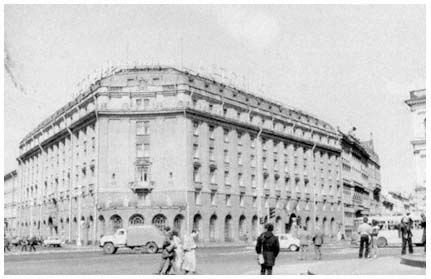
Figure 23.
The Astoria Hotel.
style moderne ." Accordingly, particular attention would be paid to restoring the hotel's facade and major public spaces to their original appearance, while service areas would be rationalized. Individual guest rooms, "several of which do not conform to contemporary levels of comfort," would be upgraded.[44]
Sokolov continued by indicating that the future prospects for the Angletera next door were more complex. The building, located on the corner of Maiorov Prospekt and Gogol' Street in central Leningrad, is much older, having been initially constructed in the 1840s and remodeled many times to suit various purposes. Sokolov noted that it would not, therefore, be possible to restore the Angletera to its original form. Rather, the city's chief architect promised that several major elements of the building's facade would be reconstituted, and some effort would be made to preserve the room in which Esenin died. The vagueness of his statements about the Angletera was emphasized at the close of the interview when Sokolov reported that the Finnish construction firm working on the Astoria site had committed itself to completing its work by August 1989, but gave no indication as to when the Angletera reconstruction would be completed.[45]
Only four days after the appearance of Sokolov's interview—and just days after the erection of construction barriers and scaffolding around both hotels—Leningradskaia pravda reported that hundreds of people had been demonstrating day and night at both sites, carrying placards reading, "Friends, the History of Our City Is Our Root! Save
Our Monuments!"[46] The paper went on to publish conversations with several participants in the increasingly raucous vigil, which had begun on March 18, the day following the Sokolov interview.[47]
Aleksandr Zhuk, an honored architect of the RSFSR and a corresponding member of the Leningrad-based RSFSR Academy of Arts, defended the renovation projects by pointing out that the plans had been developed as early as 1978 at the behest of Intourist, the agency responsible for foreign tourists in the USSR, and had been approved by the USSR Council of Ministers.[48] Zhuk observed further that the buildings had become quite dangerous. Meanwhile, Iurii Andreev, editor in chief of the publication series "Library of the Poet," joined with Zhuk to argue for renovation, pointing out that every effort would be made to preserve those rooms associated with Esenin and to turn them into a special memorial to the poet.[49]
Only days later, however, the influential national literary paper Literaturnaia gazeta recounted the entire incident in an article by Mikhail Chulaki.[50] Chulaki excoriated city officials for their mishandling of the affair, citing extreme heavy-handedness on the part of Chief Architect Sokolov as well as Leningrad city soviet Deputy Chair Boris Surovtsev. Chulaki thought the situation would have been better managed and the fate of the Angletera more secure had Leningrad officials practiced Gorbachevian glasnost.
The ruckus refused to disappear.[51] Weekly demonstrations continued each Saturday morning, sometimes leading to confrontations with the police. Letters continued to pour into the editorial offices of Leningradskaia pravda (and, presumably, to other public agencies) denouncing the insensitivity of Leningrad planners and politicians to their city's cultural heritage.[52] Meanwhile, the Finnish construction crew hired to carry out the job had totally dismantled the Angletera in a matter of weeks.[53]
As time passed, the Leningrad regional and city party committees attempted to assert their control over the situation. Evidently, party leaders moved on two fronts, both of which suggest that the real crime from their point of view was public disorder rather than the destruction of an historic building. On one hand, party agencies began quite early on to lay blame for the incident at the feet of city officials. Party agencies severely criticized city soviet Chair Vladimir Khodyrev, Deputy Chair Boris Surovtsev, and others for their lack of openness in dealing with the public prior to the beginning of demolition and for their clumsy handling of the street demonstrations once public order had broken down.[54] While few commentators seemed to argue that the Angletera could not have been saved (there appears to have been a clear consensus that the building was simply beyond repair), from the party's point of view, those involved with the project should have engaged the public in various review and deliberative sessions before the erection of con-
struction fences and the arrival of the wrecking crews. Within a year, such lessons may have been absorbed, as open discussions between planners and the public over the fate of the city center became more frequent.[55]
On the other hand, the party was not kind to the demonstrators. By some accounts, all students involved in the demonstrations were expelled from their institutions of higher learning (presumably non-student demonstrators suffered some form of punishment at work as well). After a process of negotiation, many students were readmitted, but their "leaders" were not permitted to return to their studies. In a more public vein, the regional party committee observed that, "under conditions of widening democracy," groups, on the whole, "performed patriotic and socially useful roles." Some groups, however, became "characterized by the display of nationalism, Slavophilism, unhealthy temper, and absence of civil maturity."[56] Such tendencies were seen by the regional party committee as manifest in the Angletera demonstrations and were clearly identified as violations of the public good.
Another important postmortem of the affair appeared in the July 1987 issue of Leningradskaia panorama .[57] Some architects contributing to this review reiterated those points made by Chief Architect Sokolov months before.[58] The Astoria, they argued, is one of the finest examples of Petersburg style moderne and is in urgent need of rehabilitation. The proposed plan will return the hotel to its previous splendor. The Angletera, on the other hand, is nearly a century and a half old, was originally constructed for other purposes, has been remodeled over and over again, suffered significant war damage, and simply can not be saved. Nevertheless, the architects involved in the project have worked closely with the Finnish construction crews to ensure that at least the facade will be restored before the construction has been completed. Additionally, the architect-commentators noted, plans for the project had been under consideration for nearly a decade, with relevant articles regularly appearing in professional publications since 1979. Therefore, they suggested, it is simply incorrect to assert that the city's architects have not been mindful of Leningrad's history and of the public interest.
Other commentators took exception to this position, pointing out that contemporary preservation methods, as internationally practiced, would permit restoration of the Angletera facade and interior.[59] If only Leningrad architects and builders were willing and able to practice their craft at the world level, they lamented, the entire issue could have been avoided. As it is, these commentators feared, Leningrad will be left with just another memorial plaque reading not even "In this building. . . ," but only "On this site stood a building in which. . . ."
Finally, some sought to separate questions of public decorum from the various architectural issues under contention.[60] "Youthful maximalism" cannot become the basis for serious professional deliberation,
this argument went. Although buildings of particular merit should be protected and preserved, everyone must recognize that cities are living organisms and must change. The Angletera has little architectural merit and is historically significant only insofar as someone committed suicide there. Therefore, the planners were correct in directing their attention to the more important Astoria. In conclusion, they suggested, professionals should approach complex problems such as those posed by the Astoria-Angletera project in a fully professional manner.
The commentary in Leningradskaia panorama summarizing the positions captures some of the emotion encountered and many of the practical problems raised as Leningrad architects have struggled to come to terms with the rich architectural heritage of their city. Even more important, perhaps, it helps illustrate precisely why the Angletera demonstrations mark an important watershed in public concern for historic preservation in Leningrad. As the opponents to the hotel's destruction stated over and over, what was at stake was the preservation and protection of the city's history and character from the onslaught of modern architecture. Rejection of two decades or more of architectural construction design and planning practices had now moved from the pages of professional journals to the city's streets.
At their core, such critiques of Leningrad and Soviet planning, design and construction practices—like those highlighted by the stroll along Prospect Enlightenment and by the demonstrators on St. Isaac's Square—rested on a shared rejection of modernist planning theories. Leaving aside the fact that construction in Leningrad is of lower quality than in the West, Prospect Enlightenment is not significantly different in conception from Sarcelles outside of Paris or the Southwest Redevelopment Project in Washington, D.C., or other dehumanized urban spaces created during the third quarter of this century. All these projects rest on a "radical" architectural vision that sought to liberate cities and their inhabitants from the tyrannies of bourgeois industrial development. Ironically, they do so through the construction of mass-produced apartment blocks that, by virtue of their size, psychological and physical isolation, and visual monotony, only fragment the social fabric and emphasize the tyranny of the individual over that of the public.[61] A socialist state system explicitly concerned with promoting collective values clings to an urban design philosophy that elevates res privata over res publica , even after architects and planners in various capitalist societies have turned their backs on many of these aspects of the modernist "revolution."
A New Role for an Old Center
The increasingly open calls for a retreat from the architectural and city planning principles of the 1960s and 1970s and movement toward the warm embrace of traditional Leningrad design practices spurred an
intense interest in historical preservation, and continued to do so for quite some time. Preservation efforts captured the public interest in Leningrad, with articles appearing in the daily press, mass magazines, and the professional press. But the actual restoration of historic monuments is only one of many interconnected issues that involve linkages of industrial and residential districts, balancing of service needs, reduction of overcrowding and population densities, and improvement in the distribution of cultural services.[62] Leningrad planners also attempted to improve communication and transportation links between old and new districts.[63] For example, by 1984 the city's streetcar lines, bus and trolleybus routes, and subway lines were carrying approximately 8.5 million passengers each day.[64] Somewhat at odds with standard Soviet practice—and despite the sustained expansion of the city's subway—the lowly streetcar remained a centerpiece of the city's transportation system.[65] In 1985 several existing streetcar routes were changed, and plans were announced for express streetcar routes from new districts to an ever-expanding subway system.[66] The subway system, in turn, had grown by year's end to extend 76 kilometers (about 47 miles), incorporating some 50 stations and carrying 2.3 million passengers on an average day.[67] To improve the distribution of services, Leningrad planners also initiated sociological studies to establish the service, housing, and occupational profiles of residential, commercial, and industrial districts.[68]
While the city's record on historical preservation is world-renowned and continues to attract tourists from around the globe,[69] complex issues like those already discussed have raised questions about the role of the central urban core. With the traditional role of the city center firmly protected by the 1966 general plan, Leningrad officials began to grapple with the problem of maintaining this preserved quarter as a vital and lively district.[70]
To begin with, the city's historic center continued to serve as the region's economic and cultural heart, and this status prevented central Leningrad from becoming a "museum city," despite its rather significant loss of population.[71] Preservation of the city center provided Leningrad's architects and planners with an alternative model of urban development to the one offered by central planning authorities in Moscow.[72] Leningrad's professional publications readily reflected the resulting preoccupation with architectural history and theory, with the psychological impact of physical structures, and with underlying aesthetic values.[73] In February 1985, in a plan designed to accentuate these values, the city announced a major effort to revamp 392 hectares of central Leningrad along and surrounding Nevskii Prospekt.[74] The plan, which was carried out in time for the celebration in 1987 of the seventieth anniversary of the Bolshevik Revolution, called for improving the design of existing commercial facades to bring them more into char-
acter with the avenue's original image. Further proposals advocated turning parts of the Nevskii into traffic-free pedestrian zones.[75] Meanwhile, as we have already noted in the discussion of Prospect Enlightenment, local architects inquired in print why the new districts were not more "cozy." How could the new districts really be called "Leningrad"?[76]