
Early Portraits of Charlotte Berend
Corinth's first portrait of Charlotte Berend (Fig. 80) is dated July 1, 1902. The painting was a gift to the student; it bears a dedicatory inscription to "Frl. Charlotte Berend" and is signed "Herr Lehrer Lovis Corinth." The formal tone of the inscription is matched by the painter's conception, which stresses the conventional, representative qualities common to Corinth's full-length portraits of this type. As in the portraits of 1900 of Bianca Israel (B.-C. 175) and Margarethe Hauptmann (B.-C. 196) and in the portrait of Frau Simon of 1901 (B.-C. 197), emphasis is on the handsome dress, which is set off to particular advantage by the shallow, undifferentiated ground. In contrast to the earlier portraits, however, Corinth gave the painting an allegorical dimension by adding the twig of rose leaves that Charlotte Berend holds. Read in conjunction with her white dress, it alludes to her youth and innocence. As he came to recognize the special attraction Charlotte Berend had for him, Corinth was surely troubled by their great difference in age; with the allegorical allusion he may have acknowledged a growing sympathy he was not yet prepared to state. Charlotte Berend, in turn, perhaps unsure of her feelings toward Corinth, took refuge in a staged and mannered pose that allowed her to maintain psychological distance. That both teacher and student needed the shield of some playful subterfuge to hide their emotions is confirmed by an episode that took place while Corinth was at work on the portrait. The package in which Charlotte Berend had brought the white dress to Corinth's studio also contained several items she had worn earlier to a ball: a black scarf, a fan, and a mask. One day, when Corinth asked her about the other contents of the
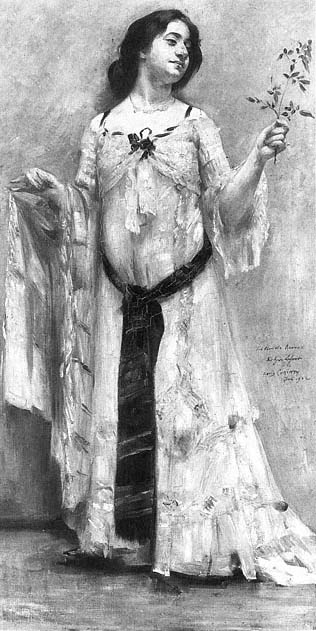
Figure 80
Lovis Corinth, Portrait of Charlotte Berend in a
White Dress , 1902. Oil on canvas, 105 × 54 cm, B.-C. 241.
Berlin Museum, Berlin.
Photo: Hans-Joachim Bartsch.
package, she put on the scarf and the mask and fanned herself coquettishly to show him how she had looked at the ball. Corinth was so enthralled that he painted her in this disguise as soon as the first portrait was finished.[10] This second portrait (B.-C. 236) is astonishingly free in execution; in gesture and posture it conveys Charlotte's vivacious temperament far more than the first. But her thoughts remain hidden by the mask.
During the weeks the two spent together at the Pomeranian seacoast, Corinth painted Charlotte Berend four times. Only one of these pictures (Fig. 81) is a portrait in the conventional sense; it is also the most intimate of the four paintings and a testimony to the affection and trust that by then had developed between teacher and student. As in the first portrait from Berlin, the pictorial structure is simple. Only a corner of the window in the upper left enlivens the background. The wildflowers in the glass on the windowsill echo the colored floral pattern of Charlotte's black dress. Her posture is graceful but without affectation, and her open gaze meets the painter's own with sympathy and understanding. Corinth underscored his affection by inscribing the words "Mein Petermannchen" in mirror writing on the arm of the chair.[11] Charlotte Berend had only recently told him how several years earlier, while on vacation with her parents and sister, she had managed to ward off the advances of a snobbish young suitor by pretending that she was not at all the bourgeois girl he wished to court but rather a Gypsy by birth, a foundling and adopted child, whose real parents, members of the tribe Petermann, had abandoned her in infancy. Petermann and the diminutive Petermannchen (sometimes emphasized for greater effect as Petermannchenchen) were henceforth Corinth's names of endearment for Charlotte.[12]
An early pencil drawing of Charlotte Berend (Fig. 82) dates from the trip the lovers took to the Starnberger See in the fall of 1902. Charlotte, who had unexpectedly fallen ill, lies asleep at the couple's inn at Tutzing. The drawing bears eloquent witness to Corinth's empathy. The face is lovingly modeled; only at the periphery of the image does the shading give way to a more summary rendering. The conception recalls the portrait of Luise Halbe from 1898 (see Fig. 73), and the drawing, with an independence of expression previously reserved for Corinth's work in oil, signals a new role for his graphic works. This is seen even more clearly if the drawing is compared to the oil sketch (B.-C. 259) Corinth completed in the course of his vigil at Charlotte's bedside. The oil sketch retains all the freshness and spontaneity of the drawing, making the latter, by implication, an autonomous work of art.[13] Henceforth Corinth's drawings frequently surpassed his paintings in their harmony of content and form.
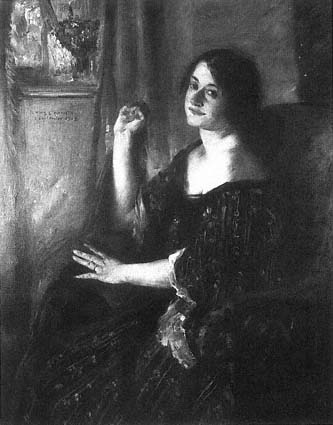
Figure 81
Lovis Corinth, Petermannchen , 1902.
Oil on canvas, 119 × 95 cm, B.-C. 240.
Private collection.
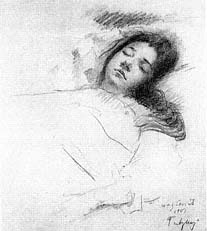
Figure 82
Lovis Corinth, Charlotte Berend Asleep ,
1902. Pencil, 35.2 × 34.3 cm.
Collection, The Museum of
Modern Art, New York.
The Joan and Lester Avnet Collection.
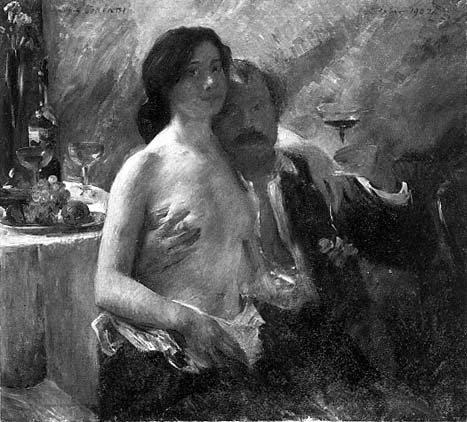
Figure 83
Lovis Corinth, Self-Portrait with Charlotte Berend and Champagne Glass , 1902.
Oil on canvas, 97 × 107 cm, B.-C. 234. Auctioned July 3, 1979, at Christie's,
London; present whereabouts unknown.
Photo: Christie's-Artothek.