
4
Negotiating Adjustment: The Industrial Sector
Over the decades, it has become established procedure for the IMF and the World Bank each to deal principally with one of two select and nearly mutually exclusive groups of LDC ministries (Figure 2).[1] Whereas IMF loans, including the extended fund facility, are negotiated and implemented primarily through central banks, the World Bank often spreads responsibilities across a broad range of ministries. In addition to its primary contact with planning agencies, the Bank can also work through finance, trade, industry, agriculture, and other ministries responsible for sectors receiving specific loans. In these interactions, Bank and Fund interests usually become inter-reinforcing with those of the transnationalist factions of the various ministries with which they deal. Ministries that successfully negotiate major loans with multilateral institutions often gain substantial prestige, enhancing the stature of the transnationalist faction overall.
When the World Bank entered the economic policy realm on a major scale with the late 1970s advent of structural adjustment loans, the combined power and flexibility of the Bank and the Fund were heightened. If
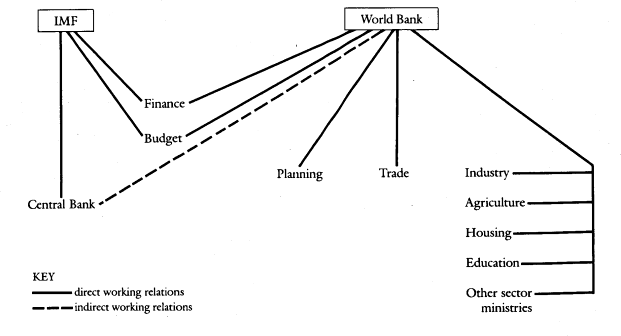
Figure 2.
Contacts with LDC Ministries
the IMF faced a hostile central bank dominated by economic nationalist interests, it could turn economy-wide policy work over to the Bank. And if the World Bank faced an unfriendly planning ministry, it could turn either to the Fund or to powerful transnationalist technocrats in other ministries involved with the loan.
A Faltering Facility
Through yearly recourse to the IMF during the 1970s, by mid-1980 the Philippines had become the LDC most indebted to the Fund. Worldwide, its $1.6 billion IMF debt that year was second only to the United Kingdom's.[2] A substantial portion of this Philippine debt was contracted during its three-year extended-fund-facility (EFF)arrangement with the IMP, which began in April 1976.[3] The IMF deployment of the EFF in certain other countries has proven quite successful in promoting far-reaching policy reorientation. In the Philippines, despite substantial efforts, the EFF largely failed in the policy arena.
This evaluation is not accepted by all parties involved. High-level officials in both the IMF and the Philippine Central Bank, whose careers are linked to the success of such major undertakings, attempted to label the 1976 EFF a success. For Central Bank Governor Gregorio Licaros, the EFF "was a success because we straitjacketed the economy according to IMF standards, which helped us weather the successive oil price increases."[4]
A more accurate picture can be drawn by comparing Philippine economic performance to original EFF targets. Among the precise conditions the IMF set for the Philippines in exchange for the SDR 217 million (about $250 million) loan were more than half a dozen quantitative targets to be met over the 1976-1978 period.[5] Philippine average annual GNP growth was to reach a minimum rate of 7 percent, and its annual inflation rate a maximum of 7 percent. The balance of payments was to reach equilibrium. Government tax efforts, measured by the ratio of tax revenues to GNP, were to increase over the course of the program from their 13.6 percent level in 1975 to 16 percent. The interest rate and controlled prices were to be allowed to rise to free-market rates. Ceilings were set on domestic and foreign borrowing; a floor marked the minimum foreign-currency reserves the banking system was to hold. In addition, the Philippine gov-
ernment was to allow the peso to float gradually downward in value over the three years.[6]
An examination of the Philippine economy in 1979, at the end of the three-year exercise, reveals that the IMF targets were not met. Inflation was higher than projected, growth rates substantially lower, and the balance of payments still in deficit, well short of the targeted equilibrium. Tax receipts (at only 13.9 percent of GNP in 1978) were far shy of their target, and import restrictions had not been lifted to any noticeable degree. After the three years of IMF guidance, the government's commitment to phasing out protective tariffs, "vigorously" using the exchange rate (i.e., devaluing the peso),[7] and increasing interest rates remained little more than promises on paper. None of the original ceilings on domestic and foreign borrowing or the floor on reserves was met. All told, the failure was serious, not just the few "marginal quantitative elements" that an IMF staff person intimately involved with the Fund's Philippine work argued were not met.[8]
When pressed about these discrepancies, certain government and IMF representatives persisted in labeling the extended fund facility a "successful exercise."[9] Their stubbornness derived not only from self-interest but also from their criteria for success. The IMF, through its constant dialogue with Central Bank officials, had a sense that the country was moving in the desired direction, unmet targets aside. Above all else, their perception of the extended fund facility's success rested on the government's establishment of a "nontraditional" manufactured-exports drive (which increased in value by 30 percent per annum in real terms, from a very small base in 1972 to 1979).[10]
Success for them was also measured in the Central Bank's new institutional initiatives, which responded to the program's demands for more rigorous economic and financial monitoring. Foremost among these was the IMF-Central Bank Inter-Agency Committee for the EFF (later the Committee for Financial and Economic Programming), which continued to meet into the 1980s to monitor the Philippines' economic performance in relation to targets set.[11]
But as the unmet targets piled up, so mounted the IMF's frustrations: the underlying Philippine-IMF relationship was not a smooth one. Longtime government officials such as Central Bank Deputy Governor Escolastica Bince readily avowed that, compared with the situation in the 1960s and early 1970s, IMF missions had taken on a "less dictatorial and
patronizing" style.[12] Governor Licaros confessed that he found "some IMF representatives . . . helpful as advisers."[13] Yet such praise did not camouflage a feeling of impropriety, especially among nationalists in government offices, that had begun when IMF influence was first felt in the Macapagal years: why should a mere IMF staff member be telling a high government official what to do? A more pervasive undercurrent of distrust confronted the IMF representative who had been posted atone central Bank since 1970 when he entered nearby offices in search of statistics and reports to relay back to Washington. Undoubtedly, that IMF representative, through his access (however begrudgingly granted) to all the central Banks files and desks, had compiled a more comprehensive statistical snapshot of the Philippines than most top government officials, stymied by interagency secrecy, ever could. Yet, staff members of both the Ministry of Finance and the central Bank admitted hiding from him "because he asks too many questions."[14]
The principal problem facing the Fund in implementing the EFF was that most senior officials in its domestic counterpart, the Philippine central Bank, did not share its transnationalist perspective. Despite successful IMF efforts to instill that perspective in certain lower- and medium-level officers at the central Bank, they made little headway at the top.
Neither Western-educated, nor young, nor perfectly fluent in English, central Bank Governor Gregorio Licaros was a breed apart from his technocratic colleagues. "I am a practical man, not a technocrat," Licaros admitted somewhat proudly.[15] Yet for more than a decade, beginning in 1970, he had occupied a post where both the World Bank and the IMF needed a close ally. In the earlier years of the 1970s, Licaros's philosophy on growth and development had meshed well enough with the Banks and the Fund's: "I am expansionary in my ideas. The more money they [the Bank and Fund] bring in here, the better."[16] That outlook was in large part responsible for the massive escalation of Philippine external debt, from $1.3 billion in 1969 to $17.4 billion by the end of 1980.[17] But when it came to strict EFF policy conditions that threatened Licaros's private domestic allies, the governor refused to make-changes.
IMF effectiveness was in this instance further stymied by IMF Callous-ness toward rising tensions within the Philippine national entrepreneur community, which made EFF conditions extremely sensitive politically, as well as toward accumulated Philippine suspicion about the decades-long
IMF history of strong policy activity, often surrounded by what was perceived as undue secrecy.
By the mid-1970s, it was widely (albeit surreptitiously) acknowledged within the Central Bank, as well as without, that the IMF was an "interfering agency,"[18] "more vocal and controversial than the World Bank,"[19] with a tendency to use its economic "models like Bibles."[20] "We've all read The Debt Trap ," explained one former deputy governor.[21] And though all certainly did not share the analysis of its author, Cheryl Payer, even Central Bank technical adviser and special assistant to the governor, Edgardo Zialcita (normally extremely reticent on the subject) acknowledged agreement on certain points:
The problem with the IMF is its secrecy in its methodology. Even in technical discussions [with us], the IMF just shares its final figures, the targets. . .. [It] doesn't say how it arrived at them. And sometimes, even if we [at the Central Bank] know what model [or formula the IMF is using], we get a different answer . . . a different projection. . .. But there's no discussion on this level. . .. The IMF does not want to be shown up; they want to be smarter [than the Philippine negotiators].[22]
In this atmosphere of general resentment and suspicion, the Central Bank and the IMF often played cat-and-mouse games. The issue of restrictive import licenses was a case in point. After years of harping on the need to liberalize Philippine import restrictions, the IMF included the policy change as part of the EFF program. The relevant Central Bank office complied by splitting the existing restricted categories into subdivisions and then liberalizing only a handful of these new less-inclusive groupings. For every item liberalized, it seemed another ten appeared in the restricted category.[23]
In fact, throughout the EFF period the protective sheltering of domestic industries continued, even as the new light-manufacturing exports were promoted through export incentives. The IMF fully realized that this dualism was condoned by Marcos himself for political reasons: abandoning protection meant losing the support of national entrepreneurs. Although generally viewing those domestic businessmen as expendable, the Fund was not prepared to risk shattering its history of general success in the Philippines by a major confrontation with Marcos. Nor was it able to reach him through the nationalist Central Bank, which also condoned the dual industrial policy.[24] As the EFF drew to an end, an IMF staff member on
the Philippine mission admitted to then IMF Alternate Executive Director Ernest Leung that they would rather not go through a similar exercise in the Philippines again.[25] Maybe a decade earlier the IMF could have carried its program off with aplomb, but in the late 1970s its goals could not be achieved without drawing daggers. Therefore the IMF made way for the World Bank and its structural adjustment loan for the industrial sector.
An Escalating World Bank Presence
Signed in September 1980, the Philippine industrial structural adjustment loan (SAL) must be viewed in the context of almost a full decade of World Bank and IMF initiatives in the Philippines. It was Ferdinand Marcos's declaration of martial law on September 22, 1972, that moved the archipelago centerstage as far as the World Bank and the IMF were concerned. Marcos's declaration not only assured him the presidency for more than the maximum two terms, but it also brought an end to the Philippines' two decades of competitive two-party politics, a system that had seen frequent changes of power among the elites in terms of both party and region.
Privately, Bank and Fund officials viewed the authoritarian regime from a perspective that glorified efficiency above all else. The martial-law state, in Bank terms, became a "public sector assuming a much more important and dynamic role," and authoritarian decrees, promulgated by a stroke of Marcos's pen, were referred to as "legislation."[26] In this, the technocrats' world, democracy of the pre-1972 Philippine vintage—especially the heightened factional struggles of the late 1960s—was to be frowned on for the "political and economic constraints on economic and development management" it had engendered.[27] In its place, the "New Society" (Marcos's favored term for his martial-law regime) held out the promise of "considerable progress."[28]
By 1976, the Philippines had climbed into the ranks of the World Bank's top ten loan recipients, with a promise of another five years of Bank largesse at a level "higher than average for Countries of similar size and income."[29] AS the Banks Philippine division chief, Michael Gould, acknowledged confidentially that year, the archipelago stood With distinction as a Bank "country of concentration."[30] Or, as Philippine government, officials phrased it somewhat proudly, martial law had transformed their country into a Bank and Fund "guinea pig," a "favorite testing ground,"[31] a "ripe field" in
which to push development, "free from the endless legislative debates" of a democracy.[32]
A presidential decree, issued just three days after the declaration of martial law, merged the descendant of the transnationalist planning agency built by the Bank in 1962 with a less powerful nationalist government economic agency to form the National Economic and Development Authority (NEDA). NEDA's designation as the highest economic planning and policy authority suggested that the formalized long-term planning historically nurtured by the Bank would have an even more important place in the mid-1970s Philippines.
When the World Banks Russell Cheetham was posted in-country for a year to draw up a "basic economic report," he worked out of NEDA.[33] In keeping with the Banks practice, the all-encompassing economic report was strategically timed to serve as a key input to the Philippines' 1978-1982 five-year plan, which emerged from that same government office in 1977, one year after Cheetham's report. Cheetham's work was only one of several references used by NEDA, but the resulting five-year plan, as the Bank has noted ad infinitum in subsequent documents, was "broadly consistent" with the report in almost every respect.[34] Undoubtedly this consistency was enhanced when the draft plan was sent to the World Bank for comments.[35]
The five-year plan was drawn up in the context of a ten-year plan (1978-1987) as well as a long-term plan to the year 2000, and these also became "broadly consistent" with the Banks basic economic report. The World Bank was left on fairly safe ground when it asserted in its own 1976 confidential five-year lending plan for the Philippines that the government had accepted the basic economic reports "broad framework for future development . . . as a basis for its future economic plans."[36]
This statement must be interpreted with care. In the Philippines, as in many LDCs, five-year plans—let alone ten-year or twenty-five-year plans—do not usually mean much. But the Philippines' 1978-1982 plan did provide an indication that, overall, the country's economic advisers were aiming at what the World Bank consultant to NEDA wanted: "take off" based on foreign loans and investments that would flow into labor-intensive export-oriented industries once domestic impediments to a free market were removed.[37]
By the end of the decade, the stage was set for the Bank to move from
reports and plans into explicit policy formulation and implementation. By then, NEDA, the pinning ministry, headed by officials sharing the Banks transnationalist perspective, was joined by the no less technocratically oriented ministries of Finance and Industry. It was only a matter of waiting for the right moment to launch the SAL.
On August 12, 1980, less than a year and a half after the Philippine government's three-year experiment with its first and only extended fund facility had officially terminated, Marcos's finance minister, Cesar Virata, sent a letter to World Bank President McNamara. There Was nothing unusual in such correspondence per se. Minister Virata and Governor Licaros had drafted many such letters to the Fund's managing director as part of the established regimen initiating new standby arrangements. Indeed, all over the world, LDC finance ministers and central bank governors had penned and would continue to pen analogous dispatches to the Fund. But this one was to be delivered across the street—to the Bank.
On the surface, Virata's note was a formal but friendly communication to share with the Banks management the Philippine government's new directions for the industrial and financial sectors. Assuming these policies met with McNamara's approval, the letter requested a SAL to help defer financial costs. Lest the policies be misunderstood, they appeared in triplicate: first, outlined generally in Virata's letter; next, presented in the context of a broader statement on Philippine industrial policy for the 1980s (a twenty-page, single-spaced attachment); and, in a last attachment, meticulously chronicled in terms of specific legislation, past, present and future. The government's policy-reform commitments emerged distinctly in five areas: (1) lowering protective tariffs, (2) liberalizing import restrictions; (3) taking action to promote and facilitate exports and investment in export-oriented industries; (4) following a "flexible exchange-rate policy . . . to reflect basic market forces"; and (5) restructuring specific industrial sectors to integrate them with the overall export effort.[38]
Here was the Philippine state announcing its intention of implementing a policy package combining many initiatives similar to those that went unheeded when affixed as conditions to the IMF's extended fund facility. But this time, what was involved was much more than simply sharing good intentions. Many of the new reforms were already underway, and a precise implementation timetable to cover the rest was attached.
Virata's letter to the World Bank was part of a larger, carefully precon-
ceived plan. Although both parties went to great lengths to camouflage it, those policy changes emanated from the Bank itself and, by the time of Virata's letter, stood as de facto World Bank directives. Buried in a government file, a working draft of Virata's second attachment provides a clue. Written in late 1979, its original title was less benign than the Industrial Development Program chronicle that landed on McNamara's desk: Measures/ Steps Taken by the Government in Connection with the Industrial Policy Recommendations Contained in the World Bank's Industrial Sector Report .[39]
The governments acceptance of suggestions it had vigorously rejected when they had been packaged by the IMF was neither as sudden nor as shocking as it may appear. Virata's letter followed years of intense "policy dialogue" between the Bank and top government officials, as well as vigorous sparring among those top government officials themselves. The framing of what eventually evolved into the industrial SAL dates back to 1976 and the EFF.
At the time of the mid-1970s drafting of the Philippines' EFF, there had been a commitment within the Bank to concentrate on agricultural lending in the Philippines. To a certain extent, the Bank agreed to leave broader policy parameters involving industry and finance to the Fund and its EFF.[40] But by no means did the Bank totally leave the formulation of industrial policy to the IMF. In broad terms, the Bank outlined a framework for industrialization in its basic economic report. More specifically, the Bank's confidential 1976 five-year lending plan for the Philippines (the 1976 Country Program Paper ) reveals that even then the Bank had quite explicitly defined its list of necessary "major changes in the existing policy framework": removing import restrictions, restructuring and lowering tariffs, overhauling the investment incentive system. There was no mistaking the Banks priorities: "rapid growth in labor intensive exports" stood as "the most important goal."[41]
But the Bank, like the Fund, realized that simply enunciating the desired industrialization strategy for the Philippines was only a first step. As the EFF's first year progressed and sticky "problem areas" emerged, the Bank began to look beyond its overall agricultural and rural development thrust. It launched "a series of sector and special studies," with topics to include export potential; effective protection; labor-intensive, regionally dispersed manufacturing; and, later, the financial sector.[42]
The World Bank effort was closely paralleled by the University of the
Philippines School of Economics' research project on protectionism and industrial-promotion policies (July 1977 to March 1979). Although the official word was that the Philippine government commissioned the study, the research was aided considerably by American economist John Power, who joined the University of the Philippines' team through the aid of a World Bank education loan. The resulting Industrial Promotion Policies in the Philippines , published in book-form by NEDA in 1979, provided a mathematical analogue to what had been the Bank and the IMF argument all along: poor industrial performance was rooted in the highly protective trade regime and the capital-intensive bias of investment-promotion policies. With the book's publication, certain top government technocrats—including such staunch believers in these reforms as then Economic Planning and Policy Minister Gerardo Sicat (now at the World Bank)—were able to hold up the policy changes as suggestions emanating from the Philippines' own prestigious university, which in turn were simply accepted by the World Bank.[43]
Although the results of the University of the Philippines' exercise would prove useful in the ensuing negotiations, the World Bank by no means planned to wait for the final calculations. A midsummer 1977 Bank mission was posted in-country for two weeks to prepare the Bank's semiannual Country Economic Memorandum for the Philippine Consultative Group.[44] Launched by the World Bank in 1970, the Consultative Group brought together all the Philippines' major bilateral and multilateral aid donors to discuss and coordinate strategies and policies for that country, as well as to review past official-development-assistance initiatives with Philippine government representatives. Each annual gathering has a special focus which, according to a NEDA official who attended almost half of the first decade of meetings, was "usually requested by the U.S. government."[45] Subsequent foci would include poverty, energy, and population; in 1977, Bank mission chief Lawrence Hinkle and his crew of four Bank staff members were instructed to pay particular attention to industrial development.
Their report pinpointed impediments to a "freer trade regime" as the root of Philippine industrial-growth problems. But the report did more than just point fingers; within the main text and its-special appendix-on labor-intensive, export-oriented industries (garments, handicrafts, electronic components, wood products, and nontraditional agricultural and food products including bananas, seafood, and unroasted coffee) appeared
policy suggestions that would return to the Philippine government in more detailed form in later negotiations. Paramount among them were cutting nominal tariff rates to an across-the-board average of 20 to 30 percent, removing all import restrictions, modernizing textile plants, and setting up trading houses.[46] Fueled by that report (and by the strong convictions of many participants), the December 1977 Consultative Group issued a call from Tokyo for "intensive efforts" to set Philippine industrial-sector reform in motion.[47]
By 1978, with the EFF in midstream and the stalemate between the Fund and the Philippine government fairly obvious, a World Bank reappraisal of its role in the Philippines led to an official (if confidentially stated) change in strategy following on the heels of the Consultative Group initiative: "Industrial and financial policy improvements should be the major objective of future Bank lending."[48] This would require a great turnabout. Previous Bank loans to the Philippine industrial sector totaled a mere $398 million, and the value of actual loans to agriculture and rural development for fiscal years 1976-1980 was three times that of industry. However, by FY1981-1986, the two sectors were programmed to assume approximately equal billing, each bringing in about one-third of the World Bank's Philippine program.[49]
In late 1978, with the Philippine extended fund facility almost completely drawn down, a World Bank industrial policy adviser in the Industrial Development and Finance Department, Barend de Vries, was dispatched to Manila to confer with the Ministry of Industry on a preappraisal mission of the industrial sector.[50] Three months later, in February 1979, he returned with eleven colleagues for a full-fledged industrial-sector-appraisal mission. Several high government officials and Bank staff members insisted that this mission had been requested by the Philippine government; others conceded that it grew out of "shared concerns" between the two parties. However, in light of the new twist given to the Bank's Philippine program a year earlier, it seems most likely that the Bank's Washington office played a fairly pivotal role.[51] The mission's invitation, for formality's sake, was happily extended by NEDA chairman Gerardo Sicat and his core of technocrats battling the Central Bank,
Whatever the circumstances of its birth, the mission's mandate was clear to both parties. As the minister of industry told a local newspaper, "The study team will determine what changes the country can adopt so it can
better achieve broader and more rapid industrial growth, generate more employment . . . and promote exports,"[52] Exactly what de Vries had in mind as he evaluated the industrial policies and incentives became unmistakable in a press conference at the end of the three-week mission. Because of "very competitive wages," he announced, preliminary findings had indicated that Philippine exports could replace those of Korea and Taiwan "due to the changing economic structure of these countries."[53] His words were splashed across Manila's tightly controlled media in stories that did not fail to add that the mission was relying heavily on the University of the Philippines' study.
More than a year later, in May 1980, the World Bank published in red-book form (that is, available to the public) what was ostensibly the product of the three-week mission: a three-volume set entitled Philippines: Industrial Development Strategy and Policies .[54] Unknown to the public, the mission's report had reached the "restricted distribution" stage by October of 1979, which meant that a "confidential" industrial report had been drafted and discussed earlier with the Philippine government.[55] Rather than offering new insights, the Bank used the mission to put down on paper the ideas concerning the Philippines' role as a light-manufactures exporter in a new international division of labor, ideas it had been developing over the previous three years. As the mission wrote, "The greatest Philippine comparative advantages lie in labor-intensive and resource-based products."[56] In less than six months, de Vries and his colleagues had integrated all recent Bank and Fund work into a coherent overall industrial-policy proposal that became the basis for negotiations over the SAL.
Those negotiations and the initial discussion of a possible SAL through which the policy changes would be implemented began in August of 1979, when a four-man Bank mission traveled to Manila. Again headed by de Vries but this time including 1977 mission chief Hinkle, the mission arrived with a definite goal: to attain "a comprehensive understanding . . . at the highest levels on the objectives that could be reached through a series of staged industrial policy reforms, the initial stage of which could be supported by a structural adjustment loan."[57]
In setting up the mission, the Bank vice-president for East Asia and the Pacific, Shahid Husain, had acted on his understanding that "structural adjustment loans do go to the heart of the political management of an economy." Husain had instructed the mission team that the Philippines was a
prime candidate for the first industrial SAL.[58] Thus charged, the ten-day mission began policy dialogues with a wide range of top government officials on the need for "greater freedom" and more competitiveness in Philippine export operations. These officials included representatives from five ministries and an equal number of other high-level public institutions.[59] Among the relevant powers in the Philippines, only the Central Bank, the "fortress" that had constantly frustrated similar IMF endeavors, received an unmistakable and deliberate snubbing.[60] The Philippine Central Bank was too central an institution in this policy realm for its exclusion to have been simple oversight.
More of what a SAL might entail was unveiled to the government at this time. For individuals in certain ministries who did not press the point, the Bank mission tended to fall back on references to an initial $200 million loan (and a possible series of loans totaling $1 billion) for "program-type assistance."[61] This term was undoubtedly chosen to please the Philippine government, which had been denied in both its 1975 and 1976 unofficial requests for the Banks old-style program lending.[62] It is understandable that the concept of structural adjustment lending was somewhat foreign to Bank clients, as McNamara's official announcement of the new loans was still a couple of months in the future.
These years of meticulous preparation for the SAL by the World Bank were in large part responsible for the speed with which the loan was subsequently disbursed. Preparation, however, was only one step in the operation; achieving a sufficient degree of harmony and consensus within the relevant Philippine ministries was the other.
SAL: The Consensus
The actual SAL would have two components. First, the loan would be a reimbursement scheme for Philippine imports and would finance about 5 percent of the country's total merchandise imports in 1980. When Philippine companies imported goods, they would pay the Philippine Central Bank the import price in pesos, and the Central Bank would pay for the items in the foreign currency required (usually dollars). The World Bank would then disburse part of the $200 million loan to the Central Bank for these foreign-currency payments.[63]
A second stage of the loan would involve placing the pesos paid by local businessmen for imports into a Central Bank "peso counterpart fund" to be used to "finance economic development expenditures" for industrial development.[64] Throughout the negotiations this was touted as an indication that the Philippine government and not the World Bank would maintain discretion over the final utilization of the $200 million peso-equivalent. However, that seemingly open-ended field for domestic control was whittled down by an agreement that "high" priorities for the fund be threefold: (1) energy generation and plant conversion to nonoil fuel sources; (2) the domestic engineering industry; and (3) the industrial estate/EPZ program.[65] Moreover, the Bank was adamant that authority for determining precisely where that money be channeled rest exclusively with the office of Finance Minister Virata. Virata's position as the Banks closest Philippine friend and confidant suggests there was good reason behind this particular negotiation stance.
Like all Bank-borrower face-to-face negotiations, the outcome of the August 20 to 31, 1979, "discussions" was encapsulated in a mission "aide-mémoire," a brief and unpolished Synopsis drafted for the benefit of both the Bank management and the Philippine government.[66] Little, if anything, had changed in the Bank's position over die period since the appropriate reforms were first spelled out in the mid-1970s. This fact was made apparent not only through the aide-mémoire's actual policy outline but also in its observation that the negotiated reforms "would be consistent with the macro policies . . . supported by the . . . IMF's Extended [Fund] Facility."[67] But the mémoire revealed a breakthrough in the IMF-Philippine government deadlock: "The discussions concluded that graduated action by the Government to implement industrial and financial policy improvements would provide the basis for substantially expanded World Bank support for the industrial sector over the next few years."[68]
Progress had, indeed, been made. Yet, though the main body of the Bank's mémoire proceeded step by step through the policy announcements that would be forthcoming from the Philippine government, a "Checklist of Items Requiring Philippine Position" was attached. The checklist, in effect, covered all the policies, indicating that what was worded as a fait accompli in the text was still probationary.[69] Philippine government participants in the negotiations recalled the August meetings as the time at
which it became evident that the SAL would be "difficult because it required lots of [policy] changes from the government."[70] Neither verbal nor written pledges for future policy reforms would do this time. "The World Bank laid it on the line," confessed another high-level NEDA participant in these early discussions: the loan would not be final until the government made a "serious commitment to the reforms." That is, "no policy announcements . . . no new legislation, no loan."[71]
Just a year later, in August 1980, a confidential World Bank document reviewed the past year's policy reforms with approval:
To date, the Government has acted promptly and in a well-coordinated manner to implement this [industrial development] program. Most of the reforms discussed during the review of the industrial report are either satisfactorily accomplished or progressing as rapidly as could reasonably be expected.[72]
There was no question that the twelve-month period had been marked by a barrage of new policy initiatives. Only one month after the August 1979 meetings, Marcos (in the words of his minister of industry, Roberto Ongpin) "rallied the country to rise to the challenge of confronting the economy" by announcing a new industrial-development policy.[73] By the December 1979 Consultative Group meeting, Bank Philippine desk chief Michael Gould, industrial-sector report and latest economic memorandum in hand, felt secure enough to applaud the progress of the Philippines. He did so by announcing to the Philippines' other major creditors that Bank industrial "lending is . . . likely to increase significantly to support the Government's efforts to expand rapidly economic growth, exports and employment."[74]
The Technocrats: Transnationalist Allies
By no means was the transformation from World Bank policy suggestions to domestic legislation a mechanical or simple process. "Actually," admitted a highly placed NEDA official, "we—that is, both NEDA and the Ministry of Industry—have wanted to move into the area of industrial protection for a long time. But there's always been such a great resistance . . . from vested interests."[75]
Resistance from exactly whom? Bienvenido Noriega, a NEDA economist directly involved with the SAL since the start of the technical dis-
cussions with the Bank, Shrugged off the question: "There was lots of resistance from different quarters of the government."[76] "Even in the Philippine Cabinet there were different views," explained a NEDA colleague. "It took several years until all parties in the Cabinet were convinced of the structural adjustment's worth."[77]
Gerardo Sicat, economic planning and policy minister, had been a staunch reformist voice in transnationalism for perhaps a decade.[78] Only in July 1979, with the Bank's industrial work in progress, did Sicat gain a strong ally, when Industry Minister Roberto Ongpin was convinced to leave the private sector. The World Bank also pinpointed 1979 as a key transition period from Philippine rhetoric toward action: "Although the Minister of Economic Planning had long advocated industrial policy reform, a cabinet consensus in favor of fundamental reform emerged only in 1979, following a major Philippine study of the incentive system and a Bank sector report which built upon it."[79]
This high-level resistance was overcome in good part because of the corps of Western-educated technocrats who underpinned Marcos. It was these "young graduate-educated administrators brought in by Marcos" (to use the Bank's words) that enabled the Bank to wield as much influence as it did in Philippine economic policy.[80] They were the World Bank counterparts on the inside. They thought like World Bank economists; they shared the philosophy that progress and growth lay in foreign investment and abundant foreign loans. They spoke the Same language of mathematic formulas. In brief, they composed a powerful, but not yet hegemonic, transnationalist faction of the Marcos government.
"The World Bank did not make us do anything we didn't want to," claimed Wilhelm Ortaliz, Ministry of Industry liaison to the Bank for the SAL.[81] He had a number of supporters in government on this point, among them ministers Sicat, Ongpin, and Virata, as well as a newer battalion of mid-level bureaucrats like himself and Noriega working on the SAL negotiations and policy changes. Although the claims of these officials that they controlled their own policy were, in part, true, they were misleading. The Bank, consorting with precisely that corps of technocrats who already shared its general outlook, helped tilt the Philippines' domestic power configuration heavily in favor of the transnationalist faction in the late 1970s.
Most of these allied Filipino technocrats clearly recognized the resulting mutually beneficial situation. "That's why the World Bank moved into pro-
gram loans [that is, SALs]," explained one of NEDA's highest officials. "It strengthens the power of technocrats and helps make the work of the IMF and the World Bank easier. If they had to work with politicians, their batting average would be much lower."[82] NEDA's Bienvenido Noriega concurred: "We're using the World Bank [structural adjustment] loan as leverage . . . to do things NEDA has wanted to do, but hasn't been able to. . . . With this World Bank backing, NEDA has more strength vis-à-vis other ministries."[83]
NEDA's assistant director-general for programs and projects was more blunt: "I use the Bank as a club."[84] "Even when we want to undertake a policy ourselves, sometimes it's hard to stick to our economic priorities without political interference," explained Central Bank Deputy Governor Bince. "After all, you can't be a prophet in your own country. It's easier when it's more than just a national commitment . . . when there's IMF or World Bank help."[85] Minister Sicat, a longtime advocate of industrial reform, phrased it simply and concisely: "We are using the World Bank to add gravy where we need it."[56]
The Bank, in turn, acted on a deep understanding that its weight could tip the scales of domestic power. As early as 1976, a confidential World Bank document surmised that an "active Bank presence" in the Philippines would have the effect of "strengthening the position of the highly capable technical leaders in the Government and helping them to achieve policy objectives, which we endorse."[87] If this held for Bank project loans in general, it was especially true for structural adjustment lending. Mission chief de Vries, trying to generalize on the applicability of the Banks Philippine SAL experience, did not fail to stress this critical component: "The Ministry of Industry, Board of Investments . . . and other government agencies have built up a competent technical staff, which makes it possible to pursue a comprehensive and rational industrial policy."[88]
Policy dialogues based on sector work lay at the core of the Banks structural adjustment initiative. But, as confidential documents reveal, "highly effective loan-related dialogue,"[89] according to the World Bank, required interaction with domestic counterparts who "have not been neutral in their policy preferences."[90] These were the transnationalists such as Wilhelm Ortaliz of the Ministry of Industry, who could say with conviction, "We don't like to think of them [the new tariff laws and other policy changes] as conditions. They are our own development thrusts, just helped along by
the World Bank's belief in them [the conditions] and commitment to us [the technocrats]."[91] By the late 1970s, Bank dialogues with technocrats like Ortaliz were characterized by a meshing of interests entirely absent from IMF debates with old-school Central Bank guardian Licaros.
From the start of the SAL, the Bank strategized its moves carefully, consciously gravitating toward a strong alliance with the Ministry of Industry. There, as in NEDA, the top bureaucrats were kumpadres (to borrow directly the Filipino term used by one of the deputy ministers of industry to explain his ministry's collaboration with the Bank).[92] The Ministry of Industry also presented a better vantage point than NEDA when Central Bank opposition had to be overcome, for an alliance with the ministry carried increased leverage. As the Bank itself noted in this regard, the as-yet-untarnished Ongpin was more than just the minister of industry: he was a member of both the cabinet's five-person highest standing committee and the Central Bank's governing Monetary Board. Furthermore, one of Ongpin's deputy ministers simultaneously held a pivotal post as chairman of the government's Development Bank of the Philippines (DBP), from whose coffers came most long-term domestic industrial finance.[93]
From the Ministry of Industry locus, the World Bank spread outward to other Philippine ministries, in line with Bank Vice-President William Clark's 1978 comment that the Bank managed to find approval for its programs (even in countries without identical priorities) by "constant dialogue," talking not only to planning and finance ministers but also to "other key men in the governments."[94] In October 1979, copying an experiment initiated during the EFF, an interagency committee was set up. Chaired by the Ministry of Industry, the committee included representatives from almost every ministry dealing with economic development. According to member Ortaliz, it was entrusted with using the World Bank industrial-sector report as an "outline" to delineate the Philippines' new industrial reform.[95]
The Bank, however, was not content simply to leave its report as a springboard for policy discussions. It continued to maintain a direct role in the domestic reform process. A Bank mission was sent in November and December 1979 "to help work out the initial package of reform measures to be supported by the proposed loan."[96] In its wake, export promotion, tariff reform, and trade policy initiatives all jumped to the forefront of the legislative slate (a slate tightly controlled by Marcos himself).
For what were considered the more difficult areas of reform—primarily the topics of investment incentives and industrial restructuring that the Banks industrial report had not detailed sufficiently—the Philippine government was given a $50,000 advance on the loan to subsidize the cost of foreign consultants. These advisers were to base themselves at the Ministry of Industry and chronicle the necessary policy changes. In keeping with its established procedures, the Bank possessed veto power over the Philippine government's choice of consultants.[97] Indeed, for all the talk of amiable policy dialogue, the World Bank still held the more powerful negotiating position; it reminded its Philippine counterparts of this inequality from time to time through statements making it clear that should the industrial policy reform falter, so would Bank funds.[98]
Why, it may be asked, was the World Bank succeeding where the IMF had failed? The answer is complex. Whereas the IMF had dealt almost exclusively with a Central Bank not yet dominated by new technocratic elements, the World Bank turned its back on these "old boys." Instead, it focused on strengthening the positions and furthering the viewpoints of sympathetic technocrats in ministries that could be played off Licaros's Central Bank.
Furthermore, the Bank learned from the IMF's mistakes and consciously strove for a different sort of image in the Philippines. Pervasive among government officials was the feeling that the IMF stood as a "watchdog disciplinarian," to be approached with caution.[99] In contrast, World Bank missions moved in and out with ease, maintaining relative freedom to contact whomever they wanted directly without seeking highest, level Philippine government approval first—and vice versa,[100] At any given time, went the standard joke among Philippine technocrats, there were at least five World Bank missions somewhere in-country, but "who knows doing what, where, or why."[101]
A feeling of camaraderie permeated the SAL negotiations, making them, according to participant Ortaliz, "quite reasonable. Our assumption is that the last thing the World Bank wants to do is screw up our economy."[102] This showed in interagency committee member Noriega's recounting of who comprised the Banks team at the negotiations:
It's quite a good group, who established a personal rapport with us. . .. There was Hinkle. He acted almost like an Asian, very patient—although according to
[another Bank staff member], he assumes a very different role at the Bank. . .. You can see that different people in the mission seem to have specific roles to play. For example, the leader of the mission plays the good guy. You can see this with Chrik Poortman. Before, when he was just assistant [mission] head . . . he was the bad guy. But when he became the team leader, he changed his style, and . . . a German took over Poortman's former role—you know, playing the pushy type. . .. You can see this sometimes: now when Poortman wants to bring up a negative point, another on the mission brings it up for him.[103]
Such amicable role-playing was widely accepted by Noriega and the other Philippine technocrats, their alliance with the bank cemented. Noted Noriega lightly, "We know their roles arc all learned in negotiation courses conducted by the Bank for its missions."[104]
Further facilitating the ease of negotiations was the sense of self-importance and confidence with Which the Philippine technocrats were able to approach the meetings. The feeling existed that much as they needed the World Bank, these Bank Staff members needed them as well. Structural adjustment lending, government participants realized from the start, was an experiment. With tensions growing between the Bank's established project and new program divisions, professional futures within the Bank were staked on the first few structural adjustment loans. So, contended Ortaliz, "when the mission got a bit pushy here, wanting us to include more policy changes than they originally asked for, wanting us also to realign indirect taxes right away [and so on] . . . it was only because they [were] really in need of a successful program loan"[105] —"successful" in the sense that significant domestic policy reform was forthcoming, which the Philippine government was made to understand had not been the case with the World Bank's first three SALs. This heightened sense of importance allowed Philippine technocrats to accept what Ortaliz admitted were the Bank's "at times unreasonable demands."[106]
Throughout the negotiations Wharton-trained Minister Virata, respected in international financial circles through his 1976-1980 chairmanship of the Bank-Fund Joint Development Committee (after which point he was made chairman of the Group of 24), played a critical role. "If it had not been for Minister Virata, there wouldn't have been quite that kind of relationship between the World Bank and the Philippine government," surmised Noriega.[107]
As the negotiations entered their final lap and as ticklish issues cropped
up in the somewhat more public interagency committee meetings, Virata, Husain, and McNamara were sequestered to iron out the wrinkles.[108] Such behind-the-scenes activity was more frequent than usual for a Bank loan, but all the participants were accustomed to these private tête-à-têtes. De facto conditions for the granting of IMF and World Bank loans are often hammered out behind closed doors by senior participants in advance of the final negotiations and, therefore, never find their way formally into the written contracts.[109] The beauty of the arrangment was that it allowed people such as Central Bank Deputy Governor Bince to sidestep inquiries into whether the industrial-sector policy changes stood as conditions for the SAL with a curt "You'll never find that in writing."[110]
In midsummer 1980, a Philippine technical team traveled to the Banks Washington, D.C., headquarters for what was to be the last in this long series of negotiations. The unusually high-level presence of Ministers Virata and Ongpin among the group at this stage of talks was striking testimony to the fact that SAL mediations were above those of normal project loans.[111] At the end of the "technical discussions," the Bank's Hinkle and the Central Banks special negotiator Soliven dispatched a joint telegram to Deputy Industry Minister Jose Leviste detailing "steps to be completed for distribution of Loan Documents to the [Banks Executive] Board." Final approval by the Bank management (who would then transmit the loan papers to the Board for a rubber-stamp vote) hinged on fulfillment of three conditions.[112] The Bank management would wait until the government had "(a) enacted a law to implement the lagreed-upon] first three stages of tariff reform, (b) adopted a policy . . . liberalizing commodity import procedures, and (c) sent a letter to the Bank outlining Philippines Industrial Development Policy."[113]
Within a month these last obstacles vanished. Virata's letter bore the date August 12, 1980. Less than two weeks earlier, on August 1, President Marcos issued Executive Order 609, declaring a comprehensive reform covering three-quarters of the items in the Tariff Code. Although eventually geared to bring nominal tariff rates down to the range of 20 to 30 percent (and thereby meeting the Bank's 1977 call for rates in this range), the reform concentrated on three initial stages of a five-year tariff reform program effective January 1, 1981.
Phase I would reduce most current peak nominal rates to a 50 percent (ad valorem ) ceiling by January 1, 1982.[114] Phases II and III would concentrate on realigning fourteen important industrial subsector rates over five
years to achieve broad uniformity. Under phase II, the average effective rates of protection for food processing, textiles and garments, leather and footwear, and pulp and paper were to be slashed from 158 percent to 30 percent. Phase III was then to reduce the average effective rate of protection from 53 percent to 18 percent for ten other key industries.[115] In addition, a fourth phase was to be proclaimed by January 1981 and was to cover the 25 percent of the Tariff Code not included in the phase I peak-rate reductions or phase II and III sectoral tariff reform.[116] In sum, the four-phased reforms, according to Bank calculations, would "reduce overall effective rates of protection for the economy from 36 percent to 23 percent and for the manufacturing sector from 44 percent to 29 percent."[117] Accompanying this tariff change was the requisite import liberalization, removing the prior-approval requirement on restricted import categories (the Central Bank's "nonessential Consumer" and "unclassified consumer" lists of so-called luxury goods).[118]
The rest was fairly pro forma. Upon reading McNamara's final report on the loan (recommending the board's countenance), the executive directors learned that the Philippine government had "implemented nearly all the recommendations on export promotion made in the Bank's industrial sector report," including "the most important and difficult actions required."[119] McNamara's report was quite explicit in enumerating how the obligatory tariff reform related to the Bank's export-oriented industrialization goals for countries like the Philippines:
The reduction in higher rates of protection afforded to some industries should lead to increases in competitiveness and efficiency and help strengthen the linkages between home and export industries. . . .[120]
Tariff reform and the liberalization of import licensing should push Philippine effective protection significantly closer to those of Korea and Taiwan which have experienced rapid industrial and export growth. . . .
They [the reforms] will place home industry in a much more competitive environment and encourage productive resources to be allocated to areas m which the Philippines has an existing or potential comparative advantage. These reforms are likely to mark a turning point in Philippine trade policy as important as that of the early 1970s [when martial law was declared]. . . .
Nontraditional manufactures would play a central role in sustaining the country's export drive.[121]
The signing of the SAL in September 1980 was marked by victory celebrations on both sides. In the Philippines, ironically, some viewed the ap-
proval as a triumph over the dominant U.S. power on the Banks board. The United States' historical disdain for broad-based program loans to LDCs was no closely guarded secret. "We half expected a U.S. veto on the loan," admitted more than one Philippine technocrat.[122]
But structural adjustment lending was not the same as the relatively unencumbered program lending, as the September 1980 accolades within the executive director's chambers revealed. There, the structural adjustment loan was heralded as a "vehicle" for "overcoming policy constraints." Indeed, the executive directors were so enthralled with McNamara's new tool that they seemed to have only one complaint: why had the Bank not attempted to use its previous Philippine industrial project loans as leverage "to have an effective dialogue?" To which the (unnamed) chairman could only reply that the "environment" had become "more sympathetic," "more conducive to dialogue" of late, adding that there were plans for "continuing and expanding" that dialogue "to embrace other issues."[123]