
Attitude toward the Political System and Power Structure
The belief that government, including the federal government, is in the hands of a small number of organized groups who have unofficially usurped power is widespread and striking. This belief is common among blue-collar workers, though also among other occupational groups. When asked whether they thought the government was run for the benefit of everybody or for the benefit of a few big interests, 59 percent of blue-collar workers in 1984 answered that the government was run for the benefit of a few big interests. About the same percentage of Americans in upper-white-collar, lower-white-collar, and service-sector occupations agreed, as did 51 percent of housewives.[13]
Survey data going back to 1964 (when the question was first asked) suggest that this belief has been a fairly stable part of the political outlook of most Americans, including blue-collar workers. Thus in every election year except 1964, at least 40 percent of the entire population has believed that the government is run for a few big interests, and in five of the seven election years in this period more than 50 percent of the population has believed this. As in 1988, variation by occupation is not especially pronounced; blue-collar and upper-white-collar Americans both followed this trend from 1964 onward (see figures 8.19 and 8.20). The survey studies do not explore these beliefs further. For example, they do not ask the obvious follow-up question, namely, which are the "few big interests" for whose benefit so many blue-collar workers (and other Americans) believe the government is run. However, data from detailed case studies give an indication of an answer. A study of employees (almost all truck drivers) of a California company that delivers packages, a study of blue-collar and lower-white-collar Italians in Brooklyn, and a study of blue-collar chemical workers in New Jersey, all came to similar conclusions.[14] The vast majority of blue-collar workers believe that Big
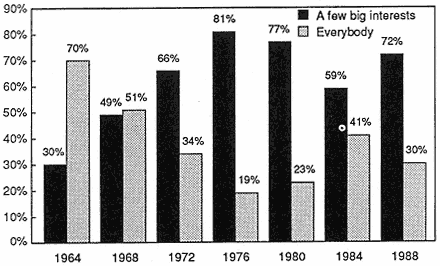
8.19
Who Benefits from Government, 1964–88: Blue-Collar Workers.
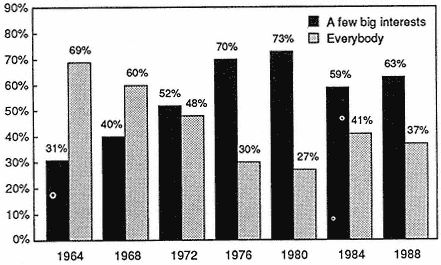
8.20
Who Benefits from Government, 1964–88: Upper-White-Collar Workers.
Business really runs America. The dominant view is that corrupt politicians are a venal facade behind which major corporations, "Big Business," prevails, in politics and economics. Remarks like "it's business that runs the country," "big corporations are behind everything," "the [political] power is in the hands of the people with money," and "oil, steel
insurance, and the banks run this country" are commonplace. These were typical comments: "Politics? It's all money! Big Business pays out money to get what it wants." "Who runs the country? Well, I suppose the president does. He makes the decisions. Of course, business is behind him. They make the real decisions. Politicians are all on the take."
That this attitude toward Big Business is widespread is also suggested by Erik Olin Wright's survey data, which found that over 74 percent of blue-collar workers believe that "big corporations have too much power" in America. It is noteworthy that, in terms of their beliefs about the power of corporations in society, American blue-collar workers are just as class conscious as workers in Sweden (presented in Wright's analysis as far more class conscious than American workers). For in both societies, between 75 percent and 82 percent of blue-collar workers believe that "big corporations have too much power" in their respective countries.[15] This underlines the importance of considering separately the three spheres: attitude toward the political regime, attitude toward the work setting, and attitude toward life outside the workplace.
Despite these critical and sceptical beliefs that American blue-collar workers have about who runs the country, the lack of approval for alternatives to the current political system is notable. The general acceptance of the American Constitution ranges from enthusiasm ("it's the best in the world") to lukewarm ("I complain a lot, but it isn't any better anywhere else"). This phenomenon needs explaining. In part it is based on a distinction between the system and those who operate it, between politicians and the Constitution: the political system is sound, but it is in the hands of scoundrels. In part, lack of support for alternative political systems results from a perception that radical change in the United States is impractical: the country is too large, and potential leaders are too prone to sell out. But in part the widespread acceptance of the Constitution and the political system is based on a key distinction most workers make, either explicitly or implicitly, between freedom and democracy. The United States does offer freedom and liberties, which are very valuable. Consider these typical comments, all made by workers who believe venal politicians subvert the electoral process: "In America you have freedom. That's important. I can say Reagan is a jerk and no one is going to put me in jail." Another worker: "You know what I like about America? You're free. No one bothers you. If I want to take a piss over there [points to a corner of the tavern], I can." Socialism and communism are ruled out in almost everyone's eyes, for they are seen as synonymous with dictatorship. They are political systems that permit neither popular control of government (democracy) nor individual freedom and liberties.[16] Survey data suggest that, like mistrust of government, this attitude toward freedom is widespread among blue- and white-collar Americans.
The vast majority both value freedom and consider it an important feature of contemporary America.[17]