
Ceremonial Kokochi, Zuñi
In the group dances in which the kachinas are all alike, the men are dressed with extreme care. Each part of a costume is as like that of its neighbor as human hand can make it. No corps de ballet in white tarlatan and pink slippers could be more uniform. The stiff white kilt is folded
around the body to the same point above each knee, the shining black hair hangs to the same straight line at each waist, and the tail of each swinging foxskin clears the ground by the same few inches. The Zuñi Kokochi (pl. 37), the good or beautiful kachinas, are an excellent example of this nicety of similarity.
In September, 1936, I made a casual visit to the pueblo of Zuñi. Leaving my car near the road, I slowly circled the adobe houses in the direction of the sacred dance plaza. Suddenly I heard the deep tones of a chant, vibrant and somber. Climbing to the housetop, I looked down upon the dancing gods below. Forty-five dancers, facing each other, stretched in two lines along one side and part of each end of the plaza. One row, thirtyone in number, representing the male characters, danced shoulder to shoulder with their backs to the plaza. Nearest the wall and facing them were fourteen Kachina Maidens, who turned with the male dancers.[52] The movement flowed continuously from one end of the line to the other. Around, behind, and in the center capered the ten Mudheads, watching the dancers intently so that they might give immediate assistance when hair was entangled in evergreen sprig or turtle-shell rattle slipped from its leg position and interfered with a performer's movements. A dancing god should be as unconscious of such irritating trifles as a West Point cadet on dress parade.
At the head of the lines stood the priest, without a mask, his gray hair clubbed at the neck and bound with a hairband, and a downy white eagle feather moving gently at his forelock. He wore a dark blue shirt of native weave with set-on sleeves, and a white kilt with a brocaded sash tied on the right side. On his legs were blue knitted leggings held in place by red and white garters. He carried a terraced-edged bowl from which he sprinkled meal to make a 'road', and a beautiful wand, the insigne of his society, made of many kinds of brilliant feathers fashioned together and concealing an ear of corn. This ear of corn is known as the "life token."
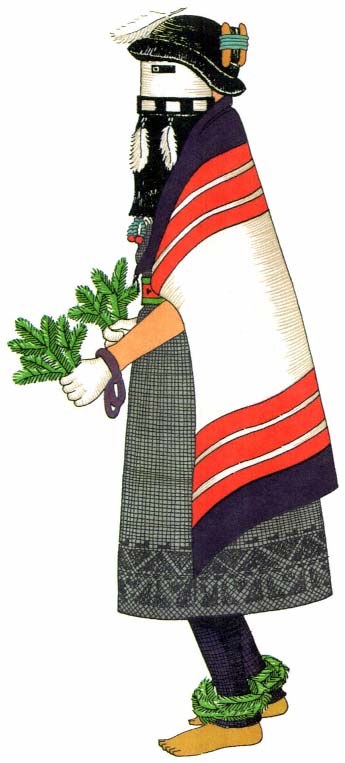
Plate 38.
Kachina Maiden, Zuñi. Conventional
dress of the female deities.
In the long kachina line there were twenty-nine Kokochi, their bodies painted with pink clay from the Sacred Lake. Each one wore the conventional white embroidered kilt. The white plaited sash, the symbol of rain, was knotted on the right side and the long cord fringe moved restlessly with the dance. A red woven belt was looped over the sash. Pendent foxskins were fastened to the belts in the back, their tails clearing the ground by a scant three inches. Sprigs of spruce were stuck in each belt and woven into bristling anklets worn just above the bare feet. Spruce was carried in the left hand of each dancer. Just below each knee, bunches of dark blue native-spun yarn were tied. At the back of the right leg, just below the bend of the knee, was fastened the turtle-shell rattle. From it hung deer hoofs which hit against the hard shell as the uneven beat was accented with the right foot. A bunch of blue yarn ornamented the right wrist, and a bow guard of leather with silver and turquoise the left. Bunches of native blue yarn and many beautiful necklaces of turquoise and white shell were worn around the necks of the dancers. The right hand carried a gourd rattle filled with pebbles, the clatter of which simulated the sound of falling rain. The half masks were blue-green with rectangular black eyes. The added strip of leather edging the bottom was painted in blocks of black and white, "symbolic of the house of clouds" where the Sky Gods live.[53] A long beard hung from the lower edge of each mask. The dancer's own hair rippled loose and free with a knot of bright yellow parrot feathers on top of the head. A white homespun cotton cord, weighted with a piece of turquoise or a silver trinket, fell down the back, and to this at regular intervals downy eagle feathers had been attached in an erect position.
With the Kokochi, and dancing in their line, were two Upoyona or Cottonheads (pl. 17); one or two of whom often dance with the Kokochi.[54] They are gentle dancers, the sons of the chief of the sacred kachina village, and they occasionally come with the Kokochi to aid them in bringing rain.[55] They were dressed exactly the same as the other dancers: body
paint, kilt, sash, belt, spruce sprigs, foxskins, and wrist guards, yarn on arms and legs, rattles. However, instead of spruce anklets they wore turquoise blue moccasins with red trim and black and white heelpieces of porcupine quill. Their helmet masks had blue faces, with domino-shaped designs around the eyeholes. There were large eartabs edged with thick fringes of hair, and the wigs were of black horsehair straight-bobbed at the lower edge of the great spruce collars. There were long, flat snouts, and topknots of downy white eagle and yellow parrot feathers, from which hung three strings of loosely twisted cotton cord laid over the black hair at the back.
The Kachina Maidens, or Kokwelashtoki (pl. 38), form the second line.[56] They wore black dresses of woven wool. White Hopi blankets with red and black borders were thrown over their shoulders. The feet were painted yellow and the hands white. The legs were covered with dark blue knitted leggings, and there were anklets of evergreens. Blue yarn was tied around the wrists, and bunches of spruce were in each hand. They also wore many necklaces. The half masks were white with rectangular black eyes, and the shiny blackness of the thick horsehair beard was broken by the soft whiteness of three long, downy, eagle feathers. The hair was parted in the middle and wound on either side over rectangular frames of wood; then it was bound with yarn. Thick black bangs of goat's wool hung completely around the head, thus concealing the edge of the mask. A single white downy eagle feather hung from the center of each forelock.[57]
The Kokochi Dance, a prayer for moisture, is performed more often than any other Zuñi ceremony. It always opens the summer series. It is especially important on the occasion of the return, every fourth year, from the Sacred Lake, where certain of the impersonators go to acquire clay and tortoises. The live tortoise is afterward carried in the dance. Later it is killed, and the shells are cleaned and made into dance rattles which
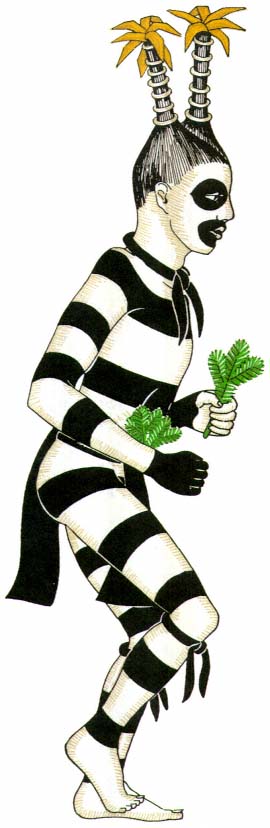
Plate 39.
"Chiffoneti" clown, striped from neck to ankle.
are worn by all masked dancers. These masked beings, "the prototype of the katcina,"[58] are particularly identified with the Lost Children. The legend says that in the course of wanderings subsequent to the mythical emergence of the Zuñi from the four worlds below, they crossed a stream. The children, carried upon the backs of their mothers, fell into the water and were immediately turned into snakes, turtles, lizards, and frogs.[59] Swimming into the Sacred Lake, they became kachinas, and they have lived there ever since. The manner of the Kokochi is always gentle and mild, and they always bring happiness to the people. Their prayers and dances call down the rains and thus keep the world green and beautiful. They come at any time in winter or summer and are impersonated by dancers from each of the kivas in turn. In winter, when the Kachina Maidens come to dance, they bring, hidden under their blankets, the corn for the people to plant in the spring. It is deposited on the altar of each kiva they visit, and the priest distributes it at the end of the dance ceremonial.
The Kokochi is one of the dances which "require the presence of a couple, male and female, at the head of the line, who go through certain peculiar motions and have certain esoteric prayers. Only three men know these prayers, and they must be invited to perform for all kivas."[60] The two lines form in the ceremonial chambers and march in order to the dance plaza. They are led by a priest who, scattering corn meal before them, "makes this their road."
These same masked dances are said to be found in other pueblos,[61] but nowhere is there such precision of step and unanimity of costume as in this oft-repeated Rain Dance of Zuñi.