
Ceylon, 1870–1930
Throughout the nineteenth century and into the 1920s, Nakarattars continued to dominate the rice market in Ceylon (Bastianpillai 1964; Pillai 1930: 1179; Mahadevan 1976: 103). From the mid-nineteenth century onwards, however, their commercial activities were strongly affected by two changes in the Ceylonese economy. One of these changes was the arrival of British exchange banks to fund the Ceylon coffee boom of 1840 to 1870.[36] The second change was the overall growth in Ceylon's export market, triggered by the opening of the Suez Canal in 1869 and further altered by the destruction of Ceylon's coffee industry in the 1870s and the growth of its tea and rubber industries. The Suez Canal provided the means for much swifter transit time in Asian-European trade generally and, consequently, reduced transportation costs and increased profits in the shipment of all kinds of commodities. Initially, this change provided little scope for Nakarattar investment, for the most profitable investment and the one which dominated the Ceylonese
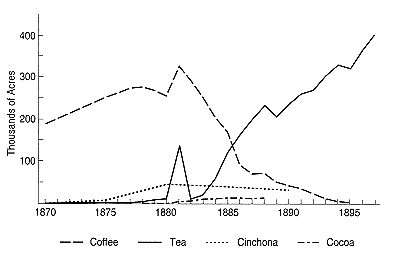
Figure 2.
Areas under selected export crops, Ceylon, 1870–87. Figures for cinchona
are five-yearly. Source : Rajaratnam (1961); based on Ceylon Blue Book
Statistics, Colonial Office, Ceylon (1870–81); Ferguson's Handbook &
Directory and Compendium of Useful Information (1870–81); Owen (1881).
economy between 1840 and 1880 was coffee, and most coffee plantations were in the hands of the British planters and were financed by British banks.[37] In the late 1870s, however, a coffee-leaf fungus (hemeleia vastatrix ) destroyed the coffee industry. In the five years between 1881 and 1886, production of coffee dropped from its peak, when the area under cultivation was approximately 322,000 acres, to virtually no acreage under cultivation at all.[38]
In the aftermath of the blight, Ceylon plantation owners looked for alternatives to coffee. In the process, native Ceylonese found opportunities to increase their share as producers in the (slightly) more diversified economy of Ceylon. The new export crops included cinchona (from which quinine is produced), coconut, cocoa, and the two crops that were to become Ceylon's major exports: tea and, after 1900, rubber (Bastianpillai 1964; Rajaratnam 1961). (See Figures 2 and 3 and Table 4). By the end of British rule, the Ceylonese controlled perhaps 20 percent of the production of tea and 35 percent of the production of rubber, which together accounted for 90 percent of Ceylon's export. In addition, the Ceylonese controlled 100 percent of the production of coconut (Arasaratnam 1964: 161), which continued as the major Ceylonese export product even during the coffee boom.
Ceylonese growers and planters entering the growing plantation industries faced one serious problem, however: no British bank would
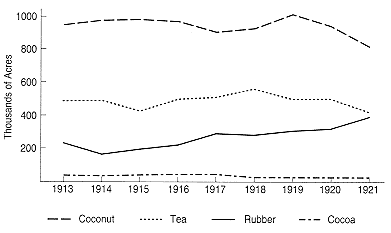
Figure 3.
Areas under selected export crops, Ceylon, 1913–21. Source : Rajaratnam
(1961); based on Ceylon Blue Book Statistics, Colonial Office, Ceylon (1913–21).
| ||||||||||||||||||||||||||||||||||||||||||||||||||||||||||||||||||||||||||||||||||||||||||||||||||||||||||||||||||||||||||||||||||||||||||||
lend them the funds necessary to purchase land, seed, or fertilizer. Similarly, Ceylonese importers and exporters, coconut millers, arrack renters, and "country boutiques" (rural moneylenders who provided credit to small-scale farmers and farm laborers) were faced with the same problem: where to get credit. The Nakarattars were happy to offer a solution and, according to the Ceylon Banking Commission, provided almost all of the investment capital employed to finance indigenous Ceylonese ventures.
Among the private credit agencies, the Nattukottai Chettiars play the most important part.... It must be said to their credit that in moving surplus capital from places, both internal and external to the point of requirements, they have contributed in no small measure to the development of the island. European enterprises relied upon English funds to acquire lands and develop them into flourishing estates. The Ceylonese had no such external support or own savings to help them. They turned to the Chettiar and found a ready response. (CBC 1934 I: paras. 159–162)
It is difficult to gauge exactly how much capital Nakarattars channeled into the production of different crops in Ceylon for the same reasons it is difficult to gauge overall Nakarattar investment. But their involvement was substantial. Between 1870 and 1916, the number of Nakarattar firms in Ceylon increased from 150 to 700.[39] By 1929, at the peak of their business, the total volume of business conducted by Nakarattar businessmen was estimated at Rs. 150 million (CBC 1934 I: 42). For reasons touched on shortly below, this volume dropped to Rs. 100 million by 1934, the major difference being a decline in loans available to Nakarattars from British banks. With this decline accounted for, however, it is possible to accept figures prepared by the Colombo Nattukottai Chettiar Association in 1934 (CBC 1934 I: 42; see Table 5) as providing an indication of their business activity. These figures indicate that Nakarattar loans to Ceylonese that were secured by mortgages totaled approximately Rs. 20 million and that loans secured by their pawnbroking operations came to another Rs. 4 million. Nakarattars loaned out slightly more than the amount of these combined categories—Rs. 25 million—in unsecured loans on promissory notes. Finally Nakarattars also deposited about Rs. 5 million with British banks. Besides these assets, totaling Rs. 54 million, the caste association figures also indicate that Nakarattars invested about Rs. 46 million in their own business and properties. That is, their assets were almost evenly distributed between money lending and non-money lending business ventures, with a slight preference for money lending.
| ||||||||||||||||||||||||||||||
Although no confirming evidence was available to me during my research, it seems likely that the proportion of Nakarattar investment in money lending expanded relative to their investment in trade and other business ventures after the 1850s. The major difference in Nakarattar business operations after this time lay in additional sources of short-term funds available to them with the establishment of the British exchange banks. These banks were faced with the problem of investing the considerable funds deposited with them by their British clients. Although the British would not extend credit to Ceylonese, they would make short-term loans to reputable Nakarattar bankers (adathis ) secured only by the cosignature of a second Nakarattar. Nakarattars, in turn, loaned these funds to Ceylonese at a higher rate (Weersooria 1973).
This is not to say that the British banks provided unlimited credit to every Nakarattar. On the contrary, they attempted to build safeguards into their Nakarattar loan operations by excluding small Nakarattar firms from consideration. Loans would be made only if the recipient or cosignatory was on an approved adathi list (see Chapter 6) prepared by the head office of the Imperial Bank of India, which was supposed to keep track of credit worthiness and indicate the maximum amount of loans for which each
firm was eligible.[40] But the safeguards never really worked. As one expert witness testified before the Ceylon Banking Commission,
As the due dates of the loans vary in the different banks, the Chettiars used to borrow from one bank to pay off their dues to others so that a Chettiar firm which is financially embarrassed can easily tide over its difficulties and if it is actually insolvent the heaviest loss is entailed upon the bank to which the loan is repayable last in order of time.
... The system of inter-Chetty lending was the chief support of the successful working of Chettiar Banking. When in need of liquid funds they lent freely among themselves, at the usual inter-Chetty rate (6 percent or under) or at the rate charged by the banks, whichever was higher, if, in order to accommodate a brother in the trade, a Chettiar had to borrow from a bank. Thus so long as some among the Chettiars had untapped margins of credit at the banks, none of them, whose position was otherwise sound and could prove it to be such to his prospective Chetty creditor, had to fear, in all normal times, any inability to meet his short term obligation to his bank.
Thus the Chettiars through the age-old practice of being their own mutual lenders of last resort, were able to use loans from banks, sometimes from the same bank, to meet the maturing bank loans. To the extent this happened, it was the banks' own money which enabled the Chettiars to keep their loan contracts with the banks with striking promptness.[41]
The implication is that Nakarattars financed not only short-term loans from their own short-term borrowings, but also risky short-term loans and even long-term loans. If their clients could not repay or if their own short-term borrowings came due before the repayment by a client, Nakarattars could simply repay the British banks, in the manner described in the testimony above, by borrowing from a fellow Nakarattar. The second Nakarattar, in turn, might have borrowed from the very bank being repaid! Since no security was required on the short-term loans that Nakarattars borrowed from British banks, and since Nakarattars found it easy to circumvent the kinds of limits that British banks placed on loans to them, virtually the only constraint on Nakarattar borrowing was their own sense of caution. In the face of a highly expansive export economy, however, there was little need to exercise caution.
The bubble burst in the "Chetty Crisis" of 1925 with the failure of the A. R. A. R. S. M. firm.[42] In the ensuing bankruptcy hearings, the High Court of Madras estimated the firm's Indian assets at Rs. 800 thousand and Indian liabilities at Rs. 3.7 million; its Ceylon assets at Rs. 150 thou
sand and its Ceylon liabilities at Rs. 1.7 million. According to the Ceylon Banking Commission,
The discovery of the questionable practices of the firm of A. R. A. R. S. M. led [British] banks to look upon those practices as not particular to that individual firm but as possible types which could be and might be adopted by other firms of Chettiars in the island. Accordingly, the banks decided to revise the securities on which they had been doing business with the Chettiars until then and they found to their dismay that many of the securities offered to them by the Chettiars were not safe and others were neither sufficient or adequate. (CBC 1934 II: 253)
The disingenuous British statement of "sudden discovery" served them as a rationale for suspending further credit and calling in all outstanding loans to Nakarattar bankers. No evidence is available to me that suggests any alternative explanation for this change in British bank lending policy. But it is hardly credible that the British banks would loan out Rs. 25 million without some idea about the security of the loans. In any case, their abrupt cessation of all loans to Nakarattars required the Nakarattars, in turn, to call in their loans to Ceylonese clients. The result, as reported by the Colombo Nakarattar association, was a decline in their business volume from Rs. 150 million to Rs. 100 million between 1929 and 1934 (CBC 1934 I: 42).
This was only the start of a series of events that rendered Ceylon inhospitable for continued Nakarattar investment. In addition, and dramatically amplifying every event, the worldwide depression sent prices for agricultural commodities plummeting—including those for tea, rubber, and coconut. What had once seemed safe and profitable loans to Ceylonese made on the basis of projections about expanding markets rapidly became losses. As these loans came due, Nakarattars (faced with their own credit difficulties) refused to grant extensions. Where no other solution was possible, Nakarattars took possession of lands or moveable property securing roughly half the outstanding debts. These actions, in turn, stimulated Ceylonese resentment of the Tamil moneylenders and led to a series of legislative acts and legal proceedings that ultimately drove the Nakarattars out of Ceylon.[43]