
Chapter 5
Supplying the Nepmen
It is the NEP-man who hurries here and there, and by devices which are always suspect, obtains exceptionally interesting goods, which somehow the Cooperatives do not always manage to offer. But why that is I could not find out.
—Theodore Dreiser
It is difficult to find a more convenient field of operations for all sorts of pretenders than our expansive country, filled either with exceedingly suspicious or exceedingly gullible administrators, managers, and social workers.
—Ilya Ilf and Evgeny Petrov
Throughout NEP the main obstacle facing traders (state, cooperative, and private) was obtaining goods, not selling them, since demand for many products far outstripped supply. Soon after launching his first business ventures in Russia, Armand Hammer discovered that the shortage of most commodities was so great "that any article of general use or consumption produced inside the country at anything like a reasonable price is generally sold beforehand."[1] One advantage held by the Nepmen over the state and cooperative retail network was their ability to acquire merchandise more efficiently and resourcefully (and sometimes more deviously). Goods flowed into private traders' hands from a number of suppliers, whose relative significance varied with the nature of a Nepman's business and with changes in the economic and political climate.
One of the most important sources was the "socialist" sector itself. During the course of 1921 and 1922 most state factories were ordered to operate on a cost-accounting (khozraschet ) basis, meaning that they could no longer rely on the state to provide them with raw materials, pay their workers, and absorb their finished products regardless of how inefficiently they operated. Instead, with the umbilical cord cut, state enterprises found themselves on their own in the marketplace, frequently in desperate need of funds for raw materials, wages, equipment, and so on. Many state operations in such straits sold off nonessential goods and equipment at low prices in order to obtain working capital. This phe-
nomenon was known as razbazarivanie (literally, "scattering through the bazaars"), which is usually rendered as "squandering." Very often, the only customers with ready cash were Nepmen. As a Soviet writer remarked in 1924, state firms that "plunged into the anarchy of the market became the source of extremely intensive primary accumulation for the new trading bourgeoisie."[2]
It is, of course, impossible to ascertain the total value of goods involved, but many observers were convinced that a large amount of state property fell into private hands through this process. The state publishing house Krasnaia Zvezda, founded in 1923 to publish military literature, sold cartloads of its paper and expensive stationery to Nepmen at low prices. Somehow, the publishing house also had musical instruments, first-aid kits, and bicycles, which, not surprisingly, it was anxious to sell to anyone available. During the famine in the Volga region at the beginning of NEP, a state livestock breeding agency sold to Nepmen a large portion of its resources (scythes, sugar, salt, oats, and hay). Even some of the agency's purebred stock was sold or rented to private persons for use in horse races. Up to 1927 state enterprises and agencies had sold 1,661 cars and trucks (and 4,000 motorcycles) worth several thousand rubles apiece to private buyers for only 400 to 500 rubles each.[3] As in the case of Krasnaia Zvezda, it was not unusual for a state operation to sell commodities that had nothing to do with its official activity. Agencies as unlikely as Glavchai and Khleboprodukt (which handled tea and grain, respectively) raised cash by unloading large quantities of textiles on the free market in 1921/22. Even Gosbank acquired a variety of goods at the beginning of NEP, some of which it sold to private entrepreneurs.[4]
Not all state sales to Nepmen were haphazard or unsound. Private traders as a rule were more efficient than the state and cooperative retail system, and they could also charge higher prices than their "socialist" competitors (since the latter were supposed to observe price ceilings). Consequently the Nepmen were often able to absorb higher prices and harsher credit terms from state suppliers than could "socialist" enterprises in need of the same goods. As a result, many officials in state factories and trusts, forced to fend for themselves on khozraschet , found it possible to overcome any ideological scruples they may have had concerning sales to the "new bourgeoisie." Though this provoked a complaint from Tsentrosoiuz (the central agency of the cooperative system) that "large amounts of goods proceeded from trusts, not to cooperatives, but to the private market [in 1921/22]," such protests were to no
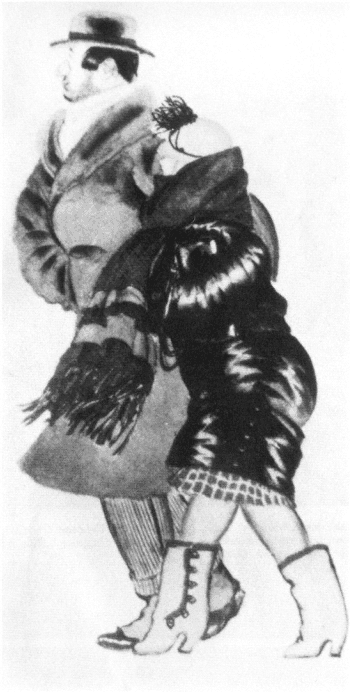
"Nepmen," a watercolor painted in the 1920s by Dmitrii Kardovskii.
(Serdtsem slushaia revoliutsiiu . . . [Leningrad, 1980], picture no. 118)
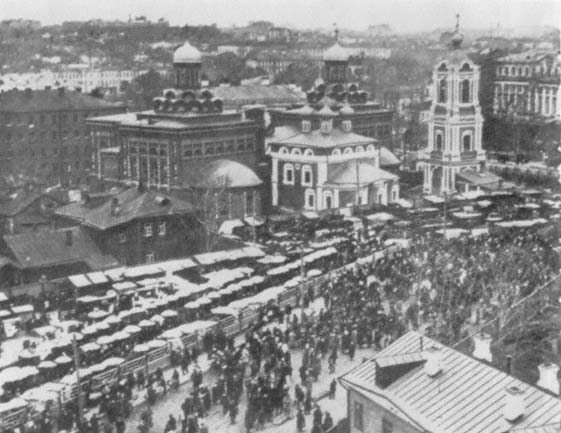
The Sukharevka, Moscow's largest outdoor market. The name of the market was sometimes used
as shorthand for private trading in general. ( Illiustrirovannaia Rossiia , no. 50, 1926, p. 1)
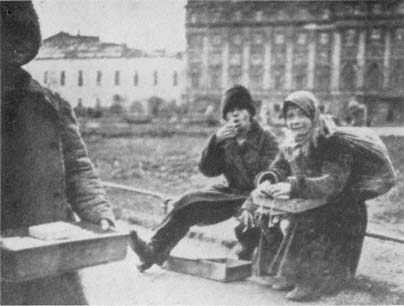
Young street traders in Moscow in 1921. Primitive trade of this sort was most widespread at the
beginning and end of NEP. (F. A. Mackenzie, Russia Before Dawn [London, 1923], page facing p. 82)
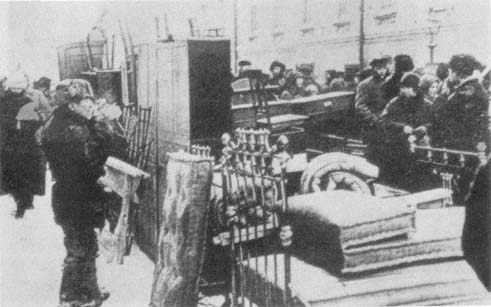
Furniture and other personal possessions for sale in one of Moscow's outdoor
markets at the end of NEP. (Illiustrirovannaia Rossiia , no. 23, 1930, p. 6)
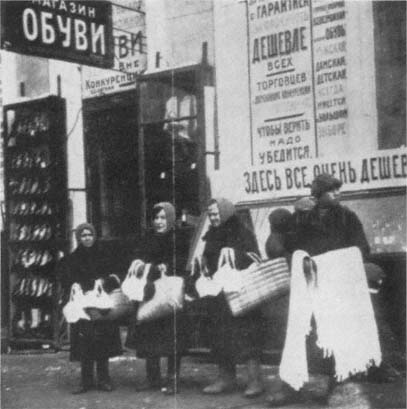
A group of street traders outside a state shoe store. ( Illiustrirovannaia Rossiia , no. 10, 1927, p. 1)
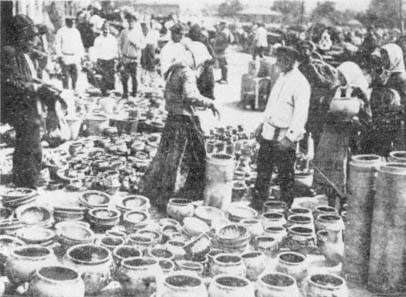
A row of clay-pot vendors in a rural market. The dominance of private traders was generally
most pronounced in rural localities. (Illustrirovannaia Rossiia , no. 27, 1929, p. 5)
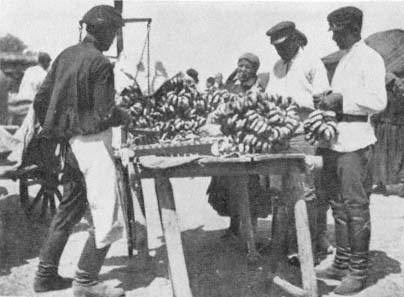
A baranka (ring-shaped roll) vendor plying his trade during a
village market day. (Illiustrirovannaia Rossiia , no. 30, 1926, p. 1)
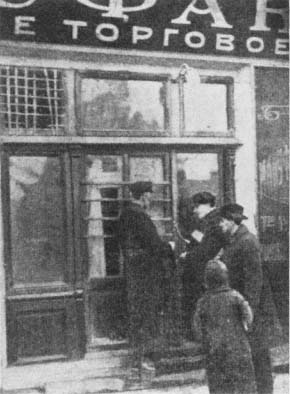
A state tax inspector and policeman sealing a shop whose proprietor had
fallen behind in his tax payments. This scene became a common sight during
the last years of the 1920s. (Illiustrirovannaia Rossiia , no. 13, 1925, p. 5)
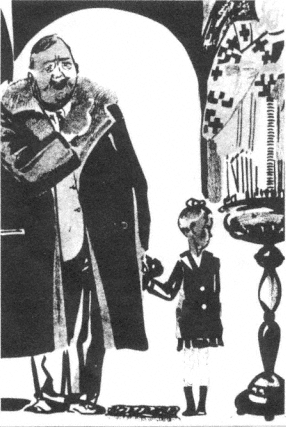
A Soviet poster depicting a Nepman uttering a prayer: "O Lord, help me,
a sinner! Help me to cheat and circumvent this [Soviet] power that I hate."
(Negley Farson, Black Bread and Red Coffins [New York, 1930], page facing p. 208)
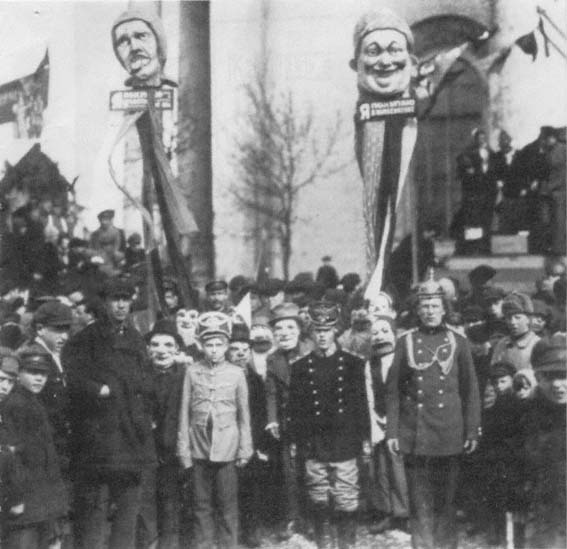
A portion of a May Day parade in Leningrad. The sign below the grimacing mask reads:
"I buy from a private trader." Below the smiling mask are the words: "I shop in a cooperative."
(Sovetskoe dekorativnoe iskusstvo. Materialy i dokumenty 1917-1932. Agitationno-massovoe
iskusstvo. Oformlenie prazdnestv. Tablitsy [Moscow, 1984], picture no. 225)
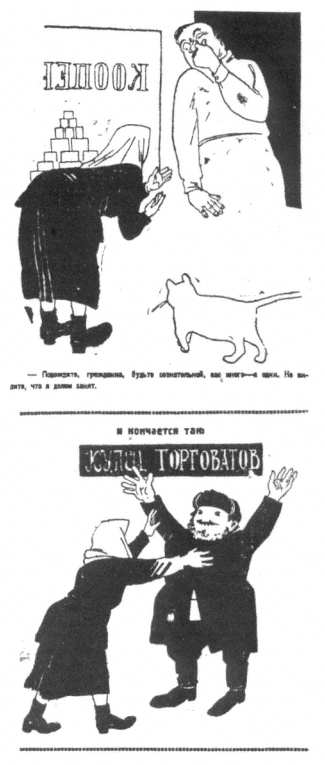
A clerk in a cooperative store (first frame) admonishes a woman:
"Wait a minute, Citizen. Notice that there are many of you, and I am alone.
Can't you see that I am busy?" This rudeness sends the woman hurrying (second frame)
to a private trader, who greets her much more solicitously. It is interesting to compare
the point of this cartoon (published in Pravda , January 4, 1928) with the point
of the masks in the Leningrad May Day parade (photo on preceding page).
avail. Indeed, a decree of April 10, 1923, permitted state trusts to give their business to Nepmen even when state and cooperative customers were available, as long as the Nepmen offered more favorable terms. Transactions of this sort were particularly common in the first years of NEP, when the state and cooperative retail network was extremely inefficient. But even in 1926, the state salt syndicate announced that it would be desirable to sell to Nepman 30 percent of the syndicate's output, precisely because private traders could accept less credit and higher prices from the syndicate than could the cooperatives.[5]
That there were comparatively few state and cooperative stores, particularly in the first half of NEP, was another compelling reason for state firms to sell to Nepmen. Otherwise, goods simply would not reach a large portion of the market. For every 10,000 inhabitants of the countryside in 1924/25 there were 6 cooperative shops, 1 state store, and 31 licensed private trading operations. The actual number of private traders was certainly much higher, for it was quite easy to trade on a small scale without a license, particularly in the countryside. As we have seen, private entrepreneurs also dominated trade in the cities during the first years of NEP, handling over 80 percent of urban retail trade in the estimate of the state Central Statistical Bureau. The effectiveness of the private retail network was clear to state officials in the trusts, syndicates, and factories. In the middle of NEP, for example, the state sugar trust maintained that it was essential to market 26 to 28 percent of its products through Nepmen because of the weakness of state and cooperative trade in the countryside. According to the division of the All-Russian Textile Syndicate (VTS) headquartered in Rostov-on-the-Don, private traders were practically the only people available early in NEP through whom textiles could reach consumers. On a related point, an article in one of the Council of Labor and Defense publications noted that during the "scissors crisis" in the fall of 1923, many cooperatives, "artificially supported" by the state, collapsed. Had there been no private traders to market textiles produced by state industry, factories would have been glutted with finished wares, and "it is difficult to imagine the sort of catastrophe for VTS that would have accompanied the autumn crisis."[6] Viewed in this light, sales to Nepmen were in line with Lenin's dictum of "building communism with bourgeois hands."
In 1922 the state system of industrial trusts and syndicates sold roughly 50 percent of its goods directly to private traders. The figure proceeded to fall to 35 percent by 1922/23; 15 percent in 1923/24; 10 percent in 1924/25; and about 8 percent in 1925/26.[7] The declining per-
| |||||||||||||||||||||
centages should not be taken as an indication that the state continually reduced sales to Nepmen during this period. Since the total output of state industry increased markedly in these years, sales to private traders, though falling in percentage terms, did not decline in absolute value after 1923/24 (see table 6). It seems likely that the volume of such sales to Nepmen was off somewhat in 1923/24 compared to 1922/23, as a result of the crackdown on private trade in 1924. But the paucity of comparable data for 1922/23 hinders quantitative comparisons. In any case, volume rebounded in the following years despite the shrinking percentages for those years.
Private merchants were primarily interested in the output of consumer goods branches of state industry, commodities such as food products (tea, coffee, sugar, and salt), textiles, kerosene, tobacco, matches, and leather and rubber items such as footwear. Information is fragmentary for the beginning of NEP, but it is safe to assume that trusts and syndicates in these branches of production generally made between one quarter and one half of their sales to Nepmen.[8] By the middle of the decade, record keeping had improved sufficiently to permit more detailed estimates (see table 7). Approximately 80 percent of direct private purchases from trusts and syndicates were concentrated in just a half dozen or so branches of production. In 1924, textiles alone (primarily cotton cloth) accounted for over half such sales to private entrepreneurs. But the demand for textiles far exceeded the state supply, and as the number of state and cooperative stores increased, textile trusts and syndicates were instructed to sell more of their goods to "socialist" enterprises.[9] The results were apparent as early as 1925 and were striking by 1926 (see table 8).
| ||||||||||||||||||||||||||||||||||||||||||||||||||||||||||||||||||||
| ||||||||||||||||||||||||||||||||||||||||||||
In addition to legal, direct purchases from state agencies, private traders could obtain goods from the "socialist" sector by various illegal, semilegal, and indirect means, much the same way large quantities of state property reach private hands today in the Soviet Union. Although little quantitative information on this activity is available, it is clear that a considerable volume of commodities reached private traders through "informal" channels. Few Bolsheviks knew how to trade during the early years of NEP, as Lenin lamented repeatedly, and state enterprises often had to hire people with experience in private trade to help market goods or obtain raw materials. These people were then in a position to divert state supplies into the private sector, because they were often more aware of what materials were on hand than were the nominal managers.[10] It was not unheard of at the beginning of NEP for a private trader to have a second "full-time" job in a state enterprise. In 1922, for instance, the state trading agency Gostorg had a number of employees who simultaneously operated private businesses that were well stocked with Gostorg's wares. Occasionally a private contractor or supplier for a state agency who was also an official in that agency could buy and sell goods to and from himself—on rather unattractive terms for the state, one might suspect. One Nepman even wrote letters proposing transactions to himself in his other capacity as an official in a state firm.[11]
Some of the first private stores opened in 1921 were owned by former state employees who had used their official positions to acquire the goods they then sold on their own. Other people remained in state service, registering their shops under someone else's name (often a close relative), and then supplied the stores with products they controlled as state officials. The search for goods was also joined by relatives scattered about in the "socialist" sector (nevesta v treste, kum v GUM, brat v narkomat; "a fiancée in a trust, a godparent in GUM [Moscow's leading department store], and a brother in a People's Commissariat," as Mayakovskii once quipped). In 1922, for example, an agent of Gostorg at the Nizhnii Novgorod fair delivered supplies at low prices to the private firm Transtorg, whose director happened to be his brother. Nor did the ties between the two enterprises end here. A member of the board of directors of Transtorg was also head of a division of Gostorg, and the founder of Transtorg was at the same time an agent for Gostorg—all quite legally.[12]
In December 1922, on the heels of similar directives and draft decrees prepared by several state agencies, the Council of People's Commissars (Sovnarkom) adopted a law making it illegal to engage in private busi-
ness activity while employed by the state.[13] If Sovnarkom's intent was to dam the "unofficial" flow of state resources into the private sector, the decree was futile for a number of reasons. First of all, the accounting practices in many state enterprises, especially at the beginning of NEP, were sloppy or nonexistent, and it was relatively easy to steal goods from an agency that did not even realize it possessed them. The disappearance of supplies from state and cooperative operations as a result of poor record keeping and other sloppy practices was dubbed the "four u's"—utruska, usushka, utechka , and ugar (roughly, "spillage," "shrinkage," "leakage," and "waste"). Eight years after the Revolution, for example, officials at the Leningrad naval yard had still not made an inventory of the vast amount of goods lying around the facility. Entire warehouses, listed as empty in the naval yard's books, were actually full of valuable commodities at the mercy of thieves and the elements. Millions of rubles' worth of state goods were stolen across the land, and much of this loot found its way into the hands of private traders. To illustrate, a Nepman named Brounshtein, representing a private firm with virtually no capital, contracted to supply a state factory with nine hundred tons of oil in return for some steel pipe. After promising the steel pipe to another enterprise in exchange for some roofing iron, Brounshtein stole the oil he needed from the Leningrad naval yard. He then carried out all of the transactions described above, leaving himself with a supply of roofing iron, which he sold. Part of the proceeds went to certain naval yard employees who had helped him steal the oil. In 1922, American Relief Administration officials in Rostov-on-the-Don learned that bands of thieves were stealing state supplies from railroad freight yards and selling them to private wholesalers. These Nepmen sometimes bribed the station agents to ship their newly acquired goods to various markets by rail. At times the thieves could be brazen. Employees in the state factory Treugol'nik stole cable from the factory and then sold it back to the factory through a private firm, Kontora Martinova, they had set up.[14]
Even Walter Duranty, Moscow correspondent of the New York Times , and Herbert Pulitzer, son of Joseph Pulitzer, were peripherally involved in the theft and resale of state property at the beginning of NEP. As Duranty tells it:
Among our flock of American wage-slaves there was one white crow in the person of Herbert Pulitzer, the principal owner of The New York World , in whose vineyard he then chose to labor as a mere reporter. The knowledge of his wealth must have reached Moscow, for one day a Russian came to his
room at the Savoy, where I was sitting, and circumlocutively invited him to buy a carload of sugar. I think the price was $1,200, and the Russian, who had a note of recommendation from the restaurant in the Arbat where we always took our meals, declared that it could be sold immediately for $5,000. There would be some small commissions, he smiled knowingly, but we could count on a clear profit of at least 200 per cent. I was interested, but the rich Pulitzer asked crudely, "Who owns the sugar now, and where is it?" "Oh," said the Russian airily, "it is Government property stored in freight cars at one of the Moscow depots. But they've forgotten all about it, and of course some of it would go to sweeten the only official who knows anything. I assure you there is not the slightest risk."
During another meeting over a good deal of French champagne, the Nepman coaxed $500 from Pulitzer and $100 from Duranty and raised the rest elsewhere. After completing the transaction, he spent half of his thousand-dollar profit on a lavish banquet (to which Pulitzer and Duranty were invited) and gambled the rest away the same evening. Duranty learned later that in the following months he had made approximately $50,000 in similar business operations and then slipped out of the country to Paris.[15]
Despite warnings and decrees from the state, some Nepmen maintained cozy relationships with state officials (frequently with bribes) in order to obtain merchandise or special services. This system, called by some wags krugovaia poruka (an old Russian term meaning mutual responsibility), was the next best arrangement to being both a Nepman and a state employee oneself.[16] The businessman I. D. Morozov, for instance, had had many connections in the West before the Revolution, and after opening a store in Moscow during NEP, he decided to try to renew some of these old ties in order to obtain Western goods. To this end he enlisted the aid of the chairman of a Soviet trust who was about to go abroad on a business trip—and who had been the director of one of Morozov's factories before the Revolution. The director of the Northern Section of the Association of State Workers Artels (ORA) illegally rented the services of one workers' artel' of five hundred men to a private contractor of ORA, named Kornilov, for four months at the rate of one ruble per head. Kornilov employed these workers in his own business ventures, which had nothing to do with ORA (such as cutting, loading, and unloading firewood).[17]
To be sure, few Nepmen contemplated international maneuvers or rented brigades of state workers. Most of the collusion between state officials and private entrepreneurs bore a greater resemblance to the fol-
lowing cases. In 1921 a man named Alkhazov was arrested for cocaine trafficking and sentenced to a year in prison. Following this setback he managed to install himself as an official in a state trading agency (Dagtorg) and soon began to conduct shady transactions. In Moscow he met an old acquaintance, now a director of a private firm, and they contrived to be of use to each other. On one occasion Alkhazov went to the Nizhnii Novgorod fair and purchased (from another state agency) a large quantity of textiles in Dagtorg's name, even though Dagtorg had instructed its representatives not to buy textiles. According to the sales agreement, the goods were to be sold to the people of Dagestan (in the eastern portion of the Caucasus), but Alkhazov hurried back to Moscow and sold half the textiles to his friend. The rest reached private traders through other channels. To cite another example, in 1922 the OGPU charged the director of a state tobacco-processing factory and two former private wholesalers with creating a "black trust" that sold 90 percent of the factory's output to Nepmen.[18] In some instances, state agencies that officially had nothing to do with the trade of various products obtained them anyway from trusts and syndicates for resale to private wholesalers.[19]
Nevertheless, most private traders were small-scale vendors in markets and bazaars and thus in no position to strike special deals with influential state officials. If such junior Nepmen (and many larger-scale merchants as well) wished to obtain goods directly from the "socialist" sector, they had to tap the state distribution system farther down the line. This would often entail bribing a clerk in a state or cooperative store to withhold goods and sell them to the private trader. On other occasions "socialist" clerks, store managers, and others took the lead in these transactions, knowing that they could sell merchandise to private traders at prices well above the official ceilings. This activity was widespread, prompting the Supreme Council of the National Economy (VSNKh) in July 1924 to send out a directive to the enterprises under it forbidding the practice. But this and numerous other official complaints proved futile, and the sale of goods to Nepmen from state and cooperative wholesale distribution agencies and retail stores continued to flourish.[20]
If bribes seemed too risky, a private trader could simply purchase merchandise from state or cooperative stores as a normal customer and then resell the items. It was not difficult to find people willing to pay more for the products than the prices charged by the state, particularly in the
provinces, where shortages were acute.[21] A report of the All-Russian Textile Syndicate issued in the fall of 1925 describes this phenomenon.
Squeezed in the grip of a goods shortage in the provincial market, private trading capital has moved to Moscow, and here, in the streets of Moscow, conducts the sort of transactions for cotton cloth that Moscow has not seen before. Crowds of unemployed people and invalids stand in lines for textiles outside retail stores of trusts and syndicates. Those who obtain goods sell them to bagmen who pay twenty to thirty kopecks per meter. The bagman brings the goods to the market where they are bought by a provincial retailer, who in turn sells them in the countryside, marked up 100 to 150 percent.[22]
It was not uncommon for a larger-scale private trader to mobilize relatives and friends or hire people (often invalids and the unemployed, as stated above) to stand in lines at state and cooperative stores to buy goods for resale elsewhere. Nepmen used these hired buyers throughout the decade, though the latter became particularly numerous in the final years of NEP as the state began shutting off the direct flow of its goods to private traders.[23]
Soviet correspondents and store employees estimated that as many as three fourths of the people standing in lines outside state and cooperative shops intended to resell the merchandise they purchased. Whatever the actual figure, there was no doubt that small armies of hired buyers were involved. More than a few Nepmen had good contacts in the "socialist" distribution system and seemed to be more aware, one correspondent observed, of which scarce commodities were in various state and cooperative stores than were some of the state's own marketing officials. When word leaked out that a desirable product was about to go on sale in a particular store, a line of surrogate buyers generally formed well before the doors opened.[24] Toward the end of the decade, as rationing was introduced, surviving Nepmen turned more frequently to trade unionists, people in members-only cooperatives, and others with access to newly restricted merchandise. Some of these people were induced either to buy goods for the private traders or to "rent" their documents to the latter, who then made the purchases themselves. Other Nepmen eliminated the "middleman" by obtaining multiple copies of cooperative membership books and ration cards.[25]
As we have seen, both Lenin and Bukharin believed that the cooperatives had to win the economic struggle with the Nepmen if socialism were to triumph in the Soviet Union. In order to tip the scales in favor of the cooperatives, the state granted various supply, credit, and tax privi-
leges to them. These measures, while improving the cooperatives' position, also encouraged some private businessmen to disguise their operations as cooperatives (or other favored organizations) in order to share the benefits of cooperatives and escape their own heavier obligations. More specifically, one advantage of the ruse was easier access to state goods (as depicted by Ilf and Petrov in The Little Golden Calf ), since supply agencies were often instructed to show special favor to the cooperatives.[26] Toward the beginning of NEP, for example, a man named Vitkun arrived in Moscow from Siberia with only a hundred rubles in his pocket. Along with his wife and some friends, he announced the formation of a joint-stock gold mining company. Shortly thereafter, one of the "partners" was dispatched to the Urals, whence he sent back telegrams describing the work in the fictitious gold fields in glowing terms. Armed with these cables and exploiting the desire of the state to increase the output of gold, Vitkun obtained provisions on credit from various state agencies, allegedly to supply workers in the gold fields. In reality, the goods were resold. The ploy even worked for a fourteen-year-old boy in Leningrad, who proclaimed the organization of a producers' cooperative, the Detskaia artel' imeni t. Lenina. The Commissariat of Finance gave him eight thousand rubles to get started; the Commissariat of Communications provided free travel tickets for the use of the cooperative; and the Leningrad Soviet donated seventy-two hundred pounds of clothing. Actually, the cooperative was just a front, and the youth (who may have been a front himself) used the money and various resources he had been given to open a movie theater.[27]
It is impossible to determine precisely the amount of goods that belonged at one time to the "socialist" sector but were marketed ultimately by private traders. The shadier the transaction between a state enterprise and a Nepman, the less likely it was recorded accurately or at all. This, along with the chaotic or nonexistent bookkeeping of many state operations, particularly in the early years of NEP, renders statistics on this score rough estimates at best. An extensive study of private capital in the USSR, prepared for VSNKh in 1927, estimated that close to half the output of state industry in the middle of NEP reached consumers through private traders.[28] Whatever the actual percentage, there is no doubt that the "socialist" sector represented an important source of goods for Nepmen until the closing years of the decade, when the state tried to turn off the flow. In 1925/26, urban private traders received approximately 40 percent of their merchandise from state and cooperative enterprises, agencies, and stores—an estimate that fell to 33 percent in
1926/27, 25 percent in 1927/28, and 17 percent in 1928/29.[29] As it became more difficult to pry manufactured products from the state, some Nepmen were forced out of business. But the more nimble and resourceful among them turned to other sources of supply.
Over half the Nepmen's wares originated in the private sector. A significant portion was produced by the peasantry, since food products were the items most frequently sold by private entrepreneurs. The number of peasants in collective farms and producers' cooperatives was negligible during NEP, which meant that virtually all the fresh, unprocessed food (vegetables, meat, eggs, dairy products) in private shops and markets was produced on individual peasant farms. Lenin had hoped that the peasants would shun the Nepmen and sell their goods to the state via cooperatives. In return the peasants were supposed to be supplied with manufactured goods at reasonable prices in the cooperative stores. This arrangement was intended to strengthen the smychka between the workers and peasants and draw the latter voluntarily into the cooperatives, thus preparing the foundation for socialism in the countryside. Throughout NEP, however, private middlemen competed successfully with state agencies for that portion of the peasantry's products which the peasants did not consume, save, or market themselves.
One reason for the Nepmen's success was that the state and cooperative zagotovka agencies (whose task was to buy grain and other products from the peasantry) had relatively few officials out in the countryside and inadequate supplies of cash and commodities to offer the peasants. In fact, the official zagotovka network was so underdeveloped that many state agencies were forced to buy from private zagotovka enterprises.[30] Probably the Nepmen's main advantage was their freedom to offer the peasants higher prices than could state zagotovka agents (who were supposed to operate under price ceilings). In the cities and towns the demand for farm products generally exceeded the supply, enabling private middlemen to outbid the state buyers and still resell the products for a profit.[31] Private buyers also profited frequently from closer relations with the peasantry than those maintained by state zagotovka personnel. The success of a private mill operator named Klassen was based on such factors: (1) Klassen accepted all the crops that the peasants brought him rather than just some, which was the practice at state and cooperative agencies; (2) he did not pass on local fees to the peasants, which state and cooperative agencies did; (3) he knew the peasants per-
sonally and paid the transportation costs of those who, he knew, had to have their grain brought across the river (unlike the state and cooperative mills); and (4) he provided free sacks. As a result of these measures, in 1924 he collected 2,160 tons of grain, which he shipped all over the country.[32] Undoubtedly, Klassen was able to provide all these services for the peasants because he knew he could command a high price for his flour.
The peasantry was an important source of goods for private traders throughout NEP, but particularly at the beginning of the period (before consumer goods industries had recovered from War Communism) and at the end (when the state tried to cut off the flow of manufactured goods from the "socialist" sector to the Nepmen). The smychka , which seemed so crucial to Lenin and Bukharin, had little chance of becoming a reality during NEP, because the state refused to offer the peasants free-market prices for their crops and a significantly larger supply of manufactured consumer goods. These and similar policies were not forthcoming from a government committed to channeling its modest resources into industrialization. Consequently, the peasantry seemed as inclined to form a bond with private traders as with the state, a development that caused considerable concern in the party. One wonders how or whether Lenin, who in his last years repeatedly warned against alienating the peasants and driving them into the arms of the Nepmen, would have tried to preserve and strengthen the smychka in the second half of the decade while pursuing at the same time a policy of industrial growth.
Most of the private traders' merchandise not produced by the "socialist" sector or the peasantry came from private manufacturing enterprises inside the Soviet Union, that is, from other Nepmen. We will consider these undertakings in the following chapter, and for the present need only note that nearly all the private "industrial" output came from small artisan shops. The craftsmen in these facilities generally produced clothing, footwear, food products (mainly bread), or various common household utensils, that is, items in demand by consumers and hence by private traders. Not surprisingly, most (approximately 80 to 90 percent) of the output from private manufacturers found its way to consumers through Nepmen.[33]
By the second half of the decade, private traders began to obtain increasing percentages of their wares from artisans (see table 9), largely as a response to the growing difficulty of tapping state industry.[34] A study
| ||||||||||||||||||||||||||||||||
in Irkutsk revealed that although the total volume of private trade there declined in 1926/27, sales in some branches of trade were up. Nearly all of the increased business involved merchandise (leather goods, dresses, hats, pottery) produced by artisans. The authors concluded that as a general rule, most of the private traders still active in Irkutsk obtained their wares from small-scale producers. Some Nepmen went as far as to close their shops, purchase goods from artisans, and resell these items as if they themselves were the producers. In this way they disguised their position as middlemen or "nonlabor elements" and so avoided the license fee and heavy taxes levied on private traders.[35]
Thus the peasantry and small-scale manufacturers, always important suppliers to the Nepmen, emerged as their most dependable sources of merchandise at the end of the 1920s. Of course the "socialist" sector continued to provide goods to private traders, both knowingly and otherwise. But the increasing unreliability of this connection forced most surviving Nepmen to search for merchandise among rural private producers—peasant farmers and artisans—in the waning years of NEP. This trend was reported from many regions, including Kiev, where a Soviet journalist wrote at the end of 1928 that those private traders still in business were supplied almost entirely by peasants and handicraftsmen.[36] The other side of the coin was the shrinking portion of goods received by Nepmen from the state (see table 10).
Smugglers provided a smaller but by no means negligible quantity of goods to private traders, particularly in the early years of NEP when
| ||||||||||||||||||||||||||||||||||||||||
domestic manufactured products were scarcest. Probably the largest volume of illicit imports came in across Russia's western border with Estonia, Latvia, and Poland, though a considerable quantity also flowed across the vast Central and East Asian frontiers.[37] Although few statistics are available for such surreptitious activity,[38] markets in many towns (especially those near the border) were reportedly well stocked with contraband.[39] According to customs estimates for October-December 1923, illegal imports equaled slightly over one third the value of legal imports.[40] During the two previous years the figure was undoubtedly even higher. A report at the end of 1922 by the Central Commission in the Struggle Against Contraband, noting that "our most important markets, not only in border . . . regions but also in the largest urban centers, are flooded with contraband," concluded that the influx of smuggled goods "far exceeded" legal imports.[41]
The bulk of this trade involved textiles, yarn, haberdashery (galantereia ), and footwear, with sugar, tea, cocoa, medicines, narcotics, liquor, perfume, and technical equipment accounting for most of the rest.[42] Prices for these commodities were considerably higher in Russia than in neighboring countries, and thus many people were willing to accept the risks associated with smuggling. Staging areas, transit camps, and inns sprang up all along the western side of Russia's European border where deals were struck, money changed, and loads of merchandise assembled for the trip east. Authorities in Poland, Estonia, and Lat-
via winked at this activity, and consequently smugglers had only to employ their ruses against Soviet border officials.[43] The state estimated that only about one tenth of the contraband entering the country was intercepted, and, ironically, even this one tenth found its way to private traders more often than not. Most of the illegally imported items seized by the state were sold at auction. The ubiquitous Nepmen attended these auctions, purchased the goods, and then resold them—all within the law. Frequently the auction prices were lower than the cost of a special import license and customs duties.[44]
Private traders also received foreign products through the mail from relatives or partners living abroad. These goods were known as "semilegal contraband" because it was illegal to resell them but not to receive them. To avoid attention some Nepmen had packages sent to friends and relatives, and a few large-scale operators had receiving networks of up to one hundred people scattered through several cities.[45] On occasion, private entrepreneurs acquired merchandise in packages from the American Relief Administration (ARA) during its campaign against the famine in the first years of NEP. Upon receipt of ten dollars for food or twenty dollars for clothing, the ARA put together a parcel to be delivered to the person designated by the American making the payment. Many Jews in particular had emigrated to the New World in the preceding decades, and through this service were able to send packages to friends and relatives who had remained behind. The process was often initiated in Russia, where ARA officials distributed cards printed in English and Russian requesting such aid. People filled in the name and address (sometimes no more than the name of a state or the word America ) of a prospective benefactor in the United States and mailed the cards.[46] The contents of these parcels were very much in demand and thus were sometimes resold.[47] They became in effect, as one observer put it, "the foundation of many small businesses."[48] There were even employees at Gosbank who obtained goods through the mail and posted advertisements for their wares around the premises. Daily announcements such as the following appeared in the women's restrooms at Gosbank: "Foreign shoes for sale, inquire at the debits section." On March 15, 1926, higher postage rates and a five-kilogram limit were applied to packages mailed from abroad, apparently in an effort to bring this trade under control. Whatever the intent of the measure, it did sharply reduce the number of packages in the mail.[49]
The last resort for private traders with no access to any of the sources of goods mentioned above was to sell their personal property. This trade was generally conducted in market squares and along sidewalks by people desperate for funds to purchase food, fuel, and shelter. In Moscow, much of this activity took place in the large, open-air Smolensk market, where on Sundays people without trading licenses could sell their wares. A foreigner in Russia toward the end of 1928 described the scene:
Imagine a bitterly cold day with the thermometer registering twenty to thirty degrees of frost, and the ground covered with snow. The trams pass through the centre of the street, and with tingling bells drive great lanes through this immense crowd. Furniture and household goods stretching for miles are piled up on both sides of the road, leaving the pavements clear for prospective purchasers. Outside this mass of junk stand men, women and young girls of all ages, mostly belonging to the [prerevolutionary] upper and middle classes to judge by their looks and general demeanour. Here they stand or squat shivering in the snow for hour after hour in the hope of selling the few remaining articles left in their homes in order to raise a few roubles for the purchase of food. Many are blue in the face, paralyzed with hunger and cold, and all have a dumb, expressionless, resigned look, as if all hope had long since departed from their souls.
. . . You could furnish your home with second-hand articles by just moving along this line of frozen survivors of the old brigade. Double beds, single beds, pianos, wardrobes, wash-hand-stands, pots without handles lie in the snow side by side with hundreds of sacred Ikons, and piles of old blankets and worn-out sheets. Old tin tubs, knives, forks, plates, glasses, and dishes lie jumbled together. There are old clothes of all shapes and sizes, pokers and shovels, musical instruments, family portraits, paintings, photographs, odd toilet requisites, looking-glasses, electric fittings, boxes of nails, worn-out shaving brushes, second-hand tooth-brushes, toothless combs, and half-used cakes of soap. There are a number of odd boots and shoes, because many Russians only have one, and are looking for another to match it.[50]
Many of the people selling their possessions were members of the nobility or other wealthy and privileged segments of society before the Revolution. Now the tables had been turned, and they were called "former people" (byvshie liudi ). Most were denied work in state agencies, state-subsidized housing, and food ration cards when these were introduced at the end of NEP. Consequently, as many observers noted, these people were forced into petty trade, generally of their personal possessions, in a struggle for life's necessities.[51] Sometimes the goods for sale were so worn or useless that the spectacle of these "former people" was pathetic.
And here, standing in the mud, is a [formerly well-to-do] woman, about fifty years old, in a dilapidated velvet coat and broken shoes. Her face is grey and motionless, her eyes dead. Straight before her she holds the single article which she has to sell: a plush-mounted stereopticon, one of those instruments in vogue a quarter of a century ago into which one stuck photographs and colored cards, to see them magnified.
No one in the market seemed at all interested in it.[52]
The three main sources of goods for private trade, therefore, were the state, the peasantry, and private industry (mainly small-scale artisans), with a considerably smaller amount of merchandise coming from smuggling operations and personal belongings. As a general rule, to which there were many exceptions, large private retail and wholesale operations depended on state enterprises for a higher percentage of their goods than did less sophisticated forms of private trade. It was often the easiest and sometimes the only way for large businesses to obtain sizable quantities of manufactured products. This comparatively heavy reliance on the "socialist" sector was one of the reasons large private firms were particularly vulnerable when the state cracked down on the Nepmen in the last years of the decade. Those private entrepreneurs, mostly smaller-scale businessmen, who did not succumb at once to the pressure found themselves more dependent than ever on peasants and artisans for merchandise. A growing number of traders in the second half of NEP tried to eliminate all contact with the state by supplying artisans with raw materials purchased from the peasantry and then selling the artisans' products to consumers. These arrangements, known as "closed circles," are treated in the following chapter, where we will see that the evolution of private manufacturing in the 1920s had much in common with the development of private trade.