
Superblock
Because the ubiquitous American grid does not lend itself to all uses, development often needs to comprise a larger mesh. Milwaukee's Grand Avenue stretches across streets to create a linear shopping center paralleling Wisconsin Avenue. In Phoenix, developments encompassing six or more contiguous blocks will create building complexes around open interior spaces. Traffic flows around or enters the complex under strict control.
The advantages of assembling elements of the grid into larger blocks are efficiency and flexibility of use. A danger is that such complexes can interrupt the free movement of pedestrians or confuse a district's traffic patterns. In the past, parking podiums underlying such developments have too often created fortresslike obstructions to pedestrian movement. Then too, larger parcels can seem to justify the development of larger buildings; the combination can make a fine-grained neighborhood seem suddenly coarse.
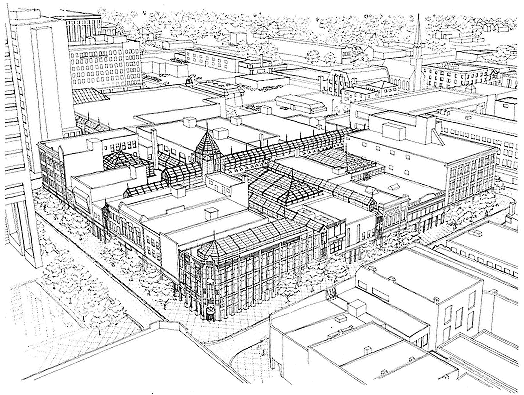
110.
The Courtyards Development, Fort Wayne, Indiana. Eric R. Kuhne and Associates, 1985.
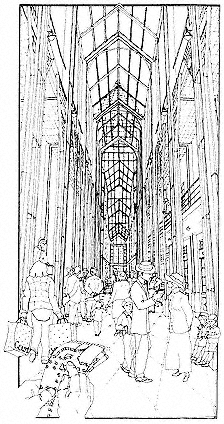
111.
The Courtyards Development, Fort Wayne.
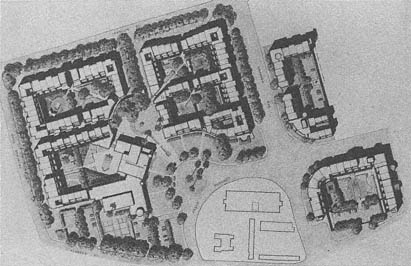
112.
A housing precinct: La Entrada housing master plan, Tucson, Arizona,
ELS / Elbasani and Logan, architects.
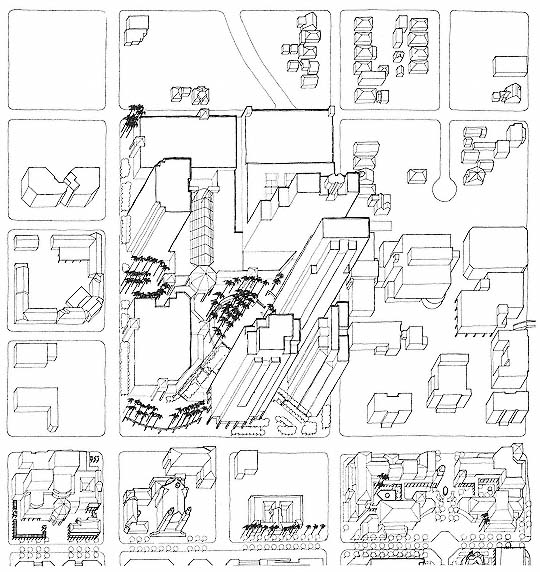
113.
Superblock proposal for downtown Phoenix, Gruen Associates, architects.
Called superblocks, these urban elements parallel strongly Le Corbusier's notion, seen at Chandigarh in India, of pedestrian-oriented precincts within a network of roads and avenues. But in American usage they are not the underlying planning schema but are incidental, a way of drawing together or crystallizing particular areas of a city. The occasional overlaying of a larger mesh upon the grid creates welcome and often unexpected complexity within the otherwise rational and predictable urban pattern.