
Acknowledgments
The company of good people is the treasury of all virtues.
I salute them with affection, and with words.
1.2.4
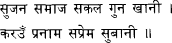
The poet Tulsidas wisely commenced his epic with a lengthy passage that has come to be known as the "obeisance to all beings" (samasti[*] vandana )—an effective way of discharging the burden of gratitude every author feels. If the truth be told, I feel scarcely less comprehensive a debt, but I will refrain from invoking planets, rivers, and mountains (although they helped too—especially the Ganga and the Himalayas) and will simply cite some of the many friends and teachers whose assistance was invaluable in the research and writing of this book.
At the University of Chicago, Colin Masica first introduced me to the pleasures of the Ramcaritmanas ; Kali C. Bahl guided me in my initial reading and recitation and also first suggested a research project on the epic's contemporary performance. Both served as readers of my first draft, together with Wendy Doniger O'Flaherty and A. K. Ramanujan, who likewise contributed much insight, encouragement, and humor. Among many others at Chicago who deserve thanks, I must single out Edward Dimock (a teacher and friend for more than fifteen years), Susanne and Lloyd Rudolph (mentors and good neighbors in India), Joan Erdman and David Gitomer (each of. whom helped me sort out troublesome passages), Maureen Patterson, and C. M. Naim. Thanks too are due to administrators Katherine Mosely and Shirley Payne. I owe a special debt to Mircea Eliade, an undergraduate mentor and a lasting example of humane and meaningful scholarship.
My study of Hindi was supported by fellowships from the United States Department of Education and the American Institute of Indian Studies; I would like to thank, at the Delhi office of the latter institution, Pradeep Mehendiratta and his staff, and my Hindi instructor, Santwana Nigam. The field research for this project was made possible by a Fulbright-Hays Fellowship; special thanks for assistance are due to Alice Brookner at Chicago and Sharada Nayak and her staff in New Delhi. In Banaras I owe gratitude to Dr. Tribhuvan Singh, my academic adviser in the Hindi Department at Banaras Hindu University; the Mankhand family, who cared for me through my first Ramlila ; and the staff of the A.I.I.S. Center for Art and Archaeology, especially Mr. V. R. Nambiar and his hospitable family; also to Dr. Virbhadra Mishra of the Sankat Mochan Foundation, and Virendra Singh and his family. In Mussoorie I owe thanks to Bill Jones and Hugh Bradby of the Woodstock School, and to Chitranjan Datt and the staff of the Landour Language School. Others in India who offered special help and inspiration were the families of Keki Desai and Kusum Singh in Delhi, Padma Srinivasan in Bombay, and Eruch Jessawalla, Mani Sheriar Irani, and other friends in Ahmadnagar, Maharashtra.
Profound thanks must be offered to the numerous Ramcaritmanas reciters, singers, expounders, and devotees in Banaras, Ayodhya, Chitrakut, and elsewhere who shared with me their knowledge and experience of their beloved epic; many of them are cited in the pages that follow. Here I would single out the special assistance given by Shrinath Mishra of Banaras; Baba Narayankant Tripathi and Ramnarayan Shukla of the Sankat Mochan temple; Ramkumar Das and Sacchidanand Das of Mani Parvat, Ayodhya; and Ramkinkar Upadhyay. Dr. Bhanuprasad Mehta gave timely help at the Chitrakut Bharat Milap, and Dr. Bhagavati Prasad Singh, retired head of the Hindi Department at Gorakhpur University, generously shared his extensive knowledge of the Ram bhakti tradition. Ramji Pandey, the chief Ramayani of the Ramnagar Ramlila , was my guide and amiable companion there and on pilgrimages to Ayodhya, Prayag, and Chitrakut. Also in Ramnagar I owe special thanks to the maharaja of Banaras, Vibhuti Narayan Singh; Giorgio Bonazzoli of the Kashiraj Trust, and in the tiny shop at the corner of the fort—the jovial vendor of the city's best tea, who opened his home to me on coronation night. Back in Shiva's city I salute my special guide in field research—and one to whom its evolution owes much—Chandradharprasad Narayan Singh, an inspiring example of connoisseurship mingled with devotion. To all such true rasiks of the epic, this work is especially offered.
The writing of the dissertation that formed the basis for this book was supported by a fellowship from the Committee on Southern Asian Studies at the University of Chicago. Apart from the members of my dissertation committee, three patient readers offered special assistance and encouragement: John Stratton Hawley, Linda Hess, and Frances Pritchett. Linda Hess and Richard Schechner generously shared with me their rich knowledge and experience of the Ramnagar Ramlila . Nita Kumar and Scott Marcus offered assistance on specific aspects of Banarsi culture; I also benefited from the insights and encouragement of Thomas Coburn, Sandria Freitag, William Graham, and H. Daniel Smith. I owe much, too, to my colleagues at the University of Iowa—especially Sheldon Pollock, Paul Greenough, Maureen Robertson, and Thomas Rohlich. Thanks are also due to Todd Papke of the Weeg Computer Center for technical assistance in the production of the manuscript. Lynne Withey and Betsey Scheiner of the University of California Press merit special thanks, both for their encouragement and for their editorial labors in bringing this text to life. I would add that the warm friendship of many whom I have cited here has meant as much to me as their substantial contributions to my research.
Finally, I must thank those whose tangible and emotional contributions have been even more sustained: my parents on both sides of the family, Gary and Helen Lutgendorf and Mike and Dorothy Donner, and my wife and daughters, Susan, Mira, and Claire. Susan Kerri Lutgendorf (at various times) enjoyed and endured the long adventure of my language study and field research, which included listening to me recite the Ramcaritmanas at odd hours and nursing me through a tedious illness in what we sometimes called the "City of Blight"—all the while helping to raise two children and postponing her own important work in counseling and healing. Her companionship has been vital to my research and to my life.