
The Red Army Studio
The Theatrical-Dramaturgical Studio of the Red Army, or Red Army Studio, as the PUR group was called, was awarded the status of a special military unit.[72] Though just about all the soldier-pupils were amateurs—such was the selection by design—the instructors were professionals. From the Mobile-Popular Theater came Golovinskaia, Lebedev, Shimanovsky, and I. M. Charov; Shklovsky would later join the staff; Meyerhold, Vinogradov's old teacher at Kurmatsep (Master Courses in Scenic Productions), was prevailed on to help; Meyerhold's disciples Nikolai Shcherbakov, Soloviev, and Radlov joined in; N. N. Bakhtin, Meyerhold's collaborator at the Instructor's Courses for Children's Theater and Festivals, also assisted.
Long before the Revolution, even before the intelligentsia interested itself in the popular theater in the 1880s, the army had served to acquaint simple Russians with theater. Soldiers had their own special repertory: melodramas and the like, such as Kedril the Glutton and Filatka and Miroshka's Rivalry, which Dostoevsky noticed before anyone even suspected that Russian popular theater existed.[73] Most popular with the soldiers were dramatic games (igrishcha ), particularly Boat (Lodka ).[74] As opposed to the ritual dramas common in folk culture, Boat, which survived in cities up to the Revolution, was a bare skeleton onto which action was attached and improvised. The game was given a dramatic framework by "Down the Mother Volga" ("Vniz po matushke po Volge"—the song adapted by Kronstadt sailors as they sailed into revolutionary Petrograd), which was sung as accompaniment and narration.
Festival theater was born on the borders of drama, ritual, and play. If Gaideburov's own Masses mated drama and ritual, Vinogradov followed another example, that of his other mentor, Meyerhold, and trod the border of drama and play. Boat was an excellent model, with its origins in mimetic play; there was no stage, no props, and few costumes. Performance began with players arranging themselves as if in a boat, one player taking a position at the helm and singing "Down the Mother Volga," the others clapping hands in a rowing rhythm. It ended
the same way. The song provided a frame onto which episodes from the lore of the great Russian brigands—Ermak, Razin, and brethren—were attached.
Boat was less a drama than a cycle of episodes joined by a common theme and characters. Its time was the time of popular culture, a loose structure of stops and starts, which can expand and contract to accommodate new episodes. Like commedia dell'arte, Boat was improvised from a pool of traditional spoken lines and actions; and even more than in the commedia, connections between episodes could be loose. Yet Boat shared the ability of popular culture to take these disparate elements and unify them. Action within episodes was continuous. Perhaps most important to their new function within Soviet culture, dramatic games traditionally alternated tragic and comic scenes.[75]
The Red Army Studio's first production, performed March 12, 1919, was an igrishche on the topic of the February Revolution, The Overthrow of the Autocracy .[76] The first mass spectacle of Bolshevik Petrograd thus celebrated the February Revolution the Bolsheviks had overturned. The performance was a game in all senses of the word; it was play at revolution, a make-believe revolt by soldiers who had participated in the real one.[77] The performance, which would eventually be repeated 250 times,[78] was based on the Skarskaia method of improvisation. Most of the actors had taken part in some of the events and needed little directorial prompting. This, however, is not to suggest that improvisation engendered a deep, "elemental" understanding of historical events; nor should it suggest that the acting was necessarily spontaneous, direct, natural. Game playing has its conventions: the actors split off into two teams and, like little boys playing at war, depicted the historical conflict through a series of skirmishes and battles. Yet the play was about a bloodless revolution!
Vinogradov claimed that the oppressed masses of The Overthrow of the Autocracy were equivalent to the chorus of ancient tragedy and, because the ideals of the Russian Revolution were superior to those of slave-owning Athens, that the production was superior to the dramas of Aeschylus.[79] This analysis was perhaps overstated; but it would be unwise to ignore the production's artistic ambitions. Vinogradov's claim suggests a dilemma running through the Red Army Studio's history: Was it to be a popular undertaking, as the military theater traditionally had been, or was it to fulfill the great artistic ambitions suggested by symbolist theory?
The play did provide solutions to problems first pointed out by mod-
ernists. The division between stage and spectator, so porous in popular performance, was breached by the studio; this had also been an aim of symbolists. Popular culture's free combination of episodes was subjected to dramatic discipline; yet the structuring elements of the performance were taken from popular culture. Perhaps the similarities to simplified symbolist realism were apparent and desirable to Vinogradov; but the simplicity came from the exigencies of working with soldiers.
Whatever the cause, benefits were forthcoming. No decorations were used for the performance; real space was freely redefined by the action. As in melodrama, characters were divided into rebels and oppressors, good guys and bad guys. The stage itself was broken up into two platforms, each at one end of the Steel Hall of the People's House, where the play was performed. Linking the two stages was a broad aisle that passed through the audience.[80] The game principle, which split the characters into two "teams," had accordingly split the stage into two platforms; individual scenes were performed on the platforms; battles were conducted in the aisle. The aura of authenticity that brought spectators so close to the stage was intensified by the placement of actors in the audience. There were no costumes; dressed in army greatcoats, they were indistinguishable from the audience, and when they stood to deliver their lines, it seemed to spectators that one of their own was sharing a spontaneous reaction. Nevertheless, it was not the popular audience but the great artist Meyerhold who recognized what his pupil Vinogradov was looking for; when a young soldier, killed on the barricades, was borne down the aisle to "You Fell Victim," a song of revolutionary mourning, Meyerhold took the soldier's rifle from the ground and leapt to join the procession.[81] This was a sliianie, the merging of stage and audience the symbolist avant-garde had awaited.
The Overthrow of the Autocracy resembled a popular game, but it was supervised by professional directors. Their influence was visible in the formation of a unified play from discrete segments of improvisation. Episodes were not chosen at random, and neither was their order. The play comprised eight episodes chosen from the downfall of the Romanov dynasty: a prologue about the riots of 1905 was followed by the arrest of underground students, a revolt in a military prison, the seizure of the arsenal by workers, the sacking of Police Headquarters, the erection of barricades on the streets, the revolution at the front, and the tsar's renunciation of the throne (later observers would find the absence of the Bolsheviks unfortunate). The episodes were strung together in chronological order, with the dual platform providing a spatial model
for temporal progression. One stage accommodated the primary action, with mass scenes of the proletarian struggle for freedom; on the other was the counteraction, the reaction of the conservative camp. Later observers were correct in asserting that the split stage, free definition of space, and other features of Overthrow, which arose naturally from its game-playing nature, laid the foundation for future mass dramas.[82]
After several performances, young studio members found themselves praised to the stars by Gorky, Chaliapin, Iurev, and others. This was heady inspiration, and for May Day another spectacle, The Third International, was developed.[83] Like Overthrow, Third International was an improvised igrishche . The stage was the same, except for a symbolic globe placed center-stage—a prop borrowed from Mystery-Bouffe . One thing was new about Third International; it was played outdoors, in front of the People's House. The mobile stage used in both the studio's works made outdoor performance fairly easy; any place could be made to fit the play.
As in Overthrow, improvisation in Third International tended to degenerate into simple fighting, to the point that the play was not dissimilar from its predecessor. In fact, most revolutions depicted in subsequent mass spectacles would look similar, which had unanticipated political consequences. In the case of Third International, the conventions inherited from Overthrow distorted the historical picture. Fighting, which made up the bulk of action, had little to do with the Third International, founded only two months before in a conference hall; and the production's thousand participants far outnumbered the International's roster. Art predicts life, as Vinogradov might have answered.
Play-based Overthrow worked with a historical reality familiar to players and spectators alike. The basic episodes were taken from this reality; and if improvisation departed from historical facts, its creative license revived the emotional experience of revolution more vividly than an accurate re-creation could have. Third International did not satisfy itself with mimetic play based on a simple, concrete experience; it aimed toward symbolic, universal truths, as the globe in the middle of the stage signaled to spectators. The stage was not just a stage but the world beyond; people were not just people but allegorical types. Mayakovsky had done the same to wrestling in his World Championship .
The Red Army Studio, despite Meyerhold's tutelage, was just not up to these additional requirements. There had been no characters in Overthrow, just masses. Characterization demanded greater continuity between scenes, a stronger focus on montage and its meaning, and, alas,
greater acting skills. It demanded, in general, more art, less play. When studio actors began to portray characters and work from a text in International, it quickly became apparent that they were poor actors. The sharp division of characters into comic and heroic, pioneered by Meyerhold in Mystery-Bouffe, did not work for the studio; there was no one skilled in comic acting, which was much more difficult than Mgebrov-style heroic declamation. A need for professionals was becoming apparent.
The Red Army players had run up against what was becoming a familiar problem: play-based culture bore the burden of meaning poorly. Meaning-bearing structures were often a hindrance to play. When their ambitions shifted, those who devised the simple but fresh performances praised by critics began to fancy themselves the creators of a "new proletarian art," and their work evolved toward allegoric ritualism. It happened in the circus; it would happen in Proletkults all over the country; and it happened in the studio.
The next development was a tragedy—perhaps more a baroque allegory—written by Vinogradov and intended for performance by the studio, The Russian Prometheus (1919).[84] Picking a common theme (both Scriabin and Ivanov had written deistva of that name), Vinogradov wrote on the conflict between Peter the Great and Crown Prince Aleksei. The central figures (along with Peter and Aleksei) were two choruses: a tragic chorus of raskol'niki (members of religious sects) and the comic chorus of Peter's Most Drunken Council of Fools and Jesters, led by the jester Balakirev. Tragedy, according to Vinogradov, was the conflict and synthesis of equal and opposing principles.[85] The conflict led to the deaths of both Aleksei and Peter and, in the finale, Peter's ascent to heaven on a bank of clouds (perhaps Alekseev-Iakovlev could have provided the special effects).
The play was never performed,[86] and it would not merit attention but for the strong praise of some very talented contemporaries: Aleksei Remizov and Blok.[87] Lunacharsky took a more sober view: he noted that, yes, it did in many respects correspond to the theater of the future, but he also noted the strong and perhaps unintentional influence of decadent symbolism.[88] Lunacharsky's subtle criticism did nothing to discourage Vinogradov, who next wrote a deistvo entitled The Creation of the World .[89]
Graduates of Vinogradov's studio were sent to all parts of the country by PUR, and reports of similar performances began cropping up in the press. The Overthrow of the Autocracy was performed in Arkhangelsk;[90] Third International found its way to Perm.[91] Students sent to Cossack
country organized topical political games, The Taking of Rostov and Novocherkassk and The Smashing of Kolchak, using the same dual stage and the same acting methods.[92]
One of Vinogradov's assistants, Shcheglov, left the Red Army Studio for a studio of his own at the Petrograd Proletkult. Shcheglov, who had directed the Red Army Studio on a trip to the front, lost no time in applying the lessons of Gaideburov and Vinogradov. On May Day 1919, in the Porokhovye factory district on the outskirts of town, he produced the first (and only) of Proletkult's mass spectacles, From the Power of Darkness to the Sunlight . As the title indicates, Shcheglov too was guilty of allegorical excesses. The production, an "outdoor agitational show," was assigned to the Proletkult studio by the Petrograd party leadership, which kept a close eye on its creation.[93] Shcheglov knew from his Red Army experience that uncontrolled improvisation could not be allowed; he took the writing upon himself. But because there was little dialogue, which would have been lost in the open air, most of the performance, including the gist of the plot, was conveyed by pantomime. Speech was mostly slogans, delivered either by a worker chorus or by individuals with megaphones.
In popular culture, a bad script can always be saved by a good spectacle; From the Power of Darkness was rescued by Alekseev-Iakovlev, in whose hands heavy-handed allegories became wondrous sights:
On a special platform, emaciated people smeared with soot spun flywheels and spoke sad words . . . taken from the proletarian poet Tarasov. . . . Occasionally a colossal figure in black with a whip in its hand would rise above the group, precisely in those moments when murmuring began and voices of protest were heard. The figure's first appearance was so unexpected, and its dimensions so huge, that the public oohed and aahed. Alekseev was truly a master of his trade. . . .
But then a red figure ran directly through the surprised crowd of spectators. . . . It stopped, raised its hand, and a red Roman Candle flared up above its head. Red "specters of communism" immediately appeared from all sides. Their appearance halted the wheels' movement: they were followed by exhausted people, but the "specters" ran past and underneath a broad old tree, in the branches of which appeared an "agitator." He read Tarasov's poem, and the workers answered from the stage: "We are here, we are ready! Battle approaches, and smoke spreads through the valley."
Hands raised hammers high to break the cursed chains; a woman with a child on her breast raced toward the "red tree" [mahogany]. But suddenly something hissed and exploded in her path, and clouds of smoke began to spread. However, this barrier could not impede the laboring masses. Raising high their hands bound in chains, the workers left the tribune for a place that
augured freedom. But suddenly from all around there appeared the "shades of evil," huge figures in black. They cracked their whips, and the orchestra began to play music from a long forgotten adaptation of Gogol's Terrible Vengeance that Alekseev had once staged in the People's House.
Bowed and tamed, the workers retreated without casting away their age-old chains. And again the wheel began to turn with its sickening screech. The woman with the child returned to the action. Climbing the steps she read:
They laid there in the corner,
In the dirt of the stinking police station,
The blood thick like paint,
A puddle congealed on the floor.
My friends! The enemy won't yield,
He will buy the sacred rights of an uplifted nation
At the price of new victims, a cruel price.
Having finished her reading, the woman ripped the black shawl from her head. Underneath was a bright red one. Others began to repeat her words, and the gray-black light on the platform where the wheel spun quickly turned red. The workers again set to breaking the chains, but, the moment the last chains were to be cast from a girl in a white dress and broad red ribbon, the forces of darkness reappeared. To the pounding of kettledrums a symbolic battle began. . . . Figures in tunics tumbled down to the enthusiastic cries of surprised spectators, and the performers themselves in their excitement forgot that the "evil forces" were only young men from the factory, standing on each others' shoulders and holding up yard-tall poles with capes and heads in top hats and "stupendous" yellow teeth bared for effect. Boys from the crowd threw themselves with exalted howls and whistles into the "battle with evil"—that is, they went to knock the giants over. The spectators applauded, . . . but suddenly everything fell quiet. One of the "forces of the past" that had managed to save itself stole up to the girl on stage who had not yet managed to free herself entirely from her chains. A duel between the girl and the enormous figure began: the girl waved a red cape; the black figure cracked its whip, all the while getting smaller and smaller. The liberated workers approached them from behind and, crushing the last "knight of darkness," took his remains to another platform, where they hoisted the head and cape and set them on fire. First there were hissing clouds of smoke—"the stench of the past"—the head caught fire and burned long and bright, throwing out multicolored sparks. From all the trees where the "red specters" had clustered bengal lights burned, and the workers again stepped onto their old platform, where the machine wheel turned out to be decorated with ribbons and flowers. The whole thing ended with a collective reading of Glory to Labor .[94]
From the Power of Darkness pleased the authorities, and in November Shcheglov was invited to produce another spectacle, From Darkness to Light, in the city center. The second spectacle could scarcely be distinguished from the first.
Late in 1919 leadership changes in the Red Army Studio sparked changes in the plot of Overthrow . A young poet, scholar, and playwright, Piotrovsky, an enthusiast of the Revolution and follower of Ivanov, took charge.[95] Piotrovsky quickly spotted a major deficiency: although the play concerned historical change, little sense of history was conveyed. Perhaps more damning was that the play, which celebrated the Revolution, failed to include the Bolsheviks. If dramatic games like Overthrow, which featured continuous action and uniform episodes, were to portray the sweep of history and the Bolsheviks' sense of historical mission, changes were necessary, but not along the lines of Vinogradov's later plays. Recognizing that the Bolsheviks' mission was manifest not in events but in the progression of events, Piotrovsky portrayed the Revolution as a process beginning in February and culminating in October. He added two episodes: a comic interlude about the Provisional Government and a heroic finale about the October Revolution. The whole thing was renamed Red Year .
The introduction of discontinuous episodes brought up the question of how they could be assembled into a whole. Piotrovsky took structures characteristic of popular drama and assigned them new functions, for which Mystery-Bouffe offered a ready model. The alternation of tragic and comic, which Mayakovsky had used for characterization, was used to stitch together episodes in Red Year . Space operated on a similar principle; in the final two scenes, Kerensky and Lenin face each other from the two stages, and the final conflict occurs in the corridor between. This principle of simple oppositions, spatial, temporal, political, and moral, would be a rule for most future mass spectacles.
Piotrovsky also introduced changes in the performance. The full-length Red Year was held together by concrete historical figures and fictional characters, who replaced the faceless masses of Overthrow . Such characterization required disciplined acting and costumes to make figures like Lenin and Kerensky identifiable, but it also changed an essential principle of Overthrow: actors were now separated from the audience. Improvisation also gave way to a scripted text, which fixed the proper message but suppressed the playlike character of Overthrow . Improvisation had been intended to release the soldiers' creative instincts, but true improvisation, like true play, is a risk. Improvisation had been to a large extent desirable in Overthrow, which was an emotional experience of the tension and uncertainty of revolutionary days, when the future was unknown. From a strictly Bolshevik point of view, though, history was not uncertain. The October Revolution was an inevitable
conclusion to the events of 1917 and, for that matter, to a century of history. This was in fact the Bolsheviks' greatest claim to legitimacy, particularly in opposition to the claims of other leftist parties.
The changes were regrettable but perhaps inevitable if the play was to fulfill the edifying function that its sponsors intended. Much the same was happening at Proletkult. Shcheglov, like Piotrovsky, attempted to discipline improvisation in his next production, Popular Movements in Russia .[96] Although improvisation was not entirely discouraged, the creative process was subordinated to the director's will. For the first time, soldiers were portraying events unfamiliar to them; they had to study events, not relive them emotionally.[97] Themes were chosen by the director. Improvisation continued unhindered in rehearsal until it deviated from the plan, when it was halted and corrected. The final result of all rehearsals was then treated as a fixed text.[98]
The episodes, selected and assembled during rehearsals, presented a new concept of revolutionary history that would much later gain broad currency in Soviet Russia: the October Revolution as the culmination of national history, ignoring Western influence. Popular Movements was something of a misnomer: it tied together the Bolotnikov, Razin, and Pugachev peasant uprisings, the rebellion of the aristocratic Decembrists, the revolt of the tiny village of Bezdna (Bottomless Pit) in 1861, the 1905 revolution, and the Bolshevik seizure of Moscow in December 1917. As the last episode of a series, the Bolshevik takeover was the assumed heir of a great historical progression.
The limits of the popular style were reached by the Red Army Studio in February 1920, when The Sword of Peace was produced for the army's second anniversary.[99] The play was called a "variation" on The Overthrow of the Autocracy, but the resemblance was distant. To emphasize ties to the popular theater, it was performed in the Cinizelli Circus, yet Piotrovsky's text was written in the blank verse of high tragedy. Radlov directed the play and employed the dual-platform stage of Overthrow, but of course, with a text in blank verse, there could be no improvisation. The plot was built from the basic stages of the Red Army's history. The play opens with a soldier in a greatcoat and helmet, spotlighted center-stage, portraying Trotsky at Brest-Litovsk. Unrolling a long scroll (the treaty) he declaims:
Comrades! the workers and the peasants
Are neither murderers nor thieves! We don't need
A predatory war. We need peace. . . .
Red soldiers, you are the hope of peace!
You are the sword of peace. The future of the Commune
Is on your banners. In bloody splendor
The Red Star ascends above the world.
In truth, a new world has been born.[100]
To Berlioz's Symphonie fantastique a shower of red stars rains down from the big top, and the Red Army rushes into battle. Battle scenes, like those in Vinogradov's productions, ensued; but an interlude, in which Three Wise Men crossed the stage in search of the Red Star rising in the East, separated the battles into episodes.
The Revolution prompted shifts in the cultural hierarchy. Popular forms once consigned to the periphery of Russian culture moved to the center and were given new responsibilities. These responsibilities could be met only at the price of structural changes. The play element that had been the essence of popular culture could not always bear the messages thrust on it by the Revolution.
When popular theater began to serve official purposes, changes could be observed: the subordination of improvisation to directorial design; a shift of emphasis from episodes (most early amateur depictions of the Revolution were one-act plays) to the way in which episodes were strung together; and the loading of symbolic interpretations onto play-based actions. Individuals replaced mass characters and choruses; costumes were introduced to identify the new characters; acting became increasingly complex. These changes were an early example of a trend in Soviet Russia: popular performance, an autonomous branch of culture with values and a style of its own, was replaced by amateur performance, a secondary reflection of high culture.
Mass spectacles had caught the attention of Bolshevik leaders and had shown the potential to project a compelling view of the Revolution. Yet to realize their significance within the new culture, they would have to expand beyond the local audience. Greater organizational skills were needed; and if an audience unfamiliar with the actors and their locality was to be attracted, the full resources of the theatrical heritage would have to be exploited. There was only one option. Professionals would have to take control.
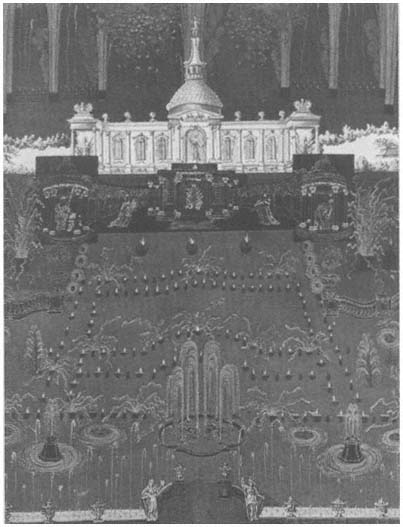
Plate 1.
Holiday fireworks display, Moscow, 1744 (A. F. Nekrylova,
Russkie narodnye gorodskie prazdniki, uveseleniaa i zrelischa:
Konets XVIII-nachalo XIX veka, Leningrad 1984).
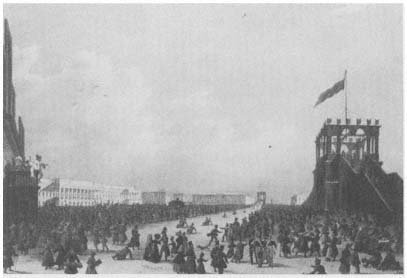
Plate 2.
Lithograph of the carnival on St. Petersburg's Field of Mars, 1825
(A. F. Nekrylova, Russkie narodnye gorodskie prazdniki, uveseleniia i zrelishcha:
Konets XVIII-nachalo XIX veka , Leningrad, 1984)
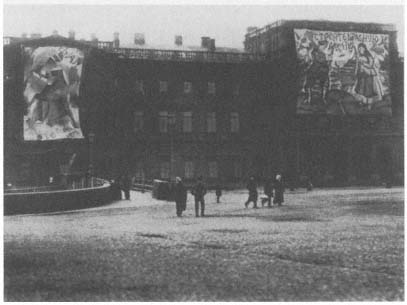
Plate 3.
Mariinsky Palace, Petrograd, November 7, 1918
(I. M. Bibikova and N. I. Levchenko, comps., Agitatsionno-massovoe iskusstvo:
Oformlenie prazdnestv , Moscow, 1984).
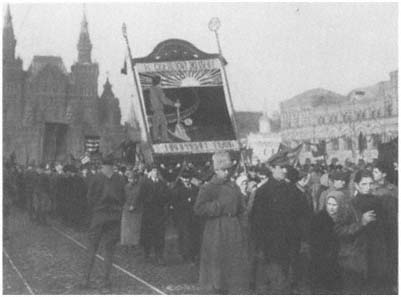
Plate 4.
Above : Demonstration in Red Square, November 7, 1918
(I. M. Bibikova and N. I. Levchenko, comps., Agitatsionno-massovoe iskusstvo:
Oformlenie prazdnestv , Moscow, 1984).
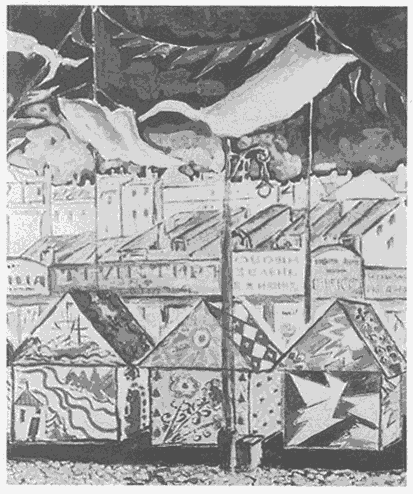
Plate 5.
Decoration of Hunters' Row, Moscow, November 1918
(I. M. Bibikova and N. I. Levchenko, comps., Agitatsionno-massovoe
iskusstvo: Oformlenie prazdnestv , Moscow, 1984).
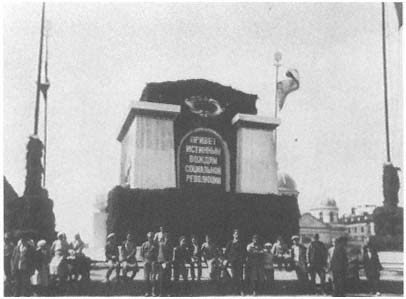
Plate 6.
Tribune covering Pavel Trubetskoi's equestrian statue, Uprising Square,
Petrograd, May Day 1919 (I. M. Bibikova and N. I. Levchenko, comps.,
Agitatsionno-massovoe iskusstvo: Oformlenie prazdnestv , Moscow, 1984).
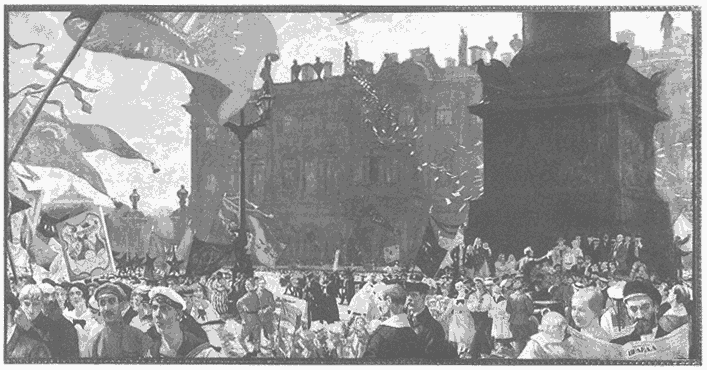
Plate 7.
Boris Kustodiev, Celebration for the Second Congress of the Third International ,
Petrograd, July 1920 (Mikhail German, ed., Serdtsem slushaia revoliutsiiu. Iskusstvo pervykh let oktiabria ,
Leningrad, 1980).
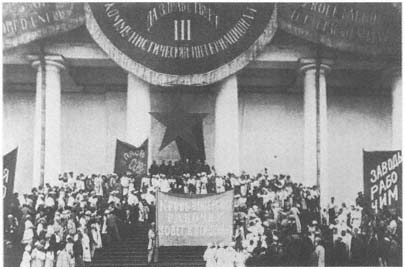
Plate 8.
Toward a World Commune , mass spectacle, Stock Exchange,
Petrograd, July 1920 (Mikhail German, ed., Serdtsem slushaia revoliutsiiu .
Iskusstvo pervykh let oktiabria , Leningrad, 1980).
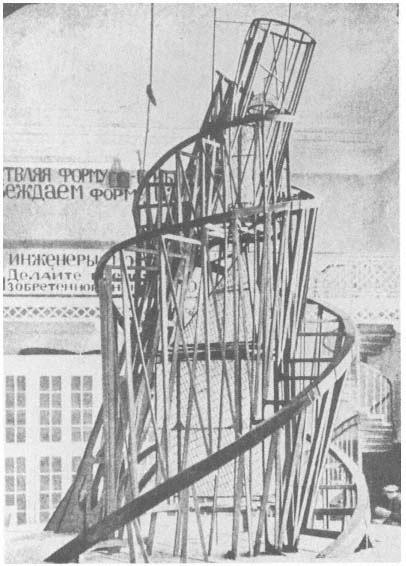
Plate 9.
Vladimir Tatlin, Monument to the Third International , Petrograd, 1920
(Camilla Gray-Prokofieva, The Russian Experiment in Art, 1863–1922, London, 1971).
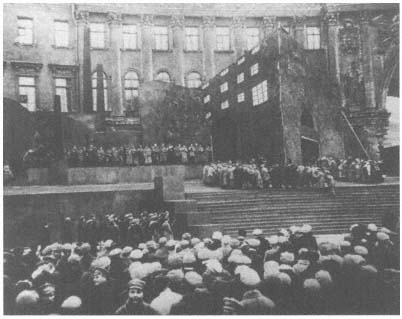
Plate 10.
The Red stage, Storming of the Winter Palace , mass spectacle, Petrograd,
November 1920 (I. M. Bibikova and N. I. Levchenko, comps.,
Agitatsionno-massovoe iskusstvo: Oformlenie prazdnestv, Moscow, 1984).
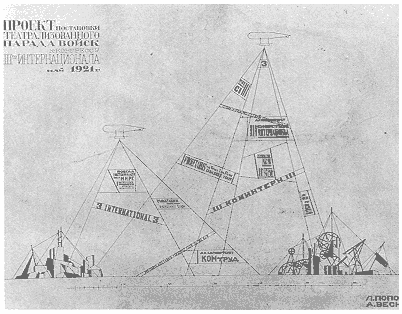
Plate 11.
Liubov Popov and Alexander Vesnin, design for a theatricalized mass maneuver
in honor of the Third International, Moscow, 1921 (Angelica Rudenstine, ed.,
Russian Avant-Garde Art: The George Costakis Collection , New York, 1981).