
Chapter One—
Production and Reproduction in Sub-Saharan Africa:
An Overview of Organizing Principles
Ron Lesthaeghe
Introduction
As the survival of any society hinges on (1) the technological adaptation to a given environment, (2) the demographic balance between births, deaths, and migration streams, and (3) the economic principles governing production and distribution, it is proper that this book on the various reproductive regimes of sub-Saharan Africa begins with the links between "production and reproduction." This is a classic starting point: Thomas Malthus integrated population dynamics into the context of the moral economies of peasant societies 200 years ago. His notions of preventive and positive checks still seem to have maintained their relevance, and although most of his applications dealt with the Western European system of the eighteenth century, it is by now evident that all populations, from the hunter-gatherer stage onwards, have generated arrangements through which the reproductive process is regulated. Moreover, these arrangements reflect the basic institutional setup that governs the functioning of the social system as a whole.
The links between the organizing principles of a society and the specific features of its reproductive regime, that is, the parameters of the starting, spacing, and stopping patterns of fertility, are not only of importance for gaining insights into demographic variations at a particular point in time, but they are of even greater value for the understanding of the various paths followed in the course of social change. More specifically, as changes in the spheres of political organization, division of labor, social stratification, economic exchange, cultural differentiation, and demographic regulation are not likely to proceed in a synchronized fashion, a clearer view of the relations between "production and reproduction" is essential to understand individual and group strategies, or, as McNicoll specified (1978, p. 89): "to
locate emerging contradictions and to assess possibilities for their resolution."
This institutional approach to reproductive regimes calls for a comparative methodology. The classic multivariate statistical techniques will continue to occupy an important place, but in the institutional approach the accent shifts from the treatment of strictly individual-level data to a multilevel approach. For instance, it does not suffice to introduce the attribute "ethnic group" into a regression equation with individual-level characteristics such as schooling level or age at marriage. For one, ethnicity stands for organizational and cultural traits of a collectivity, and these traits require further specification. One way of clarifying the situation is to study the relationships between individual-level variables separately for each ethnic context, comparing the outcomes across such contexts. For instance, the impact of a rise in female education (a microvariable) on the length of postpartum abstinence may vary across ethnic groups or regions. This variation may then be explained in terms of characteristics measured for the group as a whole, such as religious composition (a macro- or contextual variable). This approach is not free from problems.
First, as just indicated, the meaning of any broad contextual variable such as ethnic group, region, language . . . , requires specification in terms of more precise and explicit cultural and organizational dimensions such as the type of religion, level of technology, pattern of division of labor, structure of the domestic group, form of wealth concentration or circulation, authority structure, and so forth. At this point choices with respect to the presumed importance of each of these underlying features cannot be avoided. Such choices are of necessity reductionist or subjective in nature, not only because of the merging of complex organizational forms into a few manageable dimensions, but also because of the subsumed causal ordering projected by any author onto the network of cultural and organizational features.
Second, the statistical tools and models used in measuring associations and effects require slight adaptations to fit multilevel theory, that is, theory operating on the levels of both individuals and aggregates. As a consequence, we shall adopt the basic design of "contextual analysis" by establishing the separate impact of individual-level variables (holding the context constant), of aggregate-level variables (fixing individual variable values), and, above all, of interactions between these two. These interaction terms most frequently address the question of how the relationships between individual-level variables vary in shape and strength across the various contexts. In the statistical parlance of multiple regression, for instance, the question is whether slopes and intercepts characterizing the relations between individual-level variables are themselves a function of characteristics of contexts (see Boyd and Iversen, 1979). This obviously leads into a question of comparative sociology: why are individual level elasticities differentiated with respect to contexts?
From this outline, it is clear that we cannot restrict ourselves to the variables measured in the recent round of African fertility surveys, but that additional source materials have to be integrated as well. In order not to lose the advantage of subsequent statistical testing, such qualitative materials have to be operationalized, but this involves approximation and some loss of validity. More specifically for this chapter, we shall attempt to re-express ethnicity as a few basic organizational dimensions on the basis of anthropological monographs and G. P. Murdock's (1967) classification of societies according to a set of organizational characteristics. Additional survey information on variables, such as female involvement in commerce, or on the shift from animism to Islam or Christianity, will also be of use. In short, in the next sections a choice of organizational dimensions believed to be both at the core of a society's functioning and relevant for its reproductive regime will be made. This leads into the construction of an operational typology useful for further work.
General Connections between Social Organization and Reproductive Regimes of Sub-Saharan Africa
As the preventive checks of reproductive regimes are located at the level of "intermediate fertility variables," it is essential to understand why some societies rely predominantly on controls on the starting pattern of fertility (postponement of first sexual unions, celibacy), while others locate them within the spacing or stopping patterns (such as, through long postpartum nonsusceptible periods, reduced remarriage, or early "terminal" abstinence). An exploration of such differentiation leads us to a study of patterns of kinship organization and to an examination of systems of production and control over resources. At this point, various links can be made between aspects of "production" and features of "reproduction."
Several attempts have been made (1) to establish a list of variables through which the connections operate and (2) to measure the strength of the associations. In this respect, the Murdock Ethnographic Atlas (1967), which gives a relatively detailed coding of many organizational variables in over 800 societies, has often been used. The comparisons drawn from the Murdock atlas are highly illuminating for understanding the basics of African reproductive regimes, especially if contrasted to those of Eurasia. A brief account of the findings at a general level is offered here.
At the "production" end of the spectrum, all authors start from the means of subsistence and the degree of sophistication of agricultural technology in particular. The contrast is made between slash-and-burn forms of extensive agriculture, supportive only of low population densities, and intensive agriculture using the plough instead of the hoe as well as manuring and/or irrigation. Yet, already at this point, authors differ on whether to stress environmental factors such as nutrition and health or social organization factors such as landholding systems. Taken separately, these explanatory frame-
works may give the impression of edging on monocausality, but their joint consideration provides the required set of core institutional and cultural variables.
The earliest explanations accounting for a crucial element of African reproductive regimes, namely the marked pattern of child-spacing, were essentially "environmentalist" in nature: child-spacing through prolonged lactation and postpartum abstinence was essentially seen as a cultural adaptation to environmental and technological constraints. As many African societies practice swidden agriculture, producing mainly tubers such as yams and cassava, and consume very limited amounts of dairy products, protein insufficiency is a major problem. Consequently, prolonged lactation is of paramount importance to curb infant and childhood mortality. In addition to the concern about child survival, the health of women, who constitute both the productive and reproductive capital of kinship groups, requires protection against exhaustion by rapid procreation. The implication of this environmental theory is then that the duration of the postpartum taboo on sexual intercourse during the lactation period is a function of the society's protein intake. At present, the duration of the taboo varies from 40 days to over 2 years. The theory furthermore expects a major split to emerge between societies with or without access to dairy products, between farmers and cattle raisers, or between the forest belt and the savannah.
The environmental theory was most popular in the period prior to World War II: when questioning Africans about the postpartum taboo, missionaries and medical personnel were obviously getting the classic answer that "semen poisons the mother's milk and causes illness to the suckling child." Virtually all African populations, including cattle keepers, explicitly recognize the health function of the taboo in these or similar terms.
The link between prolonged lactation or long postpartum abstinence and polygyny was also firmly recognized: polygyny facilitates abstinence for lactating women without causing sexual deprivation to polygynous men. It was therefore treated as a form of structural adaptation to an environmental constraint. Revealing in this context is the attitude of colonial authorities when faced with these practices. The example taken here is that of the Ryckmans Commission of 1930 which provided a blueprint for the Belgian colonial policy in the Congo. Constituted by lawyers, missionaries, agronomists, and medical doctors, the blueprint clearly intended to model the African family on the European one and based on Catholic principles. This meant in the first place that witchcraft and polygyny had to be eradicated. At this point, however, it was recognized that polygyny fulfilled a crucial function with respect to infant health via the postpartum taboo, and a more cautious plan was drafted: restrictions on polygyny needed to be accompanied by an improvement in infant diets, and plans were made for upgrading cattle farming in areas free of tse-tse flies with distribution of processed dairy produce over
the entire territory (Ryckmans Commission, 1930, quoted by Schoenmaeckers et al., 1981, p. 37).
A worldwide test of the nutritional/environmental theory has been provided on the basis of the Murdock Ethnographic Atlas by G. P. Murdock himself (1967) and by J. W. M. Whiting (1964). The latter provides the following text (1964, p. 521):
It seems then, that there is some evidence for a long causal chain leading from the rainy tropics to circumcision. Such a climate is conducive to the growing of low-protein roots and fruit crops. A diet based largely on such crops is assumed to lead to a high incidence of a protein deficiency called kwashiorkor. This in its turn, leads a mother to avoid getting pregnant while she is still lactating, since this might reduce the already low protein value of her milk below the danger point and might result in illness of the nursing child. The avoidance of pregnancy in these societies without an alternative means of contraception is generally accomplished by abstinence, which leads the husband to seek another wife, and hence to the acceptance of polygyny as a form of marriage. Finally, there is some indication that polygyny is more compatible with patrilocal than other forms of residence. Since both a long postpartum taboo and patrilocal residence have been shown to be associated with circumcision rites, a second reason for the tropical distribution of such rites is suggested.
Tables 1.1 and 1.2 provide the results of Murdock's test, involving 166 societies chosen in such a way as to cover a wide variety of societies evenly
| ||||||||||||||||||||||||||||||||||||||||||||||||||||||||||||||||||||||||||||||||||||||||||||||||||||||||||||||||||||||||
| ||||||||||||||||||||||||||||||||||||||||||||||||||||||||||||||||
distributed over the world. Although Murdock's coding of the length of the postpartum taboo is subject to discussion itself (see for instance R. Schoenmaeckers et al., 1981, pp. 27–32 for sub-Saharan Africa), the tables clearly provide support for the links between protein intake, length of postpartum abstinence, and incidence of polygyny. Yet, aside from the general pattern, the data in these two tables also describe a remarkable heterogeneity within each type of subsistence economy or form of marriage. Among nondairying food producers, which constitute the largest subgroup in Murdock's sample, there are nearly as many societies with a postpartum abstinence duration of less than 6 months as there are with a taboo of 2 years or more (twenty-three versus twenty-five). Hence, factors other than protein intake must bear some influence on the length of the taboo as well.
Very much the same holds with respect to Whiting's thesis that the long taboo is essentially a feature encountered among forest dwellers. The test performed by Schoenmaeckers et al. for 136 sub-Saharan societies showed clearly that there is no major savannah-forest contrast, but rather a contrast between West and Central versus East and Southern Africa (1981, pp. 32–39). Moreover, early anthropological references to Eastern and Southern populations or statements by older women in these societies often provide durations that are not markedly different from those represented in Western and Central Africa. This leads us to the alternative that the postpartum taboo used to be least one year in almost every region of sub-Saharan Africa, and that current variations are the result of some initial differences coupled to major differences in the pace of erosion of the taboo (Lesthaeghe, 1984, pp. 13–17). Although this proposition does not detract from the nutrition/ child health thesis—the statements of African women all over the continent concur on this point and the presumed near universality of the taboo underscores the importance of lactation—one is nevertheless forced to look beyond the strictly environmental explanation to account for the substantial variation in the practice as encountered in the period after World War II.
It is obviously not enough to detect a serious reason for the introduction of a particular practice or ingredient of the reproductive regime: there must also be a strong social support for its maintenance. Moreover, the concern over nutrition is by no means the sole reason for enhanced spacing and child-spacing is not the only distinctive feature of sub-Saharan reproductive regimes. Consequently, we shall explore the links between the organizing principles of sub-Saharan societies and a set of distinctive characteristics of the reproductive regime.
While on the topic of the postpartum taboo, some of the findings ofJ.-F. Saucier warrant reporting and discussion. Aside from the nutrition/wet tropics factor, the associations between the taboo and exclusive mother-child sleeping arrangements, initiation rites, kin avoidance, and sorcery had been discussed by authors such as Kluckhohn and Anthony (1958), Stephens (1962), and Young (1965) (quoted by Saucier), while Carr-Saunders had already pointed out the custom's demographic significance as early as 1922. Saucier, however, extended the hypotheses much further and proceeded with the statistical testing of twenty-three propositions using a worldwide sample of 172 societies from Murdock's files. The single best correlates of the taboo, as measured via the phi-coefficient, were the following:
1. Recruitment of women into marriage via bridewealth (or sister exchange): phi = 0.38.
2. Presence of extensive agriculture (slash-and-burn, hoe) rather than more sophisticated forms of intensive agriculture: phi = 0.36.
3. Customary polygyny: phi = 0.35.
4. A high degree of physical and psychological separation between the spouses: phi = 0.31.
The identification of the polygyny factor and of the predominance of swidden agriculture, often involving tuber cultivation, are perfectly in line with the nutrition theory. However, the two remaining factors in combination with those just mentioned point in the direction of a particular type of social organization. In Saucier's words (1972, p. 247):
Briefly, the long postpartum taboo is found most frequently in small, compact communities which subsist mainly on extensive agriculture (with a low level of nutrition) and which are structured in terms of a localized unilineal kinship group. The adult women, obtained from outside via bridewealth, live in polygynous households, often in separate quarters, and perform extensive food-producing and food-processing work under the supervision of men. The inheritance of property is unequal. Daily life is controlled by rigid rules such as elaborate etiquette, kin-avoidance and joking relationships, segregation of boys at puberty, etc. The transition from adolescence to maturity is frequently marked by bodily mutilations. Although religion recognizes a high god, it describes him as unconcerned about human affairs. This description of the type of
society most likely to have a long taboo suggests some kind of community gerontocracy [Saucier's italics]. Through the command of land and cattle, the elders control the acquisition of women, and through puberty rites they maintain power over the young men.
Taking gerontocratic control of community and kinship group as a point of departure rather than the nutrition/health factor reverses some of the earlier causalities. In the Whiting framework, polygyny is an adaptation to the prerequisite of prolonged lactation and abstinence for women by giving the men access to several partners, thereby solving at least the problem of male sexual deprivation. In Saucier's framework the logic of the system works the other way around: a gerontocracy implies appropriation and control over resources, that is, female labor and lineage land or cattle, to the detriment of younger men. The political and economic aspects of polygyny (for example, see Clignet's (1975) Many Wives, Many Power ) are the core of the issue, whereas postpartum abstinence for women is a resulting characteristic, which, from the demographic point of view, amounts to a major preventive check operating through reduced fertility. Approached from this angle, the abstinence component of child-spacing constitutes not only a health- and nutrition-related practice but it is also a direct consequence of a particular type of appropriation of female labor, in much the same way as the Western European late marriage pattern resulted from the concentration of wealth in a system dominated by nuclear families with neolocal residence and requiring independent means of subsistence prior to marriage (Dupâquier, 1972; J. Goody, 1976; Lesthaeghe, 1980).
The second factor encountered in Saucier's description is the relationship between the long postpartum taboo and unilineal kinship organization. Saucier provides no further specific explanation other than that bridewealth, polygyny, unilineal kinship organization, and localized kin groups belong to the same structural context (p. 243). Caldwell and Caldwell (1977) however specify that the postpartum taboo can be seen as a device that prevents "emotional nuclearization" between the spouses and therefore protects the primacy of the individuals' kinship identification. In other words, the allegiance of adults to their respective lineages is protected by the maintenance of a certain physical, social, and psychological distance between husband and wife. This arrangement is the opposite of the one encountered in Western Europe where husband and wife form a new economic entity on the basis of conjugality. Consequently, Caldwell considers the decline of the long postpartum taboo as an indication of the success of the Western conjugal model in sub-Saharan Africa.
Another factor revealed by Saucier's analysis of the Murdock files is the relationship between a long postpartum taboo and the control of daily life by rigid rules and rites. In this respect it is worth mentioning that the zone in
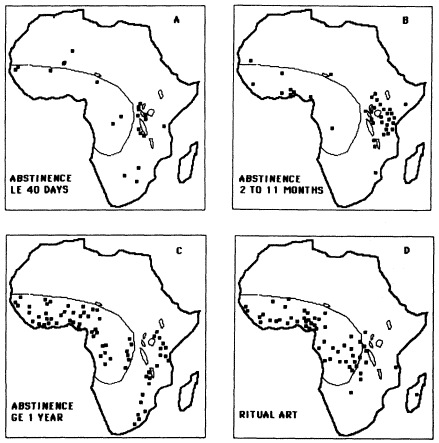
Figure 1.1.
Location of Ethnic Groups According to Duration of Postpartum Abstinence
as Stated in Ethnographic References; Comparison with Producion of Ritual Art
(Source: R. Schoenmaeckers et al., 1980)
which the abstinence feature is most intact, that is, Western and Central Africa, is also the area inhabited by populations who have produced the vast majority of African ritual art (masks, fetishes, as opposed to jewelry or weaponry). This particular finding is illustrated by figure 1.1. Panels A, B, and C of this figure contain the plots of 136 societies according to the length of the postpartum taboo, ranging from 40 days to 1 year or more. The data are those used by Schoenmaeckers et al. (1981, pp. 59–65) and stem from a scanning of the anthropological literature not included by Murdock. As a result, most of the references pertain to the situation in the 1950s, 1960s, or early 1970s. If we accept the hypothesis that the postpartum taboo of at least one year is likely to have been typical for the whole of sub-Saharan Africa,
then the maps must exhibit the progress of an erosion process. The greatest resistance to a reduction in abstinence durations is then found precisely in the zone that produced the ritual art (seen panel D). This underscores Saucier's finding that socialization and continued social control, both involving elaborate rituals (often based on fear), is essential in the maintenance of the moral code in general and of the postpartum taboo as a demographic preventive check in particular.
Gerontocratic control and its correlate, polygyny, not only lead to post-partum abstinence and child-spacing, but also account for specific characteristics of the use that is made of the overall reproductive age span. As already indicated, a gerontocracy restricts the rights of younger men who have to await their turn before being granted official access to the procreative and productive capacities of a women. Under conditions of balanced sex ratios, a high level of polygyny means that fewer (older) men exert a monopoly over nubile women. High polygyny ratios (number of married women per 100 married men) imply a large age difference between husbands and wives. The average age at first marriage is rasied for men and lowered for women. Hence, the mere mathematics of matching a small group of relatively old married men to a large group of married women of all ages contributes towards an early starting pattern of procreation in the sub-Saharan reproductive regime. This offsets, at least in part, the fertility-lowering effect of prolonged lactation and postpartum abstinence (Dorjahn, 1959).
The effects of polygyny do not end here. The large age gap between spouses has two further consequences. First, it reduces fecundity, or the monthly probability of conception, probably because of the joint effect of the following factors: the spread of sexual relations over several wives (sometimes regulated according to the periodicity of markets in West Africa), reduced male libido with age, and a similarly reduced semen count. Secondly, a portion of the overall exposure period for women is lost as large age differences between spouses lead to increased widowhood at any level of mortality. At low life expectancies widowhood can occur to women early in marriage and the amount of time lost for procreation could be substantial in the absence of remarriage. However, remarriage is common and the periods of widowhood are short. A marriage in the African context is not a contract between two individuals, but a definitive transfer of the rights in uxorem and in genetricem from one lineage or kinship group to another. There are substantial variations in the precise nature of rights that are transferred, but the deal between the two kinship groups often implies that a woman who is young enough to continue childbearing and/or to work in the fields will remain with the clan of the deceased husband. In this instance remarriage tends to take the form of widow-inheritance. Especially in East African patrilineal populations, the widow may even continue to bear children "for the deceased husband." Hence, remarriage for women in childbearing ages is generally very
common and the period of widowhood short. Widow-inheritance in particular and fast remarriage in general therefore keep to a minimum the potential loss of exposure produced by a central characteristic of polygyny, namely, the large age gaps between spouses. In other words, the system provides its own corrections.
Prior to World War II, however, such an autocorrective feature almost led to demographic self-destruction. This happened when the bacilli of venereal disease (principally gonorrhea) were brought to many parts of Africa. Sterile women were being divorced, but as their labor was still valued, they usually became higher-order wives in polygynous unions. Monogamous men rejecting a childless woman married a younger one, and it is very likely that at one point the extent of polygyny rose while the age at first marriage for women fell. Consequently the infection spread rapidly and at its height, childlessness in parts of Central Africa rose to an extraordinary 40 to 50 percent of women still without offspring after 10 years of exposure. Clearly, polygyny is perfectly devised to cope with noninfectious causes of sterility and it reacted quite reasonably according to its own logic, thereby, unfortunately, setting into motion a positive feedback loop between polygyny and the spread of infection.
So far we have established two basic facts and their raison d'être: the reproductive regime of most of sub-Saharan Africa has a major preventive check operating through marked child-spacing, but this operates within a system that makes nearly complete use of the entire reproductive age span. In Western Europe, the regime of natural fertility operated the other way round: the starting of procreation was considerably delayed, but once married, birth intervals of women were generally much shorter. This led Caldwell and Caldwell (1977) to the metaphor that the African populations have taken the period of celibacy typical for Western Europe, cut it up in pieces, and inserted these in each successive birth interval. When they operationalized the implications of their metaphor by summing up the number of person-years of abstinence/celibacy in the two regimes, they came up with comparable amounts. Analyses using more sophisticated accounting schemes and parametrizations of the intermediate fertility variables (such as, using the Bongaarts decomposition of the birth interval) have also documented these findings (for example, Lesthaeghe et al., 1981, pp. 9–13; Gaisie, 1981, pp. 237–252; Lesthaeghe, Page, and Adegbola, 1981, pp. 172–174; Mosley, Werner, and Becker, 1982, pp. 19–22; Hill, 1985, pp. 59–63; Locoh, 1984, pp. 103–114)
Compared to Asian populations, however, there seems to be much less of a difference in reproductive pattern: Asian populations frequently exhibit early ages at marriage for girls and often have marked child-spacing accomplished through lactation and in several instances (for example, Hindus, Javanese) also through postpartum abstinence. The demographic survey of
the Javanese village of Mojolama, for instance, produced a mean length of postpartum abstinence of 22 months (Singarimbun and Manning, 1976, pp. 175–176), which is definitely at the upper end of the distribution, even by African standards. Hence, the similarity of the Asian and African data on the starting and spacing patterns of reproduction clearly indicates how exceptional the Western European configuration was and implies that the exception was exported, together with Christianity, as if it were the global standard.
Yet, the Asian-African parallel does not go much beyond this point. This can probably be documented more fully by following the arguments of J. Goody (1976). The following list is at the core of Goody's theory of production and reproduction:
1. At the start, we find again the contrast between extensive agriculture based on the bush-fallow system, considerable land reserves, hoe cultivation, and a high input of female labor, versus more intensive forms of agriculture with more sophisticated technology and capital investment (plough, crop rotation, irrigation), fewer land reserves, and higher productivity. Up to this point, virtually all major theories still concur (such as Whiting, Murdock, Saucier, Boserup, Goody).
2. Grafted on this distinction is the contrast between a system where capital is circulated within a broader community or lineage on a relatively egalitarian basis and according to need, versus the system where relatively small factions or families have concentrated capital, and aim at consolidating their position, thereby institutionalizing class or caste inequality.
3. Directly related to this is the third distinction between systems with "diverging devolution" of property and systems without it. Goody's definition is as follows: "Under diverging devolution, the property which an individual disposes is not retained within the unilineal descent group of which he is a member, but is distributed to children of both sexes and hence diffused outside the clan or lineage" (1976, p. 7). Such diffusion or devolution of property can take the form of a dowry at marriage or it can occur through bilateral inheritance: in both instances capital is passed on to daughters and it leaves the family of origin. In a system of "homogeneous inheritance," by contrast, a man's property is transmitted solely to members of his own clan who belong to the same sex (a son, a brother's son in patrilineal societies, a sister's son, for instance, in matrilineal ones, or "male" property going to males and "female" property to females in African societies with duolateral descent). In societies where land is not inherited, since it was never appropriated by individuals but only temporarily granted to them by a corporate kinship group, there is obviously no diverging devolution.
4. In societies with appropriation and concentration of property com-
bined with bilateral inheritance systems or dowries, that is, with diverging devolution, there will be a marked tendency towards forms of "inmarriage," that is, endogamy (marriages among relatives), homogamy (marriages within the same social class or caste), and a preference for hypergamy (marriage to a partner of a higher social ranking). Such societies engage in marriage-politics along lines of class and caste and have a great preoccupation with locating suitable partners. As a result, prearranged child-marriages may occur. Even more important is the ban on premarital sex: uncontrolled alliances between the young could easily lead to a mismatch. In societies where there is no appropriation and concentration of property and/or no diverging devolution, there is much less preoccupation with partner selection along economic and social status lines, and hence much less fear of a mésalliance. Premarital sex is much more common and so are premarital births. In other words, marriage is not necessarily the point at which reproduction starts. Moreover, what counts for the child and for the lineage is the pater, and not so much the genitor, as long as the latter is not a lineage member (exogamy rule). With the exception of a tabooed (that is, incestuous) relationship, premarital and extramarital fertility may be encouraged in certain circumstances. If it is clear that a man cannot beget children, for instance, the rights in uxorem, which are not transferred solely to him, but also to his lineage upon the payment of bridewealth, can be taken up by a male relative of his or even an age mate in certain East African populations. The reason for this is that the payment of bridewealth also marks the transfer of rights in genetricem, and any offspring of a married woman, irrespective of who the genitor may be, is assumed to be her husband's and belongs therefore to his lineage in societies with unilineal descent. In West Africa the practice of "the sister's child" exists: here, a man without sons to continue the line and to perform the ancestral rites may choose an unmarried daughter to become pregnant and bear a son as a replacement of the male child he did not have. Such a "sister's child" may have an inferior social position, but the practice clearly shows that the continuation of the lineage may be of much greater importance than the picking of a socially or economically suitable partner.
In short, Goody's concentration on exogamy versus various forms of inmarriage, presence or lack of diverging devolution, and concentration of allodial property versus the circulation of land among lineage members according to need not only adds depth to some of Saucier's empirical findings (such as the strong relationship between the postpartum taboo and marriage via bridewealth rather than dowry), but explains why there is only a weak control on the starting pattern of reproduction and less preoccupation with children
being born in or outside wedlock in sub-Saharan Africa. Asian populations may therefore also have an early starting pattern of fertility, but such a pattern stems from entirely different sources, namely the preoccupation with caste or class in-marriage, whereas in Africa it stems from the combination of polygyny, exogamy, and the lack of the strong need to control sex among the unmarried for purposes of wealth concentration. Note again that this should not be interpreted in an absolute sense: there are very strong taboos on sex between unmarried relatives or lineage members in sub-Saharan Africa, but the aim of such controls is to maintain exogamy, that is, the circulation of women across lineages, which is just the opposite of control aimed at implementing "in-marriage." As a result, Eurasian levels and patterns of premarital and extramarital fertility and the melting together of pater and genitor contrast strikingly with African levels of "illegitimate" fertility and the traditional lack of interest in biological fatherhood.
Goody tested his propositions in very much the same way as Saucier did: he too used the Murdock files but incorporated the full 863 entries rather than a sample. Furthermore, Goody's theoretical starting point was more clearly defined. The construction of dichotomies is therefore directly meaningful to his theory, whereas Saucier's dichotomies give at times the impression of being constructed for exploration only. On the other hand, Goody has little to say about the postpartum abstinence rule and child-spacing in general. His theory accounts far more satisfactorily for characteristics of the starting pattern of procreation and for rules governing marriage and partner selection in general.
This strongly abbreviated account of Goody's theoretical foundations requires at least a brief reporting of his major empirical findings as deduced from the Murdock Ethnographic Atlas. Goody presents linkage and path analyses results (1976, pp. 35–40), but the reporting of the simple phi-coefficients are enough. These coefficients have been reproduced in table 1.3, together with the operationalization of the dichotomies involved. We have, furthermore, added the phi-coefficients belonging to the dichotomy "male versus female dominance in agriculture" in accordance with Goody's incorporation of Ester Boserup's theoretical chain, which leads from swidden agriculture into heavy female labor input and other sex role differentiation characteristics (Boserup, 1970). These female roles will be taken up in later sections.
As table 1.3 shows, the two series of phi-coefficients are remarkably similar. Note, however, as indicated by the data of table 1.4, that sub-Saharan African societies are overwhelmingly concentrated in the categories lacking diverging devolution of property and lacking predominance of male farming. For them, the phi-coefficients have to be read as implying a tendancy towards a lack of premarital sex prohibitions, a lack of advanced agriculture, and so forth.
| ||||||||||||||||||||||||||||||||||||||||||||||||||||||||||||||||||||||||||||||||||||||||||||||||
So far, we have only dealt with starting and spacing characteristics. Several elements of sub-Saharan social organization also create the possibility for an additional fertility check located near the end of the reproductive age span. If procreation has an early start and if little time is lost in widowhood or divorce, a sizable proportion of women become grandmothers from their midthirties onward. For these women the birth of a grandchild signals that a new generation is assuming the task of procreation. Moreover, if polygyny is widespread, polygynous husbands can more easily forgo sexual relations with an older wife. This combination of early starting and polygyny therefore creates the possibility of permanent abstinence associated with grandmaternal status. In several African societies—the exact incidence of the practice is unknown—an explicit grandmaternal restriction on procreation has been defined: it is improper for an older woman to compete with a daughter or daughter-in-law with respect to childbirth; a grandmother who continues childbirth regardless is oversexed and confuses social roles.
Early stopping is not occasioned solely by grandmaternal status but may occur as a mere result of polygyny or even because a woman with several surviving children refuses sex. Such a blunt refusal, however, presupposes a relatively high degree of economic independence from the husband or a domestic organization involving bargaining between the spouses. A priori, one would expect earlier stopping to be more widespread in Western Africa than in the rest of the continent. An additional reason for such a distribution is the fact that abstinence is more readily accepted in West Africa, as indicated by the regional distribution of the long postpartum taboo.
On the whole, little research has been done on the subject of the incidence of voluntary stopping in high fertility populations. The work by Caldwell, Caldwell, and Ware in Ibadan (Southwest Nigeria) is one of the few exceptions, and they established that postpartum abstinence among Yoruba women aged 35 and older was frequently extended into definitive abstinence, especially in polygynous households. The lead provided by the Ibadan study was not sufficiently taken up by the fertility surveys of the WFS round, except in Benin where questions on grandmaternal status were explicitly asked. As a result, our knowledge of the stopping pattern and its social or cultural correlates falls considerably short of what is known for elements of starting and spacing.
The conclusion for this section is that the basic organizing principles of sub-Saharan reproductive regimes clearly reflect influences of the environment, technology, and pattern of social organization. Yet the associations discovered so far cannot be considered as "monolithic": on a worldwide scale, the highest phi-coefficient between any two variables of the ecological, production, organizational, or reproductive checklist used so far does not exceed 0.42, even after optimalization of the cutting points used in establishing the contrasting dichotomies. Also, the analysis of a matrix of bivariate
associations may not be entirely adequate, since it leaves no room for interaction variables Z whose presence or absence strengthens or weakens the association between X and Y.
Caveats, Variations, and Additional Dimensions
Contrasting traditional sub-Saharan reproductive regimes and their organizational bases with those found elsewhere yields some basic insights with respect to a general pattern, but the result is a skeletal picture that cannot account adequately for important variations within the region itself. Hence several caveats and additional dimensions need introducing.
First, there is a problem of discriminating power of the variables introduced so far. There is no continent where the prevalence of the organizational props of the fertility regime just outlined is as strong as in sub-Saharan Africa. For instance, Goody counts as many as 181 societies in the Murdock files out of 193 sub-Saharan entries, or 94 percent, where diverging devolution of property is lacking (see table 1.4). Very much the same holds for polygyny with 81 percent (this author's count for 299 entries in the Murdock sample of 1967) and for the lack of male dominance in farming with 80 percent (table 1.4). The latter percentage is furthermore the result of including nonagrarian populations such as hunter-gatherers and cattle-raising peoples. Hence, the key organizational characteristics used in the previous section are so widespread in sub-Saharan Africa that they lose their discriminating power when dealing with that part of the world only. Saucier came to an identical conclusion when trying to predict the presence of the long postpartum taboo on the basis of the twenty predictors identified from the world sample: the significant relationships disappeared entirely when the sample was restricted to sub-Saharan Africa only. Schoenmaeckers et al. tried an additional test: using eleven of the organizational props of the long taboo as identified by Saucier, they tried to construct a scale in the hope that either the number or the hierarchy of characteristics might be of additional relevance. They found, however, that the 131 sub-Saharan entries had mostly six to nine of these characteristics and that the particular combinations leading to such scores provided no prediction whatsoever. Furthermore, the few societies that fell short of a total of six items were about equally divided between societies with a long and with a short taboo. Admittedly, part of the problem is that the coding of the length of the taboo, both in Murdock's sample and in the one constructed by Schoenmaeckers et al., is sometimes debatable: the original references may contain conflicting evidence or only state broad durations. Moreover, figures are for different dates, which is a serious problem when a process of differential erosion of the postpartum taboo is involved. Yet despite these problems, the two experiments carried out so far with the abstinence custom as the dependent variable clearly show that crucial determi-
| |||||||||||||||||||||||||||||||||||||||||||||||||||||||||||||||||||||||||||||||||||||||||||
nants of pattern differentiation are still lacking. We shall take up this point in greater detail later on.
The second caveat pertains to the interpretation of the postpartum taboo as a preventive check in the strict Malthusian sense. As already indicated, a parallel can be drawn between the taboo and the Western European pattern of prolonged celibacy, basically because both subtract a substantial amount of person-years of exposure from the total biological reproductive age span. Yet, in the European system, later marriage not only resulted from constraints on the creation of new units of production, thereby limiting population growth, but it also provided a direct feedback mechanism of autoregulation. Subsequent to a mortality crisis, for instance, ages at marriage for women could decline as a result of vacancies in "ecological niches," and overall fertility could rapidly increase, thereby restoring earlier population densities. The African postpartum taboo does not have this property of allowing fast population recovery as its shortening is not clearly connected with an economic factor and as a reduction in abstinence could in fact be self-defeating. Such a shortening endangers lactation, which is so necessary for proper nourishment of infants. Furthermore, ages at marriage for women could be reduced only slightly given the existence of an early marriage pattern to start with. Moreover, there is again no clear link between the greater availability of land and earlier marriage, simply because there is no connection between the establishment of a new reproductive unit and the availability of independent means of subsistence. As a result, the effects of an exogenous shock that decimated population were presumably not that readily repaired in the sub-Saharan system. A much slower recovery of population may have led to more land remaining fallow for a longer period of time, thereby sustaining the pattern of production based on swidden agriculture with low population densities. Alternatively, other populations that had not experienced a mortality setback may have moved in to occupy the territory of their neighbors for a period of time, until they too suffered a population and territorial loss. Hence, in contrast with the European marriage valve, it seems to be the lack of a fast-acting reproductive reserve that prevented sub-Saharan societies from being pushed to the point where high population densities were pressing against constraints on resources and technology, which, according to E. Boserup's theory, would have been more conducive to technological innovation. Expressed succinctly, in Western Europe it is the fast recovery of population that leads to pattern maintenance, whereas in sub-Saharan Africa, it is rather slow recovery that fulfils this function.
The third caveat with respect to our earlier contrast of African with Eurasian systems is that it overlooked forms of cultural and economic exchange between African societies. These are of major importance since they produced variations with respect to patterns of social organization and therefore also with respect to the reproductive regimes.
The oldest form of cultural and economic exchange undoubtedly took place between African groups living in different ecosystems and using different technologies in producing complementary goods. Peaceful exchanges between hunter-gatherers and farmers, or even more, between farmers and herders probably stretch back very far into history. Moreover, moving frontiers, migrations, and the endemicity of tribal warfare also account for cultural and structural penetration, especially if an asymmetric relationship between the conquerors and the conquered is maintained in the form of a new stable political and economic conglomerate. As one could already judge from Saucier's cluster of structural correlates, polygyny and late marriage for men produce large numbers of young single men whose function in society is easily defined as that of hunters and warriors. Such a military reserve can be used in a variety of ways, ranging from the guarding of tribal frontiers and cattle or the organizing of raids against immediate neighbors, to the creation of a standing army involved in large-scale military conquests and the establishment of an empire. Such major military movements were not only associated with the relocation of populations in other ecological zones, for example, savannah populations into the forest belt or into mountainous regions, but they also decimated populations when they resulted in slave raids on behalf of European and Arab slave traders. Moreover, in the context of the formation of new patterns of social organization, military conquests have also carried major non-African influences, such as those associated with the Islamization of peoples living to the north of the forest or along the East African coast.
Since it is not our aim to produce a synopsis of African history, we shall discuss only those major dimensions whose inclusion is necessary for further studying of the reproductive regimes. They can be grouped under the following headings:
1. The impact of Islam and Christianity on cultural and organizational traits, which in their turn affect reproduction
2. The impact of variations in African kinship structures and more specifically of variations pertaining to the position of women, security, and the value of children
3. The effects of the growth of new economic sectors in both rural and urban areas, during and after the colonial era, and operating via factors such as individual property, labor migration, and education.
Islamic and Christian Penetration
The Judeo-Christian and Muslim traditions have their roots among Near Eastern and European populations whose forms of social organization were on several accounts diametrically opposed to those encountered in "primal" sub-Saharan situations. We shall deal with Islamization and Arabization first.
Goody (1976) has alreay pointed out three major factors that have been introduced with Islam and which are also typically Arab:
1. The presence of devolving devolution of property
2. The tendency toward endogamy with the presence of preferential cousin marriage of the "father's brother's daughter" (Fa Br Da) type (i.e., patrilateral parallel-cousin marriage)
3. The organization along the lines of caste stratification involving "holy men," warriors, artisans (i.e., the "free" groups) and conquered servants or farmers of different ethnic origin.
These three characteristics contrast with the sub-Saharan prototype with lineage ownership of land and strong exogamy rules. In fact, at a general level Islam has weakened lineage control. It has, for instance, redefined the lineage gerontocracy by providing the broader model of a theocratic gerontocracy which implies caste literacy and acceptance of a new universalistic and unifying religion. It has cut across ethnic division by introducing the notion of Umaa or the worldwide community of believers. Islam furthermore carried the trait of strong male dominance with models of the male-provider and the male-theologician, thereby running counter to female economic self-reliance and the roles of priestesses in certain animist traditions and female secret societies. Last but not least, Islam also weakened traits of matrilineal forms of kinship organization.
Yet, these contrasts between the Islamic and sub-Saharan principles of organization must not be carried too far. First, not all features of the two systems are in opposition, and second, symbiotic or syncretic forms of social organization are far more widespread in the region than cases of complete Arabization. Hence, there is a spectrum with respect to the depth of Islamization, often corresponding to the timing of Islamic penetration (that is, starting from the eighth century in the East and the eleventh century in the West) and to the contrast between conquering and conquered peoples.
The principle of appropriation of female labor by a gerontocracy and hence also the institution of polygyny probably constitutes the most important overlap between the two systems. Although polygyny is considerably less widespread in Muslim populations of Northern Africa and Asia than in sub-Saharan ones and limited to four wives by the Islamic definition, it seems that the combination of the Arab and sub-Saharan marriage patterns has produced a particularly forceful version of it. The Arab derivative of in-marriage, namely prearranged marriage involving very young women, and the sub-Saharan practice of widow-inheritance involving many older women, have been welded together and have jointly sustained a highly polygynous regime that brings women into almost continuous marriage from very early ages onward. Also the relative ease of divorcing women, a male prerogative in the Arab setup, and the possibilities for elopement, that is, a female initiative in the sub-Saharan one, seem to have found a common
direction in the sense that they are both supportive of high frequencies of divorce. This in it turn enhances polygyny.
The duality between female seclusion typical of the Arab system and female economic independence of the sub-Saharan one is another domain of syncretic pattern formation, as illustrated by the following example. The Hausa of northern Nigeria are more Islamicized than most: Islamization started in the fourteenth century; they have Fa Br Da–preferential parallel-cousin marriage, occasionally diverging devolution of property, and wealthier men keep their wives in purdah. Yet, Enid Schildkrout (1983, pp. 106–126) found that Hausa women in Kano City, despite being secluded, continued to produce goods that were marketed by their children and managed to command independent economic means of major importance. In fact, Schildkrout argues that the custom of seclusion of women, being the expression of their husbands' economic success, has been on the increase in Kano as a result of increased prosperity in the region and as a consequence of the allowance made for continued participation of secluded women in the market economy (p. 107). Hence, purdah and control of independent resources can be fused together in a particular syncretic form and jointly specify a particular role for children. Note, however, that the case of the wealthier women in Kano is somewhat exceptional, not in the sense that Muslim women are permitted to maintain an independent source of revenue, but in that they succeed in accumulating capital (probably because of being married to more successful husbands). In many other circumstances capital accumulation is far less likely to occur given the great demands put on female incomes (see for instance Bisilliat, 1983, p. 105, for the Songhai).
Another duality exists between the dominance of husbands and patrikin versus the importance of matrikin. This duality is not particular to Islamized populations but is found in many regions of the world (for example, Southern India) where strong male-dominant and patrilineal forms of kinship organization have been superimposed on older matrilineal systems. But, Islamic organizing principles certainly are among those that have stressed the dominance of husband and patrikin to a considerable extent, so that the survival of important matrilineal allegiance is another salient element in the formation of new syntheses. Most frequently, matrikin remain important in fulfilling emotional needs. Patrikin see a child as a lineage member and interpret its socialization more in terms of producing a loyal and worthy addition to the group, whereas a freer and more affective bond is allowed to grow between a child and its matrikin. As said before, this form of "functional specialization" seems to be a frequently encountered modus vivendi wherever the two systems meet. The importance of matrikin can be much further reaching than that, even in societies that are by now thoroughly Islamized. Among the Wolof of Western Senegal, for instance, matrilateral ties may be used in soliciting support from powerful individuals, or conversely, in acquiring a
political following. Matrilineal characteristics among the neighboring Serer are of even greater importance, still today. A Serer man inherits only personal belongings from his father, whereas rights to land and cattle stem from his maternal uncle. Serer girls also entrust their earnings to a maternal uncle or brother rather than to their father (H. Nelson et al., 1974, pp. 90–95). Not only traits of matrilineal but also of duolateral kinship organization have withstood the Islamic tendency toward more absolute supremacy of the paternal type of allegiance. Examples of this can be found among Islamized Guan of Central Ghana.
An example of a Muslim transformation of an older sub-Saharan institution is provided by the Muride daara in Senegal. A common practice in sub-Saharan populations is the socialization of children in groups, culminating in the institution of age grades. Both the Serer and Wolof of Senegal had such age grades, and those of the Serer have continued to function more or less in their original form. Among the Wolof, however, the Muridiya Islamic brotherhood has recruited young men into daara communities, which are at once farms and Koranic schools designed to form the character of boys and younger men (ages 9 to 25) by hard work and rather austere discipline. The first daara was founded in 1889 and Muridism played a vital role in the spread of groundnut cultivation. Daaras are led by marabouts (Sérigne) who are also managers of these "cooperatives" and who market the produce. One of the reasons why similar ventures did not succeed among the Serer is that they were farmers by tradition, whereas the Wolof were not. Poorer Wolof families needed apprenticeships in groundnut farming and these Muride communities provided just that. The net result was that the earlier age grades were transformed into an austere Islamic fraternity with a specific ethnic basis and fostering economic and political power. Later movements of reform, however, criticized this marabout-dominated system and urged believers to confront God directly, that is, without reliance on brotherhoods or marabouts. The other part of the criticism was that Muridism had cooperated with the colonial power and exploited religious naiveté (Nelson et al., 1974, pp. 132–136). Admittedly, the daara is a typical Muride and Wolof feature, and similar institutions are not commonly encountered elsewhere, but the example is rather illuminating in that it indicates how Islamization has developed historically through different syncretic forms of social organization adapted to the various ethnic settings.
The other major religious system that has reshaped sub-Saharan culture and social structure is obviously Christianity. For our purposes, the spread of Christianity is of particular importance because of its tendency to treat about any form of African family life as "sinful" and for its open combat against ritual expressions of authority, socialization, and exchange. Christianity—in contrast to Islam—had little or no tolerance of polygyny or divorce. Nor would it understand or endure marriages being contingent on payment of
bridewealth, postpartum abstinence, or widow-inheritance. In contrast to a system that Christianity regarded as "promiscuous," it propagated the notions of premarital chastity, conjugality, and marital fidelity, thereby exporting a nineteenth-century version of a value system that stemmed directly from the late marriage pattern with neolocal residence, which was on all accounts highly idiosyncratic to Western Europe only.
The depth of Christian penetration is again quite varied and depends inter alia on the type of colonial rule and the type of church involved. In areas with indirect rule (but many were already Muslim) a head-on confrontation was often avoided by imposing restrictions on mission work. Here, Christianity relied less on mass conversion but rather on the subtle but powerful device of providing primary education for boys and girls. Generally speaking, Protestant churches were also more likely to take local customs and existing forms of social organization into account, but this expression of flexibility should be seen as a device for facilitating recruitment. In areas that had both direct colonial rule and a near monopoly by Catholic missions, Christianization was both more pervasive and uncompromising (for example, Zaire and especially Rwanda and Burundi).
The other contrast with Islam is the Christian reliance and stress on education and on the provision of medical services. Today, the boundary between regions with high versus medium or low illiteracy (especially for women) still corresponds largely to the historical demarcation zone between Islamic and Christian penetrations, despite schooling efforts in the least advantaged areas during the postcolonial period. As schooling for women is closely associated with changes in reproductive behavior all over Africa, one can expect a close relationship to emerge between the regional pattern of fertility transition and the geographic spread of Christianity, with education acting as a major intermediate variable.
The reactions against the colonial religion were manifold and frequently shared two important aspects: they were expressions of nascent nationalism and they restored African cultural and structural elements (such as the link between religion and health, tolerance of polygyny). To capture the present range, use can be made of several typologies. Here, we shall build on the one offered by H. W. Turner (1976, pp. 18–20):
1. Neoprimal movements, which are new forms of traditional African religions but are distinct from further developments within the old system. Despite the fact that neoprimal movements are often strongly opposed to older forms of animism, they are at the same time attempting to revitalize or remodel it by borrowing certain forms or ideas from Christianity in order to deal with inadequacies of the old system.
2. Syncretic movements, which have intentionally and consciously created a new system by borrowing from the African primal and the invasive traditions and intend to be neither traditional nor Christian.
3. Independent churches, which are already much closer to the Christian end of the spectrum. In fact, they consider themselves as Christian, mostly by retaining both New and Old Testament as the scriptures. A division can be made between "Ethiopian" and "Zionist" subtypes, with the former more closely resembling the parent orthodox churches and the latter being more Africanized, with faith healing and revelations through a prophet as their main emphasis. Polygyny is tolerated by both.
4. African Protestant churches, which have close ties to European and American Protestantism and are often formal members of the World Council of Churches in Geneva.
5. Roman Catholicism.
This spectrum, ranging from neoprimal to fully Christian faith corresponds largely with an educational continuum, both in terms of the educational attainments of their adherents as well as with respect to their organizing a network of schools. In the list given above, networks for primary education emerge from the independent churches onward, whereas secondary education is organized from African Protestant churches onward. This does not imply, however, that neoprimal and especially syncretic movements fail to recruit from the educated groups.
Finally, it should also be stressed that the impact of Christianity is often shallow: the conjugal family model is seldom realized, and faith-healing, divinations, presence of spirits, and, to some extent also, witchcraft are still very common expressions of an older tradition. Also polygyny has survived to a remarkable extent despite the Christian ban.
The Position of Women and Traditional Kinship Structures
In all societies women fulfill a plurality of functions and they consequently have a diversified role structure. If Oppong's classification (1981) is adopted, a distinction can be made between maternal, domestic, labor, conjugal, kin, community, and individual roles. Since all of these bear a direct relationship to processes of decision making at the individual and group levels, a more detailed discussion is warranted within the framework of this chapter.
In traditional sub-Saharan societies two of these functions can be singled out as most crucial: women are simultaneously major agricultural producers and procreators on behalf of corporate kinship groups. It is clear from the Murdock files that female labor inputs are frequently larger, and seldom lower, than those of men, and that rights in genetricem are usually conveyed to the husband's lineage through payments of bridewealth. This dual function is stressed by institutional arrangements and through normative prescriptions with respect to behavior. The reproductive function itself is so crucial to both the individual woman and to the two kinship groups concerned that the status of adulthood for women is almost completely contingent on
motherhood and the last installments of bridewealth payments are often transferred upon the birth of the first child only.
The labor value of women, on the other hand, is not only underscored by high levels of polygyny and fast remarriage, even of childless women, but also by descriptions of the code of conduct for women. Irrespective of whether descriptions of expectations are formulated by men or women, two features are commonly stressed: apart from being a dedicated mother, a woman should neither be lazy nor quarrelsome (see A. Molnos, 1973, for a collection of such descriptions). It should be noted parenthetically that the aversion to "quarrelsome" women does not stem only from husbands who may like peace and quiet, but also from other women and especially from cowives. This hints, obviously, at the importance of domestic and community roles.
More important, however, is that a balance has to be found between the production and procreative functions of women, both in terms of time use and physical capacity. Several authors place the postpartum taboo in this context since too rapid childbearing endangers female labor productivity. This view draws support from popular sayings that "pregnant women become lazy," but even more from common notions that stress a proper balance between the two activities and stigmatize either too rapid or too slow a pace of childbearing. In other words, the traditional stress on the timing pattern of fertility in sub-Saharan Africa as a whole is in accordance with the duality between the productive and procreative functions of women.
The maternal and labor roles of women are intimately linked with those associated with the domestic group, kin, and community. It is predominantly with respect to these connections that a great deal of differentiation occurs. The first division that can be made pertains to groups that are organized along strictly patrilineal lines and those that have deviations from it in the direction of bilateral or matrilineal descent and organization. Most of the Eastern African populations are patrilineal (for example, Kikuyu, Kamba, Kisii, Luo, Chagga, Mijikenda, Embu-Meru, Kalenjin, Maasai), but this also holds for many West African ones (for example, Peul and Tukulor of Senegal; the Kru and southern and northern Mande groups of Ivory Coast and Mali; the Hausa and Kanuri of Northern Nigeria; the Yoruba, Ibo, and Ibibio-groups of Southern Nigeria; the Mandara, Chari-Logone, and Adamawa groups of Northern Cameroon). Deviations from the patrilineal pattern are most commonly found in West and Central Africa. Matrilateral descent can be of importance in the maintenance of exogamy and for minor functions, often falling within the emotional and sentimental domain but possibly extended toward the formation of political alliances as well. Usually different terms are used to distinguish between matrikin and patrikin, such as the Wolof genyo ( = belt) versus men ( = breast milk), and functional specifications are attached to each. Such "modest" deviations from strict patrilineal organization are, for instance, found among the Diola of Southern
Senegal, several Voltaic groups of Burkina Faso and Northern Ghana, the Songhai of Niger, the Adangbe and Anlo Ewe of Southern Ghana, and the Bamileke and Pangwe-groups of Western and Central Cameroon.
A major step away from the patrilineal pattern occurs when the matriliny assumes importance with respect to inheritance of movable goods or rights to land, and with respect to religious functions. This pattern is found inter alia among the Serer of Senegal, several Voltaic groups, the Lobi of Northern Ghana, the Senufo and Kulango of Mali and Northern Ivory Coast, and among the Bamileke nobility of Western Cameroon.
Fully corporate matrilineages are found along a Central African geographical band, that is, from Western Zaire and Northern Angola to Zambia, Malawi, and further to Northern Mozambique. A second cluster is located in Ghana and the western part of the Ivory Coast and includes the Akan group (including the Fante, Twi, Agni-Baoulé) and the neighboring Ga, Abron, and matrilineal Lagunaires groups. It should be stressed, however, that patrilineal descent still plays a significant role in these matrilineal societies and that many authors prefer to treat the Akan system, for instance, as being based on bilateral descent. The Akan make a clear distinction between the Abusua (that is, relationship through the mother's blood) and the Ntoro (that is, through the father's spirit) and again attach functional specifications to each (for a description, see for instance Manoukian, 1950). These specifications are such that the husband is not just a figurehead of the family, especially as far as his children are concerned. Furthermore, ascension to political office and land-use rights in cash crop areas are increasingly being passed on through the paternal line. The latter change occurred as a result of private appropriation of such land, and the former when several Asantehene of the nineteenth century created new offices or stools in an attempt to curtail the power of hereditary officials moving up through the matrilineal channel. The interplay between these two systems results in various forms of accomodation, but shifts are often in the direction of greater prominence for the patrilineal side, particularly with the advent of a more modern economy. Very much the same applies across the border in the Ivory Coast where Agni matrilineages are under severe strain in a typical plantation economy (Roberts et al., 1973, pp. 104–105).
Finally, the Guan groups of Central Ghana (Gonja) and along the Ghanaian coast (Efutu and Awutu) operate a system without corporate lineages. It is characterized by duolocal marriage, duolateral descent, and by the circulation of children through extensive child-fostering to either maternal or paternal kin.
The position of women is partially contingent upon these various patterns of kinship organization. In the strictly patrilineal societies of East Africa the rights in genetricem belong exclusively to the husband's clan, even in instances of adulterous offspring. Rights in uxorem can be extended to the husband's
brothers or to his age mates, especially if it is clear that the husband himself cannot produce children for his lineage (for example, this occurs among the Maasai, Nandi, Kamba, Kikuyu, Kisii, Meru). Widow-inheritance in these societies used to be the rule and widows had only limited rights of appeal. In addition, any subsequent children born after the death of the husband and begotten by a new husband were counted for the deceased man. In several of these societies the husband's clan could claim a replacement wife from the kinship group of a deceased spouse. In other words, the full payment of bridewealth marked a definitive transfer of a rather impressive set of claims on a woman to the clan of the husband. The correlate of this strongly patrilineal and patrilocal form of kinship organization is a high degree of female encapsulation within the husband's domestic group. There is often a hierarchical ordering of females in the homestead starting from the husband's mother, senior cowives, the husband's sisters, and going down to younger wives of the husband's brothers. This hierarchy is not only of domestic importance but is also maintained in collective female work parties. A wife possesses, furthermore, only minor personal belongings and has no independent source of income. Female market activities are limited or nonexistent, and the husband provides for all the needs of his family. The "ideal woman" should not only be hardworking and a caring mother, she should also be obedient, pleasant, and hospitable to her husband's kin and friends. Childbearing occurs exclusively in the presence of affinal kin and the new mother does not return home during the postpartum period. A woman, however, retains visiting rights to her own kin; her father or brothers can complain if she is maltreated, but the initiation of divorce by the woman herself or by her kinsmen is difficult: the bridewealth—which is often used to finance the marriage of a younger brother—would then have to be returned to the husband's clan or another woman sent in replacement. Elopement is therefore the only alternative. Generally speaking, such kinship and domestic organization leaves all major decisions in the hands of a woman's affines and she can only increase her status and her security through her sons. This results in a preference for boys, which is, however, by no means comparable in strength to the sex preference found in many Asian societies. The principle of circulation of property—girls bring in bridewealth, boys spend it—acts as a major brake on son preference when considered from the point of view of the patriliny.
The social and economic position of women in West Africa revolves around three major dimensions:
1. Control over women is tightened with increased depth of Islamization, but even then there is no destruction of an essential and typically West African female prerogative, namely the participation in the market economy.
2. Female independence and reliance on own kin increase as one moves
away from stronger forms of patrilineal organization in the direction of corporate matrilineages or noncorporate kinship organization.
3. Female independence is positively correlated with increased economic complexity of traditional societies, or more specifically, with the growth of markets and trading.
The links between the position of women and forms of kinship organization can be described in greater detail for the ethnic groups that contribute demographic data in the subsequent chapters. Among groups with corporate matrilineages (such as the Akan) or without corporate kinship groups, rights in genetricem are evidently not directly transferred to the husband's lineage upon the payment of bridewealth. Among patrilineal and patrilocal societies that have such a transfer, deviations from the principle occur with respect to adulterous offspring and the custom of the "sister's child." An adulterous child can be rejected by the patriliny to whom the husband belongs and as a result, it can be reared by its matrikin (such as occurs among the Mole-Dagbani, Gonja, Anlo Ewe, Pangwe). In most West African societies a husband's sexual rights are never extended to his brothers, even if it is clear that he cannot beget children. He may accept an adulterous child or a foster child, or alternatively, the wife and her kin may initiate a divorce. Upon the death of a man, a widow often has the right of refusing the new partner, but even in instances of widow-inheritance, no further children are born "for the deceased husband." There is no replacement of the deceased wife by an unmarried sister or other female kin of hers, and several societies have no widow-inheritance (for example, the Gonja, Anlo Ewe).
The relationship between the women living in the same compound is also more egalitarian in West Africa than in East Africa. In the West, each woman has an individual plot for gardening or for more extensive cultivation and a good husband is defined as a man who avoids arousing jealousy among his cowives. His eating and sleeping arrangements may therefore rotate according to the market cycle. In West African patrilineal societies the link between a married woman and her own kin is often maintained: women can return home during the postpartum period and children (especially first ones) can be born away from her husband's compound. Child-fostering to matrikin is another possibility. In fact, child-fostering is inter alia a device for circumventing a husband's claim on the children in case of a divorce. Women can initiate divorce in a variety of circumstances and count on the support of their kin. Grounds for divorce are not only physical maltreatment but also a failure to support the wife economically or a failure to consult her when taking a junior wife. Also the notion of rape within marriage exists and is an additional ground for divorce (for example, among the Twi).
Even more important is the West African economic principle that any surplus goes to the producer in full ownership. As a result women participate intensively in the market economy and have their own revenue, even if the
product is grown on the husband's land. In other societies the provision of starting capital is a relatively common ingredient of the bargaining associated with a marriage, which, in matrilineal societies, comes in addition to a wife retaining rights to her lineage land. In such situations, for example, many Akan women have become entrepreneurs in the sector of cocoa farming, and among the fishing populations of the Atlantic coast women own boats, paying their husbands for their labor with a part of the profit stemming from the sale of the catch. Moreover, female entrepreneurs control large segments of the market, including the black market, and wield political influence. In fact, throughout the colonial and postcolonial period, Akan, Yoruba, and Bamileke women have played very prominent political roles in Ghana, Nigeria, and Cameroon respectively. In this context, polygyny assumes a specific function, namely that of producing a joint commercial venture—the husband dealing with the fiducial aspects and the wives being responsible for production and marketing. Many small-scale industries in Lagos, for example, stem from such arrangements.
Another important feature of West African social organization is the presence of women's societies. The original function of these societies was to administer initiation rites, but in societies with a more complex economy and polity, both male and female associations grew in importance by assuming a plurality of administrative and commercial functions as well, such as tax collection, price control in markets, maintenance of public order, and organization of collective work. The mandjon societies of Bamileke men and women provide good examples of such traditional associations. The women's mandjon are presided over by the mother of the fon or chief—there are over a hundred of such chiefdoms in Bamileke territory—and its members help each other in agricultural work. The mandjon used to meet on a weekly basis to organize such work. In addition to associations that fit into the political structure of Bamileke society, there are also many autonomous associations based on neighborhood. Aside from ritual functions (such as divination and faith healing) they also act as saving groups and associations for mutual assistance. More recently, Bamileke associations (but for that matter also Pangwe age grades) have been adapted to the needs of urban living and have led to a proliferation of voluntary membership clubs that provide mutual aid, companionship for immigrants, and entertainment. The saving groups are maintained by members paying in fixed amounts at weekly meetings, taking turns in receiving the entire sum. Membership is not restricted to a single saving association and the Bamileke tend to join them as soon as they earn money (Nelson et al., 1973, pp. 86–87 and 94–95). Very similar evolutions have taken place in many other societies all along the Benin Gulf—for example, esusu in Lagos—and in Central Africa—for example, Kinshasa's ikelemba (saving societies) and musiki (mutual assistance associations). In Ghana and Nigeria men and women have turned to voluntary membership clubs and organizations composed of people with common interests. Mutual aid asso-
ciations have an established tradition and the same holds for occupational societies (such as societies of market women which wield a considerable amount of influence in these countries). At least in Southern Ghana, men tend to dominate in the various ethnic clubs, but women by far outnumber men in mutual benefit and occupational associations (Kaplan et al., 1971, pp. 127–128).
The account given so far is highly condensed and fragmentary and may convey a general picture of the differences in institutional contexts within which the position of women is defined, but one should be wary of oversimplifications. Hence, a few caveats are in order.
First, the distinction between East and West Africa relative to the degree of economic independence of women should neither be exaggerated nor stereotyped. In a system with segregated budgets of husbands and wives, there are major demands on the women's incomes, and the possibilities for accumulation of savings are limited. Increasing costs of childrearing, for instance, have considerably increased the pressure on that income, while the revenue itself may not have grown in real terms. In fact, transformations of the traditional economy have frequently reduced female earning capacities for those who are not incorporated into the modern administrative or commercial sectors (Ware, 1981, pp. 19–22). Moreover, the corollary of a certain economic independence for women is that the husband's share in meeting daily expenditures of the household (food, clothing, shelter, education) is restricted and may not grow adequately in relation to the number of children or the rate of inflation. Younger children may therefore be a direct burden on their mother's income, but as they grow older and generate an income themselves, they will again be a major economic asset to women.
Second, the practice of child-fostering has to be taken into account, especially but not exclusively in West Africa. Child-fostering among kin spreads both costs of and benefits from children over a wider group of adults. A woman with young children may benefit from the services rendered by a teenage niece or nephew, while richer segments of a kinship group may help out with the education of a foster child. In societies with an expanding class structure following in the wake of differential economic development, the strength or weakness of such institutionalized forms of kinship solidarity is likely to be a major element in shaping any individual economic calculations of the costs and value of children (J. Sinclair, 1972; E. Goody, 1973; Isiugo-Abanihe, 1985).
Third, female economic independence in traditional societies is also a function of economic integration of large numbers of producers and consumers in a more complex economy and polity. As one moves away from the Benin Gulf in the direction of the Central African forest belt, population density decreases rapidly and so does economic complexity. In this environment economic exchange occurs less at large markets with a fixed periodicity and more in the form of occasional barter. In such situations with simpler
subsistence economies there is considerably less room for income generation and capital formation from trade. The corollary is that the position of women in the domestic domain resembles the East African pattern more closely and that the presence of women in the commercial sector has remained less marked in these areas, despite any recent development of a market economy.
Fourth, several sub-Saharan societies contain a large number of female-headed households. This is most clearly visible in Southern Africa where relatively low levels of polygyny combined with very substantial labor migration to the Republic of South Africa (RSA) have produced a high incidence of such households (for example, in Botswana, Lesotho, and African populations within the RSA). Characteristically, female-headed households are located at the disadvantaged end of the income distribution, which is related to the fact that men and patrilineages control land and cattle even if husbands are absent. A lack of capital assets in turn reduces the productive value of children (see for instance Mueller and Koussoudji, 1981, for Botswana) and enhances the household's dependence on remittances from a migrant worker. Female-headed households are not a feature typical of Southern Africa alone. In addition, male labor outmigration is not the only correlate: women in a polygynous union or urban "concubines" may have charge of a separate household and the same often applies to older widows as well (cf. Sala Diakanda, 1979, for Western Zaire).
The traditional position of women has undergone substantial changes especially since World War II. We have already pointed out the impact of male labor migration and the weakening of matrilineal kinship organization, but these are both the result of major structural transformations with respect to land tenure and the tendency toward private ownership, cash crop production, monetarization, modernization of technology, legal reforms, the emergence of class stratification, and rapid urbanization (see Boserup, 1970, and Ware, 1981, pp. 17–22). The position of women is further affected by Islamization or Westernization of the value systems through religious institutions, schools, and media.
Several of these issues are taken up in the next section, but it is essential to bear in mind that all these modern transformations have been grafted upon a highly diversified set of older arrangements in the domains of kinship and economic organization and on different cultural systems. As a result, the influence of the heterogeneity of traditional organizing principles on current patterns of reproduction is bound to be substantial, even in the wealthier countries of sub-Saharan Africa.
Structural Changes:
Land Tenure, Urban Growth, and Class Stratification
The general concept behind traditional sub-Saharan forms of " land tenure" is that land constitutes an inalienable ancestral trust with rights of use
extended to members of a tribe, lineage, or localized kinship group. In other words, there is no "tenure" at all. This common inheritance is administered by a chief or by local headmen, and they hold it as representatives of both the living and the dead. Aside from its economic value, land is also the symbolic expression of group affiliation: it embodies a tribe's past, present, and future (Roberts et al., 1973, pp. 293–294; Kaplan et al., 1966, pp. 446–447). Many sub-Saharan societies link their social organization to the earth, not by fiefs, titles, or contracts, but by means of shrines (such as rain shrines among the Plateau Tonga), stools (such as among the Akan), or other ancestral marks (such as skulls among the Bamileke). If there were any mapping of land use, it would have been genealogical in nature (Bohannan, 1967, pp. 55–56) since the link is not between an individual and a particular plot, but between an individual and a social group that has traditionally farmed the area and protected it against encroachment by foreigners through uninterrupted crop-fallow rotation or migration within that area.
Land can be farmed (not owned) communally—hence the organization of working parties in some societies—but more often the head of each homestead or compound enjoys granted usufructuary rights to a specific area. The notion of a right has to be understood as legitimate use based on customary and factual occupancy and not in terms of a contractual right or alienable title. Such rights of usage can be inherited according to a variety of rules (such as a single chosen heir, primo- or ultimogeniture, sharing) depending on ethnic tradition. Usage rights can also be pledged to satisfy a lineage debt. Land, however, can never be sold or mortgaged by its occupant. Land "sales" by chiefs to other tribes or European settlers were hence not sales in the Western sense, but only long-term, and in principle revocable, permits of usage. If land is no longer used beyond the normal fallow period or if it is misused, it reverts to the community or to another segment of a kinship group. Furthermore, rights to cultivation do not exclude other community members from passage, gathering of wild products, or even from grazing cattle during the fallow period.
Farming methods range from shifting cultivation, involving a relocation of the entire settlement to a new farming zone, to sedentary cultivation based on rotating of plots around the settlement. Such a settlement may have an urban character (for example, the Yoruba towns) and farming plots can be located at quite a distance from it. In a few instances, farming without fallowing is practiced, but this tends to occur on narrow riverine flood strips (such as along the Senegal River) or on small manured plots only (such as among the Serer). In virtually all such instances of more intensive cultivation, farmers still practice fallowing on the rest of their land.
Substantial deviations from this traditional sub-Saharan system have come into existence in many areas. One of the earliest departures from it came into being as a result of military conquests of farmers by Islamized
herders-warriors in the Sudanic region and by the expansion of the Shewan empire in Ethiopia. These conquests led to a reorganization of land tenure in accordance with the much more rigidly stratified political and social order prevailing among the conquerors.
The Fulani rule over Northern Nigeria during the early nineteenth century, for instance, was accompanied by the bestowal of fiefs to members of the higher caste and by the appointment of local overseers (the Fulani are not cultivators but pastoralists) who had the power to allocate unused and unoccupied land without regard for traditional community interests (Nelson et al., 1981, p. 148). The result was an influx of "foreigners" and the development of a dual system: the old customary rules applied to conquered populations accepting Islam, whereas the new system, based on occupancy permits granted by Muslim nobles against payment of tribute, applied to the new settlers. Such occupancy permits were formalized under British rule. Kirdi populations (that is, pagans) resisting Islamization were either enslaved and lost any claim to the usage of land, or were relocated in "farming colonies," owing tribute to the conquerors (such as was the fate of several Adamawa-speaking ethnic groups in Northern Cameroon).
The impact of caste stratification is also clearly visible in much of Senegal (except among the Diola of the Casamance region) and Northern Sudan. Among the Wolof and Serer every freeman not belonging to the artisan caste or descended from a former slave family had rights to cultivate land, but local nobles had reserved the better plots surrounding the villages. Among the Wolof, most cultivators pay annual tribute to such nobles or, in certain areas, to a marabout, in exchange for what used to be a free customary right. Former slaves who were granted usage of some land pay tribute to their former masters in the form of labor, a portion of the crop, or in cash (Nelson et al., 1973, p. 283). These old hierarchical arrangements are most clearly visible in the old Wolof groundnut belt and among the Tukulor in Northern Senegal whose society relied more on slave agricultural labor than that of the Wolof or Serer. In the newly developed groundnut zones of Central Senegal, that is, the "Terres Neuves," Serer tenure systems tended to become more egalitarian, that it, as long as there were vacancies, but the Wolof pattern often led to an outright dominance by the marabouts (cf. Muridism and daara). In other words, leadership in the new capitalist sector and membership of the old ruling castes overlap to a considerable extent (see also C. S. Whitaker, 1970, for such "politics of tradition" in Northern Nigeria). A stratified system also exists in the most productive agricultural zone of Northern Sudan, namely the Gezira triangle between the White and Blue Nile. In this area with substantial cash cropping (cotton), former Arab slave owners rely extensively on migrant labor from Kordofan, Darfur, or further west (such as Mecca pilgrims). This has, in some instances, led to absentee landlordism, a feature that was plainly inconceivable in the traditional sub-Saharan framework.
As already indicated, Ethiopian tenure systems also deviated substantially from the principle of circulation according to subsistence needs. At the beginning of the nineteenth century, the tenure system in the central and northern highlands (Amhara, Tigre) was based on inheritable rights to land for peasants (rist) against payment of tribute and/or rendering of labor services to the nobility (gult). The Ethiopian Church possessed land of its own in addition to gult -rights over peasants with rist -rights. In the second half of the nineteenth century, that is, following the Shewa conquest of Southern Ethiopia and the Ogaden, new gult -rights were given to Amhara nobility, administrators, and soldiers without extending the rist -rights to southern populations. These populations, who had been living closer to the more egalitarian sub-Saharan system, were thereby reduced to mere tribute-paying tenants with little security of tenure (Nelson and Kaplan, 1980, pp. 22, 98–100). The relationship between the northerners and southerners continued to develop further in this direction and it is described by Markakis and Ayele (1978) as that between "master and subject, landlord and tenant, tax collector and tax payer." This situation bears a direct relationship to the Ethiopian revolution of 1974.
A new wave of deviations from sub-Saharan principles was introduced during the colonial era. A variety of situations came into existence, depending on ecology, type of crop, and type of colonial intervention. The following sample may be helpful in picturing the range of such interventions:
1. Trading companies obtained concessions and created company estates, sometimes with smallholders on them instead of wage laborers (e.g., Ghanaian rubber plantations).
2. Colonial authorities issued occupancy permits (e.g., in Northern Nigeria) thereby "legalizing" earlier situations (cf. Fulani organization of conquered land). Alternatively, they bestowed new power on chiefs or notables by allowing them to issue titles (e.g., in Senegal).
3. Long- or short-term lease holdings were introduced in areas earmarked for new agricultural development (e.g., tenant farming in the Gezira irrigation scheme).
4. European settlement was encouraged in suitable areas (cattle raising, cash cropping) on the basis of long-term leases (99 or 999 years in the Kenyan "White Highlands" for instance) or on the basis of freeholds. European settlers engaged extensively in agriculture in Kenya and Zimbabwe, but "white farms" were also created in Malawi, Mozambique, Angola, and to a lesser degree in Zaire.
5. Colonial authorities introduced consolidation schemes in areas where land use showed fragmentation of plots scattered over a wide range (e.g., the Swynnerton Plan in Kenya's Central and Nyanza provinces), which ultimately led not only to more efficient use, but also to private ownership.
Apart from such direct colonial interventions, major changes also occurred in areas where African populations themselves initiated cash cropping (see the earlier discussion for examples of arrangements associated with Senegalese groundnut farming). The indigenous cocoa farming in Ghana illustrates an alternative set of patterns. Among the Akan who inhabit the largest part of the Ghanaian cocoa belt, the matrilineal kinship system was used to divide the land for cocoa growing, thereby respecting opportunities for women. Labor, however, was often provided by wives and children so that sons gained claims on paternal plots, which weakened matrilineal control (Manoukian, 1950, p. 50; Okali, 1983, pp. 174–178). In addition to family labor, migrant labor was imported under the abusa or nkotokuando systems. Such laborers lived on the cocoa farm with their families and were paid in kind: up to a third of the crop for farm managers (abusa) and substantially less for plucking and maintenance workers (nkotokuando). A third pattern was followed by the Krobo (that is, a subgroup of the Adangbe) who operated via huza -companies (Kaplan, 1973, pp. 306–307). Such a company was made up of either blood relatives or unrelated individuals who pooled their resources to acquire tracts of forest in Akan territory for cocoa farming. The tracts were subsequently divided between the huza members in proportion to their contribution. Colonial legal reforms permitting corporate ownership were also used by local populations in an attempt to consolidate traditional rights. The Yoruba ebi system provides a good example of such a legal transformation. The original ebi was an agnatic descent group that shared a common residence and cultivated a relatively well-demarcated area of land together with wives and children. In the modern system, the ebi has become a legal entity before the laws of Nigeria and owns land in the full sense of the word (Bohannan, 1967, pp. 58–59).
Not only the colonial but also the postcolonial period has been characterized by a continued and even enhanced shift in the direction of more leasing and ownership as defined by Western legal concepts. In Kenya, for instance, the government of Jomo Kenyatta continued the consolidation program introduced by the Swynnerton Plan of 1954, despite vigorous Kikuyu opposition to it during the colonial period. The net outcome was definitely enhanced productivity and an increase in standards of living, but also a firm rooting of individual ownership. Since the 1960s, many African governments have passed legislation aimed at bringing "unused" or "underutilized" land under direct state control. Such measures were primarily justified by the claim that they would facilitate major agricultural projects and would control urban sprawl. These measures were also supposed to simplify legal procedures, where courts were entangled in seemingly endless land disputes (for example, in Nigeria). More often than not resistance to such state intervention arose, not only because bureaucratization did not lead to agricultural development but also because of widespread corruption. The traditional occupants' reaction, moreover, has come to be that of avoiding any sharing of
land whatsoever, for fear that a stranger could claim it. Some agronomists claim that much land is still underutilized as a result.
The introduction of cash crops during the colonial period has led subsequently to the formation of producer cooperatives or state farming enterprises. Their implementation was an obvious replacement for colonial estates, and in countries with Marxist policies the road to fully fledged state enterprises has been pursued (such as in Ghana under Nkrumah, in Angola and Mozambique, in Ethiopia after the revolution of 1974). However, as many farmers also engage in small-scale cash crop production along with subsistence farming, voluntary cooperatives, often formed on a village basis, have become central institutions in countries such as the Ivory Coast and Cameroon. The Ivoirien cooperatives function essentially as autonomous entities within the framework of free enterprise, with members holding shares and electing a managerial committee and the government providing technical assistance and financial aid according to agricultural development plans (see Roberts, 1973, pp. 303–308). Cooperatives in many other countries, however, are frequently controlled more stringently by government agencies and foreign interests and can be seen as the capitalist counterparts of state enterprises.
The Tanzanian Ujamaa experiment holds a special place in the annals of sub-Saharan landholding and agricultural reorganization. The Ujamaa (or "community") principle stems from Nyerere's rejection of both private and state ownership of land and from his concern to stay as closely as possible to the traditional pattern of communal usage. An important deviation from the traditional Tanzanian pattern, however, was the emphasis on the creation of villages in territories renown for their scattered settlement. The combination of such artificial village formation, heavy-handed bureaucracy, and more stringent government controls led to the economic failure of a project that had been regarded as most promising in the beginning.
To sum up, three features seem to dominate sub-Saharan agriculture and landholding today:
1. Most of the agricultural land and most of the farmers are still engaged in subsistence agriculture, but with reduced fallowing and increased fragmentation.
2. Individual ownership has spread and has enabled an evolution towards a rural social stratification based on wealth.
3. Bureaucratically implemented schemes and government enterprises of agricultural development often have a poor record and have not managed to close the gap between food production and population growth or to generate sufficient earnings necessary to finance food imports.
The difficult transition from pure subsistence farming to enhanced market-oriented production, combined with rural population expansion, has furthermore fuelled a steady rural exodus and exponential urban growth.
A classic finding, even in countries with controls on spatial mobility, is that an urban explosion occurs in tandem with demographic growth. Rural population growth rates of 1.5 to 3.0 percent are commonly matched by urban growth rates of 4 to 8 percent, and occasionally by rates peaking above the 10 percent level for cities. The sub-Saharan experience fitted this picture of accelerated urban growth as early as the 1950s (see W. Hance, 1970, pp. 237–244 or K. Davis, 1969, pp. 164–168), but it failed to attract attention, largely because the original levels of urbanization were so low. If one considers major cities to be those with at least a quarter million inhabitants for instance, West Africa had only 2.5 percent of its population is such places in 1960. This figure was only 1.6 percent for Central Africa and not even 1.0 percent for East Africa (see table 1.5).
| ||||||||||||||||||||||||||||||||||||||||||||||||||||||||
Since then, the steady flow of young migrants, who also transfer a substantial portion of their fertility to the urban setting, has dramatically changed that picture. According to the latest United Nations estimates, West and Central Africa have at present 15 to 20 percent of their total population in such major urban centers and East Africa is crossing the 10 percent level. For the year 2000, no estimates are provided as it is difficult to forecast how many of the numerous smaller urban units will grow above the mark of a quarter million. An extrapolation for cities of at least half a million, however, is possible. Even when urban growth rates are taken to decline with increasing city size, the United Nations expectations for 2000 are that a quarter of the total population of West and Central Africa will be living in cities of more than 500,000. The figure for East Africa is 15 percent. With current definitions of "urban" (that is, as defined by the national censuses) and hence with much lower cutoff points for the rural–urban dichotomy, "urban" populations can easily grow toward a share of 50 percent of the total population (see table 1.6 for definitions and percentages "urban" in eight WFS countries).
Even if the outcome would be less dramatic than that pictured by these UN projections, the expansion of a social stratification system based on highly differential wages, wealth, education, and on the cleavage between modern
| ||||||||||||||||||||||||||||||||||||||||||||
and "informal" sectors of the economy is bound to continue. If the development of class stratification associated with appropriation of land in the rural areas that have developed beyond subsistence economies is taken into account, then one can envisage that the traditional and more egalitarian patterns of social organization are coming to an end in many parts of the continent.
The basic changes with respect to land tenure, lineage control, and social stratification imply that the traditional props of the sub-Saharan reproductive system are vanishing, which should be reflected in a "destabilization" of the traditional fertility and marriage patterns. However, such a process is bound to be fragmentary as some elements of the older reproductive regime may be eroded much faster than others, or alternatively, prove to be fully resistant to change. Substantial regional and ethnic variations are also expected to occur, reflecting both the weight of the past and that of modern structural transformation. The exploration of such variations with respect to major ingredients of the reproductive regimes in function of traditional and current indicators of social organization is taken up in the next chapter for sixty-one ethnic groups located in countries participating in the World Fertility Survey of the late 1970s and early 1980s.
Conclusions
The African reproductive regime has often been typified as a classic example of fertility maximization, with the prime goal being the safeguarding of the survival of societies living in a harsh environment and operating a subsistence economy based almost exclusively on human labor. This maximization hypothesis draws ample support from evidence regarding the universality of marriage, the restriction of the amount of exposure time lost through union
disruptions, the strong desire for large families, the major economic and social significance of children, and, as a corollary, the high resistance so far to parity-specific forms of fertility limitation.
More elaborate views, adopting a systems analysis approach, which is essentially derived from Malthus' philosophy, consider reproductive regimes in a dual context: fertility levels not only need to be high enough to offset the force of mortality, they also need to be low enough to prevent population growth rates from threatening long-term subsistence means. This view stresses the importance of preventive checks on fertility and sets them in an environmental, economic, social, and cultural context. At present, three variants of such system theories can be distinguished:
1. Long-term demographic and economic equilibrium models that often draw on animal population analogies and use notions such as "unconscious rationality" or "invisible hand" mechanisms to explain functional adaptation (for example, Wrigley, 1978; Dupâquier, 1972; Coale, 1984, pp. 477–479).
2. More complex, but also more explicit, evolutionary models that stress endogenous technical progress and the mechanisms that engender it in accounting for the development of more efficient production systems capable of supporting larger populations (for example, Boserup, 1965; Simon, 1976; and Lee, 1984)
3. "Modes of production" paradigms stressing factors operating at the level of social structure such as the appropriation of means of production (for example, Goody, 1976), social pattern maintenance (for example, Lesthaeghe, 1980), or institutional forms of risk devolution (for example, Cain, 1983).
The first framework outlined above deals particularly with the mechanisms that link demographic and economic variables. Most work using this approach stems from studies of relatively advanced peasant societies such as those found in historical Western Europe or the colonial United States (Wrigley and Schofield, 1980; Smith, 1984; Grigg, 1980). The theory deals consequently with societies that have the famous "nuptiality valve" as the pivot of their system of demographic autoregulation. Most societies elsewhere, however, do not have a preventive check that operates in both directions, that is, limits population growth and produces simultaneously a reproductive reserve that can be released following the operation of a positive check. In fact, we suspect that this two-way mechanism and its direct link to the availability of independent means of household subsistence is as idiosyncratic to Western Europe as neolocal marriage. The "elegance" of the Western European system of autoregulation, which continues to fascinate observers (cf. Dupâquier, 1984, pp. 176–179), is an exceptional feature and needs to be treated as such in any attempt at theory formation.
The sub-Saharan experience provides an example of a powerful preventive check in the form of marked child-spacing, which reduces both fertility and childhood mortality, but the system yields no possibility for accelerating population recuperation following decimation and there is no major reproductive reserve that can be released quickly given the availability of "ecological niches." The lack of such an autocorrective feedback has been found in hunting and gathering societies as well (Howell, 1986). Aside from the problem of low protein intake and its fecundity-reducing effect, it seems that the alternative model found here rests essentially on slow recuperation of population, which itself is instrumental in maintaining a low-technology, low-population-density subsistence economy hinging on the availability of open space (see Howell, 1986). Moreover, it may well be that these populations never fill their "ecological niches": the bulk of edible natural products remains unconsumed both by pygmies in the rain forest and by bushmen in the Kalahari Desert.
Sub-Saharan cultivators basically maintained this system, but have achieved higher levels of population density than hunters and gatherers. This enabled the development of urban centers and major markets and trade routes in West Africa in particular. The picture that emerged for cultivators still has the feature of open space required for fallowing as a central element, along with the characteristic of contracting and expanding tribal land occupancy (cf. Bohannan's visualization of the "rubber sheet" map of land usage). This is consistent with the occurrence of important migration waves from the sixteenth century through the nineteenth century, and the expansion and contraction of early African states (see Fage's historical atlas, 1978). All this is somewhat reminiscent of the period of Celtic, Germanic, Slav, and Altaic migrations and dislocations in Europe (fourth to sixth century A.D. ). Moreover, African tribal warfare and raids associated with these dislocations and frictions also fit the model of contracting and expanding territories and furthermore add a distinctive "struggle of life" element that surely defies any idealization based on notions of some unconscious wisdom leading to harmonious adaptation to the ecosystem. Similarly slave raids organized from the Sahel and from both the west and east coasts, and penetrating as deeply into the heartland of Africa as the Lualaba-Zaire basin, have undoubtedly contributed to this low-technology and low-population-density system of subsistence.
All of this leads to the problems raised by the second framework concerning the ways in which either demographic mechanisms themselves or exogenous forces permit technological breakthroughs, which in their turn allow for higher population densities and more complex organizational patterns. In Ronald Lee's view of the population-technology interaction, sub-Saharan populations were trapped in a situation with strong preventive checks, too sparse a population, a low marginal productivity of labor result-
ing from climate and leached soil, and a surplus too moderate to stimulate a technical breakthrough (Lee, 1986). Incidentally, the same trapping effect could result equally well in a densely settled population not producing a surplus, or producing a surplus that is extracted and spent unproductively (wars, conspicuous consumption by elites). Asian populations such as that of China could have been locked in this second type of subsistence economy, leaving mainly the European ones to combine system characteristics that permitted the escape from the older Malthusian subsistence constraints and created the conditions for the Industrial Revolution (Lee, 1986).
From the discussions in the previous sections it seems that the sub-Saharan preventive check was impressive and that environmental conditions restricted productivity. Furthermore, the more advanced sub-Saharan societies that developed an urban-based market system (operating on the principle that the producer owns and sells any surplus) had not made technical innovations that set them apart from other cultivator societies that were much closer to a pure subsistence economy and which lived in small, scattered settlements (such as in East Africa). This is surprising since theoretically the more advanced West African societies could have benefitted from the technology of Northern Africa (for example, from the wheel) via well-established cross-Sahara trade routes. But apparently, they did not seem to have had a use for it and continued farming without wheel, plough, or draft animals. Even today, hoe-based agriculture relying solely on manpower still prevails in many parts of the continent, and modern fertilization is not practiced by the majority of subsistence farmers.
There exists a further set of reasons to account for the African system being trapped at the low-technology, low-productivity end of the spectrum in addition to those already mentioned (leached soils, strong preventive check, low population density, modest surplus, disruptions by slave trade or warfare). This set captures the main features of social organization:
1. Prior to the colonial era, land usage patterns never showed any evolutionary tendency toward individualized land tenure by farmers, which, combined with the notion that farming is required to satisfy needs and not to maximize gain, curtailed incentives (cf. Bohannan, 1967, p. 123).
2. The social stratification system, lacking the basis of individual appropriation of resources, has resisted the formation of social classes and stressed lineage or kinship group membership and solidarity instead. This implied again subordination to a gerontocracy and restricted freedom for individual enterprise, except in the trade sector where the concept of ownership of movable goods applied.
3. The strong segregation of the male and female worlds, with women involved in agricultural work and men covering most of the communal decision making, is not conducive to innovation.
4. The cosmology involving interference of ancestral spirits accompanied by a cyclical rather than a linear notion of time shapes the nature of cause-to-effect linkages and detracts from adopting new instrumental approaches.
5. The stratification system of sub-Saharan Africa did not produce marginal groups who possessed resources and who, by virtue of their marginality, engaged in innovative economic behavior on the basis of a deviant subculture.
Taking this multiplicity of factors into account, it is clear that sub-Saharan Africa has been propelled into the twentieth century with forms of social organization and levels of technology that are not comparable to those of most Asian societies. The present agricultural and demographic crises cannot be understood without due recognition of this fact.
From this overview of organizing principles in sub-Saharan societies we shall retain the following factors as being of direct relevance for the study of the reproductive regime:
1. The degree of circulation versus concentration of wealth (that is, Goody's notion of diverging devolution) and the traditional forms of social stratification;
2. The social position of women as defined in the traditional context (cf. lineage organization and the exchange of rights in women, the productive value of women in the various types of subsistence economies, the degree of female economic independence and self-reliance);
3. The role of the various religions with respect to education, social stratification, and the social position of women;
4. The development of new forms of social stratification based on recent patterns of economic development, changes in land tenure, and urbanization.
The next chapter is devoted to the empirical testing of relationships between these major organizational and cultural aspects and the various components of the reproductive regime.
Acknowledgments
The author would like to thank Frank Eelens for research assistance, and Hilary Page, Allan Hill, and Etienne van de Walle for critical comments and suggestions.
Bibliography
Bisilliat, J. 1983. The feminine sphere in the institutions of the Songhay–Zarma. In Female and male in West Africa, ed. C. Oppong. London: Allen and Unwin, 99–106.
Bohannan, P. 1967. Africa's land. In Tribal and peasant economies, ed. G. Dalton. Austin: University of Texas Press, 51–60.
———. 1967. The impact of money on an African subsistence economy. In Tribal and peasant economies, ed. G. Dalton. Austin: University of Texas Press, 123–135.
Boserup, E. 1965. The conditions of agricultural progress. London: Allen and Unwin.
———. 1970. Women's role in economic development. London: Allen and Unwin.
———. 1981. Population and technology. Oxford: Basil Blackwell.
Boyd, L. H., and G. R. Iversen. 1979. Contextual analysis: Concepts and statistical techniques. Belmont, Calif.: Wadsworth Publishing.
Cain, M. 1983. Fertility as an adjustment to risk. Working Papers of the Center for Policy Studies, no. 100. New York: The Population Council.
Caldwell, J. C., and P. Caldwell. 1977. The role of marital sexual abstinence in determining fertility: A study of the Yoruba of Nigeria. Population Studies 31(2): 193–217.
Caldwell, J. C., and H. Ware. 1977. The evolution of family planning in an African city: Ibadan, Nigeria. Population Studies 31(3):487–508.
Caldwell, J. C., and P. Caldwell. 1981. Cause and sequence in the reduction of postnatal abstinence in Ibadan City, Nigeria. In: Child-spacing in tropical Africa—Traditions and change, ed. H. J. Page and R. Lesthaeghe. London: Academic Press, 181–199.
Clignet, R. 1970. Many wives, many powers—Autonomy and power in polygynous families. Evanston, Ill.: Northwestern University Press.
Coale, A. J. 1984. Fertility in prerevolutionary rural China: In defense of a reassessment. Population and Development Review, 10(3):471–480.
Davis, K. 1969. World Urbanization 1950–70: Vol. I—Basic data for cities, countries and regions. Population Monograph Series, no. 4. Berkeley: University of California, Institute of International Studies.
Dorjahn, V. 1959. The factor of polygamy in African demography. In: Continuity and change in African cultures, ed. M. Herskovits and W. Bascom. Chicago: University of Chicago Press.
Dupâquier, J. 1972. De l'animal à l'homme: Le mécanisme autorégulateur des populations traditionelles. Revue de l'lnstitut de Sociologie de l'Université Libre de Bruxelles 2: 177–211.
Dupâquier, J. 1984. Pour la démographie historique. Paris: Presses Universitaires de France.
Fage, J. D. 1978. An atlas of African history, 2d ed. London: Edward Arnold.
Gaisie, S. K. 1981. Child-spacing patterns and fertility differentials in Ghana. In: Child-spacing in tropical Africa—Traditions and change, ed. H. J. Page and R. Lesthaeghe. London: Academic Press, 237–253.
Goody, E. 1973. Contexts of kinship: An essay in the family sociology of the Gonja of northern Ghana. Cambridge: Cambridge University Press.
Goody, J. 1976. Production and reproduction—A comparative study of the domestic domain. Cambridge: Cambridge University Press.
Grigg, D. B. 1980. Population growth and agrarian change: An historical perspective. Cambridge: Cambridge University Press.
Hance, W. 1970. Population, migration and urbanization in Africa. New York: Columbia University Press.
Hill, A. 1985. The recent demographic surveys in Mali and their main findings. In: Population, health and nutrition in the Sahel, ed. A. Hill. London: Routledge and Kegan Paul, 44–64.
Howell, N. 1986. Feedbacks and buffers in relation to scarcity and abundance: Studies of hunter-gatherer populations. In: The state of population theory—Forward from Malthus, ed. D. Coleman and R. Schofield. Oxford: Basil Blackwell, 156–185.
Isiugo-Abanihe, U. 1985. Child-fosterage in West Africa. Population and Development Review 11 (1 ): 53–73.
Kaplan, I., et al. 1967. Area handbook for Ghana. Washington, D.C.: Government Printing Office.
Lee, R. D. 1986. Malthus and Boserup: A dynamic synthesis. In: The state of population theory—Forward from Malthus, ed. D. Coleman and R. Schofield. Oxford: Basil Blackwell, 96–130.
Lesthaeghe, R. 1980. On the social control of human reproduction. Population and Development Review 6(4).
———. 1984. Fertility and its proximate determinants in sub-Saharan Africa: The record of the 1960s and 70s. Paper presented at the WFS seminar on Integrating Proximate Determinants into the Analysis of Fertility Levels and Trends, London. Liège, Belgium: Ordina for the International Union for the Scientific Study of Population.
Lesthaeghe, R., P. O. Ohadike, J. Kocher, and H.J. Page. 1981. Child-spacing and fertility in sub-Saharan Africa: An overview of issues. In: Child-spacing in tropical Africa—Traditions and change, ed. H.J. Page and R. Lesthaeghe. London: Academic Press, 147–179.
Lesthaeghe, R., H. J. Page, and O. Adegbola. 1981. Child-spacing and fertility in Lagos. In: Child-spacing in tropical Africa—Traditions and change, ed. H.J. Page and R. Lesthaeghe. London: Academic Press, 147–179.
Locoh, T. 1984. Fécondite et famille en Afrique de l'Ouest—Le Togo méridional contemporain. Cahier de l'INED, no. 107. Paris: Presses Universitaires de France.
Manoukian, M. 1950. Western Africa, Part I: Akan and Ga-Adangme peoples. In: Ethnographic survey of Africa, ed. D. Forde. London: International African Institute.
———. 1950. Western Africa, Part V: Tribes of the northern territories of the Gold Coast. In: Ethnographic survey of Africa, ed. D. Forde. London: International African Institute.
Markalis, J., and N. Ayele. 1978. Class and revolution in Ethiopia. Nottingham, Eng.: Spokesman books.
McNicoll, G. 1978. Population and development: Outlines for a structuralist approach. In: Population and development, ed. G. Hawthorn. London: Frank Cass, 79–99.
Molnos, A. 1973. Cultural source materials for population planning in East Africa. 3 vols. Nairobi: Institute of African Studies, University of Nairobi Press.
Mosley, W. H., L. H. Werner, and S. Becker. 1982. The dynamics of birth-spacing and marital fertility in Kenya. World Fertility Survey Scientific Reports, no. 30. Voorburg, Netherlands: International Statistical Institute.
Mueller, E., and S. Kossoudji. 1981. The economic and demographic status of female headed households in rural Botswana. Working Paper of the Population Studies Center, no. 81–10. Ann Arbor: University of Michigan.
Murdock, G. P. 1967. Ethnographic atlas: A summary. Ethnology 6(2): 109–234.
———. 1967. Postpartum sex taboo. Paideuma 13: 143–147.
Nelson, H. D., et al. 1974. Area handbook for the United Republic of Cameroon. Washington, D.C.: Government Printing Office.
———. et al. 1974. Area handbook for Senegal. Washington, D.C.: Government Printing Office.
Nelson, H. D., and I. Kaplan. 1981. Ethiopia: A country study, 3d ed. Washington, D.C.: Government Printing Office.
Okali, C. 1983. Kinship and cocoa farming in Ghana. In: Female and male in West Africa, ed.: C. Oppong. London: Allen and Unwin, 169–178.
Oppong, C., and K. Church. 1981. A field guide to research on seven roles of women: Focussed interviews. Population and Labour Policies Programme Working Paper, no. 106. Geneva: International Labour Organization.
Oppong, C., ed. 1983. Female and male in West Africa. London: Allen and Unwin.
Page, H. J., and R. Lesthaeghe, eds. 1981. Child-spacing in tropical Africa—Traditions and Change. London: Academic Press.
Roberts, T. D., et al. 1973. Area handbook for the Ivory Coast. Washington, D.C.: Government Printing Office.
Sala-Diakanda, M. 1979. Approche ethnique des phénomènes démographiques—Le cas du Zaire. 2 vols. Ph.D. dissertation. Louvain-la-Neuve, Belgium: Université Catholique de Louvain, Département de Démographie.
Saucier, J.-F. 1972. Correlates of the long postpartum taboo: A cross-cultural study. Current Anthropology 13(2): 238–249.
Schildkrout, E. 1983. Dependence and autonomy: The economic activities of secluded Hausa women in Kano. In: Female and male in West Africa, ed. C. Oppong. London: Allen and Unwin.
Schoenmaeckers, R., I. H. Shah, R. Lesthaeghe, and O. Tambashe. 1981. The child-spacing tradition and the postpartum taboo in tropical Africa: Anthropological evidence. In: Child-spacing in tropical Africa—Traditions and change, ed. H. J. Page and R. Lesthaeghe. London: Academic Press.
Simon, J. 1976. The economics of population growth. Princeton: Princeton University Press.
Sinclair, J. 1976. Educational assistance, kinship and the social structure in Sierra Leone. Africana Research Bulletin 2(3): 30–62.
Singarimbun, M., and C. Manning. 1976. Breastfeeding, amenorrhoea and abstinence in a Javanese village: A case study of Mojolama. Studies in Family Planning 7(7): 175–179.
Smith, R. 1984. Pre-industrial European demographic regimes. In: Population and societal outlook—Populations et prospectives, ed. S. Feld and R. Lesthaeghe. Brussels: Uitgeverij Lannoo for the King Baudouin Foundation.
Turner, H. W. 1976. The approach to Africa's new religious movements. In: Religious innovation in modern African societies, ed. W. van Binsbergen and R. B. Buijtenhuijs. Leyden: Afrika Studiecentrum.
United Nations. 1982. Estimates and projections of urban, rural and city populations, 1950–2025: The 1980 assessment. New York: United Nations.
Ware, H. 1981. Women, demography and development. Canberra: Development Studies Centre, Australian National University.
Whitaker, C. S. 1970. The politics of tradition—Continuity and change in northern Nigeria, 1946–1966. Princeton: Princeton University Press.
Whiting, J. W. M. 1964. Effects of climate on certain cultural practices. In: Explorations in cultural anthropology—Essay in honour of G. P. Murdock, ed. W. H. Good-enough. New York: McGraw-Hill.
Wrigley, E. A., and R. Schofield. 1980. The population history of England, 1541–1871, London: Edward Arnold.