
The Governor
Seers and believers now worked with a new urgency to dignify their holy place. The vicar general denied permission repeatedly for a chapel, and the
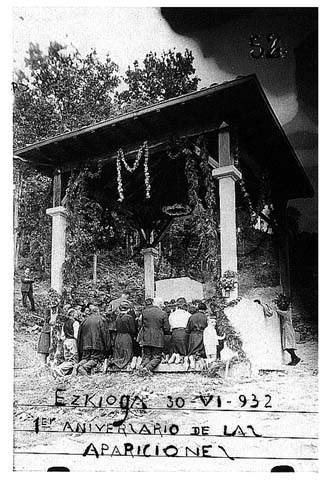
Chapel virtually completed for the first anniversary
of the apparitions, 1932. Photo by Joaquín Sicart
lectures showed that he had made up his mind. So finally, following José Garmendia's inspirations, Juan José Echezarreta started building the chapel anyway. Vigilant to the point of obsession, the Ezkioga pastor notified the diocese at once, and in an official note on June 10 the vicar general prohibited the chapel. Echezarreta pushed ahead and by the end of the month the chapel was virtually complete. Garmendia also described the image in detail; an artist sketched it in his presence, and a sculptor in Valencia, José María Ponsoda, prepared the image. Again Echezarreta footed the bill. The parish priest must have been suspicious about the large pedestal, often wreathed in flowers, waiting in the structure.[25]
Echeguren notes to Laburu, spring 1932; ARB 24-25; Echeguren, BOOV, 15 June 1932; the vicar general's note was in ED, LC, and EZ on June 16. In the summer of 1932 some priests forbade their penitents to go to Ezkioga, but this was not a diocesan policy. Garmendia had a vision on August 19 and 20 in which the Virgin said that priests could not keep properly dressed people from going, B 636. For image, B 42, 387 n. 1; the artist was Martí Gras; more in chap. 11 below.
In September 1932 it became clear that the next offensive against the seers would come from the government. In August General José Sanjurjo had led an attempt to overthrow the Second Republic from Seville. Sanjurjo was surprised when the uprising fizzled from lack of support, which he had expected in particular
from Navarra and the north. This was the rebellion that Carmen Medina was sure the Virgin of Ezkioga was announcing in 1931. At that time, when the visions were drawing tens of thousands of spectators, the government had not been worried or at least had not acted. Paradoxically, when the Republic did crack down in 1932, there were far fewer spectators and the visions were much less of a threat. There was no longer the kind of chemistry among newspapers, seers, and social anxiety that a year before had turned seers into political subversives. The difference in the government's reaction may lie in its greater insecurity after the coup attempt or, more simply, in the personality of the new governor.[26]
ARB 151.
Pedro del Pozo Rodríguez came to Gipuzkoa as governor on 20 August 1932 from Avila, where he had been governor since the creation of the Second Republic. Spanish governadores civiles , like prefects in France, are above all in charge of public order and police. During the Republic they were generally young, well-educated members of political parties in the government. Those in the provinces of the north, where the majority of citizens opposed the Republic and the political landscape was as complicated and rugged as the physical one, were men in the confidence of key members of the cabinet. La Voz de Guipúzcoa noted that del Pozo was "bound by ties of close personal and political friendship with [the prime minister] Señor Azaña" and that Azaña had personally briefed him.[27]
VG, 17 August 1932, p. 1.
Just one month later del Pozo served notice in the press on the Ezkioga seers and believers, who had been gathering in greater numbers at the new chapel:
MORE MIRACLES AT EZQUIOGA?
Word has reached the governor's office that there is a renewal at Ezquioga of reactionary religious movements, using as a pretext apparitions recently discredited by an official of the church.
It is surprising after the presidential visit to Guipúzcoa, a visit that was a triumph without precedent, after the approval of the Statute of Catalonia and a renewed governmental interest in coming to terms with the Basque Country, that once more the name of Ezquioga should be heard from the lips of deceivers who with the pretext of the alleged apparitions are undertaking a political campaign.
The governor is ready to act in this matter and will tolerate no more "miracles." Our enemies must play fair. They cannot be allowed to play politics with religious images that deserve their total respect. Seeking to maintain the faith, in fact they destroy and undermine it with their maneuvers.
"As long as I am in this post," Señor del Pozo told us, "I will not tolerate this kind of politics disguised as religion."
Very severe measures will be taken.[28]
Del Pozo press declaration, 21 September 1932, in VG 22 September 1932, p. 5, and widely reported elsewhere. B 268 claimed that the order came from Azaña.
On October 1, ten days after this warning, the Bordas and Burguera booklet on Ezkioga came out, and on October 6 or 7 Echezarreta installed the new image of the Virgin on its pedestal to "ardent tears, continuous prayers, pious hymns,
and fervent applause." All of the slow accretions of liturgical respectability had come to this climax, an image in a shrine, complete with a Way of the Cross on its approach, a holy spring, and a photographer standing by at the foot of the hill.[29]
FS 53; B 42, 379; ARB 27. An eyewitness to the image's arrival by truck (Surcouf, L'Intransigeant, 20 November 1932) wrote that some rural folk expected it to come down from heaven.
The final straw for del Pozo was an incident on a train from Zumarraga to San Sebastián on the afternoon of October 8. Tomás Imaz and two other believers, brothers who owned a bakery in San Sebastián, were returning to the city with the seer Marcelina Eraso. As they prayed out loud, Marcelina fell into a vision. At least one of the passengers began complaining vociferously that Imaz was exploiting the seer, and in San Sebastián police hauled off the little group for disturbing the peace. Dr. José Bago, the head of medicine for the government in the province and a republican hero, examined Eraso and sent her for observation to the provincial mental hospital. The governor reprimanded Imaz and fined him five hundred pesetas.[30]
Marcelina Eraso Muñagorri (b. Arriba [Navarra], ca. 1909-d. ca. 1972). Incident reported on 10 October 1932: VG, p. 7; PV, p. 9; Sol, p. 9; La Vanguardia; and B 379 (wrongly dates it October 7). Marcelina supposedly told a doctor at Mondragón that she saw a serpent around his neck, and he stopped questioning her, for he was living in sin (elderly believer, Ikastegieta, 16 August 1982, p. 2). On October 24 del Pozo released the hospital diagnosis that she had a weak memory and little judgment and was very suggestible (VN, 25 October, p. 6).
Bago, jailed for storming the provincial seat in 1930, had been the subject of a nationwide homage by republican doctors. He was a trusted adviser to governors under the Republic. See C. and J., VG, 2 May 1931; Barriola, "La medicina donostiarra," 39; and Estornés Zubizarreta, La Construcción, 295-296.
The following afternoon Governor del Pozo stopped at Ezkioga to see for himself what was going on. There was quite a crowd, and when Echezarreta came forward, del Pozo ordered him to remove the image by daybreak, to forbid entry to the site, and to take down the souvenir stands. If he did not, the government would dynamite the chapel. Perhaps not understanding the fine points of the matter, del Pozo told him to put the outlaw image in the parish church. He suggested that if Echezarreta wanted to be altruistic he could offer the property for a school. The photographer from Terrassa, Joaquín Sicart, his livelihood in immediate danger, alerted the Catalan supporters.[31]
Unlabeled clipping, 11 October; VG, 3 November; B 379-380; Sicart to Cardús, Ezkioga, 9 October. Strikes closed all San Sebastián daily newspapers from 10 October until 3 November 1932, which facilitated del Pozo's crackdown. The press of Pamplona, Madrid, and Barcelona reported del Pozo's measures in brief notes.
Echezarreta agreed to remove the image, but he had not counted on the opposition of the believers, who swore to defend it. When he returned with workers from his paper mill, there was a tense standoff. Echezarreta paused to pray part of a rosary so as not to offend the Virgin, whereupon the believers declared they would pray fifty rosaries for the Virgin to strike dead the first to touch her. The workmen then refused to help. Burguera intervened to calm things down and persuaded Echezarreta not to remove anything; rather he should let the governor do it. The standoff around the image continued from October 10 to 13 with round-the-clock prayers and visions. Del Pozo insisted not only that Echezarreta take the statue away but also that he raze the chapel and wall off the site. Four seers told Echezarreta from the Virgin that he should not give in. Civil guards protected the workers as they dismantled the stands at the foot of the hill.[32]
B 379-380; ARB 29-30. One of the workers, Juan Benarrás (Ezkioga, 15 August 1982), said the pressure not to act was intense. El Noticiero Universal, 12 October; Ahora, 13 October; VG, 3 November; Sol, 13 October; ARB 31; SC E 481/ 14. Cardús's account of these days is untitled and numbered separately; I have treated it as part of "Engrunes," in which it would follow p. 481.
José Garmendia defended his image and temple as best he could by visiting President Francesc Macià once more in Catalonia. He arrived in Barcelona on October 12, and that evening, in the private chapel of a wealthy believer, he asked the Virgin whether the image was still at the Ezkioga site. He said she refused to tell him in order to spare his feelings. The next day believers drove Garmendia and Salvador Cardús to Macià's country home at Vallmanya in the province of
Lleida. There Garmendia and Macià spoke for about fifteen minutes in the patio. According to Garmendia, Macià said that he preferred not to approach the prime minister, Manuel Azaña, who was a republican of the "red" variety but would speak instead to the president of the Republic, Niceto Alcalá-Zamora, "who always goes to mass," and ask him to intervene "to leave you in peace." Garmendia gave him a photograph of the image and the Bordas pamphlet. That night at Ezkioga about thirty believers and seers stayed with the image. Many but not all present thought they saw the image weep, and at three in the morning they sent for Burguera. He too saw the weeping and drew up an affidavit that those present signed.[33]
SC E 481/ 1-2, 6-7; Cardús to García Cascón, Zaragoza, 13 October 1932. According to Sospedra Buyé, Barcelona, 15 February 1983, García Cascón later gave Macià a replica of the Ezkioga statue. For night vigil see ARB 154.
Cardús arrived the next day just after workmen had removed the statue from the chapel. He just had time to kiss the images of the surrounding angels before the workers took them away. Citing the diocesan ban on objects associated with the visions, Sinforoso de Ibarguren had refused to let the image into the parish church, so the workers had carried it to the nearest farm. They did so reverently, on their knees, praying the rosary to the tears of the onlookers. Shortly afterward, they sawed down the great cross that Patxi had erected a year before, and it broke into pieces as it fell. Many of the several hundred persons present gathered splinters as relics. For the seers and believers, who so often had simulated crucifixion or acted out the stations of the cross, the Passion was taking place yet again at Ezkioga. They saw Echezarreta as a coward and Ibarguren as Judas. Cardús described the fall of the cross with the words of Christ: "Consummatum est, it is finished." Many seers had visions and all of them wept. The believers held continuous rosaries, some fearing divine punishment, others pleading for the Virgin to make herself visible. "In the meantime the blows of the hammers and chisels that began to demolish the building cut into people's hearts." That evening the mayor of Ezkioga announced on behalf of the governor that as of the next day all seers who had visions in public would be jailed. After dinner Cardús returned to find the image adorned with flowers and lit by a multitude of candles. Believers prayed before it in the rain.[34]
Account of events based on SC E 481/ 8-13; Benarrás, 15 August 1982; R 120; and El Debate, 15 October 1932, p. 3. For Ibarguren, DN, 15 October, p. 4. Benita claimed to see the cross falling in a vision in Legazpi (ARB 156). For after dinner, SC E 481/ 16-17.
On October 15, the feast of Teresa de Avila and the anniversary of Ramona's wounds, Salvador Cardús was surprised to encounter his spiritual director, Magdalena Aulina herself. She had come incognito as "María Boada," and with her were José María, Tomás, and Carmen Boada and Ignasi Llanza. Together in the rain they watched the workers remove the iron grille from the chapel. Around noon, on orders from the governor, the workers stopped. Burguera speculated that Macià's intercession with the government had had some effect, but it could also have been the result of the meeting in San Sebastián of Echezarreta, the mayor and town secretary of Ezkioga, and the governor. Nevertheless, civil guards prevented people from going up the hill. Sometime during the day Echezarreta had his workers take the image in a wheelbarrow down to a house on the road and install it in what had been Burguera's room.[35]
SC E 481/ 20-24; DN, 16 October, p. 4; ARB 155-156; B 380, 405. The weekly La Cruz alone questioned the governor, asking on October 16 that the believers be left alone. The house, Kapotegi, belonged to Echezarreta.
The Boada party invited Cardús, Garmendia, and Burguera to lunch in Zumarraga. There Burguera told them that his superior, the archbishop of Valencia, Prudencio Melo y Alcalde, had ordered him to go home. He was not obeying. According to Cardús,
P. Burguera also revealed his contacts in regard to the events at Ezkioga with the papal nuncio, who several times has expressed interest in them, even though he had said he could not intervene in the internal affairs of the diocese. The nuncio had a note given to P. Burguera to pass on with this significant message for Ramona Olazábal, dated 25 July 1932. "Tell Ramona from me to suffer with patience everything that Our Lord God sends her, and if she is innocent He will help her and she will triumph over all ."[36]
I do not know if Tedeschini really said this, and if so, to Burguera himself or someone else, like Carmen Medina, who was in touch with him that summer (B 137; SC E 481/ 25-27 (quote); Burguera to Cardús, 21 October 1932). The message would not have been out of character; witness Tedeschini's informal statement at Limpias in 1921 in Christian, Moving Crucifixes, 79.
On their return to Ezkioga, the party found believers and onlookers had arrived by car and bus and were milling about on the road. The houses along the road were full of believers praying and in almost every one a seer was having visions. A few defied the ban on outdoor visions. The original boy seer had his at the back door, facing the nearby apple trees. Evarista Galdós had hers under apple trees near the road and told Cardús that the Virgin told her to tell Burguera not to worry, that she (the Virgin) would watch over him. To the others she said, "Don't forget that the Virgin has said that there would be martyrs here!" Benita excitedly told José María Boada that she would write him from jail and that the Virgin had told her, "This is the hour of my soldiers." Even though she had met Magdalena Aulina in Barcelona, Benita did not see through the disguise; she even asked to be remembered to her. The guards heard that Patxi had had an outdoor vision and they tried to find him, but he escaped through a house to the hills. Then they tried in vain to locate Evarista, whom Cardús found huddling in a bus, "like a dove waiting to be sacrificed." That evening Burguera and his family were praying before the image and again saw that it seemed to weep, although there was no liquid on it. Burguera pronounced that here was not one miracle, an image weeping, but as many miracles as people who were seeing the image weep, for separate miracles were affecting the eyes of each.[37]
SC E 481/ 28-31, 34-35; ARB 156-157.
To round out this eventful day, around midnight Cardús went with Garmendia to the foot of the hill. Garmendia had had a vision in the afternoon and expected another. Since the houses were all closed for the night, they prayed by the road. Garmendia saw Gemma Galgani and the Virgin. He said the Virgin told him she was happy they had come out so late. As Cardús said good-bye to Garmendia on the dark road, a car went by and they heard one occupant say to another, "Poor man, what a shame!" It was the son of Garmendia's employer in Legazpi.[38]
SC E 481/ 32-34.
The next day the Catalan party, including Magdalena Aulina in disguise, stopped to say good-bye to Burguera and Cardús. They said the rosary, and
Garmendia entered into a lengthy trance in which he described the Virgin, Gemma Galgani, and the devil, who threatened him. Aulina almost gave herself away by pointing and saying, "Look! Our Mother!" After the rosary, pilgrims arrived from Pamplona with a letter from Pilar Ciordia, who claimed that the previous day the Virgin had said to tell Burguera that she was at his side. Burguera pointed out to the visitors that Evarista had said the same thing and that seers regularly coincided in this way. The Boada party left an observer but took Cardús, our witness, back with them to Barcelona.[39]
SC E 481/ 37-38; ARB 162.
The governor opened a judicial inquiry on October 11. Because of the Gipuzkoa newspaper strike, we catch only glimpses of the witnesses. Echezarreta testified on October 14 and October 18. Garmendia, Patxi, the child Conchita Mateos from Beasain, and María Luisa of Zaldibia appeared on October 21. Patxi had a vision before the magistrate, who sent all these seers to the mental hospital. Burguera wrote Cardús theatrically about the catacombs and of "repeating the early days of the church" and forwarded a letter from Garmendia asking further help from Macià.[40]
Burguera to Cardús, 21 and 22 October; B 380; DN, 22 October, p. 3, and 26 October, p. 3; Sol, 22 October, p. 5; Crónica Social, Terrassa, 26 October.
Over the next week the magistrate called Ignacio Galdós, Evarista, Benita, Recalde, Rosario Gurruchaga, and Vicente Gurruchaga. When seers took the train for San Sebastián, small groups of believers greeted them at many stations with flowers. On October 28 del Pozo appointed a trusted republican and fellow Freemason, Alfonso Rodríguez Dranguet, as special magistrate. By then the case centered principally on Burguera and other organizers for "fraud and sedition." This judge saw witnesses for about a month and finally remanded the case to the court in Azpeitia. Believers estimated that thirty to forty persons testified in all.[41]
ARB 161; El Socialista, 9 July 1932, p. 2, and 29 October 1932, p. 6; Sol, 30 October, p. 7; PN, 30 October, p. 3. Dossiers as Freemasons in AHN GC 211/17 and 214/9.
Burguera compiled a list of the magistrates' questions and noted the following themes: how the Virgin looked; how the visions took place; how the visions related to the Republic and if and when anyone sang the royalist anthem, "Marcha Real"; what Padre Burguera's role was; whether the seers gained any benefit from the visions; how the seers and believers organized their meetings and who were the ringleaders; whether they disobeyed church authority; and what the Catalans were up to.
The magistrate and the governor did not know what to do with seers who talked back, fell into swoons, and were ready for the worst. The telling and retelling of the dialogues, however improved or apocryphal, gave the seers an aura of martyrdom. The girls and women enjoyed going beyond the passive role of victims of God to become, like the men, active witnesses against iniquity. The believers appreciated this shift, which was in keeping with the well-publicized imprisonment of women for holding religious processions and returning crucifixes to schools.[42]
B 388-390, a court officer in Azpeitia who was a friend of an Ezkioga believer may have leaked the interview transcripts. Women fined in Viana (Navarra), PV, 9 February; Yécora (Alava), PV, 11 February; women jailed in Salinas de Oro (Navarra), CC, 27 April; women jailed, from El Debate, Casa de Miñán (Cáceres), 27 May, Anna (Valencia), 14 July, San Esteban del Valle (Avila), 30 July, Algemesí (Valencia), 6 November, and Navalperal de Pinares (Avila), 6 December. In Galvez (Toledo) women forced the mayor to carry the Virgin on the annual trip from the parish church to the chapel, LC, 3 April 1932.
The authorities released several seers after questioning them. The judge questioned Evarista on October 26. She claimed later that the Virgin told her what to answer. When the judge asked her whether she had seen a devil, she said
she had. When he asked whether the devil was naked or clothed, she allegedly said, "He was dressed like you." After more questions he let her go. A young woman from rural Urrestilla, Rosario Gurruchaga, seems to have had a fit. After ten minutes only the neighbor who accompanied her was able to unclasp Rosario's hands by touching them with a crucifix. The judge did not commit Rosario either. Benita was euphoric before she went. She wrote García Cascón, "Thank God we are not crazy; knowing this I am ready to go anywhere, as if on a social call. I am so happy I cannot explain it." The magistrate quizzed her on general knowledge, such as the capital of France, and sent her home too.[43]
For Evarista, B 380, 722; ARB 159-160; unlabeled note in the folder "La Persecució governativa," ASC. For Rosario, B 381; ARB 158-159. For Benita, Benita to García Cascón, Legazpi, 24 October 1932. ARB 161-162.
On November 25 Ramona's spiritual director went with her to San Sebastián. This was Ramona's second appearance, and the priest relayed some of the exchanges to Cardús.
Ramona told me that the judge asked her if she sees the Virgin. She said she did. [He asked] at what distance she saw it, was it within shooting range? I think at that moment Ramona had some kind of divine inspiration. She replied that yes, that she saw it close enough to fire on a civil guard, but it was the Virgin. The curious thing about this is that the man who asked this question some days before the Republic was established in Spain killed a civil guard in a riot in San Sebastián.[44]
Francisco Otaño to Cardús, Beizama, 26 November 1932.
The Catalans heard that when the judge asked María Recalde if she had lost any weight on her repeated trips to Ezkioga, she said she had. Portly like her, the judge said that maybe he too should go. She told him it would do him good—his body would lose weight and his soul would gain it. Allegedly via a vision on October 22 Recalde was sure that Justo de Echeguren was behind the government offensive.
Judge: What did the Virgin tell you about the Republic?
Recalde: She told us nothing.
J: But she must have said that now we are worse than before.
R: No. Before you acted against the clergy; now it is the clergy that has gotten you to act against us.
J: who told you that?
R: I have my sources.
J: Well, the vicar general told me he would not tell anybody.
In Burguera's account she went on to say that she laughed at her accusers, that she feared her heavenly judge, not the earthly one. She spent a night in a holding cell and went on to the mental home.[45]
ARB 159; first two questions and answers from Cardús, "La Persecució," ASC; B 391.
Burguera, the big fish, was called to San Sebastián on November 3 along with José Joaquín Azpiazu, the justice of the peace in whose house he was staying.
Burguera claims that the court typist told him that three priests from around Ezkioga had already been there to testify against him. The governor held Burguera responsible for the resurgence of the visions in the summer of 1932 and thought he had "manipulated people who were mentally ill in order to maintain the fiction of the visions." He said Burguera had "created more seers, held clandestine meetings, and organized apparitions, in some cases where the Marcha Real was played during the visions." He therefore jailed Burguera, releasing him seven nights later on condition that he leave Gipuzkoa. By that time the press had held Burguera up to ridicule. El Socialista of Madrid printed a satirical poem "The Last Miracle-Worker," which referred to "Padre Amado," who first lost his license to say mass "because he wanted to do miracles on his own without the permission of the holy mother church" and then was "thrown in the clink" for conspiring against the government.[46]
For arrest B 68-69, 393-398; VG, 3 November 1932, p. 7; and on 4 November 1932; DN, p. 3; VG, p. 4; PV, p. 3; LC, p. 3; Sol, p. 1. Next day: La Vanguardia, and Moya, El Socialista. Mariano Bordas interceded with the governor of Gipuzkoa for Burguera, who defended himself in PV, 2 December 1932. Azpiazu was accused of holding clandestine meetings in his house.
Shortly after the governor released Burguera, the mental hospital released the seers, virtually all with a clean bill of health. Recalde had visions there, convincing some of the nuns who were nurses. Catalans from the Aulina group had gone to intercede with the staff. Del Pozo fined five prominent believers a thousand pesetas each, substantial sums. He told the press he had received a letter from Navarra saying that a female seer saw devils dragging his soul into hell. After he was transferred to the province of Cádiz on December 7 the government left the seers alone. Civil guards stopped patrolling the site in late November because the towns could not pay them.[47]
Garmendia's certificate of sanity circulated among believers (AC 409). He and others were let out November 13. Recalde in ARB 162-164. Del Pozo in Noticiero Bilbaino, 30 October 1932, p. 3, and PV, 4 November 1932, p. 3. His downfall came when civil guards massacred villagers at Casas Viejas in Andalusia. Ezkioga believers noted that Casa Vieja in Spanish means Echezarreta in Basque (ARB 165-166). For the new governor, Jesúus Artola, B 403-404, 710; SC E 504-505; R 31.
Like Recalde, the other seers and believers were convinced the diocese was behind the government's actions, something Bishop Múgica vigorously denied. A more elaborate theory was that the diocese sponsored the Laburu lectures in exchange for the bishop's return from France. Múgica entered Spain on 13 May 1932 through the intercession of Cardinal-archbishop Vidal i Barraquer and of the nuncio with Prime Minister Azaña. But he could not go back to his diocese of Vitoria for a year, and it is unlikely that Ezkioga, after 1931 a negligible threat to public order, had anything to do with his return.[48]
The vicar general's inactivity was anomalous, given his swift reaction to other images in the past. Múgica entered the diocese 11 April 1933; his denial of a role in del Pozo's campaign in BOOV, 9 March 1934, pp. 241, 245.