
Chapter 2
The New American Hegemony
The French and the Cold War
What was said or thought about America in a political and ideological sense during the early days of the Cold War opens this study. High politics accompanied by an analysis of public opinion are the initial topics. We begin with the political elements of anti-Americanism because they colored the other encounters and in a sense informed them all. Geopolitical and ideological issues form not only the substance of this chapter and part of the next, but they also suffused the atmosphere of the early Cold War and deeply penetrated French consciousness. This does not suggest primacy of politics, however, for French social and cultural perceptions of America were highly developed during the interwar years before the emergence of the United States as a global power.
From this geopolitical perspective the key issue was how France should align itself in a Europe being partitioned between East and West. Should France welcome American protection and hegemony, maintain a more independent stance, or look to the East? And how much accompanying American influence was desirable? It must be noted that during the Cold War French attitudes toward America were functionally related to the reputation and behavior of the Soviet Union and for many, especially on the left, anti-Americanism was a consequence of the attraction of Soviet policy or of communism.
In this opening chapter we shall hear principally public voices—those of government officials, both French and American, and of party leaders—as well as those, less distinct but equally important, of private French men and women expressing their feelings about America. The views and
efforts of the left-wing or progressiste intelligentsia and the Communists will be addressed in the following chapter. The common dilemma that faced the French and unites these initial chapters was how to assess the new American power and its policies toward Europe and France.
Anti-Americanism during the Cold War, in my interpretation, did not represent the French and was in its most polemical form essentially the product of leftist Parisian, especially marxisant and Christian, literati and of the Communist party (Parti communiste français, or PCF). These strident anti-Americans (who will be closely examined in the next chapter) expressed their contempt in political or ideological terms. The United States was a capitalist behemoth threatening French political, social, economic, and cultural independence. Americans were, from this perspective, guilty of economic imperialism, warmongering, racism, incipient fascism, and cultural debasement. Attacks from the left distressed American officials and reporters in Paris and, at times, even the American public.[1] Some of this critique resonated among the wider French intellectual community, the political class of the Fourth Republic, and the French people, but it did not represent them.
In contrast there were many other commentators who offered either equally emotional panegyrics or calm, nuanced appraisals. These pro-Americans were more appreciative of America's virtues than they were critical of its vices. But these early Atlanticists—academics like Raymond Aron who wrote for Le Figaro, or literati like André Maurois who wrote popular books about America—may have enjoyed wide audiences, but they received far less attention in the sanctum of St-Germain-des-St-Germain-des-Prés than did newspapers or reviews like Le Monde, Esprit, Les Temps modernes, or Les Lettres françaises, which all expressed an aversion for America.
The less articulate mass of French men and women shared some of their anxieties. When the intelligentsia and Communist militants addressed certain issues—those that made America appear as a dominating influence—they also captured the attention of a wider public. Anti-Americanism was not purely a Left Bank or Communist property. Anti-Americans spoke for a large audience when they addressed three concerns. Injured national pride was one root of popular, but not necessarily visceral, anti-Americanism. It appeared that the United States had exchanged prewar isolationism for a new global reach and, at the very moment when France had ostensibly sunk to the rank of a secondary power, had emerged as a superpower, stirring up the potent emotions of envy and pride. Second, American economic success inevitably
attracted jealousy and resistance. Americans proselytized for consumer society as an alternative to French conceptions of a balanced economy and traditional ways of production, selling, saving, and spending. Third, at least for the elite, was the danger that America would export its mass culture, threatening the French conception of humanistic and high culture with adulteration by the technical values and products of mass culture. In other words the productivity mania, Coca-Cola, and the Reader's Digest were a danger. Advertising, in its brash, loud, and vulgar way of hawking products and in its artistic pretensions, represented both consumerism and popular culture. Even the most ardent philo-Americans such as André Maurois or André Siegfried expressed this cultural anxiety. Such popular perceptions of an American menace did not mean that the French were anti-American at this time, but it did mean that polemicists could count on a certain unexpressed sympathy for their attacks.
Inside the hexagon, as the French usually refer to their country, most members of the public seldom thought or cared much about America. They may have harbored the stereotype of "les Américains" and undoubtedly felt twinges of anxiety about America's new power in international affairs, its economic weight, and its cultural presence compared to their nation's relative decline. But they liked America and Americans, consumed most of America's exports, and ignored Sartre's attacks (if they even knew of them) and the signs calling for the Yankees to "Go Home." The French man or woman in the street or in the fields ignored, disagreed with, or, at most, took a little silent pride in the attacks on Yankee hubris.
In short, a substantial and influential part of the intellectual community and the powerful Communist party were anti-American at this time. While the French people shared some of the same apprehensions, they should not be designated as anti-American.
The decade following 1947, the year that nominally signifies the beginning of the Cold War, marked the peak of the politico-ideological debate about America. This was the moment when being for or against America, to some partisans, represented taking a stand for or against peace and civilisation .
The Cold War debate about America emerged from tense wartime relations between the two nations. If the fall of France in 1940 marked the nation's loss of status as a great power, the war years and the experience of foreign occupation and collaboration only deepened the
humiliation of defeat. Liberation from the Germans required a massive invasion of Anglo-American forces that earned the liberators enormous goodwill but had little effect on restoring damaged self-esteem. Moreover, and rather hidden from the public, was the stormy story of Franco-American relations during the early 1940s. Neither the collaborationist wartime officials in the Vichy government nor their rivals in the Resistance enjoyed amicable relations with the Americans.[2] Washington maintained diplomatic relations with Marshal Philippe Pétain's government until 1942 because it assumed Vichy would be of more use in defeating Germany than was the Resistance. But both Vichy's diplomatic alignment (increasingly accommodating to the Germans) and the direction of its internal policies ran afoul of Washington, and in the end actual fighting between American and Vichy troops broke out during the invasion of North Africa. Indeed Vichy was the first French government to struggle openly against American cultural penetration.[3] And by 1944 with Allied bombs raining down, Vichy propaganda attacked "Jewish" America for its atrocities. Paradoxically, rapport was scarcely better between the United States and the pro-Allied Resistance. Washington's dalliance with Vichy and President Franklin Roosevelt's stubborn opposition to Charles de Gaulle's leadership as head of the provisional government stirred rancor and distrust. And the powerful leftist elements in the resistance movement in metropolitan France harbored reservations about what the future would hold should France be liberated by the Americans and become dependent on the citadel of world capitalism.
Newsreels have captured for posterity the image of joyous crowds celebrating with GIs as Allied troops marched across the country in the summer of 1944. But liberation by outsiders only verified France's fall from grace. France had lost and America had gained in rank. This was the key political-psychological "fact" of the early postwar era. Injured national pride, unacknowledged but real, filled the underground spring that fed anti-Americanism. A France already torn by internal division, humiliated by defeat, occupation, and collaboration, and slightly embarrassed by its liberation faced a crisis of national identity. The cultural revulsion against America, as one historian argues, may have been a kind of "compensatory defense reflex" by which the liberated excommunicated the liberators.[4]
After the war the United States and France gradually became diplomatically aligned. In time the Fourth Republic relinquished its hope of balancing between the two superpowers and sought a formal alliance with the United States and a position within the Atlantic bloc. Interim
aid began under the Blum-Byrnes agreement of 1946; the following year came the announcement that led to the arrival of massive Marshall Plan aid in 1948. In 1949 France and America signed a military alliance, the North Atlantic Treaty Organization (NATO), and were soon fighting a joint war in Indochina. Military assistance at first supplemented economic aid and, once the Korean War began, virtually replaced it. But continuous feuding marred the alliance in the late 1940s and early 1950s.[5] Most of this tension was confined to official circles, but at times the public perceived the quarrels. First came friction over trade and economic policy. The United States refused to relax its obstacles to imports from France, yet it counseled and pressured Paris to remove its trade barriers. When the Fourth Republic, for example, tried to protect the French film industry from an influx of Hollywood movies, the American government, as a condition of the Blum-Byrnes loan, insisted that the French keep their market open to Hollywood imports.[6] Recriminations followed. Politicians and the press in France complained that Hollywood studios had forced quotas of American productions on an industry grievously injured by the war. French movie houses were soon inundated with American films, more because of problems with the French movie industry than because of imports, but the domestic outcry led to scrapping the Blum-Byrnes agreement.
There were also disappointments over the amount and the allocation of economic aid. Blum-Byrnes awarded the French far less than they wanted and much less than the British had received.[7] When Marshall Plan aid began, troubles only escalated. While the United States sought a balanced approach to French recovery, one that expedited economic renovation but maintained financial stability, the Fourth Republic pursued massive modernization at the risk of rampant inflation. The use of counterpart funds, that is, matching funds accumulated by the recipients of aid and controlled by America, was a continuous source of friction between Washington and Paris. In 1949 Economic Cooperation Administration (ECA) officials, who administered the Marshall Plan, were so dissatisfied with French financial and economic policies that they threatened to block the release of counterpart funds. In this instance they reported that the French minister of finance made a "moving appeal" to American officials to avert the interruption of aid.[8]
American administration of aid, which often seemed patronizing and tactless, fueled rumors about the French Republic's dependence on Uncle Sam. There was good cause for French irritation when an ECA official in Washington took the French minister of agriculture to task
about discourteous treatment of American tourists in French stores and hotels.[9] American officials justified their behavior by arguing that they acted only to monitor the use of aid and to protect American interests. Yet their demands and threats caused uneasiness about the submissiveness of the Fourth Republic.
Complicating Franco-American relations was the example of Britain. Viewed from Paris, London always seemed to receive preferential treatment whether it was a matter of strategic planning or of economic or military aid. France's repeated efforts to attain equal status with Britain as part of a three-power Western directorate were rebuffed. An equal irritant was Washington's anticolonial sentiments, especially with respect to North Africa and Indochina. As Paris perceived it, the United States in its rigid anticolonialism had dislocated the British and Dutch empires and now seemed to be cheering on independence movements in overseas French territories. Although Washington eventually came round and provided military assistance to help fight the war in Indochina, Franco-American military operations in Southeast Asia from 1950 to 1954 seemed to antagonize both sides.
Worst of all, from a French perspective, was the widening policy divergence in the treatment of Germany. From the early disputes over releasing controls on German industry to the bitter quarrels over economic and political recovery and later over rearmament, the German problem drove the Allies apart. In fact during 1945–46 Paris proved at least as big an obstacle as Moscow in discussions over joint Allied occupation policies toward Germany. In order to strengthen Western Europe against possible Soviet aggression, the United States in 1950 adopted the cause of German rearmament. Needless to say, the French were not eager to see their recent occupiers back in uniform. A confidential State Department opinion survey of that year showed that half of the French public thought American treatment of Germany was too lenient. A typical attitude was, "I'm afraid the Americans will help the Germans make a rapid recovery. They should be allowed to suffer a little. Then they would understand."[10] Later, when the Fourth Republic voted down the proposed European Defense Community (EDC), which the United States viewed as the best path to German rearmament and Europe's defense, American rancor made newspaper headlines in France. This pattern of mutual recrimination provoked anti-Americanism in official circles and had repercussions on public opinion as well.
Ideological zealotry accompanied America's new hegemonic position in Western Europe as America went on crusade against communism.
Senator Joseph McCarthy sought out Communists in high places throughout the United States and stirred the nation into a frenzy. Washington found security abroad in the division of Europe, including Germany, between the superpowers and expanded its reach on a global scale to halt the Communist danger. An expansionist and ideological American foreign policy made the French anxious. After the signing of the NATO accord in 1949, American troops returned to France. The United States built a large military infrastructure on French territory, and American military staff and GIs became a common sight. Some thought this buildup was a prelude to an American military offensive against the Soviet Union. An overwhelming advantage in atomic weapons made the American military presence even more ominous.
Within France the United States tried to use its political and economic leverage to strengthen centrist and leftist non-Communist parties and to curb the influence of the French Communist party, especially on the labor movement.[11] As early as 1946–47 the United States government, with the active assistance of American labor unions and the Central Intelligence Agency (CIA), worked to divide the Communist-dominated labor federation, the Confédération générale du travail (CGT). When schism occurred, however, it derived more from internal French labor discord than from American intervention. At the governmental level the non-Communist parties of the ruling coalition in 1947 acted on their own to eject the Communists. Washington was pleased. A year later the State Department mounted a massive cultural offensive as part of the Marshall Plan to neutralize Communist propaganda. America was fighting the Cold War on French territory.
Given wounded national pride, it is no surprise that French patriots of all stripes were prompted to shake their fists at Uncle Sam.[12] Washington's aggressiveness and clumsiness, as it seemed to some, threatened to plunge France into another war. And, one American journalist noted, the French were "tired of being occupied."[13] There were thousands of Americans working for agencies like the ECA in Paris and thousands more serving in the military elsewhere in France. Communists, neutralists, and colonialists were only some of those who actively resisted what many observers crudely labeled "American imperialism."
This political and ideological antagonism is not sufficient, however, to explain the outburst of postwar anti-Americanism. It had other causes and dimensions. The debate about America during the Cold War also echoed prewar charges about "America the menace." It should be remembered that postwar France inherited a critical assessment of
américanisme from the interwar years. If the literature written about the New World before the war often admired American dynamism, affluence, power, and even certain cultural achievements, on balance the collective judgment had been negative—especially when observers conceived of America as an economic-social-cultural model. Most of these critics, commentators like Georges Duhamel and Robert Aron, attacked from the political right or center. The postwar generation did so from the left—some from a faith in communism.
The pattern of friendly quarreling of the late 1940s led to serious confrontations at the diplomatic level during the early and mid-1950s. The American ambassador cabled home in 1952: "Franco-American relations are cooler than at any time since Gen[eral] de Gaulle resigned in 1946."[14] In part this chill reflected the accumulated acrimony from negotiations over military assistance for the war in Indochina and the release of counterpart funds. In part it resulted from French recalcitrance over ratifying the EDC treaty that Washington sought. In addition, the United States frowned on the continued French presence in Tunisia and Morocco. Finally, there was annoyance over American unwillingness to treat its Atlantic allies as true partners. The ambassador confessed, "Some of our actions and sometimes the way we do things, give ammo [ammunition] and tend to give plausibility to Commie charges that we dominate Eur[opean] 'satellites.' "[15]
In 1952 Vincent Auriol, the president of the Republic, after learning of remarks made by American officials about giving priority in aid to Germany, sent a scathing confidential letter to his ambassador:
The French are weary of being called beggars. . . . They are tired of the favours conceded to Germany and they don't understand the betrayal in the African question. They are wondering whether we are in the Atlantic Pact only to be humiliated.[16]
The United States embassy in Paris reported that the French were coming to believe that the American government and Congress considered them "fumbling and incompetent" and wanted to "start telling the French what to do in all fields, foreign and domestic."[17] In late 1952 when the French government perceived that Washington was trying to force it to redo its military budget, raise taxes, and permit close outside supervision of its rearmament program, the conservative premier, Antoine Pinay, was stung into action. None of what Washington was doing was new, though it may have been more heavy-handed, but the French
now took exception. Pinay and his ministers rebuked the Americans for unjustified prying into matters that were internal French affairs.[18] The Pinay government could take advantage of growing resentment within and outside parliament over the popular perception that France was being pushed about in sensitive matters like German rearmament and North Africa.[19]
Relations between the Allies deteriorated further in 1953 and 1954. Paris lacked confidence in American leadership because tine Eisenhower administration seemed at first uncertain of its direction and unwilling to curb Senator McCarthy.[20] There was apprehension in Paris that growing American military strength might lead the United States on an anti-Communist offensive. And there were mutual recriminations over responsibility for the defeat in Indochina and the Geneva settlement in 1954.
But worst of all was the National Assembly's refusal to approve the EDC in the same year. In order to pressure the assembly into ratification, Secretary of State John Foster Dulles issued his famous threat of undertaking an "agonizing reappraisal" of American policy toward France.[21] French legislators still voted against the treaty. The United States felt betrayed and used by the Fourth Republic, which had dragged out negotiations and had promised ratification but in the end reneged. Dulles in turn snubbed the French on his visit to Europe. By 1954 the intimacy that had characterized relations was over. Pierre Mendès France, who became premier in that year, asked the American under secretary of state to curtail propaganda in France and to cease subsidizing French publications.[22] Shortly thereafter Washington began to phase out its aid programs. American influence over French policy had peaked and thereafter waned.
After 1954 and before de Gaulle's return in 1958 there were further outbursts of anti-Americanism caused by troubles in the NATO alliance. Colonial struggles continued to promote anti-Americanism among the French public, which tended to blame the United States for the predicament in North Africa. Washington allegedly withheld its full support for France's effort to accommodate the independence movements in Tunisia, Morocco, and Algeria.[23] American policy toward the Algerian war, which began in 1954, did not improve the rapport. Washington, hoping to keep North Africa anchored to the West, tried quietly to move France toward a negotiated and liberal solution. But the American government was perceived as providing inadequate support and sometimes even aiding the nationalist Algerian revolt at the expense of its ally: the United
States refused to allow the transfer of American-built military equipment from Indochina to the French army in Algeria yet supplied arms to Tunisia from fear that the latter would turn to the Soviet bloc for weapons. Some of these American weapons, to the dismay of Paris, ended up in the hands of the Algerian rebels. At worst, French opinion viewed America as appeasing the Arab world out of economic interest or as preparing to step in and replace the French in North Africa.[24]
The Suez Canal crisis of 1956 momentarily undermined the alliance. After the United States had intervened against the Franco-British-Israeli invasion of Egypt, a poll indicated that as many as half the French people had either "no confidence" in the United States or "not much."[25] The press viewed the United States as duplicitous and guilty of betraying its ally in time of need.[26] Jacques Soustelle, a prominent Gaullist politician, compared the United States to a mythical beast that was so absentminded and myopic that it devoured its own feet without even realizing it. Soustelle complained that France was caught between "two colossi, one of which has no heart and the other has no head."[27] The American ambassador, Douglas Dillon, warned Washington of the "bitter flood of anti-American feeling now seething through France." Dillon noted the "deep emotional conviction" that in the Suez affair the United States was "callously indifferent" to the vital interests of its principal allies and was ready also to "humiliate them unnecessarily" in the United Nations in order to retain its own position in the Arab world. And the United States' refusal to alleviate the oil crisis in order to bring its allies to heel angered many bystanders: "The little people of France are being touched and they are stubbornly convinced [the] U.S. is to blame."[28] This flood of anti-Americanism was to recede quickly, typifying the rapid changes in attitude over American foreign policy.
Soon after the war ended, officials in Washington became concerned about the image of the United States in France, a country where the strategic and political stakes were extremely high. A State Department memorandum of 1946 stated, "The world drama of Russian expansion is being played in miniature on the stage of France."[29] Anti-Americanism was attributed to prewar and wartime distortions of America, to sensitivity and jealousy about France's recent humiliation, to the misbehavior of GIs, to fears of and ignorance about the United States' foreign policy, and to pro-Soviet and chauvinist attacks. As a result, the French falsely regarded the American way of life as "essentially materialistic and hedonistic," suspected that Washington's motives were "selfish and predatory,"
deprecated America's cultural achievements, and distorted its moral and social values. Ambassador Caffery bombarded Washington with feverish dispatches about Communist-inspired anti-Americanism.[30] Officials recommended an informational campaign to combat French anti-Americanism. But it was not till 1948 that the United States government acted.
In tandem with the Marshall Plan, the State Department mounted a massive cultural and informational campaign to redress America's image. The aim was to negate Communist polemics and persuade the French that America wanted only peace and freedom and respected French independence. Presenting American artistic and scientific achievements as well as the benefits of the American way of life, it was assumed, would help create a more attractive image. Slowly at first, but then with gathering momentum that reached a climax in 1952, the United States inundated France with press releases, radio programs, and documentary films. It established informational libraries, cultural exchange programs, and elite organizations like the Association France-Etats-Unis. Marshall Plan agencies contributed a mass-circulation, glossy monthly entitled Rapports France-Etats-Unis, which paraded the comforts of consumer society and published articles like "American Painters at Giverny." In 1949 some 15 percent of the population, according to the State Department, heard Voice of America programs such as "Ici New York."[31] During the last six months of 1950 an estimated five million people viewed American documentaries. Some ten thousand leaders received publications such as Ce que dit la presse américaine . American academics like Gilbert Chinard lectured in Paris and approximately five hundred Fulbright awards per year facilitated Franco-American scholarly exchange. At the peak of this cultural offensive, the United States Information and Education Agency in France printed twenty thousand copies of a biweekly bulletin describing different aspects of American life; subsidized newspapers and reviews, for example, Franc-Tireur and Preuves; and aided European intellectual activities like the Congress for Cultural Freedom.
One outspoken American information officer in Paris observed:
As of October 1952, some 70 Americans and several hundred French employees are engaged in cultural and informational work on behalf of the U.S. government in France. We are providing maps of our country to school children and corn-husking demonstrations to farmers. We are publishing a monthly magazine with circulation of more than one million copies. We are making American music available to French radio listeners and showing French engineers how to reduce the costs of cutting and bending steel pipe. We are distributing films on American surgery and manuals of trade union organization.[32]
At the same time, he noted, the American media, which were largely outside government control, overwhelmed the French with American fiction, films, and magazines; their activity led him to warn: "There is a great psychological danger inherent in an excessive American presence in this country." The problem, as he saw it, was there was little relation between creating a favorable view of life in America and ensuring political commitment. A poll of workers around St-Etienne, he observed, revealed no correlation between attitudes toward the United States or the Soviet Union and political preferences. Many Communist workers were contemptuous of Russia, for example. As a contribution to Washington's political aims, the cultural offensive, according to this skeptical official, was "largely a waste of time and money when not actually harmful."
The Fourth Republic, encouraged by American officials and CIA dollars, contributed to this anti-Communist campaign of cultural propaganda.[33] Centrist governments of the period, who were as militantly anti-Communist as the Americans, provided information and funds to a counterattack mounted by a moderate deputy, Jean-Paul David. Aroused
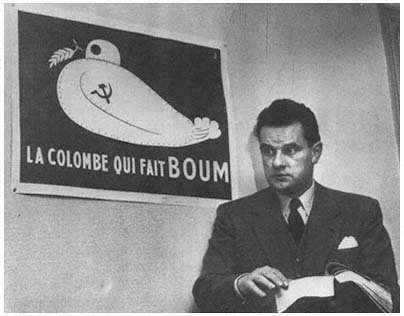
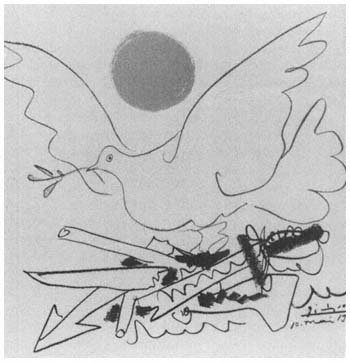
2. Picasso's peace dove (opposite) and the anti-Communist version, "the dove
that goes boom," with its creator, Jean-Paul David (above). (Pablo Picasso,
Peace Dove, © 1992 ARS, New York/SPADEM, Paris; courtesy Bettmann)
by the Communist-inspired peace movement and in the wake of the Korean War, David launched his own movement called Paix et Liberté in order to spread "the truth" about the PCF, the Soviet Union, and communism. Employing a variety of modern communication techniques, Paix et Liberté sponsored radio programs and published a history of the Communist party in the form of a comic strip. One of David's most celebrated efforts was a poster ora dove (a transparent allusion to Picasso's symbol of peace) transformed into a tank—the bird's head a turret and its beak a cannon brandishing an olive branch—that carried the caption "The dove that goes boom" (fig. 2) and thus revealed that the Communists were preparing for war while proclaiming peace. Paix et Liberté was discreet about the United States and NATO and carefully portrayed the global confrontation as a contest between the free world and the Soviet bloc. While Washington openly supported Paix et Liberté, the latter avoided references to the United States and never appealed, as Dulles did, for a rollback of communism in Eastern Europe. Naturally the PCF charged that David was in the pay of the American embassy.
The propaganda contest over America became a quarrel over high culture in the spring of 1952. Paris in May was the site of an international art festival entitled "L'Oeuvre du XXe Siècle" sponsored by the Congress for Cultural Freedom—an organization that received subsidies from the CIA. The purpose of the festival was to show Europeans, especially Parisians, that the West was culturally vigorous and to disprove Communist accusations of decadence. Orchestras from Boston, Vienna, and Berlin, the New York City ballet, and Covent Garden Opera, among others, performed for the city. There was an exhibition of twentieth-century artistic masterpieces, many of which were French, and literary discussions by such illuminati as W. H. Auden, William Faulkner, and André Malraux—the last the only internationally prominent French intellectual who participated.
While most Parisians were impressed by the display of the West's artistic brilliance, the festival also provoked nasty nationalist sniping.[34] One leftist newspaper, Combat, carried an editorial on "NATO's Festival" with snide remarks about the provincials from Alabama and Idaho, and freedom in a nation that lynched blacks and hounded anyone accused of "un-American" activities. The Communist dally unmasked the event as a way of spreading bellicose and fascist ideas and enrolling French intellectuals in a "cultural army." A conservative paper called the festival magnificent and contrasted its vitality with artistic conformity in the Soviet bloc. This same daily welcomed the Boston Symphony yet noted, "The Americans have landed, but under the command of a Frenchman" (Charles Munch). And the director of the Paris Opera ballet, affronted by exclusion from the festival while George Balanchine's New York company performed, declared haughtily: "Gentlemen, with respect to esprit, civilization, and culture, France doesn't take advice from anyone; it gives it!"[35] This outburst of cultural arrogance was exceptional. But some intellectuals used the event to register their cultural disdain for the United States. "Paris has been—and still is—the only creative center in the world," one newspaper asserted.[36] Of course these judgments were not purely aesthetic since the propaganda function of the event was transparent. It must have seemed that praising the festival meant, at least indirectly, also approving NATO and German rearmament. The organizer of the festival, Nicolas Nabokov, wrote privately: "Despite what it may have looked like to people reading the French press, the festival was a psychological success in the complex and depressingly morbid intellectual climate of France. Of course, in any other country we would have had both more sympathy and more support."[37]
If the historian leaves Paris and its political and cultural battles in order to view France as a whole, what attitudes toward America can he uncover? How did "the French," defined here in the sense of public opinion, view America and Americans in the early 1950s? Speaking definitively about this subject is virtually impossible. Such attitudes were too diverse, volatile, and contradictory and the documentation is too thin to write with any precision or confidence. In principle, public opinion is difficult to chart because it mixes memory and anticipation, unity and multiplicity, stability and plasticity. Moreover, it is both expressed and latent.[38] And in this case it was probably also suffused with massive indifference. Despite these problems we have sufficient material from public opinion polls, newspapers, embassy and consular reports, and other sources to sketch a profile of French views. The basic source is an extensive opinion survey about America carried out in 1953 at the height of Cold War anxiety.[39]
How did the French people in the early 1950s learn about the United States and Americans? Newspapers, according to the opinion survey, were the principal source of information, supplemented by radio programs, films, books, personal conversations, and American periodicals like the Sélection du Reader's Digest and the Rapports France-Etats-Unis . Both periodicals unabashedly propagandized for the American way of life. Sélection du Reader's Digest, which published over a million copies, praised American scientific, technical, social, and economic achievements with articles like "The Cold Finally Conquered," "Here Come the Modern Harvesters," or "Hurrah for the Suburbs" (as well as rhapsodies about America's contribution to Europe's liberation, reconstruction, and protection). Only 2 percent of the 1953 sample had been to the United States though half knew someone who had visited; travelers' impressions were strongly favorable. Throughout France, the most visible signs of America were U.S. military bases, American tourists, a growing number of American consumer products, and, especially, cultural exports such as Hollywood films. Yet the French admitted that they did not know much about the United States—a situation that has changed little to the present. During the Cold War very few French citizens knew who Joseph McCarthy was. (This is not to suggest American superiority in knowledge of the French. When J. Edgar Hoover was informed in 1964 that Sartre had joined an anti-American organization, Hoover supposedly scribbled a memo: "Find out who this Sartre is.")[40] But the majority did not believe crude misrepresentations
such as tales that most Americans lived in skyscrapers or that divorce had destroyed the American family.
The image of Americans was a familiar composite. Americans were rich, youthful, dynamic, practical, and modern. To an extent this was the mirror image of the French, who commonly viewed themselves as poor, old, and traditional. Americans were admired for their high standard of living, their open society, their comforts, and their technological prowess. Local newspapers reported speed records set by American transcontinental planes and carried news of the latest gadgets, such as portable radios and plastic auto bodies.[41] In the late 1940s, when the French still suffered from severe housing shortages, dailies carried photographs of new American luxury apartment houses; visitors to the United States marveled at the extravagance of American hotels, stores, trains, and restaurants. This new world was associated with economic expansion and money—"Dieu dollar." To a lesser extent it was also hailed as the liberator of France, a close ally, and a democracy. American culture was different—it recalled Hollywood, cowboys, and jazz. Above all Americans lived in a modern society: they were "modern people always taking the lead toward progress."[42] This stereotype was quite stable from 1945 through the 1950s and long after that as well.
If Americans were modern, they also made the French uneasy. Their image cast a shadow. The French in their assessment of America tended, more than other nationalities, to perceive Americans as dominateurs .[43] The most common image evoked when the French spoke about the United States was power.[44] In 1952 American domination appeared to them more in political, military, and economic guises than as a cultural menace. But American hegemony haunted the French.
If the stereotype of Americans was stable, foreign policy acted as a volatile variable that caused abrupt swings in popular appreciation of the United States while raising the specter of foreign domination. It is not surprising that approval of American foreign policy waned after the enthusiasm of the liberation. Erosion set in as the French perceived a hardening of American policy into an anti-Communist mold, as East-West tensions grew, as substantive differences between the Allies emerged, and as Washington seemed to interfere in French affairs both at home and abroad. French grievances centered on Washington's advocacy of German recovery, especially rearmament, and its lack of support for the French position in North Africa and Indochina.[45] Washington also drew reproach for its military bases in France, for the conduct of the Korean War, for its irritating way of treating the French
as poor relations, and for its lack of understanding of European affairs.[46] These developments stirred uneasiness about America as a dominateur . The danger of American hegemony, however, appeared to be at least as much economic as it was political-military.[47] There were vague misgivings about the expansion of American capitalism.
From a sample of Frenchmen in 1953 who voiced their feelings about the United States, approximately three-quarters expressed positive attitudes: especially sympathy, gratitude, and, somewhat less, admiration. Yet a quarter of the sample (which corresponded rather closely to the Communist vote) also expressed negative feelings that ranged from apprehension or irritation to antipathy and dislike.[48]
It must be emphasized that eruptions of popular resentment occurred within a context of Gallic friendliness toward the United States, a preference for alliance with the West rather than the East., and a positive appreciation of Americans. Of those, for example, who perceived that the superpowers were bent on global domination, almost twice as many attributed this aggressive stance to the Soviets as did to the United States.[49] The greater fear lay to the East.
Fear of Yankee ambitions appeared, however, even in assessments of what the French liked most about Washington's policy—its economic and military aid and its sponsorship of European unification. In the case of the Marshall Plan, which opinion welcomed (without knowing much about it), Gallic skepticism refused to ascribe altruism to the giver. In 1947 almost two-thirds of a polling sample attributed the program either to American need for foreign markets or to American desires to intervene in European affairs.[50] Three years later, according to a confidential American survey, only one out of four French citizens thought the plan was working completely to France's advantage.[51] And once the Marshall Plan ended, though American financial aid was widely appreciated, it was still perceived as motivated by anticommunism or by a desire to dominate others especially for commercial purposes.[52]
French opinion perceived the United States not only as driven to acquire world markets but also as obsessed with fighting communism (and ready, a minority thought, to launch a preventive strike against the Soviet Union). Far fewer attributed to American policy a true desire for freedom, peace, or democracy. What was most unnerving about Washington's policy was that it seemed to endanger peace. It is difficult to overestimate the anxiety about war, especially atomic war, that permeated French consciousness during the Korean War from 1950 to 1953. The United States, in French eyes, shared responsibility for this tension
with the Soviet Union. A down-to-earth response came from a farmer in the Vaucluse in 1950 when agronomists recommended that he plant fruit trees because these were best suited to the soil and climate: "Plant orchards so that the Americans and Russians can use them for a battlefield? Thanks, not so dumb!"[53] The farmer felt so insecure about the future that he refused to plant trees that would require years in order to produce income. At the same time a potential subscriber to Rapports France-Etats-Unis, the mouthpiece for the Marshall Plan, asked the periodical for a public promise to "burn all the subscription lists, letters, and other compromising papers in case the Russians come."[54] A year after the signature of the Atlantic pact, only a third of the non-Communists supported it while the Communists considered it a step toward war.[55] Irrespective of political affiliation French voters in 1952 overwhelmingly opted for neutrality in the event of war. Only Communist voters believed, however, that the United States was preparing a war of aggression. All other voters believed that if any nation were making such preparations, it was the Soviet Union.[56]
When the French expressed themselves about their nation's place in the postwar world they blended a passion for independence with realism. A pragmatic assessment of France's position dictated that alliance was the only plausible route to security. The French strongly preferred reliance on the United States over either neutrality or alliance with the Soviet Union. The optimal stance was a Western alliance that gave more support to French interests (in North Africa, for example) and also allowed more independence for France.[57] Still, some 30 percent opted for "absolute neutrality" (though only half of them thought it was actually possible), and others expressed a strong desire for increased independence. The longing for independence and for nonalignment persisted through the 1950s. At the end of the decade, when asked about preferred "allegiance," only 4 percent of those surveyed looked East and 24 percent looked West while almost 50 percent wanted France to favor neither East nor West.[58] Those intellectuals who espoused a third way, or independence during the depths of the Cold War, touched the hearts, if not the heads, of their fellow citizens.
American military bases, like the Atlantic alliance, also aroused mixed feelings. If almost half of those surveyed disapproved of the bases, there was also doubt that their removal would improve national security.[59] Over half the respondents expressed willingness to receive American soldiers in their homes and most would speak with them in the street. If a majority said the French should adopt a friendly attitude toward the
GIs, over a third preferred a more reserved stance. At the air force base at Châteauroux (Berry) the military lived separately from the French in a kind of colonial setting.[60] The troops used the town as an escape from military discipline, engaging there in antisocial behavior that did not endear them to the local inhabitants. The town's Communist newspaper publicized the misbehavior of the "occupiers," including the accidents caused by speeding in big cars. Despite the divisions and tensions between the two communities, the natives who were interviewed twenty years later remembered the American base and the soldiers warmly. The experience of the 1950s also served to sustain the illusion of Americans as happy, young, practical, attractive, and generous. This stereotype was nearly the opposite of the local inhabitants' self-image. They tended to see themselves as old, tired, poor, unattractive, and grasping. In this case we see French perceptions of Americans functioning as an ideal, rather than as a menace, in the internal debate about national identity.
Ambivalence, according to the 1953 survey, also marked general attitudes about American influence as it did feelings toward NATO and military bases. On the whole the French viewed the United States as a constructive force—but there were risks. The American presence aided peace, freedom, and socioeconomic progress yet also threatened national independence. America was tolerated. Almost no one wanted American influence increased, and two out of three respondents wanted it diminished.[61] Of those who had seen "U.S. Go Home" graffiti 40 percent disapproved (and wanted it removed), 13 percent approved, and 26 percent were indifferent (21 percent had no opinion).[62]
To those who perceived America as a menace it appeared multidimensional, brandishing economic, political, and military weapons. But almost none (only 4, percent) of the participants in this poll perceived America as a cultural threat.[63] There is evidence that the perception of cultural danger was more an elite, than it was a popular, concern. Moreover, the average French person welcomed most American consumer products such as kitchen appliances, periodicals like the Sélection du Reader's Digest, cigarettes, and even canned food (though chewing gum and Coca-Cola appealed only to a tiny minority). Opinion was sharply divided over American films and jazz.[64] With respect to consumer products and mass culture, public and elite opinion diverged.
This same survey reveals some social and political distinctions among the populace. Rural or urban residence and occupational categories, except for the working class, made little difference. With respect to age groups it was the oldest generation of men and women (over 65) who
displayed the greatest sympathy and gratitude. Those in the youngest category (ages 20 to 34), who found America progressive and more eagerly adopted some American ways such as dress, also showed more apprehension, irritation, and antipathy. The youngest disliked America's domineering ways and its foreign policy. But youth corresponded strongly with left-wing politics. And by far the most important determinant of attitude was political affiliation.
The Communist electorate with its working-class base was distinctive in answering questions related to the Soviet Union and to the possibility of war between the superpowers. Only those who identified themselves as Communist voters registered systematic hostility to the United States.[65] Here was the mass base of militant anti-Americanism. Nevertheless, on certain issues such as the perils of Americanization, the Communists only amplified what others thought. Voters for the moderate MRP (Mouvement républicain populaire) were consistently the most favorable to America. And Gaullist voters, who along with MRP voters displayed the most sympathy and gratitude toward the United States, viewed American influence in Europe as pacific, saw the Marshall Plan as indispensable, and approved American rearmament of France. Gaullist anti-Americanism was scarcely visible in 1953 except for opposition to Washington's sponsorship of European unification. On colonial issues and German rearmament, Gaullists were no more critical of the United States than the moderate parties.
Most revealing were the distinctive attitudes of the elite or what the 1953 survey called personnalités dirigeantes —meaning parliamentarians, high civil servants, academics, business managers, and other professionals. They were better informed about the United States and far more favorable toward it than was the general public. Almost a third had visited America and recalled Fifth Avenue or sunny Florida beaches; they relied on more direct sources of information, such as conversations with Americans. These leaders, unlike the general public, displayed real enthusiasm for borrowing American production techniques. They were also more willing to grant Washington selfless and humane motives. They were more positive about certain aspects of American policy, such as military and economic aid and European unification, while they objected more strenuously than the general public to Washington's policy toward North Africa. Elites and the public shared the same worry about American hegemony, but the upper stratum expressed even more hostility to any extension of American presence, especially American cultural influence. These personnalités dirigeantes, more than the average
French men or women, criticized Americans for being immature and uncivilized and disliked the American way of life, for example, its tension and pace. A typical complaint was, "American influence in Europe endangers good taste."[66] Elites, more than others, harbored cultural anti-Americanism.
At the end of the 1950s the general assessment of the United States was favorable. Approximately 40 percent of those polled held a "very good" or "good" view, 40 percent held "neither a good nor bad" attitude, and some 11 percent professed a "poor" opinion. The Soviet Union fared much less well. Yet the French continued to divide over allegiance in the Cold War with a handful preferring the Soviets, a quarter the United States, and half wanting to stand outside the blocs.[67] The French liked or tolerated most things about America—with certain strong reservations about American influence on their soil. They also opined that in the future the United States would continue to have the highest standard of living but that France was the best place to live. Despite the appeal of the American way, the French way was unsurpassed.
The most distinctive feature of French attitudes during the early 1950s was the uneasiness about American domination. More than other Europeans, the French harbored misgivings about American political, economic, and cultural ambitions—and at the same time welcomed the Western alliance and United States aid. Popular opinion (Communist voters apart as a special case) shared elite concerns about national independence, disapproved of some of Washington's policies, for example, toward Germany and North Africa, and expressed skepticism about American altruism. There was a widespread desire for a recovery, if not of prewar status, at least of national independence. A majority nursed the hope of non-alignment between the superpowers and balanced this hope against the reality of need for American protection. Yet another salient feature of opinion was the difference between elite and popular opinion over Americanization. While almost no one wanted American influence increased, the average French men and women made far less than the upper classes did of the danger from either popular culture or consumer products.
The stereotype of Americans and America remained fixed throughout the decade and heavily marked attitudes. Like most collective wisdom about others, the label that identified les grands enfants was pejorative, although it contained strong positive attributes as well. And the Gallic caricature of Americans was in certain respects the mirror image of the
French people's self-image. If Americans were conformists and youthful, then implicitly the French were individualists and mature. Here French identity was defining itself by negatively stereotyping Americans.
But the volatile nature of feelings about America arose from the evolving conjuncture of international relations. In the foreground were the disappointments and quarrels among the Allies and the intermittent explosions of resentment over issues like decolonization. In the background were dependence on the Yankee superpower and the fear of war raised by the Cold War, especially by American anticommunism.
American aid, products, and propaganda did not cap this deep reservoir of political dissatisfaction. In fact, the presence of United States military bases led to as many unpleasant encounters as to friendships. American economic aid did not earn much gratitude because many saw it as an act of self-interest rather than one of generosity and because it was often invisible. A French worker laboring on a construction project that had been funded and supplied by the Marshall Plan perceived no American gift—only wages for hard work. American exports to France were not always the finest expressions of American industry and culture. Chewing gum, Hollywood films, and comics did not convey the noblest images of the United States. Furthermore, the entry of American corporations, along with the influx of products, aroused concern about "economic imperialism." Finally, the American cultural offensive that peaked in 1952, at least as the socialist-inclined coterie of St-Germain-des-St-Germain-des-Prés saw it, antagonized as much as it converted—though in the long run certain programs, like that of cultural exchange, may have had benefit. American propaganda could not loosen the roots of the left's aversion. It is this source of anti-Americanism that we must take up next.