
Chapter 6—
Yehuda Amichai:
On the Boundaries of Affiliation
In a complex early poem of the 1950s, “Through Two Points Only One Straight Line Can Pass” (“Derekh shtey nekudot over rak kav yashar echad”),[1] Yehuda Amichai combines geometrical theorems with astrological tales and images of love in a metaphysical style reminiscent of John Donne.[2] Yet the poem was set to music by a popular singer and became quite a hit in Israel in the 1970s, under-scoring the popular success of Amichai's poetry. This poem, like quite a few others by Amichai, participates in a unique tradition—blending Middle Eastern and Eastern European custom—of blurring the distinction between poetry and song, of treating shira (poetry/song) as part of everyday experience.[3] Amichai's popular success (and the critical displeasure that it often elicits) also lies in the background of his ambivalent relation to literary modernism.
This ambivalence marks a contradictory set of orientations in Amichai's poetics. One orientation places antielitism at the center of his poetics; Amichai reduces both God and the sacred muse to life-size, sometimes bite-size, dimensions, and succeeds in generating a truly popular poetic voice able to reach people in the work-a-day world. Yet an opposite orientation within his poetry embraces much of the poetics of Anglo-American modernism, including the difficulty of classical allusion, highly figurative language, and syntactic fragmentation. These imported modernist prototypes in Amichai's poetry seem to deny or at least clash with the possibilities for a truly accessible populist poetics. Amichai does not simply oscillate between these two orientations; rather, he harnesses together both the popular
and the difficult within a systematic, unified poetics that problematizes trend affiliation in general and the boundaries of modernism in particular. Thus, while Amichai is the most central poet Israeli modernism has produced, he remains on the margins of his poetic trend affiliation. How do these two contradictory orientations, simplistically construed as modernist and antimodernist, coexist, and how do they combine in the actual poetic practice?
In the poem “Ve-hi tehilatekha” (“And That Is Your Glory”) the picture of God as a garagenik, a mechanic lying on his back underneath a world that keeps breaking down as if it were a lemon of a car, creates a quotidian image that is at once populist and iconoclastic:
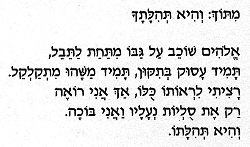
From: And That Is Your Glory
Underneath the world, God lies stretched on his back
always repairing, always things get out of whack.
I wanted to see him all, but I see no more
than the soles of his shoes and I'm sadder than I was before.
And that is his glory.
—Amichai (1962, 1977 ed.:71–72;
translated by Bloch and Mitchell in Amichai, 1986:11–12)
Framed by its title and refrain, the poem also alludes to an obscure piece of liturgy for the Days of Awe that the average reader cannot identify since it is not found in the abbreviated versions of the machzor, the holiday prayer book many synagogue goers use. Amichai alerts the reader to the allusive context by including a parenthetical remark next to the title—“(from a liturgy for the Days of Awe)”—but does not tell us where to find it, nor who the liturgical poet is. Furthermore, the title and refrain require not only the identification of this allusion but also a scholarly “excavation” of the rare paradoxical meaning of tohola (“fault,” “imperfection,” as in Job 4:18) alongside
the normative sense of tehila (“praise,” “glory”). The combination of the domestication of God and an intertextual, etymological critique constitutes Amichai's typical stance (see Arpali 1986:114–119). This bivalent position has led critics and readers alike to observe that Amichai's poetry is at once easy and difficult, accessible and elusive, familiar and strange. (See Tzvik, 1988:12–14, 29–30.)
Ironically, this simultaneous use of contradictory poetic beliefs is commonly associated with the conceptual structure of the category modernism in general. But Amichai's particular form of ambivalence leads him in part away from the modernism of his—and his generation's—Anglo-American prototypes. This further complication adds two interesting questions to an investigation of Amichai's poetics. First, how can the very ambivalence toward the modernist prototypes embedded in his poetry point to Amichai's own modernist affiliation? And, second, what use is it to talk about his modernism if the very turning away from one of its trends can itself be seen as a modernist practice? A closer examination of what it means for Amichai to be or not to be affiliated with Hebrew and international modernism might help shed some light on the particular ways in which he has come to serve as a paragon of his generation while remaining—in many important ways—on its margins.
The poetry of the entire third modernist wave of the Statehood Poets demonstrates an ambivalent position toward these complex trends. The explicit poetics (manifestoes, public proclamations) of Amichai's generation proclaimed it to be a late modernist, neoimagist grouping. However, the implicit poetics, reconstructed from the poets' actual works, contains many principles which subvert or go beyond the modernist stance, whether they are a reaction against the moderna of the pre-Statehood Generation or a partial withdrawal from—and modification of—the newly imported Anglo-American prototypes. These contradictory trends, though, are manifested much more fully in Amichai's own poetry than in the poetry of his fellow central poets of the Statehood Generation, in particular Nathan Zach, who along with Amichai and, somewhat later, Dahlia Ravikovitch is often identified as the core poet of this generation. Precisely for this reason Amichai's poetry and poetics offer an intriguing challenge to any attempt to view modernism on the model of marginal prototypes.
Modernism was always a self-referential literary movement, although this fact does not make self-reference itself into a sufficient condition for modernism.[4] The choice of affiliation among modernists
was usually quite deliberate and often entailed the compulsion either to join or to form groups of like-minded artists, in what Douwe Fokkema (1984:11–12) has termed the “sociocode of modernism.” Each group would then usually provide public declarations of its explicit poetics to distinguish itself from other groups. Not only do the icon-oclastic manifestoes of Filippo Tommaso Marinetti and the Italian futurists before the First World War set the stage for this type of writing, but the futurists remain perhaps the most salient example of the self-conscious, manifesto-publishing literary group; after the war that role falls to the dadaists, who made the manifesto into a full-fledged literary genre that embodies—again self-referentially—its own necessary and imminent destruction. These modernist groups were intent on supplying the readers as well as the critics with programmatic credos stating their aesthetic and ideological goals, goals they often deviated from—in significant, even systematic, ways—in the implicit poetics of their literary practice.
Amichai's generation of Hebrew modernist poets, led by the activist paragon Zach, follow this familiar pattern, and perhaps because of the trend's belatedness, their explicit poetics often read like self-referential allusions to the famous “high-modernist” manifestoes. Given all this, Amichai's participation in the formation of Statehood Generation groupings remains highly ambivalent. He was a founding member of Likrat, the modernist group whose magazine published the neoimagists' works and manifestoes in Israel during the early 1950s. But Amichai himself never actually signed any public credos and never wrote any manifestoes; to this day he regards himself as only a marginal member of the Likrat group. His only credo, as he once told an interviewer, is his noncredo: ha-ani ha-lo ma'amin she-li (“my nonbelieving I” or “my ‘I don't believe’”).[5]
Amichai's ambivalent relation to Likrat is acknowledged even by Zach, a cofounder of the group and its self-appointed spokesperson throughout its various transformations. Even though Amichai never publicly articulated a binding set of aesthetic principles for his own poetry, Zach, always quite keen on the manifesto as a metapoetic genre, points to Amichai as a salient prototype of Statehood Generation poetics. In Zach's major manifesto of 1966, titled “On the Stylistic Climate of the Fifties and Sixties in Our Poetry” and better known as tet-vav ha-nekudot (the fifteen points), Zach (1966a) provides a checklist of necessary and sufficient conditions for the poetry of his generation. Zach's list is revealing precisely because this type of def-
inition cannot work for modernism or for that matter for any literary trend. With perhaps a touch of self-irony, Zach finds himself at once citing Amichai as the internal paragon, the most salient example of the third trend of Hebrew poetic modernism, and also acknowledging Amichai's deviation from the various strictures of the fifteen points.
In point (a), Zach prescribes: “Opposition to the quatrain,[6] because of its excessive symmetry and static nature.” Zach then continues by citing an example from Amichai that, he claims, successfully breaks the “squareness” of the line. But Amichai clearly and consistently prefers the quatrain, especially in his early poetry, to which Zach refers in the 1966 manifesto. Zach is then forced to qualify his very first principle by saying that Amichai finds ways to break the static symmetry of the quatrain, especially through the use of enjambment, even while continuing to write stanzas in quatrains. Zach encounters similar trouble when he states in point (d) that free verse should be embraced as a rule for the generation's poetic goals. But he immediately qualifies the prescription by saying that Amichai's rhythms continue to be free even though, in this early period, they are often based on more or less regular tonic-syllabic metrical schemes. Zach cannot minimize the importance of Amichai within the neomodernism of the 1950s and 1960s, but he is forced to acknowledge that Amichai's implicit poetics provides a limit case for the explicit poetics that he, Zach, is trying to establish as the mainstream of the trend. While Amichai's poetry has since undergone many changes, his work continues to present complex challenges to any orthodox notions of literary affiliation.
Solutions to these challenges become especially elusive because Amichai rarely thematizes the aesthetics of poetry in his poems, or at least he never presents his poems as overt statements of metapoetic pronouncement. This fact in itself points to Amichai's ambivalent modernism since poems about poetry have often been considered by poets and readers alike as a quintessential modernist gesture; modernist poets have made poetry, modernity, metaphor, or poetic language in general the subject of their poems. From Paul Verlaine's “Ars Poétique” to Wallace Stevens's “Of Modern Poetry,” modernists have used their poems to explore the aesthetic, philosophical, and even the most technical metapoetic questions about their work. In the entire corpus of Amichai's work, by contrast, only a handful of poems actually thematize the poetic process; and even these few present themselves as if they don't.
However, while Amichai shuns the metapoetic use of poetry, he does compensate for it with a meditative concern for language, ordinary language, especially the kind that is traditionally considered quite unpoetic. Grammatical constructions, everyday trite phrases, and word etymologies are commonly thematized by the speaker in Amichai's poetry. But despite this concentration on the possibilities of language, Amichai's speaker never presents himself as a poet contemplating the possibilities of poetic language; for Amichai, language never goes beyond the quotidian, the realness of the everyday and colloquial. Rather than make metapoetic assertions, Amichai's speaker consistently takes on the character of an ordinary human being thinking about ordinary language. His demystification of the written word and the concomitant privileging of ordinary discourse explain why for Amichai the poem about language replaces the poem on poetry, just as journalistic interview—with its emphasis on colloquial speech, dialogue, and direct communication between people—replaces the manifesto as metapoetic genre. The poet, Amichai said during a visit to the University of California at Berkeley in 1986, is the lowest of the low; but that, he added, is the greatest achievement a poet could possibly strive for. In typical Amichai fashion, which refuses to take on any elevated role for the poet, Amichai has always claimed that he writes poetry because he is too lazy to do anything harder. For the poet, as for the reader, poetry should be easy because it is ordinary language—not any privileged poetic diction—which is magical, inexhaustible, and, if one only pays attention, infinitely complex.[7]
The privileged and complex status accorded to ordinary language is brilliantly exhibited in the early poem “Sonet ha-binyanim” (“The Verb-Pattern Sonnet”) (Amichai, 1962, 1977 ed.: 64–65). In this poem, Amichai offers a spectacular, utterly untranslatable account of life as changing grammatical constructions. The universal second-person addressee in the poem is caught within the structure of language, within the morphology of Hebrew verb forms, making the rocky journey from active to passive action, with a final, self-fulfilling stop in the reflexive. But the point is not the modernist and postmodernist cliché about the trap of the sign. Neither is this poem merely a series of puns on the traditional names of the patterns created by Hebrew verbs. Rather, through sustained verbal play with the correlation between the name of a pattern and its thematic, human significance Amichai seems to suggest, with perfect seriousness, a maximalist view of the power of dry, ordinary language. The triconsonantal roots and the verb patterns “built” around them[8] are the very core of the
grammar of the Hebrew language. In this grammar—its precision, nuances, and modulations (Amichai often uses the adjective “precise,” meduyak, derived from the same root as “grammar,” dikduk, as a poetic—even romantic—compliment)—Amichai finds true poetry, material for the late modernist revival of the Hebrew sonnet. Taking a few basic roots through the dizzying transformations that make up Hebrew verb patterns, he also tells the story of a human life. The following verbs and paradigms diagram the transformations that constitute the journey of a life within the poem (X representing a consonant variable that can be filled by any lexical root in Hebrew):
Verb | Paradigm | Function |
LIXOX | KAL | active |
XAXUX | PA'UL | passive |
NIX'AX | NIF'AL | middle voice/agentless |
XAXEX | PI'EL | active |
XU'AX | PU'AL | passive |
MAX'IX | HIF'IL | causative |
MOX'AX | HOF'AL | passive |
MITXAXEX | HITPA'EL | reflexive |
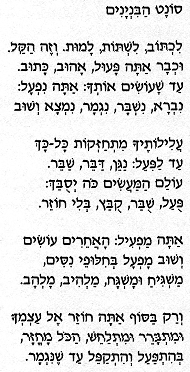
The importance of the poetic function of conjugation does not rest on the accuracy of the grammatical insight. After all, it is a gross oversimplification to assert such an automatic, predictable correlation between verb pattern and syntactic-semantic function in Hebrew. The main point of the poem is how “mere” grammar can be made to tell such a fascinating meditative story about life's processes. Drawing attention to the linguistic medium and orienting the reader toward the signifier rather than the signified are inherently modernist gestures; through a particularly modernist defamiliarization of semantic features within Hebrew, the poem forces the native reader to perceive grammar in a new, philosophically charged way. But the way Amichai expresses his point—the abandonment of standard thematic presentation in favor of an expressive thematization of grammar that follows a mimetic paradigm—both upholds and subverts basic modernist tenets at the same time. The valorization of language, its ability to express meaning and convey ontological truth, goes against the modernist concern with language's inability to signify (a position which Zach represents consistently).
Amichai's view that poetic language is no more creative and insightful than grammatical forms and the discourse of ordinary people becomes a central feature in another early poem, “El male' rachamim” (“God Full of Mercy”) (Amichai, 1962, 1977 ed.:69–70). In this famous poem, however, Amichai speaks self-consciously about the relations of poet to language, especially concerning the problems of difficulty within a modernist poetic discourse. At one important and yet subdued moment in the poem, the speaker says of himself: ani she-mishtamesh rak be-chelek katan min ha-milim she-ba-milon (“I who use only a small part of the words in the dictionary”). This simple declaration reveals Amichai's ambivalent attachment to modernism. The speaker here objects to the poetics of difficulty so common to many modernist trends, from German expressionism to Anglo-American imagism and vorticism. He is just another member of the speech community, whose experiences with humans and with God have taught him the superiority of simple literal language to lofty poetic diction. Those experiences have taught him, as the title and first three lines suggest, to take the trite metaphor el male rachamim (God full of mercy) literally, thereby unmasking its inverse meaning: “God full of mercy, / If God weren't so full of mercy / There would be some mercy in the world and not just in him” ([1962] 1977 ed.:69; translation mine).
In his later work Amichai goes even further, radically challenging the very distinction between various forms of language—ordinary, poetic, scientific—and between linguistic action and real-life action. In the poem “Ba-yom she-bo nolda biti lo met af ish” (“On the Day My Daughter Was Born No One Died”) Amichai obscures the typographic distinction between poetry and prose.
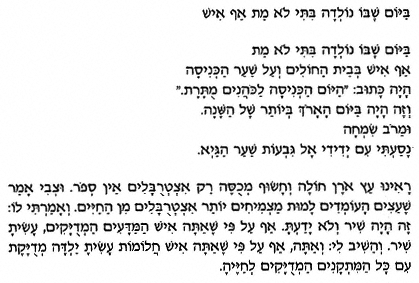
On the Day My Daughter Was Born No One Died
On the day my daughter was born not a single person
died in the hospital, and at the entrance gate
the sign said: “Today kohanim are permitted to enter.”
And it was the longest day of the year.
In my great joy
I drove with my friend to the hills of Sha'ar Ha-Gai.
We saw a bare, sick pine tree, nothing on it but a lot of pine cones.
Zvi said trees that are about to die produce more pine cones than
healthy trees. And I said to him: That was a poem and you didn't
realize it. Even though you're a man of the exact sciences, you've
made a poem. And he answered: And you, though you're a man of
dreams, have made an exact little girl with all the exact instruments
for her life.
— Amichai (1980:44; translated by Bloch and Mitchell in Amichai, 1986:131–132)
The poem takes the form of a reported conversation between the speaker, an aging poet whose wife has just given birth to their daughter, and his scientist friend, Zvi. Within this dialogue, the poem builds an important analogy between the aging poet, who is still producing both poems and babies, and, on the hills at the outskirts of Jerusalem,[9] some dying pine trees that, as a matter of botanical fact, produce more pine cones than young, healthy trees; interestingly, the analogy is built as a traditional poetic simile. But in the dramatic situation of this poem, the poetic qualities of the simile are attributed to the spontaneous speech of Zvi, the scientist, who knows the right botanical facts about trees, and not to the conventions of the literary institution within which the reader ultimately finds this simile—namely, the poetic text. This reversal—on the level of theme—of the traditional roles of poetic and nonpoetic discourse is echoed closely in the generic structure of the text.[10] The poetic first stanza gives way to prose as the spontaneous speech of the scientist subverts the lyrical ruminations of the old poet. There is no sense here of a professionalization of language or poetry, or any sense of a necessity for difficulty in poetic discourse; the point of this poem is expressed clearly, meaningfully, and prosaically by a scientist, who within traditional terms is the opposite of the poet. Thus, an egalitarian view of the poetic language is effected, a view which is much more characteristic—within the Anglo-American models of Statehood Generation poetry—of the work of the antimodernist critics of elitist modernism: W. H. Auden, George Orwell, Philip Larkin, and others (see Lodge 1981: 3–16).
Amichai's redefinition of the poet's status may be motivated by specific reactions to traditional poetic models within the Hebrew literary system as well as to international modernist movements generally. In Chaim Nachman Bialik's premodernist verse, the poet is seen not only as a prophet but also as a mother, giving birth to the tear/poem/prophecy; clearly, Amichai's poetic persona, especially in a poem like “El male' rachamim” works against precisely this type of poetic model. But Amichai's poet equally distrusts the poet qua linguistic magician, a view that continues to predominate in the work of the moderna poets of the first wave of Hebrew modernism. Ironically, the motivations for Amichai to reject the elitism of a Pound, with all its subsequent links to fascism and antisemitism, also cause him to deny the special powers that had been attached to the Hebrew poet within a Jewish nationalist or socialist framework.
Shimon Sandbank (1976:173–214) and other critics, by showing the influence of Rainer Maria Rilke and Auden on Amichai, have pointed out the poetic complications that arise from these combinations of disparate influences and reactions. The specific qualities that can be associated with Rilke and Auden in Amichai's work demonstrate the ways in which selective modeling of modernist and antimodernist prototypes helps form Amichai's particular style of ambivalent modernism: Rilke as the paragon who represents Amichai's orientation toward protomodernist poetics; and Auden representing his tendency toward an antimodernist critique. Instead of creating a homogenized unity from the combined models of his predecessors, Amichai maintains the individual strands of each and uses the differences between them as a source of tension that informs his own discourse strategies. Thus, Amichai's need to maintain a rhetorical impression of accessibility remains consistent with the Auden prototype, while his emphasis on innovation, surprise, and reversal of conventional meaning stays true to the Rilke one. Amichai's use of Auden and his use of Rilke are closely interwoven and not in the least because, as Sandbank (1976) has shown, Auden himself, though critical of Rilke, was also greatly influenced by him.
Amichai's combination of readability and elusiveness, familiarity and surprise, is perhaps best illustrated by his unique use of metaphor. The long autobiographical poema “Travels of the Last Benjamin of Tudela” is an important but often neglected poem that reflects on many of the issues that Amichai faces as both a modernist and an antimodernist poet. It offers many excellent examples of Amichai's ambivalence through his use of metaphor. Metaphor, in effect, is the overarching principle of the poem's organization: a fragmented, simultaneous journey of the adult protagonist into “everything that I had,” a nonlinear spiritual autobiography which is also “an autobiography of the world.”[11] This journey to the past of the speaker and of his culture is modeled, metaphorically, on the travels of Benjamin of Tudela,[12] Amichai self-consciously placing himself at the end of this generic tradition. This parodic point of departure is significant, for in its intertextual cycles the very possibility of presenting a life—or a literal journey—in linear fashion is denied, at the same time that it is attempted again and again.
In the middle of the second strophe, as the speaker attempts for the first time to describe his childhood and capture what it was like to see
the world through the eyes of a toddler, there appears a complex catalogue of similes which forces the adult perspective onto the child's:
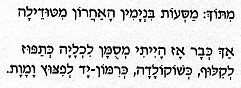
From: Travels of the Last Benjamin of Tudela
But even then I was marked for annihilation like an
orange scored
for peeling, like chocolate, like a hand grenade for
explosion and death
—Amichai ([1968] 1975:97;
translated by Bloch and Mitchell in Amichai, 1986:60)
The fragmented catalogue of similes is prototypical within modernist trends like expressionism and imagism in its focus on the simultaneous, paradigmatic aspects of language rather than on linear, syntagmatic, and logically coherent sequence. Furthermore, a striking semantic and stylistic distance between the frames of reference of the tenor and the first two versions of the vehicle within the catalogue enhances the initial incongruity of the two lines. The selection of the colloquial shokolada and tapuz, rather than their more formal equivalents, shokolad and tapu'ach zahav, for “chocolate” and “orange,” respectively, contrasts with the grand and tragic mesuman li-khlaya (“marked for annihilation”). The switch mid-metaphor to metonymy with the third vehicle (a hand grenade) further complicates the figurative structure of the catalogue; the hand grenade—the instrument of death—is like the victim, implying perhaps that the child is destined not just to be killed but also to kill.
What first appears fragmented and distant—and ultimately modernist in its apparent incongruity and lack of cohesion—actually becomes closely integrated by intricate image schemas that mitigate or bridge the semantic distance between the terms of the metaphor. Various thematic and linguistic clues absorb the vehicles into a quasiliteral frame and thus, subverting modernist tendencies, make the metaphor simple and visually accessible despite its radical novelty.
For example, the visual and associative cohesion within the vari-
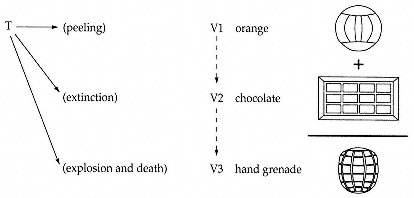
Fig. 4.
Amichai's composite image schema (T = Tenor; V = Vehicle).
ous versions of the vehicle—orange, chocolate, and hand grenade—reveals a composite visual collage that links the entire metaphoric process (see Figure 4). The mapping of one image (the chocolate bar divided into little squares) onto another image from the same domestic realm (the orange scored for peeling) produces a visually realistic motivation for the unexpected, deadly member of the catalogue (the hand grenade). The hand grenade is “simply” a “mapping” of the chocolate bar onto the orange scored for peeling, an inviting looking chocolate orange. From a child's point of view, the adult's powerlessness before the inevitability of death is given shocking sensual immediacy. In typical fashion, Amichai enhances the accessibility of this metaphor through the use of junction words, polysemies which apply—in a different sense—to the domain both of the tenor and the vehicle: the verb k-l-h (“finish off”) is used with reference to both chocolate and life. The poetic message seems to be that ordinary language, not the poet's privileged sensibility, brings together the mundane and the philosophical. Even more poignant is the use of rimon yad as a junction term, returning it to the literal meaning (“hand grenade” in Hebrew literally means “pomegranate of the hand”); thus, for one ironic moment the hand grenade becomes yet another food item on the list.
The larger context of these charged lines enhances the realistic motivation for the use of such radical figures of speech. The items in the catalogue are, for the most part, selected from the immediate experiential field of a child but seen from the war- and death-fearing
perspective of the adult. Hence the semantic distance between vehicles in this catalogue of similes is simply a realistic expression of the simultaneity of these two points of view, the child's and the adult's, so common to the genre of autobiography. In the end, the combination of surprise and simplicity, or of the attempt to present the novel and surprising as simple and readable, produces a uniquely cohesive metaphor. Amichai's metaphors follow this same bifurcated pattern of ease and difficulty throughout his poetry: at first, a wild, often playfully violent conflation of heterogeneous semantic material but—after a second look—a combination so natural that we begin to wonder why no one has made it before.
We have seen in Chapters 4 and 5 similar effects created by Amichai's uses of intertextuality to critique both the internal tradition of decorous pastiche and the elitist classicism of Anglo-American modernist allusion. In “Two Hopes Away” Amichai again plays with the combination of simplicity and complexity in one of his most favorite intertextual domains: the biblical allusion. “Two Hopes Away” is part of a quatrain cycle entitled “The Right Angle.” All the quatrains in the cycle are conceived with geometric precision as belonging in the right angle “between a dead man and his mourner” (Amichai, 1962, 1977 ed.: 153; 1986:29). Death, war, and fire imagery become recurring motifs. The quatrain “Two Hopes Away,” the title poem for Amichai's second book of poetry (1958), centers on the survivors and victims of the War of Independence. But in several of the other quatrains in the cycle Amichai extends this frame of reference to include those who survived or perished in the German death camps of the Second World War. Within this thematic setting Amichai introduces an allusion to the epiphany of the burning bush in Exodus 3:
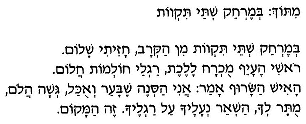
From: Two Hopes Away
Two hopes away from the battle, I had a vision of peace.
My weary head must keep walking, my legs dreaming apace.
The scorched man said, I am the bush that burned and that was
consumed:
come hither, leave your shoes on your feet. This is the place.
—Amichai (1962, 1977 ed.: 153;
translated by Bloch and Mitchell in Amichai, 1986:28)
The most striking feature about this traditional allusion is, of course, its antitraditional nature. The antitraditionalism of the allusion is generated by a series of role reversals between the sacred and the secular. The speaker of “Two Hopes Away” is a weary foot soldier, hallucinating about peace a reified “two hopes away” from the battle.[13] His is a thoroughly antiheroic epiphany, for he is no Moses, and there is no God speaking from the burning bush. Rather, the symbolic bush is replaced by the literally burnt/burning comrade. But while there is no miracle, the very trial by fire makes the burnt man—like Tiresias in Eliot's Fire Sermon in “The Waste Land”—into the true oracle. There is no transcendent, sacred authority present before whom the surviving soldier must remove his shoes, as he feels compelled to do. Instead—and this is the point of the deflation of the miraculous and of the sacred—it is he and his fellow soldiers that are sacred; the power of the epiphany resides in them. In a play on words that highlights precisely this reversed function of the sacred and the profane, the speaker says, “This is the place,” meaning also “this is God,” since makom is one of the common euphemistic names for the deity. The divine promise of rescue from the enemy in the verses of the evoked biblical text that follow the burning bush narrative is deflated by its contrast with the emphasis on human suffering. Moreover, the human and divine roles are completely reversed, with the poetic epiphany deeming the ordinary human victim the only truly sacred authority.
Amichai's celebration of the ordinary and deflation of the sacred becomes the larger ideological framework within which he articulates a critique of modernism. But the anticlassicism of this particular allusion is also an example of Amichai's rejection of the elitist, intentionally difficult, use of allusion in Anglo-American modernism. However, this rejection does not allow Amichai to remove completely the label of modernist. In a move that is also typically modernist, Amichai's almost obsessive use of biblical and liturgical allusion demonstrates that a poet can effect the simultaneous activation of two texts and their implied contexts, thereby overcoming the linear confines of language. Moreover, the poet can produce intricate, innovative, and iconoclastic
deviations from the norms and conventions set by those evoked texts, and yet appear perfectly lucid and completely accessible to the general reader or professional critic. Hovering on the borders of poetic affiliation, embracing modernism yet escaping it, Amichai seeks for the poet a state of syncategorematic existence, a state between ontological and aesthetic categories, a state he calls beyna'yim or “interims”:[14]
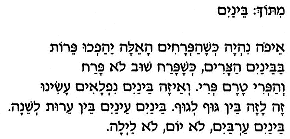
From: Interims
Where will we be when these flowers turn into fruit
in the narrow interims, when flower is no longer flower
and fruit not yet fruit. And what a wonderful interim we made
for each other between body and body. Interim eyes between
waking and sleep.
Interim dusk, neither day, nor night.
—Amichai (1989:35; translation mine)