
Roland Simounet
Pouillon's sweeping approach to architecture and urban design and his radical interventionism vis-à-vis site conditions present a contrast to the architecture of Roland Simounet. Simounet's responsive and imaginative buildings gained him respectable status and a place among Chevallier's leading architects, despite his relative youth and his blatant disapproval of the aesthetic sensibilities of Pouillon, the mayor's chief architect.
Simounet was greatly inspired by the work of Le Corbusier, but he was also a careful student of Algerian architectural culture, with a focus on the Algerian vernacular. His architecture was shaped by the lessons he learned from European modernism, his respect for the site, and his inquiry into vernacular residential forms (including squatter houses) and patterns of daily life and ritual.[42] In a retrospective evaluation in 1980 that maintained the fervor of the debate of the 1950s positing Pouillon and Simounet as polar opposites, Pierre-André Emery, another Algiers-based architect of Le Corbusier's school, criticized Pouillon's urbanism by suggesting that he could have learned a thing or two from the contextual approach of the turn-of-the-century Austrian architectural theorist Camillo Sitte and dismissed Pouillon's architecture for being "very personal" and not relating either to the site or to the local context. Simounet's work, in contrast, stood out with its "plastic language that had evolved naturally , allowing [the architect] to resolve new problems simply "—in the words of Jean de Maisonseul, another member of the same circle.[43]
Simounet's first housing project was a collaboration with Parisian architects A. Daure and H. Béri, who had won a competition to design the vast complex of La Montagne, intended solely for Muslims in 1955.[44] Located above Bel-Air and to the west of Maison-Carrée on the hill of the same name, the settlement consisted of two parts: "col-
lective" housing (walk-up apartment blocks) on the summit and individual houses on the slopes (Fig. 81). Communal facilities, namely a market, shops, baths, and "Moorish cafés," constituted the rest of the program.[45]
The architecture of La Montagne displayed Simounet's respect for the customs and habits of the future residents, especially in the design of individual units. The apartments in the longitudinal blocks of the collective housing had an unusual plan type, with two loggias facing opposite directions (Fig. 82). The living room (with a kitchenette) was sandwiched between the loggias, and the two bedrooms were interconnected, resulting in a peripheral circulation pattern. The architect separated the elementary functions that occurred in the courts of the "traditional" houses: the narrower loggia in the back acted as the entry zone, whereas the front loggia housed the water closet. Cross-ventilation, "indispensible in Algeria," was provided in all spaces. The tiny kitchenette, however, squeezed in a corner of the living room, was not adequate for cooking for large families.
The architectural conception of the individual house stemmed from the "independence of the entrance from the kitchen and the patio—both reserved for women."[46] Units with one or two rooms were placed in rows, and the topography of the site was utilized to energize the overall massing of the settlement. The entrance of each unit was through a small court, to which a general room, the bathroom, and the abri (a sheltered but not enclosed space where the kitchen was placed) opened (Fig. 83). Separated from the entrance, the garden became a private place. In the larger units, a second room, in line with the first, connected to the garden. The "horizontal" housing in La Montagne was developed on the basis of a prefabricated construction system consisting of load-bearing walls and double-shelled (ventilating) vaults. Responding to the irregular topography, the siting of the rows allowed for the vaults to be oriented in three directions, thereby introducing a subtle plasticity to the overall composition. Two reasons dominated the choice of vaults: to evoke the picturesque character of indigenous forms and to discourage vertical additions that would increase densities and damage the unity of the nuclear family. In the housing discourse of the time, overcrowding and cohabitation were considered "destroyers of family life."[47]
The architecture of the shops and workshops echoed that of the "horizontal" housing in its attempt to create an "indigenous" environment (Fig. 84). Rows of shops under vaults repeated a regular pattern that accommodated prefabricated construction techniques in four types responding to different needs. Capitalizing on his knowledge of local

Figure 81.
(above) Roland Simounet, A. Daure, and H. Béri, Cité La Montagne, model, 1955.

Figure 82.
(below) Simounet, Daure, and Béri, Cité La Montagne, plan of units in an apartment block,
1955. (1) living room, (2) bedroom, (3) water closet, (4) kitchenette, (5) entry, (6) loggia.
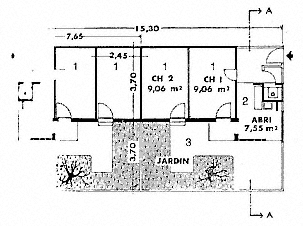
Figure 83.
(above) Simounet, Daure, and Béri, Cité La Montagne, plan of low-rise
unit, 1955. (1) room, (2) shelter, (3) garden.

Figure 84.
(below) Simounet, Daure, and Béri, Cité La Montagne, plan of shops, 1955.
lifestyles, Simounet created sitting areas for informal socialization in front of shops, as well as inside some, and gave the majority of shops a private court in the back.[48]
"Horizontal" housing, now considered most appropriate for the most recent immigrants to Algiers because they had the strongest ties to rural living, was also envisioned for Cité Dessoliers in the Ste.- Corinne quarter of Maison-Carrée. Roland Simounet's contribution to this settlement, commissioned to several teams of architects, was a cellular scheme that attempted to relate to the slight slope of the site. Consisting of two rooms, courtyard, kitchen, abri, and water closet, the individual unit duplicated many characteristics of La Montagne.[49]
Despite their problematic initial collaboration, in 1957 Simounet worked with Daure and Béri on another housing project, the Cité Carrière Jaubert, named after the stone quarries nearby.[50] Carrière Jaubert was part of an experiment in "transit housing" to provide temporary shelter for the residents of demolished bidonvilles, who would eventually be moved to newly built permanent housing projects. Considered as a "transit hotel," a caravansary around a vast courtyard, the complex would shelter sixteen hundred apartments in a tripartite composition. Of this ambitious scheme, only the central unit was realized, reducing the original program by half.[51]
The result was a huge, fortresslike structure, a long rectangular building around a narrow courtyard that maintained its references to a large caravansary (Fig. 85). The regularity of the plan was deceptive, as the architects used several devices to animate the massing. The building adhered to the topographic conditions, with the heights of different sections varying along with the sloping site. The fragmented silhouette attempted to inscribe the building into the site in a manner reminiscent of the old stone quarries.[52]
The units were kept small, with the majority consisting of two spaces, an 18-square-meter living room and a 7-square-meter loggia. Simounet's drawings of the interiors revealed the architect's vision of life in these units, where nothing was permanent and the sparse furnishings were transportable (Fig. 86). Two variations accommodated larger families: a "twin" unit, formed by combining two neighboring units, and a duplex. Every unit received light and cross-ventilation. There were, however, no washing and toilet facilities in individual apartments, but a communal lavatory could be reached by means of the back corridor, the latter considered an inner "street" that periodically opened up onto a "communal space." The concentration of hygienic facilities

Figure 85.
Simounet, Daure, and Béri, Carrière Jaubert housing, axonometric view.
stemmed from economic considerations but also fit the idea of a caravansary and could be easily justified as communal places derived from local culture. References to traditional living patterns were reiterated by drawing parallels to the public fountain and the bath, the hammam. Issues of privacy related to gender differences—a recurrent theme in the discourse on the Algerian home life—were totally ignored.[53]
Following his architectural collaborations, Simounet had the opportunity to work independently on a housing project, the Djenan el-Hasan. Widely published and discussed, this project established Simounet's reputation as one of the most talented architects in Algiers. In the vicinity of Climat de France, on the southern slope of M'Kacel Valley, the 210 units of Djenan el-Hasan were intended to rehouse temporarily one thousand former residents of the demolished bidonvilles in the area. Confident in his knowledge of the residents' lifestyles and former living conditions, and experienced in low-cost housing issues, Simounet accepted the challenges of the project—the difficulty of the site and the economic restrictions—with great enthusiasm.[54]
The scheme, described as "between vertical and horizontal," accommodated eight hundred inhabitants per hectare, compactly settling as a series of terraces on the steep slope of the terrain (Figs. 87 and 88).[55] The superimposed uniform, vaulted units reinterpreted, rationalized, aestheticized, and synthesized the lessons Simounet had derived from the

Figure 86.
Simounet, Daure, and Béri, Carrière Jaubert housing, sketches and plan of units, 1957.
casbah and the bidonville. The overall image borrowed at the same time from the architecture of Le Corbusier, in particular the 1949 Roq et Rob project in Cap St. Martin—a particularly relevant scheme in the "Mediterranean" tradition and on a dramatically steep site. Rationalizing the street network of the casbah, Simounet developed here a complex circulation system that responded to the site and opened up to communal
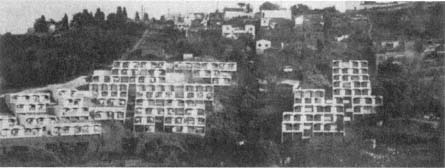
Figure 87.
(above) Simounet, Djenan el-Hasan, overall view, 1959.
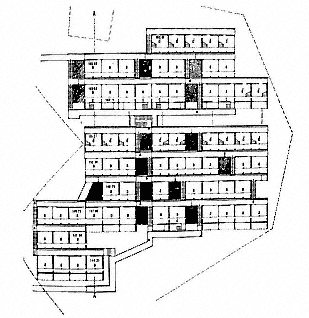
Figure 88.
(below) Simounet, Djenan el-Hasan, partial site plan, 1958.
spaces. It consisted of two interconnected networks: single-level paths and stepped paths. Horizontally laid out paths on leveled terraces served the individual units, as well as separating them from the concrete foundation walls of the neighboring terraces above. Stepped paths in staggering rows ran perpendicular to the horizontal ones and the contours of the land. A public patio was placed next to each staircase for ventila-
tion and good views. All existing trees on the site were preserved and "productive trees" (mainly fig trees) were planted in the communal zones.
Siting principles and the circulation system made the units "strictly independent" and gave them "absolutely uninterrupted views." A strictly modular system, derived from Le Corbusier's Modulor, organized the complex and the two types of apartments. The first type consisted of a single room, about 12.4 square meters large, and a loggia of 4 square meters; a water spigot and the toilet were located on the loggia. Each room boasted "a well-lighted corner" and "permanent ventilation" from the French windows (porte-fenêtres ) that connected the living room to the loggia, and the door that opened to the alleyway behind. The second type was a duplex. Its upper level replicated all characteristics of the first type, while its lower level was made up of a single room; an interior stairway linked the two stories.
The load-bearing walls in concrete masonry blocks carried the vaulted, tile-covered roof. The blocks were deemed to provide good thermal insulation and resistance to rainwater and wind. On both the interior and the exterior, the walls were whitewashed. The sanitary system was enclosed within the construction, with access doors at the top for easy repairs. This avoided the previously common practice of breaking open the walls to get at the pipes.[56]
Simounet's apartment designs recalled closely the ones he had developed for Cité Carrière Jaubert, both projects intended for the most destitute members of the Algerian population. Aside from the gridlock of their economic situation as recent immigrants to the city, these people were confronted with a new lifestyle, in their encounters not only with urban colonial culture, but also with an Islamic urban culture. As recorded over and over by French ethnographic studies, life and the forms that accommodated life were drastically different in the Algerian countryside—a phenomenon whose correspondence to the differences between Arabs (urban) and Berbers (rural) was insistently stressed. The housing developments of Djenan el-Hasan and Carrière Jaubert focus on this difference as well as the transitional situation of the immigrants which Simounet had studied in the bidonvilles:[57] fitted within a strict matrix, the residential units themselves resemble nomadic structures. They provide basic shelter, and their grouping reinterprets and regularizes the "organic" quality of gourbis . In these projects Simounet developed a new dwelling type distinct from the "horizontal" schemes and the multistory blocks with apartments essentially based on European
precedents. Despite their intended "temporary" status, the buildings embodied a powerful permanency due to their architectural imagery and construction techniques—in contrast, for example, to the single-story barracks next to Diar el-Mahçoul built as temporary housing, which seemed ready for dismantling at any time.
Another issue raised by Djenan el-Hasan and Carrière Jaubert is the degree of commitment to the "civilizing mission" of French colonialism. A consideration of the sanitary facilities in these projects—as well as all other projects to varying degrees—reveals conflicts between enforcing hygienic reforms and considering economics. Given that the sanitary amenities of indigenous housing had been a major point of criticism by the French, the provisions in the housing built for new immigrants cast doubts on the sincerity of efforts to improve the living conditions of local populations. In view of the resulting hygienic facilities (bathrooms and kitchens, but especially bathrooms), the elaborate lip service paid to the "customs and needs" of "indigenous people" seems in conflict with the agenda to "civilize." The residents were persistently denied the most basic technological comforts of European "civilization" in the very projects intended to ease their transition to a better life.
Like Carrière Jaubert and other "transitional" housing projects, Djenan el-Hasan eventually became permanent shelter. Nevertheless, lack of space had turned into a major issue immediately after completion of the settlement. According to projected figures at the time of the development's conception, an average of five people would live in each unit in Djenan el-Hasan.[58] Mainly due to the continuous flow of new immigrants joining their extended families, this number turned out to be much higher. As the tight site plan did not allow for any incremental growth—an essential characteristic of squatter housing—the only answer to lack of space was to turn the loggia into living quarters. This intervention robbed each apartment of its breathing space and transformed both the quality of the well-lighted and well-ventilated interior and the plastic integrity and aesthetic rhythm of the exterior. The numerous materials employed in the later additions were chosen for their cost and availability, rather than in light of the original construction. The result was an overall patchy appearance that again disrupted the formal purity of Simounet's design. Finally, to make up for the loss of the loggias, the residents installed horizontal rods from their windows to dry their laundry, pushing the limits of their units into the open air, as the residents of 200 Colonnes and other new housing projects had done.[59]