
3—
Impossible Objects:
Apparitions, Reclining Nudes, and Chopin's Prelude in a Minor
"Oh! no, indeed, this [Prelude in A Minor] is no concert piece," wrote André Gide. "I cannot see any audience liking it. But played in a whisper for oneself alone, its definable emotion cannot be exhausted, nor [a] kind of almost physical terror."[1] Gide's proposal to turn Chopin's baffling miniature into a pretext for private reflection is less a solipsistic gesture than a helpless one. The Prelude in A Minor positively resists both esthetic and analytic understanding. Much of it is deliberately ugly by early-nineteenth-century standards, and arguably by ours. Its harmonic processes are perplexing by any standards. Latent continuities can be teased out of the piece, as out of most others, but the value of doing so is questionable. The A-Minor Prelude is not enigmatic on a measure-by-measure basis, despite an important block of undecidable harmonies. It is not riddling but disruptive: it repeatedly breaks away from structural or textural patterns while maintaining a deceptive uniformity in melody and accompaniment. From a hermeneutic standpoint, the question that needs to be asked of this music is not what deep structure holds it together, but rather what motivates it to keep breaking apart. I will try to give some answers to that question in the present chapter,
[1] From Gide's Notes on Chopin , cited in the Norton Critical Score: Preludes, Op. 28 , ed. Thomas Higgins (New York, 1973), 96.
answers that gradually ramify to include the ill-assorted items named in my title. As one interpretive pathway after another opens up, so should most of the musical processes at work in the prelude—and so, too, should a group of culturally ascendant models for representing the very things that André Gide singles out in his little aperçu: the reflecting mind and the reflected body.[2]
I
Like several other pieces in Chopin's Op. 28, the Prelude in A Minor unfolds by negating its own apparent premises. It begins with two measures of glaringly dissonant accompaniment figuration; it ends after completing two strains of smooth, sinuous melody from which almost all accompaniment has fallen away (mm. 17–18, 20–22; Example 10). Taking this framework as a hermeneutic window, we might try to understand the prelude itself as a study in reversal or, more precisely, as a study in dialectic, conceived of in nineteenth-century terms as a series of dynamic oppositions that lead to reversals of meaning or value.[3]
Romantic writers tend to associate dialectical reversals with heightenings of subjective intensity—ideally, with advances in insight or self-possession, but more often with mental pain. The closing stanzas of Keats's "Ode to a Nightingale" are exemplary:
7.
Thou wast not born for death, immortal bird!
No hungry generations tread thee down;
The voice I hear this passing night was heard
In ancient days by emperor and clown. . . .
[Perhaps] the same that oft-times hath
[2] For another attempt to link the problematical features of the A-Minor Prelude to nineteenth-century culture, see Rose Rosengard Subotnik, "Music as Post-Kantian Critique: Classicism, Romanticism, and the Concept of the Semiotic Universe," in On Criticizing Music , ed. Kingsley Price (Baltimore, 1981), 87–95. Subotnik carries her argument further in "On Grounding Chopin," in Music and Society: The Politics of Composition, Performance, and Reception , ed. Richard Leppart and Susan McClary (Cambridge, 1987), 105–32.
[3] My formulation here is loosely Hegelian. For an overview of dialectical thought in the Romantic period, see M. H. Abrams, Natural Supernaturalism: Tradition and Revolution in Romantic Literature (New York, 1971), 174–77 and passim.
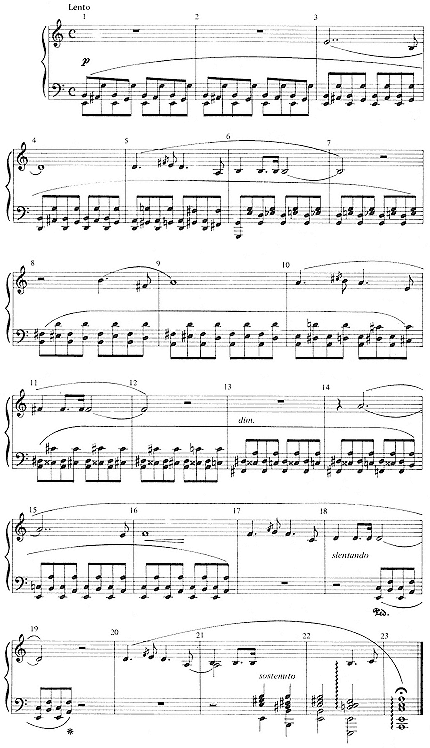
Example 10
Chopin, Prelude in A Minor, Op. 28, no. 2.
Charm'd magic casements, opening on the foam
Of perilous seas, in faery lands forlorn.
8.
Forlorn! The very word is like a bell
To toll me back from thee to my sole self!
The chiasmatic structure of this passage is complex in detail but clear in outline; it can be schematized roughly by saying that the pair immortal bird/faery lands forlorn is reversed by the pair Forlorn! The very word/sole self . Stanza 7 begins with an apostrophe to the nightingale that posits a fantasy of immortality; as it closes, the stanza seeks to stabilize the fantasy in the image of the faery lands forlorn that are enchanted by the nightingale's song. Stanza 8 disrupts this effort by turning the evocative term forlorn into a memento mori that "tolls" the poet back to disenchantment and the sole (singular, solitary, one-and-only) self. (Tolls: like a passing bell, a clock chime, or the morning bells traditionally said to banish faery spirits.) The reversals encompassed here are both psychological and epistemological. Fantasy gives way to consciousness of fantasizing; absorption in poetic imagery, to consciousness of poetry as language; and consciousness itself, to self-consciousness.
Dialectical reversals can also embrace unconscious processes, though they typically do so with a certain transparency. The epilogue to Coleridge's Christabel includes a good example:
A little child, a limber elf,
Singing, dancing to itself,
A fairy thing with red round cheeks,
That always finds, and never seeks,
Makes such a vision to the sight
As fills a father's heart with light;
And pleasures flow in so thick and fast
Upon his heart, that he at last
Must needs express his love's excess
With words of unmeant bitterness.
(656–65)
The surprising close of this passage derives from a double twist of dialectic. Wrought to excess, the father's love expresses itself in the form of anger. Pleasure comes all too "thick and fast"; it turns into a feeling of suffocation that demands a violent release. Meanwhile, the father's pleasure is vexed by more than its own excess. "Singing, dancing to itself," the child—who hovers imponderably between the fictional Christabel and Coleridge's own son, Hartley—acts out a blissful self-sufficiency. As the terms fairy thing and elf suggest, the father is enchanted by this, but he is also dispossessed by it, as if the child were a changeling. More than that, he is stricken with a pang of unconscious envy: the resentment of the adult who has lost the art of always finding and never seeking. Coleridge's term unmeant bitterness thus needs a certain Freudian revision. The bitterness is unmeant only by the father's conscious ego, which represses his defeated longing to become once more the "limber elf" of his own childhood. The father's words form an unconscious speech act; their aim is not so much to rebuke as to address the child, to intrude on the undivided self-address of its singing and dancing to itself.
A first approach to Chopin's A-Minor Prelude might link the music both to Keats's conscious and Coleridge's unconscious dialectics. Keats's contrast between the untroubled nightingale and his own much-troubled mind loosely resembles Chopin's contrast between plaintive melody and abrasive accompaniment. Both contrasts seem to raise the same question: Is pure songfulness a consolation or a lie? Meanwhile, the process by which Chopin arrives at the most basic reversal in the prelude—the reversal from unmelodized accompaniment to unaccompanied melody that frames the work—can be taken to suggest the same sort of unconscious conflict that Coleridge renders transparent. The accompaniment figuration plies its angular monotony for sixteen measures, then abruptly stops while the melody continues unimpeded. On its return (m. 183 ), the accompaniment seems damaged, uncertain; the tempo slackens, and the pedal, used only here, dulls the once hard-edged sonority. A silence quickly intervenes (m. 193 ); then the melody returns without accompaniment and leads the piece to a close. Given the expressive polarity that divides the melody from the accompaniment, it is tempting to hear the vacillation between the two as a musical analogue to the
psychological defense mechanism known as doing and undoing—the classical manifestation of unacknowledged ambivalence.[4]
Taking these first surmises as points of orientation, we can begin to probe more deeply into the musical processes of the prelude. On the largest scale, dialectical movement appears in this piece as a gradually unfolding antagonism between melody and harmony. Melodically, the prelude consists of two parallel statements of a slowly descending theme, which itself consists of two parallel strains. During the first statement (Example 10, mm. 3–12), the melodic line is made up essentially of chord tones, and the melodic cadence of the first strain coincides with the first harmonic cadence (m. 6). As the second strain concludes, however, the accompanying harmony suddenly vaporizes into ambiguity just at the point where a cadence is expected (m. 11). The second melodic statement (mm. 14–21) is basically an elaboration of (local) dissonances, which, as we have seen, twice silences the previously implacable accompaniment. At first an articulation of the harmony, the melody evolves into the antithesis of the harmony.
This reversal rests on a group of important background processes.[5] In his analysis of the A-Minor Prelude, Leonard B. Meyer points out that the large-scale melodic design is based on the establishment, disruption, and resumption of a process—the linking of melodic phrases by common tones—while the harmonic design involves the "decisive" disruption of a process that is not resumed—the harmonic progression established at the outset (mm. 1–7).[6] Meyer calls this relationship between melody and harmony a parallelism, but it is more like an incongruity, and the prelude unfolds by turning it into a many-sided process of dissociation. Not only do the harmonic and melodic articulations of form pursue different courses, but they are also asynchronous—indeed, asynchronous twice over. Melodically, the breakdown of common-tone linkage divides the prelude at m. 142 , where the disruptive melody-note, A, begins the process that
[4] This defense mechanism was first described by Freud in his case history of the "Rat Man"; see Freud, Three Case Histories , ed. Philip Rieff (New York, 1963), 50–51.
[5] The terms background and foreground are used throughout this chapter in a generalized, not necessarily Schenkerian, way to mark off relative degrees of structure and ornament.
[6] Leonard B. Meyer, Emotion and Meaning in Music (Chicago, 1956), 93–97.
stabilizes the large-scale structure.[7] By contrast, the original harmonic cycle breaks down at m. 11 during a melodic cadence, where the disruptive chord begins the process that de stabilizes the large-scale structure. Similarly, the melodic shape of the work is defined by a pair of equal and parallel periods (mm. 1–122 , 123 –23). Each of these begins with bare accompaniment figuration and overlays it with the slowly descending melodic line. Harmonically, the piece divides into unequal and complementary segments at the junction of mm. 14 and 15, where the tonic-to-be materializes for the first time out of what has come to seem hopeless tonal ambiguity.
Only in the last two and a half measures are melody and harmony realigned, but here they are not so much reconciled as fused together, rendered indistinguishable from each other as the second melodic statement becomes the upper voice of the block-chord progression that acts as a coda. The arpeggios introduced at the last moment (mm. 223 –23) dramatize this conflation of antithetical elements. After teasing melody and harmony further and further apart, the prelude closes by collapsing the difference between them. It is suggestive that only at this point of expressive collapse do we get a tonic cadence,[8] so that in some sense the cadence completes the composition less than it negates it. This feeling of forced termination is heightened by the rather intrusive effect of the unembellished block chords, which usurp the place of the fantastically dissonant accompaniment figuration and thus call attention to the formulaic, in context even archaic, quality of the closing cadential pattern.
The unresolvable clash between melody and harmony represents Chopin's way of staging a larger dialectic between Classical authority and Romantic innovation—a dialectic whose very definition prejudices it in favor of Romanticism. The melodic design of the prelude pays homage to the Classical demands for balance and resolution,
[7] M. 14 = m. 14, beat 2. The details of large-scale stabilization (from m. 14 ) and destabilization (from m. 11) are discussed below.
particularly the symmetrical resolution that Charles Rosen sees as central to the Classical style.[9]
The second melodic statement can be heard as a resolution of the first at two levels of structure. Ignoring a grace note in m. 10, the first statement uses only a single pitch, F


At a more background level, the resolution of one melodic statement by another depends on the structural use of a single interval. As Michael Rogers has pointed out, the first melodic statement articulates the descent of a minor seventh (E to F
As my account may already have suggested, the melodic half of Chopin's dialectic in the A-Minor Prelude is itself conceived dialec-
[9] Charles Rosen, The Classical Style: Haydn, Mozart, Beethoven (New York, 1972), 99.
[10] Michael Rogers, "Rehearings: Chopin, Prelude in A Minor," 19th-Century Music 4 (1981): 244–49.
tically. In keeping with its classicizing impulse, what might be called the melodic prelude identifies dialectical reversal with structural resolution. In the process, it even approximates the figure of chiasmus in its large-scale design. The chiasmatic pairs are formed by the tones that outline the structural sevenths, E—F
By casting his melodic reversals as resolutions, Chopin suggests that even a music of doing and undoing can stabilize itself in the light of tonal laws. And if dialectic always posits a subject, an "I," of the dialectic, then that suggestion can be rewritten as the claim that subjective intensity is not doomed to collapse into either self-consciousness or unconsciousness.
The harmony of the prelude has other ideas. Like the melody, it forms a dialectic in its own right, but not one much given to stabilizing itself. Anticlassical and antinomian, the harmonic prelude carries the process of reversal to a dizzying extreme.[11]
Consider first the large-scale tonal plan. The prelude makes only two full cadences, one in G major, the other in A minor.[12] The two keys divide the piece, but only by disjunction; they must be understood as utterly unrelated to each other. In particular, G does not represent the flat seventh degree of A, to be related to A via plagal
[11] Rogers (ibid.) points to a latent Classical element by suggesting that the harmony of the prelude is aligned with a formal segmentation based on golden sections. If Rogers is right, Chopin may be tacitly (intuitively?) placing a limit on the harmonic disruption that he explicitly cultivates.
[12] The piece is sometimes said to begin in E minor, but it would be more accurate to say that it begins as if in E minor. The E-minor triads of mm. 1–3 form a static tonal level, not a key. Although they feint at marking a tonic, their only confirmed function is vi of G—a fact that led Schenker to declare unequivocally that the prelude begins in G major (Heinrich Schenker, Harmony , ed. and annot. Oswald Jonas, trans. Elizabeth Mann Borgese [Cambridge, Mass., 1973], 252). Those with a more monotonal view of tonal music than my own might prefer to speak of cadences to G minor or other tonal levels.
movement through D major. Such a movement, initiated in mm. 9–10, is emphatically aborted by the harmonic mishap in m. 11, which begins with an alteration of D to D
Several dialectical determinations converge on these events. The harmonically undecidable chain of chords in mm. 11–14 represents an enhanced form of the most conspicuous feature of mm. 1–10, the grating nonharmonic dissonance of the accompaniment. With the appearance of the chain of chords, the normal relationship of structure to ornament is reversed. The dissonance can no longer be rendered coherent by subordination to an underlying harmony, while the harmony of the prelude as a whole is—in Classical terms—rendered incoherent by subordination to the dissonance. At best, the juxtaposition of G major and A minor that results might be understood, taking A as the tonic, as a harmonic articulation of the structural interval of the minor seventh that underpins the melodic design. The G-major cadence in mm. 5–6 can be heard to reach its long-term resolution (or at least its undoing) when its melody makes an essentially note-for-note return in mm. 20–21 in the context of A minor. In each case, the A–B step that brings about the melodic cadence also completes the large melodic descent of a minor seventh. The distribution of harmonies would thus seem to be modeled on the intervallic design of the melodies without reference to the principles of Classical tonality. And this produces yet another dialectical irony, since it is the melodic design alone that links the piece to the Classical style.
The harmonic details of the Prelude are no less vertiginous than its broad architecture. And whereas the melodic prelude tends to identify resolution with reversal, the harmonic prelude tends to replace resolution with reversal as the dynamic principle of the music.
In its first ten measures, the prelude follows what seems to be a cyclical harmonic process, more or less as described by Meyer:

The submediant chords in this progression provoke uncertainty; the six-four chords impart clarity. The initial sonorities of G major and D major assume their submediant character only in the light of subsequent six-four harmony. The six-four chords, though unstable as local dissonances, orient and stabilize the larger harmonic structure.
Following the harmonic collapse of mm. 11–14, these values are reversed. Clarification now comes not from a six-four chord but from a fictitious submediant, namely the French sixth at m. 144 , which stands in for the earlier submediant chords by the placement of its bass note on the sixth degree of the minor scale. The placement is emphasized by the important

This role reversal is subsequently compounded as the six-four harmony, which on both of its earlier appearances had resolved without much delay, is subjected to a long and dissonant prolongation. Chopin now opens out the inherent instability of the chord and converts it into a source of such drastic tension that the newly achieved tonic quality of A minor is actually thrown into doubt.
II
What motivates this web of dialectic reversals, this self-interfering mesh of ironies? One answer lies in the position of the A-Minor Prelude in the cycle of preludes as a whole. Part of Chopin's purpose in the cycle is to confront the classical foundations of musical co-
[13] Other instances are noted in my Music and Poetry: The Nineteenth Century and After (Berkeley and Los Angeles, 1984), 94, 102.
herence by putting them under stress from a wide variety of sources.[14] With the A-Minor Prelude, he does this to the main principle of coherence of the cycle itself, the arrangement of the pieces around a double circle of fifths that pairs each major key with its relative minor. The cyclical process starts with the Preludes in C Major and A Minor. By holding back the identity of its tonic, the A-Minor Prelude defers the recognition of the inaugural major-minor pair. More than that, by suggesting G major as a tonic in its opening measures the prelude even makes a feint at the wrong circle of fifths, a single movement through the major keys.
Within the prelude itself, Chopin seems to be pondering the relationship between subjectivity—more particularly the too-keen subjectivity of dialectic—and musical time, which in this case means time as harmonized. By beginning in medias res with uncertain harmonies and employing six-four chords to resolve them, Chopin in mm. 1–7 highlights one of the distinct privileges of tonal music: the establishment of musical meaning by means of an integrative process that combines recollection and anticipation. The parallel design of mm. 73 –9 confirms that this heightened shuttling before and after the immediate moment is, so to speak, the subtext of the G-major half of the piece. Recollective movement then shatters against the harmonic brick wall of mm. 11–14, and musical time now shapes itself by anticipation alone. The French sixth of m. 14 has no functional relationship to anything that precedes it. The chord can be recognized at all only because of its distinctive whole-tone sonority, and its only role is to issue the demand that A emerge as the tonic. The A-minor six-four chord that follows is, of course, equally proleptic; it arouses a harmonic expectation that rises in intensity to an almost anxiety-laden expectancy as the chord ceases to sound and the mandatory dominant resolution is deferred. The slowing of tempo that ensues as the first melodic strain leads away from the dominant adds a notable turn of the screw. But the peak of tension, and the astonishing climax of the piece, comes in the full silence that occupies the second half of m. 19, a moment in which the musical fabric is constituted entirely by the listener's heightened expectation of a
[14] For a full discussion of this aspect of the preludes, see ibid., 92–95, 99–104.
dominant chord. The moment is so supercharged that more than one pianist has defended against it by holding the pedal down to the end of the measure.
Anticipation without recollection is a possible definition of desire. Romantic poetry in particular is full of passages that construe desire as pure prolepsis, from Wordsworth's definition of the human as "Effort, and expectation, and desire,/And something evermore about to be," to Goethe's injunction, "Schneller als die Gegenstände/Selber dich vorüberfliehn!" ("Swifter than the objects/Flee past your [present] self!"). In the same spirit, the structure of concentrated anticipation at the core of the A-minor Prelude refashions the tonic of the Classical style in the image of desire. There is no longer a "home key," a tonal center that is (or seems) intrinsic to the music; there is simply what the ear wants to hear, what it cannot bear not to hear. And yet, in one last reversal, the cadential pattern that closes the prelude is distinctly disappointing when it arrives, muffled by the motionlessness of its upper voice and depreciated by the conventionality of its block chords. The silence in m. 19 informs us that Keats was right: heard melodies are sweet, but those unheard are sweeter. Romantic desire always expects something . . . else.
III
To review our findings thus far, Chopin's dialectical design in the A-Minor Prelude relocates the focus of specific musical actions (not just general effects) from the object to the subject: in the melodic prelude by an idealized union, and in the harmonic prelude by a radical disjunction. Similar reorientations are basic, even in their similar internal contradictions, to most Romantic critiques of language and knowledge. The underlying attitude is epitomized by Wordsworth's claim that a world of objects uninformed by subjectivity constitutes "a universe of death" (Prelude [1850], 14.160). But other aspects of Chopin's design remain to be considered; we can go much further than this.
Why, in particular, does Chopin incorporate his multiple dialectical patterns within a single continuous texture? And why has he combined so many different patterns, superimposing them on one another in a kind of loose conceptual polyphony? One answer lies in
the recognition of a structural trope that forms or pictures what might be called impossible objects—taking the term object to refer to the target of powerful feelings, as in the phrase object of desire . Objects in this sense are usually symbolic representations of persons, in which form they figure prominently in psychoanalysis. What I call an impossible object is a body or body-substitute (image, body part, sensory presence) with three salient characteristics: (1) it is excessive either in beauty or deformity; (2) it arrests an observer by its irrevocable strangeness; (3) it exerts a fascination that arouses desire, repulsion, or both at once. The curious magnetism of impossible objects has its roots in the same self-consciousness that propels Romantic dialectic; the objects act either as self-images or as erotic ideals for those who confront them.
An account of impossible objects in their own right will occupy us for the next several pages. The digression, however, is only apparent, a necessary corollary of the kind of study I am attempting here. What follows is meant to help establish a cultural position for the A-Minor Prelude, and to develop ways of understanding further musical details.
Perhaps the best introduction to the impossible object is a little parable by Kafka called "A Crossbreed," which tells of a "curious animal, half kitten, half lamb," who at times "insists almost on being a dog as well," and may also have "the ambitions of a human being." Among many remarkable things pertaining to his relationship with this animal, Kafka's narrator singles out one occasion
when, as may happen to anyone, I could see no way out of my business problems and all that they involved, and was ready to let everything go, and in this mood was lying in my rocking chair in my room, the beast on my knees[.] I happened to glance down and saw tears dropping from its huge whiskers. Were they mine, or were they the animal's?[15]
The animal, as impossible an object as one could wish, is imbued with a surplus of the narrator's subjectivity. Continually touching him in intimate places—the lap, between the legs, on the ear—it
[15] Franz Kafka, "A Crossbreed," in The Complete Stories , ed. Nahum Glatzer (New York, 1976), 427.
brings to life an unintegrated fragment of his psyche, symbolically set apart from him as a bodily incoherence. By embracing the animal while rocking in despair, the narrator is tacitly preparing to recover something of himself, something associated with the tears he should have shed, or has shed unknowingly. When he sees—recognizes—the tears, he acknowledges both his identity with the animal and the strong feelings that his apathy has disavowed.
The nineteenth century sometimes seems to have been overrun by impossible objects, many of them more equivocal than Kafka's animal. (Kafka himself, who counts here as an honorary nineteenth-century writer, has another one, an animate/inanimate biped/spool who/that is pure equivocation. Named "Odradek," a word of equivocal origins, the object may embody Kafka's texts; "[It] does no harm to anyone that one can see," he writes, "but the idea that [it] is likely to survive me I find almost painful.")[16] A glance at a few more instances will prove to be helpful with Chopin's prelude.
In Wordsworth's "Resolution and Independence," a speaker beset with anxiety—"the fear that kills;/And hope that is unwilling to be fed"—tries to restore an earlier state of joy through his encounter with an impossible object, an old leech gatherer who seems "not all alive nor dead,/Nor all asleep":
Motionless as a cloud the old Man stood,
That heareth not the loud winds when they call;
And moveth all together, if it move at all.
(75–77)
The rest of the poem traces a dialectic between the speaker's desire to draw "human strength" from this strange figure and his impulse to keep all of his subjectivity locked within himself. "Longing to be comforted," he puts some questions to the old man; when the answers come, he promptly wards them off—literally ceases to hear them as he withdraws to the privacy of his mind's eye:
The old Man still stood talking by my side;
But now his voice to me was like a stream
Scarce heard; nor word from word could I divide;
[16] Kakfa, "Cares of a Family Man," in ibid., 429.
And the whole body of the Man did seem
Like one whom I had met with in a dream.
(106–10)
Eventually, the speaker works through most of his resistances and adopts the image of the old man as a kind of magical charm against future anxiety. It is worth noting that when Lewis Carroll parodied "Resolution and Independence" in Through the Looking Glass , he seized unerringly on the themes of psychological deafness and the poet's "noble health."
A second literary instance can be taken from E. T. A. Hoffmann's "A New Year's Eve Adventure." The tale introduces us to Erasmus Spikher, a man who has lost his mirror image because of his infatuation with a daemonic mistress. (He also appears to have two faces, one young, one old.) Spikher is both a real person and an alter ego for the narrator, the Traveling Enthusiast. A victim of erotic delirium, Spikher embodies the Enthusiast's own supercharged and transgressive sexuality, together with a dread of sexual inadequacy.[17] These forces have almost destroyed the Enthusiast's ego, but he is able to subdue (if not master) them after a seemingly chance encounter with Spikher. Looking into a mirror, the Enthusiast sees an increasingly radiant image of his beloved, together with a reflection of himself so pale and tired he can barely recognize it. Shortly afterward, looking into the same mirror with Spikher at his side, he sees—and instantly recognizes—himself and no one else.
On Spikher's first appearance in the tale, his cloak undulates as if it were "a series of forms . . . dissolving and emerging from one another, as in Ensler's magic lantern show."[18] Hoffmann's allusion is to a highly popular form of entertainment that, for much of the nineteenth century, filled European cities with impossible objects. Based on the technology that would eventually produce slide and film projectors, magic lantern shows were purveyors of apparitions, most of them associated with supernatural terror or violent death. Though obviously "impossible," these ghosts and phantoms impressed con-
[17] The Enthusiast repeatedly refers to the "dried-up" Spikher as "the little man," a term that would be suggestive enough even if it were not also a common German euphemism for the penis.
[18] Best Tales of Hoffmann , ed. E. F. Bleiler (New York, 1967), 110.
temporary observers as astonishingly real, the more so as technology improved. Terry Castle, who has studied this phenomenon closely, suggests that the effects of the specter shows rested on an epistemological confusion. Developed when belief in spirits had "more or less definitively" begun to disappear under the pressure of scientific rationalism, the shows brought the spirits back as figments of the imagination. But not mere figments: the shows, writes Castle, "induced in the spectator a kind of maddening, irrational perception: one might believe ghosts to be illusions . . . but one experienced them here as real entities, outside the boundaries of the psyche. The overall effect was unsettling—like seeing a real ghost."[19] Unsettling though the effect may have been, however, its popularity tells us that it was also highly gratifying. The epistemological confusion seems to have been just what audiences wanted. For what the specter shows offered was a respite from demystification and rationality, a way to revisit the world lost to Enlightenment by perceiving apparitions both inside and outside the mind. The nostalgia satisfied thereby is a constant presence in the nineteenth century, from "Ode to a Nightingale" and the epilogue to Christabel , with their thwarted longing for faery things, to the later development of spiritualism and spirit photography.
In the broadest terms, impossible objects are products of an epistemological/topographical discourse in which human subjectivity ceases to be a common field and becomes, instead, a secret recess. No longer a shared sameness, the self is an essential difference; its watchword is a form of self-consciousness dramatically announced on the first page of Rousseau's Confessions : "I am made unlike anyone I have ever met; I will even venture to say I am like no one in the whole world."[20] Once conceived in these terms, the subject—call it the Romantic subject—is most often represented as an enclosure filled with conflicting impulses, a site "beset/With images, and haunted by itself" (Wordsworth, Prelude [1850], 6.159–60). This mental activity is so restless and prolific—and so like a specter show—that the subject is constantly threatened with separation from the outer world. And
[19] Terry Castle, "Phantasmagoria: Spectral Technology and the Metaphorics of Modern Reverie," Critical Inquiry 15 (1988): 49–50.
[20] Jean-Jacques Rousseau, The Confessions , trans. J. M. Cohen (Baltimore, 1953), 17.
not just in literature: the nineteenth century recognized excessive reverie as a medical disorder. Impossible objects mitigate the excesses of Romantic subjectivity by absorbing a piece of it. The objects are projected fragments of the subject's incoherence, fragments stabilized—or at least constrained—by the trope of embodiment. As such they assume an ambivalent fascination that, with luck, can reanchor the self to the world. The ego, to borrow a formula from Freud, creates in order to avoid falling ill.[21]
Impossible objects tend to disguise their origin in such desperate creation by seeming unmotivated, context-free, inexplicably present. Often enough, they simply turn up when most needed by a "peculiar grace," a "something given" ("Resolution and Independence"). That is why, uncanny though they are, the leech gatherer, the lamb/kitten, and even Erasmus Spikher all possess a certain healing quality. The leech gatherer, for example, in keeping with his occupation, heals by wounding; he provides both an embodiment of Words-worth's fears and the means to allay them. Yet impossible objects are hardly safe to idealize. All of them pose the risk of making subjective fragmentation worse, not better, and at worst, like the gigantic insect in Kafka's Metamorphosis , they can imprison the "whole" self in a symbol for one of its fragments. A startling example of such an all-too-impossible object appears in one of Théodore Géricault's anatomical studies (Figure 1). The painting shows two severed legs, placed crosswise and covered by an arm. That would be all, the stuff of the artist's field work in the dissection room, except for one thing: the arm is positioned so that it gives an uncanny impression of embracing, caressing, the legs. The erotic value normally thought proper to the body as a whole—especially to the painted figure—is displaced onto the body in pieces, so that whole and part, and even self and other, become arbitrary distinctions.
When it comes to music, we find impossible objects at their most familiar in the form of bravura pieces. The "transcendental" aspect of Romantic virtuosity, the satanic mystique of Paganini and the daemonic/erotic aura of Liszt, derived in part from the sense that these musicians were driven to create works of superhuman diffi-
[21] Sigmund Freud, "On Narcissism: An Introduction," in Freud, General Psychological Theory , ed. Philip Rieff (New York, 1963), 67.
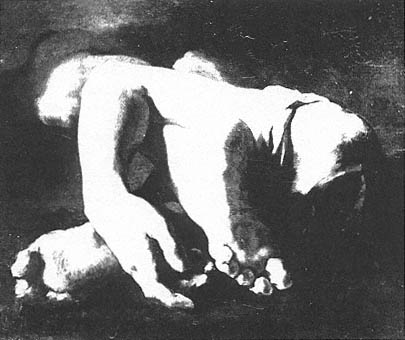
Figure 1
Théodore Géricault, Study of Dissected
Limbs (1818–19). Musée Fabre, Montpellier.
culty—objects impossible to anyone but them. This makes the identification of the composer/performer as a charismatic, all but indescribable presence essential to the expressive situation. The esthetics of bravura reduces music to sound production. What the audience sees is a theatrical icon of the inspired musician; what it hears is a highly charged extension of the performer's touch, breath, rhythm: the body electric, in Walt Whitman's phrase. Hence the cultivation of certain physical peculiarities (Liszt's long hair, Paganini's emaciated pallor) and hence, too, the many cartoonlike caricatures of musicians like Paganini, Liszt, Berlioz, and Wagner. (Composer/conductors had a bravura of their own.) Robert Schumann recognizes much of this syndrome when he remarks that "the Viennese, especially, have tried to catch the eagle [Liszt] in every way—through pursuits, snares, pitchforks, and poems. But he must be heard—and also seen; for if Liszt played behind a screen, a great deal of poetry
would be lost."[22] The performer at center stage, be it Liszt playing solos by Liszt or Wagner conducting Beethoven, acts out a scenario in which a figure like a rhapsodist exorcises the burden of his excessive passion or self-consciousness. Schumann describes Chopin's own playing in just these terms: "I [w]ould never forget how I had seen him sitting at the pianoforte like a dreaming seer, and how one seemed to become the dream created by him while he played, and how it was his terrible habit, at the close of every piece, to travel over the whistling keyboard with one finger as if to tear himself forcibly from his dream."[23] Not even Brahms was immune from the allure of this musical specter show. Clara Schumann did not call his "Paganini" Variations "Witches'" Variations for nothing; she knew what their difficulty signified.
Beyond the matter of performance lie questions of musical design. Some compositions are "impossible" not because they are abnormally hard to play but because they are musical Odradeks: they sound abnormal, and cannot be made to sound otherwise. By combining expressive insistence with formal perplexity, such works present themselves less as reworkings of a paradigmatic musical order than as concretizations, material em-bodiments, of the composer as a subject. (One historical index of this process is that composers identified with it tend to be snapped up as icons of subjectivity: the "stormy" Beethoven, the "sickly" Chopin.) Beethoven's "La malinconia" and Wagner's Tristan und Isolde , to select from works discussed elsewhere in this volume, are model instances of the impossible object in music, and so too, with its reiterative texture and crazy quilt of structures, is Chopin's A-Minor Prelude. We already know that the dialectical features of the prelude link it to the struggle of the Romantic subject to interpret and master its own intensities. By recognizing the prelude as an impossible object, we can move on to interpret what I characterized earlier as the conceptual polyphony of the music: its play of one dialectic against another, its multiplicity of superimposed patterns. This constructive incoherence can be taken as a trace (projection, embodiment) of the self-haunting incoherence that no Ro-
[22] Robert Schumann, On Music and Musicians , ed. Konrad Wolff, trans. Paul Rosenfeld (New York, 1969), 156.
[23] Ibid., 135.
mantic subject can escape, and that must be stabilized in order to bridge the gap between self-absorption and the social/material world.
Going further, we can ask what features of the prelude seem particularly expressive of the subjective incoherence that becomes articulate in impossible objects. The accompaniment stands out at once: a conspicuously abnormal and abrasive pattern, all the more compelling because it is played softly. The accompaniment is the feature that concretizes the effect of embodiment in the musical foreground. As we know, however, one of the basic processes in the prelude is the undoing of the accompaniment, something achieved negatively by abrupt curtailments and affirmatively by the little block-chord coda. The coda might be understood, accordingly, as a turn toward normalization, a repression of embodiment marked by a bland cadential formula. Dialectically understood, however, the coda sounds rather different. Implausible as its cadence may be, its block chords add a material fullness to the music: the warm sound, withheld until this point, of close-position harmonies. With this sonority (enhanced by registral placement and arpeggiation) the coda preserves the effect of embodiment—the chordal resonance being no less problematical and overintense than the intervallic friction it replaces.
Another effect of embodiment can be found in the structural background. Example 11 is a graph of the melodic prelude; it shows the two structural descents of a minor seventh in relation to the melodic foreground. What the graph reveals is that the first half of the work is founded on symmetry. The structural tones of the melodic strains marked a and b form the same intervallic pattern: major second, minor third. In the second half of the work, both the symmetry and the intervallic pattern break down. The strain marked c follows the intervallic pattern: major third, minor third; the last strain, d , condenses this to a minor third alone. This shift from fixity to dynamism has at least three consequences: (1) it establishes the minor third as the preeminent structural interval, and this in dynamic terms: the interval rises in value as the work proceeds; (2) it gives extra intensity to the tone
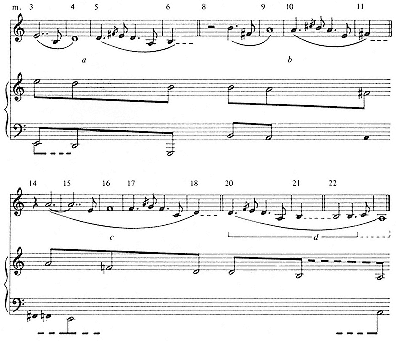
Example 11
Chopin, Prelude in A Minor, Op. 28, no. 2. Melodic graph.
pattern minor third, major second—the retrograde of the pattern established by strains a and b . This resolution-by-reversal, however, occurs only outside the structural boundaries of the minor-seventh descents—occurs, that is, as a disruption. By thus problematizing a boundary and accentuating a tone and an interval, the melodic prelude invests its structural background with an overdetermined effect of embodiment. That is to say: the discourse of the Romantic subject penetrates this music to a level of structure that its composer lacked a vocabulary to describe, the level, so to speak, of the musical unconscious.
IV
The harmonic prelude, too, offers a further provocation to commentary. The harshest passage in the work (mm. 11–14), where the melody freezes and the harmony stops making sense, can be heard as a disruptive interlude between one melodic descent of a minor sev-
enth and the other. Similar disruptive interludes, both brief and extended, are frequent in music between Beethoven and Mahler, and probably trace their lineage to the Romanza of Mozart's D-Minor Piano Concerto. The interludes destabilize the recapitulated material that follows them, in feeling or texture if not in structure. Even the Cavatina of Beethoven's String Quartet in B

Thus in the Andantino of Schubert's late Piano Sonata in A Major, the plaintive opening gives way to a middle section that mounts steadily to a climax of extreme violence. The violence gradually ebbs away, but when the opening returns it is doubly disturbed: by a stabbing counterpoint above it and a new, uneasily rocking accompaniment below. The closing measures avoid—or more exactly, dispel—a cadence and die away deep in the bass on a nerveless plagal progression (iv–i [prolonged]–i). The harmony forms an intimation that the seemingly bygone violence is cyclical, unexhausted. The plagal progression, right down to its voice-leading, is identical to the earlier progression that forms the transition to the disruptive interlude (mm. 65–68).
Perhaps the most extravagant instance of this structural trope occurs in Berlioz's Symphonie fantastique , where the body of the entire third movement can feel like a disruptive interlude between the English horn solos that frame it.[24] As Schumann notes, the movement reaches its climax as the idée fixe "undertakes to express the most fearful passion, up to the shrill

Literary versions of the disrupted interlude are based on reflection—both the mind's and the eye's; they depict some kind of
[24] Beethoven, as I noted in Chapter 2, provides the prototype for this kind of extravagance in the opening movement of the Piano Sonata Op. 111.
[25] Robert Schumann, "A Symphony by Berlioz," trans. Edward T. Cone, in Berlioz, Fantastic Symphony , the Norton Critical Score, ed. Edward T. Cone (New York, 1971), 237.
mirror image that is distorted when the surface in which it appears is approached or breached. In most cases, the spectator idealizes the original sight of the image, but the disturbance brings about a change in value, so that the image afterward comes to evoke loss or frustrated desire. The disrupted image has the potential to grow increasingly seductive, even persecutory, as the desire that it elicits becomes insatiable. Its role, however, is complicated by the fact that the Romantic subject often shows a compulsion to disrupt idealized reflections precisely in order to set its own desire beyond all limits. Another way to describe this is to say that the interlude transforms the original reflection into an impossible object.
In the "Witches' Kitchen" scene of Goethe's Faust , for example, Faust stands mesmerized before a mirror, "now approaching it, now standing off":
What do I see? A form from heaven above
Appears to me within this magic mirror!
Lend me the swiftest of your wings, O Love,
And lead me nearer to her, nearer!
Alas! but when I fail to keep my distance,
And venture close to where she rests
Her image dims as if enwrapped in mist!
(2429–35)[26]
The impetus for Faust's mirror play is his demand as a subject for insatiable desire, which he can gain only if the reflection remains unattainable, an erotic ideal. Ignoring Mephistopheles' offer to "track down such a sweetheart" for him, Faust keeps his place at the mirror. He soon admits, "I'm going completely crazy" ("Ich werde schier verrückt"), but he cannot tear himself away.
A similar pattern appears in Coleridge's "The Picture." This poem is narrated by a split subject, an "I" who declares himself to be free of a hopeless love, and a "he" who persists in loving. "I" recalls that "he" once spied the reflection of the beloved in a stream, only to have her disrupt it with beheaded flowers (!):
[26] Johann Wolfgang von Goethe, Faust , ed. Cyrus Hamlin, trans. Walter Arndt (New York, 1976), 59. Translation modified.
Then all the charm
Is broken—all that phantom world so fair
Vanishes, and a thousand circlets spread
And each mis-shapes the other. Stay awhile,
Poor youth, who scarcely dar'st lift up thine eyes!
The stream will soon renew its smoothness, soon
The visions will return! And lo! he stays:
And soon the fragments dim of lovely forms
Come tumbling back, unite, and now once more
The pool becomes a mirror.
(91–100)
When the mirroring surface renews itself, however, the idealized image is gone. "I" then addresses "he" ironically, urging the "ill-fated youth" to intensify his misery until it becomes a madness that will reinstate the image as an impossible object:
Go, day by day, and waste they manly prime
In mad love-yearning by the vacant brook,
Till sickly thoughts bewitch thine eyes, and thou
Behold'st her shadow still abiding there,
The Naiad of the mirror!
(107–11)
The irony of these lines is obviously double-edged: "I" has been busily doing what he projects for "he," and the startling catachresis, "The Naiad of the mirror," can be read against "I" as a sign of his reenchantment. It comes as no surpise when "I" collapses back into "he" at the end of the poem. Desire is prized here, ultimately by "I" and "he" alike, exactly to the degree that it consumes the desiring subject. In this connection, it is worth recalling the fragment by Wordsworth that we encountered in the last chapter. When Wordsworth wants to preserve an idealized image from subjective excess, what he does is preserve a reflection from being shattered.
Like these episodes from Goethe and Coleridge, Chopin's A Minor Prelude makes a disturbed reflection the sign of subjective extravagance. The parallelism between the work's two melodic statements highlights the role of the second as a skewed mirror image of the first: disjunct in key, locally dissonant where the first is conso-
nant, dynamic in structure where the first is rigid. The significance of this melodic mirror relationship derives from the harmonic activity of the disruptive interlude. The interlude begins by negating the cadential process that precedes it, and ends by dialectically calling forth the deferral of a cadence: the all-too-prolonged six-four climax of the work. The climax, as we observed earlier, has a purely expectant, purely desiring character; and its expressive vehicle—its largely unaccompanied expressive vehicle—is nothing other than the second melodic statement. The disruptive interlude may thus be taken to invest Chopin's Romantic subject with something of the same unqualified longing that drives both Faust and Coleridge's lovesick youth. What we hear in the harmonic mis-shapings that fill the interlude is the sound of a willful self-alienation, the tone of voice of a subject impatient to establish itself as transcendental, as incapable of final satisfaction or unity.
This suggestion is greatly enhanced by Chopin's management of expectancy-laden harmonies once the interlude has reached its all-important French sixth. Since the normal resolution of the French sixth is to the dominant, the six-four harmony that follows this one has its own impetus toward a dominant resolution powerfully reinforced. As I noted earlier, this impetus reaches its peak in the silent half of m. 19, where heightened expectancy alone literally becomes the music. The failure of m. 20 to provide a resolution is thus particularly cruel, and exacerbates desire past the point of satiability. The distorted image constituted by the melody of this passage, like the feminine images in Faust's mirror and Coleridge's stream, appears only to cheat the desire that it sustains.
V
A chapter devoted to incoherence should not tie things up too neatly. A final group of hermeneutic moves, however, may round our topic off without closing it. My analysis has suggested that nineteenth-century tropes of embodiment serve primarily to limit the interiority of the Romantic subject. Why, we might ask, must the bodiliness put to this purpose be concretized as excess or disruption? Why must it appear as an impossible object?
One answer may lie with a massive historical shift in the social disposition of mind and body. Michel Foucault has suggested that modern techniques of social observation and regimentation originated in the eighteenth century, taking hold through the design of prisons, barracks, schools, and other spaces of confinement. The historical aims of these techniques included the control of unchecked bodily activity—activity associated with both social and physical lower strata, with urban crowding, infectious disease, messes, orifices, and sex.[27] As Wordsworth declares in The Prelude , a world swarming with lower-bodily activity, "buffoons against buffoons/Grimacing, writhing, screaming" ([1805], 7.672–73), is paralyzing to subjectivity; it lays "the whole creative powers of man asleep" (655).[28] The Romantic subject experiences unlimited bodiliness as unlimited blockage.
A small dose of poison, however, can be medicinal. Impossible objects act on this principle: they limit bodily excess by putting it into discourse. Mediated through the trope of embodiment, lower-bodily activity becomes accessible to the subject—ideally as a means of self-restraint or self-possession, but in any case in a framework of dialogue.
Some impossible objects make this process explicit. Consider, for example, Edouard Manet's notorious painting Olympia (Figure 2), a work that will also prove pertinent in the next chapter. The "impossibility" of this reclining nude is obtrusive, and was recognized as such by both Manet's friends (Mallarmé: "[the figure is] captivating and repulsive at the same time") and his enemies (Gautier: "Olympia can be understood from no point of view").[29] Olympia belongs candidly, even aggressively, to the lower-bodily sphere, in pointed con-
[27] Michel Foucault, Discipline and Punish: The Birth of the Prison , trans. Alan Sheridan (New York, 1979), esp. 195–217.
[28] For a fuller discussion of this topic, with special reference to Book 7 of Wordsworth's Prelude , see Peter Stallybrass and Allon White, The Politics and Poetics of Transgression (Ithaca, N.Y., 1986), 1–27, 118–24; and my "Gender and Sexuality in The Prelude : The Question of Book 7," ELH (English Literary History) 54 (1987): 619–38.
[29] Jean Collins Harris, "A Little-known Essay on Manet by Stéphane Mallarmé," Art Bulletin 46 (1964): 560; and Théophile Gautier, article in Le moniteur universel , June 24, 1865; cited by J. Lethève, "Impressionists and Symbolists and Journalists," Portfolio and Art News Journal 2 (1960).
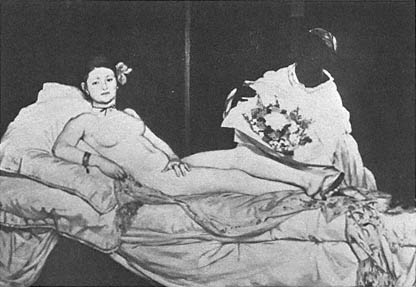
Figure 2
Edouard Manet, Olympia (1863). Musée
d'Orsay, Paris. Photo: Musées Nationaux.
trast to Titian's Venus of Urbino, whose pose she parodies. Given the allusion to Venus, Olympia might even be taken to personify the lower-bodily, as a profusion of details attests: the rumpled sheets; the flowers wrapped in newspaper (an icon of the Paris streets); the provocative splay of Olympia's hand over her genitals, which parodies the gesture of concealment typical of Renaissance Venuses; and above all the stretching cat, a visual pun on la chatte , French slang for those same female genitals. (No one missed this detail; as Anne Coffin Hanson observes, "Olympia was rebaptized 'The Venus with the Cat' . . . and a spate of cartoons quickly made the cat into Manet's special symbol.")[30]
The way that Olympia is painted, however, suggests a restraint rather than a release of the lower-bodily. As Carol Armstrong puts it, Manet's "stark, unmodulated contrasts and broad, harsh areas of signboard paint . . . refuse . . . the transformation of painted surface
[30] Anne Coffin Hanson, Manet and the Modern Tradition (New Haven, 1977), 98.
into the fleshy thicknesses of the female body."[31] This style, like the little choker around her neck, binds and regulates the force of Olympia's unabashed nakedness. Manet's refusal to enflesh her figure, as Titian had enfleshed the less dangerous (because more idealized) figure of his Venus, fixes Olympia as an object for consumption. Like her black servant, she belongs to a visual order that is also an order of domination. For the unseen master in that order, be it her client or the spectator, she represents—embodies—the overlap between the will to power and sexual desire.
Olympia occupies a border zone between the body as tangible, fleshy, weighty matter and the body as imaginary form, substanceless image. The reclining nude in Faust's magic mirror does just the same thing. These figures are perfect microcosms of the impossible object. They entangle the Romantic subject with the body and release the dialectical energies of both. They collapse rigid distinctions between social, material, psychological, and epistemological forces. They disturb hierarchies of value.
As we have seen, all these are also the activities of Chopin's A-Minor Prelude, activities that the music carries out with a complexity and a depth of cultural resonance that bear comparison with those of Goethe's text and Manet's painting.
In closing, I would like to return to the music one last time and venture a speculation—the typical reward of more rigorous hermeneutic work. It is possible that the effect of embodiment in the prelude refers less to the body in the abstract than to the much-troubled body of the composer himself. During November and December 1838, Chopin worked on the preludes in Palma de Mallorca under conditions of severe physical discomfort. After a while he began to cough up blood, which made him an object of "horror and fright" to the local populace; the Mallorcans were phobic about consumption.[32] In early March 1839, two months after finishing the preludes and a week after leaving Spain, he let drop a revealing remark in a letter to his friend Julian Fontana. Referring to his
[31] Carol M. Armstrong, "Edgar Degas and the Representation of the Female Body," in The Female Body in Western Culture , ed. Susan Rubin Seleiman (Cambridge, Mass., 1985), 234.
[32] George Sand, Un hiver à Majorque ; cited in the Norton Critical Score of Chopin's Preludes, Op. 28, 5.
Polonaise in C Minor, a highly disruptive work, Chopin comments: "It is not my fault if I am like a mushroom which seems edible but which poisons you if you pick and taste it, taking it to be something else."[33] In writing strange, problematical music, then, Chopin finds a way to revalue the object of horror and fright that his body has so recently been. He becomes a poison mushroom: fleshy, deceptive, alluring, and dangerous.
[33] Selected Correspondence of Fryderyk Chopin , coll. and ed. Bronislaw Edward Sydow, trans. and ed. Arthur Hedley (London, 1962), 171.