
Canticum Canticorum
The two editions of the Canticum canticorum are printed in a brownish ink, from two sets of sixteen blocks of Netherlandish origin. The thirty-two scenes are placed as two horizontal panels on each page. In the banderoles are text verses drawn directly from the Song of Songs. There is no typology in the concepts, but rather the Old and New Testaments seem to be merged in the symbolism of Mary as the Bride and Jesus as the Church.
The medieval interpretation of the Song of Songs as prefiguration of the New Testament was the subject of many religious treatises. The passionate metaphors of devotion in the verses were interpreted as expressing God's love for his people, or Christ's love for his Church, and Mary is elsewhere seen as a symbol of the Church. The cult of the Virgin, which appeared in the twelfth century and developed throughout the thirteenth, was extensively drawn from the writings of St. Bernard (1090–1153) on the Song of Songs, in which he applied many of its references to the Virgin Mary as the Bride.[23]
In the woodcuts Mary wears a nimbus and a crown and is accompanied by tall maidens (Song of Songs I, 3). Jesus is identified by the nimbus with a cross which always symbolized one of the Trinity: Father, Son, or Holy Ghost. Since his robes are like those of the maidens, only this nimbus distinguishes Christ from the other figures in the scenes. The blocks were probably made in a religious community, for in the first picture, at the right, appear Brothers occupied with the work of the harvest (fig. IV-12).
The first edition of the Canticum is much superior to the second in simplicity of composition and the grace and elegance of the figures. It has been considered an artistic masterpiece, with all the poetry of the Song of Songs captured in these blocks.[24] The artist can be associated with the first artist of the Speculum woodcuts, or at least with the atelier where he worked (fig. IV-13).
In style of design and cutting there are striking likenesses to the Biblia pauperum and to the Speculum humanæ salvationis . The background trees as little pyramids of horizontal strokes, the tufts of small straight lines indicating grasses, the lines of drapery, the rectangular slabs of earth or stone in the landscape, the shading of walls and figures with short horizontal lines, the leaded windows and tiled floors of the interiors, all show some consistent techniques which unite these three blockbooks and suggest that they should be assigned to the same circle of artists and/or engravers. The addition of several varieties of plants in the Canticum that do not occur in the Biblia pauperum seems to place it later. The Speculum editions, with text printed in a press, may have been later still, but the blocks may have been made long before that took place, since they show a less sophisticated style than those of the Canticum .
[23] Emile Mâle, The Gothic Image (1913; reprint New York, 1958), p. 233, translated from L'Art religieux du XIII siècle en France (Paris, 1898), as Religious Art in France of the Thirteenth Century .
[24] Delen, op.cit. , p. 73.
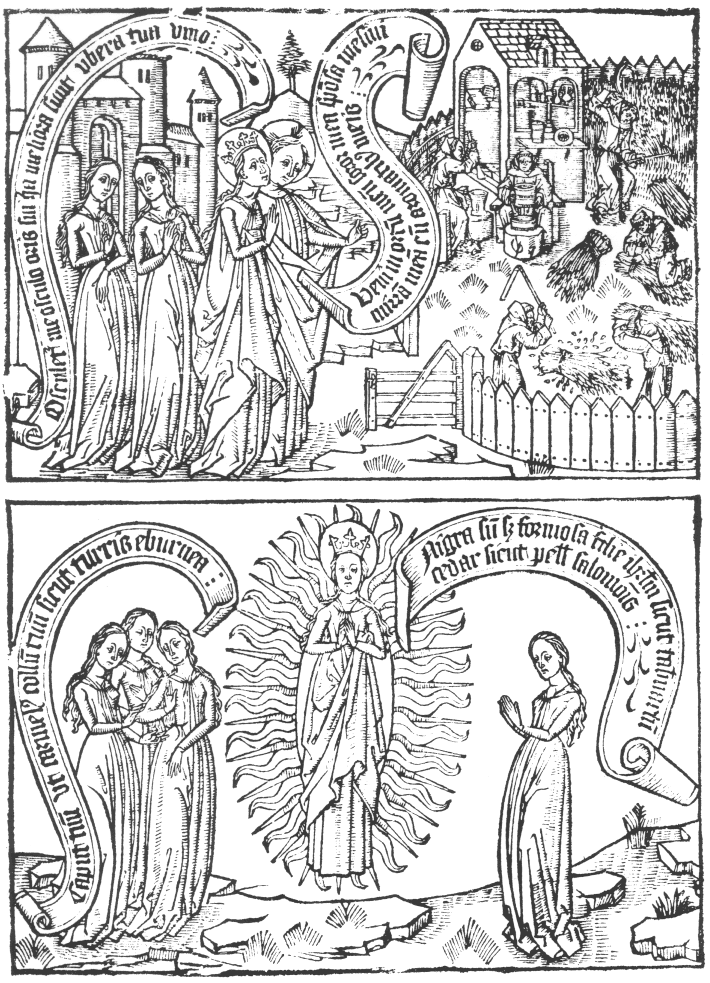
IV-12.
Canticum canticorum blockbook, Schreiber I.
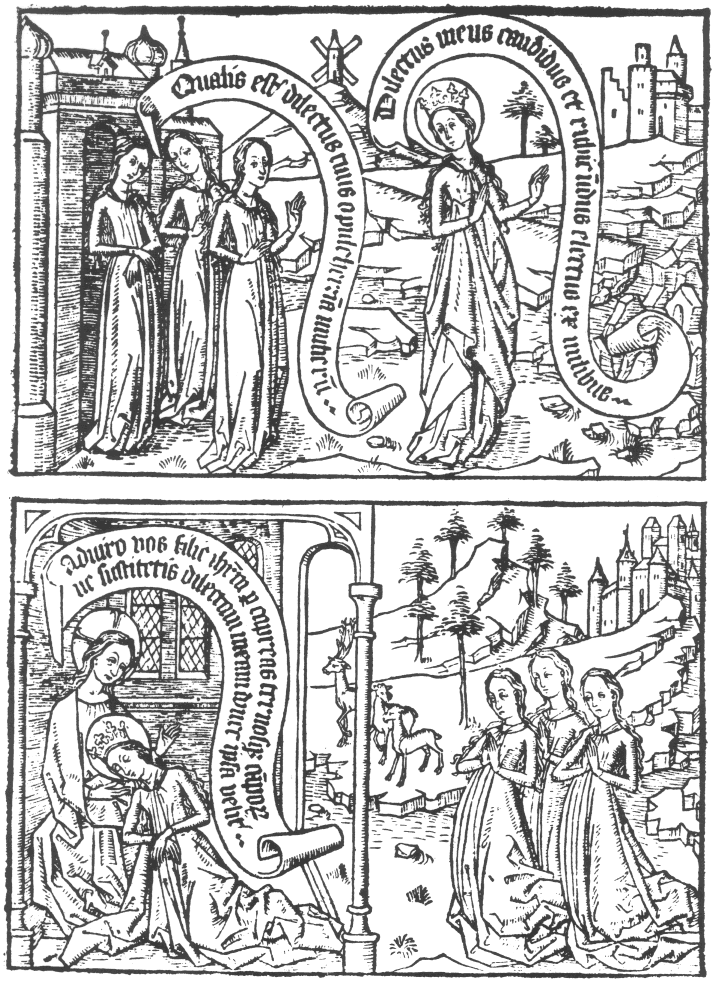
IV-13.
Canticum canticorum blockbook, Schreiber I.