
STATE
Four—
The State as a Moral Agent
Political Science as Moral Theory
However Americans structure moral obligations, most modern liberal democrats do not rely on the market to establish the rules that guide their interdependence; they look instead to the state. When people consider their debts and legacies to past and future generations, when they want to acknowledge their ties to others around them, when they try to develop rules for sharing the things they have in common, they tend to reach, almost automatically, for laws and bureaucratic regulations. Governments may be as uncomfortable in recognizing the inherently moral nature of the decisions they make as political scientists have been in recognizing the inherently moral nature of their subject matter, but both, in concerning themselves with public policy, are involved with how modern liberal democrats regulate their moral relations with one another. As Theodore Lowi succinctly puts it, "Despite what social science may say, politics is morality."[1]
Reliance on government to organize rules of obligation to others is the starting point for various efforts at developing a political approach to moral regulation. Instead of suggesting that one can fulfill one's obligations to others by first satisfying one's obligations to oneself, the political approach stresses the need for some authoritative instrument capable of providing the direction and steering necessary to account for the needs of all. What has traditionally made the state seem capable of acting as a moral agent is the supposition that while individuals have interests, the actions of governments can rest on dis interest. Because markets celebrate interest—indeed, because they view the pursuit of interests as the only realistic
substitute for the no-longer-viable pursuit of such aristocratic practices as virtue—the defense of the state as a moral agent and, consequently, the political approach to moral obligation were once associated with the political right. Conservatives, in Kenneth Dyson's words, "had . . . in common a pessimistic conception of human nature, above all a fear of the anarchy and destruction that could follow from the 'self-interested' individual who was detached from the bonds of a well-ordered society."[2]
Whatever else may be said of them—that, for example, they were elitist, patriarchal, and antidemocratic, all of which are true—conservative theories of the state rarely lacked a concern with the relationship between morality and politics. Even when the state was viewed as Machtstaat rather than Rechtstaat, an emphasis on the ethical nature of politics was central to conservative thought.[3] Political conservatism of this organic kind, however, could not survive the transition to modernity. As Albert Hirschman has put it, "The possibility of mutual gain emerged from the expected working of interest in politics, quite some time before it became a matter of doctrine in economics."[4] As self-interest in economics and liberalism in politics swept through eighteenth- and nineteenth-century thought, conservative theorists of the state either held fast to fixed principles that most people no longer followed or—at first reluctantly, later enthusiastically—joined in the celebration of an individualism they had once condemned.
Liberal principles now have a near monopoly among political theorists of modernity. Western liberal democracies, as their name implies, are characterized by respect for the idea that individuals themselves have the freedom to determine what they ought to do. This has been a momentous development in the Western world's political history, and nearly all to the good, but nonetheless it has one serious problem: if everyone is free to act as he or she chooses, what exists to insure that people will recognize their obligations to one another? I will argue in this chapter that for most of its history liberalism did not need to answer this question. A liberal theory of politics was linked to a conservative theory of society. By simply assuming that liberal citizens were tied together morally by tradition, culture, religion, family, and locality, liberal theory was able to emphasize the benefits to be gained by the free exercise of political rights, since society could always be counted on to cement the moral obligations that politics neglected.
In contemporary liberalism, by contrast, the assumption that strong social obligations make possible weak political ties is harder to maintain. As the moral world associated with civil society comes to be taken less and less for granted, liberalism moves in two directions: either toward a reliance
on economic models of politics (in which it is assumed that rules of self-interest can bring about appropriate results without civil society playing a role) or into a defense of the state (as the only agent capable of serving as a surrogate for moral ties of civil society that are no longer especially binding). While the former approach has attracted a good deal of attention in contemporary liberal thinking, manifested in such developments as "public choice" theory and, to a lesser degree, the political philosophy of John Rawls, the latter has had far more currency in practice, for it forms the core idea of the welfare state. The welfare state brings to the surface the unanswered question in liberal theory—who is responsible for others when people are expected primarily to be responsible for themselves?—and then provides an answer: government will assume the task of protecting the moral order that makes society possible. The political approach to moral obligation, once associated with the right, has, with the development of the welfare state, come increasingly to be associated with the left.
Reliance on government to strengthen a sense of moral obligation is, in the minds of most modern liberal democrats (and certainly in the mind of this author), a substantial improvement over reliance on the market. Particularly when it concerns meeting obligations to distant and hypothetical others, the welfare state has increased a general recognition of the interdependence of fates that characterize social life in modern society. Yet the welfare state works best when it builds on and strengthens already-existing social ties. When government is relied on to furnish rules of moral obligation, will it weaken the very social ties that make government possible in the first place? How one answers this question will determine one's position with respect to the political approach to moral regulation. If one concludes that government is capable of serving as a substitute for the moral ties in civil society once associated with family and locality, the welfare state must be judged a great success. But if the assumption by government of moral responsibility is seen as subtracting from a sense of personal responsibility for the fate of others once associated with the intimate realm of society, the problems of the political approach to moral obligation begin to seem more serious.
The Marriage of Liberalism and Sociology
Early liberal political theory struggled valiantly with the problem of how citizens could be at once individuals possessing rights and members of a community obligated to others. Despite various (and important) differ-
ences in emphasis, the early liberal thinkers usually invoked a theory of contract; people enter voluntarily into relationships with government (or each other) and are therefore bound to it (or them). Even since David Hume's criticism of contract theory—how can a promise be made the basis of a social and philosophical order, Hume asked, when the very notion of a promise presupposes such an order?—philosophers, political theorists, and sociologists have had their doubts that consent, especially the tacit consent of generations living long after the social contract was signed, could serve as an adequate theory of political obligation.[5]
In recent years, the liberal theory of obligation has come under unusually strong criticism. John Dunn, while noting the attractiveness of liberal theory, writes that "there seems every reason to doubt the possibility of a comprehensive and coherent modern philosophy of liberalism."[6] A. John Simmons, after reviewing the arguments within the liberal tradition about tacit consent, natural duties, gratitude, and fairness, concludes that liberalism "cannot offer a convincing general account of our political bonds" and that "citizens generally have no special political bonds which require that they obey and support the government of their countries of residence."[7] Carole Pateman, on different grounds, finds that "the problem of political obligation is insoluble unless political theory and practice moves outside the confines of liberal categories and assumptions. The modern problem of political obligation arose with liberalism, but liberalism cannot provide a solution."[8]
Early liberal thinkers could not, it is true, justify a moral order within the terms of liberalism; but the point is, they did not even try. Unlike some contemporary thinkers who try to find in government a place within which moral obligations can be inscribed, seventeenth- and eighteenth-century liberals located the source of the moral order in society instead. Early liberalism assumed a sharp distinction between state and society: only if the latter were strong could the former be allowed to be weak. The same understanding of civil society that tempered the effects of self-interest in economic theory also provided the basis for the social contract in liberal political theory. Liberal theory, in other words, was not completely a political theory; there existed a sociological component to liberalism, without which little in the theory could make sense.
Not all liberals can be described as contractarians. Liberalism has attracted not only those inclined toward rules based on reason and logical rigor, but also those, such as Benjamin Constant or William Wordsworth, influenced by romanticism and feeling.[9] While admittedly a sociological
influence is more likely to show itself among the latter than the former, it is important to realize that even among those early liberals most committed to pure contractarian principles, a sociological component was never absent. No thinker in the liberal tradition, to take the extreme case, was more radically individualistic in his assumptions than Thomas Hobbes. Gregory Kavka sees in Hobbes's political theory a notion of political obligation so relentlessly modern that, with a few corrections, it can be used to develop rational models of game-theoretical choice.[10] Yet even Hobbes possessed something of a sociological theory, or at least a social-psychological one. Men leave the state of nature, he wrote, because among the laws of nature is "complaesance, that is to say, that every man strive to accommodate himselfe to the rest."[11] Moreover, there are in Hobbes's social psychology a surprisingly large number of motivations (such as reputation, gratitude, envy, honor, dignity, shame, pity, emulation, admiration, jealousy, ambition, offense, displeasure, contempt, and lust) that rely on others for their realization.[12] We may not like them, but we recognize real social creatures, not abstract mental calculators, living in Hobbes's state of nature.
For John Locke, the social and moral background within which liberal assumptions made sense—but outside of which they would be disastrous—was provided by religion. Locke shared a well-understood tradition of religious cosmology with the thinkers of his time that was so important, as Dunn has argued, that he would never think to analyze it in his writings. This religious order establishes the preconditions that make it possible for individuals to be individuals. As Dunn puts it, "Men exercise claims over other men. They also exercise claims over non-human nature, both animate and inanimate. They have responsibilities, too, in the exercise of either of these—responsibilities to God in both cases and thus derivatively, in the case of claims over men, to other men."[13] Within such a cosmology, individualism is not nearly as radical as it seems; the realm to which it applies, after all, is a relatively small one: everything that is left over after God has done his divine work. Because of Locke's understanding of Christianity, Sheldon Wolin writes, "a society based on the consent of each of the members implied that each was a moral agent fully capable of understanding the moral postulates on which society rested."[14]
Individualism was not, for the early liberal thinkers, an end in itself. True, bourgeois society would unleash individuals to realize their self-interest, but this was not because individuals were "inherently" self-interested. If anything, people were viewed as driven by passions, for which individualism would be the corrective. Thus it was possible to be-
lieve, as we know from Hirschman's investigations into these issues, that the world of business and commerce, while driven by self-interest, would also be a realm of harmony (doux commerce ) because individualism would be less antisocial than what it replaced.[15] Individualism was valued because it would contribute to a realm of authenticity, which stood in sharp contrast to the intrigue, gossip, and artificiality of court society.[16] One could be a free individual only within civil society; a man completely without social ties, because he was a slave to his passions, could never be free. Only in civil society could one be civilized.
There has thus long existed a relationship both intimate and estranged between sociology and liberalism. For one thing, they begin with different first premises. From the one tradition stemmed the idea that, as Anthony Arblaster puts it, "the individual must choose his values for himself, and construct his own morality."[17] From the other came the notion that society creates the need for a morality that precedes the individual and gives meaning to his existence. These differences could, however, be resolved through the concept of civil society. Civil society enabled eighteenth-century liberals like Ferguson, Hume, and Smith to add a sociological dimension to their work, just as a more modern understanding of civil society enabled the sociological theorist Durkheim to add a liberal dimension to his. For all their differences, liberalism and sociology needed each other.[18] Even Jeremy Bentham, who so often serves as the foil for sociology's own self-conceptions, was, as Charles Camic has pointed out, capable of saying that "it is desirable that on every occasion the course taken by every man's conduct should be in the highest degree conducive to the welfare of the greatest number of those sensitive beings in whose welfare it exercises any influence."[19]
So long as liberalism and sociology coexisted, even if uneasily, the inherent problems of each could be overcome. For sociology, the acceptance of liberalism was an introduction into modernity, about which it was otherwise ambivalent. For liberalism, the willingness to accept sociology meant that the full consequences of a purely individualistic understanding of the world could be postponed. By the end of the nineteenth century, the link between liberalism and sociology became more explicit than ever before. In England, liberal thinkers such as T. H. Green, Henry Sidgwick, and their followers rejected laissez-faire, from within essentially liberal premises, as incapable of generating a satisfactory account of moral and ethical obligations.[20] L. T. Hobhouse saw himself as a professional sociologist (although his efforts in that direction are no longer taken seri-
ously), even as he tried to formulate a satisfactory liberal political theory.[21] Much the same was the case in the United States, where sociology was linked to traditions of social reform and Protestant evangelical redemption.[22] The marriage between sociology and liberalism, in short, led to the introduction of the modern welfare state and its emphasis on obligations to all—embodied, most illustratively, in T. H. Marshall's oxymoronic term social citizenship .[23]
Even though late-nineteenth- and early-twentieth-century liberals laid the groundwork for thinking about welfare, they were not prepared to argue that all matters involving the common welfare ought to be regulated by the state. Critical of the market yet suspicious of reliance on government, most of these thinkers hoped to stress the importance of civil society in opposition to the state. This they did through the theory of pluralism. The key concept that allowed the tempering of liberal individualism for the sake of obligation to others became the group. "A nation can be maintained only if, between the state and the individual, there is intercalated a whole series of secondary groups," Emile Durkheim wrote in The Division of Labor in Society .[24] Durkheim, who in his writings was so hostile to individualism and the notion of economic man, could turn around and identify himself as a liberal believing in individualism only through his commitment to some form of pluralism.
The discovery of the group enabled Durkheim to combine his belief in morality with his commitment to modernity. Throughout his writings, Durkheim worried about the corrosive effects of liberal individualism. Anomie or normlessness, he said, faced those atomistic individuals who were cut off from others. Intermediate groups, lying between a purely individualistic market and a coercive and distant state, enabled modern individuals to avoid an anomic fate. Through the concept of a group, liberalism and sociology could maintain their relationship. Durkheim's views were therefore quite similar to many of the prominent British liberals of his day. Harold Laski, for example, argued that groups should be conceived of as persons, a point of view he later rejected, while G.D.H. Cole went so far as to speak of a "group soul."[25] Thus the group became civil society in modern dress.
It was not just intimate groups such as families and local communities that were capable of tempering the effects of pure liberal individualism. Guild socialists of the early twentieth century looked to labor unions to play the same role. As the century progressed, professional associations, schools, and even business organizations were viewed favorably by plu-
ralist thinkers, because each stood midway between the state and the individual. Organizations and institutions in the social realm were seen as alternatives to mass society: they could "socialize" individuals, thereby softening and deflecting demands on public authority before these reached the elite; conversely, the demands of the elite would be transmitted through intermediate associations down to individuals, losing their sharp, authoritative edge in the process.[26]
Sociology was thus essential to liberal theory because civil society (or its functional equivalent, the group) provided the moral dimension that liberalism lacked. Through their social ties liberal citizens, who were otherwise individualistic, would operate in a moral order that made their individualism tolerable. Sociology, in that sense, was the missing ingredient in an otherwise unworkable liberal theory of obligation. The ties that linked people together could grow out of friendship, gratitude, personal knowledge, groups, informal networks, deference, loyalty, obedience, and conformity, but whatever the motivations that led people to recognize their moral obligations to others, the concept that solved the riddles that liberal theory could not answer within its own framework was nearly always sociological and rarely liberal.
By mid–twentieth century, liberalism and sociology had become even more entangled. Confronting a world of large organizations, bureaucratic states, economic planning, and challenge from communism and fascism, liberalism, instead of being a theory of individualism, began to show an "addiction towards social conformity," to use Wolin's apt phrase.[27] Appalled at the consequences of individual action in a collective society, liberalism as a theory of pure individualism seemed to have reached a dead end. The dominant partner in the marriage between liberalism and sociology, to the shock of both parties, turned out to be sociology. Individualism, if post–World War II American political science was any indication, was the one thing that liberalism no longer seemed to tolerate.
Collective Anomie
Political theory plays increasingly less of a role in the debate over approaches to moral obligations in modern society, while political science plays increasingly more—for all its recent preoccupation with objectivity and scientific technique. This is especially true of those American political scientists who, in the years after World War II, looked back to Durkheim's France and Laski's England and tried to bring the theory of pluralism up to date within an American context.
Although the leading pluralists of the early postwar period were liberal in their political sympathies (appreciating capitalism as an economic system and individualism as a fundamental good), the essence of their approach to political regulation was the development of models of the political system that constrained individual self-interest and channeled it in safe directions in order to insure the stability of the overall society. Even sociology was not anti-individualistic enough for them; to understand American politics, they turned to anthropology, the discipline most compatible with a view that culture, not individuals, shapes reality. If an anthropologist sensitive to symbols and ritualistic behavior and an economist searching for rational political conduct modeled on the market both examined how political scientists described the conditions of political life in the United States from the 1930s until sometime in the recent past, the anthropologist would have stood in more familiar territory.
Anthropology was often explicitly used to understand the operation of national political institutions. David B. Truman's The Governmental Process borrowed from such writers as Clyde Kluckhorn, Ruth Benedict, Emile Durkheim, Ralph Linton, and Karl Polanyi; Truman attributed the success of interest-group democracy to certain unwritten "rules of the game," defined as "norms, values, expectations" the violation of which "normally will weaken a group's cohesion, reduce its status in the community, and expose it to the claims of other groups."[28] Similarly, Donald R. Matthews devoted an entire chapter in a book on the U.S. Senate to what he called "folkways" such as reciprocity, apprenticeship, courtesy, and institutional patriotism, all based on something other than self-interest.[29] Of all political institutions, the Senate was the most like a "club." In it, unquenched desire for power was checked by the necessity to wait one's turn for a committee assignment; seniority institutionalized a criterion of distributional justice based not on individual rational choice, but on institutional needs.[30] Bureaucratic policy making was undertaken through relationships of "clientelism" (a term borrowed from peasant communities, not modern urban life), in which, whatever the formal mechanisms of politics, informal negotiations between like-minded partners was the rule, not conflict between antagonists.[31]
At the same time, politics at the individual level was not, according to the pluralists, the product of rational self-interest calculated by isolated individuals. Political machines in urban areas, to take one example, were seen as premised on traditions of solidarity and group loyalty: while the standard text on the subject describes them as "interested only in making
and distributing income—mainly money—to those who run it and work for it,"[32] other writers have found the political machines to represent a "moral force" teaching "standards of right and wrong that can guide practical decisions—that can be manifested in the smallest things—in the ways in which people bring up their children and treat their neighbors, or the manner in which they generally deal with the interests of others."[33] Voters, candidates, even activists similarly entered the political system to express social needs and community norms.[34] By serving as "supplier[s] of cues by which the individual may evaluate the elements of politics," parties assured stability in the political system.[35] Trust in that system and in the candidates who served it was taken for granted, even though trust is difficult to find when relationships are strictly instrumental.[36] When the single most prestigious group of political scientists in America sought a term that would mark the distinctive characteristic of successful Western democracies (of which the United States was presumed to be a model), they turned again to anthropology: political "culture" was the buzzword of 1960s political science.[37]
The world of American pluralism was safe and secure. There was no need to be anxious about the corrosive effects of liberal individualism, because groups—from the family all the way to that group to end all groups, the state—took care of collective needs. As long as such a world existed in theory, the liberal problem of moral obligation did not have to be faced: true, our political ties to others were weak, for that is what made us liberal, but our group ties to one another were strong, for that is what made us pluralists. By borrowing an approach to moral obligation from sociology and anthropology, political scientists were able (at least until the 1960s) to avoid the question of whether individuals whose only links were political rather than social could satisfactorily regulate their interactions. When the break came, when sociology and liberalism finally divorced from each other, it was because the sociological assumptions that pluralist writers made about group behavior could not survive the actual way that groups operated in the modern state.
Groups, thinkers like Durkheim had hoped, would serve as the corrective to anomie. But groups can perform that role only if a distinction exists between state and society, one in which groups, by remaining part of society rather than turning to the state, act as individuals' collective conscience. What Durkheim (and pluralist political scientists in America) failed to anticipate was that groups could become attached to the state itself, divorcing themselves from society in the process. In contrast to Durk-
heim's hopes, groups in modern liberal democracies became too important to remain private. As Lowi in particular has emphasized, modern liberalism is not individualistic but collectivistic; groups compete for the favors bestowed by the state. "Interest-group liberalism," as Lowi calls it in The End of Liberalism, in effect changes the moral rules of liberal society.
As the political benefits of the modern state increase, groups organize to fight for them; but in so doing they make impossible the sociological practices that the early liberals saw as tempering the implications of liberalism. Interest groups do not have passions that need to be tempered by interests; they have only interests. Individuals can create bonds of loyalty and personal obligation, but groups cannot. Individuals enter into contracts; groups can be conceived of only as forming alliances. It is possible, as sociological liberals like George Herbert Mead pointed out, for individuals to develop a social self by putting themselves in the position of others, but groups commit institutional suicide if they try to act that way. A society of individuals seems possible, for individuals are capable of having a collective conscience; a society of interest groups seems impossible, for groups do not know guilt. Individuals, in a word, because they are social, can have moral obligations, while groups, because they are organizations, cannot.[38]
As interest groups seek to maximize their advantages over other groups in order to obtain benefits from government, behavior undertaken without regard for its effects on others becomes not just routine, but expected. Durkheim's solution to anomie is instead a cause; groups, rather than absorbing private egos into the collectivity, collectivize anomie, transforming it from an attribute of individuals to an attribute of organizations. Collective anomie threatens a return to Hobbes's war against all, but with a difference. For Hobbes the necessity for sovereign authority stemmed from forces over which people had little control, produced as they were by nature or by scarcity; because individuals were by nature selfish, they needed a sovereign to regulate them. For modern interest-group liberals, though, it is our institutions, not our nature, that demand we distrust one another. We are not responding to constraints in our environment; rather, we are creating those constraints in our very actions. Under conditions of interest-group liberalism, because we have a sovereign institution called the state that exists without an alternative morality rooted in civil society, we have continually to recreate selfishness in our actions with one another.
The notion that sociological and anthropological practices could restrain self-interest in favor of collective norms no longer seemed realistic
when the state came to play so large a role in regulating interest-group conflicts. As if recognizing new political realities, American political science, so recently pluralist, began to shift to a point of view emphasizing how self-interest—at the governmental, group, and individual levels—operates unconstrained by moral obligations to others. Political machines, for example, which had been understood as based on solidaristic principles, were now viewed as in decline, replaced by administrative agencies that negotiated with interest-group representatives.[39] Political parties, which had expressed ties of tradition and the group, were undermined by independent voting and shifting loyalties.[40] Rather than taking their voting cues from others around them, citizens began to judge politicians in the light of rational choices; if elected officials did not stimulate the economy, they would be punished in the voting booth.[41] Candidates were now understood to rely increasingly on political consultants, whose only responsibility was to the person who hired them, not to any unwritten rules of the game.[42] Public opinion was organized by a "marketplace for ideas," but that market, like all markets, isolated individuals in the formation of their opinions.[43] Society, more than ever before, seemed to drop out of politics, leaving only individuals and states behind.
Because groups in civil society that once restrained individual self-interest have begun to break down, political scientists now increasingly view government as operating by a moral code that emphasizes individual rational choice. Informal networking in Congress gives way to technical staff experts who do not share traditions of reciprocity and mutual understanding with those with whom they negotiate.[44] Political scientists talk of the "rampant individualism" in institutions like the Senate which have abused the "collegial process"[45] or emphasize the impact of the "me decade" on the House of Representatives.[46] Samuel Kernell expresses the changes in one sentence when he writes that Washington, D.C., "is a community governed less by leaders and more by the requirements of independent egocentric actors."[47] Even bureaucratic clientelism was affected by these developments. At first liberal efforts at social regulation brought government into more activities; when the reaction set in, conservative efforts at deregulation began to remove it. Yet these two trends, so different in many ways, had one thing in common: instead of the administrative process being viewed as adjudicated by like-minded interests, both trends are characterized by a litigious model of administrative politics based on the assumption that interest groups and bureaucrats respond primarily out of self-interest as they understand it.[48]
The American political-science literature illustrates the consequences for the political approach to moral regulation when social ties no longer prevent actors from acting in a purely liberal fashion. A situation in which large-scale organizations press government to satisfy their immediate demands irrespective of the social consequences is completely foreign to the moral universe of early liberal political theory. Then the morality of civil society was assumed to make liberal politics possible; now the rules of liberal self-interest make moral obligation impossible. When sociology and liberalism were forced to part ways, liberal thinkers had to return to the question they had long been excused from considering: who is responsible for others if each actor in the liberal world is concerned primarily with his own interest?
The answer was provided by one of the most important books dealing with groups in the modern state, Mancur Olson's The Logic of Collective Action. Olson painted a remarkable picture of how, in a world without sociology, a theory of liberal individualism inevitably becomes a defense of coercive authority. The nature of the groups in Olson's portrait stands in direct opposition to that envisioned by the early pluralist thinkers. For them, groups would "socialize" individuals into their obligations to one another. The members of Olson's groups, in contrast, do not act out of sentiment, loyalty, passion, or belongingness: they join groups only to obtain the rewards that groups can offer, and since the benefits groups provide are collective goods, they will obtain those benefits whether they participate in the affairs of the group or not. Thus, since every member receives the same benefit, even if one risks her life in a picket line, a second gives twenty hours a week of his free time after work, and a third stays home and watches football, the last is acting the most rationally.
So long as participation in the affairs of a group is not expected, the paradox of the "free rider" does not pose any particular problem of social coordination. In a modern society, however, everyone is affected to some degree by the actions of everyone else. Even if direct participation in the collective life of the society is not encouraged, some form of indirect participation is always necessary. How, under such conditions, is participation to be organized? Because the free-rider option is so tempting to rationally calculating individuals, people will not advance their collective objectives
unless there is coercion to force them to do, or unless some separate incentive, distinctive from the achievement of the common or group interest, is offered. . . . If
the state, with all of the emotional resources at its command, cannot finance its most basic and vital activities without resort to compulsion, it would seem that large private organizations might also have difficulty in getting the individuals in the groups whose interests they attempt to advance to make the necessary contributions voluntarily.[49]
If Olson is correct, obligations to others cannot be satisfied, when each actor has no moral ties to others, without some form of coercion.
Liberalism, which before was a minimalist theory of the state, has, if this picture is correct, become instead a minimalist theory of society. Government could be weak, according to classical liberal theory, only because society was strong. In contemporary versions of liberal theory, the opposite has occurred: society has become so weak that government, by necessity, has become strong. No longer is a liberal theory of the state linked to a conservative theory of society; in Olson's world, all motivations, wherever located, are individualistic. The notion that people might carve out a realm of social existence to be organized by moral rules emphasizing trust and solidarity is as foreign to liberal theorists like Olson as that "compartmentalization" is to the self-interested calculators envisioned by the Chicago school of economics. Politics without society, in a word, threatens both: politics cannot exist because all behavior between individuals and government is reduced to an economic quest for self-interest, while society is rendered impossible because no moral ties between individuals exist to soften a Hobbesian struggle over resources.
A Republic of the Head
The disappearance of civil society from the liberal theory of politics creates an awkward problem. If individual actors are not tied together by sentiments, culture, reciprocity, and other features familiar to any sociologist, the only agency capable of providing moral guidelines would, from Olson's analysis, appear to be coercive authority. Yet many liberals retain a bias against state intervention. Consequently one important trend in contemporary liberal theories of politics is to search for substitutes for government, a search that can succeed only by finding other institutions that share with government some coercive capacity.
The variant of contemporary liberal theory that best illustrates the futile search for an alternative to government regulation is "public-choice theory," the most complete effort to extend market principles from the eco-
nomic sector of society to the political. That this by now enormous literature is normative I take to be beyond question, for inherent in all of it is a standard not only of how people allegedly do act but of how they should act as well.[50] Nor is it my intention to criticize this literature, for everything I could say about it has already been said, even thirty years ago before the public-choice approach became so widespread:
Man is not just an animal who, unlike the others, is provident and calculating. . . . How men see themselves . . . is intimately connected with their mental images of the community; they are not mere competitors, however benevolent, in a market for the supply of personal wants; they are members of society, and their hopes and feelings, both for themselves and others, would not be what they are apart from group loyalties. They see themselves having rights and duties, as moral beings, because they have some conception of a social world with parts for themselves and others to play in it.[51]
I turn instead directly to the writers in this tradition, for they illustrate why the state—or whatever one chooses to call it—is the only alternative to the social ties of civil society if all individuals think first of themselves.
Most, though by no means all, public-choice theorists are politically sympathetic to a weak state. Indeed, they take the notion of a voluntary contract that has always existed in liberal theory and make it the basis of all interaction—illustrated, for example, by transaction-cost economics, the minimalist principles of political consent associated with writers like James Buchanan and Gordon Tullock, or William Riker's efforts to demonstrate that various paradoxes of voting cast suspicion on any populistic notions of a general will.[52] Yet unlike early liberal theorists, who assumed that society would provide the strong ties that made a weak state possible, public-choice theorists share assumptions about human nature that make it impossible for individual rational actors to act out of sociological motives. How, then, is the social contract enforced if all rational actors will seek not to have it enforced? The only answer to this question is to create a coercive authority that, for all intents and purposes, acts like a state without being called one.
The fascination with coercive authority that we find in extreme versions of public-choice individualism can be seen in the work of James Buchanan. If all individuals act rationally to further their self-interest, it stands to reason that they would want to use the public treasury to line their own pockets. And if all politicians responded to those demands, the result would be fiscal bankruptcy. Responding to this dilemma, Buchanan, to-
gether with Gordon Tullock, called in an early work for "enlightened self-interest" on the part of pressure groups, since they could never be expected to "exercise sufficient self-restraint, given existing rules."[53] As if recognizing that such a call was premised on the existence of norms in civil society that his own theory denied could exist, Buchanan later argued that because "budgets cannot be left adrift in the sea of democratic politics," the rules of politics would have to be changed.[54] The argument was brought to its logical conclusion when Buchanan realized that only a new constitution, one that placed monetary matters completely outside public choice, could guarantee a stable currency.[55] Buchanan trusts rules more than he does people: "Good games," as he and Geoffrey Brennan put it, "depend on good rules more than they depend on good players."[56] The problem, as I argue in Chapter 8, is that the players—and no one else—make the rules. By advocating an inflexible constitution, that part of government most difficult to change by democratic procedures, Buchanan becomes, in an important sense, more statist than the Keynesians and welfare-state politicians he criticizes.
The application of transaction-cost economics to firms and hierarchies reveals a similar bias toward strong authority. As long ago as 1937 R. H. Coase, in his classic article on the theory of the firm, recognized that the logic of self-interest for organizations in the external world—called the market—could not apply to the decision-making structure within the organization.[57] Because theories of rational egoism assume that everyone operates out of self-interest, relations within a firm are marked by "transaction costs" in which freely calculating actors demand something in return for their participation. To followers of transaction-cost economics, individuals within organizations do not restrain their interests, give favors, or act from a concern for the common good. Thus hierarchical authority, the direct opposite of the presumed voluntarism in the external market, is necessary so that the firm can manage its internal relations efficiently. Only through hierarchy can we "prevent agents from engaging in dysfunctional pursuit of local goals," writes Oliver Williamson. Since it is important to regard "the business firm as a governance structure rather than as a production function," transaction-cost economics demands that we "supplant the fiction of economic man" and develop "an elementary appreciation for 'human nature as we know it.'"[58] Organizations, it would seem, can be free only if individuals live in chains. Once again, rational-choice liberalism cannot solve the problem of obligations to others when civil society is
weak, except by creating some form of "governance structure" that can compel obedience.
The moral philosophy of John Rawls also sheds light on what happens to liberal political theory when it is no longer attached to a conservative theory of society. Unlike public-choice theorists, John Rawls does not believe that rational action should be the basis of all human activity. "The ideal market process and the ideal legislative procedure," he writes, "are different in crucial respects. They are designed to achieve distinct ends, the first leading to efficiency, the latter if possible to justice."[59] In Rawls's version of liberal theory, individual actors are not egoists; indeed Rawlsian principles are generally viewed as leading to a defense of the welfare state, not of the free market. But Rawls, like public-choice theorists, assigns no role to civil society in his moral theory. Consequently he, like them (if at a more elevated level), leans toward a substitute for the coercive capacity of the state: the notion of obligation as a duty stripped of voluntary motivations.
Rawls argues that morality passes through three stages: authority, association, and principle. In the first stage, which is associated with childhood, we simply accept our moral rules from our superiors because we cannot judge them ourselves. Having learned discipline this way, we are prepared to move on to the morality learned through association with others. Rawls here develops ideas remarkably similar to those of Talcott Parsons: "The morality of association includes a large number of ideals each defined in ways suitable for the respective status or role."[60] Thus, so long as we exist at the level of the morality of association, Rawls has a point of view that, like Parsons's, is based on a functionalist reading of Durkheim:
Since the arrangements of an association are recognized to be just (and in the more complex roles the principles of justice are understood and serve to define the ideal appropriately), thereby insuring that all of its members benefit and know that they benefit from its activities, the conduct of others in doing their part is taken to be to the advantage of each.[61]
Had Rawls stopped at this point, he would have been in the grand tradition of liberalism, relying on conformist sociology to soften atomistic individualism. (See Chapter 7 for more on this point.) But the morality of association is a passing phase, one that prepares people for "the ideal of just human consideration"—a morality of principle.[62] (Rawls is strongly influ-
enced by Lawrence Kohlberg's idea that morality passes through certain stages with an implicit ranking.)[63] Through our associations, Rawls argues, people learn the importance of purely abstract deontological principles of justice. We make decisions in the original position in order to create moral rules that enable us, in a well-ordered society, to return to that position for our morality: "The appropriateness of moral sentiments to our nature is determined by the principles that would be consented to in the original position."[64]
Rawls presents and elaborate, even eloquent, statement of what a just society would resemble. Love of the principles of justice would serve as the basis for human cooperation. We would live in a social union, and unlike the situation in pure laissez-faire, our fates would be interdependent. There would, in a well-ordered society, exist a division of labor, community, sociability, reciprocity, history, and culture. Yet unlike eighteenth-century theories of civil society, Rawls's theory of morality contains little or no sociology to provide the glue of moral obligation. It is far better, according to Rawls, to feel guilty that we violated a principle than that we violated a friendship.[65] Trust, loyalty, friendship, love—these are "contingencies" or "accidental circumstances of our world"; moral considerations are therefore not to be premised on "the well-being and approval of particular interests and groups, but are shaped by a conception of right chosen irrespective of these contingencies." Conscience, which in Durkheim's view makes society possible, is according to Rawls something "oppressive" that a just society will help us to "suffer much less from."[66] People, in the Rawlsian republic, do not love other men and women: they love humankind instead. Rational people are not even allowed the quality of envy in Rawls's original position, even though they are in Hobbes's state of nature.[67] Rawls's moral vision is one in which we are all tied together by our common intellectual respect for the rules of justice. This is a republic of the head, not the heart.
By relentlessly downplaying a sociological dimension to his theory Rawls develops an understanding of moral obligation which he shares with Lawrence Kohlberg, an understanding that, in the words of Carol Gilligan, is "formal and abstract" rather than "contextual and narrative."[68] Liberal society in this portrait may be just, but it has no richness of interpretative meaning, no collection of stories, traditions, and practices which, because they are imperfect and ambiguous, allow real human beings to create a morality for themselves out of the textures of their interactions with others.[69] Facing the momentous questions posed by Plato's noble lie
or Dostoevsky's Grand Inquisitor, Rawls relies on a secular and rational notion of moral order: "Conceptions of justice must be justified by the conditions of our life as we know it or not at all."[70] Modern people are tied to one another, but in a completely impersonal way—as Michael Sandel puts it, "not [as] egoists, but [as] strangers, sometimes benevolent." The republic according to Rawls, Sandel has argued, is cold and unfriendly: "Unlike classical Greek and medieval Christian conceptions, the universe of the deontological ethic is a place devoid of inherent meaning, a world 'disenchanted' in Max Weber's phrase, a world without an objective moral order."[71]
In a world where people raise children, live in communities, and value friendships, a moral theory that demands rational cognition to the degree that Rawls's does is little help and may well be a burden. It teaches people to distrust what will help them most—their personal attachments to those they know—and value what will help them least—abstract principles that, for all their philosophical brilliance, are a poor guide to the moral dilemmas of everyday life. By upholding a world of perfect thinkers, it has little of relevance to say to imperfect doers. Having sacrificed their affective and known bonds for abstract principles, and having yielded their capacity to empathize and interpret in favor of a capacity to reflect, how would such principled individuals govern their moral obligations in a thoroughly secularized society?
According to Rawls, political obligation is a concept that applies only to legislators and people of privilege; everyone else has, not obligations, but natural duties. Duties, unlike obligations, "apply to us without regard for our voluntary acts." Surprisingly for a thinker within the liberal contract tradition, Rawls strips from the notion of duty (which, after all, applies to most people in the society) any voluntary choice whatsoever:
Thus if the basic structure of society is just, or as just as it is reasonable to expect in the circumstances, everyone has a natural duty to do his part in the existing scheme. Each is bound to these institutions independent of his voluntary acts, performative or otherwise. Thus even though the principles of natural duty are derived from a contractarian point of view, they do not presuppose an act of consent, express or tacit, or indeed any voluntary act, in order to apply.
Rawls argues that people who acknowledge "the natural duty of justice" avoid the need for "a greater reliance on the coercive powers of the sovereign."[72] In short, authority is inside of us telling us what not to do instead of outside of us doing the same thing. Although Rawls offers a passionate
defense of civil disobedience and is clearly more humanitarian than public-choice theorists, the implications of his approach indicate that liberalism without sociology treads on ground hostile to the very emphasis on voluntarism with which liberalism began.[73]
The opposition between individual freedom and state authority that guides so much of contemporary liberal political theory is, as both public-choice theory and Rawlsian liberalism show, a false opposition: civil society, not the individual, is a better alternative to government in modern society. Although believers in laissez-faire complain that the state has grown at the expense of individuals, and advocates of a stronger state sometimes bemoan individualism, the truth is that the decline of obligations once associated with civil society strengthens both individualism and governmental authority. On the one hand liberal theory without society leads individuals and organizations to view the state as an agency that can satisfy their desires, and to be quite insistent when they feel it does not. On the other hand the state, in the absence of civil society, has grown to meet those needs, expanding into areas of policy that were once considered outside its purview. As Hegel first argued, the growth of liberal individualism and the expansion of the state occurred together. It is unclear which is more problematic: complete anarchy or complete authority. In contemporary liberal theory, they actually seem like two versions of the same fate.
Moral Neutrality and Social Democracy
Not all political scientists, theorists, and activists are satisfied with an approach to moral regulation that calls for an authoritative solution to the moral dilemmas of modernity but only reluctantly find that solution in government. Instead of looking to some model of individual rational choice as a substitute for a civil society that no longer works, one can instead rely unapologetically on government to carry out the moral tasks that civil society once played in liberal theory. Although it is anything but fashionable to defend the state as a moral agent, two examples are particularly relevant to the problems of moral regulation in modern liberal democracy. One is a form of conservatism that, unlike rational-choice theory, distrusts the market and supports state intervention in moral matters. The other is a social-democratic understanding of the welfare state that justifies government as the only agency in modern society capable of insuring the maintenance of moral obligations between individuals.
An example of a conservative defense of government as the necessary protector of morality can be seen in the writings of political scientist Lawrence Mead. "A 'free' political culture," he writes, "is the characteristic, not of a society still close to the state of nature . . ., but of one already far removed from it by dense, reliable networks of mutual expectations." Mead argues, following Tocqueville, that only when people exist in strong civil societies with well-defined codes of moral obligation can a good society be realized. For Mead, however, civil society is a thing of the past. Over the course of a generation or so, Americans have become "less able to take care of themselves and respect the rights of others."[74] It has therefore become imperative that Americans be made to feel more responsible for their sense of moral obligation.
Mead understands morality in conservative terms, as adherence to rules of conduct shaped by tradition and respect for authority. From that perspective, civil society is not what it used to be, since modernity unquestionably lessens the hold of patriarchal families or hierarchical social institutions. Unable to see the turmoil of modernity as an opportunity for incorporating the views of moral agents into the operation of moral rules, however, Mead has little choice but to call for state intervention in the moral sphere. Pondering the lack of success of welfare programs, Mead implicitly endorses a proposal by former Representative Martha Griffiths to force welfare recipients to work "if necessary under the threat of taking their children away."[75] If Chicago school economists think about letting mothers sell their babies, some contemporary conservatives think about taking them away; without a sociological understanding of economics and politics, it would seem, one can do everything with children except raise them. (This issue is not merely academic; the right of the state to take babies away from their families, as well will see in the next chapters, became a major political issue in Scandinavia.)
Mead should be admired for his intellectual honesty in facing up to the need for moral regulation, not only in contrast to those who call themselves conservative but rely almost entirely on the market, but also in contrast to tendencies on the left toward moral neutrality in politics. The explicit moralism of his way of thinking at least recognizes that modern liberal democrats do have obligations to one another. Yet Mead illustrates the inherent problems of relying on government to supply a sense of obligation no longer present in society, for in the end obligation can be achieved only at the price of democracy and self-realization. More likely, however, it
will not be achieved at all; if families and communities have already failed to develop a capacity for recognizing the mutual interweaving of fates, states will hardly be more successful.
Social democracy, like Mead's emphasis on obligation, also began with a moral dimension: the welfare state received its inspiration from Christian and humanitarian emphases on moral responsibility.[76] Some concern with notions of a moral community inspired most of the important theorists of the modern welfare state. Thinkers like Richard Titmuss, for example, argued that the welfare state symbolized the art of giving and thus created a moral environment within which governments could strengthen ties among individuals.[77] Similarly, T. H. Marshall's concept of "social citizenship" combined elements of both sociology and politics. Social citizenship was neither a kinship bond associated with traditional society nor a materialistic bond associated with capitalism; it requires, he wrote, "a bond of a different kind, a direct sense of community membership based on loyalty to a civilization which is a common possession."[78]
Yet even though social democracy and the welfare state were inspired by moral ideals, their advocates soon grew suspicious of civil society as a place in which they could be developed. Distrustful of localism, private charity, "small is beautiful" attitudes, and even, on occasion, families, social democrats are quick to point out—in the words of Gösta Rehn, one of the contemporary architects of the Swedish welfare state—that "networks organized on the basis of local or group solidarity alone will inevitably leave many out in the cold."[79] As the concern for equality of conditions and universal access to benefits became a major feature of welfare state thinking, government became the primary tool to realize these goals and moral language something of an anachronism. The passage of the moral world of civil society, from the point of view of many social democrats, was a sign of progress. If conservatives like Lawrence Mead long for civil society but, in its absence, endorse government as a moral agent, social democratic defenders of the welfare state, if not enthusiastically, then certainly with little reluctance, come to the conclusion that government is a preferable moral regulator to any other available option.
As the inheritor of the political approach to moral regulation, the modern welfare state faces a paradox: whereas contemporary liberals are uncomfortable with an explicit discussion of moral issues, contemporary governments are actively intervening ever more directly into moral matters. Liberals ought to be committed, Ronald Dworkin has argued, to "official neutrality amongst theories of what is valuable in life."[80] (Or, as Bruce
Ackerman puts it, it is a "hard truth" that "there is no moral meaning hidden in the bowels of the universe.")[81] Government in modern societies tends to follow such advice, concerned less with results than with procedures, balancing claims without judging the claims themselves, acting, in short, as a referee between different interests in society without, at least in theory, having an interest of its own. In the United States, for example, the New Deal marked a major transition toward a better life for most people, yet in "shifting the grounds of democracy from ethical to technical considerations," to quote Russell Hanson, it left a moral vacuum at the heart of American politics,
for it then became apparent that this rise of a conception of democracy that looks neither to the past nor to the future signified the relative decline of all ethical conceptions of democracy, regardless of their specific moral content. Henceforth, the meaning and legitimacy of democracy in America was linked to economic performance and the abundance of consumer goods, rather than moral achievement.[82]
Yet while anxious not to become involved in moral discussion, the modern state, especially the modern welfare state, assumes responsibility for raising children, taking care of the elderly, insuring that the disadvantaged are looked after, and establishing the rules by which people's fates are interlinked. Modern welfare states are, more than ever before, engaged in the business of regulating moral obligation, even in the absence of a moral language by which to do so. "When the economy becomes the polity," Sheldon Wolin has written, "citizen and community become subversive words in the vocabulary of the new political philosophy."[83] Without a moral language shaped by community, one rooted in ties in civil society that give people a sense of personal stake in the affairs of others, how can we be sure that the welfare state's greatest accomplishment—its sense of caring—will be preserved?
There is little doubt that government does a fairly good job of providing material things, that its ability to transfer funds from the wealthy to the poor can create greater equality in society. But whether government can act as a giver of care, especially those forms of care we associate with families and communities, is another matter entirely. As government becomes more involved in activities once believed to be the proper realm of families and local communities, Max Weber's prophetic warning not to introduce the salvation of souls into politics needs reinterpretation. Since government is a primary moral actor in any case, the question is no longer whether this should be so, but instead whether government has the right
to seek the same monopoly over morality that it has assumed over the control of violence. It is at least possible that ever greater state intervention in civil society may ultimately have the same consequences as the weakening of the boundary between civil society and the market: a world without strong caring relations among people who are close can harm the capacity of people to take responsibility for unknown distant others.
In order to examine the relationship among the welfare state, civil society, and moral obligations, it is useful to turn away from the United States, where reliance on government to organize the moral order is haphazard and reluctant. The most appropriate place to look to instead is Scandinavia. The Scandinavian societies are far more willing than those in North America to rely on government to insure that their citizens meet their moral obligations to others. Indeed, many Americans look with a certain envy at Scandinavia on the grounds that experiences there prove the possibility of socialism.[84] Whether these countries are in fact socialist or not, they undoubtedly illustrate not only the advantages, but also the problems, of relying on a political approach to moral regulation. Few can object to the conclusion of Stein Ringen, a Norwegian political scientist, that the Scandinavian societies illustrate the "possibility of politics," the notion of "seeking to attack social inequalities via legislative and administrative measures of a piecemeal kind."[85]
To argue that the Scandinavian societies best illustrate in practice the dilemmas of liberal theory described here in theory is not to claim that these countries rely so much on the state that there is no longer any room for society, or even sociology. We are—not only in Scandinavia, but everywhere in the world—a long way from a purely liberal society in which government regulation becomes a substitute for ties in civil society that no longer exist. In Scandinavia in particular, social solidarity and norm-driven behavior are a very important part of social life. (The various Scandinavian terms for society—the Swedish samhälle , for instance, or the Danish samfund —emphasize, more than does the English term, the collective, or Gemeinschaft , aspects of the social order.) Moreover, the Scandinavian societies have been unusually successful at creating, for most of their citizens, something very close to the "good life." An effort by Richard Estes of the University of Pennsylvania to measure this good life—based on indicators ranging from vulnerability to natural disaster to cultural diversity, the status of women, and welfare benefits—lists Denmark as the most desirable society in the world to live in, with Norway second and Sweden not far behind.[86]
A further examination of the moral consequences of the Scandinavian welfare state is called for not because it has proved a failure, but instead because it has been such a great success. Just as Americans appreciate and have benefited from the market, Scandinavians have appreciated and benefited from the state. Yet it is also true that the welfare state in Scandinavia has developed in a way never anticipated by its founders. Rather than engaging in the business of transferring money from the wealthy to the poor, the welfare state has increasingly been occupied with the building of institutions designed to satisfy moral obligations once associated with civil society. Just as in the United States the market has begun to cross the border with civil society, in Scandinavia the state has begun to cross that border from the other direction. It is because state intervention in civil society has progressed further in Scandinavia than anywhere else in the world that new and awkward questions about moral responsibility in modern society need to be addressed in a Scandinavian context. Liberal political theory, even at its best, has in recent years had difficulty recognizing a role for moral obligations and intimate social ties. It remains to be seen whether liberal political practice—even at its best—has encountered difficulties of the same kind.
Five—
Welfare States and Moral Regulation
A Scandinavian Success
Success stories in twentieth-century politics have been all too few, but the Scandinavian welfare states certainly count among them. It is difficult to think of societies where principles of solidarity and a recognition of obligations to strangers have been more embedded than in Sweden, Denmark, and Norway. (Iceland, although part of an entity called Norden, and Finland, although geographically, if not linguistically, tied to the rest of Scandinavia, will not be considered here.) At a time when other countries use the state to wage wars or even exterminate whole races, the Scandinavians use it to encourage a sense of moral obligation. That is something to be proud of, and most Scandinavians are.
An increasing reliance on government to express the rules by which people are obligated to one another is an undeniable fact of recent Scandinavian experience. In 1960, public expenditures as a percentage of gross domestic product (GDP) were 25 percent in Denmark, 31 percent in Sweden, and 30 percent in Norway. Two decades later they were close to or had exceeded 50 percent; only Holland was in the same class as Sweden and Denmark in terms of total amount of public spending, and no other country in the world saw government grow at such a rate during those years as those two. (Norway's increase in public outlays, although smaller, was still quite high comparatively speaking.) Compared to the United States, where public expenditure as a percentage of GDP in 1982 was 10 percent higher than in 1960, in Sweden and Denmark it was 36 percent higher.[1]
Also unlike the United States, the great bulk of this money was used not for defense or interest on the public debt, but for welfare state activities that, in one way or another, express a sense of obligation to others. In Norway, where the welfare state is less developed than in Sweden and Denmark, an effort to break down the spending increase since 1950 into its component parts revealed that welfare expenditures rose, while all other categories (except the miscellaneous category) decreased.[2] Most welfare state programs have, as a result, become more generous; real social security expenditures, one of the largest items in the budget, increased by 124 percent in Norway, III percent in Sweden, and 88 percent in Denmark between 1970 and 1980.[3] The welfare state has grown to a size, and at a rate, never imagined by its founders.[4]
For these reasons, the Scandinavian welfare states are the best places to turn to examine empirically the consequences for civil society of a greater reliance on the political approach to moral obligation. (Important differences distinguish the Scandinavian countries; these will be discussed as we go along. My point here is that, especially in comparison with the United States, there is a "Scandinavian" approach to moral obligation that overrides local differences.) The strength of the welfare state—indeed, the accomplishment that makes the welfare state the great success story of modern liberal democracy—is its recognition that the living conditions of people who are strangers to us are nonetheless our business. The problem is whether this success comes at the cost of weakening social and moral ties in civil society, especially in families and communities. If it is true that people are more likely to learn a sense of obligation to others through the social practices they develop in the intimate sphere of society, and in that way also learn of their personal responsibility to distant and hypothetical others, the welfare state can bring in its wake an unanticipated problem: when government assumes moral responsibility for others, people are less likely to do so themselves.
Public Families
A major task of the welfare state has always been to provide for people who could not provide for themselves. Since most people live in families, the aid they received from government—in the form of old-age pensions, welfare benefits, or medical care—created a connection between the family and the state that has existed for some time. In its early formulation the welfare state borrowed the language of the family; it was, according to the
Swedish leader Per Albin Hansson in the 1920s, a folkhem, or people's home. "In a good home," Hansson noted, "equality, consideration, cooperation, and helpfulness are the guiding rules."[5]
Considered in a material sense, the consequences of the welfare state for the family have been extremely positive. By removing families from the vagaries of the market, by protecting workers against arbitrary firings, by contributing to economic growth, by creating equality in society as a whole and thereby reducing stress, and by (in later years) making it easier for women to work in order to add to family income, the welfare state in Scandinavia raised a large number of families out of the realm of need and into the middle class.[6] Given the success of various programs of social support in scandinavia, it is self-evident to argue that "the family supports the welfare state, and the welfare state needs the family."[7] Yet recent changes, both in the family and in the state, raise the question of whether these realms are not really distinct, with implications for how people balance their obligations in the intimate sphere with those in the distant.
In the early days of the welfare state, government programs primarily emphasized transfer payments: shifts in income from one part of the population to another. With respect to families, child allowances—cash payments paid to parents on the birth of each child—are the most representative type of transfer payment. Particulars vary from country to country, but Scandinavian child-support systems tend to be divided into ordinary payments on the one hand, available to all families until the child reaches the age of sixteen, and special supplements to single women or handicapped children on the other.[8] (The Swedish system also includes support for educational study, which can last until the age of twenty.) During the 1970s, child allowances in general decreased in all the Scandinavian countries. To some extent this was because of a falling birthrate, but it was also because of public policies that broke the principle of universalism—such as means testing in Denmark in 1977 and 1981 or the 1982 Norwegian decision to stop support in the month the child reaches sixteen rather than continuing the entire calendar year. (The latter decision was due in part to the fact that expenditures on child allowances in Norway, which had increased 300 percent at the end of the 1960s, began to increase again in 1979–80.)[9]
Yet if direct payments to families in the form of child allowances decreased, overall government expenditures for the family increased during this period. At their highest point, expenditures on family programs represented only 3 to 5 percent of the gross national product (GNP)—small in comparison to large-expenditure items such as social security, but
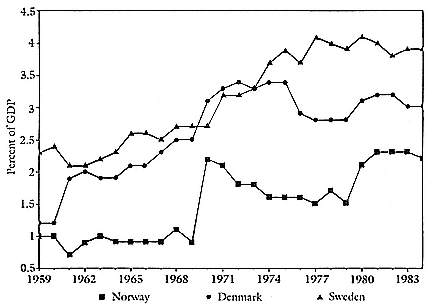
Figure 5.
Family Welfare Expenditures, Scandinavia, 1959–84 (as percentage of GDP)
Source: Yearbook of Nordic Statistics, 1959-85.
still representing a substantial increase (in Sweden, a doubling) over a twenty-year period (see figure 5). Much of the explanation for why general family expenditures increased while child allowances decreased lies in a greater reliance on newer kinds of programs that changed the character of the relationship between the family and the welfare state. Instead of being based on the principle that the obligation of government was to transfer money from those who needed it less to those who needed it more, these programs emphasized the principle that government could build the institutions and carry out the services that the family itself had once provided.
Of course, government has always provided services for families, the most important of which is education. Unlike in the United States, where the market has become far more involved in the business of schooling, education remains an overwhelming public priority in Scandinavia. Sweden actively discourages private schools in any form; Norway, while it also relies extensively on public schools, does recognize some areas—such as religion or training in specific trades—where private schools are appropriate.[10] Of the three countries, Denmark is the only one that actually encourages private
schools: 10 percent of school-age children attended private schools there in the late 1980s, up from 5.2 percent a decade before.[11] Yet even in Denmark the state plays a role, because the government pays up to 85 percent of costs of sending a child to private school.
What has changed in the past two decades with respect to schooling is not the public commitment to education itself, but rather an increasing reliance on government to provide after-school programs—in marked contrast to the United States with its latchkey children. An extensive range of institutions exists for watching children in the late afternoon, and demand for such programs is growing: a 1980 use study showed that approximately 16 percent of Swedish and Danish children relied on such after-school centers, and by 1984 that figure had risen to 30 percent.[12] Besides the wide range of activities offered by after-school programs, many organizations that once had a more private character, such as sports clubs, are now increasingly supported by public funds.[13] Youth in Scandinavia, in short, have a good deal of contact with the state, not only when they are in school but even after school is over. As a Norwegian writer puts it, youth has become more "organized" in this part of the world.[14]
A second indication of an increasing reliance on government in the family sphere in Scandinavia is the greater use of foster homes, institutions, and other methods for coping with problem children. A strong ideological component of the Scandinavian welfare state involves the idea that social problems can be passed on from parents to children and that government intervention is required to break the vicious cycle of inheritance.[15] When there is a problem in the child's immediate environment—such as alcohol or drug abuse, poverty, violence, or a mother unable to cope—it is expected that the state will play an interventionist role. In general, that role has grown. The number of children under preventive care in Norway increased from about 2,000 in 1965 to over 5,200 in 1984, while in Denmark between 1970 and 1980 the number of children placed in foster homes increased by 400 percent.[16] In 1974, 16,884 Swedish children were voluntarily placed in foster homes, and 9,960 involuntarily; by 1981, the proportions had shifted dramatically, as 12,378 children were involuntarily placed and 9,483 voluntarily.[17] Sweden, as a result, developed a world reputation as the home of a "child Gulag." In 1983, for example, the German magazine Der Spiegel ran a story on Sweden saying that "nowhere else has the state become so totalitarian as in this country."[18] A 1982 change in the law, however, helped bring the rate down;[19] now, on a per capita basis, Denmark has more children "outside the home"—both voluntarily and involuntarily—than Sweden.[20]
No one doubts that it is better for children in extremely problematic circumstances to be moved. The problem is who makes the decisions and how. In the Scandinavian countries, social workers and other therapeutic professionals have developed a preventive approach to these matters; for example, the expert testimony of psychologists is generally relied on to decide whether children should go to foster homes (or, in divorce cases, which parent should get custody) to an unusually high degree.[21] Often basing their decisions on statistical tendencies and the hypotheses generated from these tendencies, social-welfare professionals feel that by knowing which kinds of families are likely to have the most problems, authorities can step in before the trouble starts. Thus, according to three Swedish social workers, circumstances such as alcoholism can have "a destructive influence on the child even when specific acts of abuse [do] not occur ."[22] Scandinavian societies in this sense resemble what Jürgen Habermas has called a therapeutocracy , in which professional expertise comes increasingly to substitute for family autonomy.[23]
Far and away the biggest component of the increase in government's role in providing services once assigned to the family, however, is the decision to finance and build a nationwide system for the provision of public day care, especially in Denmark and Sweden. The figures compiled in table 5 indicate that in all three Scandinavian countries, the number of children in public day care has doubled, or in some cases tripled, from the mid-1970s to the mid-1980s. (The gap between Denmark and Sweden on the one hand and Denmark and Norway on the other is even greater than these figures indicate, since in Norway more older children are in public day care part time than full time.)[24] Yet in spite of these increases, public day care is far from universal, since only in Denmark, and then only for older children, does the utilization rate account for more than 50 percent of all children.
Various efforts to examine reliance on public day-care institutions indicate that demand for them exceeds supply and that if more were to be built, more would be used. Danes lead Scandinavia in this respect. In 1985, only 5 percent of Danish children under the age of six were being raised full time by their mothers at home, while 55 percent were in public day care, 21 percent were in private day care, and between 3 and 5 percent were being watched by working parents on shifts, mothers on pregnancy leave, unemployed members of the labor force, or parents who worked at home.[25] (The first figure is somewhat deceptive, since women can be in the labor market and still be home full time with their children, what with maternity leaves, shift work, and work at home.)[26] In Sweden, by comparison, a 1980
| |||||||||||||||||||||||||||||||||||||||||||||||||||||||||||||||||||||||||||||||||||||||||||||||
study showed that 43 percent of children up to six years of age remained at home with one parent, while 30 percent went to public institutions, 14 percent went to private day care, and the rest were provided for with other solutions; 19 percent of children who qualified for public day care could not obtain it.[27]
In the area of family welfare, especially with the commitment to public day care, we can see the emergence of what can be called a "new" welfare state, which, unlike the older one with its reliance on transfer payments, is much more directly involved in the regulation of moral obligations in civil society. Some sense of this shift in the character of the welfare state is provided by figure 6. In the mid-1960s, day-care facilities absorbed approximately 2 percent of all welfare state expenditures for families in Norway and Denmark, while child-care allowances constituted approximately half. By the 1980s, the balance had shifted considerably. Now (with Norway again the exception) day-care expenditures absorb close to half the family welfare expenditures, while the family allowance proportion has fallen to less than 20 percent. The new welfare state represents an important change in the relationship between government and the moral order as the state
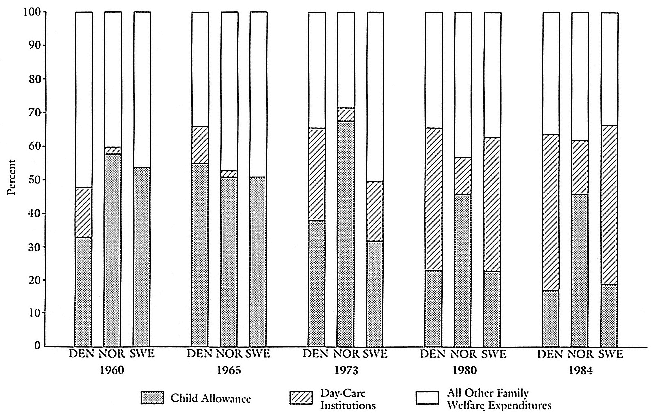
Figure 6.
Family Welfare Expenditures, Scandinavia, 1960–84
Source: Nordisk statistisk årbog , selected years.
has come to play a far more direct role as a surrogate parent, making important and difficult decisions such as how children should be raised or which children ought no longer to live with their parents.
At the same time that changes in the welfare state have had a more direct effect on families, changes in the family have had a more direct effect on the welfare state. Statistically speaking, the Scandinavian countries have among the world's lowest rates of family stability, with Sweden as the extreme case.
Sweden is a society where the traditional family does not have a strong position. By international comparison, the marriage rate is low, the frequency of informal cohabitation high, and average household size small. The rate of family break-ups, the average age of mothers at first birth, the rate of children born outside of wedlock, the rate of single-parent families, and the rate of gainful employment are all high.[28]
All these trends have been increasing in Scandinavia. A study of the Danish family and how it changed between 1975 and 1985 indicated that young people, especially boys, were twice as likely to leave home at a young age; that there were fewer families with young children; and that the percentage of children born out of marriage increased (although more children had two people raising them).[29] As this last point indicates, high divorce rates (the divorce rate doubled in all three countries between the 1960s and 1980)[30] do not necessarily mean more single parents: the percentage of "paperless" marriages, as they are called here, doubled in Norway between 1977 and 1984; in Denmark, 23 percent of cohabitating couples in 1986 were unmarried, compared to 9.6 percent in 1974; and in Sweden, 46 percent of the children born in 1984 were to parents who were not legally married.[31] Yet because cohabitation is so extensive, the divorce rate actually understates family instability, since the breakup of many relatively long-term relationships is not included in the figure.
The consequences of divorce, especially for women, are not as severe in Scandinavia as in the United States. A Danish study found that women were often better off in new partnerships than in their former relationship. Moreover, their social contacts with kin and neighbors did not decrease after divorce, although in around 10 percent of cases there were problems with loneliness and isolation.[32] Still, divorce does weaken relations in civil society: people who were once intimate, of course, have less contact with each other, and when they do, they experience difficult emotional problems; serious consequences for health and longevity are associated with di-
vorce; and the children of divorced parents find themselves in awkward, and often lonely, situations.[33] While such trends are similar, if somewhat more extreme, to trends throughout the West and in that sense cannot be attributed to the growth of the welfare state per se, it also seems clear that the welfare state makes divorce somewhat easier to obtain and weather (by providing day care for the children, for example) and then seems the most appropriate mechanism for resolving the problems created by divorce (such as providing extra funds for newly divorced women).
As the state grows and families weaken, it becomes more difficult to remain hopeful that state intervention will not significantly alter the character of the institutions in civil society. Certainly the "traditional" family, in which the wife stays home and raises the children while the husband works (a tradition that is, in fact, the historical exception), has been changed significantly by the welfare state. The results from studies of low-income maintenance experiments in Seattle and Denver—where greater financial help to women increased the rate of family breakup—are applicable to women at all income levels in Scandinavia.[34] The important question is not whether the nuclear family has declined, but what is in the process of replacing it.
In Scandinavia something is emerging that can be called a public family, in contrast to the emergence of a private family in the United States. A dramatic increase in the percentage of women entering the labor force has occurred in Scandinavia, as elsewhere; in Norway, whereas in 1965 14 percent of women with small children were in the work force (full and part time), by 1986 that figure stood at 69 percent.[35] The great bulk of this new work involves civil service jobs that carry out the functions once performed by private families. In Norway, 66 percent of social workers, 93 percent of nurses, and 98 percent of home helpers are women.[36] Of the growth in the labor force that took place in Denmark between 1960 and 1981 owing to the entrance of women, 25 percent was in day-care institutions and old-age homes, 12 percent in hospitals, and 27 percent in schools.[37]
Socializing the young and caring for the sick, viewed traditionally as women's work, are still women's work, but now they are carried out for a government wage rather than within a family setting. Within a twenty-five-year period, women have jumped from the family sector over the market sector to a direct, and often difficult, relationship with the state sector—as dramatic, if not more dramatic, a development as the transformation of men from peasants to workers two hundred years ago.[38] It is in this sense that we can speak of the public family in Scandinavia. The distri-
bution of sex roles has not greatly changed in Scandinavia (gender-defined work has probably been more thoroughly transformed in the United States), but their character has changed greatly: they have become "nationalized," in the sense that the Scandinavian welfare states organize through taxation and public services activities for all of society that were once undertaken more intimately and privately.
Many positive things can be said about the public family, especially that it has incorporated into T. H. Marshall's concept of social citizenship the rights of wives and mothers.[39] But because the family symbolizes to such a great extent the moral relations of civil society, its character is inevitably too intimate and emotional to be well regulated by government. The notion of a "people's home"—with which the welfare state began and to which a great deal of attention is once again being paid—seems increasingly problematic.[40] A people's home suggests that the caring which characterizes the intimate sector ought also to characterize the public sector; as Hansson put it in 1928, the rules of the home, when extended to society as a whole, "will mean the dispersal of the social barriers that now divide the citizens."[41] But the term raises as well the opposite possibility: if commitments in the home weaken, so will commitments to the people (I will explore this subject in Chapter 6). Home, in short, is where "the people" ought not to be, at least not on a permanent basis; it is rather the place where specific people seek to strengthen their moral ties to other specific people. This is not to say that the penetration of the welfare state into civil society is a mistake; there are many cases when state intervention in the home is justified. But it is to say that the moral issues involved in the new welfare state are more serious than at first was realized. The Scandinavian welfare states, which express so well a sense of obligation to distant strangers, are beginning to make it more difficult to express a sense of obligation to those with whom one shares family ties. The irony of this development may be that as intimate ties weaken, so will distant ones, thus undermining the very moral strengths the welfare state has shown.
Social Networks and the Welfare State
Johan Borgen, a Norwegian novelist, wrote of his childhood: "Good people lived in our street, people who knew one another and greeted one another—in a way it was each person's security in a society that was already facing hidden threats from outside."[42] In Scandinavia, the experience of farm life, village sociability, and regular church attendance is only a generation removed; older residents of the dense housing complexes in
Oslo and Stockholm were born into an entirely different world. Few wish to return to that world (although Borgen, when he read his memoir on Norwegian radio, did attract a huge audience). The point is, rather, that social changes which may have taken a century to take hold in other places occurred within one lifetime here.
Of modernity's trinity—urbanization, industrialization, and bureaucratization—the first two came late to Scandinavia. Sweden, the most industrially advanced of the three Scandinavian countries, was still primarily agrarian as late as 1900, and even its early industry was decentralized throughout the country in milltowns. Forty years later, as Gösta Esping-Andersen puts it, "Sweden had become the epitome of the Marxist polarized class society."[43] Although the changes that have taken place in Denmark and Norway are not as dramatic as in Sweden, there they are even more recent. "Between 1960 and 1980," Natalie Rogoff Ramsøy notes, "two-thirds of all the smallholdings in Norway (that is, farms with no more than 12.5 acres under cultivation) went out of production"; moreover, from 1930 to 1980 the number of self-employed persons decreased 45 percent, while the number of people employed for a wage increased 122 percent.[44] In Denmark it was not until 1958 that as many people were employed in industry as in farming, and by 1970 agricultural employment had decreased until it accounted for only 10.8 percent of all jobs; twice as many people worked in the professions as on farms.[45]
The "great transformation" was not only more rapid and more recent in Scandinavia than in Great Britain or the United States, but it was also, and to a much greater degree, led by the state rather than the market. Fundamental moral questions, such as where and how people ought to live, were answered by relying on government. From 1931 to 1960, the urban population of Sweden increased from 38 percent of the total to 73 percent, in part because of public policies designed to reshape the map of Sweden.[46] The question of where to house these new urban residents faced Social Democratic governments, which developed what they called the miljonprogamm: a plan to build one and a half million new apartments between 1960 and 1975.[47] Such plans succeeded: by 1980, well over half the housing in Sweden had been built in the previous thirty years.[48] (Only war-devastated West Germany built more housing in this period.) In Norway, as Rogoff Ramsøy has pointed out, housing and similar social services were also developed by administrative logic:
The trend toward practicing economies of scale extended far beyond the limits of the productive economy. . . . The same principle was applied to local administration and to the transformation of the primary school system. A considerable
amount of Norway's postwar urban housing was built in the form of large projects following principles of industrial organization.[49]
(Denmark, by contrast, encourages more private housing than, especially, Sweden, and its cities are characterized more by suburban patterns familiar to Americans than by large-scale apartment complexes.)[50]
The situation in Scandinavia is both similar to and different from that in the United States. In America, as I argued in Chapter 2, a strong reliance on voluntary associations, traditions of local autonomy, kinship networks, tax subsidies, and other practices delayed the entry of marketplace principles into real-estate transactions for a surprisingly long time. In Scandinavia, changes in the moral dynamics of local communities are just as recent. Some sense of how dramatic these changes in the character of civil society have been can be gained from table 6, showing information based on a sample of five thousand Danes interviewed in both 1976 and 1986. The intimate world of a Dane born in 1910 is radically different from that of one born in 1950: the former was likely to have been raised in a rural area with a tight-knit and large family, presumably (although we have no direct data on this) in frequent contact with other similar families in the same locality, whereas the latter was likely raised in a smaller, more unstable family in a more urban area. The difference with the United States, of course, is that in Scandinavia it is not the relatively late arrival of the market that has changed the character of civil society, but the relatively late arrival of government.
The major question posed by changes of this magnitude is whether they cause a weakening of social ties and informal networks similar to that caused by the growth of the market as a moral code in the United States. Bent Rold Andersen argues that they have:
Weakened social networks, a phenomenon widespread in the Western world, cause fewer conflicts in the welfare state, where the public sector readily takes over. Like a vicious circle, this itself tends to speed up the dissolution of networks and thereby extends the public sector ever more. This flexibility, this ease of response, has become a threat to the welfare state itself.[51]
Andersen's view has been strongly challenged, especially by Stein Ringen and Gösta Rehn, both of whom argue that the welfare state has in fact strengthened informal networks and social ties.[52] All three, however, may be correct.
Ringen and Rehn rely on a series of studies undertaken by the Institute for Social Research of the University of Stockholm. Surveys of the Swed-
| |||||||||||||||||||||||||||||||||||||||||||||
ish population in three separate years—1968, 1974, and 1981–were conducted to discover, among other things, the amount of contact people had with friends and relatives. These data show, almost without exception, increases in the number of social contacts over this thirteen-year period. For example, the number of people who visited relatives regularly increased from 28.1 to 31.0 percent of the total sample, and the number that visited friends increased from 29.8 to 39.9 percent. Measuring the same phenomenon in the reverse way, the Swedish studies showed that isolation has decreased: the number of people who had very few contacts with relatives dropped from 15.8 to 11.9 percent of the total, while the figures involving friends decreased from 9.8 to 5.8 percent.[53] Material published after Ringen's book appeared confirms his point. Although the number of Swedes living alone has grown, social contacts showed little significant difference between 1981 and 1986, and in some cases even increased.[54] The appropriate conclusion to be drawn from this material is that, especially in comparison to societies that rely on the market, there is no reason why reliance on the state has to be accompanied by isolation and alienation for the majority of citizens.
Yet the number of contacts people have says little about what they expect from one another. That question is better answered through community studies, which explore the nature of the social contacts between people at the local level. One such study, based on the social-network analysis techniques developed by North American sociologists such as Claude
Fischer and Barry Wellman, had results in Sweden quite similar to those discovered in the United States. Working-class people had fewer ties to others than middle-class people, but the ties they did have were much stronger and involved relying on others for help. Among middle-class civil servants, by contrast, ties between individuals were more geographically spread out and specialized, characteristic of "weak ties" that, according to Mark Granovetter, have their own kind of strength.[55] A similar study, conducted in a medium-sized Danish city in Jutland and a Copenhagen suburb, revealed that while large numbers of people would ask others for help in the form of advice or to "give a hand" with moving, very few were willing to ask people from their networks for more ongoing assistance, such as picking up or watching children, shopping, or cooking. Moreover, significant numbers of people had no real desire for greater help from their social contacts.[56]
One possible conclusion to be drawn from all this research is that the social trends associated with the welfare state both strengthen and weaken community ties simultaneously. (Whether the welfare state actually causes these trends is beyond the ability of this observer, and most likely any observer, to determine.) By contributing to social prosperity, these trends, as Ringen and Rehn emphasize, increase leisure time and expand the social horizons of the beneficiaries. At the same time, by raising working-class families into the middle class, they contribute to the geographic and social mobility that undermines solidaristic neighborhood patterns; help to create networks of civil servants that can provide necessary services more efficiently, but also more impersonally, than friends; and cause new housing to be built, the very practicality of which improves the material conditions of many families but also contributes to a certain anonymity. Ties between neighbors and friends, in short, expand and contract at one and the same time.
The trends associated with the welfare state do not abolish community, but, as with the family, they do alter its character. Obviously the family still exists: people still get married, have children, and experience daily life through their families. In turning some of the functions of the family over to government, Scandinavian societies have strengthened some of its aspects, especially its level of economic support, but weakened others, especially its ability to serve as a source of moral rules. In a similar way, the rapid urban development and extensive social programs of the welfare state do not eliminate the frequency of contacts with others; informal networks, for example, can still be relied on to solve some of the social problems
handled by the welfare state.[57] In general, however, such contacts express a sense more of sociability than of moral obligation.
That moral ties in civil society may have weakened in Scandinavia, even while social ties have been strengthened, is indicated by rates of crime, alcohol consumption, and, to a lesser degree, suicide, all of which tend to garner a good deal of attention when these societies are discussed. One should interpret these statistics with some care. Sweden, for example, does not have—as most people believe it to—the world's highest suicide rate: that honor belongs to Hungary. Nor is a dramatic increase in alcoholism all that uncommon: every Western society has experienced an increase since World War II, and in Sweden the rise in alcohol consumption follows almost exactly the rise in disposable income. Yet one cannot ignore such trends, for ever since Durkheim, the notion that the strength of civil society can be measured indirectly through behavior patterns indicating weak social networks has become something of a commonplace.
What should concern us most is not the number of suicides in Scandinavia relative to other countries—a difference that might be explained by, for example, the weather—but instead the increase in suicides in this part of the world when the weather is held drearily constant. (Actually, in all the Scandinavian countries suicides are less frequent in December and February and more frequent in May and August.)[58] Such an increase—ironically, given its reputation—is not true of Sweden, where the suicide rate declined from 22.3 per 100,000 people in 1970 to 18.2 in 1985.[59] The other two countries, however, experienced a significant increase. In Norway the suicide rate, though it remained at roughly the same level from 1951 to 1970, began to increase substantially after 1970.[60] A similar pattern holds for Denmark, where the total number of suicides increased from 931 in 1960 to 1,484 in 1983 before leveling off in the past few years.[61] If Durkheim was correct that suicide is symptomatic of declining social solidarity, then the increase that has taken place over the past twenty years is at least partial cause for believing that the moral ties of civil society are less strong than they once were.
A similarly dramatic rise can be detected in yet another indirect measure of the strength of civil society: the rate of consumption of dangerous substances. As with suicide, Scandinavians are known as hard drinkers, but again, what is of importance is the increase that can be measured over time. All three Scandinavian countries have relatively similar patterns. In general, the consumption of hard liquor has decreased, in part because of stricter regulation, whereas the consumption of wine and beer increased
sixfold between the 1950s and the 1980s.[62] These trends have been accompanied, again as elsewhere in the West, with increases in tobacco consumption and narcotics use.[63] There is, of course, much debate about what this increase in alcohol consumption means, since even with recent increases it is at about the same level it was in the nineteenth century. Yet the visible rise in the number of derelicts on the streets of Stockholm, Oslo, and Copenhagen says something about the weakness of ties in civil society, even if exactly what it says is open to dispute.
Finally, a sharp rise in crime has taken place in all three Scandinavian countries over the past twenty years. In 1970, 47 murders were reported in Denmark, 6 in Norway, and 218 in Sweden; ten years later the numbers were 236, 31, and 394, respectively. Assaults also increased, if not at quite the same rate.[64] But perhaps the most illustrative statistics in this context are those for breaking and entering, for it is relatively petty crimes of this sort that most break down the kinds of trust and mutual help networks of civil society. As figure 7 indicates, these rates have nearly quadrupled in Denmark and Sweden. Behind such figures lies a change in the nature of the civil society: less trust, greater fear of involvement, and a dramatic increase in the use of bicycle locks.
What is perhaps most important to emphasize about all these figures is not that each, by itself, represents a weakening of the social fabric; in comparative terms, Scandinavia is certainly not characterized by normlessness. (Indeed, the opposite charge—excessive conformity—is the one most often leveled against these countries.) Rather, each category is related to the others, suggesting that all together they measure the extent to which a group exists, whose size is difficult to determine, that is not part of the welfare state's success story. People who commit suicide, for example, are far more likely than people in the general population to suffer from problems of alcoholism; and excessive use of alcohol in turn contributes to violence against others.[65] They are also likely to be, in classic Durkheimian fashion, unmarried, residents of large cities, and without siblings or friends, as one Norwegian study concluded.[66] (Similarly, Danes who attempted suicide were three times more likely to live alone than members of the general population, and those who succeeded were four times more likely to.)[67] These interrelationships suggest that while social contacts and networks are still healthy among those who benefit from the welfare state, they are weaker than ever among those who, for whatever reason, are alienated from its way of functioning.[68]
Such a conclusion is reinforced by an examination of the relationship
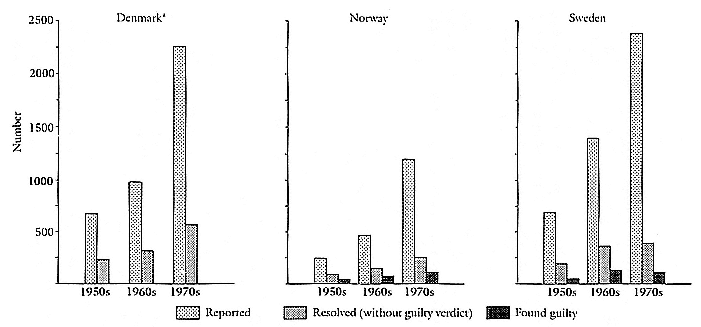
Figure 7.
Breaking and Entering, Scandinavia, 1950–80 (from reporting to sanctioning, per 100,000 population 15–67 years of age)
Source: Hans von Hofer, Nordisk kriminalstatistik 1950-1980 (Copenhagen: Nordic Statistical Secretariat, 1982), 142.
a Figures for guilty verdicts and resolved verdicts are combined for Denmark.
between income level and social isolation under the welfare state. Social research in Scandinavia has long emphasized a concern with reducing the effects of inequality. Consequently, the populations of these societies are routinely divided into various "social groups" measuring such characteristics as income, political resources, and other indicators of unequal social status. In a recent Danish study of the quality of life, all five social groups reported less isolation over time; the number of people who felt that there was no one they could-talk to or that they were too often alone even though they did not want to be decreased between 1976 and 1986, thereby confirming the point that the welfare state does not lead to isolation and weak networks. But the most interesting fact that has emerged from this breakdown of social contacts by social class was not that working-class people have fewer contacts than middle-class people, although they do; it was that the only group in the entire population whose degree of loneliness and social alienation has increased, and often at significant rates, was that which could not be categorized as a distinct social group at all.[69]
There is, in conclusion, one way in which higher suicide or alcohol consumption rates, if interpreted with caution, seem to indicate a weakening of moral obligations in civil society in Scandinavia. Strong moral ties in civil society can help to soften the fall of those unable to function in a modern political and economic system. When these ties weaken, they add to the isolation and marginalization of those already isolated and marginalized. The welfare state, because it relies on government to strengthen the social bond, places a premium on the mobilization of political resources. For that reason, its primary moral commitment is to those who share a political definition as citizens, not those who share a social definition as generalized brothers or sisters. Scandinavian societies have broadened the concept of citizenship to an unusually wide, but still not all-inclusive, degree. Hence, for all those who are brought in to the functions of the welfare state, there will always be some who are left out. Reliance on government instead of the moral ties of civil society to express obligations between people improves the social conditions of most but worsens the lot of those who, already worse off, lack the resources to operate effectively in a system organized around political rules.
When we try to answer the question of whether community and social ties have weakened as the welfare state has grown, we find evidence that can support almost any response. A reasonable conclusion might be that both the social trends associated with the welfare state and, to an undeterminable degree, the welfare state itself have altered the character of every-
day life, moving it from informal reliance on what Gösta Esping-Andersen and Walter Korpi call "kinship and community altruism" toward what they call "the strength of entitlements to welfare based on social citizenship." As a consequence, we can agree with them that in this part of the world "the principles of the welfare state are pushed further into civil society than is internationally common."[70]
The notion of social citizenship embodies all the strengths and weaknesses of a political approach to moral regulation. Citizens, even social citizens, have rights. People who live in civil society have obligations. The replacement of one language by the other implies a movement from society to politics, from a recognition that we owe things to one another because we share certain understandings to a recognition that we can expect things from others because we vote and belong to an organized political community. This is not a problem if one believes, as Helga Hernes does, that "although the institutional balance between state and society in Scandinavian social democracies has quite clearly gone in favor of the state, there is . . . an awareness of the dangers of alienation that has resulted in important participatory reforms at all levels, involving individuals in their functionally limited corporate roles."[71] But if one shares a Weberian distrust of government, even of benevolent and participatory ones, a political approach to moral regulation, by thinning out the moral texture of civil society, does seem to contribute to a sense that moral obligations can be satisfied without the active participation of individuals as moral agents.
From Welfare State to Welfare State
Created by working-class men at a time of economic insecurity, the welfare state brought into being a new kind of society, characterized by a commitment to full employment, the provision by government of services deemed essential to the realization of a better life (such as medicine and education), and a system of transfer payments designed to promote the general goal of rough equality between social classes. So impressive has been the overall performance of the Scandinavian welfare states that we tend to forget how recently they were constructed. As Esping-Andersen and Korpi point out, the "Scandinavian model" is almost entirely a post—World War II phenomenon.[72]
Just as the Scandinavian welfare state itself is a recent phenomenon, even more recent is the emergence of a "new" welfare state emphasizing the construction of institutions designed to carry out tasks once assigned
to civil society. (The commitment to the building of public day-care centers, for example, stems only from 1970.) If the old welfare state, in the course of the 1980s, has stopped growing and is instead entering a period of consolidation, the new welfare state is growing more rapidly than ever.[73] If it continues to grow at the pace it has, we can expect that by the year 2000 Scandinavia will again have created a new social experiment. Unlike the earlier version, this welfare state will be one in which both men and women work while their children are cared for in public institutions. (It may also be the case, as a Norwegian projection points out, that women will come to dominate the public sector as men flee to the private sector.)[74] At the same time, the industrial working class will continue to shrink and the middle class will not only grow but also, to a greater degree than ever before, avail itself of the benefits of the welfare state. Finally, public policy will not only protect against economic insecurity but also try to secure the good life for as many as possible. These societies, in short, will continue to be caring ones, but the caring will increasingly be carried out by therapeutic professionals in institutions and less by immediate kin, neighbors, and social networks. Moral obligation will, in that sense, be more public than ever before: government, to an unprecedented degree, will be involved in the structuring both of obligations to distant others and of obligations to intimates.
What is taking place in Scandinavia, in short, is the replacement of the welfare state by the welfare state . Instead of familial and community relations creating a sense of responsibility for the welfare of others, which the state enforces as a matter of last resort, the state is becoming the primary moral agent in society, seeking to express, as best as it can, a sense of responsibility for the welfare of those who no longer have much power in civil society. The emergence of the new welfare state has helped to create an atmosphere of uncertainty about future directions. That uncertainty can be understood neither politically, for the welfare state is still very popular,[75] nor economically, for it has not faced, at least to this point, an unsolvable economic crisis.[76] It is, rather, moral in nature. In everyday life it takes the form of tax avoidance, distrust of authority, and, in the words of former Danish social minister Bent Rold Andersen, a feeling that "the Nordic governments, in their steady expansion of the public sector, have overrated the willingness of individual citizens to contribute their share to the communal pot."[77] Among academics and social scientists, it usually takes a conservative form, with the argument that the welfare state has become "heartless" and tends to weaken families and private charity.[78] (Left-
ist intellectuals, who in the 1960s were critical of the welfare state, now tend to defend it and to call for its extension; feminist thinkers, similarly, while often ambivalent, generally find the programs of the welfare state to their liking.)[79] At no time since World War II has concern over the moral consequences of state intervention been as strong in Scandinavia as during the past few years.
There are, in particular, two essentially moral issues that the new welfare state has been unable to address satisfactorily. The first involves the dilemmas of the public family. Early notions of the welfare state were premised on the idea that men would work and women would stay home, thereby making unnecessary (to be more correct, unthinkable) the idea of government substituting for one critical ingredient of civil society—the family. As one Danish historian has put it, "While the working class movement strongly stressed a struggle over the old society's patriarchy and patriarchal relations in production and the public society, it was completely silent about patriarchal relations in the workers' own families."[80] Now that the rates at which women work for a wage are higher in Scandinavia than in most other countries, reliance on government to carry out tasks of social reproduction fills the gap between the society that existed a generation ago and the one that exists now.
As many feminists have correctly argued, the bulk of welfare work has traditionally been invisible and unpaid, performed by women within the family.[81] The entry of women into the labor market on the one hand and the growth of a new welfare state on the other make the invisible a public policy and the unpaid a civil service career. This represents progress: women are freer, workers are less easily exploited, contributions are recognized, and the problems of destructive families are corrected. Yet when the state is responsible for social reproduction, the family cannot be as responsible, despite the best efforts of many families. One can therefore admire the frankness of someone who argues that in the face of all these problems, our best hope is to accept the reality of Goffmanesque "total" institutions for carrying out these tasks and to try to make them as humane as possible.[82]
That we may have to turn our moral responsibilities over to institutions, no matter how reformable they may prove to be, acknowledges, however, why the new welfare state, for all its benefits, treads on slippery moral ground. Day care provides an illustrative example. Surely any two-income couple is grateful to be able to deliver their small children to a day-care center before going to work. And most people recognize that, despite cutbacks and staffing problems, day-care centers try to be caring places.[83]
Yet when small children spend the greatest number of their waking hours being watched by public employees—who have their own children, their own rights, and their own wage to consider—moral dilemmas easily arise. What is in the best interests of parents, especially two working parents, is not always in the best interests of children (see Chapter 6 for more on this theme). While parents generally like the system of public day care, they would prefer different kinds of work arrangements that would allow them more time with their children—and reduce their feelings of guilt.[84]
It is, in short, possible to have two full-time-employed partners, state-financed day-care institutions, and well-functioning families, but not all three at once. Yet most people want, and feel entitled to, all three. One response to such a dilemma is not to choose among the three goals, but to juggle. Each of the Scandinavian societies juggles in a different way: in Norway, public day care is relied on far less than in the other two countries, and friends, neighbors, and grandparents are relied on more; Sweden has a very large amount (second only to Norway among the industrialized countries) of part-time work for women, which, in combination with paid maternity leaves, substantially reduces the number of small infants in public day care; and Danes, who tend to be more libertarian than Norwegians and Swedes, solve the problem by somehow finding a way to pick up their children by 3:30 P.M.[85] Yet such juggling does not resolve the moral guilt that people, especially women, feel. No matter how publicly articulated the ideal is that raising children is a social responsibility which can be carried out by the state, many women still feel that the responsibility is their own. The result has been described by Natalie Rogoff Ramsøy:
Women today suffer from a role squeeze—an incompatibility between their family and other obligations. Recent surveys document the problems that result. Married women with young children have far less time at their disposal than any other group in the population, and they also exceed all others in psychosomatic symptoms—sleeplessness, nervousness, depression, use of tranquilizers, etc.[86]
As a substitute for the family, it would seem, government is a second-best solution. Given other goals—the most important of which is greater sexual equality in the workplace—state intervention in civil society becomes a necessary, but not completely satisfactory, response.
A similar set of moral problems follows from a second difficult dilemma: the degree to which the new welfare state, instead of transferring funds from the rich to the poor, becomes a subsidy for the middle class. The original goal of the welfare state was to alter the rules of distribu-
tive justice in society by reducing the barriers between social classes. As Esping-Andersen and Korpi have argued, a political strategy designed to represent only the interests of the working class could never hope to succeed. In order to appeal to middle-class voters, Social Democratic parties developed notions of universality in the distribution of benefits. Benefits were no longer a matter of charity but a right, comparable to the property rights historically enjoyed by the rich.[87] The popularity of Social Democratic governments in the 1960s and early 1970s was due to the political success of universal programs financed by seemingly endless economic growth.
The very success of the welfare state in raising more people into the middle class has, however, changed its moral equilibrium. Unlike the egalitarian thrust associated with the first welfare state, which used the powers of government to level income differences between classes, the new welfare state increasingly begins to provide disproportionate benefits to the middle class. (This is true not just of Scandinavia, but of other societies as well.)[88] To some degree, this change in the distributional effects of welfare programs is directly attributable to the fact that the new welfare state, unlike the old, builds institutions to carry out tasks of moral obligation once associated with civil society. For one thing, a large number of people elevated to the middle class are themselves public employees working in the labor-intensive area of service delivery. As they begin to exceed the number of people employed in the private sector, they develop a double claim on the welfare state as both providers and users: "In Scandinavia, the producers and clients of the welfare state together make up between 40 and 50 per cent of the electorate."[89]
In addition, the political dynamics of service delivery are quite different from those of transfer payments. It is, administratively speaking, relatively easy to universalize a cash payment, since all it involves is sending out a check in the mail to everyone. When government provides a service, by contrast, those who are most likely to benefit are those organized to take advantage of it. In the field of day care, where the ideal of universal access would come close to bankrupting society, selectivity had to be introduced, and the selectivity, not unexpectedly, shows a class bias: working-class women are more likely to stay home with their children or, when they work, to rely on relatives or hire other mothers (often paid for, and regulated, by the state).[90] Furthermore, when cutbacks become necessary, it is more difficult to cut back institutions with highly articulate middle-class clients and constituencies. The idea of universality, which made perfect
sense when the primary task of the welfare state was to redistribute income, becomes an impossible goal (and can only contribute to cynicism toward the welfare state's objectives) when society is better off.
As opposed to transfer payments, which represent a "vertical" redistributive effect from the rich to the poor, institutions such as day-care services tend to benefit the middle class and therefore represent a "horizontal" shift from one part of the middle class to another. This may help to explain why no legitimacy crisis faces the welfare state. It may also help to explain why the tax revolt against the welfare state has fizzled (the welfare backlash parties in Norway and Denmark, after a period of decline, are now as strong as ever, but their focus is as much on immigration as on taxation), since it was only a matter of time before the middle class discovered that, for all the tax burden imposed by the welfare state, the advantages in policy were considerable. Hence, white-collar workers in Norway have begun to polarize in their attitudes toward the welfare state, with those who work in the private sector more against it and those in the public sector more for it.[91] In Denmark, the number of lower-paid civil servants who supported the parties to the left of the Social Democrats nearly doubled, between 1971 and 1984, going from 14 to 26 percent of the vote.[92] Even in Sweden, where working-class solidarity for the welfare state is strongest, other income groups clearly recognize an interest in government provisions.[93]
The middle-class bias that follows when the welfare state intervenes in activities once carried out by civil society undermines the logic of solidarity that made the welfare state such a powerful idea in the first place. Esping-Andersen in particular has emphasized that the moral power of the welfare state comes from the "decommodification" logic it introduces by universalizing benefits.[94] Yet if reliance on institutions, as opposed to transfer payments, is inevitably selective, the result is to re commodify what government has to offer. The new welfare state increasingly enables middle-class people to buy the labor of others who will perform their moral obligations for them. That is not only a far cry from what the welfare state was originally designed to do, but it also raises the uncomfortable question of whether subsidizing middle-class life-styles can generate the same kind of consensus and moral solidarity once associated with creating greater social equality.
The Scandinavian welfare states have for over half a century been premised on the assumption that the state could act as the moral conscience of society. It is remarkable how long that assumption has been maintained, and certainly many people think it can continue to be so maintained indefi-
nitely. Yet it is also the case that in Scandinavia society has acted as the moral conscience of the state. Ties of political consensus, strong moral traditions associated with Lutheranism, solidaristic ideologies growing out of social and political movements, and common moral lessons taught by the family have long worked to insure that state intervention would occur within generally accepted boundaries. In particular, government intervention took place primarily within the economic sector of society, and its major forms—even in Sweden, where reliance on the state was strongest—were indirect. (Sweden did not consider nationalizing private companies until the 1970s, and it remains reluctant to regulate private industry; indeed, in many ways direct government regulation of industry is more directly enforced in the United States than in Sweden.)[95]
Unlike the situation in the United States, where the entry of the market into civil society was heralded by Chicago school theorists before it happened in practice, in Scandinavia the boundary between the state and civil society was increasingly crossed in practice without anyone thinking about it in theory. As the Scandinavian welfare states approach the year 2000, the precarious balance between state and society that made the older welfare state work so well is becoming harder to maintain. Families and communities, instead of contributing to the articulation of moral understandings that soften political regulation, are themselves increasingly organized according to political rules. Notions of solidarity and a consensus around the principle of equality, which made sense when governmental intervention was indirect, are turning into a defense of the interests of those classes who benefit primarily from the new services the welfare state offers, as interest groups become passionate about defending the programs that benefit them but less concerned about the programs that benefit others. Nearly everyone laments the increase in antisocial behavior associated not only with criminality, but also with everyday rule-breaking and moral shortcut-taking. The international outlook and humanitarian instincts long associated with Scandinavia are put under strain as a result of increased immigration. Surely not all these changes can be attributed to a greater reliance on politics as a way of organizing moral rules, but at the same time, such a reliance does make it more difficult for the Scandinavian societies to protect traditions of consensus and solidarity—for which state intervention can be a helpful, but never complete, substitute.
The concept of welfare, Erik Allardt has written, contains three elements: having , defined as the realization of both physical needs such as good health and long life and material needs such as sufficient income;
being , defined as individual identity and the possession of enough political resources to realize this identity; and loving , defined as "needs of solidarity, companionship, or, above all, participation in a network of social relations, in which people think about and pay attention to one another."[96] The question posed by the new welfare state is whether a weakening of loving will affect having and being. One way to find out is to examine the implications of greater state intervention in the intimate sphere of society on the same measures of moral obligation to distant strangers used earlier with respect to the market: intergenerational transfers, ties to others expressed through altruism and charity, and the webs of social existence defined by common possession of cultural symbols. If there is a moral problem with the new welfare state, it will show up precisely where the older one was strongest: in the sense of solidarity people feel toward those they do not know and probably never will.
Six—
States and Distant Obligations
The Social Democratic Generation: Before and After
One of the most important questions we can ask about the Scandinavian welfare states, in both their earlier and their more recent forms, is how they sustain a sense of obligation across generations. This question is particularly appropriate in Scandinavia, because there the social-democratic movement that created the modern welfare state is itself a generational phenomenon:[1] shaped by the experience of the Great Depression, social-democratic voters possess distinctive attitudes emphasizing equality and economic security.[2]
There is certainly good reason for this generation to be proud of its accomplishments. The welfare state has created what Swedish demographers call a "golden generation": an entire cohort of people whose conditions of material life have improved as a result of government programs.[3] Those who were born between 1920 and 1930 are today unusually well off. Their children have left home, their pay is high thanks to seniority rules, and they can expect generous pensions when they retire. The combination of all these factors gives them enough disposable income to come about as close to the good life as is possible in any Western liberal democracy. Yet what is true of the golden generation is not necessarily true of all generations in Scandinavia. The problems that follow from reliance on the state as a moral code are more likely to appear among people who are both younger and older than the golden generation itself.
Political approaches to moral obligation tend to be as oriented to the needs of the present generation as economic approaches, if for different
reasons. Whereas the market discourages sacrifice for future generations in exchange for maximal satisfaction now, the state organizes moral obligation by mobilizing political resources, a practice that tends to slight the needs of those, especially the very young, who have fewer resources at their disposal. In that sense, reliance on the state as a guide to intergenerational obligations produces results in Scandinavia not dissimilar to those produced in the United States by reliance on the market. The economic security and material achievements of the welfare state have created a positive legacy for future generations, but at the same time they have, to some degree, contributed as well to a weakened moral commitment to those generations.
The situation facing young people in Scandinavia parallels in significant ways the situation facing young people in the United States. Declining fertility rates (what Alva Myrdal has graphically called a "birth strike"), pessimism about the future, youth unemployment, increased rates of crime and drug addiction among the young, and a sense that the "youth revolt" which began in the 1960s has turned sour are all common themes in discussions about Scandinavian youth.[4] Despite the success of the welfare state, consequently, specialists on youth problems speak in terms quite familiar to their American colleagues. Ivar Frønes, for example, views attitudes toward children as representing direct consumption rather than investments in the future, while Inger Koch-Nielsen, in a study of future prospects for children in Scandinavia, talks about "a ticking bomb in the development of society."[5] The feeling has been best expressed by Frønes: after World War II, he said, it was "youth [that] would build the country. Now youth has become synonymous with problems."[6]
The very young in Scandinavia today are being raised completely unlike any previous generation. "Growing up postmodern," as the Swedish psychologist Lars Dencik puts it, involves living with adults, one of whom is likely not to be one's biological parent; having step-siblings as often as one has siblings, and having fewer of the latter in any case; spending most of the day, from a relatively early age until the start of school, in a public day-care institution; experiencing generally low levels of contact with friends and neighbors; maturing extremely quickly, and developing a series of capacities that stress self-control and self-mastery.[7] One question raised by these patterns is whether the accomplishments of the new welfare state—its achievement of greater equality between the sexes and its emphasis on rights rather than responsibilities—come at the cost of exposing children to new ways of growing up the future consequences of which are uncertain.
Such a question is generally asked at the point where the postmodern family overlaps with the new welfare state: the public day-care center. A series of efforts have been made in Scandinavia to determine the consequences for children of public day care. The most positive results were found by Bengt-Erik Andersson, who, in conjunction with an international group of social psychologists, conducted a longitudinal study of 119 Swedish children from age one through age eight. While many of his findings revealed that participation in public day care had neither a positive nor a negative long-term effect, either in the development of academic skills or in psychological measures such as self-confidence, Andersson did discover that age of entry into the public day-care system seemed to be a consistent predictor of success later on: the earlier a child began, the better the later academic success.[8]
Andersson's findings were contrary to the conclusions of many child psychologists, especially those influenced by the "object relations" school of psychoanalysis who stress the need for early and permanent contact between parents and children. (They were also contrary to the proposals of the Swedish Social Democratic party, which argue for eighteen months paid maternity leave.) They are, however, consistent with other studies that show positive results from the experience of public child care, emphasizing, for example, the autonomy that children can learn or the value of day-care centers to bring children into contact with other children from a wider variety of backgrounds, including differing ages, than would have been possible if they had been brought up at home.[9] From studies such as these one can conclude, as both Andersson and Dencik do, that a good deal of the guilt experienced by parents when they utilize public day care is unnecessary. But there are reasons, many of them not quantifiable through statistical research, to believe that such a conclusion is not justified.
One reason is that Andersson's research stresses the importance of "good" day care, but not all public day care is good. Various problems plague the day-care sector in Scandinavia, the most important of which are the notoriously frequent turnover of personnel in day-care institutions and the fact that children in day care spend little time together with the immediate family.[10] This latter problem, moreover, is compounded by the fact that small children in the Scandinavian countries, because of the general weakness of civil society, have relatively little contact with friends and relatives outside their immediate family network.[11] Such factors may explain why other studies have found serious emotional problems associated with public day care: some, for example, found that young infants were particu-
larly disturbed by their entry into a new environment, even if such feelings tended to pass with time, while others, not only in Scandinavia but elsewhere as well, have concluded that children in public day care tend to be more aggressive.[12] Once-optimistic views about public day care—which assumed that, in Birthe Kyng's words, children would be "more self-sufficient, that is, more independent of support from adults, less shy than children raised at home, and more open in peer-group relations"—are increasingly being replaced with the neutral notion simply that public day care does no harm.[13]
Denmark relies on public day care to a greater degree than any other country in the world. It is therefore worth pointing out that a Danish national commission on the status of children, in a report issued in 1981, warned of a "closed children's world" cut off from adult life.[14] Responding to that report, the National Association of School Psychologists also investigated what many have called "the new children's character" in Scandinavia and concluded, among other things, that
it is becoming more common that children who are beginning school are antisocial, loud, and confused. They are uncertain, unhappy, and badly in need of contact. They do not have the awareness that early beginners in school once had, and they are lacking moral conceptions. They have no respect for elders and are untrained in using their body and their hands. Many are passive or aggressive, and they do not understand ordinary reprimands.[15]
This notion of a "new children's character" must be interpreted with some caution, for, as Kyng points out, it applies to all children, not just those who attended day care while young.[16] (It has also been suggested, by a therapist who works extensively with small children in Denmark, that the proper term ought to be a "new parent's character," since it is the parents whose behavior has changed, more than the children.)[17] Still, findings such as these suggest that the public family does involve an element of moral gambling with the future.
There can be little doubt that many children are served well by public day care, especially in contrast to the United States and the haphazard effects there of reliance on the market. If the American and Scandinavian approaches to raising children were the only ways possible, the needs of future generations would, at least in this observer's opinion, be better served by the latter. Nor is there any doubt that even if public day care is organized more according to the needs of the parents than of the children, more productive and content parents make for happier children. Yet none-
theless, there is reason to listen when Scandinavian parents express guilt about their children. As nearly all studies of public day care suggest, every child has different needs, and individual parents are usually in the best position to know what the specific needs of their children are. Public provision of day care has undoubtedly made the Scandinavian state, as Helga Hernes puts it, "woman friendly."[18] Whether the new welfare state is "child friendly" remains undetermined.
In contrast to the situation with the very young, the response of the welfare state to the very old, at least in recent years, has not been one of building institutions to carry out tasks once associated with civil society. Rather, public policy toward the elderly has changed from an effort to provide nursing homes and other forms of institutional care to one emphasizing "community care" for the elderly, such as service centers that assist older people during the day, housing complexes for the elderly with special provisions for their needs, and extensive home-help coverage. This pattern has been clearest in Sweden, which historically has had the greatest commitment to institutionalized care: in 1970 the number of places in institutions for the elderly in Sweden was three times that of Norway and twice that of Denmark, although by 1980 the differences among the three Scandinavian countries had begun to even out.[19] Projections for the future, moreover, indicate that decreasing institutionalization in Sweden combined with the building of nursing homes in the United States (often under private sponsorship) will equalize the pattern between these two countries, otherwise so different, within a decade.[20]
Deinstitutionalization reflects one of those rare meetings of the mind between political ideologies: it satisfies the right, because it is the cheapest solution, and it satisfies at least some on the left because it is more humane. Consequently, little support for routinized institutionalization for the elderly remains in Scandinavia. Even when older people are so sick that they must depend completely on institutional care, old-age homes still require families and social networks to complement what they can offer.[21] The trend against building institutions for the aged, then, represents something of a shift in welfare state thinking, for the goal in this area of public policy is not to supplant civil society but to strengthen it—although in so doing, such a policy exposes itself to criticism from a social-democratic perspective, which stresses that only government delivery of services can approximate the goals of universality and relatively equal access.[22]
The significant question posed by these reforms is not whether, as ways of encouraging moral obligation in the intimate sector, they are a good
idea, for they are, but whether civil society is strong enough to support them. Because so many other aspects of the new welfare state in Scandinavia use government as a substitute for the moral ties of civil society, greater reliance on family or community help can mean turning to sources of moral support which themselves have been weakened.[23] Consequently, for all the improvements in the material, physical, and even social conditions of the elderly that have taken place in Scandinavia in recent years, the webs of interdependence between the elderly and other generations have weakened in ways not dissimilar to those in the United States.[24]
An informal system of caregiving based on the family assumes that families can accept the burden. That assumption becomes harder to maintain when the family has been transformed as much as Scandinavian families have been in the past quarter century. Single people, whether they have never married or are divorced, experience more strain in caring for their parents than do married people.[25] Similarly, the two-income family often has less time to take care of the elderly.[26] Furthermore, the past twenty years have seen dramatic changes in the household structure of the elderly: the percentage of those living either alone or just with their spouse has increased in all three countries, whereas the percentage of those living with their children or with others has decreased (see figure 8). The cross-generational family unit living together no longer exists, at least not in any great numbers.
Changes in family structure carry many positive results. Older people now have the means to be independent of their children, and they clearly like it that way.[27] As in the United States, grandparents prefer what has been called "intimacy at a distance";[28] the ideal situation for them is one where they can maintain their independence but still live close enough to be with their families occasionally. (Visiting across generations, not surprisingly, increases as co-residence between generations decreases.)[29] Moreover, the desire of the elderly to be independent of younger generations is reciprocated by a desire on the part of younger people to be independent of their elders.[30] Caring for the old is enormously difficult work that requires personal self-sacrifice and can create almost unbearable strain, especially for women, who, to a much greater degree than men, tend to take on these responsibilities.[31] It has for example been found that in Scandinavia older men are far less likely to care for a sick wife than are older women to care for a sick husband.[32] Similarly, when a spouse of either sex dies, the role of caregiver is assumed by daughters, rarely by sons.[33] Just as the wel-
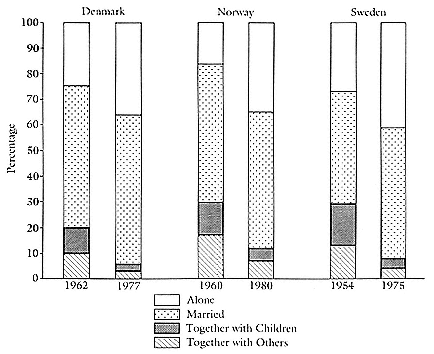
Figure 8.
Living Arrangements of the Elderly, Scandinavia, 1954–80
Source: Svein Olav Daatland and Gerdt Sundström, Gammal i Norden,
(Stockholm: Initiatives for Service and Housing Sectors for the Elderly Project, 1985) 42, 108.
fare state has reduced the burden on women of caring for children, it has also reduced the significant burden of caring for the elderly.
Some demographers and social scientists argue that independence from family ties—ties that can be emotionally destructive—represent a positive gain for the elderly.[34] Yet a good deal of recent research has also shown that older people thrive best when they can count on informal help from social networks, including the family.[35] Clearly some kind of balance between public and intimate caring is required: the question is whether a political approach to moral obligation can provide it. To some degree it can; Scandinavian programs for the elderly are among the best in the world (and are often cited by Americans as models for treating responsibilities to older generations).[36] Yet because political approaches to moral obligation tend to emphasize the interests of various groups who are struggling for bene-
fits from the state, a weakening sense of moral obligation toward the elderly can be detected in Scandinavia. Younger people, for example, show less willingness to support programs for the elderly, while, at least in some circumstances, programs for the elderly have been sacrificed as part of interest-group politics to the needs of parents of small children.[37] (In Denmark between 1977 and 1987, expenditures on day care increased 77 percent, whereas those for nursing homes increased 48 percent, home helpers for the elderly 56 percent, and community care 38 percent.)[38]
Community networks among the elderly are not relied on as much as family networks; one Norwegian study found that government services first, and families second, were more important as sources of care than were friends in the immediate environment.[39] To the degree that reforms in the provision of services to the elderly try to rely more on local networks and ties, they often show mixed results at best. It is difficult for local ties to supplement government programs because government programs for so long served to supplement local ties. The progrowth policies of postwar Social Democratic parties—which often put a premium on the geographic mobility of labor, as in Sweden, or on the construction of new housing projects that depleted older neighborhoods and towns, as in both Sweden and Norway—weakened the kinds of long-standing friendships on which older people can rely. In a study of intergenerational mobility, Gunhild Hammarström discovered that moral solidarity across generations in Sweden had not decreased over time and in some ways had increased, but the extent of such solidarity was dependent on stable communities, irrespective of whether they were urban or rural.[40] Geographic and social mobility pay greater economic rewards than they do moral rewards, at least insofar as intergenerational obligations are concerned.
Whether the housing projects of the postwar period can provide their own sources of social support for the elderly is doubtful. One study in Denmark did find that when the elderly move to a new housing development, they tend to maintain the friends they had before and, especially if they are already active, to make new friends in their new situation.[41] More common, however, is the experience in Norway, where the government attempted to design community solidarity into new housing projects for the elderly. Among the first residents, ties of reciprocity did enable people to call on each other for help, but as the population aged and health problems increased, the reciprocal system broke down. Ties of civil society among old people, researchers discovered ten years later, were simply not strong enough to be sustained.[42] It would seem that the pattern among the
elderly with respect to civil society is similar to the pattern in Scandinavia as a whole discussed in the previous chapter: informal networks exist, but they cannot be relied on to any significant degree for caring. Older people, especially those without children, feel sorely the lack of friends with whom personal problems can be discussed.[43]
As elsewhere in the world, problems of generational interdependence will become even more complex in the future because of greater longevity. The Scandinavian societies lead the world in life expectancy. Parents and children can now expect to have fifty years of life overlap. Grandchildren and grandparents (and, of course, great-grandparents and great-grandchildren) will have opportunities to know one another better and longer. It is likely that in the near future Scandinavian societies will experience as a common occurrence two generations of retirees in the same family (and likewise, as Kari Wærness has pointed out, two generations of widows).[44] The very success of the Scandinavian welfare states in prolonging life and contributing to its material satisfactions, even among the oldest members of the population, will to some degree be lost if trends in its development contribute to what Bent Rold Andersen has described as a segregation of generations, leading to "the knowledge and experiences which they share . . . becoming less common, to the disadvantage of all but mostly the old."[45]
The welfare state, it would seem, has reached the point at which it becomes difficult to achieve equality among present generations without taking steps with implications for future generations that cannot be determined and for previous generations that are problematic. No one in Scandinavia seems to have solved the problem of how to combine two contrasting goals, each laudable in itself: on the one hand, an extension of citizenship rights in the present, reflected especially in support for women to enter careers and achieve equality with men; and on the other, reliance on the family and community to supplement institutional care for both the very young and the very old. Both goals can be met, but they require the use of common sense and everyday moral sentiments rather than an insistence on political rules disproportionately stressing the rights won by present generations. A reliance on government to satisfy obligations to the old and the young is a precondition for modernity, but it also becomes morally complicated when it replaces, rather than supplements, care for individual children and elderly. Taking care of the young and the old is no doubt demanding and burdensome, but it is also one of the only ways we have to understand personally the vertical nature of the social fabric.
The Welfare State and Social Obligations
Understanding more about the invisible ties of moral obligation that make society possible has always been part of the sociological mission, as exemplified in the study by Richard Titmuss of British and American blood donation patterns.[46] Yet the spirit of voluntaristic altruism that Titmuss so praised mixes uneasily with a political approach to moral regulation, for the latter, especially in a Scandinavian context, views charitable giving and voluntarism through unfriendly eyes—as threats, and niggardly ones at that, to the idea that social benefits ought to be a right guaranteed by government and delivered to all rather than a feeling dependent on individual whim. The replacement of private charity with universal access to benefits and rights guaranteed by government surely represents a strengthening of a sense of obligation to people unknown to us. But it also potentially means that if in some ultimate sense the responsibility for the care of strangers belongs to government, then it no longer belongs to us.
It is not the case, as some critics of the welfare state have charged, that because the role of government is so extensive, people in Scandinavia no longer care to donate their time and energy to others. As a result of the welfare state people have more free time, and as the studies of social networks cited in the previous chapter indicate, they often use their time in cooperative activities with others. One of those activities involves voluntarism: participation in community organizations, sports activities, scouting and other similar groups, political movements, and even private social-welfare activities. Research conducted in both Denmark and Sweden indicates that voluntarism is alive and well in Scandinavia. In Denmark, for example, only a small portion of the population was found to have engaged in traditional social work—the welfare state does that—but, depending on definitions, anywhere from 25 to 44 percent of the adult population was engaged in voluntary activities of one sort or another.[47] Swedes use their free time in many ways, including private-consumption activities such as watching television or repairing their homes, but around 40 percent of them participate in public activities such as organized sports or cultural events.[48] Moreover, such participation in voluntary activities has grown over the past decade.[49]
Nor is it the case that private charity has disappeared from the welfare state. In Sweden to be sure, where private charity is discouraged, relatively few example exist of organizations in the area between the state and the market (called in recent publications of the Swedish Finance Ministry
"border organizations," a newly coined term).[50] Even though new self-help-type organizations have appeared in the 1980s—in the realm of day care, for example—these tend to be small and localized. Such is not the case in the other two Scandinavian countries. In Norway, a study conducted in the city of Bergen found private organizations active in such areas as pensions, mother's help, aid to the handicapped, help for the sick, international solidarity, and many other areas.[51] In Denmark, an examination of 115 voluntary organizations indicated that they still play a major, if invisible, role in social welfare, leading social workers and social theorists to begin a debate over the nature of what has been called the "third network" or private charitable organizations and the role they ought to play "between the market and the state."[52]
Private charitable organizations surely do have a role to play, even in societies where the welfare state is highly developed. To illustrate, consider the experience of one such organization, a Danish charity called Mothers' Help. As a result of the horrendous conditions that faced poor, young, single women who became pregnant, private charitable efforts to help them were a feature of Danish life since the turn of the century.[53] These efforts were coordinated in 1939 when an earlier generation of Danish feminists, acting often out of a spirit of noblesse oblige ("hat ladies," as they are called in Danish), founded Mothers' Help.[54] The aim of the organization was to provide legal and social advice, economic support, educational funding, services for infants, and institutions to care for the single mothers both during their pregnancy and for the period immediately after childbirth. Between 1939 and 1973, the total number of women who used the charity increased more than tenfold, from 3,342 to 44,158.[55]
As is often the case in matters of social help, conservatives preferred that initiatives such as this be in private hands ("I don't believe in the Good Samaritan when he becomes a civil servant," one conservative member of parliament said when Mothers' Help was founded),[56] while Social Democrats thought it ought to come under direction of the state. The latter route was taken in 1976 under a new social assistance law developed—ironically, given some of his later statements about the weakness of social networks in the welfare state—by Social Minister Bent Rold Andersen. In return for greater governmental resources for unwed mothers, the new law abolished Mothers' Help, incorporating it into the state. The idea behind the reform was that, instead of having many different needs met by many different agencies, people who relied on government for social support should be able to see only one social worker or agency to help
them with all their problems. The reform was typical welfare-state policy: sensible, rational, and efficient.
In 1983, a new generation of feminists—upset by the cutbacks in social services supported by a conservative government—refounded Mothers' Help. Thriving on the spirit of the feminist movement, the new voluntary organization flourished. Proud of its independence, it existed almost entirely on grants from foundations and contributions from individuals, with the exception of some funds from the Common Market and from the Danish lottery system.[57] Yet because the organization flourished, the question of public support immediately came up again; a 1987 evaluation, for example, suggested that since Mothers' Help had been able to accomplish so much with "free labor power," it ought to receive more direct public support.[58] Combined with the usual problems that face voluntary organizations—administrative difficulties, personality conflicts, disagreements between volunteers and paid staff—it seemed inevitable that Mothers' Help would once again have a high public subsidy.
As this example indicates, an organization that begins voluntarily will either meet a need or it will not. If it does not, it goes out of business. If it does, the state will play a far more active role, sometimes by taking the organization over, more commonly by financing it.[59] Governmental subsidies to private organizations vary from year to year and from organization to organization. Table 7 contrasts the share of the budget that comes from voluntary contributions with the share that comes from state subsidies for nine Scandinavian charitable organizations: the Red Cross, Save the Children, and the emergency relief organizations associated with the established Lutheran church in all three countries. In general, between one-quarter and one-half of the money is from public subsidies. Moreover, the public share has increased over the course of the 1980s: in only one case was the share of the budget from voluntary donations higher in 1986 than in 1980; similarly, in only one case was the share of the budget from government sources smaller in 1980 than in 1986. Because of the degree of public subsidy, the terms private or voluntary with regard to social organizations take on a different meaning in Scandinavia than in the United States.
As the state comes to play a greater role in subsidizing private charitable organizations, will individuals feel less of an obligation to give time and money to charitable and voluntary causes? Of the three Scandinavian countries, Denmark offers the best answer to this question, for it is the one that relies most on private organizations in the social-welfare sector. Two general indicators of a sense of voluntary obligation to strangers are Titmuss's own example, blood donations (since only Denmark among the
| |||||||||||||||||||||||||||||||||||||||||||||||||||||||||||||||||||||||||||||||||||||||||||||||||||||||||||||||||||||||||||||||||||||||||||||||||||||||||||||||||||||||||||||||||||||||||||||||||||||||||||
Scandinavian countries relies completely on voluntarism for blood donations), and "home visits" sponsored by the Danish Red Cross.
There was a dramatic increase in the voluntary giving of blood over the fifty-year period 1932–1982 in Denmark, from 1,639 individual donors a year to almost 410,700.[60] This evidence indicates that the expansion of the welfare state can be accompanied by an increased personal sense of one's stake in society. Yet since 1982 the number of blood donors has not increased at anywhere near the same rate; in fact, it has even begun to fall, as
| ||||||||||||||||||||||||||||||||||||||||||||||||||||||||||||||||||||||||||||||||
table 8 illustrates. Similar patterns exist with respect to home visits: a dramatic increase followed in very recent years by a general leveling off. If the number of participants in voluntary charity is taken as an indication of moral obligation, the idea of voluntarily helping others has clearly not diminished in the welfare state, at least not in Denmark. Yet in terms of the rate of absolute increase, obligations to others are not growing as they did in the past.
It is, however, somewhat unfair to measure the strength of Scandinavians' sense of obligation to distant strangers by using examples of voluntary activities. The promise of the political approach to moral regulation is that government can do a better job of insuring obligations to others than can private charity. Since reliance on government represents a transfer of funds from some people to others through a system of taxation and public spending, a more meaningful test of people's feeling of obligation to perfect strangers ought to lie in their willingness to pay taxes. Any American reader of the last sentence may be skeptical—who is ever willing to pay
taxes? Yet Scandinavia is, on this point, quite different from the United States. Swedes are more likely not to be negative about their tax obligations and even, in terms of the benefits they receive, to be positive.[61] In Scandinavia much more than in the United States, the legitimacy of taxation is accepted, precisely because the welfare state promises to do a better job of using the money to meet the needs of others.
Scandinavian societies, because they rely so extensively on government to express citizens' moral obligations, have the world's highest taxation rates, over 50 percent of gross income in both Sweden and Denmark.[62] Whether such high rates will lead to tax avoidance and hence a weakened sense of obligation to others has been much debated in Scandinavia; the late Gunnar Heckscher, citing a claim by Gunnar Myrdal that Sweden is becoming a nation of tax dodgers, concluded that "the gap between legal and moral concepts is growing: tax dodging is undoubtedly illegal, but many Scandinavians refuse to regard it as immoral."[63] It is difficult to obtain precise empirical information on whether high taxation leads to tax avoidance, given that nonpayment of taxes is illegal. Evidence from Norway, however, suggests that as income increases, and hence the rate of taxation, people attempt (in legal ways) to stretch their deductions further. Between 1973 and 1979, for example, the deductions that people claimed increased—presumably as a result of higher taxes.[64] Public-opinion surveys for Norway also pointed in the same direction. Although the questions on tax avoidance differed between 1971 and 1980, making direct comparison impossible, 21 percent of the Norwegians surveyed in 1971 admitted that they avoided paying taxes, compared to 39 percent in 1980, while 60 percent in 1971 said that they would have liked to, compared to 64 percent in 1980.[65]
Further conclusions about obligations to others can be drawn, not from the overall rate of tax avoidance, but from an assessment of who tries to escape paying taxes and who does not. Women, according to Einar Øverbye's Norwegian study, seek to avoid tax obligations less than men. Yet both men and women between fifteen and twenty-four years old were in most cases twice as willing as those over sixty-five either to admit to tax avoidance or to say that they plan to avoid taxes, a development that foreshadows problems of moral obligation in the future.[66] The clearest finding is that tax compliance is related to class position. In Sweden, a 1970 study by Joachim Vogel found that wage-earners were less likely to agree that taxes were high enough to justify finding means to avoid them than those who owned their own businesses, a finding confirmed again, if to a weaker
degree, in 1980–81.[67] In Norway, a more recent study showed that greater income was positively correlated with the wish to avoid paying taxes.[68]
What matters when it comes to tax avoidance is opportunity; those who can avoid paying taxes, will. This fact in turn suggests that in Scandinavia questions of tax obligation have less to do with a sense of obligation to others than with a utilitarian calculation of costs and benefits.[69] Vogel, for example, discovered that fear of being caught is the single most important reason for tax compliance in Sweden. Moreover, he found that people who felt that their friends were cheating on their taxes were more likely themselves to cheat on their taxes.[70] Beyond a certain point—and the problem always is that no one knows exactly where that point is—high tax rates do seem to encourage less of a sense of obligation to strangers and more of a sense that the perceived and actual costs of the new welfare state have made the free-rider option more attractive for those who can take advantage of it. In the Scandinavian welfare states the result is, as Pekka Kosonen puts it, a deemphasis on solidarity and a greater stress on individualism.[71]
Similar results are found when work done off the books—another form of tax evasion—is investigated. Here again, because the activities are illegal, hard data are hard to come by. While it is clear that Scandinavians are less likely to engage in illegal work than, say, Italians, most studies indicate that such activities are on the rise in all three countries. Gunnar Viby Mogensen, relying on survey data, concludes that between 1980 and 1984 the number of Danes engaged in illegal work increased from 8 percent to 13 percent of the population, with revenues amounting to around 4.5 percent of total income—figures that ought to be taken as a minimal indication of unreported work.[72] The underground economy, however, is probably stronger in Sweden than in Denmark; one estimate suggests that it now stands at between 12 and 25 percent of total income.[73] (Surveys in Norway, by contrast, found that the shadow sector diminished slightly in size between 1979 and 1983.)[74]
When investigators do not use survey data, they often rely on two other approaches to assess the extent of illegal work. One, called the currency-demand approach, tries to measure changes in the amount of money in circulation, on the assumption that illegal work is likely to be paid for in cash rather than by check or credit card.[75] The other approach, the causal approach, seeks to identify the cause of illegal economic activity and to identify its amount based on changes in the cause.[76] The figures produced by both approaches (see table 9) allow us to draw some tentative conclu-
| |||||||||||||||||||||||||||||||||||||||||||||||||||||||||||||||||||||||||||||||||||||||||||||||||||||||||
sions. First, although the two approaches yield varying results in many countries, that is not the case for the Scandinavian countries; we can therefore place some confidence in them. Second, they indicate that the shadow economy has in fact grown in Scandinavia. (It has elsewhere as well, though rarely by the same magnitude.) Sweden and Denmark rank among the world's leaders in illegal work, along with Italy, Spain, and Belgium, while Japan and Switzerland fall at the other end of the spectrum.
The figures in table 9 also point to a third conclusion with respect to shadow-sector work. The fact that in Italy the currency-demand approach shows a high figure and the causal approach a low one suggests that there the need for cash is the strongest motivation for entering the illegal labor market. To be sure, a monetary incentive for such work exists in Scandinavia as well; the average black-market transaction in Denmark costs about $100.[77] But the fact that the Scandinavian countries do not show up
much higher in the currency-exchange approach than in the causal approach suggests that illegal work in Scandinavia is also the result of stringent government regulation. If it is illegal for a painter to paint his own house or for a farm family to consume more than one pig a year, then it is not surprising that people engage in illegal work not only as a way of gaining extra income, but also as a way simply of exchanging services. The largest sector of the shadow economy in Denmark is in building and construction, where, for example, a painter might do work on an electrician's house and vice versa.[78] Even the second-largest category, service delivery (consisting largely of a black market in day care), though done for extra cash, also contains an element of informality in that it allows women with children of their own to remain at home while still earning extra income.[79]
As with tax avoidance, participation in the illegal economy varies with one's position in society. The two groups most likely to pay their taxes—women and older people—are also least likely to engage in underground work.[80] Young men, the presumed major wage-earners of the future, are the most likely to avoid obligations to society. In contrast to the situation with tax avoidance, however, working-class people take far greater advantage of the market in illegal work than do salaried and self-employed people. If the wealthy purchase services off the books, it is the working class that sells them; in that sense, shadow-sector work is the poor man's form of tax avoidance. Together, tax avoidance and illegal or "black" work suggest that the number of people who carry out their obligations scrupulously may be approaching a minority in Scandinavia.
In many ways, the desire to escape heavy taxation reflects a preference for the obligations of civil society rather than those of the state; the exchange of services conducted in the Scandinavian underground economies is often among neighbors and kin. Yet taxation has assumed the importance it has in Scandinavia precisely because the distrust of private charity makes government almost the sole tender of obligations to others. The moral gamble of the welfare state follows directly from its moral monopoly. Having discouraged private charity and voluntarism with the argument that governmental provision is more reliable and more fair, the welfare state also monopolizes resistance to moral obligation: what in other societies might be viewed as a trend away from charitable giving in Scandinavia inevitably becomes resistance to taxation. At the same time that the welfare state extends care to more people and fulfills important obligations to strangers, it also encourages a cynicism toward social obligation, making what ought to be a sense of solidarity with others into a cat-and-
mouse game against the authorities. High tax rates in Scandinavia encourage governmental responsibility for others; they do not, however, necessarily inspire a personal sense of altruism and a feeling of moral unity toward others with whom one's fate is always linked. In that sense, obligations toward others have been transformed into duties, weakening a personal stake in those obligations in the process.
Political Culture and the Welfare State
One of the more controversial debates in Scandinavia in recent years was initiated by a German, the poet and political essayist Hans Magnus Enzensberger. After a visit to Sweden in 1982, Enzensberger wrote a series of articles for Dagens Nyheter in which he complained that Swedes had given up their sense of freedom and personal autonomy in exchange for faith in a benevolent state. "Whether it is a question of using a 'hot line,' of alcoholism, of state planning or health care, of bringing up children or having their wages taxed, Swedish citizens are always prepared to come to the authorities innocently and full of trust, as if their benevolence were beyond question," he wrote. "It ought not be surprising," he added, "that the state's power has grown unopposed, creeping into all the cracks of daily life, regulating people's doings in a way without precedent in free societies."[81]
Enzensberger is certainly not the first non-Scandinavian to find too much authority in this part of the world; conservatives, especially of the free-market type, have done so for years.[82] To anyone at all sympathetic to the welfare state, the notion that Sweden is essentially an Eastern European country without lines, where individual freedom is constantly under attack by Big Brother, is absurd. Greater equality in Scandinavia has undoubtedly contributed to a decline in the ability of the very rich to lead lives of eccentricity, but for the overwhelming majority the welfare state has greatly expanded the scope of free choice.[83] Yet Enzensberger's remarks, while exaggerated, cannot be dismissed—and not only because he, unlike earlier critics, is on the left. As a poet, Enzensberger is talking about culture more than anything else, and in this sense he is correct: reliance on the state, like reliance on the market, makes more difficult the development of cultural practices that contribute to the narratives which give people a stake in the fate of others.
It is often forgotten, given the breadth of the welfare state, that reliance on government was not the only possible path to modernity in Scandinavia. Modern Danish culture has been shaped to a remarkable degree
by only one man, the poet and theologian N. F. S. Grundtvig. His emphasis on folk high schools that would combine practical and theoretical knowledge with an ethical sense of personal responsibility and concern for the fate of others provided an institutional basis for the modernization of Denmark.[84] While Grundtvig himself is unique in Scandinavia—"In Sweden," Arne Ruth has written, "there is no similar cultural hero on whom an analysis of the deeper layers of national identity could focus"[85] —his emphasis on education and moral growth is not. In 1899, for example, the Kooperative Förbundet (KF) was developed in Sweden as a consumer federation based on principles hostile to both the market and the state. At one level the cooperative movement was a business engaged in the manufacture and sale of products to consumers; at another level it was an ethical and moral movement with purposes primarily educational and cultural. Consumers, according to a central ideological theme of the movement, needed to be able to take responsibility for themselves, a responsibility that the KF organized through training courses developed at its own headquarters, the Vår Gård (Our Place).[86] The cooperative movement, furthermore, was only one kind of people's movement; turn-of-the-century Sweden had others, in such areas as sports, nonestablishment religions (primarily Methodists, Baptists, and the Salvation Army), and temperance. Even social democracy, which created the modern welfare state, began as a people's movement.[87]
As this last fact suggests, not all the founders of modern social democracy were convinced of the benefits of a completely political approach to moral regulation, although some were: the Dane who created his country's social insurance system, K. K. Steinicke, wrote in his autobiography that he "never had anything like the same interest in politics as in legislation and administration."[88] In Norway, what we today call the welfare state was called by its founders the "social state," by which they meant an emphasis on the use of government to improve the conditions of people in poverty, not necessarily the use of government as a more general regulator of moral obligations.[89] In Sweden, Gustav Möller, minister of social affairs in 1924–26 and 1932–51 and the most important builder of Sweden's system of social insurance, viewed the state as symbolic of the old-order ruling class. Bureaucrats were, in his view, conservative defenders of privilege who would, if they could, undermine efforts to bring about greater equality for the working class. Distrustful of the state bureaucracy, Möller sought to rely on local authorities rather than centralized power and tried to build into the design of public policies some degree of personal respon-
sibility.[90] (Möller developed the idea of child allowances, which, as I discussed in Chapter 5, have in recent years been supplanted by newer institutional forms that take on much of the moral responsibility of families.)
In part because social democracy was a movement of enormous power and importance, its triumph during and after the Great Depression became one of those stories that gave people a sense of a common fate. What I called earlier in this chapter the "social-democratic generation" is characterized, not merely by material satisfaction, but also by a common sense of struggle and purpose. To this day, the solidarity that has motivated the building of the welfare state remains strong, particularly among those who recall the earlier years of working-class struggle. As Ruth has pointed out, the result of the success of social democracy was a change, "not only in the formal division of power, but in the moral quality of society as well."[91] Social democracy itself became a culture, complete with symbols, stories, and moral teachings.
Popular movements such as Grundtvigism, cooperativism, and early social democracy, because they contained moral alternatives to the market and the state, tended to emphasize individuals as being part of the culture in which they lived. To use modern social-scientific language, they viewed individuals not as consumers or voters with stable preferences, but as moral agents capable of personal and social growth. Much of this has changed as the state (and, to some degree, the market as well) came to play an ever greater role in organizing modern life in Scandinavia. The folk high schools associated with Grundtvig still exist, but they have become more integrated into society, losing some (just how much is a matter open to much debate) of their distinctive moral character in the process.[92] The cooperative movement, too, has fallen victim to the widening reach of both the market and the state as not only successful merchandising in the private sector but also the extension of the welfare state into educational policy have undermined early accomplishments.[93] Swedish educational policy is especially difficult to reconcile with the educational and cultural ideals of the cooperative movement, for it was in this area more than any other that the fears of men like Möller were realized: today education in Sweden remains under the control of boards that tend to be bureaucratically rigid and concerned chiefly with the promulgation of strict rules.[94]
Finally, social democracy itself can no longer inspire a sense that individuals belong together as sharers of a common fate. The economic and political stagnation of social democracy in the 1980s is a moral and cultural stagnation as well. The story of how the working class took political power
and created a society based on principles of equality and solidarity no longer inspires the same sensibility it once did. Yet no other stories have developed to replace it. For Sweden, Ruth writes, "a fundamental problem for any movement seeking an alternative course is that there is no binding moral tradition behind the project of Swedish modernity." The constitution, he points out, is too recent. Religion plays little role in so secular a society. The peasantry no longer exists. Workers lead relatively comfortable bourgeois lives. Because "a plausible political alternative is nowhere in sight," the "Social Democrats have reappeared as the administrators of the fragments of collective destiny; their appeal, however, derives more from their perceived competence in holding growth stoppage and unemployment at bay in these troubled times than from any positive vision of the future."[95]
The market, as I argued in Chapter 3, tends to unbind cultural ties. Without the existence of common stories defining why individual instincts need to be restrained for the sake of living together with others, people who rely on the market for their moral code lose a sense of a shared fate. Reliance on the state makes escaping one's obligations to others far more difficult, but it too produces a similar kind of "deculturation." As tends to be true everywhere in Western liberal democracies, the stories that form a common culture thin out as people allow government to organize for them their obligations to others. It is in this sense that Enzensberger's comments about the reach of the state in Scandinavia should be understood. A political approach to moral regulation substitutes the sense of participation in a common struggle with administrative rationalization: it is, for most people, a great relief to know that the struggle is over, and an even greater relief to know that it has been won. But it is also impossible to ignore that, in winning, Scandinavians have begun to lose the art of defining for themselves what about their cultures links them together in webs of mutual obligation.
Personal Responsibility and Moral Energy
Although considerations of balance and style would make such a task appropriate, it has never been my intention in these chapters to argue that the market and the state are equally problematic in their organization of obligations to both intimate and distant others. In a few areas, my own political feelings to the contrary, the market does appear to do a superior job, most especially in the realm of private charity. But overall the Scan-
dinavian welfare states are far more successful at organizing modern moral obligations than are market-oriented societies like the United States. In the welfare state there is better provision for the elderly and the young, government support for the socially needy can be counted on, and a sense of general social solidarity, although weakened, still exists.
My point, rather, is that the welfare state has in recent years been called to organize moral obligations in ways for which it is ill equipped. By intervening in civil society to an extent that no one could have anticipated, the "new" welfare state has paradoxically made the organization of obligations to distant strangers and hypothetical others more difficult. One common theme runs throughout the three areas discussed in this chapter. Whether it is a question of obligations to young and old, of private charity and voluntarism, or of cultural definitions regarding the collective project, the new welfare state, in assuming greater responsibilities, has led to a decline in a sense of individual moral responsibility that threatens the ability of Scandinavian societies to find new sources of moral energy.
Problems of personal responsibility in the new welfare state arise particularly with the young, with the generations to come. Economically, of course, the welfare state guarantees the young that they will never have to face the problems of insecurity which plague teenagers in the United States. Consequently, there tends to be less generational selfishness among young people in Scandinavia, but more of a sense of bewilderment and moral confusion. Generally unaware of the struggles that made the welfare state possible in the first place, often unfamiliar with a world in which insecurity was a common lot, teenagers in the welfare state often seem ill prepared to act as moral agents responsible for their own fate. They tend to assume, in other words, that when their parents are no longer responsible for them, government will be. As Bent Rold Andersen has written,
Increasing numbers of young people are going to the welfare office on their eighteenth birthday, arguing that, since the legal financial duties of their parents have ceased, it is now the obligation of the public to support them. . . . Many people do feel that the public has a responsibility toward these young people and would consider it immoral if the welfare offices refused to help.[96]
Although what Andersen writes is obviously not true of all young people in Scandinavia, he touches on an important point. It is not the moral failure of "welfare dependency" that is of concern but its opposite: a fascination with rights and benefits so finely tuned that the idea of not asking for a right to which one nevertheless is entitled rarely occurs. One of
the great successes of the welfare state has been the extension of the language of rights downward in age. Yet because an emphasis on rights blends so easily into the notion that someone else ought to assume responsibility for one's own decisions, future full members of society, in so quickly transforming themselves into rights bearers, contribute to the moral problems of the society they will eventually inherit.
Similarly, the distrust of private charity and voluntarism that has so characterized the growth of the welfare state is bound to have long-term social repercussions. It is often conservatives who concern themselves with the effects of the welfare state on generalized feelings of altruism toward strangers. Sweden's Gunnar Heckscher, for example, has written as follows:
One of the slogans of the advocates of the welfare state has been that "society is to blame," for poverty, delinquency, and many other ills. In the long run such attitudes have eroded individual responsibility. . . . The opposition to "charity" has had similar effects: suffering and need "should" be dealt with by the state and local authorities at the expense of the entirety of taxpayers, and as a consequence individual citizens/taxpayers believe that they are under no obligation to act. . . . Voluntary social work is frowned upon and has virtually disappeared, with some exceptions in the case of religious organizations, but the vacuum has not always been filled.[97]
But the same issue has been raised by thinkers on the left. Michael Walzer, for example, asks why socialists have been so afraid of the idea of voluntarism. "After all," he writes, "a great deal of socialist activity has been paid for by private contributions or made possible by voluntary labor for the cause. . . . Why should we become the defenders of the bureaucratic state?"[98]
Why indeed? In a society like the United States, where government support for the needy is minimal, private charity plays an important material role in assuming responsibility for the fate of anonymous others. In Scandinavia, where government support is extensive, the role of private charity and voluntarism fulfills an important symbolic role. As Walzer writes, "The act of giving is a good in itself; it builds a sense of solidarity and communal competence."[99] There has to be a point at which the welfare state is pronounced a success, a point, in other words, at which the most basic problems of inequality and need in society have been solved. At that point, a sense of altruism and voluntary obligation toward others ought to supplement what the welfare state does best. If this does not happen, then the welfare state will continue to find problems that only it can solve, rely-
ing on experts to identify the scope of the problems and, as a result, becoming an administrative substitute for the common conscience that people themselves ought to have.
Finally, a general sense that the state has taken over tasks once associated with cultural solidarity has also contributed to a declining feeling of personal responsibility. Because the state has come to be so heavily relied on in Scandinavia, it is easy to conclude—as Enzensberger did—that Scandinavians are in danger of losing their moral autonomy to government. This, however, is an incorrect interpretation of a correct problem. What is really taking place in Scandinavia with the intervention of government in so many areas of life is the politicization of cultural rules. The welfare state substitutes the notion of a right for the notion of an obligation. The language of rights, though positive with respect to individual freedom, is nonetheless limited with respect to social interdependence. As Ulrich K. Preuss has written, modern legal forms emphasizing rights are "disembedded" from the social order in ways similar to Karl Polanyi's analysis of markets. The growth of legal rules parallels the "dissolution of comprehensive social institutions and the distinctive institutionalization of economic, cultural, religious, familial . . . motives, interests, and interactions."[100] The political logic of the welfare state is vertical, emphasizing the relations between individuals (or the groups to which they belong) and the state; it is rarely horizontal, emphasizing the interrelationships between individuals (or groups) themselves. Whether individuals are sovereign and government their servant or the other way around is not as important, ultimately, as the fact that individuals and government—and not the cultural meanings existing between them—are the only forces in the equation that matter.
An inability to solve moral problems as it has been able to solve economic problems will always create difficulties for the Scandinavian welfare state. These societies have clearly, to use the words of Esping-Andersen and Korpi, "emancipated individuals from the traditional compulsion to work and save for a rainy day." But it is not true, as they continue, that "the old liberal dogmas of self-reliance and new liberal dogmas of 'help to self-help' have been replaced by a powerful commitment to collective social responsibility for the optimal welfare of citizens."[101] These dogmas have been replaced instead by governmental responsibility, by reliance on the state to organize rules of moral obligation among both strangers and those in the intimate environment of civil society. If government were the only collective authority that mattered, there would be nothing mere to say on
the subject. Yet it is precisely because society itself is also a source of collective authority that the story of the welfare state has not ended. By overcoming economic scarcity, the welfare state has made possible a new sense of moral obligation. By replacing economics with politics rather than a social commitment based on personal responsibility, however, it finds itself unable to complete the project it began.