
An Unknown "New Negro"
Harold Bruce Forsythe's training as a musician made him both an enthusiast and a wonderfully insightful commentator on Still's concert works, which were generally ignored by better-known writers of the Harlem Renaissance/New Negro movement. None of what eventually emerged from them comes close to matching the now-unknown Forsythe's vivid perceptions. I supplement his "Study in Contradictions" and "Plan for a Biography of Still" with this biographical study because of the quality of Forsythe's work, because of the significant artistic collaborations he undertook with Still, and because of his influence on Still's personal life.
Indeed, Forsythe's artistic and personal impacts on Still are not fully separable. To begin with, he was a powerful advocate and facilitator for the Africanist aesthetic position he read in Still's music. During Still's 1929–1930 sojourn in Los Angeles, Forsythe arguably served as a catalyst for several works Still produced at the end of his "African" period, immediately after his return to New York City. Forsythe played a role in stimulating Still to clarify his conceptions of the ballet Sahdji and the Afro-American Symphony, and probably also Africa, the suite for orchestra that Still completed in Hollywood in February 1930. An early title page for Sahdji in Still's hand acknowledges Forsythe as the author of a prologue, now missing.[1] Forsythe's availability as a librettist was a major reason for Still's return to Los Angeles in 1934. Indeed, Forsythe wrote the libretto (to Still's detailed specifications) for Blue Steel, Still's first completed opera, and he provided the start for a second, which turned
into a ballet, The Sorcerer, later withdrawn. Moreover, it was Forsythe who introduced Still to his future wife and later artistic collaborator, Verna Arvey. The romantic triangle that developed in 1934—discussed below—was the immediate cause of his estrangement from Still and Arvey, although there were underlying aesthetic issues as well. The complications of these personal relationships probably influenced the way in which Still's "universal" aesthetic developed, and possibly its timing. More concretely, they may have affected Still's decisions to withdraw or alter certain of his works composed around 1935.[2] Forsythe's importance may thus be even greater than "A Study in Contradictions" suggests. Before the gifted, vulnerable librettist/ scenarist/ poet disappeared from view he had played a major role in the lives of both Still and Arvey.
Forsythe was born in Georgia (July 14, 1908) and taken to the Los Angeles area when he was about five years old, possibly earlier.[3] He attended Manual Arts High School, where he was an older contemporary of Verna Arvey. The two established a friendship that lasted almost fifteen years, longer than his association with Still. Several years before he went to New York City to study, Arvey wrote about him in the Manual Arts weekly paper:
Harold Forsythe . . . not only composed one piece of music, but many. Music was his natural mode of expression; and as Miss Rankin says, "His music is beautiful thoughts, lovely ideas. While he is able to speak and write in exquisite language, he has also the happy faculty of explaining himself in music." His compositions, on first sight, have an almost disarming simplicity. One imagines that they are easy to perform, but in reality they are most difficult. He is indeed a sensitive soul, responsive to all musical impressions.
Although he has composed many songs, short piano pieces, a string quartet and a fantasia for violin and piano, he is remembered in particular here for several of his works which were performed in assembly.[4]
About a decade after Arvey's article, Forsythe wrote this self-description for the Hamitic Review, a short-lived Los Angeles literary magazine:
Whether I'm a writer-musician or a musician-writer is a matter that doesn't trouble me. I've always kept the two functions in separate psychic compartments. My musical education was received from Prof. C[harles] E. Pemberton of U.S.C., and Dr. Rubin Goldmark of the Juilliard in New York. Since one disastrous venture into public taste, my music has been held in reserve. Have composed an opera, a symphonic poem, a monody and various works for small orchestra, string quartet and voice. Adolf Tandler, Nicolas Slonimsky, Leonard Walker, Fannie Dillon and others have spoken of this music. Be-
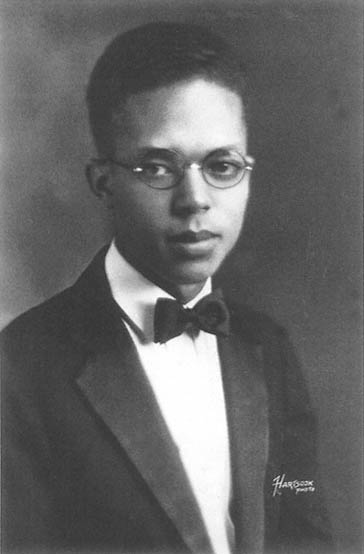
Figure 3.
Harold Bruce Forsythe.
Courtesy of Harold Sumner Forsythe.
ing a peculiar cuss, Verna Arvey and Gladys Mathonican alone play and sing it. My literary studies have been entirely independent and secretive. I have written about a dozen books covering the field of novel, biography, poetry, drama, scenario, libretto, metaphysics and criticism. Much interested in Negro history, art, religion, magic. Associated with the composer, William Grant Still in an effort to articulate the subtler currents of ethnic sentience. First published stuff in W. Thurman's old Outlet, and his Looking Glass . Did some bad articles for the California Eagle . Wrote during its lifetime for the stormy Flash, a sharp little publication. Am more than happy to be associated with the Hamitic Review, and have in mind a series of articles that might be of interest.[5]
His sensitivity in response to a rather well-received recital and the "secretive " character of his writing suggest, at least in hindsight, his extreme shyness and vulnerability.[6] The references in this biographical sketch and other of his writings also suggest a chronicle of the African American intellectual connections he made in his midteens. Wallace Thurman, later a prominent Harlem Renaissance literary figure, attended the University of Southern California in about 1922, then published his Outlet, to which Forsythe contributed, while working in the post office alongside Forsythe's uncle around 1922–1923.[7] Thurman boarded with Forsythe's family for a time and was at least indirectly a mentor. Forsythe later wrote, "You see although never a 'friend' he's closely bound up in my life. He was a friend of my brother and boarded in our house when i [sic] was a stripling. Nietzsche, Hearn, Flaubert, all came into my life from the books Thurman left about the house."[8] Arna Bontemps, later a poet and novelist of the Harlem Renaissance, was in Los Angeles at roughly the same time; it is very likely that Forsythe knew Bontemps as well.
Bontemps's 1941 letter to Arvey, giving biographical information for one of her articles, describes his own Los Angeles background and gives a rationale for his family's westward migration that very likely parallels Forsythe's:
When I was three, my parents moved to Los Angeles [ca. 1905, from Louisiana; 1912. or 1913 for Forsythe]. The following year they entered me in the kindergarten of the Ascot Avenue school. I believe I was the only colored child in the room (and perhaps in the whole school at that time), and I still remember how amused and pleased my mother seemed when she visited the school and found me completely integrated into the group. . . . Kindergarten turned out to be an epitome of all my schooling. I am a product of neighborhoods in which relatively few Negroes lived and of schools in which we were always greatly in the minority. The same is true, I believe, of a good
many Negroes who grew up in Los Angeles in those days. . . . My parents were always anxious to put the South (and the past) as far behind as possible. . . . One by one, however, our relatives migrated to Southern California during my childhood, and a link with the past was established for me in spite of all efforts to the contrary.[9]
Coming to Los Angeles was in fact an old tradition for African American musicians, who were visiting regularly by the 1890s and often performing to mixed audiences in white-run theaters. Flora Batson, the Original Nashville Students, and Sissieretta Jones were among those who had concertized there before the turn of the century.[10] Forsythe might have heard Will Marion Cook's American Syncopated Orchestra in Los Angeles shortly after World War I. In Forsythe's teen years, the city was the launching point for bands of both races that formed in the West and traveled East as well, contributing to the development of jazz. Freddie Keppard played in Los Angeles just before his successful move East, as Paul Whiteman also had. Keppard's Olympia Orchestra, including New Orleans bassist Bill Johnson, later became "the first black dance band, and the first from New Orleans, to make transcontinental tours, as the Original Creole Band. . . . It was this band . . . that carried the jazz of New Orleans to the rest of the nation."[11]
Many African American musicians had come to Los Angeles to live before Forsythe arrived. The vigorous classical music activities of the African American community are chronicled most fully in the weekly California Eagle to which Forsythe briefly contributed. Music making in African American churches was very well established.[12] Forsythe may well have heard groups like the choir of one hundred white-clad African American women, choral singers from local churches, who joined several hundred more of their white sisters in a formal greeting to President Theodore Roosevelt in 1912, as he campaigned in Los Angeles for election on his third-party Bull Moose ticket and women prepared to vote for the first time.[13] The African American community was relatively small but well educated. John A. Gray operated a conservatory and wrote a weekly column in the Eagle . Arkansas-born and Los Angeles-trained William T. Wilkins, in whose conservatory Forsythe first studied piano, began presenting his students in recitals in 1914. Forsythe, according to his son, hung out at Wilkins's conservatory. His piano teacher there was Nada McCullough, a graduate of the University of Southern California.[14] After several decades of teaching, Wilkins's and Gray's students
would number well into the thousands.[15] Thanks to the work of Gray, Wilkins, and others, many of L.A.'s jazz musicians were, like Forsythe, classically trained, which means that they did more reading from arrangements and less improvising than was done in New Orleans or Chicago.[16] Later, Charles Mingus was among the products of this tradition.[17]
Forsythe must have known about Still from an early age, for a Still cousin, Charles Lawrence, also a musician, lived in the same close-knit African American neighborhood around West Jefferson and Thirty-fifth Street in Los Angeles where Forsythe spent part of his childhood. Still had orchestrated a piece by Lawrence in the early 1920s.[18] (Later on, Forsythe and Lawrence shared living quarters in New York City.) It is quite likely that Forsythe had begun to learn about the possibilities of the Harlem Renaissance and the "New Negro" by then and that he introduced Arvey to its new intellectual currents while they were high school students. (Perhaps they read Alain Locke's 1925 The New Negro together, discovering among its treasures the first sketch of Richard Bruce Nugent's "Sahdji.")[19] Their friendship suggests the likelihood that Arvey became aware of Still and his work much earlier than she might have otherwise and that her meeting with Still in 1930 carried more weight than one might think from her later statement that she had barely met him in 1930. It is at least likely that Arvey is the "'not much praised but altogether satisfactory lady'" of Forsythe's essay who already in late 1930 "has become sweet on him [i.e., Still]." The chronology as well as the dynamic of Still and Arvey's relationship began earlier than previously thought because of this friendship, a matter of considerable import. This hypothesis is strengthened by H. S. Forsythe's report that his father's friendship and working relationship with Still ultimately foundered over Arvey.
Forsythe was a gifted pianist, as Arvey recognized and as is confirmed elsewhere.[20] He may have been among the student pianists that Arvey, whose own skill is well documented, recognized as a superior performer. His training in piano and composition was in the European concert music tradition, a background he shared with Still as well as with many other African American musicians of his time. The training in composition he received (after leaving Manual Arts High School and the Wilkins Conservatory) from Charles E. Pemberton, who had been a working musician in Los Angeles since the late 1890s, would have been very much in a conservative nineteenth-century German tradition. Forsythe's
relatively early short piano compositions at William Grant Still Music, his graduation gifts to Arvey, are in the European tradition (characterized by him as French-influenced) and testify to his pianistic ability. Many songs now among the Forsythe papers reflect his conservative training in Pemberton's hands.[21] However, Forsythe later made arrangements of one or more spirituals "with a jazz flavor," according to the report of his and Arvey's friend Harry Hay, who sang the arrangements on several occasions in Los Angeles. Forsythe lists other now-lost compositions, including an opera and a lengthy symphonic poem. He wrote to Arvey about them,
I have been looking over my long Symphonic Poem, the Opera and a small pile of songs. All done three or four years ago. I THINK MY BEST WORK IS BEHIND ME. So I've another balm. Deaf like Beethoven and Franz, stoop shouldered like Mencken, I do my best stuff early, like Mendelssohn, Poe. (Don't tell me that's the only resemblance with such guys. Ah knows!!!)
But art is Not technique, knowledge, . . . it is inspiration. And as I look at the pages of the Symphonic Poem, a work NOBODY has read and studied but me mahsehf I get broody and sad as the devil. That Spring was gorgeous . . . the months of its composition. Each morning I awakened with music bubbling and trembling in the head . . . could hardly get dressed before dashing for pencil and paper . . . Never will forget the glorious day the climactic section was written . . . and that strange passage where the theme rises, like a phoenix from fire, in the trumpets from a rumbling chaos of polytonal trombones, cellos and contrabassi and fiddles, sul. G portamento.[22]
Forsythe's impulsiveness seemingly contrasts with his interest in neoclassicism, his general distrust of the modernism of which neoclassicism was a major aspect, and his respect for the training he received at the hands of the German-trained Pemberton. With some of his contemporaries, he formed a club whose sole remnant is a letterhead bearing the heading, "The Iconoclasts: 'Down With Tradition,'" dating from the 1920s.[23] In the early 1930s he produced a lengthy novel, "Frailest Leaves," which contains a short and highly imaginative lecture on the historical values of counterpoint. His profound ambivalence about modernism is clear from this extract. The lecturer, a gifted but floundering young artist trying his hand at teaching younger students indifferent to both his brilliance and the expressive power of music—transparently Forsythe himself, perceives the ambivalence of modernism's claims to objectivity. A few excerpts:
The perfectly worked contrapuntal exercise was the nearest thing to absolute communism we will ever witness. That is true, but it is at the same time the
more aristocratic of the arts. Everything is part of the whole, yet nothing is subordinated to it. Its parts have all the characteristics of the best among men. They have character, charm, purpose. They must vary their tendencies, yet remain true to their own destiny, they must be strong, yet not inflexible. And most important, and this is where most of us fail, in life as well as in art; the parts conduct themselves with courtesy, respect and regard, each for the other. This is the most stringent note in our art. We admit here no percussive discords, no appoggiaturas, but only prepared discords of suspensions.[ . . . ]
[ . . . ] It is not my purpose to denounce contemporary music, but to encourage you in a fuller understanding of it by drinking deep of these purer, more intellectual fountains. The intellectualism of modern music is more psychopathic than has been generally understood.[ . . . ] Above all, do not regard this as the study of a dead language.[24]
The unreconciled, conflicting currents in Forsythe's thought are complicated by his anger about the race barrier. He was acutely aware of his distance from his white friends, including Arvey, but did not hesitate to tackle prominent African Americans who did not agree with his opinions, including Clarence Muse, the prominent actor, singer, and composer, then a Hollywood fixture:
So darned mad at a Negro that for the moment I hate all of them. Clarence Muse. The most blankety-blankest idiot the Devil ever tossed upon the poor, long suffering Nig.[ . . . ]
Tomorrow I will be calm and contemptuous again. Today I'm rip snorting, and hating, and furious.[ . . . ] I could whoop for the Ku Klux Klan, if an equally asinine white man hadn't irritated me before C.M. got started.[25]
On recommendations from both Pemberton and Wallace Thurman, Forsythe was awarded a fellowship to the Juilliard Graduate School in New York City for 1927–1928.[26] There he studied composition briefly with Rubin Goldmark and theory with another, unidentified teacher. He withdrew from Juilliard on March 18, 1928, before completing a full year of study.[27] Harold S. Forsythe reports that Forsythe wrote to his mother from New York that he was having trouble with his hearing, something that he seems to have kept from his friends. Whether he was in New York City before the fellowship began and how long he was able to remain in New York City afterward are not known; his mother's letters to him reflect her taking on extra work and making other sacrifices to send him money. The fictional but autobiographical hero of his "Frailest Leaves" describes a brief, disastrous affair with the woman
designated by Goldmark to teach him; one of the few letters from his New York sojourn confirms a brief engagement.[28] His later letters from New York used as their return address the location of Thurman's Fire commune on 135th Street, suggesting both that he lived or worked there and that he had some association with Harlem Renaissance literary activity. Yet his self-descriptions listing a lengthy series of short-term jobs do not include a connection with the short-lived, flamboyant Fire . Likewise, his claim in the sketch quoted above to have studied with Varèse—Still's teacher—has not been verified and is not repeated in other places.
Forsythe and Still renewed their acquaintance during Still's sojourn in Los Angeles in late 1929 and early 1930, just before "A Study in Contradictions" was written. The implication is very clear that they discussed future projects; perhaps Arvey even participated in some of the discussions about whether Forsythe and/or Still were really more "African" than "Afro-American," and if so, how that quality should be reflected in Still's compositions. The later evidence is that they talked about subjects for operas and that Still acted on some of these discussions. One of Forsythe's proposals that Still did not accept or even acknowledge (so far as is known) was Forsythe's offer to complete the libretto of Roshana, the project Still had begun in collaboration with his wife, Grace Bundy.[29]
Forsythe had a hand in the sequence of events that brought Still back to Los Angeles permanently in 1934. In his first application to the Guggenheim Foundation for funding (rejected in 1932 but awarded for use in 1934), Still wrote that he planned two operas, one about black Africans set in Africa, the other about African Americans in the United States. He wrote, "The librettist has already completed a portion of the first act, and his work is well done."[30] From this it is plain that Still had decided on the subjects of his operas and on his collaborator before he applied in 1931 and probably earlier, before he returned to New York in 1930. The first of the two operas was to be The Sorcerer, for which Forsythe produced a one-scene libretto. In 1933, while Still was in New York, he composed a ballet to The Sorcerer, whose scenario resembles the libretto scene and is attributed to Forsythe. Four years later, Still sent the manuscript to Howard Hanson for a possible reading at an American music symposium in Rochester, scheduled for fall 1937. After expressing doubts about its value, Still withdrew it, not even allowing an orchestral reading in a closed rehearsal, then sent his orchestrated
version of his song "Summerland" from Three Visions (for piano) instead.[31] Still did not destroy this manuscript, which exists in the form of a seventeen-page piano score, but the orchestration is so far unlocated.[32]
The second opera, on an American subject, was to be Blue Steel . The libretto fleshed out a short story by Carlton Moss.[33] This is the project that Still chose to work on in Los Angeles. In keeping with the composer's manner of working on opera, Forsythe stayed obligingly close to hand, providing new or changed text as Still worked.[34] It is likely that at this time (1935) he wrote the essay on Still's ballet, "The Significance of Still's Sahdji, " which appeared in the Hamitic Review, probably in the same April 1935 issue for which he provided the self-description given in full above. Forsythe's essays on Sahdji show that he became deeply involved with the work; in the longer essay he claimed to have suggested that Still rewrite the final dance, something that Still later seems to have done.
There seemed every intention of continuing the collaboration following the completion of Blue Steel .[35] On May 21, 1935, Still and Forsythe contracted to collaborate on an opera called The Sorcerer and a ballet called Central Avenue .[36] In the first case, Forsythe was to provide a libretto for a story already "invented" by Still, no doubt an expansion of the earlier sketch/ballet or a movie short. In the second, Forsythe was to complete the scenario, already partly "invented" by Still, for a ballet. There is no evidence that the opera The Sorcerer ever went forward beyond the ballet Still had composed in New York. Central Avenue was composed and, according to some sources, discarded. Much of it resurfaced as the suite for radio orchestra and later ballet, Lenox Avenue, for which Arvey supplied the scenario. Letters from Howard Hanson and Thelma Biracree, who had directed and choreographed performances of Sahdji and La Guiablesse at Eastman, indicate that Still sent them Central Avenue and that Biracree and Hanson were very eager to perform it. Before it could be produced, Still withdrew it in favor of Lenox Avenue, whose scenario Biracree regarded as much less satisfactory for the resources available at Eastman. Lenox Avenue remained unperformed at Eastman, and the mystery of Central/Lenox Avenue remains unresolved.[37]
On the basis of their common interests in composition, the piano and its literature, and music criticism, Verna Arvey had maintained a longstanding, warm friendship with Forsythe that peaked in the eight or nine
months after Still's arrival. In August 1934 she wrote with unusual eloquence to Carl Van Vechten, a major patron and champion of the Harlem Renaissance, in behalf of Forsythe's literary production:
Aug 6, 1934
My dear Mr. Van Vechten:
. . . For the past ten years, I have known and written to Bruce Forsythe, a young Negro intellectual, writer and composer-friend of Langston Hughes, William Grant Still, Wallace Thurman, Richard Bruce, etc. His letters to me have been impersonal, yet filled with a most interesting view of the race situation in America today, various musical and literary thoughts which may or may not prove of value, comments on those famous colored people he has known and anecdotes, his own personal history, etc. Because they extend over a long period of time, the later letters are necessarily more mature. All of them are beautifully written.
I have compiled these letters into a book (with Forsythe's permission and approval)—and now I wonder whether you would be interested enough to read it, pass judgment and to suggest a possible outlet for it? For the last few years I have been writing articles and criticism of my own (mostly on music and dance subjects) for various and sundry publications.
If you are interested, may I call on you when I come to New York, or would you prefer that I mail it to you? . . . Sincerely yours, Verna Arvey[38]
Given this prodding, Forsythe put aside his earlier opinion of Van Vechten (expressed in "A Study in Contradictions") as "a mere surface polisher and wise-cracker" and wrote his own letter describing something of his life and his work as a composer and writer. He revealed his own shyness and vulnerability in the process:
[August 24, 1934]
Mr. Carl Van Vechten
Dear Sir:
Letters of this sort, which assume an enormous amount of importance to the writer, are very difficult to write. But after having postponed the writing of this one for several years I have at last reached a sort of serenity and perspective; and from this little perch I do not feel so much of my former fear of thus addressing you.[ . . . ]
It is simply that having never mailed a book or a piece of music to a publisher; having never really contacted a first-rate critic, and having, at 26, lived a sufficiently peculiar life devoted to such pastimes as dish washing on a diner, office boying, elevator operating, night watchmaning, janiting, soda jerking, shipping clerking, private secretarying, ditch-digging, editing a tiny magazine, studying harmony, counterpoint, orchestration, composition, with Goldmark among others, piano pounding in sweet houses, ditto on a steamer, ditto in jazz bands, ditto in vaudeville, book reading, and having
found time during this to compose with a minimum of exhibitionism a symphonic poem, an opera, innumerable smaller stuffs, and having loved and studied the [European art] Song. Hallelujah to Wolf, Franz, Debussy, van Dieren and composed three volumes of it . . . as well as about fourteen literary slices, many of which have been burned by this hand. . . . At last comes the urge to a more practical view of things, and a genuine view of what I have done. Since it is an axiom about starting at the highest perch I approach you in this manner. . . .
In all seriousness now, I have now a book. . . . In some respects a biography of my dear friend William Grant Still, that most brilliant (Musically) of all Negro musicians. This is not a conventional biography, but one told through a figure of personal and ethnic experience. The book not only places an entirely fresh evaluation of the "Spiritual" but takes a somewhat strange view of Jazz. At the same time it serves to throw into relief the work of a man known by few (if any). He has composed beautiful music . . . music of a far deeper spiritual and mental significance than any other Negro composer ever heard of. I am a musician. I compose. I am a Negro composer. Yet I approached this book with a beating heart for at last a composer of my blood spoke with something other than bilgewater spiritual derivations or sloppy sentimentality.[ . . . ]But Still's music is rooted in the Dark-heart. How deeply I show in the book.[ . . . ]
Very sincerely yours, Bruce Forsythe[39]
Within a few days, he wrote to Jean Toomer, expressing his great admiration ("you are not so much the finest but the only writer partaking of the Blood, in this country") for Toomer's novel Cane (1923) and its hero, Kabnis, and asking permission to quote from it in his own work.[40]
Forsythe busied himself with revision of the material he had agreed to send to Van Vechten, while Arvey prepared for her lecture-recital at the New School in early December and the warm-up performance in Los Angeles a month earlier. Perhaps it was the growing tension as her travel date drew nearer that led to the warmth of his letter to her, following her Los Angeles recital:
And since you are going away I do want to step outside everything, Verna. And say a final word. You may imagine perhaps, that to have known one person for many years, and to value them highly, and to almost live looking forward to their brief visits, and then when a stranger comes to town, to have that old friend suddenly cease . . . bingo! Do you realize you haven't set foot in my house since Bill came to L.A. Do you wonder that this hurt me, and caused me to say and do rude things. For I say for the final time; I have no utilitarian bone in my body. I love a few people very strongly and
for themselves alone. And am acutely sensitive where they are concerned. But tho it now is a matter of no importance, I still think as highly of Verna as ever since M.A.H.S. and suppose I always will in years to come when the silly causes of my foolish losing of your friendship have vanished, and you move in an entirely different group.[41]
Upon receiving a postcard reporting on her call on Van Vechten, Forsythe sent off not one manuscript but three, and enclosed a small snapshot of himself for good measure:
Dec 13, 1934
Dear Mr. Van Vechten:
[ . . . ]This novel, biography and romance are dear for several reasons, (none literary). They were largely composed in a fine old house in San Gabriel where I was attended to by my sister-in-law Irene, so lovely a person and so rare. I had no job then; and had only to write all day and drink and talk all night. At that time I had no thought of publication or of large minds. I wrote for the sheer love of it and because Irene wanted me to. There is no page in "Rising Sun" or "Maron-Mutra" that has not been discussed and rewritten, re-written and discussed by us for days on end. It was Verna A., however, who encouraged and insisted upon the revision of the novel when I disgustedly almost gave it up. . . . As in my first note to you I tried hard to explain my position and the peculiar way such colleagues as Wallace [Thurman] have always looked at me. I think that Still and I are a little more Negro than they are, a little more African . I do not remember ever showing anything to Langston Hughes who has had highballs with me several times. . . .
. . . Five feet eight, very thin, with an "agnostic stoop" (Moore?) Pale yellow face, . . . gray eyes, large mouth and heavy mustache (now). Much stronger than look. Played quarterback as kid and was handy with boxing gloves. Very shy at times and very pugnacious at others. Given to silence among strangers and wild monologues among friends. Like beer, port and scotch, and since 1928 have repudiated gaudy wearing and use only black from head to foot [ . . . ]
I praise heaven that my work on Still's opera is largely if not completely finished. . . .
Gratefully, Bruce Forsythe[42]
Van Vechten's answer, unlocated, stunned him to the point of incoherence:
Jan 15, 1935
I come just this once again with much humility, for I thank you deeply for your courtesy. And yet although I have boasted that I could take it, the air
is very bleak from the hint of doom in your letter. A year or two ago it would have thrilled . . . or even a year ago, for then I felt bursting with books and music, and the suggestion that these things are yet thin, and Future yawned brighter would have been terribly encouraging. But now . . . Many more lonely years ahead, and those years no doubt filled with the errors and foolishness of the past ones. This letter shouldn't be written of course, for it is just after reading yours, but I think a man who fears his emotions, or better, fears his fear is in some ways a coward, and of all virtues that is the least.[ . . . ]
Sincerely yours, Bruce Forsythe
P.S. If it were possible to explain the real reason for this sudden passion, after years of indifference to opinion and publication, I'm sure you would agree that it is not all mere ego and self-seeking.[43]
Van Vechten must have queried Arvey after receiving this letter, for she reported back to him:
2/5/35
When I returned, Harold seemed to be as he was, and showed me your letter. Strangely enough, and unlike the warlike old Harold, he seemed very meek and was constantly studying your suggestions to see where he could use them and thus help himself. More, he was very grateful to you for your frankness. He is going to revise "Frailest Leaves" now, according to your suggestions. In other words, (though this is small consolation for all the time and trouble you took in reading the mss., seeing me and writing to us) I think you have done Harold a far greater service by doing exactly what you did than if you had followed out your first idea, and, as a matter of fact, I think perhaps that is what I hoped for all along. Because a little personal triumph is relatively unimportant when it comes to making finer human beings of people! In the long run, I am sure Harold will profit more.[44]
Although Arvey tried to put a good face on it, Forsythe must have been devastated by what he saw as his failure, especially in combination with the loss of Arvey's friendship after Still's arrival in Los Angeles. Even without the sexual aspects of this triangle, Arvey had supplied him with a one-person audience and with knowledgeable encouragement for his creative work; now she focused these attentions on Still and away from him. We cannot know more ramifications than this unless Still's diaries, missing for 1931–1937, the period of his collaboration with Forsythe, are recovered, and perhaps more of Forsythe's materials. Arvey's annual datebooks are likewise lost, subsumed into five-year summaries that do not give sufficient information to make things clearer. The loss of Forsythe's letters to her, except for the half dozen from late 1933 and
early 1934 (just before Still's arrival) that are quoted here, becomes even more poignant in this circumstance.
Still family tradition has it that Forsythe was unable to live up to his side of the contracts for The Sorcerer and Central Avenue because of his alcoholism and that Still's piano piece, "Quit Dat Fool'nish," was initially intended as a bit of unsolicited advice for Forsythe.[45] We know now that the unusual contracts to supply librettos were somehow tied to the literary disaster that Arvey precipitated through her overture to Van Vechten as well as, perhaps, to the alcoholism. Arvey never lost her anger at what she perceived as Forsythe's self-destruction, and perhaps her guilt at having had a role in precipitating it. Later, in one of her "Scribblings," she acknowledged his early deafness (while he was studying with Pemberton, before he went to New York in 1927) and her belief that he had tuberculosis. In private, she summed him up this way:
HBF was a marvelous, strange character. He wrote wonderful letters. I admired them and compiled them into a book, only to discover afterward that he was a drunkard, that he lied about me, that he didn't like the book merely because I had arranged it Journalistically. He had whitewashed himself in his letters to make me know him as he wanted me to! One of the finest things in his life was his love for Irene, but even she grew disgusted after a time.[46]
Irene Forsythe, the sister-in-law who had encouraged him to write and allowed him to live in her comfortable house in San Gabriel, died in 1938, another severe blow. One imagines Forsythe destroying his manuscripts as he retreated noisily from his literary and creative friendships into the grinding poverty that was his family's lot.[47] Would he have continued as a musician? Although his name does not show up in the directories of Local 47, or in the surviving directories of Local 767, the segregated African American local that was abolished only in 1953,[48] Forsythe had once found employment as pianist on Prohibition era gambling ships anchored outside the three-mile limit, where they were free to sell alcoholic beverages.
The denouement to Forsythe's story told by his son is different: Forsythe, the loser in a classic triangle, broke with Still over Arvey.[49] He did not, and could not, continue his career as a musician. His deafness, apparently a congenital condition shared with other family members, advanced inexorably to the point that by 1940 he sought and received retraining from the county as a horticulturalist. Thereafter he learned the
botanical names for thousands of plant species and worked steadily, six days a week, at the Enchanted Way Nursery at La Tijera and Slauson. On the seventh day, he often got drunk. In 1945 he married the former Sara Turner, a onetime Cotton Club showgirl. Their two sons were born in 1947 and 1955. By 1950 the piano had disappeared, Forsythe being too deaf to play it. The family, which included Turner's daughter, lived in the cramped cottage Forsythe had first rented as a bachelor when he returned from New York. In the 1960s his health deteriorated further; the family subsisted on the earnings of the two older children. He died in 1976, within a few days of Paul Robeson, to whom he had a family connection. He is remembered by his son as an unhappy man, often depressed.
When he wrote to Van Vechten, Forsythe can hardly have imagined how thoroughly he would find himself "retreating to the shadows whence [he] came." Even in this rediscovery of his work, his initial importance lies in the manner in which his shadow throws the life of his role model, friend, and rival into a richer perspective.