
Formation and Collapse of Caves and Arches
A unique feature of this section of coast is its caves and seldom-formed arches. The caves are of three different types. First, in Leucadia, the caves are formed along weak rock shear zones four to eight feet above sea level and are solution-formed in origin rather than entirely caused by wave erosion (fig. 35a ). These caves enlarge laterally into the cliffs. They may grow downward and enlarge rapidly as they are abraded by beach cobbles and waves. Accelerated cave and cliff erosion occurred during the stormy period of January to March 1983 (fig. 35b ). Many cave roofs collapsed and cliff retreat amounted to ten feet in places.
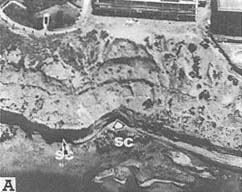
Figure 36a
Oblique vertical photo of condominium
construction in south Solana Beach, 1974.
Note the small cave at the base of the cliff.
Photo: B and A Engineering.
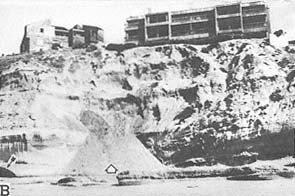
b . View of the same location as that in 36 a , 1975. The sea
cave was formed by beach cobble abrasion and marine
erosion along the vertical remnant shear zone and along
the essentially horizontal weak bedding plane. Note the
recent collapse of the upper unconsolidated sands.
Photo: G. Kuhn.
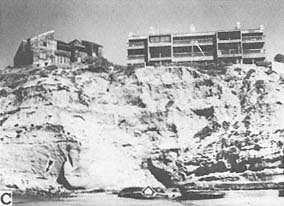
c . View of the same site as that in 36 a and 36b , 1977.
Note that the sea cave on the left has collapsed.
Photo: G. Kuhn.
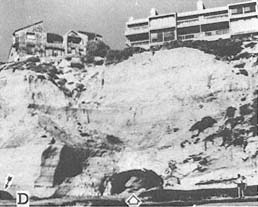
d . June 1978 view at the same site as that of 36 a –c ,
following the storms of February through April
1978. The recently enlarged sea cave is the result of
beach cobble abrasion during high tides.
Photo: Sea Grant/G. Kuhn.
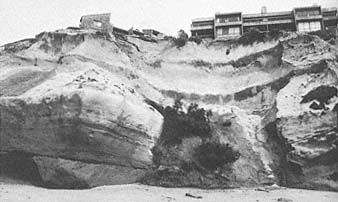
Figure 36e
April 1983 view at the same site as that at 36 a –d following the
latest collapse of the massive sea cave roof.
Photo: G. Kuhn.
Second, exposed caves in Encinitas and Solana Beach are mainly marine in origin and are seen to enlarge and collapse as a result of beach cobble abrasion with relatively small wave activity (figs. 36a –36d ). During the storms in January to February 1983, a massive sea cave roof collapsed, endangering the buildings on the bluff above (fig. 36e ). Third, a recent geological investigation in Solana Beach (Libby 1978; Shepardson 1978) indicates the presence of a large subsurface cavern inland of the cliffs (fig. 37). Concrete was poured into the void that had been encountered during construction. When it was not filled after forty-five minutes, it was assumed that the concrete was flowing into an intricate passageway. Normally such caverns occur in limestone or other soluble rock, not in sandstone. Solana Beach also has sea caves and tunnels caused by wave, sand, and cobble erosion.
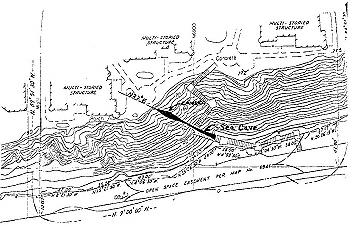
Figure 37
Map showing locations of the sea cave in the cliff face and the
cavern located directly inland. During construction, concrete was
poured into the cavern for forty-five minutes before it was realized
that an intricate passageway had been encountered. From Libby 1979.
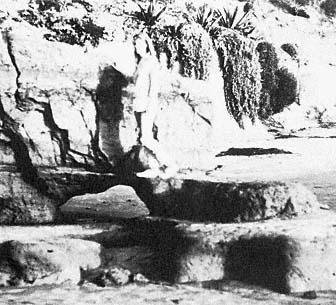
Figure 38a
December 1982 photo showing the early stages of a rapidly
enlarging sea arch forming in weakly consolidated rock.
Photo: G. Kuhn.
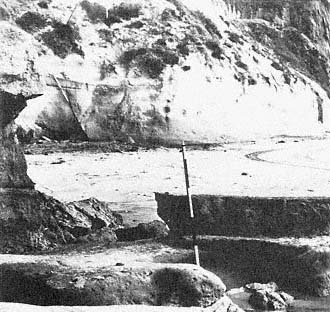
Figure 38b
January 1983 photo showing the same site after the arch
collapsed.
Photo: G. Kuhn.
During the storms in January 1983, many of these caves and tunnels were enlarged in as little as two days. Surprisingly, an arch was seen to form in the slightly consolidated Del Mar formation of Eocene age. It enlarged rapidly between 27 and 30 December, 1982, and collapsed on 1 January 1983 (figs. 38a , 38b ). As far as we know, this arch was formed by the hydraulic effect of moderate and excessively high tides, and without any cobble or sand abrasion. In late January and early February 1983, six feet of cliff face directly adjacent to the arch site also collapsed (fig. 39).
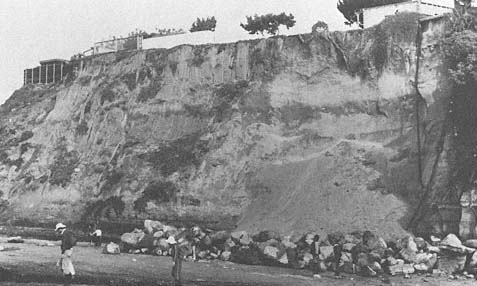
Figure 39
View of the cliff collapse at north Solana Beach, 1983.
Photo: G. Kuhn.
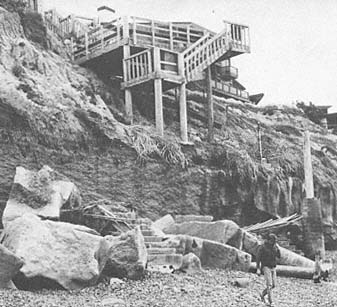
Figure 40
April 1983 view of the public stairway to the beach. The stairs,
in north Leucadia, were crushed by a mass that separated from
the cliff.
Photo: G. Kuhn.
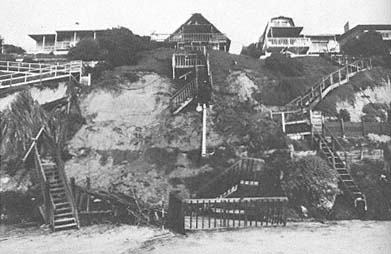
Figure 41
View of the private stairway that collapsed in Leucadia, 1978. Note that
the stairs failed as a result of a small storm-drain collapse.
Photo: G. Kuhn.
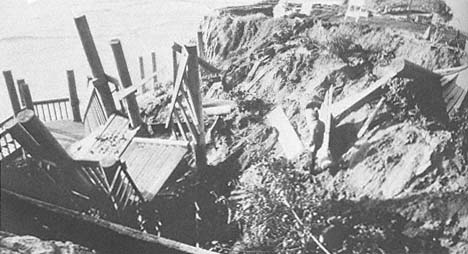
Figure 42
Photo of the stairway at D Street in Encinitas which collapsed as a result of surface
water flowing down the adjacent street end, undermining the underlying buried water
main and causing it to buckle, break, and erode the cliff, 1978.
Photo: G. Kuhn.