
Explaining Political Acquiescence
Despite the PNDC's previous efforts at mobilizing the workers, the devaluation and increases in prices that the government announced in April 1983, as well as the firm indication that more costly reforms were on the way, led to immediate union protests. As noted in chapter 3, the unions were exceptionally vocal in their protests. Many workers went beyond these statements and publicly protested the budget. For instance, worker protests prevented a speech by Finance Secretary Kwesi Botchwey in Kumasi in May 1983.[23]
In the crucial period immediately after the budget announcement, however, the government was able to survive with little difficulty. Workers blustered, but did not take to the streets. Similarly, as figure 5 indicates, although there was an upsurge in strikes in 1983, it was not a significant increase compared to previous labor activism in Ghana. Indeed, there are some indications that in the period immediately after the budget announcement, the PNDC retained the support of at least some of the workers. For instance, Hansen notes that when the regime faced its most severe coup threat on June 19, 1983, the WDCs mounted road blocks and rallied to support the regime.[24]
[23] People's Daily Graphic, 13 May 1983.
[24] Emmanuel Hansen, "The State and Popular Struggles in Ghana, 1982–1986," inPopular Struggles for Democracy in Africa, ed. Peter Anyang' Nyong'o (London: Zed Books, 1987), 181.
There are probably several reasons why workers did not organize in the days immediately after the coup and present a significant challenge to the government. The first factor, usually ignored in political studies, is simply chance. Large mob actions of the type that African governments fear most usually form spontaneously, and it may just have been that the mob did not come together in the right manner. Once a few days had elapsed, the moment for mass popular protest had passed.
Second, the PNDC had destroyed much of the unions' traditional leadership and replaced it with people who owed their political survival to Rawlings. The new regime viewed the existing trade union leadership as part of the problem to be overcome rather than part of the solution. As Rawlings noted in a speech in 1987, "The traditional union movement, like other institutions . . . has had its own history of power being exercised by a few who do not always express the real interests of that constituency."[25] Beginning shortly after the December 31 coup, the previously elected TUC officials were subject to continual harassment. For instance, in January 1982, sixteen general secretaries of various unions were "reported to have gone into hiding for fear of molestation by the workers, some of whom cursed and cried for their blood."[26] In April 1982, the existing union leadership was deposed, and the TUC was placed under the control of an appointed Interim Management Committee made up of radical supporters of the new regime.[27]
The Workers' Defence Committees, especially as they operated during 1982, can also be seen as a profound challenge to the organized union structures that were supposed to represent workers' interests on the shop floor. Certainly, other Ghanaian governments had attempted to co-opt the labor movement. However, this was the first time in the nation's history that a regime had gone so far as to try to supplant actual union organization on the shop floor. As Emmanuel Hansen noted, "The WDC's became the main centres for the expression of shop-floor militancy and struggle within the labour process, first for the control of the labour movement and secondly for the control of the labour process itself."[28]
The PNDC was therefore able to mobilize a significant number of
[25] People's Daily Graphic, 8 January 1987.
[26] Echo, 31 January 1982.
[27] U.S. Department of Labor, Foreign Labor Trends: Ghana (Washington, D.C.: U.S. Department of Labor, 1989), 4.
[28] Hansen, "Popular Struggles," 179.
workers, although outside normal union channels. For instance, when the Ghana Textile Products Company in February 1982 threatened to lay off half its workers because of the country's grave economic condition, the workers took over the factory. The government did nothing until March 1983, when the police attacked a WDC march in Tema. It then intervened and supported the workers, condemned the police action, and deported the expatriate manager.[29] More generally, workers turned out in large numbers at the continual rallies the PNDC had during 1982.
The new labor leaders, who had been appointed outside the traditional labor union structure, were then fatally compromised when the PNDC announced its economic reform package in 1983. There was no denying that the PNDC had made a fundamental reversal in its economic policies and that labor was no longer seen as particularly important to the regime. But no core of leaders existed around whom workers could coalesce in a concentrated wave of antiregime protests. In fact, the only leaders the workers had "appealed to workers to exercise utmost restraint whilst the leaders engage in consultation with the government in order not to jeopardize the long-term goals of the workers' struggles."[30]
Third, as with the devaluation, much of the urban population was already paying higher prices through the black market. Indeed, as early as 1970, Tony Killick had found that only 17 percent of items in stores were priced according to government controls; 11 percent were below the control price, but 72 percent of the goods actually cost more than they should have. In the urban areas, where most of the workers were concentrated, there was only a 30 percent observance rate.[31] Given the decay that Ghanaian administrative structures underwent after 1970, it is likely that even fewer of the controlled prices were being observed by the early 1980s. As one Ministry of Finance official noted,
It was not too difficult to reduce price controls. Price controls were for civil servants and others whose salaries were high . . . the only merchandise that was available was from the black market. You were lucky to get one bar of soap at the controlled price.[32]
[29] S. K. Kwakyi, "A Study of Social and Political Struggles in Ghana since 31st December 1981: A Case Study of TUC/Government Relations," Honors Thesis, Department of Political Science, University of Ghana, Legon, 1988, 30.
[30] People's Daily Graphic, 25 April 1983.
[31] Tony Killick, Development Economics in Action: A Study of Economic Policies in Ghana (New York: St. Martin's Press, 1978), 288.
[32] Interview, Accra, 25 July 1990.
In fact, the black market prices that most urban dwellers paid were, as explained in chapter 3, probably at least as high as shadow prices for most basic commodities.
Finally, the role of government repression must be made clear. Rawlings earned a universal reputation for being tough after he ordered the execution of three former heads of state. This reputation was bolstered by severe human rights violations during the first year of the PNDC. It must have been easy for the workers to imagine that the regime was more than willing to turn its violence on them should they publicly oppose the new reforms. Indeed, Finance Secretary Botchwey immediately made clear that criticism of the budget would be seen as a disloyal act:
The sudden alliance between certain negative elements in society and workers following the release of the 1983 budget is an attempt by such elements to hide behind legitimate workers' grievances and subvert an economic programme meant to put the economy right.[33]
Similarly, in 1988, shortly before the TUC was to elect a new leadership, Kojo Tsikata, the PNDC member in charge of security, warned,
The trade union movement is like a ship. . . . If we permit these infantile leftists, these super revolutionaries, these people who want to be more Catholic than the Pope to seize control of this ship . . . well for those of you who can swim "good luck," but for those of you who cannot swim, you better say your last prayers.[34]
Bates and others have noted that repression against trade unions often does not work because, especially in Africa, threats to the government usually come in the form of wildcat strikes rather than organized actions, which can be prevented by locking up leaders. However, the particular type of repression so evident in 1982, when violence was directed in a highly decentralized manner against many members of society, may have inadvertently deterred workers from engaging in any kind of antiregime activity because it was clear that even the ordinary person was susceptible to repression. Of course, the central role that repression played suggests that arguments about the political nature of Ghanaians have relatively little relevance in understanding the unfolding of post-1983 developments.
In fact, government repression did have a significant effect on labor's calculations concerning the amount of political space it had to operate
[33] People's Daily Graphic, 27 April 1983.
[34] Quoted by K. Owusu, "Caring and Sharing?" West Africa, 23 July 1990, 2152.
in. In December 1983, the interim committee of the TUC was voted out, and many pretakeover leaders of the congress were returned to power. The new leadership continued to attack the evolving economic reform program of the government. A. K. Yankey, the new head of the TUC, said, "The plain truth is that the ordinary Ghanaian, the poor worker, is suffering. And the government must know that there is a limit to human endurance."[35] Similarly, a resolution adopted by the TUC executive board in 1984 noted that
as a result of these IMF and World Bank conditions, the working people of Ghana now face unbearable conditions of life expressed in poor nutrition, high prices of goods and services, inadequate housing, continuing deterioration of social services and growing unemployment above all. . . . We caution government that the above conditions pose serious implications for the sharpening of class conflict in the society.[36]
In addition, sporadic worker protests embarrassed the regime. For instance, in January 1986, after a minimum wage announcement, workers in Tema marched through the streets while the local labor coordinator said that the increase in the minimum wage represented nothing more than "a slave-wage which is not our choice."[37]
However, while they continued to agitate about the reforms, union leaders clearly recognized that, given the nature and history of the PNDC, there were real limits to the government's patience in confronting actual protests. For instance, when the TUC sought to protest the Cocoa Board's retrenchments and the matter of paying out terminal benefits, the PNDC surrounded the TUC headquarters with armored cars.[38] Accordingly, trade union officials have adjusted their tactics. As one senior TUC official told me,
The TUC knows that if it had a militant policy with strikes it might end with the dissolution of the TUC. Then we would have the double task of trying to get reinstated and to help protect the workers' movement. We are working toward the survival of the workers' movement. Therefore, we use these methods [talks with government] rather than violence.[39]
In addition, the TUC was also handicapped by not having the analytic and organizational ability to develop an alternative to the government's
[35] Pioneer, 21 September 1984.
[36] Ibid., 5 November 1984.
[37] Ibid., 22 January 1986.
[38] "Paying the Price," West Africa, 13 January 1986, 78.
[39] Interview, Accra, 27 September 1989.
programs. The labor movement's organizational ability had been greatly weakened by the long economic decline and the various changes in leadership that the PNDC had engineered. Thus, protests against the government could only be viewed as a negative action, one that did not lead the country anywhere.
Despite the workers' timidity, however, by 1986 the regime was becoming increasingly insecure about popular reaction to its policies because of sporadic worker actions and increasing resistance to its economic policies among its cadres. As noted in chapter 3, the regime resorted to a foreign exchange auction in 1986 in part to deflect increasing pressure from the urban areas. The PNDC government has also occasionally capitulated to labor demands to avoid conflict. For instance, in 1987, the government announced that it was eliminating leave allowances for employees. There was a huge uproar throughout the country; and the TUC, under severe pressure from workers, asked government to review the announcement, which it eventually did.[40] Rawlings stated that it was strategically important to concede to the workers, but he warned that "members of the military and some trained militia [are] on standby and ready to take over essential services."[41] Thus, labor acquiescence in Ghana is not based only on repression but also on the government's at least occasional ability to adopt strategies that avoid outright political conflict.
As the ERP progressed, some workers probably began to do better economically. Unfortunately, the data that the Ghana Statistical Services provide on wages are so erratic that the figures cannot be used for any type of serious analysis. Therefore, it is unclear how workers' salaries have evolved over the last few years. However, it is evident to everyone in Ghana that the overall economic situation is improving and that the regime's policies are bringing benefits—even if these benefits are not immediately concentrated among the working class. As figure 6 shows, starting in 1983, Ghana has experienced a real increase in per capita income of approximately 2 to 3 percent each year. This is a spectacular performance given that the rest of the continent, on average, has experienced an annual decline of 1 percent in per capita income.[42] Of course, Ghana is still well below where it was even in the late 1970s, but there
[40] Kodwo Ewusi, "Social Welfare Theory, Structural Adjustment Policies and Labour Responses in Africa," paper presented at the International Conference on Planning for Growth and Development, Legon, March 1989, 13.
[41] Quoted in "A Shameful Affair," West Africa, 5 May 1986, 920.
[42] World Bank, World Development Report, 1991 (Washington, D.C.: World Bank, 1991), 207.
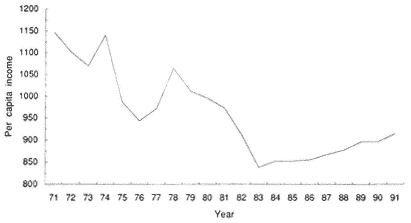
Fig. 6.
Per Capita Income during the Recovery (1985 U.S. $)
Sources: R. Summers and A. Heston, "The Penn World Table (Mark 5)," computer
disk provided by authors; and Enhancing the Human Impact of the Adjustment Program
(Accra: Government of Ghana, 1991), Annex Table 2.
has been enough progress to dissuade some from opposing the government. Some workers, notably those in gold mines, also are probably beginning to benefit from the upturn in their export-oriented industries that the devaluation caused. As the incomes of some workers increase, the potential popular coalition against the government weakens, making any kind of action against the government more unlikely.
Thus, through a combination of luck, repression, and political skill, the government was able to survive worker anger and implement a far-reaching economic reform program. This analysis accords with the developing conventional wisdom on economic reform, which finds that the coalition that develops to oppose cuts in subsidies and price increases during economic reform is often far less threatening than is usually imagined. For instance, Henry Bienen and Mark Gersovitz have noted that "urban food prices in African countries have in fact risen in recent years without endemic instabilities."[43]
The primary lesson of Ghana for the rest of Africa is that urban unrest cannot be predicted primarily on the basis of the severity of the economic reform program. For instance, because so few were benefiting from price controls and the overvalued exchange rate, the actual effect of the ERP on workers has probably been far less than the announcements would
[43] Henry Bienen and Mark Gersovitz, "International Debt and Political Stability," International Organization 39, no. 4 (Autumn 1985): 753.
indicate. Because the program hurt less than it appeared to and because opposing the regime publicly could entail large costs, popular unrest was not an attractive option.