
Prologue:
Who Is Mme du Coudray?
1—
The Portrait:
Paris, Summer 1985
Angélique Marguerite Le Boursier du Coudray fixes me with one eye, a direct stare. The other seems trained on the beyond. It is not just her gaze that captivates, half here, half elsewhere. She alone, as the extraordinary note beneath her portrait explains, is "pensioned and sent by the King to teach the practice of midwifery throughout the Realm" (fig. 1). Louis XV might have designated a whole corps of women to undertake this task of nationwide birthing instruction, but it was given only to her. I am dealing here with a singular phenomenon, the royally commissioned expert deliverer; you do not ignore such a person once you meet her.
She smiles slightly. From this first encounter, as she appraises me with amused interest, she seems to know I am spellbound. Well pleased with herself in her generously upholstered frame, she sits squarely, a person of large presence, double chin proudly high, forehead unfurrowed, decked in secular, feminine garb, velvet band about her neck, bow and flowers along her plunging neckline, fur ruff draped over her shoulder. This is how she, the artist's consensual subject, chose to be remembered: corpulent, spirited, and sure of herself. She dressed up for the occasion! Most other midwives of her day looked grim and meek, as if reluctant to pose at all, somberly dressed and nunlike, hooded heads bent, almost apologetic expressions on their faces, eyes often averted. These diffident contemporaries of hers humbly thanked the Almighty, in poems and prayers beneath their portraits, for whatever skills he bestowed upon them. But du Coudray, the national midwife of France, requests no special blessings, shares credit with no god.
Evidently thriving in a big job in a man's world, she does not look in this magisterial portrait like she has paid dearly, or even at all, for her unconventional life. There she sits in a frame rich with emblems: the fasces of power, the full heraldic crest with faithful hound, cornucopia, and jewels. Yet could things really have been as smooth as all that? I suspect not, and my curiosity surges. Something in the midwife's candid solidity discourages worship. This is not a flattering likeness, but matter-of-fact and frank. Here is a robust bourgeoise , however adorned she may be with insignia and pageantry. I sense
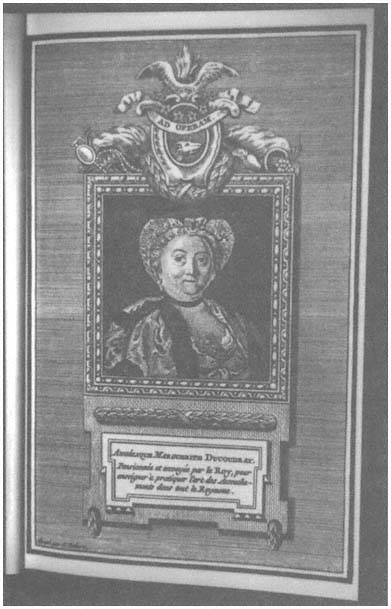
Figure 1.
This portrait first appeared as the frontispiece in the new
edition of Mme du Coudray's textbook in 1769, by which time she
was already a very important person.
from the first that she is beckoning her beholder to learn and tell her story, that she has designs on me. Above her picture is emblazoned the energetic command that animated her: "AD OPERAM ," she seems to order me—"to work."[1]
Actually, I already knew her a bit by reputation. She is featured in numerous eighteenth- and nineteenth-century collections on femmes célèbres that I consulted for my earlier work on female journalists. The short notices in these volumes all recount how Mme du Coudray had written a book about childbirth, had invented an obstetrical mannequin on which she demonstrated delivery maneuvers to facilitate instruction, had traveled throughout France teaching the art of midwifery to thousands of peasant women for over a quarter of a century as the monarchy's emissary, and had awakened and mobilized the nation in a fight against infant mortality. What a story! This woman, I remember thinking, must have played a major role in the dramatic demographic recovery of the second half of the eighteenth century. Surely a thorough scholarly biography of her had by now been written. . . .
But when I looked I found no full-length study about her at all. Instead I was strongly encouraged to write one myself. Shelby McCloy, in his work on public health in Enlightenment France, states, "Historians have little remembered the work that Mme du Coudray performed. Nevertheless, she charmed her contemporaries, and many an intendant [king's man] wrote eulogistically of her work. That there were still a large number of quack midwives on the eve of the Revolution reveals the magnitude of the task she faced." In a footnote McCloy remarks, "There appears to be no biography of her, not even an article in a learned journal."[2] These comments were made in 1946. Since then Mme du Coudray had been mentioned in some articles and a book by Jacques Gélis, but still, in 1985, no full-scale work on her had appeared.[3] In 1982 Dr. Bernard This suggested that her journey must have been rife with excitement and romance, that the details "merit an exhaustive study. What novelist will be able to write this vibrant and passionate life?"[4]
Well, I thought, Mme du Coudray needs no novelist. She needs a historian. The tale of this seemingly indefatigable medical missionary and royal ambassadress did not sound to me like it required any fictional embellishment whatsoever. Hayden White might stress the porosity of the membrane between "facts" and authorial creation, and Roland Barthes might call biography a novel that dare not
speak its name, but I still sensed a distinction between these genres. I wondered what evidence remained of du Coudray's teaching stints throughout France, what archival sources I might mine. I contemplated setting out in pursuit of those numerous eulogies McCloy mentioned. But first, and easiest, I would examine her published textbook at the Bibliothèque nationale. And the day I did that I saw her portrait, the book's frontispiece, before I even glanced at a word she wrote. Her look, at once steady and searching, feminine yet framed in such formidable authority, reached me and quickened my interest. From that moment on I was committed to writing this book.
So I began. First I sent letters to the ninety-odd departmental archives of France, explaining that I hoped to reconstruct my midwife's voyage. (Yes, I already thought of her as mine.) I knew that correspondence between the minister of finance and the royal intendants, men chosen by the king and stationed throughout the country to implement his bidding, can be found in the C series of ancien régime provincial records, and I asked the archivists to check inventories for any dossiers on du Coudray's teaching in their region. Many of the replies were positive. Yes, they said, she was here. Some even suggested other municipal or communal documents I might consult, as well as records of provincial academies, agricultural societies, medical schools, local parishes, and philanthropic organizations. I was particularly excited to discover that hundreds of letters by du Coudray herself still exist, and of course numerous others to her and about her. Because each archival response I received told me either the dates of du Coudray's stay in areas where she did teach or that she did not go to certain other areas, I was eventually able to rough out an approximate map of her route.[5]
The vision that emerged was astounding. For nearly three decades she systematically covered the nation, skipping only the Midi, the Pyrenees, the outer reaches of Brittany, and Alsace. In all, she taught at more than forty cities (see map). As a portrait sitter du Coudray may be immobile, but as a biographical subject she rarely stayed still. So if I was going to follow her trail I had my work cut out for me.
2—
Biography As History and Mystery:
Los Angeles and France, 1986–1996
Sabbaticals, leaves, summers, spring breaks, a stolen week here and there. Countless trips during these ten years to libraries and archives
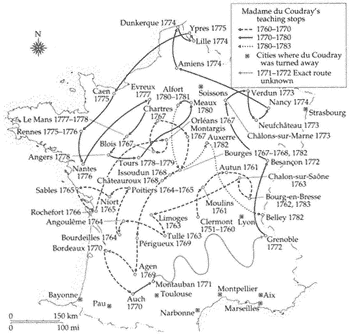
This overall map of Mme du Coudray's teaching travels is divided into
three parts: 1760–1770, when she covered much of the center of France;
1770–1780, when she taught mostly in the periphery of the country; and
1780–1783, when she hoped to get the go-ahead to finish the areas she had
not yet "done." Because a number of cities in the south turned her away,
her exact whereabouts between mid-1771 and mid-1772 are unknown.
in the provinces of France, in Bourges, Caen, La Rochelle, Besançon, Périgueux, Tours, Bordeaux, Rennes, Châlons-sur-Marne, Nancy, Clermont, Rouen, Epinal, Poitiers, and on and on, piecing together bits of Mme du Coudray's works and days. Not a picture, but pictures; not a story, but stories take shape.
She was a bold pioneer in obstetrical pedagogy in the service of France, tirelessly promoting the interests of the government that dispatched her. She was a curse visited upon the traditional village matrons who practiced time-honored ways of birthing and wanted no "help" or instruction disrupting their lives. She was a female upstart usurping the turf of doctors and surgeons who had traditionally presided over all examinations and degree-granting ceremonies for midwives throughout the country. She was a wondrous, brilliant phenomenon. She was a virago. A loyal patriotic servant. A fraud not to be trusted. An ingenious inventor. An outrageous, pretentious quack. A self-sacrificing, devoted teacher. Feminist role model. Traitor to her sex. Savior of the French population. Mere flash in the pan. Boon to humanity. Royal (literally) nuisance. Any and all of the above, depending on your point of view.
I worked through roughly a thousand documents and letters in the official records concerning du Coudray's mission. Her contacts range from lofty—Turgot, Necker, Calonne, and other ministers of Kings Louis XV, Louis XVI, and the empress Maria Theresa—to lowly—obscure country matrons and parish priests—and these exchanges are preserved, along with a massive diffusion of correspondence between her and the royal provincial administrators. There are discussions of her in the letters of her medical contemporaries, references to her in almanacs of the day, petitions and certificates and contracts she signed. I found, in short, an overwhelming amount of material about her ambitious deeds in this paper trail.
What I did not find were any personal papers, anything introspective at all. No diary, no journal intime , no self-referential writings. In 1834 A. Delacoux, the author of a book on celebrated midwives, mentioned that he saw a collection of "numerous documents left by Mme du Coudray and gathered together by Mme Coutanceau," her niece.[1] Delacoux dismisses these documents in a few offhand sentences, but his comments are enough to reveal that the collection included things that have never been preserved elsewhere and have not been seen since. Perhaps they showed a gentler, less guarded side of her, because Delacoux revised her portrait, divesting her of
her masterful frame and credentials, softening and rounding off her edges (fig. 2). Where is that packet of papers now, with its possible clues about du Coudray's interior life? I wrote to three hundred or so Coutanceaus presently living in France in the wild hope that, eight or nine generations later, some distant descendent might still be a keeper of this family flame. To no avail.
But of course, my inability to learn private details about du Coudray was not due entirely to the loss of these papers. It had at least as much to do with her conscious attempt to construct her own reputation, leaving out the personal, concealing her inner self. It is as if she made a bargain with herself to mute the feminine core of her being in exchange for appropriating the prerogatives of male behavior. She tailored, in other words, her own official story, which was one of stunning achievements. Another scholar might find this perfectly satisfying; yet it was only part of the story I wished to tell about her. Stubbornly perhaps, I was looking and listening for her , refusing to let her get lost within the neat narrative she offered to contain and hide life's chaos. She gave me her doings, but I also sought her feelings. So from the start, because this very public woman was so maddeningly private, we were in a struggle, she and I. This gave rise to several kinds of reflection: on the nature of the historian's craft in general, on the relationship between biographer and biographee, and on my particular subject, a woman who left behind a record at once so full and so spare.
For centuries history was written in an authoritative, detached voice, communicating an illusion of logical progression, objectivity, completeness. It claimed to have discovered "how things really were," to be scientific and factual, and to present a linear, seamless tale. Recently such empiricist presumptions of certainty in the discipline have been attacked; recovery of the past once and for all, the "whole story," now seems a naive and strange conceit. Feminist and post-modernist critics in particular have fought to turn old historical accounts on their ear, to "bring the margin to the center," to "problematize" age-old assumptions, to expose the futility and bankruptcy of searching for absolute answers. Such energetic challenges bring to the field tremendous new vitality and interest, but also considerable discomfort. If we acknowledge that our understanding is at best partial, that our views, far from being objective, are inescapably colored by the concerns of our present vantage point, that evidence itself is subjective, serendipitous, and fragmentary, that our
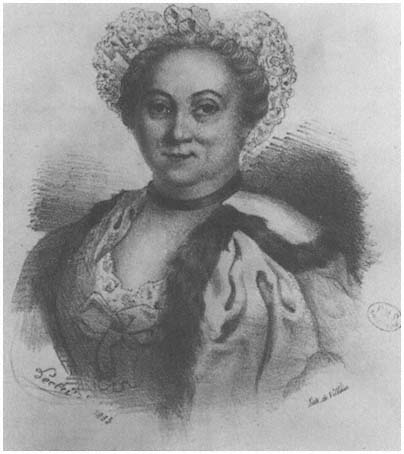
Figure 2.
This much-softened picture, made forty years after Mme du
Coudray's death and clearly based on the original in the textbook, flatters
her but deprives her of her imposing frame and credentials.
pictures of the past are incurably approximate and full of artifice, that they are constructed by us and not found or given ready-made, how then can we distinguish history from fable? How can we convince ourselves that our research leads to anything sound, trustworthy, or accurate?[2] Hayden White has even questioned whether historians, as they assemble their stories, are doing anything fundamentally different than novelists.[3] If there is no "disinterested site from which one can sit back and objectively make unbiased choices
and judgments,"[4] what, if anything, can we ever really, responsibly know?
With biography, the history of a particular human being, these problems are only compounded. Here the evidence has often been tampered with by the historical subject herself, who may have destroyed some things deliberately, or who may have written an autobiography, a staging of the self, the reliability of which needs to be critically assessed.[5] Biographers have been called "artists under oath," because they must exercise restraint and resist the temptation to invent.[6] Yet such distance is hard to keep, because in life-writing two identities confront each other in an intense, reciprocal relationship. The biographer is unavoidably included in her work, an absent but strong presence. She determines what gets said about her subject; selects, omits, highlights; sets the sequence and pace; changes here and there the velocity of the narrative. But her subject is never the passive victim of such manipulations, for she too is controlling, resisting the inquiry here, cooperating there, a willful agent whose choices to reveal or withhold information ultimately color and shape the whole project. The point is that a "catalytic conjunction" occurs here; writer and subject are in this together, and the interaction is complicated. Explicitly acknowledging this negotiation is not perverse, and can yield surprises.[7]
I realized I could make a virtue of necessity by using Mme du Coudray's case to illustrate these larger issues: the spotty, opaque, incomplete record that all historians have to work with, the tentativeness of answers, the impossibility of closure, and the opportunity for useful storytelling anyway. I want to show the process, not just the product, the recognition that many of the pieces are missing, that the puzzle will be full of holes. That is why this book is arranged by date-line entries, pulses of time, turning points, epiphanies, "liminal threshold" moments.[8] My choice of an episodic rather than a smooth structure seems crucial, to suggest that what happened in between, the connective tissue of reasons and motives, is often unknowable. Historians always have to work with fragments and lacunae, with revelations and secrets. We may crave coherence and synthesis, but because much remains indecipherable we do not get it.
In Mme du Coudray's case the gaps are enormous and impossible to hide even if I wished to. Of the time before her fame she tells
us nothing. In her hundreds of letters there is never a single mention of her origins, parents, childhood, siblings, education, young adulthood, training, marriage if there was one, children if she had any, friends outside of her work. But for her death certificate, scribbled in Bordeaux in the midst of the Reign of Terror, which states that she was seventy-nine when she died in 1794 and a native of Paris, I wouldn't even know her place or date of birth. Clearly this biography could not follow the conventional cradle-to-grave pattern. Family cannot be the zero point of origin here, and it is extremely difficult to discover traces of this woman from the years before she, already in her mid-forties, burst into national prominence in 1760. Her teaching mission is then fairly well documented for the next quarter century. She fades from view again after retirement in the mid-1780s and the news of her darkens. How she filled her time in the last decade of her life is anybody's guess. For she is as unconfessional as they come, and I can scarce know the dancer from the dance.
Why does it matter? one could ask. What difference does it make? The story of her work suffices. We know little of Shakespeare's private life, after all, or Chaucer's, but there is still plenty to say about what they did. Du Coudray, too, did a great many noteworthy things. She was a woman with dazzling accomplishments to her credit who has been overlooked by historians. On the strength of that she should be a new star in the feminist work of retrieval and rescue of powerful (and therefore threatening) "foresisters," dubbed by Mary Daly in her invigorating wordplay "crone-ology," "hag-ography," "gyn/ecology."[9] Certainly as a public servant and celebrity du Coudray was not at all shy. That story she clearly did want told. She always referred to her calling in grandiose terms—she was ensuring nothing less than the "good of humanity"—and to her midwifery book and obstetrical mannequins as "monuments to posterity for centuries to come." She wished to be remembered for her mastery.
Yet the fact that she was a woman with an interior life cannot be escaped, however much she downplayed it, so my challenge was to thicken the texture of her tale by keeping that fact in view. For gender, that "overarching category of human identity similar to race in its immutability and contestably more primary than class," is quite simply central to an understanding of any woman, even a woman who does not make an issue of it.[10] Mme du Coudray defied the
normal pattern by making a mission, not a man, the focus of her being, having no home where I might discover her "inwardness" or "bridge her silences," never settling with a person in a place.[11] Indeed, there seems to be an unbridgable chasm between her and others of her sex. This paradox of the singular, idiosyncratic woman who follows a "quest plot" instead of a "marriage plot" has been aptly summed up by Carolyn Heilbrun: "Exceptional women are the chief imprisoners of nonexceptional women, simultaneously proving that any woman could do it and assuring, in their uniqueness among men, that no other woman will." Du Coudray reached a level of achievement not commonly excusable in a female self.[12] And yet she accepted for her approximately ten thousand students subordinate positions in the hierarchy of medical practitioners. Like Florence Nightingale, du Coudray did not seek stardom for her female disciples.[13] Of course, there is something undeniably transgressive, if not truly subversive, about her mission, focused as it was on providing professional training to large numbers of women (she called them "my women"). They learned and laughed and struggled and cried together, bonded in unprecedented ways, got a sense of themselves as a valuable group, pictured new plotlines for their lives. Du Coudray didn't put it that way, of course. If her mission was to succeed, she could not engage in female advocacy; instead she must convey a sense of harmony with male practitioners and present herself as a loyal patriot.
Whatever she might have said, though, medical practice is a battleground, fiercely contested by the men entrenched in the profession, and she was a trespasser. It was my task, therefore, to develop the confidence to sometimes override her self-assessment, to interrogate rather than embrace her rosy picture. She wanted her version of the story accepted; I want it examined. I would explore just how the woman du Coudray composed her life, carved out her own special place in the world, formulated her agenda, negotiated herself into a position to do something great.[14] What drove her to such creative efforts? What conditions did she have to accept? How did she adapt and adjust to changing political regimes and to the modernizing trends in Enlightenment medicine to advance her career? When did public and private intersect in her trajectory? Why in mid-life did she create a new script for herself? Where is what Virginia Woolf calls the "iridescence" of her personality, what Phyllis Rose
calls her "central spine"?[15] By crafting and shaping the narrative in a way that leaves room for such inquiries and thus gives it meaning for me, I suppose I am committing "fiction" in Natalie Davis's sense of the term.[16] But then I like to think that du Coudray would sympathize with some of these moves. She was herself a great creator of fictions, as we will see, playing with different names and identities, fashioning as she went along what real life failed to provide. So I should not settle for appearances, since things are seldom as they seem.
The subjects about which du Coudray said little held a special fascination for me. Eking out meaning from such reticence is hard, but then, when I agreed to work with her, she never promised it would be easy. For example, she disdained sightseeing. She focused in her numerous letters on the business she was doing, not on cathedrals or fountains, not on peasants pegging up their wash or drawing well-water, not on the weather. And she rarely spoke of the decades-long journey itself, whether bone-bruising or picturesque. Not for her the frivolous travelogues of the chatty. Yet the woman criss-crossed and saw the entire country! If we squeeze the letters for all they can possibly yield, we learn that she loved to eat—she traveled with a cook—and read—even the newspapers—and go to the theater and entertain—her rented houses were always outfitted with a service for large parties. One official commented: "It would surely be easier to quarter a company of cavalry than to furnish the lodgings for Mme du Coudray and her students"; another observed: "She demands a house fully equipped from cave to attic."[17] Du Coudray, as her portrait shows, was no misanthrope. She had a strong sense of fun, and certainly did a lot of living in the many places she visited. I wanted to reconstruct some of that experience, even though she didn't help much.
So as I spent time in the archives of these places, I learned where she lived during her stay, I wandered in her neighborhood, I smelled the waxy church interiors where she took babies for baptism, I strolled along the rivers where water coaches sometimes carried her baggage, I ate regional specialties that she must have enjoyed, I explored numerous hôtels de ville (town halls) where she gave her lessons in the main hall. In Rouen I actually found one of her obstetrical mannequins, with all of its cloth parts and labels intact. This sole survivor, this last extant model, linked her to me very tangibly; she probably sewed those stitches herself. These are the things I could
see today that make hers what Henry James calls a "visitable past." The rest I had to imagine: her horsedrawn carriages on rutted dirt roads, the trumpet fanfare and noisy announcements by town criers of du Coudray's upcoming courses, the commotion of mobs of barefoot women hastening to town to hear her, the grave diggers scavenging bones to be used in the anatomical demonstrations, the relay watering posts along the routes where she and her horses took hurried refreshment during day stops, the moats and locked town gates, the extreme poverty of much of the countryside.
Du Coudray discovered or developed a taste for forging into the shadowy unknown to shed her light. She makes it all sound so purposeful, so directed, because all this activity was heading her toward something she had pledged to accomplish. But I could not help thinking that her strenuous exertions were also moving her away from something else. Was the fierce ambition for public success a kind of compensatory flight from some private failure? For what reason did she place herself safely beyond the risks of intimacy, into a life where competence and achievement took its place?
From the first it struck me as the ultimate irony that this national midwife was herself childless. The only heirs she had were ones she created late in life by adoption. Without this maneuver she would have left no progeny, appearing a pathetic figure in a culture that so valued fertility. Was her avoidance of what Adrienne Rich calls "pairing and bearing" the stimulus for her boundless commitment, indeed her passion, to save babies for her patrie?[18] Having shunned, by choice or necessity, the traditional role of childbearer and mother, was she driven to transcend from the personal to the patriotic arena, to make her work fruitful though her body had not been, to propagate both the bien de l'humanité and the biens of the French state, to literally deliver the good(s), to make human life on a grand scale her very business?
3—
The National Midwife's Mission Statement:
Clermont, 1 August 1760
Monsieur,
Monsieur the Controller General desired that I have the honor of sending you a copy of the little work I composed on childbirth. It is perhaps even more useful because I was determined
to make it simple; I have assembled in it all that is most essential in this art, and most accessible to those least schooled in this matter.
The infinite calamities caused by ignorance in the countryside and which my profession [état ] has given me occasion to witness moved me to compassion and animated my zeal to procure more secure relief for humanity. Drawn to Auvergne, I invented there a machine for demonstrating delivery. Monsieur de la Michodière [former intendant of Auvergne] realized its utility and his intention was to benefit from it, but he left the province. Monsieur de Ballainvilliers, who succeeded him, was equally supportive, and these first successes encouraged me to present it at Court and to the Academy of Surgery. The advantages of this invention are immediately apparent. The academy approved it and the king accorded me a certificate [brevet ] permitting me to teach throughout the realm. M. de Ballainvilliers wished to be the first to obtain this help for his region. And I was eager to give my first attentions to the inhabitants of the province where the machine was born. The magistrate, whose name will always be blessed among the people of Auvergne, formed an establishment to make these instructions permanent. He distributed a machine in each of the most populous cities of the province; able and zealous surgeons came for fifteen days to study closely with me and learn its workings; the machines were entrusted to them, and they in turn are now committed to instruct at no charge, as I did, the country women who will be sent to them by the subdelegates. In three months of lessons a woman free of prejudice, and who has never had the remotest knowledge of childbirth, will be sufficiently trained. We have the advantage of students practicing on the machine and performing all the deliveries imaginable. Therein lies the principal merit of this invention. A surgeon or a woman who takes the sort of course available until now will learn only theory, [and will expect] the situations encountered in practice to be uniform, or at least not very varied. The course no sooner finished, [these] young surgeons and women, rushing to benefit from a profession they know only superficially, spill out all over the countryside. But when difficulties arise they are absolutely unskilled, and until long experience instructs them they are the witness or the cause of
many misfortunes, of which the least terrible is the death of the mother or the child and even both. Nothing is sadder than being deprived of the use of one of our limbs. How many poor wretches seem born only to excite the pity of a public that is impotent to relieve them. These subjects could have been useful to the state, and mothers often would not have to lose their fertility in the flower of youth; one learns on the machine in little time how to prevent such accidents.
Love good works, Monsieur; procure them through inclination and through love for the people who regard you as their father. It is your daily occupation and to second you I have the honor of proposing an establishment like that which M. de Ballainvilliers has set up in Auvergne. Monsieur the controller general who watches over the good of the state and the multiplication of subjects useful to the king has approved all the expenses that have been necessary. I am delighted to be able to cooperate. My zeal showed me the way, and the same motive animates me to share it. I am with respect, Monsieur, your very humble and very obedient servant,
Le Boursier du Coudray[1]
By any measure, an arresting letter. Who is this person, that she addresses each of the king's royal administrators, the thirty provincial intendants, as an equal, indeed as a somewhat superior political advisor? How has she earned her posture of moral rectitude? This is her first exercise in mass self-promotion, yet the deft argumentation seems to come so naturally. She is having many copies made of this letter by secretaries and sent around the country, informing His Majesty's men that there is now a national midwife commissioned to serve and rescue the state, for it is widely believed that France is becoming depopulated. Except for the deferential closing—a mere formality—her letter is strong, almost imperious. She begs no pardon, as a female, for advertising her worth and importance. On the contrary, with the king and the minister of finance behind her, she is above needing to make even the usual opening bow; she has dispensed with the monseigneur —my lord—commonly used for the intendants. The controller general himself is simply monsieur! In other ways too she has crossed the threshold into the male world of instrumentality and control, penetrating with unrehearsed familiarity, treating men as her peers.
Her opening sentence announces without apology that she has written a birthing textbook, thus matter-of-factly invading the patriarchal province of medical print culture, taking for granted her right to make a valuable contribution to knowledge. That she introduces her book even before she introduces herself is a hint of what a central role this volume, and her authorship, will play in her mission. Her very act of writing and publishing is audacious, a refusal to accept subordination to learned males, and she sends a copy of her textbook to every intendant with this letter.[2] It is her passport to legitimacy, in a sense. Now we can talk, she seems to be saying; because I have produced a volume, you must take me seriously. Her pared-down work, as she points out, will have especially wide appeal because it can reach and benefit many whom the writers of erudite treatises generally ignore. Targeting an audience overlooked by the elite custodians of culture, she further attempts to bridge this gap between city and country, high and low, by inventing a prop, an obstetrical mannequin on which to demonstrate birthing techniques. Miniature anatomical models of wax, glass, ivory, and wood had existed for some time, but life-size, malleable ones made of fabric, leather, and bone, and used so aggressively for practice, are of her own devising. Mme du Coudray's introduction of the palpable body into medical instruction on such a grand, innovative scale constitutes nothing less than a revolution in pedagogy.[3] By reducing infertility, infant and maternal mortality, and disabling accidents at birth, she and her radiating network of students and trained teachers can end the peacetime massacre of innocents. They can regenerate France.
But this letter does much more than advertise her services. It calls upon the reader to react, shaming the recipient out of his complacency. It sets up an equality, not just in its forcefulness but in its reciprocity, its demand for a reply, its challenge to the status quo. The receiver will now need to become a sender of his own letter; the "you" will become the active "I" of a decisive response.[4] All the royal intendants will feel compelled to write back, to endorse and join the obstetrical enlightenment of the countryside. They have never received such a letter from a woman before, but that she is female is not emphasized, indeed, it is not even mentioned. It is beside the point. She steps forward with unselfconscious ease, takes these men into her confidence, and simply assumes that she and they
are all together in this crusade. Their common foe is ignorance—not incompetent village crones, not mean-spirited surgeons, but the absence of the proper training that, with the intendants' support and assistance, she will now be able to provide. This midwife is proposing to teach numerous men as well as women (the nonchalant offer to instruct surgeons coolly topples the age-old medico-political hierarchy, which always placed males on top), and the issue of any professional or gender rivalry between midwives and surgeons is not even hinted at. The critical thing is the call to joint action, the shared gesture of revolt against fatalism.
She has shaped her language for this group of addressees, devising for them a particular rhetorical formula. Her letter, entirely relaxed in its stylistic imperfections, longwindedness, and inconsistent tenses, is designed to convey energy and an innate sense of authority, to give a picture of activity already under way, to make her readers feel responsibility for preserving this momentum, and to gain obedience. The king has chosen her for this job; only uncooperative, passive, benighted intendants would allow its failure. If on the other hand they facilitate her mission, she assures them, they will be more loved by their people than ever. The midwife knows how to flatter and cajole. Despite her assertiveness—she has "composed" a book, "invented" a machine, "presented it at court"—she seems to recognize that these men must ultimately feel in control. As if they, not she, had had the idea of inviting her to teach in their region, she agrees to "second" them, to back up their interests. Together they will carry out the king's bidding, the "multiplication of subjects" for the crown. She wants to be seen not as a dangerous woman making public mischief but as a dedicated servant of the state who can count on other enlightened individuals to vanquish ignorance and bring about much-needed reforms.
A word about the signature. The midwife plays name games. This is her only letter, of hundreds that still exist, signed "Le Boursier du Coudray." Both the letter and the book date from a transitional period of just a few years during which she used this long version of her name. Earlier communications of hers say simply "Le Boursier," later ones simply "du Coudray." In more ways than one, then, this letter of 1760 marks a watershed. A metamorphosis is taking place. Its middle-aged sender has been gradually giving up one persona for another much more public one, seeing fit to assume a
new name—with the coveted noble particle—and a new identity.[5] She is reinventing herself, leaving behind her private life as Demoiselle Le Boursier, a maiden lady, and giving herself flat out to France as Madame du Coudray, an expert matriarch.
She is forty-five years old. Is this an awesome manifestation of what Margaret Mead calls "post-menopausal zest," that hidden resource of energy and vitality tapped into by women in their later years?[6] Du Coudray becomes now something of a secular saint, but she is also the king's trusted emissary soldiering in his service. No other woman in her day of whom I am aware devoted herself exclusively to public service in this manner, sacrificed herself entirely to the bien public . And du Coudray makes clear her uniqueness. She credits no mentors, claims no ancestral help. If she descends from the great seventeenth-century midwife Louise Bourgeois Boursier, she does not tell.[7] She betrays absolutely no attachments, no tethers.
Does she even know her origins? Was she perhaps one of the enormous number of abandoned children—some say 40 percent of all born in eighteenth-century France—raised in foundling hospitals?[8] Does she hide some painful emptiness, some distant shame? Certainly she displays particular sensitivity to the indigent and to unwed filles-mères with their misbegotten offspring.[9] She devotes herself to a profession whose business is saving lives regardless of rank or fortune. Her contemporary, the philanthropist Piarron de Chamousset, believed that foundlings were truly the most faithful enfants de la patrie , deeply beholden to the state that reared them.[10] Was she one of those anonymous children, who, not knowing her own roots, vowed to define herself anew, to forge a lone path and pay back her debt to France in this spectacular way?
Either life has stripped her of conflicting loyalties, or she never had them. She seems totally unencumbered by marriage or motherhood. The practice of inventing husbands is not unheard of among enterprising females of the day, and in her case it comes in especially handy. She is a consummate role-player who uses pseudonymity creatively, who sees it as enabling.[11] Her new marital status is her first of many improvisations. And this husband is even disposable, for almost immediately she becomes veuve du Coudray. Widowhood is of course still more useful, affording many legal advantages in business transactions. By sheer force of character and an acute political sense she makes her skill in midwifery into a national
institution. She is shouldering this responsibility for and by herself, and she takes charge fully, splendid in her autonomy.
But when, where, why, and how did she develop the taste for it? As we follow her we must be careful not to view each action as a step toward some manifest destiny; even so, we must ask whether, early in her career, she recognizes in herself some special gift. What makes her separate, pull away from the others, spark to do something out of the ordinary? Is there an awakening? She writes this exceptional letter before she actually begins her famous mission, but after decades of development and growth of a different kind. To track things from the first trace we have of her (because we know nothing of her biological birth, her professional birth must serve as our beginning), we need to go back another twenty years.