
Chapter VII—
Life and Reflection on a Transformed Landscape
Within the space of about fifty years, from the 1840s to the 1890s, the environment of the Willamette Valley underwent incredible and rapid change. By 1890 the Kalapuya had completely disappeared, and with them went an age-old landscape, ecological balance, natural abundance, and a cosmology that viewed the land and its animals in spiritual relationship to people. Although white-tailed deer and migrating and resident fowl still remained in or frequented the valley, their numbers had been greatly reduced. By the 1890s some native animals, among them the grizzly, cougar, and wolf, were locally either extinct or near extinction. Exotic species such as cattle, swine, and horses had replaced them. Non-native and native grasses, shrubs, and trees had invaded the prairies, from which various native grasses and large expanses of camas had disappeared. Euro-Americans had also introduced to the valley a number of cultivated plants—wheat, oats, and garden vegetables. The once scantily timbered foothills supported denser forests, while streamside woodlands had become sparser. Some soils in the valley had been exhausted. Erosion had increased on certain streams, and at the same time flood plains had been diminished and many marshes eliminated. Fish habitat and spawning grounds were impaired or altogether destroyed. And the valley was now divided into parcels of privately owned property.
This enormous disruption and change occurred because one group of people, Euro-Americans, replaced another, Native Americans. But the Kalapuya had altered the environment as well. They did so most strik-
ingly with the annual use of fire, preventing continuous forests from covering the Willamette Valley. For basic needs of food and shelter, the natives, working within the limits of natural possibilities, created in the valley an environment that included, among other things, an abundance of camas meadows, oak groves, forest-prairie edges, tarweed, and white-tailed deer. But merely listing the separate components of the environment does an injustice to the complex ecological relationships among animals, plants, climate, and people that existed in the Willamette during prehistoric times. The environment that the Kalapuya and nature wove together in the Willamette remained in ecological balance for at least several hundred years. The people, and the environmental change they induced, followed a continuous seasonal cycle year after year after year. Of course, this cycle may not have continued indefinitely had not Europeans and Euro-Americans arrived on the scene. Larger, slower changes have occurred in the Willamette, with the climate varying between dry/warm and moist/cool periods. These changes have influenced and will continue to influence vegetation and animal life as well as human occupancy.
Euro-American settlers replaced the Kalapuya in the Willamette Valley within a brief period of time. Because the culture of the Kalapuya and the Willamette were closely intertwined, the tumultuous disruption of native culture also represented a convulsive change in the ecological balance of the valley. As the Kalapuya vanished, so, too, did the environment they and nature had created. Nature, however, remained a constant, and Euro-Americans working within its possibilities and responding to growing and distant markets created a new, relatively unstable environment in the valley. Euro-Americans entered the Willamette with a set of cultural assumptions much different from the one their predecessors had held. The new inhabitants conceived of their whole history of westward migration as one of continual progress. They had a sense of time as linear, not cyclical. They hoped to transform the valley into an environment based on the vision of their history and future: towns, farms, wheat fields, pastures, fences, private property, factories. Essentially, they wanted to create a pastoral landscape. With the pastoral in mind, Euro-Americans believed that they depended less directly on the primitive environment than had their predecessors. This belief may have led them to take the environment for granted; it certainly encouraged them to take less care of it.
The evidence I have collected here certainly supports some of the
conclusions of other environmental historians interested in explaining the differences between native and Euro-American cultures and economies and the environments they create.[1] But I am primarily interested in asking and answering other questions about the relationship between settlers and the western environment: How did settlers respond to the primitive environment of the West? How did the western environment influence settlement culture? What role did Native Americans play in the cultural-environmental relationships of Euro-Americans settlers? What changes in peoples' minds accompanied changes in the environment? And how did Euro-Americans feel about the changes in the landscape as it altered over the course of settlement?
Mid nineteenth-century western settlers responded to the environment of the Willamette in a number of positive ways. They appreciated its primitive beauty, they valued some of its "wilderness" qualities, they worked within its possibilities, and they even incorporated some of its natural attributes into their vision of a future pastoral community. The initial settlement of the Calapooia Valley shows that Euro-American pioneers, on levels from material culture to aesthetic responses to emotional connection, intimately interacted with and felt positively about their surroundings.
Environmental historians accept without question that when Euro-Americans moved West and imposed their culture on a new landscape, they necessarily altered the environment in significant ways, with both short-term and long-term consequences. But historians still debate whether or not the western environment—more precisely, the frontier—influenced the mind and therefore the institutions of the American people. The history of the settlement of the Willamette demonstrates that Euro-Americans did indeed alter the environment. This history also shows that the environment did subtly influence the culture and attitudes that settlers brought with them from the Ohio Valley. For instance, housing styles remained the same, but settlers realized these styles with new materials. Settlers found the Willamette Valley initially easier to clear as the forests were already diminished because of Kalapuya burning. Similarly, farmers found the sod of the Willamette easier to plow than the sod of the Midwest, but they had to give up the cultivation of corn. Settlers continued to raise livestock in their new home for the same reasons they had in the Ohio Valley, but the nature of the Willamette, with its grasslands, camas meadows, and mild climate, allowed livestock to forage year-round. In addition, early settlers recognized and appreciated their
new home's milder climate, lack of summer humidity, dearth of thunder storms, and healthier atmosphere. Finally, Euro-Americans had to balance themselves with the idiosyncrasies of the landscape, especially the nature of its foothills and prairies, thus making the Willamette settlement process a unique experience in the West. Although subtle, these environmental differences between the frontiers of the Willamette and cis-Appalachia underlie cultural differences between the Midwest and the Far West, particularly western Oregon.
An examination of the Euro-American settlement process in the Willamette Valley demonstrates that Native Americans played a role in shaping the settler-environment relationship, influencing settlement culture, and conditioning the vision Euro-Americans held of their own future in the valley. For example, the Kalapuya were largely responsible for the location of wood and summer water sources in the valley, and thus for early Euro-American settlement patterns and the settlers' intimate connection with the environment. The Kalapuya were also partly responsible for the abundance of deer and fowl that settlers depended on and appreciated. And the Kalapuya created the prairies that settlers looked at in pastoral terms. Undoubtedly, mid nineteenth-century Americans would have held much the same pastoral vision of their future regardless of where they settled, but the Kalapuya-created grasslands of the Willamette captivated settlers' imaginations.
As a case study of the West, the example of the Calapooia and Willamette valleys demonstrates that settlers had an intimate and often positive relationship with the primitive landscape; that they altered the environment; and that the environment, which the natives had been instrumental in shaping, modified the culture Euro-Americans brought with them from other western frontiers and also influenced their vision of the valley's possibilities. The last and perhaps most important question this study has centered on, and which the remainder of this chapter assesses, concerns Euro-Americans' changing feelings and attitudes about the primitive environment and the pastoral landscape of the Willamette. To shed light on this fundamental question of nineteenth-century settlement in the Far West, this study has employed the metaphor of movement between the foothills and the plains of the Willamette Valley.
From Foothills to Valley Floor:
Flux in the Late Nineteenth Century
During the early years of frontier settlement, Euro-Americans avoided the open prairies of the southern Willamette Valley, instead taking refuge among the foothills of the periphery and secondary valleys such as the Calapooia. Settlers consciously sought out the forest-prairie ecotone along the foothills, for this environment afforded the various resources they needed during this primitive phase of living in the Willamette: wood, water, and well-drained soil, as well as the prairie grasslands. During this initial phase of settlement, and because of a plethora of factors (including access to resources, poor transportation, aesthetic appreciation, lack of a developed market economy, land-claim laws, and psychological need), settlers of the foothills developed a direct and intimate relationship with the environment. But they also brought with them to the Willamette Valley a vision of a civilization they wished to create there, and they constantly looked away from the foothills to the plains as the refuge for this ideal, which was a brand of pastoral or garden imagery.
By the late nineteenth century, the population center of the Calapooia and southern Willamette valleys had indeed moved out onto the plains. By 1887 four-fifths of Linn County's population, which reached more than sixteen thousand in 1890, lived on the open prairies on farms, in Albany (the county seat) along the Willamette River, or in villages that the railroad had created, such as Shedd and Halsey. In this same year the plains region contained eleven-twelfths of all taxable property in Linn County. Of inestimable value to the early settlers, foothills had at one time been taxed at a higher rate than the prairies. But during the shift of the center of economy and population, the value of prairie land actually rose above foothill land (table 8). The impending arrival of the railroad in 1870–71 had the greatest influence on the change in value of prairie land. Between 1864 and 1870 the taxable value of prairie land rose 110.6 percent higher than what it had been in 1864. Simultaneously, the market value of prairie land skyrocketed over lands along the foothills. In 1875 prairie land ranged from $20 to $40 per acre while foothill land was only $3 to $15. The proximity of the railroad had a direct bearing on these figures. Land within five to six miles of a shipping point sold for at least $30 per acre.[2]
By the late nineteenth century, residents of the southern Willamette
| |||||||||||||||||||||||||||||||||||||||||||||
Valley considered the most valuable land to be the open prairies. There, too, concentrated the bulk of the southern valley's population. Calapooians achieved this transformation through a number of means: the Donation Land Claim Act, modern transportation (the steamboat and the railroad), prairie drainage, a developed market economy, and manufactories. In achieving the future, the Calapooians also cultivated a new relationship with the landscape. In the case of the Finley gristmill, utilitarian values of the landscape became preeminent in the fledgling community, and traditional mores concerning land claiming fell by the wayside. The Donation Land Claim Act forced new and old settlers alike to abide by arbitrary and invisible survey lines, no longer allowing them to place claims on the landscape according to the natural setting. The same survey also shunned property boundaries recognized by the land's natural features.
With the growth of the livestock trade in the 1850s, the open prairies' utilitarian values became most pronounced, and a struggle ensued over who would control these grasslands. One of the results of this battle was a decided effort to fence the land. Eventually, improved transportation, the growth of a commercial market, and the drainage of wet prairies all combined to allow human occupation and exploitation of these very same lands. In the midst of these prairies, towns sprang up practically overnight. Finally, with the establishment of manufactories and the growth of technology came the full development of the land's utility. The diversion of the Calapooia's waters allowed the establishment of
grist, lumber, and woolen mills. And the railroad became the most promising way to allow the landscape's utility to be fully realized. Within a few years, the earliest Calapooians and their descendants had created a pastoral landscape, simultaneously cultivating a new relationship with the landscape as well.
The Garden Realized
A comparison of two panoramic views of the Willamette Valley one dating from 1847 (figure 1) and the other from 1888 (figure 7), reveals the great transformations that the landscape had undergone. The 1888 sketch shows the forests of 1847 cut down, with only patches confined to the geometrical divisions conforming to fence and DLCA survey lines. No longer are natural divisions between forest and prairie discernible. Furthermore, the three deer in the foreground of figure 1, representing the valley's primitive nature, have yielded in 1888 to three Euro-American inhabitants of the valley, representing civilization. The 1888 picture also shows a variety of fences and fields disunifying the scene, with a village barely visible in the hazy distance.
As early as 1855, Blain had seen the beginnings of this transformation, as he noted in a letter after returning from a spring trip to the lower part of the Willamette: "I was on the whole much pleased with the evidence of extensive improvement which every where met the eye. New houses, barns, and farms clothed many portions of the road, with which I had been familiar, with the novelty of a new country."[3] Blain, as we have seen, appreciated the natural beauty of the valley as well as its primitive, even wilderness aspects. Indeed, he revealed equivocal feelings about the effects of continued Euro-American settlement on the primitive nature of the valley.
Late nineteenth-century Euro-Americans' relationship to, and perception of, the transformed, pastoral Willamette landscape were as complex and multifaceted as Blain's and others' initial responses to the primitive landscape. What is most intriguing about this later generation's reactions to the transformed landscape, however, was their concentration on the beauty it still possessed. To late nineteenth-century Willamette and Calapooia valley inhabitants, human artifice, such as villages, farmsteads, and mills, coupled with the valley's remaining primitive qualities, created a scene of domestic enchantment that they considered beautiful in its own right. Thus commented the Willamette
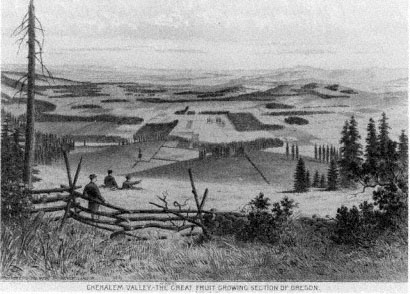
Figure 7.
The transformed landscape of the Willamette Valley, 1888. Compare this sketch of the
Chehalem area of the Willamette Valley (near Newberg) with Paul Kane's rendition of
the valley in 1847 (fig. 1). Unlike Kane's painting, which depicts an uncultivated
landscape inhabited only by wildlife, this 1888 illustration emphasizes the Euro-American
presence—humans, fences, rectangular fields, a village in the distance, and abrupt
divisions between prairies and forest patches. Courtesy of the Oregon Historical Society,
Portland (negative number ORHI 35543).
Farmer in 1873: "Neither can there be a more charming spot of earth than this blessed valley which offers us a home, with its delightful climate, rich and certain harvests and with its undeveloped resources." One year later the same newspaper commented, "Is this a dream? Beautiful fields of golden grain, green orchards, meadows, the Willamette River, like a silver belt, glistening in the sunlight."[4] In both these instances, the observer paired the valley's natural beauty with utility and human artifice.
More vividly, in 1882 an observer of the Willamette Valley scene, E. Ingersoll, wrote at length about the confluence of nature and human artifice on the valley's landscape.[5] Ingersoll began by describing average Willamette Valley farms that "follow one another from the river back into the wooded foot-hills." He then turned his attention to the houses,
"which are almost invariably of frame, and of good size, with far more attention paid to comfort and attractive surroundings than it is customary in the Eastern States." He also noted the "little villages scattered here and there," as well as schoolhouses and churches. The vision he describes conveys to his reader an idea of a domesticated landscape.
Significantly, nature had a role here, too, for it provided a charming setting within which Willamette Valley inhabitants built their community. Ingersoll mentioned, for instance, the "many scattered oaks," "yellow pines," and "stately firs," which "gave an opportunity not lost sight of to place one's house where the effect would be that of an ancient homestead, around whose sacred altars trees planted in grandfather's youth had had time to become of great size and dignity." This "pleasant description," Ingersoll explained, "is seen everywhere; and it is deceptive, . . . giving an impression of a country occupied for centuries and full of traditions."
For Ingersoll, human occupation of the land transformed nature, turning elements of the landscape into embellishments of a domestic garden. From this immediate scene, which he himself termed one of "domestic felicity," Ingersoll then described the greater surrounding landscape: "The whole wide basin lies open to the eye, robed in green, but green of what infinite variety of tint and shading, between the emerald squares of the new wheat and the opaque mass of the far-away hill forests sharply serrate against the sky, or melting into farther and farther indistinctness of hill and haze. The foreground, too, is always pleasantly sketchy."[6] Reminiscent of Blain's descriptions of the Willamette and Calapooia valleys just thirty years earlier, Ingersoll's verbal rendition of a visual experience, however, is punctuated by the hand of man, though in a positive way, as seen in the "emerald squares of the new wheat." Ingersoll continued, "if you think my picture lacks color, look at that . . . brown patch of freshly ploughed ground; at this brilliant red barn and white farmhouse half hidden in its blossoming orchard!" For Ingersoll, only with the addition of human artifice—houses, barns, plowed fields, and orchards—could the true beauty of the landscape be appreciated.
The overwhelming beauty found in the now domesticated, pastoral Willamette Valley was commented on by observers of the Calapooia area and Linn County as a whole. A correspondent for the Willamette Farmer who traveled from Lebanon to Shedd in May 1877 declared of the view near the foot of Saddle Butte, "The scenery was magnificent.
Map 8.
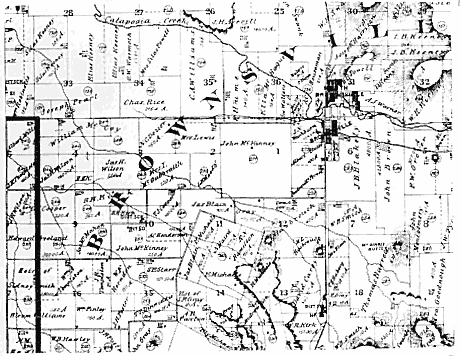
Land claims at the mouth of the Calapooia Valley, 1878.
SOURCE: Illustrated Historical Atlas Map of Marion and Linn Counties, Oregon .
We could count twenty-one teams putting in grain, in going one mile. Linn County is literally one grand wheat field." Another correspondent wrote later the same season about the view as he and his companion headed southeast from Halsey to the foothills, "passing nearly all the way over prairies as rich as need be, showing everywhere comfortable homes."[7]
Much of the area through which they traveled, the once formerly open, uninhabited plains of the Willamette Valley west of Brownsville at the mouth of the Calapooia Valley, is shown in map 8. Note that on this map, executed one year after the newspaper correspondent traversed the area, the landscape is divided into numerous farms. Figure 8 allows us to glimpse the plains of the Willamette adjacent to the Calapooia River as they appeared in 1878. This lithograph shows the formerly avoided prairies now transformed into a realm of domestic bliss. it reveals neatly kept farms, with fences dividing and therefore
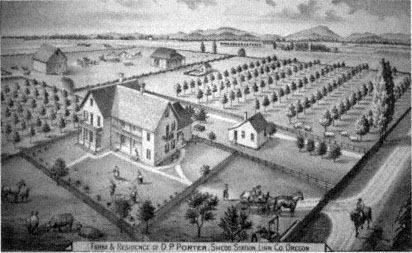
Figure 8.
D.P. Porter's farm and residence, 1878. Located near the town of Shedd, Porter's
residence is an example of the pastoral achievement of southern Willamette Valley
inhabitants in the late nineteenth century.
Source: Illustrated Historical Atlas Map of Marion and Linn Counties, Oregon .
putting into captivity prairies that have now been changed into productive fields and pastures. Barns, other outbuildings, and young orchards embellish the scene, while men busily attend grain fields, and farm animals laze about the barnyard. The lithograph even captures a croquet match in progress. All these adornments and activities however, serve only as embroidery for the most important feature of the scene, the domestic abode, standing in a central, stately location.
In this lithograph and the period descriptions, the natural beauty of the primitive valley has given way to the utilitarian beauty of the transformed landscape. The meaning of this landscape had also changed. We see this most graphically in the comments of an 1884 correspondent to an Albany newspaper. This writer first described the panorama of the valley as viewed from "a slight eminence on the [east] edge of the Willamette valley," where the town of "Brownsville stands in her glory." This correspondent appears to have stood in almost exactly the same place where Wilson Blain had stood thirty-three years earlier when he "gazed with rapture" across a valley that combined, in the most
"remarkable manner, variety, beauty, and sublimity, in the natural world."[8]
But the vision of the 1884 observer, while superficially similar to Blain's, is in fact quite different. He begins by regarding the "background made up of the Cascade range and with a front view of the beautiful Willamette valley and its native scenery." He continues, "But a little beyond this scenery is the Coast range, which has been termed the dyke of the great Pacific." What made this scenery most "beautiful, indeed romantic" to this viewer, however, was not simply its natural and sublime beauty—as it had been for Blain—but the fact that he heard a special message "echoing" over the valley, reverberating from the heights of the Coast Range. That message was "business."
Notes on the beauty of the transformed Calapooia scenery were not limited to panoramic vistas alone, for observant eyes dissected this landscape, isolating its important utilitarian features, such as the Calapooia River itself. Regarded as the "leading element" in North Brownsville's prosperity as of 1878, observers saw the Calapooia as "splendid and never-failing [in] water power . . . which drives all . . . mills and factories." Eleven years later another viewer of the Brownsville scene remarked that the dam built across the Calapooia turned "almost the entire river into a race." One year later, another enumerated the manufactories the river powered in Brownsville: "a woolen mill, flour mill, saw mill, sash and door factory, furniture factory, etc." He ended his commentary by noting that there was yet "plenty of power to spare." Commentators on the Calapooia positively assessed this realization of the river's utility; indeed, in 1876 one resident of Crawfordsville suggested that the river was so important that it deserved "a better name than it bears."[9]
Even individual towns and their situations were considered idyllic scenes. In 1878 a viewer described South Brownsville as "picturesquely-situated and flourishing . . . at the entrance to the valley of the Calapooia River, and more beautiful surroundings than it possesses would be hard to conceive." The twin towns of South and North Brownsville together had "picturesque dwellings, neatly-arranged grounds, in the cool shade of innumerable trees, present[ing] a picture of comfort which no other town can excel and few equal." Even Brownsville's small industrial area around the woolen mills had a domestic lure, according to one late nineteenth-century observer: "Surrounding, and in near proximity to the mill, are the dwellings of the operatives, and the
observer will be pleased with the general air of neatness and comfort pervading this section of the city, most of the houses being built and surrounded by orchards and gardens prolific in their yield."[10]
The late nineteenth-century Calapooia, as well as the whole of the Willamette Valley, may not in reality have been the tranquil pastoral landscape that its inhabitants so gloriously proclaimed. In fact, these descriptions ignore some of the reality of environmental degradation under which these people suffered. But it is important to note that this is how they wished to view the world they and nature had created. Here, comfortable houses and productive farms dotted the prairies, industrious villages reposed among shade trees, and bustling rivers powered factories. All this they viewed as a jewel set in the beautiful green basin of the Willamette.
Late nineteenth-century Willamette and Calapooia residents believed they lived in an actual garden. Immigration agent C. G. Burkhart, who lived in Linn County his entire life, argued in 1887, "It is stated that if the Willamette Valley is the garden spot of the state, Linn County is the garden spot of the valley. The comparison is now extended and the statement confidently made that, if Linn County is the garden spot of the valley," the prairie extending west of the Calapooia "is the garden spot of the county." In other words, these open prairies that the Calapooia community once hoped would become a garden had, by the end of the nineteenth century, far exceeded all expectations and had become literally the garden spot of the garden spot of the garden spot of the entire state.[11]
Burkhart and his successor, B. F. Alley, marketed the garden image of the Willamette plains adjacent to the Calapooia during the end of the 1880s. Burkhart noted, "In all this plain the land is all taken and converted into fine farms." In another reference he remarked that the "belt from the Willamette River to the foothills . . . is an open, level prairie country, the most productive in the valley. . . . Wheat, oats, barley and all kinds of vegetable and fruits are grown here with the greatest success." Elsewhere he pointed out,
In all parts of the country, along the river and creek bottoms and all through the foot hills, fruits of most kinds are grown in the greatest abundance and the quality is unsurpassed by that of any other state. Apples of all varieties, pears in size and quality call out the unstinted praise of all who see them, plums as large as hen eggs, rich and juicy, cherries that in both quality and
quantity challenge comparison with similar fruits grown anywhere else, prunes that delight the eye and taste of all.[12]
Alley described the fertile plains of the Willamette, "stretching away to the west and south" from the Calapooia, as "carpeted with numberless fields of grain, dotted with farm houses and settlements, showing a prosperous and successful people." He also wrote of "the beauty and fertility" of the prairies surrounding the town of Halsey and of "the unmistakable healthfulness of its climate." According to Alley, "All the essentials that go to make up a desirable country abound here."[13]
These descriptions of the Calapooia's prairies in particular, and the Willamette Valley in general, rely on the image of the garden. Settlers dreamed of such a garden at an early date and then realized it through a variety of interdependent natural and human factors: fertility of soil, drainage of the valley's plains, a variety of natural resources, a salubrious climate, the growth of markets and their accessibility through improved transportation, a growing population, development of early manufacturing and the utilization of rapid streams, and the expansion of agriculture. Here, indeed, a garden thrived.
The beauty and utility of the landscape, however, were as two-dimensional as the descriptions and sketches of the Calapooia's gardenlike appearance. Scratch the surface of these lithographs and we find that the grazing cattle and rooting swine, coupled with the cessation of burning by the Kalapuya, helped destroy the grasslands of the plains on which settlers once gazed with pleasure. Fencing diminished the Calapooia as a wildlife habitat. The draining of prairies destroyed the valley's natural sloughs, home to waterfowl and animals. Furthermore, the early lumber industry not only felled the native trees but converted the Calapooia into a highway for logs, with harmful effects on the stream and its ability to replenish the floodplain. And nature reacted. The environment continued to act independently of its human inhabitants, as it had during early pioneer years. But its reaction in these later years was magnified because the changes humans attempted to make were more environmentally significant. Although settlers could alter prairies and woodlands, they could not stop natural succession. Soon, invasions of brush and weeds, native and exotic, and the depletion of soil fertility made life difficult for the civilization that unwittingly initiated the change.
From at least the 1890s and well into the twentieth century, longtime settlers recognized changes in the land, many of which they lamented. John Minto noted just after the turn of the century, "These damp-land and water fowls and animals, which once found here their breeding places, have gone forever, unless farmers in the near future construct artificial fish ponds, and reservoirs for irrigation when needed." A Calapooia Valley old-timer remarked to a historian at about the same time, "You can not imagine the beauty of this country when we first came here." Another Calapooian remarked in the late 1930s of the vanished white-tailed deer, "Now I presume they are all gone, though it may be possible that there are still a very few of them in the woods and among the small wooded islands."[14] Lamentation over the lost wildlife and primitive landscape of the Calapooia and Willamette valleys certainly composed part of residents' responses to the transformed environment.
One can also find at the end of the nineteenth century a human-landscape relationship truncated by a myriad of intermediaries now separating the two. Living in this garden, valley inhabitants lacked a certain depth in their relationship to the landscape, for the process undertaken to achieve this garden actually amputated the third dimension of intimacy, a closeness to the primitive landscape that the early settlers enjoyed. Lacking this third dimension, residents' relationship to the land collapsed into two-dimensionality. They still went about their activities, but they felt a significant loss that they were unable exactly to describe. This change, and the necessity of leaving the foothills for the prairie where future development would take place, resulted in the loss of a certain quality of life. By the end of the nineteenth century, valley inhabitants were looking back to the foothills, and their still relatively primitive nature, for this vanished quality of life, and aspects of the foothills were celebrated in literature and deemed desirable. If the garden qualities of the Willamette could be so widely glorified, the foothills, too, had their own benefits, which were missing from the plains.
Foothills in Retrospect
When George Atkinson traveled through the western portion of the mid Willamette Valley in 1848, he kept a diary of his journey. On 15 July he noted in his journal that he had met along the way a Mr. B. (possibly Glen O. Burnett), who evidently mentioned that "a man can live [in the Willamette] with half the labor done in the States." Three years later
Wilson Blain reported that he had "heard an Illinois farmer sum up the character of Oregon in a very few expressive words. 'It is a great country . . . for a lazy man; for in no other could such a man live with so little care or labour.'" Blain went on, however, to note how "great" the country was "for an industrious man."[15]
Some thirty years later, an important change in the message that Atkinson and Blain related can be detected. In 1887 the Linn County Immigration Agent wrote, "This County is not a paradise. It requires labor and industry, indefatigable to win a fortune here. It requires earnest effort to make a living here. If a person cannot sacrifice this much of self, he should not make this his home." This message to prospective immigrants was probably designed, in part, to weed out what the Immigration Agent called "sluggards." But it also reveals a clue to a changed relationship with environment of the Willamette and Calapooia valleys.[16]
From late nineteenth-century valley literature, we hear complaints from inhabitants about the life they led. Some of these complaints came from farmers whose agricultural practices had changed, or at least intensified, since the early years. Drawn into a market economy, they extended cultivation onto the Willamette prairies, which they had to drain of excessive winter and spring waters. In time the fertility of these same lands declined, forcing the complete abandonment of some areas.
In response to this environmental change, one valley farmer wrote to the Willamette Farmer in 1872, "When the soil was new and rich, it did not seem to take much thought how to farm; but, as the fertile prairies have been used for many years in constant cropping, men began to see the necessity of more thorough farming." Two techniques required for this "more thorough" type of cultivation, and on which this farmer commented, were draining and subsoiling, both arduous tasks. He then commented that although Oregon farmers should write to the Willamette Farmer for advice, they were unlikely to do so: "The truth is farmers, after the toils of the day, feel more like resting than writing [to your paper for successful advice]."[17]
In response to growing markets, the Willamette Valley farmers demanded increased yields, which required extensive cultivation techniques and resulted in complex and perplexing ecological responses, and in turn caused the wearisome toil they experienced. As we have seen, the cessation of Kalapuya burning, for instance, encouraged shrubs to invade prairies now used for cultivated crops. When commenting on the "brush invasion," one valley farmer prefaced his remarks by
noting, "It is natural for man to shun hard labor." But in combating ecological succession, this same farmer submitted, "It requires not only a strong head but strong muscles." The invasion of other plants, such as bracken, added to these problems and were themselves "very difficult to eradicate."[18]
Burkhart, the Linn County immigration agent and a lifetime resident of the area, noted, however, that there existed refuge from such wearisome toil. This refuge could be found in the landscape itself:
Situated in and rising out of this [Willamette] plain are quite a number of buttes or single circular hills from three to five hundred feet high, covered more or less with timber or brush though some are destitute of both.
Bubbling from the sides of these hills are to be found springs of pure, living water, as well as rich nutritious grass. . . . Dotted over these hills are many romantic, shady groves, where, in spring and summer time people from all surrounding country hold their picnic, grange, and other outdoor gatherings to recuperate from the exhaustion brought on by the toils and burdens of every day life.[19]
The description of this geographical refuge suits well the land the first settlers, such as Thomas Ward (map 6), took up in the late 1840s and early 1850s before extensive settlement on the prairie proper. Figure 9 shows one such butte as it appeared in 1878.
Retreated to out of necessity during early days, and then considered of secondary importance as later arrivals realized the potential of the valley's floor, the small buttes and foothills of the valley now became "romantic" refuges where locals "from all surrounding country" could "recuperate" from everyday toils. Some locals have left references about such retreats. For instance, during the mid 1880s Sarah Cornett noted in her diary the daily weather conditions as well as the innumerable chores she, her husband, and other members of the family performed every day. Sunday, though, was usually a day of rest. On Sunday, 10 May 1885, she wrote of a family outing to Soda Springs in the foothills: "quite warm has some appearance of rain John and I and Mother and Mary all went to Soda to day we had a very nice time." Living in the shadow of the isolated Saddle Butte, Cornett simply mentioned on another Sunday, "John and I went to the butte this evening." In 1866, Jasper Cranfill remarked, "Ploughed one half the day. Remainder I passed off in going to the largest Buttes on a hunting tour & pleasure trip."[20]
But Burkhart's comment on "the exhaustion brought on by the toils
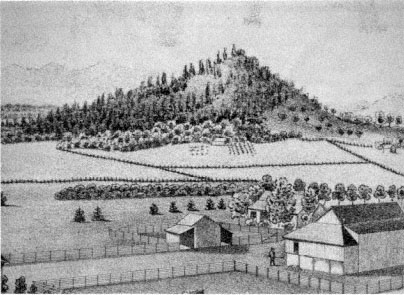
Figure 9.
Small butte in northern Linn County, 1878. Conical buttes, such as the one pictured
here, and surrounding foothills offered southern Willamette Valley inhabitants a
romantic refuge from the drudgery of everyday life. Note the dense forest on
the north (left) side of the butte and the sparser woodland on the drier south side.
Source: Illustrated Historical Atlas Map of Marion and Linn Counties, Oregon .
and burdens of every day life" had a broader meaning than just the laborious work experienced in rural living as farmers attempted to produce more efficiently for wider markets. When looking to the foothills, Burkhart, like other Calapooia and Willamette Valley citizens, was actually looking away from the complexities of life in the late nineteenth century. Another valley inhabitant summed up the problem—after glorifying the amenities of life that might be enjoyed in the foothills—with his remark, "If some of us must wear our lives out in the drudgery of town work, we hope the people of the hill country will appreciate their privileges and use them right."[21]
Commentators celebrated at length the privileges of living among the foothills: "The water is better and the air is purer in the hills"; "It must be healthier in the hills, and where there is health there is happiness"; "A single day among these hills will make any man who has eyes for beauty and lungs for fresh air." The practical qualities the earliest set-
tlers noted about the foothills, especially good drainage but also access to water, timber, and good pasturage, were all once again discussed at the end of the nineteenth century.[22]
Observers realized that practical considerations were not the only qualities of the foothills to be enjoyed. What became the most significant feature in this celebration of the foothills was the "natural" quality of life available there and its psychological implications for residents. Thus on a trip to the foothills, one valley inhabitant remarked about a particularly memorable moment "not beyond the reach of settlement where the foothills wear inviting aspects and the sounds of civilization seem an actual invasion of Nature's domain."[23]
Linn County and Calapooia residents desired the release that nature afforded them during the late nineteenth century. Some residents, not always able to go to the foothills, substituted a wilder area of their farms. Jasper Cranfill, for instance, did not always have time to retreat to the hills, but he still needed to get away from everyday toil. Thus, he "went down into the timber for diversion" on more than one occasion in the late 1860s.[24]
Another telling incident is recorded in Sarah Cornett's diary. As noted in chapter 4, Cornett's forebears on the Calapooia in the late 1840s and early 1850s, Agnes Courtney and Elizabeth Blain, domesticated their wilderness claims by planting flowers. In the 1880s Cornett also had a flower garden in which she took great pride. She lamented in her diary on 19 January 1883, for instance, that it was "very cold last night" and "froze all of our flowers." Another time she was apparently delighted when Allie Elder stopped in "and brought me some dahlah bulbs." While Cornett enjoyed her garden very much, her domestic flowers did not always provide her with the satisfaction she desired. One day, when "Ada and Nellie were here . . . we went down to the timber to get some wild current blossoms." Agnes Courtney and Elizabeth Blain used flowers to domesticate their wilderness claims during early settlement; Sarah Cornett used a bit of the "wild" to embellish her domesticated surroundings in the 1880s.[25]
Western Oregon resident Frances Fuller Victor noted the significance of wooded corners of inhabitants' claims and labeled them "truly 'Arcadian' groves." On one occasion in the 1870s, Victor lamented at length the abuse of one of these patches of timber. On visiting the home of one valley farmer, she declared it "a sort of profanation that [he] . . . has allowed one of these grand forest cathedrals to be used as a shelter for
his stock, and so to become defiled." In essence, Victor criticized what had transpired in the Willamette over the past few years when she chided her own view as having neither "utilitarian, nor even humanitarian" values. To Victor, utility and "humanity" had wrought havoc on the naturalness of the valley. In making a deep bow to these forces, Victor also averred that there was still something mystical in remnant stands of "these giants of centuries old" to which impermanent humans (specifically their cattle which "are born and die in half a dozen years") had no right "to bring grief."[26]
While wooded corners of late nineteenth-century farms provided havens for valley inhabitants, as they had for Cranfill, Cornett, and Victor, the foothills, with vaster areas of what appeared to be natural or wild, became the focus of attention. Descriptions of little valleys like the Calapooia and nearby foothills tended to concentrate on the more natural surroundings than could be found on the plains of the Willamette: "The prospect is better and the scenery more varied. The groves of oak timber are a delight to the eye." The following lengthy description of Brownsville's setting also shows a concern to point out the natural beauty of the Calapooia and not the signs of human habitation. Brownsville, we are told, is situated
at the entrance to the charming little valley of the Calapooia, where the first low hills rise from the level plains of the Willamette Valley, and stretch in rolling landscape, hill upon hill, away toward the snow clad Cascades. The village has a population of something like six hundred, and is nestled along the margin of the Calapooia Creek, about one-half on the grass covered hills that reach down almost to the sparkling waters of the stream, and the other on the sough bank, whence the level bottom land extends out for miles toward the ever green hills. [It] is the most romantically situated of any village in the country, and is remarkable for its pleasant surrounding.[27]
Breathing fresh air, drinking pure water, and looking onto the foothills' scenery lent a certain "naturalness" to life that had been lost on the valley floor. The late nineteenth-century way of life in the foothills, particularly in the small valley of the Calapooia, allowed residents to participate in what might appear to be a completely different realm of psychology:
This rolling, hilly region is interspersed with little skirts of prairie bottoms here and there along the creeks and rivers that wend their way to the Willamette River from the snows of the Cascades. These little valleys along these streams are a thing of beauty, a joy forever to those who are so lucky as to
find a home in them. So varied and romantic in their form and appearance as to excite the admiration of all who are of poetical inclinations.[28]
Thus, the variety of elements the foothills mysteriously possessed made it possible to lead in them a life of romance. In fact, those "so lucky as to find a home in them" might even live a life there that replicated poetry. These surroundings would induce, according to another observer, a certain quality of thought in its residents so that one day "some of the best brains and truest hearts of future generations will come from 'The Hills.'"[29] Essentially what these people noted about the foothills was that their primitive qualities still existed and were vital for psychological health.
Psychologist Harold F. Searles has noted that the "advancement of our technology has made for a psychological distancing of man from . . . innumerable . . . elements of his non-human environment." This distancing has been caused by a loss of "contact with nature," resulting in a "profound sense of meaninglessness."[30] The history of Euro-American settlers and their relationship to the environment along the banks of the Calapooia in the nineteenth century is a history of humans becoming estranged from the land. The earliest settlers sought out the foothills along valleys like the Calapooia as the best place to settle. There they developed a close relationship with the land. In time, the various values of this land went down as settlers and their descendants exploited the expanse of the Willamette plains. But by the end of the nineteenth century, people looked back to the little valleys and foothills for something they apparently no longer experienced on the floor of the Willamette Valley. If the plains of the Willamette west of the Calapooia had become a two-dimensional garden spot, then the smaller valleys like the Calapooia, with their numerous foothills and small patches of prairie, held within their geographical form the psychological third dimension missing from the complex life on the expansive plains of the Willamette.
History had come nearly full circle. Retreating to the foothills to make a living during the early years, settlers looked wistfully on the open prairies. On those plains they believed a pastoral community would be created. In reality, when looking onto the plains from the vantage of the foothills, they looked into their future. Unable to know what the realization of this future would mean—most important, a changed relationship with the landscape—they set about working to-
ward it. When sitting on their farms of the prairies at the end of the nineteenth century, however, valley inhabitants noticed a void in their lives, a void that could be traced to their changed relationship with the land. Thus, when they looked to the foothills for the answer, they were, metaphorically, looking into their own past.