
Trends in Mortality by Age
Figure 12.3 shows annual movements in probabilities of death at ages 71, 75, 80, and 85 (4 q71 , 5 q75 , 5 q80 , and 5 q85 ) for 1900 to 1936 derived from the Penn-
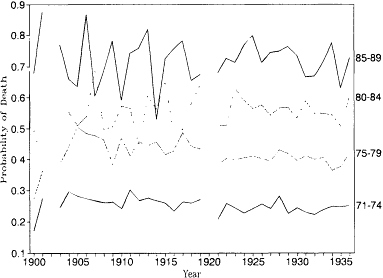
Fig. 12.3.
Probability of death, by age: Pennsylvania Railroad
Pension Fund, 1900-1935.
sylvania Railroad Pension Fund data. In table 12.4 and figures 12.4 through 12.7, these mortality rates are aggregated into five-year periods centered on years ending in 5 and 0. The mortality rates for ages 71-74 have been extrapolated to ages 70-74 to facilitate comparison with U.S. life tables (also presented in table 12.4 and figs. 12.4-12.7). Trends are easier to detect in these figures without the confusing influence of annual fluctuations.
The influence of the selection effects described above are apparent in the first two years of the pension fund. The mortality rates for ages 71-74 were noticeably lower in the first two years of the pension fund, because currently employed workers tend to be healthier than those who retire early. This effect disappeared relatively quickly as disability pensions at age 65 became available, however.
The most remarkable aspect of these data is the difference between the trends in mortality above and below age 80. The mortality rates at ages 71-74 and 75-79 show clear and steady declines between 1905 and 1935. It is much more difficult to detect trends at the two older age groups. The age group 80-84 has a generally rising pattern with the suggestion of a peak around 1925. Ages 85-89 also peak near 1925, but the overall trend is even more difficult to identify.
Table 12.4 and figures 12.4 through 12.7 show life table mortality estimates for the U.S. death registration area. Joseph A. Hill (1936) provides
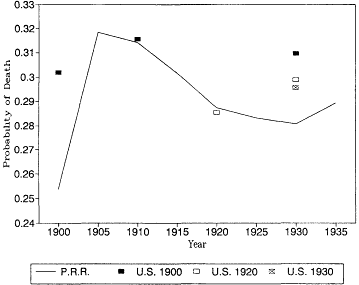
Fig. 12.4.
Probability of death at age 70: Pennsylvania Railroad Pension
Fund, 1900-1935, and U.S. Life Tables, 1900, 1920, and 1930.
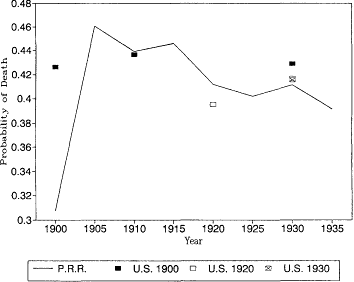
Fig. 12.5.
Probability of death at age 75: Pennsylvania Railroad Pension
Fund, 1900-1935, and U.S. Life Tables, 1900, 1920, and 1930.
TABLE 12.4 | |||||||||
Pennsylvania Railroad Pension Fund | |||||||||
Aged | 1900-1901 | 1903-1907 | 1908-1912 | 1913-1917 | 1918-1922 | 1923-1927 | 1928-1932 | 1933-1936 | |
70 | 0.2537 | 0.3186 | 0.3143 | 0.3018 | 0.2876 | 0.2833 | 0.2808 | 0.2893 | |
75 | 0.3077 | 0.4608 | 0.4394 | 0.4461 | 0.4119 | 0.4021 | 0.4114 | 0.3917 | |
80 | 0.4765 | 0.5616 | 0.5176 | 0.5581 | 0.5546 | 0.5803 | 0.5610 | 0.5520 | |
85 | 0.7584 | 0.7097 | 0.7311 | 0.7297 | 0.6860 | 0.7504 | 0.7099 | 0.7152 | |
90 | 0.8284 | 0.8683 | 0.8670 | 0.8189 | 0.8176 | 0.8516 | |||
95 | 0.8808 | 0.6915 | 0.9613 | ||||||
U.S. White Male Life Tables | |||||||||
1901 | 1910 | 1920 | 1930 | ||||||
Contemporary U.S. death registration area | |||||||||
70 | 0.3019 | 0.3156 | 0.2854 | 0.2958 | |||||
75 | 0.4265 | 0.4366 | 0.3955 | 0.4157 | |||||
80 | 0.5718 | 0.5769 | 0.5382 | 0.5603 | |||||
85 | 0.7101 | 0.7040 | 0.6850 | 0.6889 | |||||
90 | 0.8274 | 0.8103 | 0.7835 | 0.8041 | |||||
95 | 0.9179 | 0.8940 | 0.8907 | 0.9125 | |||||
(Table continued on next page)
(Table continued from previous page)
U.S. White Male Life Tables | |||||||||
1901 | 1910 | 1920 | 1930 | ||||||
Registration states of 1900 | |||||||||
70 | 0.3019 | 0.3156 | 0.3098 | ||||||
75 | 0.4265 | 0.4366 | 0.4290 | ||||||
80 | 0.5718 | 0.5769 | 0.5702 | ||||||
85 | 0.7101 | 0.7040 | 0.7008 | ||||||
90 | 0.8274 | 0.8103 | 0.8122 | ||||||
95 | 0.9179 | 0.8940 | 0.9055 | ||||||
Registration states of 1920 | |||||||||
70 | 0.2854 | 0.2989 | |||||||
75 | 0.3955 | 0.4170 | |||||||
80 | 0.5382 | 0.5602 | |||||||
85 | 0.6850 | 0.6908 | |||||||
90 | 0.7835 | 0.8039 | |||||||
95 | 0.8907 | 0.9170 | |||||||
Registration states of 1930 | |||||||||
70 | 0.2958 | ||||||||
75 | 0.4157 | ||||||||
80 | 0.5603 | ||||||||
85 | 0.6889 | ||||||||
90 | 0.8041 | ||||||||
95 | 0.9125 | ||||||||
a The probabilities of death for ages 71-74 have been converted to 70-75 using the formula 5 q70 = 1.169 4 q71 . | |||||||||
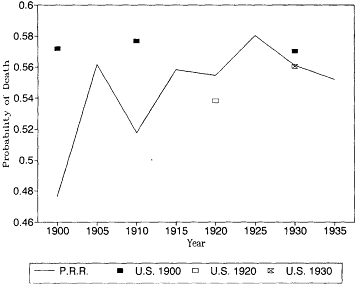
Fig. 12.6.
Probability of death at age 80: Pennsylvania Railroad Pension
Fund, 1900-1935, and U.S. Life Tables, 1900, 1920, and 1930.
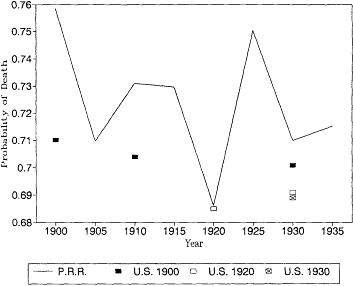
Fig. 12.7.
Probability of death at age 85: Pennsylvania Railroad Pension
Fund, 1900-1935, and U.S. Life Tables, 1900, 1920, and 1930.
U.S. life tables for 1930 based on the death registration areas of 1900 and 1920. At most younger ages the differences between the earlier and later registration areas would not change our interpretation of the trend in mortality. At these ages, however, the expanding death registration area suggests a larger decline in mortality than the original registration states of 1900. In 1930, the estimates based on the 1.900 death registration area are higher than the other two estimates, and the 1930 death registration area yields the lowest mortality rates of all.
It is also reassuring to see that the Pennsylvania Railroad pension mortality was very close to the more general experience captured by the U.S. Bureau of the Census life tables. There is no evidence here that the railroad annuitants were select lives with lower than normal mortality. At age 85 the railroad mortality rates are higher than the U.S. life table estimates. This is probably due to age misreporting errors in the U.S. data, which were discussed above.
A statistical analysis of mortality trends at different ages is presented in table 12.5. Logit regression models have been used to estimate the relationships among age, time period, and the age-specific mortality rates of the Pennsylvania Railroad Pension Fund. The dependent variable in this analysis is the set of death rates for single years of age (lqx) in each of the years from 1903 to 1935. Death rates based on fewer than 10 lives at risk were excluded, which left 649 observations for the full period. Logit regression was used because the range of the dependent variable is restricted to the interval from 0 to 1. This restriction results in heteroskedasticity, which biases standard errors derived from ordinary least squares regressions. Observations were weighted by the number of lives at risk in all computations.[10] Estimates are provided for three periods. The first period, 1903-1935, uses all of the available data except for the three initial years of the pension fund, which show strong selectivity effects. The second period, 1903-1929, excludes the last six years of the pension fund, in which mortality appears to have been falling at all ages. The third period, 1903-1919, refers to data for only the eastern operating division of the railroad and excludes the possible confounding effects of the western lines added when the two pension funds merged in 1920.
Model I provides a simple estimate of the relationship between age and mortality without distinctions by time period. The logit model of mortality is similar to the Gompertz model, which is more commonly used to approximate adult mortality.[11] In both models the logarithm of the probability of death is almost linear at younger ages, but it increases more slowly at the highest ages as it converges toward 1.0. The estimated coefficient for age in this model represents the rate of increase in the probability of death as age increases. The desirability of additional parameters in modeling the Pennsylvania Railroad Pension Fund data was tested by adding an age-
TABLE 12.5 | ||||
Years | ||||
1903-1935 | 1903-1929 | 1903-1919 | ||
Model I | ||||
Constant | -9.238* | -9.210* | -8.542* | |
Age | .0927* | .0927* | .0845* | |
Model II | ||||
Constant | -9.274* | -9.256* | -8.545* | |
Age | .0932* | .0930* | .0845* | |
Year | -.0044* | -.0040* | -.0002 | |
Model III | ||||
Constant | -9.252* | -9.502* | -8.966* | |
Age | .0929* | .0962* | .0901* | |
Year | -.0057* | -.0062* | -.0014 | |
Year for age 80+ | .0057* | .0096* | .0061 | |
Model IV | ||||
Constant | - 9.252* | - 9.502* | - 8.966* | |
Age | .0929* | .0962* | .0901* | |
Year for ages 71-79 | -.0057* | -.0062* | -.0014 | |
Year for age 80+ | .0000 | .0034 | .0046 | |
NOTE : Dependent variable is life table lqx. | ||||
* The probability of obtaining this result if the true coefficient equals zero is p < .05. | ||||
squared term to the logit regression. This additional term did not improve the fit of the model significantly.
The estimates in table 12.5 support the impression that the shape of the mortality curve was changing. If mortality at ages 70-79 was decreasing and mortality above age 80 was constant or increasing, the rate of increase of the probability of death with advancing age should have become more pronounced. This is exactly the kind of change that we find in Model I by comparing the estimates for 1903 to 1919 to the estimates for 1903 to 1929 or 1903 to 1936. The estimated coefficient for age increases from 0.0845 in the earlier period to 0.0927 when the 1920s and 1930s are included.
In Model II, the year is added as an independent variable in the logit regression equation. This allows the level of the mortality curve to shift upward or downward over time. The estimates for all three periods indicate that mortality was falling, but the change from 1903 to 1919 is not statistically distinguishable from zero.
Models III and IV allow us to distinguish between the trends in mortality at ages 71-79 and trends over the age of 80. These models are actually mathematically identical, but they yield tests of somewhat different statisti-
cal inferences. In Model III, a variable is added to distinguish trends in mortality at ages 80 and over from the trend at ages 71-79. This variable is set equal to the year at ages 80 and over but is set to zero under age 80. In Model III, the coefficient for the independent variable "Year" measures the rate of change of mortality at ages 71-79, and the coefficient for "Year for age 80+" measures the difference between the rate of change at ages 80 and over and ages 71-79. The estimated coefficients for this "interaction" variable indicate that mortality decreased less above age 80 in each of the three periods. The difference in trends is greatest for the period 1903 to 1929, and the differences in the periods 1903 to 1929 and 1903 to 1936 are both statistically significant.
In Model IV, the variable for the year is replaced with a variable that is equal to the year at ages 71-79 and zero at ages 80 and over. Since this change does not add any new information, the estimated coefficients for this independent variable are the same as those for the variable that is replaced in Model III. However, the interpretation of the variable "Year for age 80+" is different in Model IV. This variable now provides a direct measure of the trend in mortality at ages 80 and older, instead of measuring the difference between trends above and below age 80. In Model IV, the statistical test associated with this variable considers the null hypothesis that there was no trend in mortality at ages 80 and over. In the previous model the null hypothesis was that there was no difference between the trend at ages 71-79 and the trend at 80 and older.
Model IV indicates that mortality was increasing above age 80 until 1929. When the seven years from 1930 to 1936 are included, however, there is no measurable trend above age 80. This pattern is consistent with other indications in both the Pennsylvania Railroad Pension Fund and the death registration states that old age mortality peaked in the 1920s and declined in the 1930s. It is also noteworthy that the period 1903 to 1919 shows a stronger upward trend at ages 80 and older and a weaker downward trend at ages below 80. This suggests that the mortality peak in the mid-1920s is not due to changes in composition of the pension fund after the western lines were added in 1920. We cannot attach much certainty to the inference that mortality above age 80 was rising, because the statistical tests on Model IV indicate that the estimated coefficients for the "Year for age 804+" variable could differ from zero because of random variations in the data.
The logit regression models in table 12.5 provide statistical confirmation of the impressions derived from figures 12.4 through 12.7. Mortality below age 80 was declining, and there was a significant difference between the trends in mortality above and below age 80. The estimated coefficients indicate that mortality above age 80 was rising in the period from 1903 to 1929, but the statistical tests do not reject the null hypothesis that mortality at these ages was constant.
Thus these data from the Pennsylvania Railroad Pension Fund support the evidence from U.S. vital registration. Both data sets show divergent trends in mortality, at the older and younger ages. Furthermore, both data sets point to a turning point around 1926, when mortality at the oldest ages peaked and began to decline.