
Indebtedness and Estate Management
The monastic community of Peterborough Abbey produced to consume in the early twelfth century. An analysis of its move toward large-scale production and direct management must account for changes in consumption. A growing demand for money combined with indebtedness and inflation to transform money as a medium of consumption and production in medieval society over the twelfth century.[1] The transformation of money in the twelfth century is more easily grasped at the regional level first. Its impact on one agrarian estate, Peterborough Abbey, can then be considered.
English kings began to search for new sources of money over the twelfth century as traditional revenues, such as county farms, settled inertly at their customary limits. The fiscal valuation of military services based on the fee, the inauguration of tallages levied on English towns, the implementation of high fees for settlements and writs in the king's court, and the shift of the taxation base away from land to movable wealth, all served to drain money from town and country into the king's coffer at a quickening tempo.[2] The king in turn dissipated this revenue on war.[3] Paying mercenary troops, erecting and maintaining castles, settling alliances with money pacts, and supporting a growing bureaucracy, all increased the costs of administrative kingship in England over the twelfth century.
As the demands of English feudal government on its lords and peasants mounted, European trading networks underwent depression and realignment.[4] Silver grew scarcer for coinage and trade wars
flourished.[5] To satisfy the new levels of demand for money in the world economy, credit and finance developed at a European scale over the twelfth century. On the basis of fragmentary early evidence it is not possible to measure the scale of interregional or international indebtedness; it is possible, however, to examine qualitatively the early techniques used by merchants to indebt agrarian lords. Such techniques created a new set of economic relations between creditor and debtor in the twelfth century and impinged on agricultural production in England.
By the mid-twelfth century, English agrarian lords were contracting debts by taking advance payment from merchants for crops and animal products, especially wool.[6] Most impressive were the activities of the Flemish financier, William Cade, who advanced them money and then collected in kind. The economic relations created by such contracts are crucial to understanding agricultural development in England in the twelfth century. First, such loans, really instruments of trade, drew the agrarian producer into vertical links with financiers who monopolized the exchange of agricultural products from production points to the distribution points of the industrializing sectors they represented.[7] If English lords spent the cash advances before their creditors collected in kind, they were induced to commit future crops to the same merchant. The relation produced a structure of indebtedness whereby creditors pushed agrarian producers further into cash-cropping.
English agrarian lords grew structurally indebted over the late twelfth and early thirteenth centuries.[8] They increased the scale of their production to compensate for the costs of their borrowed money; agrarian loans were more costly than commercial loans.[9] Increased scale of production also ensured the increased flow of borrowed money. Structural indebtedness locked the English agrarian sector into cash-cropping grain and wool for the expanding industrial sector of Flanders. As a response to this structural change, English agrarian lords moved abruptly toward direct management of their estates.[10] The older agrarian arrangements of farming out estates and collecting food or its cash equivalent were unsuited to new forms of agrarian indebtedness and its demands for large-scale production.
The Abbey of Peterborough was vulnerable to such economic transformations. Its monks grew familiar with debt over the twelfth century. The chroniclers of the Abbey first comment on debts left by
abbots upon the death of Martin of Bec (1132-1154). His successor, William of Waterville (1155-1175), "settled all the debts of Abbot Martin to the amount of three hundred silver marks (£200) except the sixty marks (£40) of interest which by the Abbot's effort our lord the king ordered to be pardoned."[11] The interest rate represented 20 percent of the principal. The actual interest rate for the loan depended on the time involved, which we do not know.
William left his own debts of more than 1,500 marks.[12] Locally, the same William advanced money. He kept lands of a certain Ives of Gunthorpe until "the Abbacy should receive therefrom sixty marks" a good example of a vif-gage.[13] During his abbacy William also faced the growing fiscal demands of the Crown. The continuous series of Pipe Rolls, preserved from 1159, furnish information on the royal charges on the Abbey and the Abbey's payments on these charges.[14] In figure 6 the annual fiscal renders demanded of Peterborough Abbey by the Crown are plotted along with the Abbey's annual payment on those demands. Over the period 1159-1218 (for which edited Pipe Rolls are available) the royal levy on the Abbey increased. The Abbey did not meet these demands and emerged as a chronic debtor to the Crown. The king did not regard benignly the failure of the Abbey to pay. Exercising his feudal prerogative, the king seized the Abbey upon the death of its Abbot in 1177 and again in 1210 and used the seizure as an occasion to funnel the Abbey's income into the royal treasury. In 1177, for instance, the king seized 23 percent of the Abbey's annual income from the estate and did not reduce the debt of the Abbey accordingly.
The Pipe Rolls also reveal that the Abbey owed money to Aaron of Lincoln, a leading Jewish financier in twelfth-century England.[15] Upon his death in 1191, the king confiscated the Abbey's debts to Aaron and charged the Abbey one hundred pounds for settling them. The total sum of the Abbey's debts to Aaron is not known. The discounted debt of one hundred pounds ranked the Abbey fifth among twenty-eight Northamptonshire debtors whose debts to Aaron ranged from twenty shillings to 493.5 pounds. Even deeper debts lay in the Abbey's future. In the abbacy of Robert of Sutton (1262-1274), Peterborough owed £4,324 18s . 5d ., almost twice the debt of Canterbury Cathedral Priory in 1254, when their debt stood at £2,168.[16]
The Abbey had harvested money as a chief crop of its estate in the
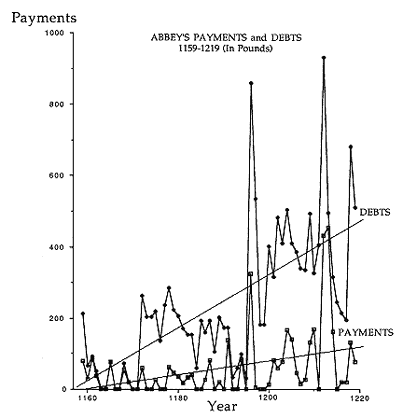
Fig. 6.
The Abbey's payments and debts to the royal treasury as recorded in the
Pipe Rolls, 1159-1219.
early twelfth century. By the end of the century the Abbey was a sharecropper of money. The king deflected a growing share of the crop to his treasury, and a good part of the crop was burdened by the surcharge of debt. The purchasing power of English money also changed over the later twelfth century.[17] By 1200 the Abbot could buy 30 percent less with the money returns from the estate. The Abbey faced a choice between continuing to consume cash returns from its estate as a sharecropper and undertaking the direct production of grain and animal products. Along with other English agrarian lords, the Abbey chose the latter course.