
Alternative Etymologies
To educated Indian ears, the word nautanki sounds a bit uncouth, with its hard consonants and nasal twang. Hindi dictionaries do not include the term before 1951. It occurs in neither Thompson's Dictionary in Hindee and English (1862) nor Platts's Dictionary of Urdu, Classical Hindi, and English (1884). Of the Hindi-English dictionaries currently in wide use, Chaturvedi and Tiwari's Practical Hindi-English Dictionary contains no entry, and the Minakshi hindi-angrezi kosh says simply "folk-dance, village-drama." Nor does the unabridged Hindi shabd sagar (1968) mention Nautanki in its ten volumes. Ramchandra Varma's Pramanik hindi kosh (second edition, 1951) appears to contain the first dictionary definition: "a type of renowned drama occurring in the Braj region in which they act and sing chaubolas (quatrains) to the accompaniment of the nagara (kettledrum)." The most detailed entry is in the fifth edition of the Manak hindi kosh (1964): "A type of folk-drama performed among the common people, whose plot is generally romantic or martial, and whose dialogues are usually in question-answer form in verse. It contains a predominance of music and chaubolas are sung in a particular manner accompanied by the dukkar (paired drums) or nagara ."
What explains the late occurrence of these definitions? And why does
the lexical silence persist? Sampling the dictionaries would lead us to believe that this folk art is obscure and insignificant. But dictionaries are slanted mirrors of language and society, reflecting the linguistic tapestries constructed by social, political, and economic forces at different moments of history. We might wonder if a censorious intent is at work, an effort to expunge Nautanki from the authorized indexes of the language. We begin to suspect from its omission that Nautanki may not rank with the prestigious, officially approved performance genres of modern India. Why then this attempt to exclude Nautanki from the canons of acceptable speech?
Part of the reason may be the uncertainty of its etymology. Most of the generic labels for folk theatre in North India are derived from words meaning "stage, play, show, processional theatre," for example, the Manch of Madhya Pradesh (from Sanskrit mancakam , "stage"), the Ram and Ras Lilas of Uttar Pradesh (Sanskrit lila , "sport, play"), Maharashtra's Tamasha (Arabic tamasha , "entertainment, spectacle"), Bengal's Jatra (Sanskrit yatra , "procession, pilgrimage"). In the parallel etymology conjured by Hindi scholars, nautanki has been traced to nataka , the Sanskrit high drama, via a hypothetical term nataki . The argument is inconclusive in the absence of references to nataki the dramatic literature. Taking another approach, Hindi novelist Amritlal Nagar explains the term as the theoretical admission price, nau tanka , nine silver coins, or as the fee paid by a patron for sponsoring a performance, nau taka , nine rupees. Others believe the word refers to a distinctive music and drumming style, nay tankar , "new sound."[12]
Beyond these speculations, folklore preserves the story of Nautanki, the beautiful princess of Multan. The dramatized romance of Phul Singh and Nautanki (although it may be older) first appears in published form as Khushi Ram's Sangit rani nautanki ka (The musical drama of Queen Nautanki) in 1882 (fig. 1). R. C. Temple lists "Rani Nautanki and the Panjabi Lad" in his index of legends collected from the Punjab in the 1880s. In the early 1900s, folk-drama poets from the Hathras area, Govind Chaman, Muralidhar, and the famed Chiranjilal and Natharam team, composed their much published versions of the story; they had many imitators (fig. 2). The popularity of the tale grew with repeated performances, as the folk theatre moved out from the Punjab region and Haryana into Uttar Pradesh and Bihar in the twentieth century.[13]
The traditions of the Nautanki theatre, moreover, include a metastory. The name of the princess Nautanki became so famous that it came to signify the theatre genre itself.[14] Such semantic extension is not
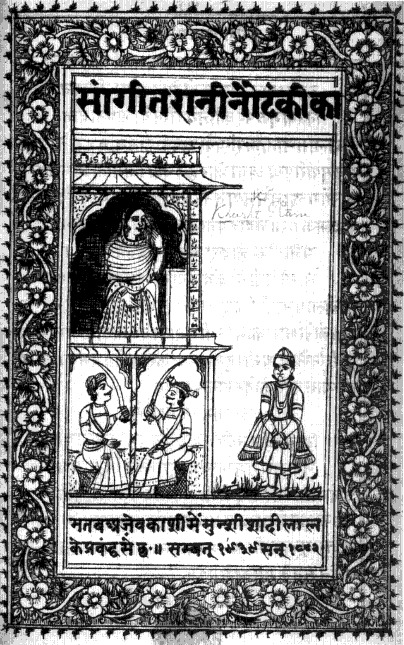
Fig. 1.
Title page of Sangit rani nautanki ka by Khushi Ram (Banaras, 1882).
By permission of the British Library.
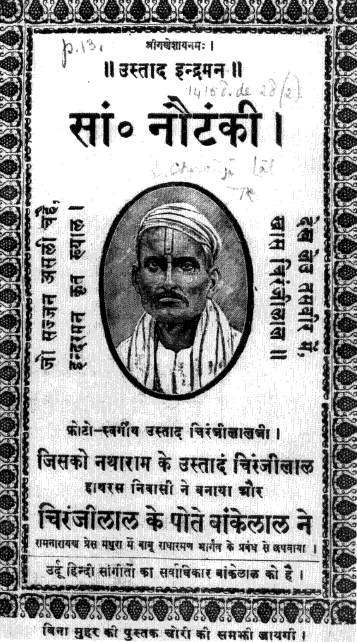
Fig. 2.
Title page of Sangit nautanki featuring portrait of the author,
Chiranjilal (Mathura, 1922). By permission of the British Library.
unknown to classificatory practices in North India. The name of a protagonist may designate a story, as well as the poetic meter used to tell that story, the musical motif associated with the meter, and finally the performance genre as a whole. For example, Alha is the name of a twelfth-century Rajput hero whose exploits were set down in the Alha khand of Jagnaik. Alha refers to the martial saga, which engendered a specific performance style called Alha, sung in the alha meter, to a tune recognized by listeners as alha , practiced by alha ganevale (Alha-singers)—which now includes other topics along with the original story of Alha.[15] Another example is Dhola, hero of the medieval Rajasthani epic Dhola maru. Dhola is also the classifier of a North Indian ballad form.[16] So too "Nautanki" names the beautiful princess, her well-known tale, and the unique theatrical style in which her story is performed. In popular usage, nautanki also refers to an item in the performance repertoire, as in the question, "Which nautanki did you see?"[17]
Having clarified the issue of etymology, let us return to the question of Nautanki's absence from the lexicons. A clue may be discovered in the unusual association of a folklore genre with a female character. Whereas the Alha and Dhola epics are named for male warriors, this art draws its title from a princess. The fetching Nautanki of legend may be intent on conquest, but her territory is the heart, not the battlefield. Does this make her theatre less noble than the epics of the heroes? What is implied when a theatrical tradition is identified with a woman, a supremely desirable woman? The nomenclature linking this folk theatre with the female gender may be the most singular indicator of its nature. It suggests the sociolinguistic and cultural veils that have cloaked Nautanki in mystery thus far.