
The Jesuit Expert, José Antonio Laburu
Forty-eight years old, José Antonio Laburu was then at the height of his popularity as one of Spain's most eloquent preachers. He was also a kind of popular scientist whose specialties in 1931 were "psychology, psychobiology, and characterology." He gave lectures to audiences in the thousands, with simultaneous radio broadcasts, on subjects that ranged from morality on the beaches to the psychology of fighting bulls. His oratory was "eminently popular, attractive, full of overwhelming conviction, within reach of the illiterate worker as well as the university professor." He taught biology at the Jesuit school in Oña (Burgos) and traveled widely the rest of the year. In 1930 many of his thirty-seven lectures were in Chile, Argentina, and Uruguay, to audiences top-heavy with university, government, and military leaders. His psychology leaned more to the Germanic than the French, but he was dismissive of Freud and occasionally cited Pierre Janet. In the ecclesiastical firmament, he was a very bright star. Oña was close to Vitoria and Laburu had fluid relations with the diocese. In Holy Week of 1930, according to the diocesan bulletin, his spiritual exercises in San Sebastián "were the sole topic of conversation in cafés and workshops, factories, and offices."[6]
Profiles in Estrella del Mar, 8 November 1931, p. 457, and Caro Baroja, Los Baroja, 274-275; oratory description from El Debate, 24 March 1933; for his psychology see Laburu, Psicopatología; BOOV, 1930, p. 372. From April to July 1932, in addition to his Ezkioga lectures he gave at least eight in Bilbao, Vitoria, and San Sebastián on childhood education, the psychology of children, wealth and social justice, and the psychology of Ignacio de Loyola. One in San Sebastián, held outdoors, attracted eleven thousand persons.
Apparently Laburu's natural curiosity led him to try to capture the experience of the visionaries on film, perhaps as material for his lectures. He first went to Ezkioga with a priest from San Sebastían on 17 and 18 October 1931, just after Ramona's wounding, when he filmed Ramona and Evarista Galdós. Evarista, he said, obligingly rescheduled her visions to midafternoon so there would be enough light.[7]
Laburu's family also went to Ezkioga and his mother wanted to know his opinion (letter to Laburu after 8 February 1932).
He returned to Ezkioga around January 4 to show the films to theseers and their friends. On the next day he filmed some more, in part at the request of the seers. This time he included Benita Aguirre, who also rescheduled her visions for him. Skeptical from the start and perhaps inspired by the photographs of religious hysterics in books by Janet and other French psychologists, he intended to compare the seers to mental patients. Seers and believers considered his presence a good sign. They still hoped for a favorable verdict. After all, Bishop Múgica had treated Rigné, Carmen Medina, and the sample seers gently; and even the vicar general's delegate Sertucha had been convivial while drawing up his affidavits.[8]
The priest José Ramón Echezarreta, brother of the owner of the apparition site, thought Sertucha's questions were part of the approval process, whence the prohibition of priests at the site, "a measure used first at Lourdes and lately at Fatima." At Ezkioga he had seen Laburu's films, "which provided us with a most agreeable moment" (to Cardús, Legorreta, 4 January 1932).
In the first months of 1932 activity picked up at the apparition site. The nonstop stations of the cross proved attractive not only to the Catalans but also to the Basque and Navarrese. The removal of crucifixes from public buildings helped focus attention on the living crucifixes at Ezkioga. The Rafols prophecies fed this enthusiasm. Echeguren needed a master stroke, so he asked Laburu to give a series of public lectures critical of the visions. At the beginning of April he sent Laburu the evidence he had against content of the visions and the seers' conduct. Since much of this was rumor and some of it actionable, Echeguren specified what Laburu could mention but not print and which names he could use. Laburu himself gathered more information from the seers' former employers or skeptics in the Bilbao and San Sebastián bourgeoisie, to whom he had easy access.[9]
For activity in early 1932: ARB 20-21; Romero, "Comunicado"; "Vuelve la afluencia de gentes a Ezquioga," LC, 9 February 1932, p. 1; Andueza, LC, 11 March 1931. The high point was Holy Week, with buses from Pamplona, VN, 24 March 1932, p. 2. Early in April Echeguren succeeded in getting Patxi, through an Ataun priest, to take down the stations of the cross he had put up in February (Echeguren to Laburu, 13 May 1932); note in ADV Varios file, 1927-1934, for Echeguren's measures. Echeguren wrote to Laburu regarding the talk on 3, 13, 15, and 18 April 1932.
The Vitoria vicar general hoped that Laburu's first lecture, in the seminary in Vitoria, would serve to disenchant those professors, parish priests, and seminarians who believed in or were confused about the visions and persuade influential laypersons then providing moral and logistical support to the seers. Echeguren posted the parish priest of Ezkioga at the door to keep the seers out.[10]
The seminarian Francisco Ezcurdia (9 September 1983, p. 5) originally had been assigned the task of excluding the seers.
Both in its debut on April 20 and in repeat performances at the Teatro Victoria Eugenia in San Sebastián on 21 and 28 June 1932 Laburu's lecture against the "mental contagion" at Ezkioga was a devastating success.[11]
As far as I know, Laburu never published the complete lecture. In the archives at Loyola are three texts, one handwritten, undated, with corrections by another hand, possibly that of Mateo Múgica; I use, citing as L, a forty-page, double-spaced typescript of the same text; there is also a French translation. I have listed some newspaper reports under Laburu in the bibliography. The best is that by José Miguel de Barandiarán in the seminary's student magazine, Gymnasium. That of GN was reprinted in BOOV, CC, and Semanario Católico de Reus. There were short summaries in Easo, EM, and La Verdad of Pamplona. The June 20 lecture, which had new details and was more combative, is reported best in PV.
With daunting theological and psychological vocabulary, Laburu laid out the characteristics of true visions, citing Thomas Aquinas and Teresa de Avila, and showed how those at Ezkioga did not measure up. Rather, he said, they were purely natural, if unusual, mental processes. He went down a list of aspects that disqualified the visions:1. The seers' certainty about when their visions would occur. They had a special stage and they could have their visions virtually at will. He cited in particular the behavior of Ramona, Evarista, and Benita from the time when he made his films.
2. The childishness of what the seers asked about and saw. He cited their asking whether the duke of Tárifa would survive an operation and whether
various relatives were in purgatory. He mentioned visions in inappropriate places, visions of persons in hell or heaven or still alive, visions of the devil making faces at Benita through a bus window, visions of the Virgin walking through a house in Ormaiztegi and blessing the rooms, and visions of divine figures with the wrong attributes (Jesús Elcoro allegedly described the Virgin Mary with a Sacred Heart of Jesus pierced with a sword). And he referred to "the alleged delivery of medals, ribbons, rosaries, without any purpose other than the gift of these objects to 'seers' whose spiritual life was an open question."[12]
L 11.
3. The falsity of what the apparition was supposed to have said. His examples: the Virgin said she would not forgive those who did not believe in Ezkioga, whereas the church did not require belief even of "approved" apparitions; a seer saw someone in purgatory who was actually alive; and a seer said that Carmen Medina's brother-in-law would survive, though he did not.
4. The behavior of the seers before and after the visions. Here Laburu referred, at least in his unpublished text, to the reputation of Patxi and Garmendia as drinkers; to Ramona's dancing soon after her wounding; to the seers' showing off in gestures, photographs, and on film; to boasts as to the length of time in trance; to female seers being alone behind closed doors with male seers or believers; and to male seers kissing female believers.
5. Obvious frauds: Ramona's wounds and rosary; a false report in a Catalan newspaper.
6. "The total absence in the 'seers' of supernatural behavior, whether in (1) humility; (2) recollection; (3) prayer; (4) penance; or (5) obedience; and their distinguishing themselves by overt exhibitionism, utilitarianism, and dissipation."[13]
L 13.
He also remarked on a kind of habitual dullness (abobamiento ) on the part of several seers caused by their repeated trances.7. "The enormous emotional pressure on the seers to have visions." Here he mentioned as examples: that believers gave slickers, shoes, stockings, and wool socks to Ramona and Evarista; that Carmen Medina took the girl from Ataun to live with her; that believers admired or praised the seers as if holy and asked them to pray for people; that believers kissed Patxi; that believers offered Patxi the use of automobiles; and that the seers gave the general impression of being on holiday.
Finally, in a kind of catchall category, Laburu cited the refusal of the seers to remove the cross and the stage; the scheduling of apparitions of the Virgin at ten o'clock at night or later, "an hour at which it has been the prudent and traditional custom of the church to suggest that young women should be in their houses" (what can happen at these gatherings, he added darkly, is obvious); and the repeated announcements of extraordinary events for all to see, none of which had occurred.[14]
L 15.
Although the Jesuit referred favorably to the public display of faith at Ezkioga, he warned that people could not deduce from this piety that the visions were supernatural. He distinguished "a true faith, solidly reasoned and cemented, a faith instructed and conscious," from "faith of pure emotionality or family tradition [held by] sentimental and mawkish persons who confuse secondary and unimportant things with what is essential and basic in dogma." After reviewing diocesan policy in regard to Ezkioga, he emphasized that the diocese had made no formal inquiry because there was no trace of the supernatural to investigate. Finally he showed his films of the seers and compared them with a film of patients in insane asylums.[15]
L 18-19. In Laburu's films at Loyola I did not find those from Ezkioga.
Laburu stayed at the seminary in Vitoria and made himself available to answer individual questions or doubts of the professors and seminarians. One professor had brought back a blood-soaked handkerchief from Ramona's wounding. The seminarians were divided. Attitudes of the clergy in the zone around Ezkioga ranged from tenacious opposition to tacit approval.
But Laburu convinced many. Francisco Ezcurdia was then a seminarian and had been a frequent observer of the visions. The Rignés lived in his parents' boardinghouse in Ormaiztegi in the winter of 1931–1932. He had been especially puzzled by the case of an acquaintance, a cattle dealer from Santa Lucía whom María Recalde repeatedly tried to see. The man did all he could to avoid her, but she finally caught up with him and told him a secret about himself. The event so changed the dealer that thereafter he received Communion daily. Through his teacher José Miguel de Barandiarán, Ezcurdia asked Laburu how this knowledge of conscience was possible. Laburu's commonsense response was that there were other, natural ways, such as gossip, to find out people's sins. Ramona's spiritual director also had a chance to consult Laburu personally. He too was convinced by the Jesuit, if only temporarily. Another priest who was a seminarian at the time told me that although he personally found Laburu's talk superficial and pseudoscientific, it convinced the other students.[16]
Francisco Ezcurdia (1908-1993), Ataun, 9 September 1983, pp. 5-6; for Ramona's spiritual director: Ramona to Cardús, 6 June 1932; for convincing of seminarians: Daniel Ayerbe, Irun, 13 June 1984, pp. 4, 7, who did not, however, support the visions.
Laburu's impact went a far beyond the seminary. Major regional newspapers repeated his main points. So did local periodicals in areas where there were supporters of the visions, like a Basque-language weekly in Bizkaia and the parish bulletin of Terrassa in Catalonia. El Matí, at first enthusiastic about Ezkioga, by then opposed it. Even El Correo Catalán summarized the talk. It was clear that Laburu spoke for the diocese, and his lecture permitted priests and laypersons opposed to the visions to speak out. And the lecture changed the minds of many believers, like the priest of Sant Andreu, in Barcelona, who in his parish hall spoke first in favor of the visions in December 1931 and then, on the basis of Laburu's lecture, against them six months later.[17]
Basque-language weekly: Ekin-Jaungoiko-zale, 30 April 1932, p. 3; Full Dominical (Terrassa parish bulletin), 5 June 1932; La Verdad (Pamplona parish bulletin), no. 36; Joan Colomer i Carreras to Cardús, Barcelona (Sant Andreu), 10 May 1932; SC E 476-480.
Among Ezkioga enthusiasts the lecture provoked consternation, disillusionment, and anger. For those whom the visions touched in a personal way or who felt that they were witnesses to miracles, Laburu's arguments were thin stuff.
Only greater miracles could have persuaded them to disavow the seers. The rector of Pasai Donibane warned Laburu not to give the lectures in San Sebastián.
You have no right to come and play the Vitoria phonograph record as if we the priests of Gipuzkoa could not demand more respect for matters related to the Mother of God…. If your reverence wants to preach in a theater, preach against the terrible torments that in hell await those who adore the flesh, but let Most Holy Mary appear to whomever she wishes at Ezkioga, although she did not appear to your reverence who went to Ezkioga with a movie camera.
Never shy about writing anyone, Rigné asked Laburu to study the problem with greater care, rebutted specific points regarding Ramona and Evarista, and informed the Jesuit that "the Most Holy Virgin spoke to me herself at Lourdes last August 9, the feast day of the saintly Curé d'Ars for whom I have a special devotion. She entrusted me with a certain mission and now I know why." In the same vein a Catalan pharmacist informed Laburu of an Ezkioga spring that allegedly went cloudy when an unbelieving soldier approached it. In sizzling terms an art restorer from Vitoria denounced "official science and the pedantry of this collection of dolts with pretensions of wisdom who monopolize the diffusion of knowledge they do not possess." He blamed Laburu and the diocese for not orienting the seers from the beginning and then making fun of them for being disoriented.[18]
For Pasaia rector, Pedro Gurruchaga to Laburu, San Sebastián, 18 June 1932; Rigné to Laburu, Ormaiztegi, 26 June 1932. Three days later Rigné in Llamamiento denounced the vicar general for opposing the apparitions, for using Laburu as his pawn, and for presenting the bishop with a fait accompli. Pharmacist Gonzalo Formiguera Hernández to Laburu, Barcelona, 29 April 1932; art restorer Pedro María Lage to Laburu, Vitoria, n.d.
Ezkioga believers were not the only ones upset by the speech. The novelist Pío Baroja's sister had gone to Ezkioga from Bera and returned impressed with the piety. Baroja thought it ridiculous that Laburu should adduce proofs against the seers, and he said so in a shortbook, Los visionarios: "The exact measurement of a miracle is sort of thickheaded. The only ones who would think of that are these poor Jesuits we have now, who are pedantry personified." His nephew later wrote, "Everyone knew that my uncle did not believe in miracles; but in that case, as in others, what irritated him was the pseudo-positivism of those who denied them, not the denial in itself."[19]
Baroja, Los Visionarios, 539, and similarly, for Ezkioga and Limpias, El Cura de Monleón, chap. 21; Caro Baroja, Los Baroja, 275.
After the first talk in San Sebastián, the Ezkioga parish priest, Sinforoso de Ibarguren, wrote to Laburu that he had stirred up a hornet's nest.
You must surely be tired of having hot ears, as they say; this is inevitable after the storm you have raised with your talk. The Ezquioguistas are of course infuriated. Even the farm folk have heard about the lecture and comment on it. And the Catalans tear into you on every occasion. They would skin you alive.
Ibarguren ended with a thought about the long-term consequences: "Church authority comes out of all this badly shaken. Great damage is being done; how will it be repaired?"[20]
Sinforoso de Ibarguren to Laburu, Ezkioga, 27 July 1932.
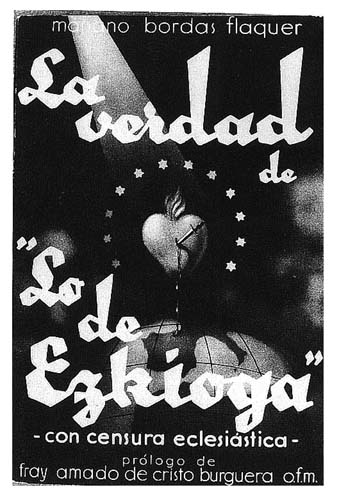
Cover of pamphlet by Mariano Bordas Flaquer
defending apparitions, published October 1932
Because Laburu was so effective, believers scrambled to find a priest to counter his arguments in public. Some asked a learned Carmelite, Rainaldo de San Justo, which worried the vicar general enough for him to contact the Carmelite provincial in Bilbao. The provincial reported that Padre Rainaldo said he would not speak unless his superiors in the order and the diocese asked him to. With the diocese thus on the alert, the rebuttal could come only in print. Mariano Bordas Flaquer was one of the leaders of the weekly Catalan trips. A lawyer, former member of parliament, and former assistant mayor of Barcelona, Bordas had led a pilgrimage to Limpias in 1920. In June 1932 he prepared a series of articles refuting Laburu. The diocese of Barcelona approved the series for El Correo Catalán, but for some reason the newspaper did not publish the articles. Burguera added a preface that gave Bordas some theological legitimacy, but The Truth about Ezkioga did not come out as a pamphlet until October 1932.[21]
For P. Rainaldo see B 137, 288; and the Carmelite provincial Ecequiel del S. C. de Jesús to Echeguren, Bilbao, 20 June 1932; and see chap. 8 below, "Religious Professionals." For Limpias see Diario Montañés, 6 November 1920, p. 2.
Bordas distinguished seers who were true, naming ten Basques and the Catalan seers in the weekly groups, and others who, he admitted, were not. But he denied that the great majority of seers asked childish questions or had visions at any set time. He explained the vision messages containing errors in dogma as misunderstandings on the part of seers or mistakes in copying. He accused Laburu of slandering the seers but said that in any case their behavior before and after the visions was irrelevant to the truth of the visions themselves. He argued that even if there were seers who said someone alive was in purgatory this would not disqualify the others.
As proofs for the visions he gave the seers' clairvoyance, their knowledge of unconfessed sins, and their conversions of sinners. He adduced three instances of the seers' preternatural knowledge: a seer's answer of a Catalan youth's unspoken question about the fate of his mother; Benita Aguirre's and María Recalde's knowledge of the pious death in Extremadura of a Catalan's relative; and María Recalde's reply in vision to an unread, carefully folded, query.
As their popularity and even their respectability melted away, the seers reacted in their own way against the lectures. Already before the first lecture, Garmendia had worried about its effect. According to a visitor, in the week after the Laburu talk the only people around Ezkioga who believed in the visions were Joaquín Sicart the photographer, the Zumarraga hotel owners, the taxi drivers, and some of the inhabitants of the Santa Lucía hamlet. Benita Aguirre wrote plaintively that in her town of Legazpi "no one believes; almost all have grown cold."[22]
For Garmendia, SC E 421, 17 April 1932; for effect of Laburu lecture: Joan Colomer i Carreras to Cardús, Barcelona (Sant Andreu), 10 May 1932, and Benita to García Cascón, Legazpi, 22 May 1932, in SC D 111.
María Recalde told her Catalan friends that two weeks after his lecture in Vitoria Laburu called her to a convent in Durango and reproved her for sending him a disrespectful letter. Feeling divinely inspired, she allegedly rebuked him for making Christ suffer on the cross during his talk, and what she said led Laburu to renounce the lectures planned for San Sebastián. Since he subsequently gave them, the account is of dubious accuracy. But it captures the depth of the seers' distress.[23]
The meeting, described in a letter from Cardús to Pare Rimblas, 17 June 1932, and ARB 73-74, allegedly took place May 5 with Franciscan nuns as witnesses.
After Laburu spoke in San Sebastián, the Virgin supposedly told one seer that he was a sinner and another that in the end he would change his mind. Subsequent rumor among seers and believers had it that Laburu had a cancer of the tongue as punishment, that he wanted to retract what he had said and to study Ezkioga seriously. In visions in 1933 Benita Aguirre and Pilar Ciordia said the Virgin gave messages for Laburu to mend his ways and help Padre Burguera with the book. But this was all wishful thinking.[24]
For Laburu as sinner, Juana Aguirre vision, 28 June 1932, in Boué, 78; for change of mind, Evarista vision, 29 June 1932, in B 334 and 721; on cancer, Boué, 97, and EE; dismissed by Múgica in BOOV, 15 March 1934, p. 245; Benita Aguirre, n.d, B 592, and 5 June 1933, B 494-495; Pilar Ciordia, 14 July 1933, B 691.