
Data-Processor (DP) Module
The DP module provides the means for on-site and remote monitoring of system performance, communications with remote users, digital and analog recording of data, maintenance of data buffers, display of data for a selected time window on a graphic terminal, and many other functions. Its principal role is the enhancement of the functions of the DA unit, on-site quality control, and providing station personnel and remote users with information on seismic events.
The station DP consists of commercially available hardware modules and is based on a standard VME bus. Figure 7 gives some details of the DP configuration. The computing power of the 68020 chip is such that only a small fraction of its capacity will be used for the planned tasks, which leaves much room for expansion. Even now it is a fairly complex, sophisticated system.
Figure 8 is a block diagram of the DP unit's data-manipulation functions. The VBB data are decompressed so that they can be processed through a series of digital filters that produce short-period (SP), long-period (LP; 1 sps), and very-long-period (VLP; 0.1 sps) data. The LP and VLP data
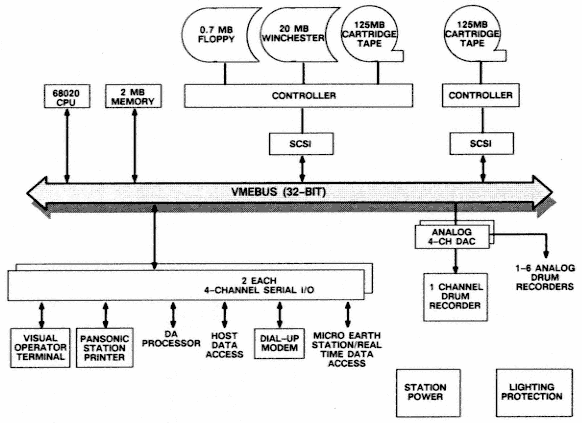
Figure 7
Configuration of the GSN station data processor (DP). From report U87-260 by Gould Inc.
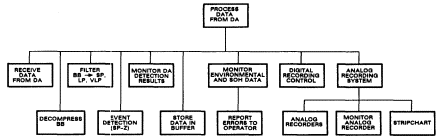
Figure 8
Data processing functions carried out by the DP unit. U87-260 by Gould Inc.
streams are obtained using finite-impulse-response (FIR) filters with a very sharp corner near the edge of the passband. This assures retention of the maximum information in the passband and may modify the way in which seismologists evaluate the usefulness of various data streams.
Figure 9 is taken from Steim (1986). It shows the original VBB channel and five channels derived from it. There is a twenty-second delay caused by a FIR filter. The trace labeled LP is obtained from the VBB stream using a 201–points FIR filter. It is clear that is contains most of the information present in the VBB stream, but with twenty times fewer samples. It very well may be that this will be the most frequently used data stream, particularly because of its relatively light archival burden. The other data streams shown contain less high-frequency energy, with the simulated SRO-LP channel representing an extreme. The VBB response is particularly convenient for a stable recovery of the ground displacement function (bottom trace).
The command, control, and algorithmic functions executed by DP are shown in figure 10. Rather than discuss them in detail, let us list functions that the operator can execute from the system console without interrupting acquisition of data:
1. Adjust the scale and select active analog monitor channels, including the selection of simulated WWSSN and Seismic Research Observatory (SRO) response functions.
2. View a continuously updated full-screen status display that shows a snapshot of all data channels, the internal and received UTC time, and several other system parameters.
3. View the system event log.
4. Change the tape cartridge without loss of data.
5. Examine the status of active processes.
6. View selected data waveforms from buffers or in real time.
7. Set, change, or display event-detection parameters.
8. Exchange message text over the real-time and dial-up ports.
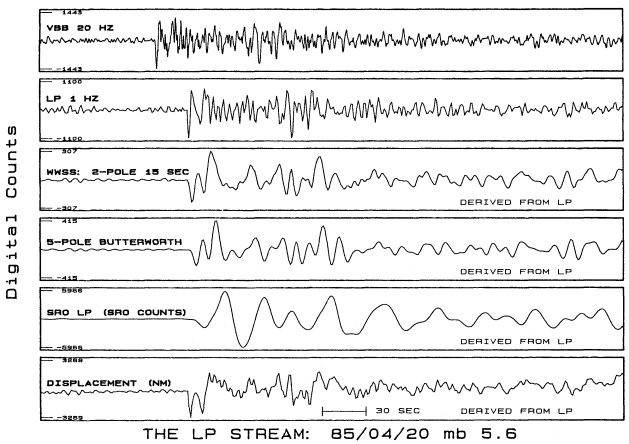
Figure 9
The information content of the "broadband" 1-Hz LP data stream, obtained by processing VBB data
with a FIR filter with a very sharp roll-off near the edge of the passband. The four lower traces,
showing alternative responses, are derived from the LP data stream. The 20-s delay is due to the
finite length of the FIR filter. From Steim (1986).
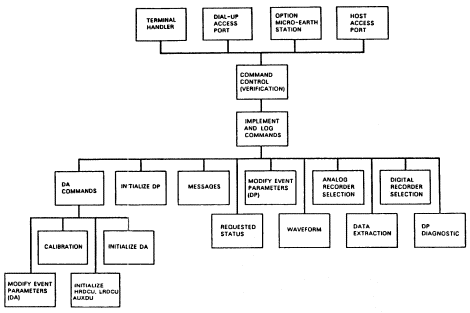
Figure 10
Command, control, and diagnostic function structure within the
data-processor (DP) unit. From Gould Inc. report U87-260.
9. Control and set up a calibration cycle or program the onset time of a calibration sequence to be recorded with the station data.
10. Run a calibration analysis as a low-priority background job.
11. Log messages and the results of calibration to the system's mass-storage device.
Many of the functions described above can be performed through a dial-up port, which allows for frequent checks of station performance from the network maintenance center.
It is expected that a prototype of the GSN system will be delivered in the fall of 1988 and, following tests, production units will be ordered. The first ten, budget permitting, will be deployed in 1989.