
Comparison of Style
Animal impersonations show also a development from the primitive forms to the more highly symbolic and artistic ones—from the realistic to the stylized.
Taos.
—The Animal Dance as given at Taos (pl. 25) represents one of man's earliest efforts at mimetic magic. Here the impersonator of the Deer wears the head and entire skin of the carefully cured and preserved animal. "The head of the animal is over the dancer's head, the pelt hanging down his back."[23] The spectator is hardly conscious of the men's faces as they bend over two sticks which represent the animal's forelegs. A dark kilt and low moccasins complete the costume. There is little color; the sandy gray-brown hair on the back blends into the white of the bellies. Above the head rise the colorless, sharply pointed horns, and from the mouths of the animals sticks jauntily the deer's favorite food, the tender tips of the dark green spruce.[24]
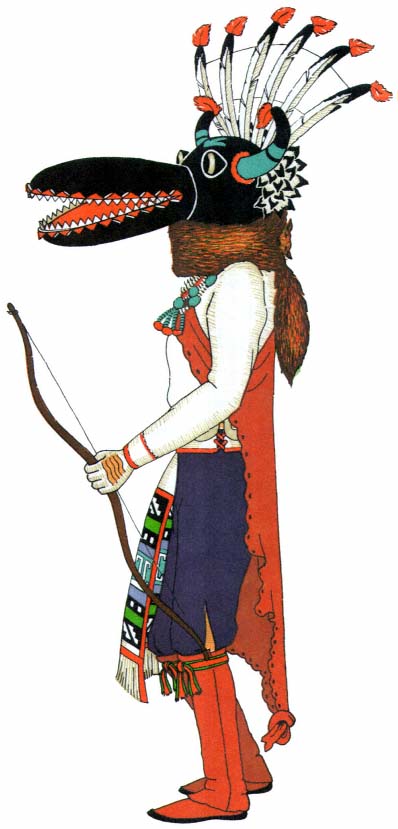
Plate 33.
Natacka Man, Hopi. This is the bogeyman of all Hopi
children. A deerskin mantle is worn over the right shoulder.
The great snout is made of gourd halves hinged together.
San Ildefonso.
—San Ildefonso (pl. 26) offers the next attempt at stylization.[25] Here the impersonator has emerged from the hide and retains only the antlers supported on a tight-fitting cap, from which hangs a sheaf of feathers. The dancers of this pueblo have also retained the ears and two canes for the front feet. An irregular visor of thin sticks has developed in front, topped by eagle's down, and sprays of evergreen hang over each shoulder. The face is painted black with an edge of white; the hands are whitened. A white shirt covers the upper body, which was probably nude until a few years ago. The kilt may be of dark blue native cloth or white Hopi cotton, and the plaited sash hangs down the back. Crocheted leggings, held in place by strands of red yarn at the knee, end in white moccasins and skunk-fur heelpieces.
San Juan.
—The Deer of San Juan (pl. 27) suggests a further step in stylization and a tendency to vary the detail. The close gray cap, tied under the chin, is dotted with eagle's down, and the antlers rise high on either side. A wide, high visor of thin yucca strips fans out around the head and destroys much of the quiet, deerlike quality. The rear of the buckskin cap tapers low over the queued knot of shiny hair and supports a wide semicircle of long eagle feathers held in place by a cornhusk ring, like a half sun-disk hanging down over the shoulder. The body is covered with a white shirt and a white kilt. The embroidered panel of the kilt is worn at the back and is somewhat concealed by the long, loose fringe of the plaited white sash knotted above it. White crocheted leggings, with bells at the knees and fringes of white cord down the front, and white moccasins with skunk-fur heelpieces complete this dress of predominant black and white. A tall staff, with three eagle feathers and an evergreen bound to the top with cotton cord, is carried in one hand, and a gourd rattle in the other. The action of the dancers is much stiffer and more conventionalized, and the animallike movements are only suggested. The dance pattern is a mere formality, and the sticks become a decoration, losing entirely their significance as the forelegs of an animal.
Hopi.
—Further degrees of stylization are seen in the Deer impersonations of Jemez,[26] Zuñi,[27] and Hopi,[28] among those masked figures which appear with all the animals in the mixed dances.[29] The simplest mask is seen at Jemez: a round green helmet of deerskin, with a flat top, from which deer horns are projected, as well as two pointed ears fashioned from leather. An evergreen collar is around the neck.[30]
At Hopi the Deer dancer (pl. 28), like the Eagle dancer, has the usual brilliant body paint, the white embroidered ceremonial kilt, white sash with brocaded ends, red woven belt, and pendent foxskin. His moccasins are of red-brown deerskin, with ankle fringes of the same material. The mask is a turquoise blue helmet with a black center and rectangular, wide, black eyes. Around the top is a low visor made from slit yucca leaves and painted yellow and red. A long, flat, black snout projects in front. On each side are squash-blossom ornaments, made of yarn wound over little sticks and forming wide, flat cones. At the back, standing upright from a bunch of owl's feathers, are two tall eagle feathers. They represent a prayer for rain. The only elements remotely related to the deer are the two horns fastened to the top of the mask. Everything else has been exaggerated or bears relationship only to the stipulated pattern of ceremonial dress. This, although aesthetically satisfactory, destroys all illusion of realism. The Indian desired this of his masked figures; since they are supernatural, they should not appear like human beings.
In many villages the characters of the ceremonial dramas surrounding these gods are often similar. However, each pueblo prescribes its own rules for costume and action, so that they do not appear alike even when borrowed. The masked figure symbolizes, to the Indian, a kind and gentle people who are fond of singing and dancing and whose greatest concern is the welfare of the human race. That is why there is no feeling of terror for them; the kachinas inspire only respect and honor.
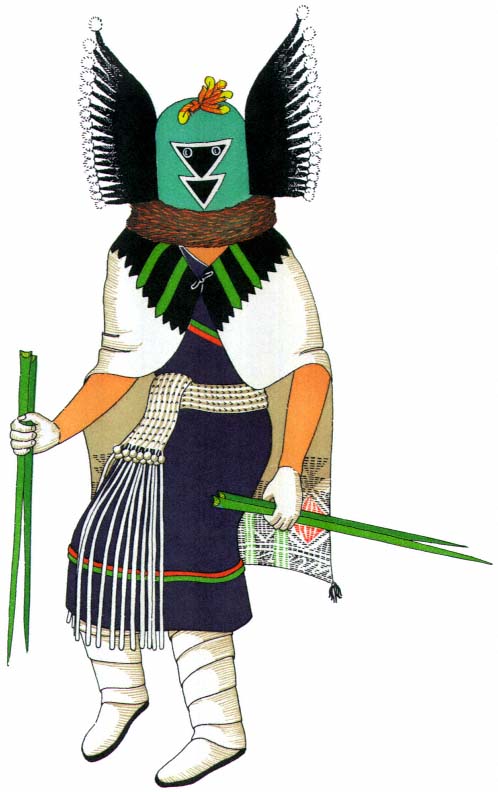
Plate 34.
Tümas, the Mother of the Floggers, Hopi.
The mask is trimmed with crow's wings.
The number of masked impersonators is almost unlimited. New characters are added from year to year and ancient ones are often revived. Many characters are presented by groups to whom they were eventually handed down by clans now extinct.[31] This assured to the favored pueblo, throughout many generations, the benefits of the power and goodness attributed to the kachinas thus bequeathed. Whenever the costume and distinctive traits of a character become defined, that character is handed down, together with whatever ritual and legend surround him. The knowledge of this mass of ritual and legend in all its complexity gave preëminence to the office of priest, for only through him could the information be perpetuated. There are both individual and group characterizations. The individual is the only one of his kind and he has a special part to play; the group consists of a large number, all alike and appearing together in dance and song. The size of the groups depends upon the number of men who are able to participate and who desire to do so.
A description of certain important and typical ceremonies may make clear the action as well as the appearance of some of the supernatural characters. They are representative of kachina types and illustrate the various methods by which characterization is obtained.