
C—
Alcimede's Pessimistic Speech (278–94)
In her plaintive address to her son, Alcimede says that she wants to die and identifies the two greatest fears she has for an old age without Jason: lack of burial by her own son and abandonment in an empty home like a slave because of the loss of the one who provided her with distinction in Iolcan society:
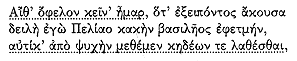
[14] Cf. Levin 42–43, Beye 32–33.
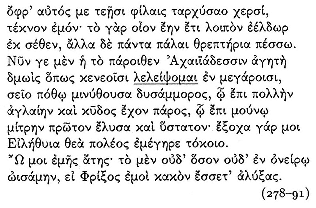

uttering the wicked command that would cause me such ruin,

so that you yourself would have buried me with your own hands,
my son. For this was the only desire I still had
of you; I have long ago received all the other rewards a child owes a
parent. As it is, I, who before was envied by the Achæan women,
will be abandoned like a slave in an empty palace,
wasting away with ill-starred longing for you, because of whom
I had honor and glory in the past, for whom alone
I, first and last, loosened the girdle of childbirth. For
the goddess Eileithyia adamantly forbade my having many chil-
dren.
O what misery is mine! I did not reckon even in my wildest dreams
that Phrixus's salvation would become my demise.
Commentators have duly observed and recorded the relevant verbal and conceptual echoes in Alcimede's speech (see below), but have not called attention to the fact that the most important of these recall from different angles the effect that the death of Hector had on his family, especially on Andromache.
First of all, Alcimede opens her speech with the wish that she had died when she first heard of the expedition, so that Jason would have been able to bury her; this scenario is all the more desirable since, as far as Alcimede is concerned, Jason has discharged all his other responsibilities (i.e., the







Apollonius evidently wants the audience to compare Alcimede's anxiety over the departure of Jason with Andromache's fears for herself and Astyanax in the aftermath of Hector's death. With this in mind the Homeric hapax legomenon

[15] Levin 41–42 and Vian 13 and 63 n. 2 both observed the resemblance of Alcimede to Andromache in this wish. M. Fantuzzi, "Varianti d'autore nelle Argonautiche d'Apollonio Rodio," A&A 29 (1983) 150–52, however, argues that whereas the version in the proecdosis (preserved by Sad 1.285–86a) recalls the Iliadic lament for Hector, the second version brings the fate of Electra in Sophocles' play of the same name into mind. Although no one will deny the influence of Attic tragedy on the Argonautica in general, the similarities between the orphan girl and Sophocles' Electra are only superficial; Electra's fate, as far as I can see, is not at all germane to that of Alcimede.
little girl's pathetic response to her want of a


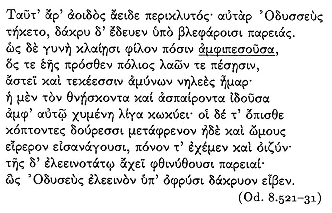
The celebrated poet [sc. Demodocus] sang this song. Odysseus
melted, and tears streamed from his eyes down his cheeks.
Just as a woman laments her dear husband, falling down
upon him ,
who fell before the eyes of his city and people
as he tried to protect his city and children from the piteous day.
Seeing him in the throes of death, she
holds him in her arms, shrieking loudly. Behind her, others
striking her back and shoulders with their spears
lead her into slavery, to a life of pain and lamentation;
her cheeks are sunken from pitiable grief.
Just like this Odysseus shed a pitiful tear from beneath his brows.
The picture of a woman grieving for her dying husband, whose duty it was to ward off the day of slavery from city and children, closely parallels Andromache's situation at the conclusion of the Iliad ; so much so that Apollonius well might have seen in the Odyssean text an allusion to the fates of Andromache and Hector. Be that as it may, both the specific references to Andromache's loss of Hector and this allusion to the unidentified woman in the Odyssey prompt the reader to associate Alcimede's response to Jason's departure with the grief of a wife for a dead husband, and in particular, of Andromache for Hector.