
The Funerary Mask
Metaphor of Transformation
Just as life for the pre-Columbian inhabitants of Mesoamerica culminated in the funerary ritual that marked the beginning of the passage back to the realm of the spirit from whence the individual's life came—often a difficult passage, according to Mesoamerican mythology—so our study of the masks of pre-Columbian Mesoamerica comes to its conclusion with a consideration of the funerary mask that brings together in its final image all of the cosmological conceptions for which the mask stood as the metaphor throughout the long development of Mesoamerican spiritual thought and art. Death, for the peoples of Mesoamerica as for all peoples, was the great mystery. The Aztec account of the metaphoric journey to Mictlan after the body's physical death suggests that except in the case of divine rulers, death was seen as a gradual fading of the individual identity of the person into the anonymity of the life-force.[99] Like the monumental Aztec image of Coatlicue (pl. 9), it was both the womb and the tomb, generating and receiving back all the individual lives in the natural world.
Meditate upon it, O princes of Huexotzinco;
although it be jade, although it be gold,
it too must go to the place of the fleshless.
It too must go to the region of mystery;
we all perish, no one will remain![100]
The gradual movement from individual life to dissolution in the life-force, metaphorically a journey fraught with danger and difficulty in all Mesoamerican myths, begins with separation and detachment from human society, continues through the intervening liminal state, and ends in the mysterious and hitherto inaccessible world of the spirit. Through that metaphor of the journey, as well as the metaphorical funerary mask, the cultures of Mesoamerica attempted to comprehend the mystery of death, to convert what would seem the finality of the end of life into a passage to the essence of life. In this sense, the imagery associated with death in both Mesoamerican myth and art—all the skulls, bones, and skeletal figures—are not emblematic so much of death as of the essence and regeneration of life.[101] "The place of the fleshless, the region of mystery" is, after all, the home of the eternal life-force. And in that realm, "in one way or another" according to the poet, life mysteriously continues. [102]
Life's continuation was the message conveyed by all of the cycles of death and regeneration making up the natural world in which man existed. These cycles found their clearest example in the daily and yearly movement of the sun which provided the basic framework for much of Mesoamerican cosmology and served as the ideal metaphor for the dualistic, cyclical order of the cosmos, particularly for the complementary opposites of matter and spirit, life and death. Just as the sun made the inevitable passage from the life of day to the underworld, followed by a return to life, so man's spirit would repeat the endless pattern and return to life again. Symbolically, then, life existed within death and death within life. The funerary mask symbolized that unity.
Just as the ritual mask allows the wearers' identity to merge with that of the being the mask represents, the funerary mask, as C. Kerényi indicates, allows a fusion of life and death.
The mask . . . is an instrument of unifying transformation: negatively, in that it annuls the dividing lines, e.g., between the dead and the living, causing something to be manifested; positively in that through this liberation of the hidden, forgotten or disregarded, the wearer of the mask becomes identified with it.[103]
Kerényi's observation is consistent with the fundamental Mesoamerican cosmological principle that there is no death in the world, only transformation; there is no end to life, only changing forms, changing masks placed on the eternal and unchanging essence of life.
But unlike man's first, biological birth, "the beginning of a new spiritual existence," as Eliade reminds us, does not happen naturally; "it is not 'given' but must be ritually created,"[104] and this, in Mesoamerica, was the task of funerary ritual and particularly of the funerary mask. Since death was seen as transformation rather than an end, it seems natural that cremation was widely practiced in Mesoamerica. Fire, the great transformational agent, could transform the material into the spiritual and thus free the spirit from the body. The Aztec funerary ritual associated with the cremation of rulers suggests precisely this view: before cremation, the ruler's body was elaborately arrayed, and masked, in the costume of a god,[105] and as the fire consumed his body, his spirit started on the journey that would end in his becoming the god in whose attire he had been arrayed. When the body was not cremated, the funerary mask—whether placed over the face of the deceased, buried in the tomb, or placed on the funerary bundle—served exactly the same symbolic purpose as the crematory fire; it was both catalyst and metaphor for the transformation of the material reality into the spiritual essence.
Thus, funerary masks functioned like other ritual masks to express visually the inner, spiritual identity of the wearer which survives the death of the body. Portrait masks recreating the physical face of the deceased, common among the Maya, reflected the belief that through the course of his life, the person had "created" a face that expressed his deified heart, while masks like those of Teo-
tihuacán, which created an abstract and impersonal "ideal" face, suggested the essential unity of the spirit animating all of humanity. Painting the face of the deceased in the symbolic pattern of a god, or the common practice of representing that face painting on a mosaic mask, combined the attributes of the portrait and idealized funerary masks since it allowed the death mask of the man, his actual face or an idealized mask, to be fully visible under the symbolic mask of the god. The important person, often a ruler, wearing such a mask remained himself—the human ancestor who could be contacted through ritual—while becoming a god. Thus, the funerary mask moves a symbolic step beyond the ritual mask worn by the god impersonator in recording the final and complete transformation: the man has become a god. Seen in this way, the funerary mask serves to create another being different from the person who was alive and is now dead. This is "a recreation close to procreation when, in the Mask, two images are combined to make a new single being. . . . [Thus] the Mask often claims a triumph of life over death,"[106] exactly the "fusion" noted by Kerényi.
Of whatever type, the funerary mask is the metaphor par excellence of liminality as it bears witness to man's ultimate movement between the worlds of spirit and matter. And from the earliest times, those masks and their accompanying ritual were a part of Mesoamerican life and death. Burials as early as the El Riego phase in the Tehuacán valley (ca. 6000 B.C.) "not only have abundant burial goods but suggest elaborate burial rites," which led MacNeish to speculate that "the rich ceremonialism of later Mesoamerican culture is only the culmination of a long tradition."[107] While these burials do not indicate funerary mask use, another early burial does. At about 2000 B.C., a woman was buried in a shallow grave at Cuello wearing a necklace of roughly chipped shell beads with a pottery bowl over her face and another at her feet.[108] This was clearly a ritual burial, and just as clearly there was a concern to protect and preserve the face of the dead woman, precisely the impetus behind the funerary mask. Interestingly, that pot placed over the dead woman's head recalls a much earlier burial. Speaking of a skeleton he considers post-Pleistocene but Preceramic, Aveleyra Arroyo de Anda says, "the human skeleton was found, according to the farmers who uncovered it, . . . with one of the large flat stones over the skull, a situation which suggests a ritual interment"[109] and which, we contend, places the impetus for the development of the funerary mask with the earliest evidence of ritual activity. It is interesting that in most late Classic period burials at Jaina, the head of the deceased was protected by a pottery bowl.[110] This demonstration of concern for the preservation of the face has a long history in Mesoamerica.
Actual funerary masks begin to appear in the Preclassic, and as with the other types of masks we have discussed, they appear first, and in a very sophisticated form, among the Olmecs. Perhaps the most sophisticated are the group of about thirty-five jade and jadeite masks found at Arroyo Pesquero, Veracruz. Strikingly realistic, they were obviously designed to capture the identities of the dead nobles and rulers with whom they were buried.[111] Probably of La Venta origin (ca. 900-800 B.C.), the masks were presumably solely funerary in function as they seem too heavy to have been worn, although a few do have eye and nose holes as well as perforations that could have been used to tie them to the faces of their wearers. According to Alfonso Medellin Zenil, "the hollowed interior" of one of the masks "fits the face of a normal person, indicating the functional purpose of the mask.[112] Most, however, lack the characteristics of the ritual mask.
The eyes were probably inlaid with shell and obsidian or a black metallic stone to simulate the living organs. . . . Hourglass-shaped perforations along the edge of the Arroyo Pesquero masks indicate former attachment to funerary bundles that were probably cremated. Indeed, some of the masks have fracture lines caused by extreme heat, while fire changed the original color, and occasionally transmuted even the stone itself, of others.[113]
These masks, and others like them, thus suggest that the ritual use of the funerary mask began early in Mesoamerican history, as the characteristics of these masks accord perfectly with the practices of later times. They also indicate the conceptual relationship between ritual and funerary masks which clearly derived from the idea that the deceased was involved in the ritual movement from one state to another in a way comparable to the movement of the shamanistic ritual performer.
This conflation of the funerary and ritual mask is seen even more clearly in the burial practices of the village cultures in the Valleys of Oaxaca and Mexico contemporary with the Olmecs. The small pottery masks of these cultures (pls. 44, 52), exemplified by those found at Tlatilco, Las Bocas, and Tlapacoya in the Valley of Mexico, were found in burials, though not over the faces of the dead. As we have seen, these were "pierced for suspension" and actually used in ritual, being worn in the manner shown on the pottery figurines accompanying them in these burials.[114] That they also have a particularly funerary purpose, however, is indicated by one type of mask, the characteristics of which can be seen in an example from Tlatilco depicting a face half-skeletal and half-living (pl. 52), a conception that can only represent the liminal state of the deceased in his movement from life to absorption in the spirit, "the land of the fleshless" as the Aztec poet calls it. This striking
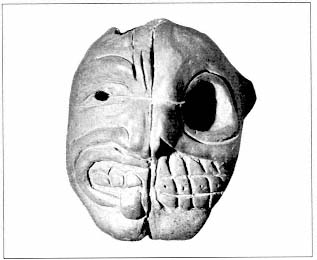
Pl. 52.
Ceramic mask, half-fleshed, half-skeletal, Tlatilco
(Museo Nacional de Antropologia, México).
manifestation of the dualism at the heart of Mesoamerican thought can also be seen in a Classic period Mixtec funerary figure from Soyaltepec, Oaxaca (pl. 53) exhibiting the identical motif centuries later.
As we have seen, the village cultures demonstrating this funerary mask use were those that transmitted Olmec religious concepts, ritual, and artistic forms to the Classic period cultures of Monte Albán and Teotihuacán. For the Maya, the Izapan culture performed the same function. It is significant, therefore, that we see at Kaminaljuyú the same funerary mask use—although the masks are quite different—as in the Valley of Mexico. The richly furnished Preclassic burials at that site, which we discussed in our consideration of the development of the mask of Chac, are typified by Tomb II in Mound E-III-3, the tomb of a ruler whose body had been placed on a litter, covered with red cinnabar, and wrapped in a burial cloth. A mosaic mask of greenstone placed over his face completed his preparation for the journey to the world of the spirit, a journey on which he was believed to be accompanied by the sacrificial victims whose bodies were interred with him.[115] In Tomb B-II nearby, what appear to be the remains of an actual ritual mask were found,[116] suggesting a conceptual identification of ritual and funerary masks similar to that of the Valley of Mexico. That these tombs were within pyramidal platforms and had been covered by floors that were used for ceremonial activities suggests the belief manifested by later cultures, especially the Maya, that the ancestral dead existed as gods and could be called on, through ritual, by the divinely ordained current ruler. A different kind of ritual interment was found in another pre-Maya burial, this one not Izapan. In the Preclassic Burial 10 at San Isidro, Chiapas, the deceased, an adult, was positioned facing east, sitting with his right leg inside of the left and his arms crossed over his chest. His face was masked by a large, flat, pink-hued seashell perforated for attachment.[117] The careful masking, with the mask tied to the face as in ritual, and the symbolic implications of the seashell relate this funerary mask to ritual as well.
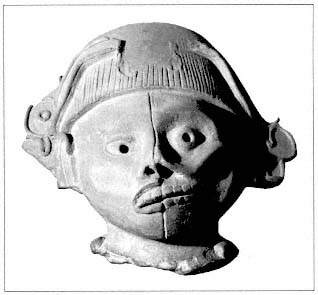
Pl. 53.
Mixtec ceramic figure, half-fleshed, half-skeletal, Soyaltepec, Oaxaca
(Museo Nacional de Antropologia, México).
These early examples of the funerary mask led to its widespread and sophisticated use among the Classic period Maya, a practice with clear ties to the Maya view of death expressed in the mythic narrative of the Popol Vuh. In the account of the adventures of the Hero Twins in the underworld, Xibalbá or "the place of fright," we have what Coe calls "the most complete description and explanation of the ideology behind the funerary cult that we have or ever will have from anywhere in the world." Fittingly, as he has shown, this narrative account of the defeat of the Lords of Death and the attainment of rebirth is also depicted on the painted ceramic vessels created solely to be buried with "the honored dead." Symbolically, these vessels "comprise one great mythic cycle, along with explanatory chant, to prepare the defunct for the dread journey into the Underworld, much as the Egyptian Book of the Dead or its Tibetan counterpart do."[118]
And that function of those beautiful and profound works of art was also served by the striking jade mosaic masks created by the Maya to cover the faces of the honored dead. Found in tombs at Palenque and Tikal, these masks, unlike the composite masks of Maya ritual, recreated the face of the deceased in order, no doubt, to preserve his identity by preserving his face. [119] This, of course, is one of the primary symbolic purposes of the funerary mask, one clearly related to the belief that the
dead ancestor somehow retains his identity while "becoming a god" who can be called on by his successors. The most famous of these masks, the death mask of Pacal, ruler of Palenque (colorplate 9), illustrates the connection between the mask and that particular set of beliefs. Pacal's tomb, in its shape, in the reliefs decorating it, in its color, and in its placement, is one vast metaphor of regeneration, and the serpentine "psychoduct" connecting that tomb to the temple above indicates the precise nature of the resurrection it symbolizes. Pacal became a god, yet retained his earthly identity; he died, yet lives.
Pacal's mask is one of the most expressive and beautiful works of Mesoamerican art of any period, perhaps because it reflects this fundamental belief. It represents handsomely the powerful face of the ruler over which it was placed and in so doing, compels even our belief that his face reflected his inner strength and beauty. Ruz describes the mask as he found it during the excavation of the Temple of Inscriptions tomb in 1952:
It is composed of some 200 jade fragments of different shades but principally an intense green, at times very dark and shiny, with the eyeball made of conch shell and the iris of obsidian. In the center of the iris a point on the reverse side of the obsidian is painted black to represent the pupil. The personage must have been interred with the mask in place, but during the interment it slipped to the left side of the face where the majority of the fragments were found, a number of them in a position which permitted us to deduce their original location. Under the fragments of jade we discovered, partially conserved, a layer of fine stucco that had been applied directly over the face of the dead man and that served to attach the mosaic fragments of the mask. The nose was sufficiently complete to allow us to see the anatomical form, but the fragments which had composed the right ear and the right side of the mask were found displaced among the bones of the face, over the nose and the upper teeth. It is likely that the mask was originally composed on a model of the head, perhaps on one of the stucco heads left as offerings under the sepulcher. At the moment of preparing the corpse for interment, a thin coat of stucco was applied over the face and the fragments of the mask were immediately moved from the model to the corresponding place in the stucco.[120]
Because it has been very difficult to ascertain whether masks found in and around tombs were actually funerary, Ruz realized that his discovery was a crucial one: "The discovery of the crypt at Palenque confirmed our supposition about the funerary use of masks and to date is the only known case of a jade mosaic mask discovered . . . still in place . . . over the face of the corpse."[121] The reconstruction of the mask indicated to Ruz that it "must have reproduced the features of the personage more or less faithfully."[122] The obvious care with which the mosaic mask was transferred from the model to the just-dead face of the ruler surely indicates the concern to preserve that royal identity. If a memorial had been all that were intended, the stucco head that served as a model for the mask would surely have been sufficient, but more was needed. His actual face—with all that the face symbolized in Mesoamerican thought—had to be preserved for all time.
That face still conveys to us the strength and wisdom of its "wearer" and the fundamental spiritual belief that prompted its construction, but alone it cannot convey the intricate structure of belief carved metaphorically into the lid of the sarcophagus containing Pacal's body and his death mask. The lid's image
depicts the instant of Pacal's death and his fall into the Underworld. . . . The cosmic event that forms the context for Pacal's passage into death is the movement of the sun from east to west. . . . The sun, poised at the horizon, is ready for its plunge into the Underworld. It will carry the dead king with it [and] . . . he anticipates the defeat of death. [But] a bone attached to his nose signifies that even in death he carries the seed of rebirth. . . . [That bone] is the seed of Pacal's resurrection.[123]
The image thus reflects the Maya belief that "a king dies, but a god is born. . . . Here a ruler is shown suspended in time, about to enter the Underworld from which he will be reborn a god."[124] The mask was placed over the face of Pacal to assist in that process. Thus, all the complex symbolism of the image on the sarcophagus lid is contained within the simple features of that jade mask.
This profound use of the funerary mask was not limited to Palenque; at Tikal, important figures were also buried with jade or greenstone masks or cremated in bundles to which masks were tied.[125] In the late Preclassic Burial 85 located on the axis of the North Acropolis,[126] a ruler's "jade mask, with eyes and teeth of inlaid mother-of-pearl, had originally been attached to a mortuary bust, the individual having been interred, after decapitation and mutilation of the legs, seated and wrapped in a shroud. In this case the mask had been substituted for the head."[127] Thus, both at Palenque and at Tikal the funerary mask served the same purpose in slightly different ways, and were our information more complete, it is certain that we would find similar evidence at other major Classic period sites.
That these Classic period burial practices continued in the later stages of the development of Maya civilization is confirmed by Diego de Landa's account of burial practices in the Yucatán at the
time of the Conquest, an account that incidentally suggests what may have happened to the missing head of the ruler interred in Tikal's Burial 85.
Among the ancient lords of the house of the Cocoms [the ruling house of Mayapán] they cut off the heads after death, boiled them so as to remove the flesh; then they sawed away the back part of the skull, leaving the front with the cheeks and teeth, supplying in these half sections of the head the removed flesh by a sort of bitumen, and gave them almost the perfection of what they had been in life. . . . These people have always believed in the immortality of the soul, in greater degree than many other nations.[128]
At Palenque, the deceased ruler's head was covered with a realistic mask that preserved his features; at Tikal, the head was replaced with a similarly realistic mask; and, later, in the Yucatán, the head became the mask. Step by step the face became the mask; by the time of the Conquest, the artfully reconstructed living face had become a mask covering the ruler's lifeless skull. The viewers of that mask, aware as they must have been of the ruler's past and present states, would have "seen" the living mask and the dead skull simultaneously and thus would have had the same sensation as the viewer of the half-fleshed, half-fleshless masks and heads from Tlatilco and Monte Albán which we discussed earlier. With the Maya we have come one step closer to the gods; the mask is no longer a separate entity in a sacred-human relationship as it was in the case of the ritual masks with the X-ray view; it is the sacred being man has become. The Maya tradition had its counterpart in central Mexico. The pottery masks found in Tlatilco burials (pls. 44, 52) were the precursors of funerary masks used throughout the Classic and Postclassic periods up to the time of the Conquest. Perhaps the best known are the ceramic and stone masks of Classic Teotihuacán. Although none have been found in situ, in part because no tombs of any importance have yet been discovered at Teotihuacán, it is clear that their use was funerary. Séjourné believes that ceramic masks found at the apartment compounds of Tetitla and Yayahuala were affixed to the funerary bundles of the deceased before cremation,[129] a practice illustrated on a number of ceramic incense burners that display funerary bundles carrying such masks.[130] As Covarrubias points out, such a use would account for a number of the physical features of the masks, especially those of stone. The bundles, in addition to bearing masks, are
provided with a great feather headdress and massive earplug flares and beads of jade. Possibly the life-size stone masks were attached to such dead bundles, which would explain why the masks are cut off horizontally across the forehead for the headdress to rest on, and would justify the many perforations: on the ears to attach the earplug flares, under the lower jaw to hang the necklaces, and on the temples and forehead to secure the headdresses.[131]
Moreover, both the ceramic and stone masks often have marginal perforations that might well have been used to attach them to such funerary bundles.
The stone masks (colorplate 8)—often of greenstone, serpentine, onyx, or obsidian and meant to be covered with mosaic designs—are particularly reminiscent of Olmec stone masks, also presumably funerary, in the way they are carved and the manner in which their backs are finished,[132] and both manifest a similar "predilection for hard, lovingly polished stone, the same concise vocabulary, the same consummate craftsmanship." [133] But there are differences. While the Olmec stone masks are strikingly realistic, the masks of Teotihuacán present idealized, expressionless faces. Westheim suggests that this idealization can be seen in two tendencies: first, the widening of the head so that the height and width are approximately equal, thus eliminating the natural verticality of the face, and second, the flattening of the naturally rounded mass of the head, "giving it an almost bidimensional effect."[134] The relatively flat, horizontal shape that results is emphasized by the projecting flanges of the ears and the unbroken ridge of the eyebrows sweeping across the mask above the horizontal slits of the eyes and, as Kubler points out, by the "chin and forehead boundaries [being] treated as flat, parallel planes." Kubler goes on to suggest that "this geometric conception of the human face is dictated by the technique of working the stone. The eyes, the nose, and the mouth are defined by six fundamental saw-cuts. One horizontal cut marks the parted lips. Two more horizontal cuts mark out each of the eyes."[135]
But Westheim sees something more profound than the dictates of technique at work in the stylization of those masks. For him, they are conceptualizations of the essential spirituality of humanity, consciously designed to avoid realistic portraiture. By reducing the face to the essentialperhaps even the symbolic—the artist "spiritualizes" the natural form. Thus, for Westheim, it is not a matter of "stylization." Instead, the masks are "the plastic expression of a conception of the world governed by dualism," and they capture the basic concept underlying all Mesoamerican art in their combining of reality and irreality so as to reflect "the cosmic," "the meaning of things."[136] These symbolic qualities can also be seen in the designs painted on the ceramic masks and worked in mosaic and inlay on the stone masks, designs seen elsewhere in the art of Teotihuacán which no doubt designated the status of the deceased in life and the particular aspect of the realm of the spirit to which his spiritual essence became assimilated
after his death. It is that spiritual essence, rather than the physical face as with the Maya, that these masks depict and perpetuate, and it is that which is captured in the idealized features of these masks, in their "nobility, serenity, timelessness, and impassivity."[137]
The funerary mask was similarly important in Oaxaca, both among the Classic period Zapotecs and in the Postclassic among the Mixtecs. In our discussions of the metaphoric mask of the rain god and of the use of the mask in ritual, we considered at some length the Zapotec funerary urns of Monte Albán and suggested that their frequent combination of a relatively realistic human face wearing or emerging from a composite mask brought together the death mask of an important person with the mask of the god symbolic of his spiritual essence (pl. 39). In addition to these urns, actual masks have also been found in the tombs of Monte Albán. One of the most striking of all Mesoamerican masks, in fact, comes from Burial XIV-10 (pl. 54). Probably representing the features of a bat, the mask is composed of twenty-five carved and polished pieces of dark green jade with eyes made of shell. Caso calls it "one of the most beautiful jades discovered in Mesoamerica,"[138] and Covarrubias says, "this extraordinary mask is a masterpiece of the lapidary art and shows an uncommon sophistication in concept and design."[139] Whether designed for the buried personage with whom it was found or, as Covarrubias believes, imported from the "'Olmec' zone,"[140] those who placed it with the remains of the deceased surely saw in it a metaphor for the spirit of that dead leader. And if it did represent a bat, the metaphor would be clear. The bat flies, that is, "lives," at night and returns at daybreak to the cave where it rests. As we have seen, the cave was always viewed in Mesoamerica as the entrance to the world of the spirit, so the bat symbolically reversed man's life. The bat's "day" was man's night, and its "night," man's day. Metaphorically, this reversal could thus be used to suggest the continuation of life after death and to indicate that the man interred with the mask had not died but had "flown" to the life of the spirit. In that sense, the bat mask can be seen to illustrate in a particular way the general conception underlying all funerary mask usage.
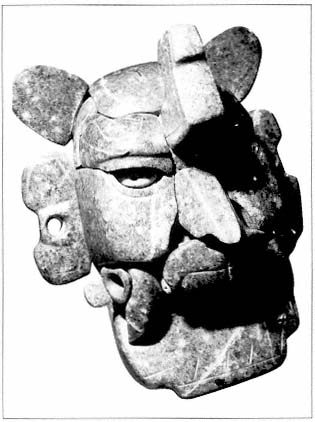
Pl. 54.
Jade mosaic mask, probably funerary, Adoratorio
near Mound H, Monte Albán II
(Museo Nacional de Antropologia, México).
The existence of that and other funerary masks at Monte Albán is complemented by another indication of the importance of the funerary mask there. An offering made up of ceramic figures discovered in the patio of the house built over Tomb 103 (pl. 55) appears to depict a funeral and strongly suggests both the importance of funerary ritual and the central role the mask played in it. The deceased is represented by a mask set atop a step-shaped funerary bundle behind which five priests wearing masks and headdresses form a semicircle. Off to the side of the scene is a seated figure quite similar to representations of the old god of fire found at Teotihuacán, and in front of this assemblage of figures is a small (both in size and numbers) band of musicians, there, no doubt, to provide music to accompany the ritual.[141] The funerary ritual depicted is complex: as the headdresses and masks of the priests indicate, they are of two related varieties and probably served two different symbolic functions. The hook-billed bird in the headdresses of the two priests holding large circular plates or mirrors is worn as a mask by the other three priests, who wear different headdresses. The representation of the old god of fire adds yet another symbolic dimension to the ritual.
In addition to this level of complexity, the scene also suggests a complex series of interactions with other areas of Mesoamerica. The hook-billed bird mask and the old god of fire are reminiscent of Teotihuacán and, in fact, are united in the Tepantitla mural (colorplate 3). That mural symbolizes the union of spirit and matter in the context of fertility, while this scene may well symbolize that same union at the moment at which one might think spirit and matter had reached the point of separation. The purpose of the ritual, however, is to indicate the continued union of the two, a continuity most economically symbolized by the large, centrally placed mask, also visually related to those of Teotihuacán. The mask stands as a meta-
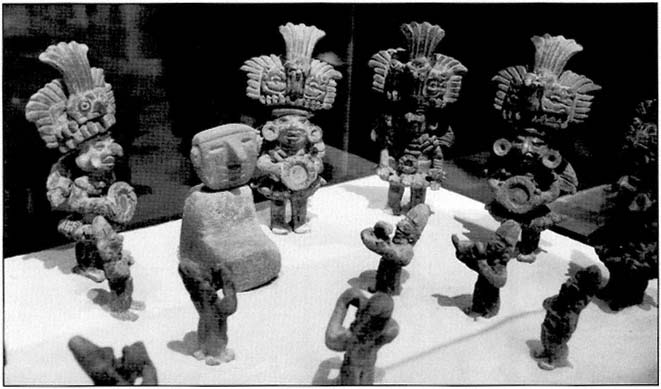
Pl. 55.
Funerary offering composed of ceramic figures arranged to form a ritual scene, Tomb 103, Monte Albán III
(Museo Nacional de Antropologia, México).
phor for the continued existence of the man, probably a ruler, who had just become a venerated intermediary between the human community and the great supernatural forces on which their individual and communal lives depended.[142] That this recreation of the funerary ritual of the dead ruler was found buried in the patio of the house constructed above his tomb suggests exactly the same relationship between living and dead rulers we have seen among the Maya—most clearly, at Palenque. But the symbolic figures that make up the scene are related to Teotihuacán, not to the Maya. Thus, this scene reflects both the complexity of the interaction of influences within Classic period Mesoamerica and the fundamental similarities of all of those traditions, similarities that permit the assimilation of influences in symbolic scenes such as this.
The later Mixtec burials in Oaxaca yield additional, though somewhat different, evidence of the importance of the funerary mask and are themselves related to funerary practices among the Maya and in the Valley of Mexico. A common feature in the elaborate tombs and burials of Mixtec rulers and important citizens is turquoise mosaic masks such as those associated with the two principal burials in Tomb 1 at Zaachila which Caso has identified, on the basis of the Mixtec Codex Nuttall, as the final resting place of one of the lords of Yanhuitlan.[143] Similar masks have been found at Monte Albán in association with Mixtec burials, and recently the remains of other masks were found in the exploration of a large, heavily looted Mixtec cave with at least forty-five tombs or cells at Ejutla. Christopher Moser, a member of the exploring team, believes that some of the cells had served as tombs, and that those tombs
provide evidence of the profound Mixtec belief in an afterlife and demonstrate that the concept of survival of the spirit—which retained its personal status—was central to the funerary ritual which included the killing of servants who would then attend their fallen master in the land of the dead as well as the offering of ornaments and personal riches, the sacrifice of birds, self-sacrifice, and the burning of incense and amatl.[144]
The remains of two wooden masks encrusted with turquoise mosaic left by the looters are probably a small indication of the number and importance of such funerary masks in that cave, but
these mosaic artifacts are of particular interest because of their similarity to the masks illustrated by Saville (1922, fig. 6) which now form part of the collection of the Museum of the American Indian in New York. Saville says that the seventeen examples in this collection came from "a cave in the mountains of the Mixtec region of Puebla" (1922, 48). Dockstader, director of the museum, could not distinguish between a photograph of the mask from the cave at Ejutla and the fragments
of masks in the collection of the museum he directs.[145]
Those masks now in New York may thus very well be the ones that originally accompanied the deceased Mixtec luminaries buried in the cave at Ejutla, "a burial site for nobles and their retainers from one of the Cuicatec (or Mixtec?) cacicazgos in the Cañada below." The deceased nobles "were wrapped in textiles, given a turquoise mosaic funerary mask, and sealed up in stone masonry cells. This procedure would fit the ethnohistoric descriptions of Mixtec and Cuicatec funerary rites as well as portrayals in the Postclassic codices."[146] The Mixtec burial cave at Ejutla, then, once more symbolically brings together burials, caves, and masks to mark the liminal point of passage from the world of nature and human life to the world of the spirit.
That funerary masks were as important to the Aztecs as to their Mixtec contemporaries is certain. Cecilia Klein points out that
the corpses of deceased Aztec rulers were, we know, dressed and masked for cremation, and the secondary funerary images set up in their honor in the Tlacochcalco were dressed in several superimposed costumes, each of which represented the garb of a different deity. . . . Fray Gerónimo de Mendieta says that their masks referred to either the patron deity of their home town or that of the temple in which their ashes were to be buried.[147]
Westheim describes the Aztec mortuary bundle as made of cloth and shaped like a seated person, which, interestingly, is precisely the shape of the bundle on which the mask rests in the offering scene we described from Monte Albán. This bundle was then covered with the attire of the deceased, and a mask was attached in the position of the head. In cases where the body was not prepared in this way for cremation, but was to be buried, the mask was placed directly over the face of the deceased.[148]
Townsend's discussion of the Aztec conception of death suggests the symbolic function of the funerary mask:
The ancestral dead were considered to be assimilated to the cosmos. . . . "To all their dead they gave the name téotl so-and-so, which means 'god so and so' or 'saint so and so,'" writes Motolinia. . . . [Thus] the use of teixiptlas [ceremonially attired cult effigies] in funerary contexts spelled out the continuing connections of community leaders with the cosmic forces.
Funerary masks were often associated with these teixiptlas; in the case of the ruler Axayacatl, for example, an effigy was constructed with five layers of attire, each representing a different god, and atop that layered figure was placed a bird-billed jaguar mask, a fascinating example of what we have earlier called a secondary mask. Then, "in the conclusion of the ritual, this composite bundle was placed together with the body of the deceased emperor upon a pyre in front of the Huitzilopochtli idol, and both were burned."[149] The mask was clearly a means of preserving the transcendental affinity of the deceased with the cosmic forces he expressed as the living ruler. Once again, then, we have an example of a funerary mask related to the inner, spiritual identity of the deceased rather than his physical identity, a conception succinctly expressed in the last lines of a Nahuatl poem:
For this reason the ancient one said,
he who has died, he becomes a god.
They said: "He became a god there,"
which means that he died.[ 150]
The Aztec funerary mask use explained by these fundamental conceptions seems to unite the practices of the Postclassic Mixtecs with those of Classic period Teotihuacán as two distinctly different types of masks were probably associated with funerary practices by the Aztecs. On the one hand, there are a number of stone masks (pl. 56) that may well have had a funerary function. Although she does not connect them specifically with such a function, Pasztory describes them as related to deities, often Xipe Tótec, but obviously not meant to be worn in ritual since they have no eyeholes. Furthermore, "these masks represent the Aztec facial ideal: a long head, wide mouth, straight nose, and eyebrows set close to the eyes."[151] Though they do not look like the stone funerary masks of Teotihuacán (colorplate 8), Pasztory's description suggests that they expressed the Aztec spiritual ideal in exactly the same way that those earlier masks expressed the ideal conception of Teotihuacán and thus contain all the elements associated
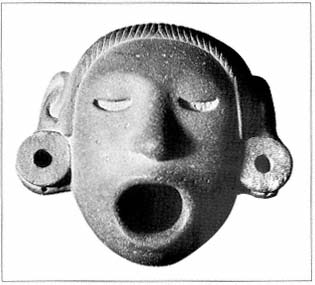
Pl. 56.
Aztec stone mask (The British Museum).
with the funerary masks.[152] Interestingly, Pasztory illustrates a carved wooden, gilded mask[153] that is remarkably similar to the stone masks. The existence of this mask suggests that the stone masks may well have been luxurious versions used by royalty of the more common wood masks used by illustrious Aztecs of somewhat lower status. These wooden masks, of course, would have perished in the flames of the funeral pyre or rotted in the earth after burial.
In addition to these stone and wood masks that seem to continue the tradition begun by the 01mecs and brought to the Valley of Mexico at Teotihuacán, turquoise mosaic masks in the Mixtec style (see pl. 58) were also used by the Aztecs. According to Pasztory, they probably had multiple functions. Some were used on effigy figures, others were worn in ritual, while still others "were placed on the bundles containing deceased rulers who were dressed in the regalia of the gods for the funeral in which they were finally cremated.[154] Whether these masks were created by Mixtec craftsmen in Tenochtitlán, as many believe, or were the work of Aztec craftsmen, perhaps in imitation of Mixtec work,[155] or were sent as tribute to the Aztec capital[156] is not fully understood. But their remarkable formal similarity to the Mixtec funerary masks clearly suggests a similar function.
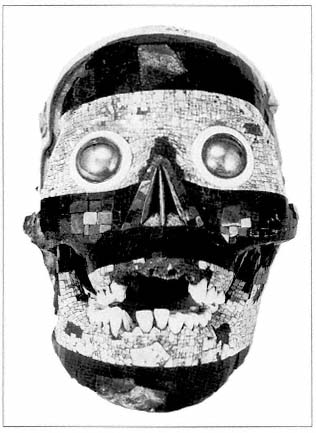
Pl. 57.
Aztec mosaic-covered skull (The British Museum; photograph
courtesy of The British Museum, reproduced by permission).
While these mosaic masks are relatively realistic representations of the human face built on wooden frames, what is perhaps the most striking Aztec mosaic mask, and one clearly related to funerary ritual, is different. The mosaic in this case rests on the front half of a human skull lined with leather so that it could be worn as a mask (pl. 57). The alternating bands of blue turquoise and black lignite which compose the face recall the patterned mosaics of the stone masks of Teotihuacán (colorplate 8) and suggest the facial painting of Tezcatlipoca whom the mask may well represent,[157] but the idea of preserving and decorating the skull of an important person is reminiscent of the Maya practice noted above. A number of similarly decorated skulls in both Aztec and Mixtec offerings[158] indicates that this skull-mask is not an isolated phenomenon. Rather, it is yet another way of suggesting the link between life and death, a link represented metaphorically by the conception of the funerary mask.
As this mask so clearly illustrates, life and death were not separate states for the peoples of Mesoamerica. The life-force was eternal, and one's brief "life" on earth was a moment in that eternity. Assimilation into that eternal force was not death; on the contrary, it was a movement into the essential nature of life. The funerary mask was the most fundamental metaphor created by the peoples of Mesoamerica for that conception. All of the varied masks found in Mesoamerican graves and designed for Mesoamerican cremations are variations on that single metaphorical theme.
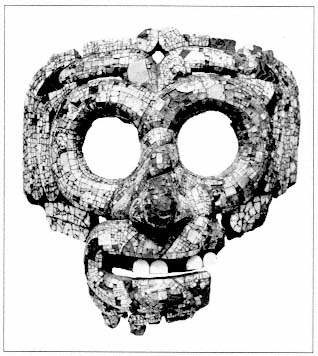
Pl. 58.
Aztec mosaic mask, perhaps one of the masks
presented to Cortès by Moctezuma (The British Museum;
photograph by The British Museum, reproduced by permission).