
Eight—
The Blue-Collar Working Class:
Continuity and Change
David Halle and Frank Romo
The blue-collar working class in America (and elsewhere) has always evoked extreme pronouncements about its political and social attitudes. Observers have long been drawn to one of two polar positions: either the working class is a conservative force that is integrated into the class structure or the working class is a radical force at odds with the middle class and with capitalists.[1]
In the depression years of the 1930s and in the context of the burgeoning of radical new labor unions affiliated with the CIO, many observers saw a radical and even revolutionary American working class. After World War II, by contrast, in the context of a sustained period of economic growth in the West, the model of a working class integrated into the mainstream of society (and often dubbed "affluent"), gained ground. The American working class was, at that time, usually seen as the extreme case among the Western working classes (just as America was the economically and politically dominant capitalist society), and the phrase "the American worker" became, for some, a shorthand term for a working class that was politically quiescent and socially integrated.[2] In the 1960s and 1970s, a model of the radical working class regained popularity, as a series of studies disputed the idea that the working class was integrated into society or especially content with its position.[3] Now the pendulum has swung again, and the model of the quiescent (if not content) American working class has returned to dominance.[4]
The reason for the oscillation between these extreme models in part has to do with actual changes in the position and attitudes of the working class itself. Blue-collar Americans were, for example, surely more dis-
The names of the coauthors of this chapter appear in alphabetical order. The authors wish to thank James Bardwell for his help with computer programming.
content and more inclined to political radicalism in the 1930s than in the 1950s. But in part the pendulum swings between the two models because neither is fully adequate to capture the situation of blue-collar workers in advanced capitalism in the United States (and elsewhere). A convincing model has to take account of three separate, though related, spheres that influence blue-collar lives and beliefs. There is, first of all, life at the workplace—in the mode of production. It is on this crucial sphere that many classic studies of blue-collar workers have concentrated. Second, there is life outside the workplace—the neighborhood of residence, family, and leisure life. With suburbanization and the widespread possession of automobiles, life outside the workplace is often located at a considerable geographic distance from the plant or other work site. Finally, there is life vis-à-vis the government, especially the federal government. This involves the critical act of voting—above all in presidential elections—as well as basic attitudes toward the federal government and the political system, and attitudes toward a whole range of national policy issues. These three areas are somewhat distinct. What is often done, though it should not be, is to focus on just one aspect of workers' lives and from it infer the character of behavior and attitudes in either of the other two spheres.
Here we will use a combination of case studies and national survey data to demonstrate the inadequacies of extreme models of the blue-collar working class that do not take account of each sphere of blue-collar life or of changes that have taken place in those spheres over time. Most of the survey data have been drawn from the National Election Study (NES) carried out by the Survey Research Center of the University of Michigan, which represent the best continuous data series on political attitudes in America. This multidimensional account of working-class attitudes also sheds light on some of the main transformations in American life that have occurred over the past twenty-five or thirty years.
The first question to be addressed is the actual size of the blue-collar working class today, and its relative size compared with the other main occupational groups. In view of prevailing notions of the demise of blue-collar labor in America, it is important to note that the number of blue-collar workers reached its highest level ever in 1989—31.8 million (see figure 8.1).[5] (The blue-collar working class is here defined as consisting of skilled workers, such as electricians and plumbers; factory workers; transportation workers, such as truck and bus drivers; and nonfarm laborers. Men constitute about three-quarters of all blue-collar workers and over 90 percent of skilled blue-collar workers.[6] )
Moreover, blue-collar workers were still a larger proportion of the labor force than either of the two main white-collar groups (see figure 8.2). Thus in 1989 blue-collar workers constituted 27.1 percent of the labor
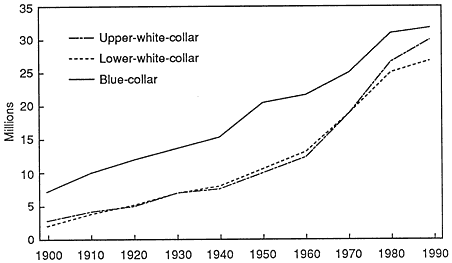
8.1
Composition of the Civilian Labor Force, Major Occupational Groups,
1900–1989: Number of Workers by Year.
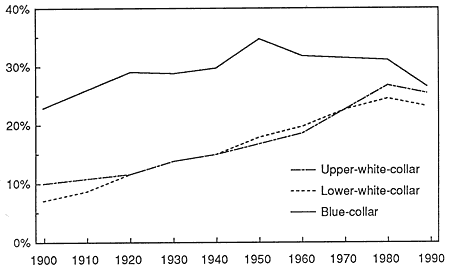
8.2
Composition of the Civilian Labor Force, Major Occupational Groups,
1900–1989: Percent Composition by Year.
force. Compare this with the upper-white-collar sector, defined as managers and professionals, who composed 25.9 percent of the labor force; and compare this with the lower-white-collar sector—defined as clerical, secretarial, and sales workers—who composed 24.2 percent of the labor force.
What is true is that the proportion of blue-collar workers in the labor force has declined, from a peak of 34.5 percent in 1950, and is now declining faster than before. Still, it should be noted, especially given the talk about "postindustrial" or "deindustrial" society, that the proportion of blue-collar workers in the labor force is now either higher than or about the same as it was in the period 1900–1940, when America was unarguably an "industrial society."[7]
Blue-Collar Workers and the Federal Government
Presidential Elections and Political Party Identification
Blue-collar workers were a crucial part of the electoral coalition that Franklin Delano Roosevelt put together for the Democratic party. The current disaffection of blue-collar workers, especially of the skilled and better-paid blue-collar workers, from the Democratic party represents one of the major changes in American politics.
Skilled blue-collar workers voted, by a clear majority, for the Democratic candidate in five of the seven presidential elections that took place between 1952 and 1976 (1952, 1960, 1964, 1968, and 1976); they voted by a clear majority for the Republican candidate only once, in 1972 (see figure 8.3). Less-skilled blue-collar workers (defined here as all blue-collar workers except the skilled ones) also voted, by a clear majority, for the Democratic candidate in five of these seven elections, as shown in figure 8.4.[8] They too voted, by a clear majority, for the Republican candidate only once, in 1960. However in the three presidential elections since 1976, the picture is far less clear-cut. Skilled blue-collar workers voted Republican more heavily than Democrat in 1988, while splitting their vote about evenly between Democrats and Republicans in 1980 and 1984. Less-skilled blue-collar workers split their vote about evenly between Republicans and Democrats in 1988, voted more heavily Democrat in 1984, and more heavily Republican in 1980. By contrast, upper-white-collar workers have voted, by large majorities, for the Republican candidate in every election from 1952 to 1988, except for 1964, when they were clearly presented with an intolerable candidate in Barry Gold-water (see figure 8.5).
Figures 8.6 through 8.14 give a detailed analysis of the determinants of the blue-collar vote in the 1988 presidential election, showing that
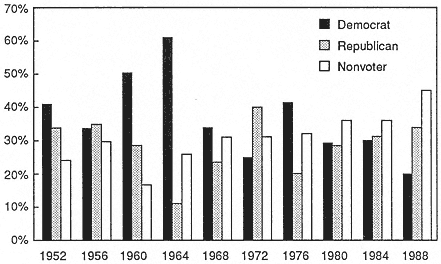
8.3
Presidential Vote, 1952–88: Skilled Blue-Collar Workers.
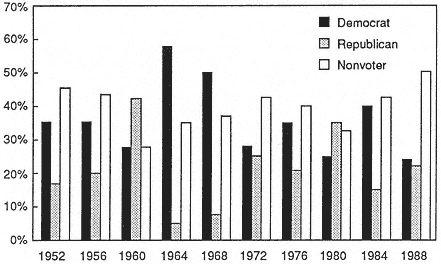
8.4
Presidential Vote, 1952–88: Less-Skilled Blue-Collar Workers.
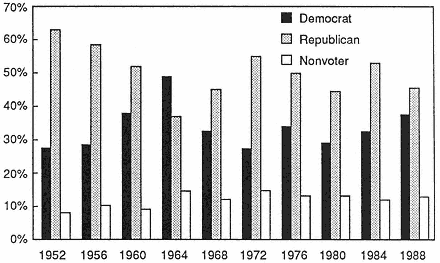
8.5
Presidential Vote, 1952–88: Upper-White-Collar Workers.
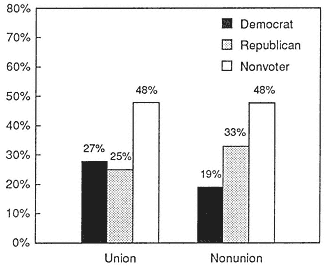
8.6
The 1988 Election: Effects of Union Membership
on the Blue-Collar Vote.
SOURCE : Based on figures from the logistic regression
model presented in the appendix to this chapter.
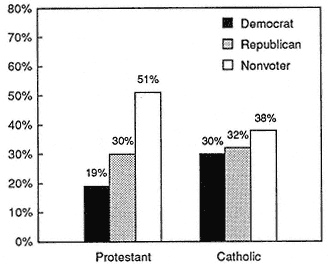
8.7
The 1988 Election: Effects of Religion on the Blue-Collar Vote.
SOURCE : Based on figures from the logistic regression
model presented in the appendix to this chapter.
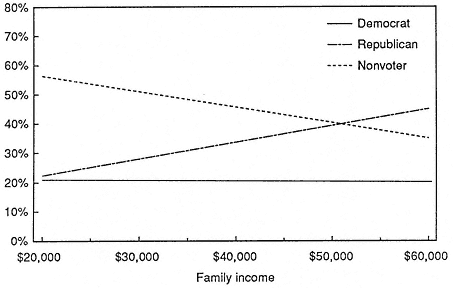
several of the traditional factors associated with voting Democratic still hold for blue-collar Americans. (These figures and figure 8.15 are based on a multivariate logistic analysis of the vote; see the appendix to this chapter for details.) Union members were more likely than non-union members to vote Democrat (figure 8.6). Blue-collar Catholics were more likely to vote Democratic than were blue-collar Protestants (figure 8.7).[9] Blue-collar blacks were more likely to vote Democrat than whites (figure 8.8). And as their income rises, the proportion of blue-collar workers voting Republican increases (figure 8.13). Notice, however, that the effect of region is now complex. Ironically, the voting profile of blue-collar workers in the East (controlling for such factors as religious differences) is now rather similar to that of blue-collar workers in the South (figure 8.10). Notice also that gender—not one of the factors traditionally associated with voting Democratic or Republican—still makes no difference. Male and female blue-collar workers are alike in their voting preferences (figure 8.9).
The movement of blue-collar workers away from Democratic presidential candidates in recent elections is paralleled by, and partly the result of, a tendency that is at least as striking—that of blue-collar workers not to vote at all in presidential elections.[10] Thus in 1980, 1984, and 1988, a larger percentage of skilled blue-collar workers did not vote than voted for either the Republican or Democratic candidate; and among
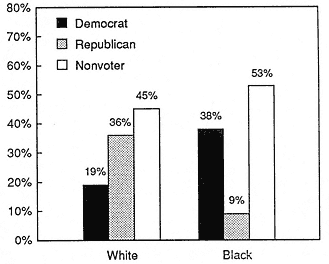
8.8
The 1988 Election: Effects of Race on the Blue-Collar Vote.
SOURCE : Based on figures from the logistic regression
model presented in the appendix to this chapter.
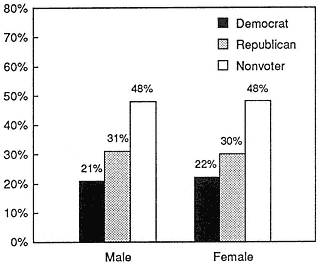
8.9
The 1988 Election: Effects of Gender on the Blue-Collar Vote.
SOURCE : Based on figures from the logistic regression
model presented in the appendix to this chapter.
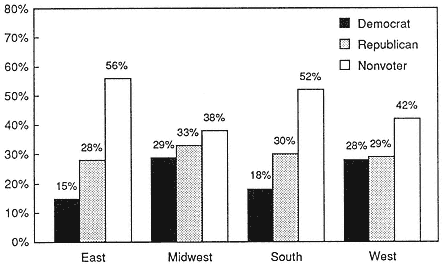
8.10
The 1988 Election: Effects of Region on the Blue-Collar Vote.
SOURCE : Based on figures from the logistic regression model presented
in the appendix to this chapter.
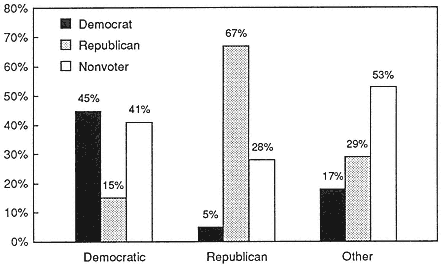
8.11
The 1988 Election: Effects of Party Identification on the Blue-Collar Vote.
SOURCE : Based on figures from the logistic regression model presented
in the appendix to this chapter.
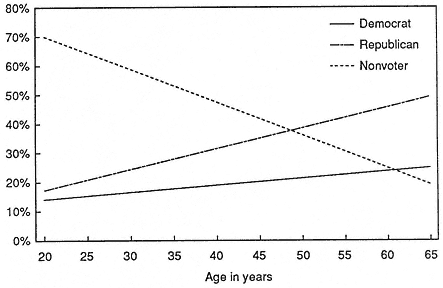
8.12
The 1988 Election: Blue-Collar Vote by Age in Years.
SOURCE: Based on figures from the logistic regression model
presented in the appendix to this chapter.
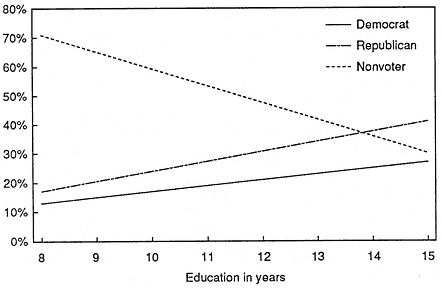
less-skilled blue-collar workers in four of the five elections from 1972 to 1988, a larger number did not vote than voted for either the Republican or Democratic candidate (see figures 8.3 and 8.4). Further, the proportion of blue-collar workers not voting in the 1988 presidential election was especially high (51 percent of less-skilled and 45 percent of skilled workers). More detailed analysis shows that age, income, and education are the most important determinants of whether blue-collar workers vote (see figures 8.12, 8.13, and 8.14). The younger they are, and the lower their income and level of education, the less likely they are to vote.
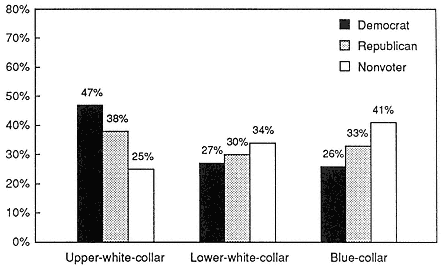
Figure 8.15 sums up this tendency of blue-collar workers not to vote. It shows the effect of occupation on the 1988 vote. controlling for race, union membership. religion, age, family income. region and gender. Blue-collar workers were about as likely as either of the white-collar groups to vote Republican, but much less likely than the upper-white-collar sector to vote Democratic, mostly because they were less likely than the upper-white-collar sector to vote at all.
The upper-white-collar sector is in sharp contrast to the blue-collar sector in the matter of voting. The percentage of upper-white-collar workers who did not vote was low in 1988 (only 14.1 percent)[11] and at no time in the period 1952–1988 was it higher than 15.3 percent (see figure 8.18).[12]
8.13
The 1988 Election: Blue-Collar Vote by Family Income.
SOURCE: Based on figures from the logistic regression model
presented in the appendix to this chapter.
8.14
The 1988 Election: Effects of Education on the Blue-Collar Vote.
SOURCE: Based on figures from the logistic regression model presented
in the appendix to this chapter.
8.15
The 1988 Election: Effects of Occupational Status on the Presidential Vote.
SOURCE: Based on figures from the logistic regression model presented
in the appendix to this chapter.
8.16
Party Identification, 1952–88: Skilled Blue-Collar Workers.
8.17
Party Identification, 1952–88: Less-Skilled Blue-Collar Workers.
8.18
Party Identification, 1952–88: Upper-White-Collar Workers.
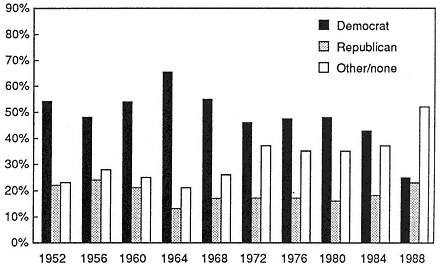
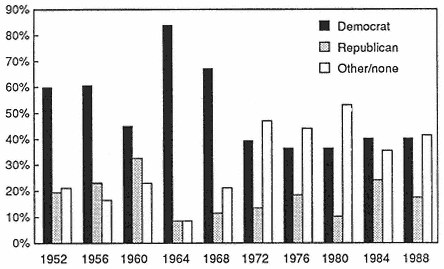
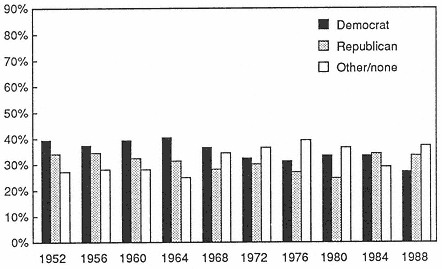
Changes in the political party identification of blue-collar workers since 1952 are also central. Blue-collar workers once identified in large numbers with the Democratic Party. For most of the time from 1952 to 1968, 60 percent or more of less-skilled blue-collar workers saw themselves as Democrats (the exception is 1960 for less-skilled blue-collar
workers), while only 20 percent or less saw themselves as Republicans (see figure 8.17). During most of the same period, 50 percent or more of skilled blue-collar workers saw themselves as Democrats, while only 25 percent or less saw themselves as Republicans (see figure 8.16). There have been two clear changes since 1972. First, a decline in the proportion of blue-collar workers identifying as Democrats (among the less-skilled, the proportion has hovered around 35 percent since 1972; among the skilled, it stabilized in the mid-forties until 1988, when it dropped sharply to 23 percent). The second change is a large increase in the proportion of blue-collar workers reporting no party identification (among less-skilled workers it is now about 40 percent; among skilled workers, it rose to about 38 percent in the period 1972 to 1984, and then climbed sharply in 1988). Interestingly, there has been no major shift of party identification toward the Republicans.
Attitude toward the Political System and Power Structure
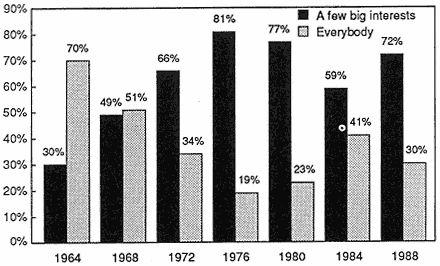
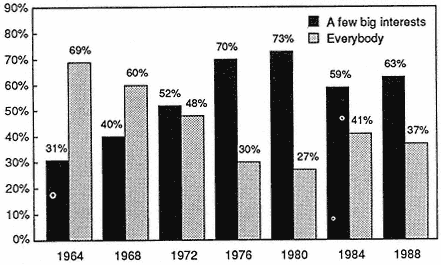
The belief that government, including the federal government, is in the hands of a small number of organized groups who have unofficially usurped power is widespread and striking. This belief is common among blue-collar workers, though also among other occupational groups. When asked whether they thought the government was run for the benefit of everybody or for the benefit of a few big interests, 59 percent of blue-collar workers in 1984 answered that the government was run for the benefit of a few big interests. About the same percentage of Americans in upper-white-collar, lower-white-collar, and service-sector occupations agreed, as did 51 percent of housewives.[13]
Survey data going back to 1964 (when the question was first asked) suggest that this belief has been a fairly stable part of the political outlook of most Americans, including blue-collar workers. Thus in every election year except 1964, at least 40 percent of the entire population has believed that the government is run for a few big interests, and in five of the seven election years in this period more than 50 percent of the population has believed this. As in 1988, variation by occupation is not especially pronounced; blue-collar and upper-white-collar Americans both followed this trend from 1964 onward (see figures 8.19 and 8.20). The survey studies do not explore these beliefs further. For example, they do not ask the obvious follow-up question, namely, which are the "few big interests" for whose benefit so many blue-collar workers (and other Americans) believe the government is run. However, data from detailed case studies give an indication of an answer. A study of employees (almost all truck drivers) of a California company that delivers packages, a study of blue-collar and lower-white-collar Italians in Brooklyn, and a study of blue-collar chemical workers in New Jersey, all came to similar conclusions.[14] The vast majority of blue-collar workers believe that Big
8.19
Who Benefits from Government, 1964–88: Blue-Collar Workers.
8.20
Who Benefits from Government, 1964–88: Upper-White-Collar Workers.
Business really runs America. The dominant view is that corrupt politicians are a venal facade behind which major corporations, "Big Business," prevails, in politics and economics. Remarks like "it's business that runs the country," "big corporations are behind everything," "the [political] power is in the hands of the people with money," and "oil, steel
insurance, and the banks run this country" are commonplace. These were typical comments: "Politics? It's all money! Big Business pays out money to get what it wants." "Who runs the country? Well, I suppose the president does. He makes the decisions. Of course, business is behind him. They make the real decisions. Politicians are all on the take."
That this attitude toward Big Business is widespread is also suggested by Erik Olin Wright's survey data, which found that over 74 percent of blue-collar workers believe that "big corporations have too much power" in America. It is noteworthy that, in terms of their beliefs about the power of corporations in society, American blue-collar workers are just as class conscious as workers in Sweden (presented in Wright's analysis as far more class conscious than American workers). For in both societies, between 75 percent and 82 percent of blue-collar workers believe that "big corporations have too much power" in their respective countries.[15] This underlines the importance of considering separately the three spheres: attitude toward the political regime, attitude toward the work setting, and attitude toward life outside the workplace.
Despite these critical and sceptical beliefs that American blue-collar workers have about who runs the country, the lack of approval for alternatives to the current political system is notable. The general acceptance of the American Constitution ranges from enthusiasm ("it's the best in the world") to lukewarm ("I complain a lot, but it isn't any better anywhere else"). This phenomenon needs explaining. In part it is based on a distinction between the system and those who operate it, between politicians and the Constitution: the political system is sound, but it is in the hands of scoundrels. In part, lack of support for alternative political systems results from a perception that radical change in the United States is impractical: the country is too large, and potential leaders are too prone to sell out. But in part the widespread acceptance of the Constitution and the political system is based on a key distinction most workers make, either explicitly or implicitly, between freedom and democracy. The United States does offer freedom and liberties, which are very valuable. Consider these typical comments, all made by workers who believe venal politicians subvert the electoral process: "In America you have freedom. That's important. I can say Reagan is a jerk and no one is going to put me in jail." Another worker: "You know what I like about America? You're free. No one bothers you. If I want to take a piss over there [points to a corner of the tavern], I can." Socialism and communism are ruled out in almost everyone's eyes, for they are seen as synonymous with dictatorship. They are political systems that permit neither popular control of government (democracy) nor individual freedom and liberties.[16] Survey data suggest that, like mistrust of government, this attitude toward freedom is widespread among blue- and white-collar Americans.
The vast majority both value freedom and consider it an important feature of contemporary America.[17]
Life Outside the Workplace
Home Ownership and Suburbia
The combination of home ownership and suburbia is of considerable importance for understanding the American working class. Together they provide the material context for American blue-collar workers to live, or to hope to live, a residential, leisure, and social life in which the barrier between blue- and upper-white-collar is considerably muted (at least, as compared with the typical workplace situation of blue-collar workers).
The high rate of home ownership among Americans, including blue-collar Americans, has for a long time been striking. Back in 1906, Werner Sombart contrasted the United States with his native Germany: "A well-known fact . . . is the way in which the American worker in large cities and industrial areas meets his housing requirements: this has essential differences from that found among continental-European workers, particularly German ones. The German worker in such places usually lives in rented tenements, while his American peer lives correspondingly frequently in single-family or two-family dwellings."[18] By 1975, three-quarters of all AFL-CIO members owned houses.[19] Home ownership not only offers blue-collar workers the possibility of economic gain but also provides a site where they can control their physical and social surroundings—not, of course, completely, but far more than in the work setting where they are typically subordinate to the authority of a direct supervisor, as well as of management and the owners.[20]
Suburbanization, in combination with home ownership, has played a crucial role in undermining working class residential communities, especially after World War II. Suburbanization can be defined as a process involving two crucial factors. First, there is the systematic growth of fringe areas at a pace more rapid than that of the core cities; second, there is a life-style involving a daily commute to jobs in the urban center.[21] The regular commute to a workplace a considerable distance from the work site is an important factor in the fading of working-class residential communities. Many classic labor movements established their strongholds in the nineteenth century in towns and urban areas that were not especially large (by later standards), or especially spread out. Paterson, New Jersey, for example, had only 33,000 inhabitants in 1870. These places were typically urban villages, where, as Eric Hobsbawm put it, "people could walk to and fro from work, and sometimes go home in the dinner-hour . . . places where work, home, leisure, industrial relations, local government and home-town consciousness were inextricably mixed together."[22]
In fact, suburbanization involving the commute to work by public transport started before many of these working-class communities were formed. It began in 1814, with the first steam ferry, and continued with newer modes of public transport (the omnibus in 1829, the steam railroad in the 1830s and 1840s, the electric streetcar in the late 1880s).[23] Each of these developments doubtless somewhat undermined working-class occupational communities. But so long as workers were dependent on public transport to get to the workplace, there were limits to where they could live (nowhere too far from public transport).[24] After World War II, as automobiles became widely owned by blue-collar workers, a qualitative change occurred. Workers could live anywhere they could afford that was within commuting range. And since the incomes of better-paid blue-collar workers often approached, equalled, or exceeded those of several upper-white-collar groups (such as teachers and social workers), there developed many occupationally mixed suburbs, where the proportion of blue-collar workers ranged from about 20 percent to about 45 percent, as did the proportion of upper-white-collar workers.[25] For example, when the vast new suburb Levittown, New Jersey, opened in 1958, these two groups bought houses there in roughly equal proportions. By 1960, 26 percent of the employed males there were in blue-collar occupations, while 31 percent were in upper-white-collar occupations.[26]
This residential context provides the framework for the marital and leisure lives of many blue-collar Americans. Several other factors that are also important influences on the leisure lives of blue-collar workers cut across occupational or educational lines. These include gender, age, position in the marital cycle, and income level. For example, many blue-collar workers are enormously interested in sports, as participants and spectators. Among the sports in which they participate are hunting, fishing, and softball; golf, traditionally an upper-white-collar activity, has grown in popularity among blue-collar workers. And, like other American males, many blue-collar workers spend considerable time watching sports on television. Clearly, this interest in sports, shared in many ways by upper-white-collar males and other Americans, has as much to do with gender as with class.
It is true that certain factors add a flavor to the lives of blue-collar workers. In particular, they typically have modest levels of education (an average of twelve years) as compared with upper-white-collar workers (an average of fifteen years of education).[27] Partly as a result, blue-collar workers are less likely than upper-white-collar workers to be interested in high culture (opera, ballet, classical music, serious theater). However, these differences should not be exaggerated, for the level of interest in high culture among upper-white-collar workers is not great. For example, a survey conducted in the early 1970s on exposure to the arts in twelve major American cities showed that no more than 18 percent of
managers and professionals had been to a symphony concert in the past year, no more than 9 percent had been to the ballet, and no more than 6 percent had attended the opera.[28]
Finally, there is the issue of marital life. There are certain features of working-class life that may add a distinct flavor to the marriages of blue-collar workers. For example, blue-collar jobs can carry somewhat low status as compared with upper-white-collar jobs and even as compared with some lower-white-collar jobs. Some couples' comments suggest that wives of blue-collar men sometimes resent their husbands' low status occupations. And the modest level of education that blue-collar workers typically possess may affect the character of their marriages; for example, some studies suggest that the level and quality of "communication" between spouses increase with their amount of education.
Still, as with leisure life, there are a variety of forces that affect the marital lives of blue-collar workers but that are by no means confined to them. These include the conflicting demands of home life and work life, the difficulties (and benefits) that arise when both spouses work, and the host of questions associated with raising children (all of which are discussed in other chapters of this book).[29] The best studies of the marital lives of blue-collar Americans suggest that there are as many similarities as differences between their marital lives and those of upper-white-collar people.[30] One explanation is that, as with leisure lives, gender differences are at least as important as class differences. For example, whatever their class, many American wives face the likelihood of being able to find jobs only in poorly paid, lower-white-collar occupations and, at home, of having the major responsibility for child care and housework.[31]
Life at the Workplace
It is in the workplace that differences between blue-collar and white, especially upper-white-collar, are most pronounced. Blue-collar jobs are often dirty and sometimes dangerous, and usually require some degree of physical labor (hence the need to wear special protective clothes—the "blue collar").[32] In addition, such jobs usually involve the following features: (1) work that is repetitive and therefore dull; (2) work that is clearly connected to the creation of a tangible product; (3) work that offers little chance of upward mobility (workers may rise to first-line supervision, but above that level, lack of educational qualifications poses a serious barrier); and (4) work that is supervised, in an obtrusive or unobtrusive manner (there is human supervision, and there is the mechanical supervision of a time clock). These features provide enough real basis for distinguishing blue-collar from upper-white-collar jobs and, to a lesser extent, from lower-white-collar jobs.[33] In occupational settings with a va-
riety of work levels, management usually has little difficulty deciding which workers should be classified as blue-collar and therefore be assigned to distinct work areas and required to wear special work clothes, though some groups on the margin may be hard to classify.
Class Consciousness
Last, but definitely not least, there is the question of class consciousness. How do blue-collar workers see their position in the class structure, with whom do they identify, and whom do they oppose? These questions have always been, and remain, central in the debates over the blue-collar working class. In a recent article dramatically titled "Farewell to the Labor Movement?" Eric Hobsbawm, one of the foremost socialist historians, stressed the question of class consciousness:
It is class consciousness, the condition on which our parties [mass socialist or workers parties] were originally built, that is facing the most serious crisis. The problem is not so much objective de-proletarianization, but is rather the subjective decline of class solidarity. . . . What we find today is not that there is no longer any working class consciousness, but that class consciousness no longer has the power to unite.[34]
Hobsbawm cites the fact that in 1987 almost 60 percent of British trade union members voted for parties other than the Labor party. Clearly this is comparable to the tendency for blue-collar Americans nowadays to be at least as likely to vote Republican as Democratic in presidential elections.
Much of the debate over class consciousness has revolved around, or at least begun with, the issue of whether blue-collar workers tend to see themselves as "working class" (and therefore more class conscious) or "middle class" (and therefore less class conscious). It is, then, surprising to discover that in 1988, asked if they saw themselves as "working class" or "middle class," 75 percent of American blue-collar workers said working class. Further, this is only a little less than in 1952, when 80 percent of blue-collar workers categorized themselves as working class in response to the same question (see figure 8.21). Indeed, the proportion of blue-collar workers categorizing themselves as working class has never fallen below 64 percent in the period between 1952 and 1988. Clearly a certain kind of working-class identity can coexist with a declining tendency for blue-collar workers to vote for Democratic presidential candidates and to identify with the Democratic party. This suggests a problem with the debate over class consciousness, which, as we have pointed out, has long pervaded the general debate over the blue-collar working class, namely, the tendency to infer from one area of blue-collar life the nature of behaviors and beliefs that prevail in other areas of those lives. In the
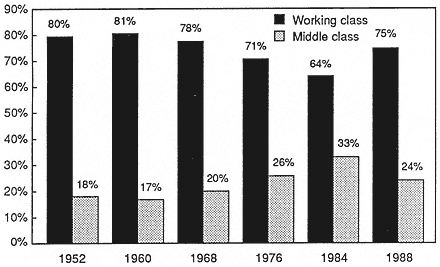
8.21
Social Class Identification by Major Occupational Group, 1952–88:
Blue-Collar Workers.
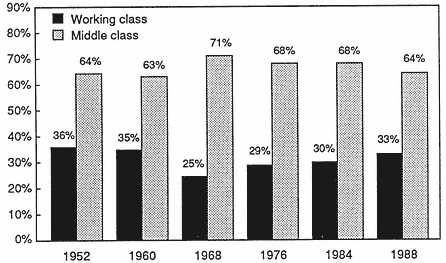
8.22
Social Class Identification by Major Occupational Group, 1952–88:
Upper-White-Collar Workers.
case of class consciousness and class identity, this amounts to assuming that blue-collar workers have a single image of their position in the class structure.
A central theme of this chapter has been that the lives of blue-collar workers revolve around three separate, though related, spheres—life at the workplace (in the mode of production), life outside the workplace (residential, marital, and leisure), and life vis-à-vis the federal government. Indeed, there is reason to think that many American blue-collar workers have three social identities, each relating to one of these spheres. These identities are that of the "working man," (or "working woman" for female blue-collar workers); that of being "middle class" or "lower middle class" or "poor," with reference to life outside the workplace; and that of being part of "the people" or "the American people," with reference to the notion of the individual citizen vis-à-vis the federal government and the related power structure. If these spheres have not emerged clearly in much previous research, it is because the main methods used to study class consciousness have tended to encourage, explicitly or implicitly, only one of these identities.
The analysis that follows is based on David Halle's study of class identity among blue-collar chemical workers in New Jersey. These workers were, in several ways, among the better-off blue collar workers. They were comparatively well paid and unionized; about one-quarter of them were skilled; 69 percent were homeowners. They were all men, reflecting the dominance of men in more desirable blue-collar jobs.
Consider, first, the concept of "the working man." A close reading of formal and informal interviews reported by a variety of researchers suggests that male blue-collar workers in America commonly refer to themselves as "working men," but rarely as "working class." This can be seen in interviews with voters during the 1968 and 1972 presidential election campaigns; in the views working-class residents of a new suburban township expressed about their preferred political candidate; from the comments of a group of skilled workers in Providence, Rhode Island; from comments of a group of white working-class males in an East Coast city; from comments of workers in Milwaukee, Chicago, and Pennsylvania; from comments of auto workers in Detroit; and from comments of Italian construction workers in Brooklyn.[35] The concept of the "working man" has also been central in the history of the American labor movement. For example, when trade and craft workers before the Civil War founded political parties, they called them "Workingmen's Political Parties," and the Workingman's Advocate was the name of one of the most important newspapers of the nineteenth century.
The concept of the working man, among the chemical workers studied by Halle, has as its central idea the notion that blue-collar work takes
a distinctive form and is productive in a way that the work of other classes is not. This notion has two central components. One involves the features of the job. Being a working man involves one or more of the following clusters of related ideas: (a) physical work ("It's hard physical work," "It's working with your hands"); (b) dangerous or dirty work ("We get our hands dirty"); (c) boring and routine work ("We do the same thing over and again"); (d) factory work (as opposed to office work); (e) closely supervised work ("We have to punch in and out," "We're told what to do").
The other central component of the concept of the "working" man links it to a moral and empirical theory about who really works in America. It implies, in one or more of the following ways, that those who are not working men are not really productive, do not really work. Those who are not "working" (a) literally do not work ("Big business don't work, they just hire people who do," "People on welfare aren't working men, they don't want to work"); (b) perform no productive work ("Teachers aren't teaching the kids anything," White-collar office workers "just sit on their butts all day"); (c) are overpaid ("Doctors earn huge fees," "Lawyers charge whatever they want").
The combination of the "job features" and the "productive labor" aspects of the concept logically entails the idea that only those whose labor involves such job features are productive. As a result, blue-collar work is generally seen as productive. But those whose work lacks many or all such job features, definitely big business and the white-collar sectors in general, are not.
A central point about the concept of the working man is that the term expresses both class and gender consciousness. It expresses class consciousness in implying that blue-collar work is especially productive. But it also implies that blue-collar work is for men (working man ) rather than women, which is a form of gender consciousness. This reflects the history of American labor. In the early stages of industrial growth, women (and children) were the first factory workers, for at that time such jobs were seen as less desirable than agricultural work. As the status and pay of factory and other blue-collar work rose, women were pushed out of almost all except the least desirable jobs. The blue-collar working class is now composed primarily of men, and this is especially true for the better paid and more highly skilled blue-collar jobs.
Among the chemical workers Halle interviewed, the idea that blue-collar work was for men was a form of sexism that most workers were prepared to explicitly support in discussing their own jobs. For example, they would maintain, sometimes in arguments with those of their wives who are feminists, that women cannot be chemical workers because they are too weak to move heavy chemical drums. But such sex stereotyping
of occupations is under increasing attack in the United States. As a result, few workers were prepared to explicitly defend this sort of view for the entire spectrum of blue-collar jobs.
This discussion also raises the question of how female blue-collar workers see their position in the class structure at work. Naturally, they see themselves as working women rather than working men. How they use the concept of the "working woman," and how its meaning compares with the concept of the working man, is a question that scarcely has been investigated.[36]
The blue-collar workers that Halle interviewed also place themselves in the class structure, in part according to their life away from work rather than on the job. In this second image, they assume a class structure composed of a hierarchy of groups that are distinguished, above all, by income level but also by standard of living and residential situation. Income level, life-style, consumer goods, and neighborhood constitute the material framework of their lives outside work. (It is true that income originates from their employment, but its effect on their lives is outside, where almost all income is spent.) These criteria for determining position in the class structure increase the range of persons with whom workers consider they have common interests (as compared with the concept of the working man). Thus, though most see clear gaps between their situation and those of the upper and lower extremes (for instance, "the rich" and "the poor"), the categories in between are almost all ones to which they consider they do or could belong. As a result, according to this perspective, the class structure has a sizeable middle range that displays some fluidity, permits individual movement, and takes no account of a person's occupation. This reflects the actual ability of workers, in their life outside the factory, to enjoy a certain mobility through their choice of house, neighborhood, possessions, and life-style.
Income level is the most important of the factors underlying this second image of class. Almost everyone has at least a rough idea of the income distribution in America and his place within it. Workers read government statistics in newspapers and magazines on the average income of an American family, and they are aware of estimates of the income level needed to maintain a minimum, a comfortable, and an affluent standard of living. The federal and state income tax systems both entail a picture of the class structure based on income, and most workers follow with keen interest the relation between their weekly earnings and the taxes deducted from their paychecks. Income level is not the only criterion underlying class distinction based on the setting outside work. Lifestyle, material possessions, and the quality of residence and neighborhood are other criteria that people often use.
Most, but not all, workers place themselves in the middle of the hier-
archy (below the "rich" and above the "poor"). But some identify with a category between the poor and the middle class. This view is most common among younger workers. They may have a mortgage, young children, and a spouse who stays at home to look after the children. But for these workers, being middle class implies being able to maintain that life-style without economic pressure. They deem their own situation below that of the middle class because they cannot live such a life-style without a strain—perhaps a serious strain—on their resources. Their income level, material possessions, and life-style make them better off than the poor, but not comfortable or free from major economic worries (as they believe the middle class to be).
The chemical workers studied by Halle were comparatively well paid for blue-collar workers, so it is likely that numerous less well paid blue-collar workers, in thinking of themselves outside the workplace, would classify themselves as below middle class.[37] The coexistence of these two identities—that of being a "working" man, with reference to life at work, and that of being middle class or less, with reference to life outside the workplace—would explain the large number of blue-collar workers who categorize themselves as "working class" rather than "middle class" in response to a survey question on that topic (see figure 8.21). Some workers categorize themselves as working class because they think of themselves as "working" men. Others place themselves in the working class because they are thinking of their position in the class structure outside work and believe their income level or life-style is not high enough to place them in the middle class. Either way, the forced choice of "working class" or "middle class" conceals the coexistence of two images of position in the class structure.
Almost all the blue-collar chemical workers have what amounts to a third image of their position in the class structure. They routinely use the concepts of "the American people" and "the people" in a populist sense. This concept involves the idea of a clear opposition between the power structure, especially big business and politicians, and the rest of the population. According to this view, "the American people" means all those excluded from the heights of political and economic power. Consider this worker, discussing corruption in politics: "Take Johnson for example. When he entered the White House he had $20,000 and then he bought all those estates with the American people's money."
This populist current is the third major aspect of the class consciousness of these workers. The concept of the working man refers to a position in the system of production. The concept of being middle class or lower middle class refers to a position outside work—to a life-style and standard of living. The concept of the people, or the American people, in the populist sense, refers to the division between all ordinary citizens and those with political and economic power.
Conclusion
The situation of blue-collar workers is complex and cannot be summed up by approaches that assume that the three main areas of blue-collar life are changing in concert. On the federal level, there is a movement away from voting for Democratic presidential candidates and away from voting at all, which is especially pronounced among younger workers. This has been accompanied by a diminished identification with the Democratic party (though identification with the Republican party has not taken its place). It is this fading of party loyalty and, perhaps, the declining tendency of blue-collar workers to vote at all, that is probably the most distinctive feature of the later decades of the twentieth century. If class solidarity for blue-collar Americans means voting for Democratic presidential candidates and identifying with the Democratic party, then class solidarity is definitely on the wane.
However, a majority of blue-collar workers (and other Americans) believes that the country is "run by a few big interests," particularly by large corporations. And there is reason to think that many blue-collar workers, like many other Americans, will at times subscribe to a version of populism that contrasts "the people" (as those excluded from the heights of political and economic power) with the power structure (above all, big business and politicians). This entire perspective has probably long been a central component of the belief system of many ordinary Americans. (It was, for example, surely prominent during the "trust-busting" movement of the early 1900s.) It is likely to remain so as long as large corporations (American or foreign) play a central role in American life.
Further, the vast majority of blue-collar Americans appear to see themselves, in the workplace, as "working men" (or "working women"), with an implicit solidarity at least with other blue-collar Americans (and probably, in varying degrees, with lower-white-collar Americans, too). This reflects a kind of class consciousness and identity that has long been important and is unlikely to fade, so long as the distinctions in the workplace between blue-collar workers on the one hand and white-collar workers (especially upper-white-collar workers) on the other hand, are pronounced. The current weakness of the union movement is significant in its own right, but may not diminish this class identity. Indeed, to the extent that blue- and lower-white-collar workers are less protected by unions than they once were, their feelings of vulnerability in the face of, and hostility toward, the corporations that employ them are as likely to increase as to wane.
Outside of the workplace, class identity is somewhat more fluid, reflecting the greater degree of penetration and intermingling of blue- and white-collar people outside the workplace—in places of residence, in leisure, and in marital lives.
Some of these trends in the attitudes and behavior of blue-collar workers have been present for a long time. Others are more recent. Examining a number of arenas of working-class experience at once, and allowing each to express its own internal dynamics, shows the inadequacies of the two prevailing models of the working class—the radical working class and the integrated working class—each of which focuses on one or two areas of experience to the exclusion of the others. Social life is complex, and the fact that blue-collar workers have several bases for their attitudes and behavior reflects this complexity, which must be incorporated into any model of the American working class.
Appendix to Chapter Eight
Several data sets were used to construct the figures presented in this chapter. The source of the employment data in figures 8.1 and 8.2 is explained in note 5. Figures 8.3, 8.4, 8.16, 8.17, and 8.18, which chart presidential vote and political party identification by year and major occupational groupings, are based on the National Election Study (NES) combined file, 1952 to 1986, produced by the Survey Research Center at the University of Michigan. Figures 8.19, 8.20, 8.21, and 8.22, which chart beliefs about who benefits from government and social class identification, for selected years from 1952 to 1988, are based on the specific NES studies for years reported. Figures 8.6–8.15, which take a detailed look at the blue-color vote in 1988, are based on a multinomial logistic regression equation calculated on the NES data for 1988.
The 1988 Logit Model can be clarified as follows. A multinomial logistic regression model was calculated (using maximum likelihood estimation) on the 1988 National Election Study data to assess the impact of demographic variables on the presidential vote.[38] The model is a simple linear regression when the dependent variable is converted to the log of the odds ratios. The dependent variable in this analysis comprises three categories: Voted Republican; Voted Democrat; and Did Not Vote. The odds ratios are (Voted Republican)/(Did Not Vote) and (Voted Democrat)/(Did Not Vote). These two odds ratios (resulting in the estimation of two simultaneous equations) are sufficient to calculate every combination or odds comparison implied by a three-category dependent variable. Independent variables include family income in thousands of dollars (direct effect); age in years (direct effect); education in years (direct effect); region (categorical effect: East, Midwest, South, West); union membership (categorical effect: yes, no); religion (categorical effect: Protestant, Catholic, Jewish); race (categorical effect: white, black); gen-
| ||||||||||||||||||||||||||||||||||||||||||||||||||||||||
der (categorical effect: male, female); occupation (categorical effect: homemaker, upper-white-collar, lower-white-collar, service, blue-collar); and party identification (Republican, Democrat, other). Variables identified as "direct effects" are quantitative insofar as their interval values are entered directly into the design matrix. Categorical effects are qualitative, and each category forms a variable in the model, with the exception of the last category, which is estimated by the intercepts. In this model, categorical variables are estimated using an "effect coded" design matrix.[39]
The results of the logistic regression model are given in tables 8.1a and 8.1b. Table 8.1a (analysis of variance) assesses the fit of the overall model and the significance of each set of independent estimators. It reveals that, with the exception of gender, all estimators have obtained a chi-square large enough to be significant at an alpha-level less than 0.05. At the bottom of table 8.1a is the "likelihood ratio," which permits an assessment of the fit of the model to the underlying data. This statistic is distributed as chi-square with degrees of freedom equal to that listed at the bottom of table 8.1a. If the chi-square is large relative to the degrees of freedom, the model demonstrates a poor fit, but if it is small relative to the degrees of freedom, then the model exhibits a close fit to the original data. Traditionally, a chi-square that cannot obtain an alpha-level greater than 0.05 is considered a strong indicator that the model does not fit the data. In the case of the model assessed in table 8.1a, the chi-square is such that the alpha-level is at its maximum of 1.0, indicating a very good fit between the model and the data. It should be noted that the linear design matrix used in this model is an extreme simplification of
| ||||||||||||||||||||||||||||||||||||||||||||||||||||||||||||||||||||||||||||||||||||
| ||||||||||||||||||||||||||||||||||||||||||||||||||||||||||||||||||||||||||||||||||||
| ||||||||||||||||||||||||||||||||||||||||||||||||||||||||||||||||||||||||||||||||||||||||||||||||||||||||||||||||||||
the possible interactions among categories of the independent variables and the possible nonlinear direct effects implied by such a complex set of variables. Hence, the fit of this very simple logit model is indeed a significant finding.
Table 8.1b (analysis of individual parameters) gives the logit estimates, their individual standard errors, the associated chi-squares and alpha-levels. The estimates are linear with respects to the log of the odds ratios. This makes direct interpretation of the estimates nonintuitive. As a result, we have interpreted the estimates in figures 8.5 through 8.15 for the blue-collar vote. That is, we held the effect of occupation constant at "blue-collar" and calculated the ceteris paribus effects of each independent variable on the probability of voting in one of the three ways (Republican, Democrat, No Vote). For each calculation, the effects of all other independent variables included in the model were held at their "blue-collar" mean effects. These means are presented in table 8.2.