
IV
Family, Kinship, and Society
A broad and varied range of social and occupational groups participated in local society in Alta Extremadura. In exploring the position, resources, and interaction of these different groups, a picture emerges suggesting the crucial role of family and kinship relationships and strategies in the structure and functioning of local society. Family and kinship networks to a great extent provided the basis for the organization of social relations and the allocation of economic resources in early modern society. An individual's position in the family, the family's position in society, and the existence of larger kinship networks encompassing the individual and family in many ways defined the individual's position and expectations from birth to death. And decisions made within the family with regard to marriages, occupations, distribution and management of resources not only patterned the lives of individuals but also collectively shaped the nature and ordering of society itself. Family and society were distinct but inseparable.
Virtually every stage of the formation and maintenance of the family reflected socioeconomic, legal, and individual considerations as well as demographic realities. The marriage of a couple, for example, usually involved an agreement between two families (or the heads of the families or households concerned) on the dowry. The marriage contract reflected the social and economic status of both bride and groom, and it probably usually was tied to the new couple's prospects for establishing an independent household. These prospects depended both on their own resources (generally meaning the man's income and occupation and whatever property
either held) and the contributions made by either or both families. While age at marriage certainly had important demographic implications, especially for the number of children a couple might have, age as such appears to have been a less important consideration than the ability to establish an independent household. A marriage reflected not only economic and legal factors but social and even political ones as well, as seen particularly in the marriage alliances of the nobility.
A variety of decisions and considerations thus entered into the establishment of a new family with the marriage of a couple, and marriage itself was but one aspect of family life. Occupational and career choices for children; the position of women; the disposition of property in dowries, donations, wills, and entails; the complexities of family and household structure that resulted from remarriage; the existence of illegitimate children; the inclusion in the household of poor and illegitimate relatives (or even nonrelatives); the kinship network of which families formed a part; family solidarity; as well as the possibility of family conflict, scandal, and even violence all hinged on and generated a similar variety of considerations that both because of their impact on the individual and their wider implications for the structure and functioning of society merit examination.
This chapter will examine the family as a social and economic unit more specifically than was possible in the two preceding chapters—even though, as seen, one can hardly describe the lives of hidalgos or commoners without constant reference to family position, marriage, wills, and the like. Specific focus on the different components of family life, however, unavoidably tends to fragment choices, values, and obligations that usually were closely related and interdependent. By looking at the experiences of one person we can see the importance and centrality of family and kinship in an individual's life and career and the connection between the various concerns related to family.
Alvaro de Paredes: An Extremeño in Mexico
Alvaro de Paredes Espadero, a cacereño from a distinguished hidalgo family, left Cáceres for New Spain, probably in the mid- to late 1580s. He doubtless was a younger son of Licenciado Gonzalo
Martínez Espadero and doña Estevanía de Paredes. He probably was fairly young when he emigrated, perhaps in his early twenties, although he had already earned his bachelor's degree in law by the time he left Spain. After his arrival in New Spain he served for a time as the alcalde mayor (chief magistrate) of Colima, but soon afterwards took up residence in Mexico City. He did not use the title "bachiller," nor did he seek a position as a letrado until 1608, when he asked his brother in Cáceres to send his university degree, which he had left behind, probably for safekeeping. From Mexico Alvaro de Paredes maintained a long-term correspondence with his brother Licenciado Gutiérrez Espadero in Cáceres; this brother probably was the oldest son and principal heir who became the effective head of the family on their father's death in the late 1580s. Alvaro also had a sister in Cáceres with whom he stayed in touch (although none of these letters have survived). She at one time asked him for financial assistance and on another occasion sent Alvaro several cartons of law books he had requested.
Alvaro's family was prominent in Cáceres. Family members sat on the city council, and the family had a strong affinity for the legal profession. As seen, Alvaro's father and brother were letrados, as was Alvaro himself, and their relative Licenciado Alonso Martínez Espadero sat on the Council of the Indies. Apparently Alvaro had done well when he first got to Mexico just on the strength of that family connection. He wrote in February 1590, soon after Licenciado Espadero's death, that "although he did nothing for me, his shadow reached here and with it I was able to maintain myself and because of it I was favored." All that changed drastically with his illustrious relative's death. As long as he could capitalize on his name, Alvaro had hoped to make a good marriage; but after Espadero's death, the prospects looked bleak indeed.[1]
In 1590 Alvaro had to resort to borrowing 1000 pesos from a friend, don Antonio de Saavedra, who was on his way back to Spain; he asked his brother to repay Saavedra from the inheritance owed him from their father. Remaining in Mexico, Alvaro disposed of the property or income he had in Cáceres in various ways over time. After his father's death he assigned the income from his paternal inheritance to his mother, and after her death at least partially to his sister. Only in 1609 did he give his power of attorney to a pair of men on their way from Mexico to Spain to collect from
his brother the legacy from his parents. He delayed all those years in spite of the fact that—according to his own statements at least—he was often in severe financial straits.
But the year 1590 also brought Alvaro a stroke of good fortune; he married doña Beatriz de Sotomayor, the sister and ward of the relator (secretary) of the audiencia, Licenciado Estevan de Porres, himself a widower with one son. Alvaro wrote of his brother-in-law that "although he knows well of my poverty, he wanted my company, and he could have married his sister to wealthy men of quality, and knowing who our parents are, he thought it better to do it with me." His brother-in-law provided a dowry of 8000 pesos and other things, possibly including some land. The next year Alvaro wrote glowingly of his wife: "I am so happy in her company as I never thought I'd be in all my life." He must have talked at length to his wife about his family in Cáceres. "From what I've told doña Beatriz about my lady doña Isabel [his brother's wife?], she is so fond of her that I think she wouldn't mind going to Castile just to see her." The couple did not make such a trip but instead, during the next decade—by 1602—had six children. By 1604, however, two of them, Jerónimo and Beatriz, had died, as well as a mulatto named Juanillo "who was like a son because he was born in the house and raised my sons." By 1606 two more children had arrived, and the couple by then had four sons and two daughters.
That year Alvaro wrote with pride of the progress his son Gonzalillo was making in his study of grammar and Latin verse. Gonzalo must have been his oldest son and a teenager by that time. Alvaro's cherished hope was that he would be able to send Gonzalillo to study in Salamanca—law, of course. His brother in Cáceres told him that it would cost at least 400 escudos a year for Gonzalo to live and study at Salamanca, and in 1608 Alvaro despaired of being able to afford the expense. He did, however, ask his brother to have twelve reposteros de armas (wall hangings) made in Salamanca with the arms of his own and his wife's family, so that his children would not forget their origins and lineage. He told him to cover the costs from the legacy from his mother.
From 1606 on yet another familial relationship figured in Alvaro's letters home. In that year he mentioned that "our brother Juan Tejado of the company of Jesus" was due to arrive in Mexico. Juan Tejado, apparently not a blood relative, had been raised from an
early age by Alvaro de Paredes's father, who apprenticed Tejado in 1579 for a year and a half to a shoemaker, paying 10 ducados and two bushels of wheat.[2] The relationship between the boys who had grown up together endured throughout their adult lives. Tejado also wrote letters from Mexico to Paredes's brother Licenciado Gutíerrez Espadero, and he referred to the "brotherhood that there is between" himself and Alvaro.
It is impossible to read the letters from Alvaro de Paredes to his brother without being struck by the high proportion of their content which relates quite directly to family concerns and affairs. Certainly to a large degree this can be explained by the very nature of the correspondence; Paredes and his brother did not have complex legal or financial matters to discuss, so family news logically would play a large part in their letters. Nonetheless Alvaro's descriptions of developments regarding his marriage and family, his continued concern for the family left behind in Cáceres, his maintenance of the childhood tie with his adoptive brother, Juan Tejado, all reveal him to have been an individual for whom family and all its ramifications—personal relationships, extended kinship networks, status—were central and vital. And there is no reason to think that Alvaro was in any way unusual in this respect; in fact the familial relations and concerns that emerge from his letters are notable more for their typicality than the reverse. His references to Licenciado Espadero on the Council of the Indies, for example, indicate not only his awareness of a wide network of kinship ties but also the standard expectation that such ties would generate opportunities and resources.
Alvaro's marriage, while it clearly brought him personal happiness and satisfaction, doubtless resulted from more pragmatic motivations. By his own statement he had been hoping for a lucrative match (even before he became engaged to doña Beatriz); he could hardly have done better under the circumstances. His marriage brought him useful connections in high governmental circles in Mexico and ties to a prestigious family (the Sotomayors), as well as a decent dowry. For his part, his brother-in-law apparently was eager to form an alliance with such a distinguished letrado family as the Espaderos (recall Alvaro's statement that his brother-in-law was mindful of "who our parents are"). In face of such considerations, personal feelings surely took second place. After marriage also
Alvaro and doña Beatriz's family developed along standard lines. Eight children were born in fifteen years, somewhat higher than the normal birthrate for the time (two of the children did not survive childhood), and the three children's names mentioned—Gonzalo, Jerónimo, and Beatriz—were all traditional in the family (the first two from the Espadero line, and Beatriz from the maternal side). The repetition of given names in families was conventional, especially among nobles and hidalgos. Alvaro followed family tradition in his desire to send his oldest son to study law, and he wanted his children to be aware of their distinguished paternal and maternal lineages.
The connections that Alvaro actively maintained with his family in Cáceres also reflected the ties of loyalty, obligation, and affection that withstood separation over time and distance; as will be seen, the strength of such connections often imbued the movement to the New World with a distinctive character. In Mexico Alvaro talked about his family, wrote many letters, and assisted his mother and sister financially despite his own economic difficulties. He maintained his ties with his adoptive brother. The relationship between Alvaro and Juan Tejado underscores yet another aspect of Spanish family and household structure—its ability to encompass individuals of varying ranks (note that Alvaro said that the mulatto boy who died "was like a son"). The flexibility of the family made it possible for a status-conscious man like Paredes to call someone who had been apprenticed as a shoemaker his brother. Certainly he would not have thought that they were social equals; but because Alvaro's father adopted Tejado, the two did belong to the same family.
Family, Household, and Kinship
The details of Alvaro de Paredes's family and kinship relations suggest, among other things, that the family was a complex entity that functioned in different ways and on different levels. The family was a legal and economic institution that distributed property and income, but this function was mediated by the positive (or negative) feelings family members had for one another (recall Alvaro's delay in collecting the parental legacies owed him in order to assist his mother and sister). The nuclear family of parents and children stood in relation to the larger network of kin, which varied in its
relevance to the individual or family over time. And the family formed the nucleus for a household. Although the two were not identical, the familial norms of affection, loyalty, and duty often extended to include nonfamily members raised in or closely associated with the household so that, like the kinship network, the household also could broaden the scope of familial relations.
In face of such complexity it is perhaps best to begin with the most basic unit, the nuclear family. Despite the existence of large households and the importance of kin, as has been suggested, marriage usually implied that a couple should establish their own household, which meant separate living quarters of some kind, no matter how modest.[3] The frequent inclusion in dowry agreements (as will be discussed), especially among commoners, of such items as beds and linens, as well as houses, underlines the importance of establishing a household. A newly married couple living with the parents of one spouse or the other for very long probably was exceptional.[4] The true multigenerational (or multiple family) household was a rarity, except where a widowed parent might live with a married child and his or her family.[5]
Couples normally married for the first time while in their early to mid-twenties. A demographic study of the city of Cáceres in the sixteenth century has shown that the average age at marriage for women was twenty and for men twenty-four,[6] but of course there could be considerable variation in the age at which individuals married and in the difference in age between husband and wife. Teenage marriages for women were fairly common in all social groups.[7] In 1575 Cristóbal Hernández Tripa was thirty, his wife Teresa González twenty-five, and their oldest son eight years old, so Teresa probably was sixteen or seventeen years old when they married.[8] However, men in the process of establishing themselves or relocating might have delayed marriage. Licenciado Diego González Altamirano was ten years older than his wife doña Leonor; their first son was born when he was about thirty-five and she twenty-five, so he probably did not marry until his early thirties.[9] Alonso Delvás, a trujillano emigrant, married a woman in Seville, where he lived for a while before going to New Granada. Witnesses described her as being "already older . . . She couldn't give birth unless it were by great chance."[10] Presumably Delvás himself was also middle-aged when he married.
Remarriage, of course, also led to greater discrepancies in age. A thirty-year-old trujillano named Juan de Tapia petitioned to go to Peru in 1579 with his wife Isabel García, who was forty-five, and their sons aged six and eight years.[11] Possibly this was Isabel García's first marriage, but at the least the case was rather unusual. The reverse situation was more typical; it was far more common for men who lost their wives to remarry, and they usually chose relatively young women. Hernando de Encinas at the age of fifty petitioned to go to Peru in 1591 with his second wife, Felipa de Corolla, age thirty-six; they had an infant and a four-and-a-half-year-old and also took with them Encinas's fifteen-year-old son from his first marriage.[12] Juan de Muesas left Cáceres for Peru in 1579 with his wife and family. At the time he was forty-four and his third wife, Jimena González, was thirty. They were accompanied by the twenty-year-old son and three daughters aged eighteen, seventeen, and thirteen from Muesas's previous marriages, and the three children of his current marriage, ranging in age from two to eight.[13]
Early age at marriage for women could mean the birth of children over wide intervals. In 1579, for example, two sons of the trujillano returnee from Peru, Pedro Barrantes, and his wife, doña Juana de Paredes, left for Peru. The older son, Alvaro de Paredes Loaysa, a priest, was thirty-six years old and his younger brother, Alonso Barrantes, was a boy of twelve.[14] These ages were plausible if their mother married in her mid-teens. Generally birth rates were fairly high, with an average interval between births of one to two years; but high mortality rates, the death of either spouse, and probably an increase in the length of intervals between births as parents aged limited family size.[15]
Birth rates in noble families were somewhat higher than among commoners. Wealthy nobles were likely to be healthier (because of better diet and housing), marry young wives, and use wet nurses, avoiding the relative infertility caused by lactation.[16] The division of the legacy of doña Beatriz de Paredes after her death in 1560 involved eleven living heirs, most of them minors; however, two sons died soon thereafter.[17] A list of births and baptisms for the family of one of doña Beatriz's sons, Cristóbal de Ovando Paredes (a returnee from the Indies) and his wife, doña Leonor de Godoy, who married at age fifteen, recorded the births of nine children between June 1589 and October 1602 (another son, not included in
the document, was born in 1605). The shortest interval between the births listed was twelve months and the longest twenty-nine. A girl born on 26 March 1592 died the same night; a son born in 1596 died within a week; and the daughter born in October 1602 died three months later.[18] A woman's age at marriage and the age at which she stopped conceiving set the limits for childbearing; the late thirties to forty was considered to be the age of menopause. Licenciado Altamirano's wife doña Leonor de Torres could not leave for Peru with her husband in 1569 because, at the age of forty, she was seven months pregnant.[19] Frequent and rapid remarriage, especially among hidalgos, also helped account for the large size of some families. A noble who lost his (or her) spouse was likely to remarry quickly and produce more children.
Households often extended beyond the nuclear family to include other relatives (including illegitimate ones) and nonrelatives. Large households characterized the nobility in particular because they could afford such establishments. At the age of nearly forty in 1549, Inés Alonso Ramiro testified that she had lived almost thirty years in the house of her "uncle" Cosme de Chaves; her father Diego García de Chaves and Cosme were first cousins.[20] Because of the number of children that Captain Gonzalo Pizarro (father of Francisco, Hernando, Gonzalo, and Juan Pizarro) fathered both inside and outside of marriage, the Pizarro household in Trujillo at times must have been quite large. Captain Gonzalo recognized and raised his illegitimate sons Gonzalo and Juan. The latter had siblings on the side of their mother, María de Aguilar, who had married Bartolomé de Soto. Letters from one of these maternal siblings, Blas de Soto (who was with Gonzalo Pizarro in Peru) to his sister Isabel de Soto indicate that Isabel also had been brought into the Pizarro household and raised in part by the Pizarros' sister Inés Rodríguez de Aguilar. Isabel de Soto married a Pizarro retainer and returnee from Peru, Diego de Carvajal.[21]
Household structure and the kinship network to some extent might have tempered the importance or centrality of the nuclear family, although probably this was more often the case for the upper and upper-middle groups than for working people—peasants, artisans, and laborers—for whom the nuclear family usually was the crucial economic unit.[22] Yet even among working people the nuclear family usually existed in relation to other kinds of connections, not
only those of common residence, occupation, or membership in cofradías but of kinship as well. Examples of siblings who all worked in the same or related trades demonstrate the importance of economic associations and productive units based on family and close kinship ties. The architect Francisco Becerra worked with his father and his first cousin (son of his father's brother) on several projects.[23]
Families, households, and kin groups were hierarchies under patriarchal authority. The position of the patriarch could be filled by the oldest or wealthiest adult (father or even grandfather) or oldest sibling. Usually the family patriarch was male, but women could occupy that position quite effectively and successfully. Consider the case of Inés Rodriguez de Aguilar. After the death of her father, Captain Gonzalo Pizarro, and in face of the absence (and subsequent death) of her brothers Francisco, Juan, and Gonzalo, as well as Hernando Pizarro's long-term imprisonment after he returned to Spain, Inés, who apparently never married, became the effective head of the Pizarrro household in Trujillo. She accompanied her brother Hernando to Seville when he left for the Indies in 1534. When a man named Pablo Vicencio who had come from Peru (where he seems to have known her brother Gonzalo) went to Trujillo in 1547, he visited Inés to ask if she wished to send anything to Peru when he returned. Inés doubtless was recognized as the head of household in the 1530s and 1540s. In her will of 1551 doña Graciana Pizarro (youngest daughter of Captain Gonzalo Pizarro) called Inés Rodríguez "mi señora" and made her one of her executors.[24]
Certainly it was unusual for an unmarried woman to remain at home and become the dominant figure that Inés Rodríguez undoubtedly was. Widows more commonly could attain such positions if they avoided remarriage, and if their children were still fairly young and they sought and obtained legal guardianship. Isabel Corvacho, a vecina of Cáceres widowed by her husband Bartolomé Pizarro by 1552, was a middle-level hidalga who showed remarkable flair and success in managing her own and her family's economic affairs. In the 1550s, 1560s, and 1570s, she bought rents and properties in and around Cáceres and Trujillo. In 1579 she donated her goods and property to her three sons, but reserved 90,000 maravedís of rents for herself each year and retained the right to dispose of up to 1000 ducados in her will.[25] But probably only the most enterprising and determined women were able (and
permitted) to take up the position of matriarch. Francisca Picón, the widow of Pedro de Sande and mother of Dr. Francisco de Sande and several other sons, in certain ways was ideally placed to assume such a role, since her sons spent years away from Cáceres in Mexico, the Philippines, or elsewhere in the Indies or Europe; but there can be little doubt that Dr. Sande effectively assumed the position of family patriarch.[26]
A strong patriarch, especially a long-lived one, could wield considerable power by the virtue of the property he controlled, his rank, and his authority over the lineage. The great-great grandfather of the chronicler Juan de Chaves, "Luis de Chaves, mi señor, el viejo, died in [14]92, the year in which the Jews were thrown out of Castile and Granada was conquered, at the age of 90." Luis de Chaves was a powerful man, an ally of Ferdinand and Isabella and friend of the Jewish community in Trujillo, who married doña María de Sotomayor, the daughter of Gutierre de Sotomayor, master of Alcántara, and sister of the first count of Belalcázar, don Alonso de Sotomayor. A royal letter of pardon that Chaves received in 1476 underscored his position. It listed 193 people, including his two sons and two nephews, as well as his criados and the criados of his retainers.[27]
The patriarch served as the custodian of the wealth and status of the lineage. Property in land, houses, and rents was considered to belong to a family and lineage rather than an individual as such, but the person who controlled its disposition occupied a powerful position. Given the importance of inherited property to the nobility, and the fact that children did not legally come of age until twenty-five years, a patriarch could long overshadow his progeny; until the age of twenty-five children had to obtain parental permission for most legal acts and transactions.[28] Martín de Chaves, el viejo, entirely eclipsed his son Tadeo de Chaves. The complicated relations in this family emerged in the course of testimony regarding ownership of the dehesa of Magasca. Doña Isabel de Chaves was supposed to inherit this estate from her mother, Inés Alonso Ramiro (Inés Alonso was the mother of at least two of Martín de Chaves's children, although they apparently did not marry). The confusion over the ownership of the dehesa arose from the fact that Tadeo de Chaves, doña Isabel's brother, had asked for the usufruct of the estate because "he was poor and had no other property with which
to sustain himself" until his father Martín de Chaves died. Tadeo must have had some legacy from his mother, but his sister probably inherited the largest share. Tadeo died before his father, and his son Martín de Chaves, el mozo (who departed for Peru in 1534 with Hernando Pizarro), became heir to the bulk of the estate of his grandfather Martín de Chaves, whom he called "mi señor."[29]
The case of Tadeo de Chaves, who had to turn to his sister because his father was unwilling to relinquish control of any of his estate, was not necessarily typical. Custom, affection, or duty usually tempered the authority and power of the head of the family, and most fathers provided some kind of income for their sons or made outright donations, especially when they married (which apparently Tadeo's father had not done), sometimes of a sizable portion of the estate. Such donations in fact represented a part of the inheritance and would be deducted when the final division of property was made.
The family patriarch not only wielded economic and legal power but was often directly responsible for the care and well-being of other family members. This aspect of the patriarchal family emerges in cases where both parents died and the oldest sibling (usually but not always male) became the head of household. Such situations can be seen in connection with the move to the Indies. The priest Bachiller Gaspar González took three of his siblings—a twenty-three-year-old brother and sisters aged thirty-two and twenty-nine—and the orphaned daughter of another brother to Peru when he left Trujillo in 1579, as well as a criada from Orellana and a criado from La Cumbre.[30] Ana González de Cuevas, the daughter of a notary, obtained a license to go to New Spain in 1575 with her brother Hernando de Cuevas, a priest. Witnesses said she had lived with her brother since their parents had died.[31] In both these cases a brother assumed responsibility for his siblings and kept them with him when he relocated. One might imagine that a similar situation accounted for the presence in Peru of the mother and two sisters of Fray Alonso Montenegro of Trujillo, who was prior of Santo Domingo of Quito in the late 1540s. One of his sisters, doña Isabel de Aguilar, married an encomendero of Quito.[32]
How was the kinship network defined? In the case of commoners (and probably lower-level hidalgos as well), less concerned with lineage and property, the effective kinship network possibly did
not extend much beyond a fairly small circle of relatives—uncles and aunts, first and sometimes second cousins (or first cousins once removed). Nobles and hidalgos were aware of and kept close track of a wider range of kinship ties, sometimes up to the fourth degree;[33] but beyond the second degree people tended to forget the precise nature of the relationship and remembered only that one existed. Generations of intermarriage between hidalgo families multiplied and complicated kinship ties. In 1573 don Francisco de Torres and his uncle Pedro Rol de la Cerda of Cáceres sought a dispensation at court for Torres to marry doña Luisa de la Peña, Pedro Rol's daughter. Torres stated that "on the one side we are first cousins and on the other we are second cousins."[34] Doña Juana de Acuna of Trujillo married Luis de Chaves, her "nephew" (actually her first cousin once removed), the grandson of Luis de Chaves, el viejo. Nonetheless, while the majority of nobles in Extremadura married women from the same city, marriages between close blood relations (first or second cousins) were not very common. Certain families, however, did form multiple marital alliances (for example, siblings marrying siblings).[35]
Not surprisingly, hidalgo men especially placed a strong emphasis on the male line and agnatic kin, in keeping with patriarchalism and entails that favored males. Wills and other legal documents, transactions, and even letters all contain many more references to agnatic kin than to cognates. But orientation to the male line was not a hard and fast rule; if the female side was more important, it could overshadow or at least rival the male line in importance. Francisco de Saavedra, whose mother, doña Leonor de Orellana, was the only child of Francisco de Ovando, el viejo, by his third wife, created an entail in 1528 with his wife for their son Gonzalo de Saavedra. The entail included lands and houses in Malpartida and a house within the walls of the old city of Cáceres. Saavedra and his wife, doña Marina Gutiérrez de Carvajal, stipulated that in default of their son and his descendants and of Saavedra's brothers' sons, the entail would go to Saavedra's cousins on his mother's side—Francisco, Cosme, and Cristóbal de Ovando; in their default the entail would go to whoever succeeded to the entail of his uncle Francisco de Ovando, el rico.[36]
A number of conventions helped to maintain and reinforce the ties of kinship and recognition of a common lineage. Certain names
were traditional in families, as mentioned in connection with Alvaro de Paredes. Naming patterns often meant that in generation after generation the firstborn son and heir bore the same name, as seen in the series of individuals named Diego de Ovando de Cáceres who succeeded Captain Diego de Ovando de Cáceres, or the Francisco de Ovandos who followed Francisco de Ovando, el viejo, the brother of Captain Diego de Ovando.[37] Another common practice was to alternate in the name chosen for the oldest son, naming a son for his grandfather rather than his father (the Ribera family of Cáceres, for example, alternated between Alvaro and Alonso). More broadly speaking certain names in conjunction with surnames might appear generation after generation or in different branches of a family, such as Diego García de Paredes and Sancho de Paredes (Golfín) (see table 2). The first sons in the direct male line were not the only ones who received these names, and illustrious names from the maternal line were likely to be used as well. One of the brothers of the chronicler Juan de Chaves was don Alonso de Sotomayor, who died of an illness contracted during the 1558 campaign against the French. Their mother, doña Juana de Acuna, was the granddaughter of doña María de Sotomayor and hence the great-niece of don Alonso de Sotomayor, first count of Belalcáçar.[38] Gómez de Solís, a captain and encomendero in Peru, was the great-grandnephew of Gómez de Solis, a fifteenth-century master of Alcántara from Cáceres. His mother, doña Juana de Solís, was from a Trujillo family (she married in Cáceres); she was the granddaughter of another doña Juana de Solís who was the sister of the master of Alcántara.[39] The naming of women reflected a similar process of repeating the names of important ancestors.
It might be argued that the purpose of the name given to a child was to underscore the child's relationship to the lineage and kin group rather than his or her individuality; hence two children in the same family might receive the same name. Two sons of Diego de Vargas Carvajal and doña Beatriz de Vargas were named don Diego (both survived to adulthood); Lorenzo de Ulloa, an early settler of Trujillo, Peru, was joined there by his younger brother of the same name. One Trujillo family with eight children included three daughters named María, aged nine, eight, and seven years in 1591.[40] The designation of names and their utilization was flexible. The terms of entails sometimes specified that the successor take on
a new name, and individuals at times voluntarily changed all or part of their names. Men and women entering religious orders frequently did so. Hernán Pérez Rubio from Trujillo called himself Juan Rubio, his brother's name, when he went to live in Popayán in New Granada, even though his brother was still alive.[41] People ascending the socioeconomic ladder might add or drop a surname; successful returnees from the Indies sometimes did this. Thus Francisco Rodríguez, a notary who went to Peru with his wife in 1575, styled himself Francisco Rodríguez Godoy on his return to Trujillo several years later.[42] Women's surnames were even less fixed than men's; sometimes a feminized form of the surname—for example, "la Solana" or "la Ramira"—was appended.
Another practice that had the effect of drawing kinship ties closer was that of using equivalent terms for more distant relatives, as has been observed. The children of first or even second cousins usually were called nephew or niece. Such designations generally (although not always) followed generational lines. Thus in 1544 twenty-three-year-old Francisco de Villalobos testified that he was the "uncle" of a minor, Diego de Figueroa, because his father and Diego's were second cousins.[43] In reality they were third cousins, but probably the difference in age and fairly close relations between the two families put Francisco de Villalobos in the position of "uncle" to Diego de Figueroa. It was also common to call a brother-in-law ("cuñado") brother ("hermano").
Probably most significant for the vitality and cohesiveness of kinship and marriage networks was that they provided a framework for a wide range of legal and socioeconomic functions—choosing godparents; appointing guardians for minor children; buying and selling censos, lands, and rents; lending and borrowing money; passing along important positions such as seats on the city council; perpetuating traditional professions, occupations, and callings (such as the priesthood or legal profession); choosing executors for estates; and assigning powers of attorney for specific purposes or to take charge of an individual's affairs. Naturally these transactions took place outside the network of relationship as well; but they frequently were realized within it, and probably that was most people's preference.
One can see how this preference operated in the transactions of several related families—the Vegas, Vitas, Canos, and Moragas (see table 5). The Vegas and Vitas were first cousins, and the Vitas
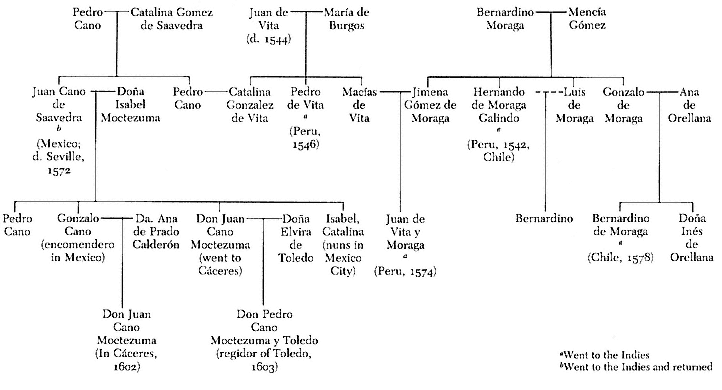
Table 5
The Cano, Vita, and Moraga Families of Cáceres
married members of the Cano and Moraga families. Diego Pérez de Vega made his will in 1547, naming Pedro Cano (the husband of Diego Pérez's first cousin, Catalina González, a member of the Vita family) his executor. In his will he said that his legacy should be used to establish a capellanía if his brother Andrés Vega did not return from the Indies, and he named his first cousin Macías de Vita (the brother of Catalina González) the patron. Pedro Cano also had a brother Juan Cano who had gone to the Indies; Pedro looked after Juan's affairs, and they made some joint investments. Juan Cano was an associate of Cortés who married doña Isabel Moctezuma (daughter of the Aztec emperor) in Mexico. He bought lands from the wife of Macías de Vita (his brother's brother-in-law), doña Jimena Gómez de Moraga, and from her brother Gonzalo Moraga in the 1550s. Two of Macías de Vita's Moraga brothers-in-law assigned him responsibility for the patrimony left in Cáceres by a third brother, Hernando de Moraga, who went to Peru.
Of this group of connected families, the Moragas were the wealthiest and most important, at least in the first half of the sixteenth century. Members of the family sat on the city council of Cáceres, and they held extensive properties around the village of Aldea del Cano (in Cáceres's district). The 1561 census of Aldea del Cano included Macías de Vita, Gonzalo Moraga, and Pedro Cano, so the three brothers-in-law maintained residences near one another (although they were all actually vecinos of Cáceres).[44] Because of this close contact and collaboration, it is not surprising that members of all these families went to the Indies. In addition to those already mentioned (Andrés Vega, Juan Cano, and Hernando Moraga), Pedro de Vita and Juan de Vita y Moraga, respectively the brother and son of Macías de Vita, went to Peru in 1546 and 1574, and Bernardino de Moraga, a nephew of Hernando de Moraga, went to Chile in 1578.[45] Of all those who emigrated doubtless the most successful was Juan Cano, who eventually returned to live in Seville. One of his sons left Mexico for Cáceres, where his father had accumulated considerable wealth in rents and properties, married into a high-ranking noble family, and built the so-called Palacio de Moctezuma in the parish of Santa María in the old city.
A final aspect of kinship networks that merits mention is that they linked individuals (and families) who did not necessarily live in
the same town or city, or even the same region. The geographical separation of relatives, of course, was one product of the move to the New World; but it should be borne in mind that the separation of family members and kinsmen resulting from emigration across the Atlantic had longstanding precedents in early modern society. Marriage patterns and the forms of mobility discussed in connection with both hidalgos and commoners meant that one's relatives might be distributed over a wide area. The presence or absence of such kinship ties might have had implications for the existence of a sense of regional cohesion or identity, as opposed to one that was strictly local. People living in towns such as Santa Cruz or Zorita in Trujillo's jurisdiction who had relatives in the city, for example, might have felt more strongly and directly tied to Trujillo than those who lacked such personal connections; this in turn might have been significant when such individuals found themselves in a very different environment, such as Peru, where local or regional identification took on a new meaning.
If it is possible to establish some sense of how kinship networks were defined and what were the socioeconomic and legal parameters of family and kinship relationships, can we also form a notion of the personal and emotional side of these relationships? Affirmations of loyalty and love for family members appear frequently in the documents and letters of the period. Regardless of whether duty and loyalty can be equated with the modern concept of love, many people formed undeniably strong attachments to family members. Use of the word "love" (amor) reflected an important emotional bond. In his will of 1534, made on the eve of his departure for Peru, Martín de Chaves left 50,000 maravedís to his brother Juan Ramiro, should he come from the Indies without enough capital, "so that he can live according to who he is. . . . because of the kinship [deudo] and love I have for him." He left the same amount to his brother Francisco de Chaves, also "por el amor que le tengo."[46] In 1602 in Peru Juan de Vera de Mendoza donated 800 ducados to his nephews to help support them in their studies "because of the great love he had for his siblings" (the parents of his nephews).[47] While high mortality rates at times could have engendered a certain transitoriness in family relations, they also might have strengthened the feelings of love and loyalty that surviving
family members had for one another. The letters of Andrés and Antonio Pérez from Puebla de los Angeles in New Spain in the 1550s to their brother Francisco Gutiérrez in Cáceres inviting him to join them stressed that he was the last of their stock ("nuestra generación") still living.[48] Expressions of concern and affection for family and relatives appear constantly in letters from emigrants in the Indies (as seen in those of Alvaro de Paredes) to their siblings, parents, aunts, uncles, or children. There is no reason to believe that such expressions were purely formulaic or that emigrants were at all unusual in having or expressing such feelings.
The bond between siblings possibly was the strongest, but there is also evidence of concern on the part of children for parents (especially mothers), parents for children, husbands for wives, and vice versa. For example, in 1567, after their father's death, Alonso Delvás wrote from Victoria in New Granada urging his brother Francisco Delvás to emigrate with his family and their sister; he sent 50 pesos, to "do what is obligated for the lady our mother and our sister until I provide more." The next year he wrote saying that their mother should not worry "because I will provide for her as long as I live."[49] Bequests in wills often included siblings, parents, nieces, nephews, and cousins, in addition to children. These again surely reflected personal feelings of affection or obligation since they were entirely discretionary. Hernando Corajo, who in his will of 1513 made his uncle Diego García de Paredes ("el Sansón") his universal heir, made bequests to the sons and daughter of his nephew Juan Corajo but explicitly barred Juan Corajo himself from inheriting anything; so there can be little doubt that personal preferences and sentiments must have figured. Alonso Bravo of Trujillo, who left a number of things to his wife, also bequeathed her 50 ducados "for the love and union and good fraternity we have had."[50]
As the example of Hernando Corajo suggests, feelings for family members need not all have been positive. The legal, socioeconomic, and customary framework that defined family relations might have acted to minimize conflict, at least within the nuclear family itself, since this framework served to define the expectations and obligations of each family member. Thus a younger son in a hidalgo family whose estate was entailed, for example, would know from an early age that he probably could expect only a limited inheritance, that he must seek an alternative career, and that he
might never marry. Open conflict between siblings seems to have been relatively rare, although it did occur occasionally. Doña María de Alvarado in 1554 sought to prevent her brother, Juan de Hinojosa de Torres, from sending his representative to Peru to look into the inheritance of their deceased sibling, Captain Pedro Alonso de Hinojosa. Juan de Hinojosa quite reasonably pointed out that until they found out if their brother had left a will and whether he had made some provision for his illegitimate children, there would be no way of knowing if any of his family in Trujillo stood to gain from his legacy. Yet the fact that Juan de Hinojosa planned to send a representative on his own without involving his sister suggests that her anxieties were not unfounded.[51]
Cousins were more likely to become embroiled in disputes than were siblings. In the 1550s Pedro Calderón de Vargas tried to claim the rich Vargas entail to which his cousin, doña Beatriz de Vargas, wife of Diego de Vargas Carvajal, had succeeded.[52] Andrés Calderón Puertocarrero sued for lands in Medellín that the mestizo son of his uncle don Pedro Puertocarrero, an encomendero of Cuzco, had inherited.[53] Cousins were more likely to become enmeshed in such conflicts because at this level of family relationships the legal complexities and loopholes of inheritance might leave some room to maneuver, whereas among siblings usually the terms of inheritance were clear-cut and incontestable. In the arena of more distant relations, a powerful and influential individual might succeed in imposing his will and bypassing legal safeguards. In Cáceres in the 1540s a lengthy suit pitted Pedro de Paredes, illegitimate son of Alvaro de Paredes Becerra, against his first cousins (his father's nieces). Their father, Alvaro's brother, had taken over the estate worth some 20,000 ducados after Alvaro de Paredes Becerra's death. An illegitimate child ("hijo natural") who had been recognized was legally entitled to two-twelfths of the father's estate if no other provision was made. Pedro de Paredes's cousins alleged that he was not their uncle's son and that he had not acknowledged him as such; but the court in Granada held that they had failed to prove their case and ordered them to pay Paredes his share.[54]
Women and orphaned children with property probably were especially vulnerable to exploitation if they lacked the protection of someone genuinely committed to their best interests. In his will of 1534 Martín de Chaves specifically repudiated a transaction he was
said to have made under the tutelage of Gonzalo de Torres (probably a cousin): "If I did it, which I deny, it was because I was a child and did not know what I was doing . . . and was led to it and deceived and I did it against my will."[55] Doña Mencía de Ulloa, the widow of García Holguín, in her will of 1570 complained that in 1562 she had signed certain instruments in favor of her nephews Sancho de Paredes Golfín and Pedro Alonso Golfín. She said that they had "told me that they were for my benefit and advantage . . . and I, as a woman and their aunt and very poor and more than 70 or 80 years old, believed them and trusted them and in effect they tricked me." She said that they pressured her into executing documents without her understanding what they were, and she revoked them in her will "because I am told by lawyers and theologians that I could not do it in prejudice of myself and of the legacies of my children and grandchildren.[56]
Intergenerational conflict and disputes over property were common. Under rare circumstances a parent actually could disinherit a child. Juan Carrasco, an innkeeper of Trujillo, in 1551 left his inn and the "third and fifth" of his goods to his sons Pedro and Gaspar Carrasco, but said that Juan, the son of his first wife, should inherit nothing. According to Carrasco, his son Juan had been very "ungrateful and disobedient," married against his will, tried to attack him with a sword, and injured someone else.[57] More commonly a parent might reduce the discretionary portion of an heir's legacy. Cristóbal de Ovando de Paredes, one of the wealthiest and most successful returnees to Cáceres from the Indies in the late sixteenth century, lived long enough to become estranged from his eldest son, don Cosme. Cristóbal de Ovando had succeeded to the entail of his father and grandfather (Francisco de Ovando, el rico) after two older brothers died without heirs. In 1602 he made a will in which he created a new entail; the original family entail was to go to don Cosme de Ovando and the new one to his second son, don Rodrigo de Godoy. But in a codicil of 1618 (by which time he probably was in his late seventies) Cristóbal changed the terms of succession radically, making don Rodrigo heir to the family entail and his third son, don Francisco, heir to the new entail, virtually cutting don Cosme off from any substantial parental inheritance. In 1635 don Cosme was still trying to claim one of the entails.[58]
Certainly property was not at the root of all family conflicts. Leverage over property could be used as punishment, and thus property as such might come into play only in the late stages of conflict. Personality clashes could wreak havoc in domestic situations, as occurred in the disastrous marriage in 1517 of the military hero Diego García de Paredes to doña María de Sotomayor, daughter of the lord of Orellana, Rodrigo de Orellana. The marriage lasted long enough for doña María to conceive their only child, Sancho de Paredes; but before the year was out, she had fled her husband's house, taking refuge first in the convent of the Coria in Trujillo and then later in her brother's house in Orellana.[59] The couple never lived together again, and Diego García spent most of the remaining years of his life outside Spain. The Crónicas trujillanas, especially the Hinojosa manuscript, recount a number of tales of family violence and scandal—jealous husbands who killed their wives, an argument between cousins that ended in bloodshed and the murderer's escape to "la India de Portugal"—but most of these stories belong to an earlier period. On the whole it seems likely that violence most often was directed toward nonrelatives (or distant ones) rather than close family members.
Discussion to this point mainly has focused on the structure and dynamics of the family and kinship network as units. Within these units the experience of individuals could differ notably. Two groups in particular—women and illegitimate children—occupied a position in the family (and society) that often was ambivalent and difficult. Because of the distinct and sometimes problematic nature of their position, they will be considered separately.
Women
A good deal already has been said or implied about the position of women in the family and society. Whereas within the family, particularly in the noble family, women sometimes were at a disadvantage with respect to the inheritance of property (especially in the case of entails, unless there were no male heirs), in terms of the larger society women had much the same legal rights as men. Women, like men, reached the age of majority at twenty-five, at which point they could in their own right conduct a full range of
legal transactions—buying, selling, and otherwise disposing of property, arranging dowries for daughters, drawing up wills—if they were single; if married, they had to obtain their husbands' consent. A woman retained the right to control and dispose of her dowry, and she was legally entitled to one-half of the economic gains ("bienes multiplicados") made during her marriage. Hidalgo women, and probably others as well, often received basic schooling and knew how to read and write. As seen, they could become the effective heads of household.
Women at all levels of society could be active economically. In the working groups they made a vital contribution to the domestic economy, both inside and outside the household. They not only shared the work of their husbands but also entered directly into occupations. Virtually all the bakers and cheese vendors were women, as were many candlemakers and innkeepers and, of course, midwives. The censuses of the towns almost always included women who were farmers. Girls and women entered domestic service as servants, housekeepers, and nurses; like men they might stay in service a relatively short time or remain in that situation virtually all their lives. Women with occupations who were married operated their businesses quite independently of their husbands. The 1571 will of Catalina Hernández la Rentera, wife of Francisco Sánchez Madaleno and vecina of Cáceres, shows that she was fully responsible for her bread-baking business. The will detailed a number of transactions that were still pending, mainly money advanced or lent outright. She left her daughter 12,000 maravedís and three beds.[60]
Upper class women did not, of course, pursue trades. Most upper class women who did not marry entered convents, usually local ones. The dowries families paid to convents might not have been standardized, but certainly they were well below the dowries provided for daughters who married. In addition to the dowry families had to guarantee an annual income for daughters who professed; 1000 maravedís a year probably was the minimum.[61] The convents provided what the nobility saw as a suitable alternative to marriage for daughters for whom they could not afford marriage dowries or for illegitimate daughters who perhaps did not fit in elsewhere. Cristóbal de Ovando Paredes placed his mestiza daughter, doña Beatriz de Ovando, whom he brought back from the Indies, in the convent of Santa María de Jesús.[62] Underage
women who had no close family with whom they could live also might be placed temporarily in a convent.[63]
While charitable donations might provide the wherewithal for a small number of women from the humbler classes to enter these convents, they were above all the province of noble women. The names of some of the women in the cacereño convent of San Pablo in 1556, for example, read almost like a register of the leading noble and hidalgo families: doña Ana de Ovando, abbess; María Gutiérrez de Ulloa, vicar; Beatriz de Figueroa, purveyor; Isabel de Paredes, doorkeeper; doña Catalina Enríquez, sacristan; and Francisca de la Rocha, Lucía López de la Rocha, Mayor de Orellana, doña Teresa de Monroy, doña María de Mendoza, doña María de Ovando, and Elvira de Paredes, nuns.[64] Women led a mostly comfortable and not necessarily very isolated life in the convents. The rules that the bishop of Coria sought to institute as a result of the visit he made to San Pablo and Santa María de Jesús in Cáceres in 1588 (no visitors unless a nun was sick, no personal servants, no visits outside except in the case of grave illness of a family member) surely reflected practices that were common at one time.[65] Given the large numbers of hidalgo women who entered the local convents, many must have been living alongside their sisters, cousins, or aunts. And, as often has been suggested, the religious life could afford a woman with intellectual or administrative ambitions or abilities a good arena in which to exercise them.
So far, then, the picture of the position of women in society does not appear especially bleak. They had legal rights and protections, important economic roles, and some possibilities for exercising real authority in the household or convent. But it will be recalled that almost invariably the majority of the paupers in the towns and cities were widows and single women. Certainly not all widows were poor; but the frequency with which they were listed as poor and having little or no property in the censuses suggests that the customary and legal mechanisms that governed family property and inheritance might have failed to provide consistently and adequately for older women. One woman included in the 1561 padrón of Zorita, described as "viuda dueña pobre," was the mother of an hidalgo said to have 12 oxen and cows, 250 sheep, and 30 pigs, quite substantial holdings in livestock.[66] If she was poor, clearly her son was not. If a husband failed to ensure that his wife would have
at least the usufruct of his property after he died, she might end up with very little indeed. Nonetheless, since frustratingly little is known about the significance of the classification "pobre," one cannot reach definitive conclusions about the economic status of many of the women designated as such.
Widows were not the only women whose position could be marginal. Upper-class women who did not marry could enter convents or perhaps live in the household of parents or siblings; but what became of the other women who did not marry, could not afford to become nuns, and had no male relatives to support them? If they could not enter service and had no trade, they had few recourses. One girl living in Ibahernando in 1561 was an orphan who owned only a small house with the roof partly fallen in. The census of Santa Cruz for the same year included a young woman who was "moza muy pobre vive de por si."[67] It is not surprising that the opportunities offered by the Indies might have been very attractive for single women who could find the means to get there. The sisters María, Catalina, and Marina Solano (ages forty, thirty, and twenty-eight years) left Trujillo for the Indies in 1563. Inés Gonzalez, a thirty-year-old single woman, left Trujillo in 1579 as the criada of the widower Diego Hernández de Aguilar, who was taking his two unmarried sisters and a three-year-old son to Tierra Firme. Lucía Alonso testified that Inés González had lived in her house since her mother died and had worked; now she had "sold the little she had to go to the Indies."[68] There are many similar examples of women emigrating as servants or accompanying brothers or uncles to the New World. In a society where many people were economically vulnerable, widowed and single women were especially so. The laws and customs that regulated the control and disposition of property at times might have failed to protect many women from privation and made them second-class citizens of society. The attractions of emigration might well have outweighed the risks for many single women who understood the precariousness of their position.
Illegitimate Children
Illegitimate children were no rarity in this society, but their position often was uncertain, dependent on the recognition and acceptance accorded by their fathers or other relatives. Some families
seem to have incorporated illegitimate children as a matter of course. Diego García de Paredes ("el Sansón") grew up with an older, illegitimate half-brother, Alvaro de Paredes, who accompanied him on his first trip to Italy. Both Diego and Alvaro had illegitimate sons of their own. Diego García de Paredes, born in 1506 and named for his father, during his active career made three trips to the New World and fought in Europe as well; Sancho de Paredes was Alvaro's son by a slave woman who belonged to his nephew, Hernando Corajo. The latter raised both of them; Corajo named his illegitimate cousin, Sancho de Paredes, successor to his entail in default of his uncle, Diego García, and his legitimate descendants and also freed Sancho in his will, since technically he was his slave.[69] Captain Gonzalo Pizarro, as noted, brought most of his illegitimate children into his household, with the exception of Francisco Pizarro.[70]
Possibly in the latter part of the fifteenth century and early years of the sixteenth local society was still sufficiently fluid even at the highest levels that integration of illegitimate children into the main line of the family was common.[71] The children of such respected trujillanos as Martín de Chaves, el viejo, and Gómez Nuño de Escobar were illegitimate but were the principal heirs, married well, and apparently were fully accepted into hidalgo society. During the sixteenth century, with the increasing consolidation and institutionalization of families and estates that resulted from the growing number of entails, incorporation of illegitimate children became less common. Nevertheless the tradition of having children outside marriage remained strong in the sixteenth century among all groups. Hidalgos might have one or two children by the same woman (usually, although not invariably, from the lower classes) before they married and established their legitimate family and household. Normally they made some provision for the children and sometimes the mother, and occasionally they brought the children into the household. This well-entrenched pattern proved to be ideally suited to the needs and circumstances of emigrants in the New World. During their early years in the Indies men would form liaisons with Indian (or sometimes black) women and father mestizo children, whom they often raised themselves, even after they married. When Andrés Pérez wrote to his brother Francisco Gutiérrez in Cáceres in 1559, he mentioned three legitimate children and
three illegitimate ones. His eldest illegitimate daughter, whom he named for his mother, was already married (he named another for an aunt); the oldest of his legitimate children, Francisco, was 10.[72] Since he probably arrived in Mexico in the mid-1530s, Andrés likely spent the first ten years or so there living with an Indian mistress who bore his three older children; only subsequently did he marry.
Perhaps the most striking aspect of the experience of illegitimate children was the variation in the treatment accorded to them. With the exception of the legal requirement that one-sixth of a man's estate go to illegitimate children whom he had recognized, treatment of such children otherwise varied according to the individual. While there are many cases that show concern on the part of parents for their illegitimate offspring, it must also be borne in mind that the documents reflect precisely those instances where parents made provisions for the care and support of children; the records are mostly silent as to the rest. Francisco de Ovando, el rico, who left substantial entails to each of his three sons, designated 50,000 maravedís for his bastard son Antonio when he died, quite a meager sum, given his means.[73] The rather high birthrates among slave women,[74] when considered in conjunction with the fairly modest rates of manumission, would suggest that many fathers did not trouble themselves to any great degree about their illegitimate offspring (although it might be argued that a child born to a slave would be raised in the household and therefore receive a certain amount of care).
Illegitimate children of hidalgos no doubt fared best when there were no legitimate heirs. Don Diego de Ovando de Cáceres, who died without legitimate heirs, made careful plans for the education and future of his illegitimate son and daughter. In 1574 he arranged for his son Hernando de Ovando to learn to read and board for a year with Bachiller Ojalvo, a priest. At his death don Diego placed him under the tutelage of his brother (and heir), don Francisco de Torres, and left him 300 ducados to go to the Indies or join the military. Don Diego's daughter, doña Teresa Rol, was to learn how to read and then enter the convent of Santa Clara in Trujillo.[75] Don Juan de Sande, member of the Sande family so active in the military, who fought in the Granada campaign but died soon after his return to Cáceres, made his illegitimate sons, Diego de Paredes and Jerónimo
de Sande, his heirs. At the time of his death he was still a bachelor, and the boys' mother, doña María de Paredes, was an hidalgo. The boys were brought up in Sande's parents' home (probably in Torrequemada).[76] Another cacereño, Diego de la Rocha, had to change the terms of the entail he founded in 1527 in which he named his son Juan de la Rocha, comendador of Santiago, his heir. In 1549 he made Diego de la Rocha, the illegitimate son of his deceased son Fabián de la Rocha, the successor, as he was the sole surviving heir in the direct line; his son Juan had been missing and presumed dead in Italy for years. The amended entail, however, stipulated that thereafter only legitimate children could inherit.[77]
While it is impossible to guess the status of most illegitimate children, certainly it was not unusual for parents to concern themselves with their upbringing. The attention paid to these children might have stemmed in part from the custom of making at least minimal provision for all children; it also might have represented a kind of hedge against the possibility of running out of heirs altogether, as in the case of Diego de la Rocha. In 1578 Juan de la Peña asked to be named guardian of his four-year-old illegitimate daughter, doña María de la Cerda. Her mother had died, and in any case the child had been raised in his home. Alvaro Sánchez de Ulloa in 1561 was named tutor of a one-year-old illegitimate son.[78] Noble fathers who raised or at least recognized illegitimate children for the most part probably expected them to join the middling ranks of hidalgos. Alvaro de Aldana Ulloa gave his "hijo natural" Gonzalo de Aldana lands and a vineyard in Sierra de Fuentes, 250 ducados in cash, and a pair of oxen when he married in 1577 on the condition that Gonzalo not ask for anything else from his estate beyond this. Aldana's marriage reflected his respectable but modest status. His bride's family pledged a dowry of 400 ducados and said that she "will go dressed in holiday clothes for her wedding, in accordance with her rank."[79]
For commoners illegitimate children might not have posed the same problems of social status, but they too had to decide how to treat them in terms of upbringing and inheritance of property. Jerónimo Cotrina of Cáceres simply recognized his two "hijos naturales" along with his two legitimate sons in his will of 1557.[80] Nuño Gutiérrez, a pharmacist of Trujillo, however, in 1551, together with his wife, made complicated arrangements on behalf of his
"bastard daughter" María reminiscent of those sometimes made by the nobility.[81] Thus, commoners were just as likely as nobles to show concern for their illegitimate children. In 1557 a barber named Francisco Martín bought his ten-year-old mulatto son from the executor of don Francisco de Carvajal's estate. A criado of Juan de Perero who had a child by one of Perero's slaves raised the boy in his home and secured his freedom from Perero's daughter, as Perero had promised he might do when his son reached the age of sixteen.[82]
Discussion of the treatment and experiences of illegitimate children raises again the question of the position of women. Who were the mothers of these children and what happened to them? They probably fell into two very broad categories—women who formed stable (if often short-term) liaisons (for example, doña María de Paredes who had two children by don Juan de Sande), and those who did not, including (sometimes but not always) slave women, but mainly prostitutes. The sisters Isabel García la Castra and Isabel García la Cuaca, who had between them five children when they decided to go to Mexico in 1578 to join their half-brother, probably belonged to the latter category.[83] Such women must have expected and received little or nothing in the way of assistance for themselves or their children from the children's fathers. For women of the first group, especially if the man were noble, possibly fairly well-understood rules governed the relationship between a man and his mistress. She would not have expected marriage to result from such a liaison, but most likely hoped for some provision for her support and possibly assistance in her marriage. A noble of Cáceres, Diego Cano de la Rocha, who decided to get married in 1568, made arrangements to end his relationship with Ana Sánchez. She was the mother of his two illegitimate children and might have been pregnant with a third in 1568. At that time he said he would provide her with a house and thirty fanegas of wheat but only on the condition that she would live "well and honorably" and have nothing to do with any man unless she married, which in fact she did two years later.[84] Women with illegitimate children often went on to marry; Francisco Pizarro and his half-brothers Gonzalo and Juan (who were full brothers) all had legitimate maternal half-brothers.
The status and position of illegitimate children, especially those born to parents of very different rank as the result of liaisons be-
tween hidalgos and women who were commoners, servants, or slaves, was uncertain. As neither completely noble nor common, they did not automatically fit in anywhere in the existing social hierarchy, and hence were likely to be marginalized—consider the aforementioned case of Gonzalo de Aldana, whose father provided him the means to become a prosperous but modest hidalgo-labrador in one of Cáceres's villages. The priesthood offered a suitable career for some illegitimate sons, just as the convent was appropriate for daughters. One of the sons of the influential priest Alvar García de Solís of Trujillo, Cristóbal de Solis, virtually grew up in the clerical life.[85] Alonso Pizarro's father, Juan Pizarro, a wealthy hidalgo and stockraiser of Caceres, supported him while he studied for the priesthood and promised him a bed, rents, and other things he would need after he was ordained in return for the time Alonso had served in the household of Juan Pizarro and his wife.[86]
Departure for the Indies was another option available to illegitimate children whose position and prospects at home were uncertain. Francisco Pizarro spent years in Tierra Firme before conquering Peru and returned to Spain only once, to secure the royal capitulaciones for the conquest and to recruit his brothers and other men. Diego García de Paredes, the illegitimate son of the military hero of the same name, must have found his position in Trujillo problematic despite recognition by his father, especially after the birth of his legitimate half-brother. Paredes's career reflected the contradictions between his abilities and social background, on the one hand, and his insecure position at home on the other. By the age of twenty he had left Trujillo for the Indies, spending time in Tierra Firme and Peru before returning to Spain in the 1530s. Soon after his return he joined the military and fought in France, Flanders, Germany, Italy, and Sicily, attaining the rank of captain, returning to Trujillo only to leave again in 1544 with Francisco de Orellana's expedition to the Amazon. Active in the area of Venezuela for some fifteen years, he went back to Spain again in 1562 and then departed within the year as the appointed governor of Popayán. He was killed by Indians on the Venezuelan coast before he could take his post.[87] While doubtless Diego García de Paredes benefited from family connections despite his illegitimacy, he could hardly have achieved such distinction if he had stayed at home.
Inheritance
The basic pattern of inheritance in central and southern Spain was equal division of property among heirs, male and female. A number of practices sanctioned by law, however, in fact often modified the system of partible inheritance. Either parent could set aside one-third of the inheritance for one child, who also received one-fifth of the remaining two-thirds; this was the "tercio y quinto."[88] Among the nobility the tercio y quinto became the basis for entails that became increasingly common in the sixteenth century; but in fact anyone could opt for this mode of inheritance rather than equal division. Children who entered religious orders received a smaller inheritance than other heirs, and they frequently renounced any further claim to their parents' legacy when they joined the order. Other individuals also might renounce their inheritance in favor of their siblings.[89]
These aspects of the system of inheritance are reasonably clear, but others are more problematic. A woman retained her dowry and therefore was free to dispose of it in her will (she might in fact have promised or donated part or all before her death, possibly as part of a dowry agreement for a daughter). She also was entitled to half of the "bienes multiplicados" or economic gains made during her marriage; but whether she could dispose of this property, or whether it was considered part of the inheritance to be divided equally among heirs after her husband's death (that is, she would have the usufruct of such property until her own death, but then could not dispose of it herself) is not entirely clear. The wills of commoners often designated the spouse as a coequal heir along with the children, or even the principal or only heir.[90] García López de Aviles, whose eldest son, Pedro Lopez de Aviles, received the tercio y quinto of his estate and married Isabel Ruiz, the daughter of the returnee from Peru Alonso Ruiz, assigned his wife the usufruct of his property for her lifetime if she did not remarry.[91] Nobles usually made few provisions for wives, beyond perhaps the furnishings and usufruct of the house or the income from rents during her lifetime, since a woman had her dowry and whatever other property she inherited from her parents.[92]
Although property was conveyed in different ways and at different times (through donations, dowries, wills, entails), all property
"counted" in the final reckoning of inheritance. A woman might receive her entire inheritance as her dowry, or a man might receive the bulk of his when he married; but ultimately the legacy took into account all earlier donations. Gonzalo de Olmos, a returnee from the Indies, in his will of 1574 divided his legacy equally among five sons and three daughters (the only exception was a daughter in the convent of San Pedro). He said that the 100,000 maravedís of censos that he gave to his son don Juan de Olmos when he married should be deducted from his share.[93] Three of Gonzalo de Olmos's sons were in the Indies at the time the division of property was made, but physical absence in no way altered an heir's rights to a share in the legacy. Francisco Pavón, a wool carder, and his wife, Isabel Martín la Corneja, executed a joint will in 1574 in which they stated that their son Juan de Cáceres had left for the Indies more than twenty-six years before. They had heard news of his death but did not know if he had left any legal heirs. They instructed that their legacy be divided among their other children but that an appropriate portion should be paid if a legitimate heir of Juan de Cáceres appeared in Cáceres bearing the required proofs of identity, taking into account the 24 ducados they once had given Juan de Cáceres to buy a horse.[94]
Mandatory partition of property generally made wills unnecessary, unless an individual wished to make special bequests or otherwise depart from the basic pattern of equal division among heirs. Members of the upper and upper-middle classes—above all, wealthy hidalgos—were most likely to go before notaries to draw up wills and entails; they held the largest amounts of property and often made complicated arrangements for disposing of it. Therefore we can examine in some detail their inheritance practices.
Entails proliferated in the sixteenth century, reflecting the consolidation of wealth among upper class families and the desire to preserve and perpetuate the family estate (and hence the family's status). The entail often was linked to a surname, coat of arms, and title; when a number of noble families of Trujillo acquired señorío over villages formerly under Trujillo's jurisdiction, these villages also entered into the family entail. Both men and women could establish entails, those of the latter reflecting greater variation. Direct descent in the legitimate male line was the universally favored formula for the entails of fathers and the eldest son was
usually favored. Entails generally barred inheritance by illegitimate or adoptive children, but daughters usually received preference over other relatives.
The entails established by women were likely to designate a younger son or a daughter, since the oldest son presumably stood to inherit his father's entail. Doña Francisca de Mendoza, the wife of Diego de Ovando de Cáceres (son of Captain Diego de Ovando de Cáceres) founded an entail in 1539 in favor of her youngest son, Juan de Vera y Mendoza. Doña Isabel de la Peña created an entail in 1575 for her second daughter; but if this daughter married someone who held an entail, doña Isabel's legacy would go to her second son or other daughter.[95] Here again, then, the desire to make an equitable provision for as many children as possible figured. Women's disposition of property in wills and entails often complemented or supplemented the disposition made by their husbands, reflecting a coordinated strategy for the distribution of property and wealth to the next generation. Women sometimes joined their legacies or entails with those of their husbands, at least if they stayed in the direct line; if the husband's entail passed outside the direct line, however, they frequently named their own relatives as subsequent potential heirs.[96]
Despite the many conventional and formulaic elements that characterized the entails of men especially, in one sense their hallmark was their individuality; the founder could make his own determinations with regard to succession, and entails could incorporate a number of particular provisions along with the standard ones.[97] The eldest son was not always the principal or most favored heir. Francisco de Solís of Cáceres wanted to leave his entail to his emigrant son Gómez de Solís rather than to his eldest, although Gómez ultimately turned it down and stayed in Peru.[98] Francisco de Ovando, el rico, established entails for each of his three sons, rather than just favoring the oldest, in effect creating three new branches of the family.[99]
Entails sometimes included the conditions under which heirs might succeed or how they were to be chosen. Diego de la Rocha (whose heir was his illegitimate grandson) said that any woman inheriting the entail must marry someone from the Rocha lineage and retain the name and arms. Mandatory changes of names as well as designated spouses could form part of the conditions for succes-
sion. Diego de la Rocha required his grandson to marry doña Mencía de Carvajal, whose family pledged a dowry of 4000 ducados.[100] Hernando Corajo, on the other hand, suggested that if his illegitimate cousin Sancho de Paredes succeeded to his legacy, he might marry his nephew's daughter, María Jiménez, if she wished; but he stressed that this was a request, not a requirement.[101] Children did not necessarily do what their elders suggested, even when the stakes were high. In her will of 1575 Catalina Alvarez de Toro said that she and her husband had created an entail that her eldest grandson would have inherited had he married her niece doña Mencía de los Nidos. Since he did not, her grandson Diego de la Rocha would succeed if he changed his name to "Rodrigo de Toro de los Nidos."[102]
Many instruments of entail specified detailed lists of successors in default of the direct male line, but others were more abbreviated, sometimes directing the establishment of a capellanía or some charitable foundation if there was no one in the direct line or among close relatives who could inherit. Diego de la Rocha, for example, instructed that if his son or grandson or their descendants were unable to succeed, the entailed property should be used to found a convent of the order of Santa Clara (under the Franciscan order). His house on Pintores street was to be used for the convent itself, and he made provisions for some poor women of Cáceres to receive food, clothing, and medical care and to enter the convent without paying a dowry.[103]
Entails, along with the conditions for inheritance sometimes laid down in wills, often restricted the choices an individual had in disposing of property. The entail held by Dr. Nicolás de Ovando, which he had inherited from his father and included his house in the parish of Santa María, a country house, and lands in Zamarrillas and Torreorgaz and other properties, went to his nephew Hernando, since he apparently had no legitimate children of his own. If Hernando could not succeed, then the entail would go to his niece, or to whoever inherited the estate of his grandfather, Captain Diego de Ovando. Dr. Ovando left to his daughter, doña María de Ovando (doubtless illegitimate) only a silver dish; he apologized to her and her husband, Dr. Carrillo, saying "I beg [them] . . . to forgive me for not being able to do for them what I would like, because my estate is entailed." To his grandson, Nicolás de Ovando,
who wanted to study in Salamanca or Alcalá, he left all his law books.[104]
Dowries
Dowries fulfilled a dual role in family relations and strategies. On the one hand the value of the dowry related directly to the whole question of the division and conveyance of property discussed above, whereas on the other the dowry played an important part in creating or maintaining alliances between families, whether for economic, social, or political reasons (most likely some combination). The bride's family's decision regarding distribution of property and its economic means together determined the dowry's value and composition, but the marital alliance formed as a consequence could generate new means and resources. The dowry agreement marked the intersection between property considerations and the formation of a new family and household, two distinct but related aspects of family life. A marriage could represent the culmination of some complicated negotiations and considerations, as seen in the example of don Francisco Altamirano, the oldest son and principal heir of Licenciado Altamirano. In June 1580, soon after his father's death, don Francisco gave his power of attorney to one of his brothers to arrange his marriage to doña Leonor de Montoya of the Villa de los Santos. Within a year, however, don Francisco was married not to her but to doña Francisca de Silva Puertocarrero, who gave her husband license to sell some lands she had near Villanueva de Bancarrota in 1581.[105]
As was true for wills and entails, dowries among the nobility involved much higher sums and more complicated arrangements than those of most commoners. The dowries of the nobility frequently included rents, properties, and jewelry, although there was a tendency during the sixteenth century increasingly to express the amounts in lump sums (which still might be met in various ways). When Cosme de Ovando Paredes married doña Isabel de Cárdenas in the late 1570s, she brought a dowry of 5000 ducados in juros, agricultural land, trousseau, furniture, and cash, guaranteed by her brother and his wife since her parents were dead. Families generally did not pay the dowry all at once but rather in a series of installments over several years. In 1577 Cosme de Ovando Paredes
had received about 2400 ducados of his wife's dowry; in 1580 he received another sum of around 550 ducados plus a female slave.[106]
Despite the great discrepancy in size between noble dowries and those of more modest hidalgos, middle-class, or working people, there were nonetheless elements in common. The dowry or marriage agreement normally included house furnishings and a trousseau. Pedro Calderón de Vargas testified that before his sister doña María de Carvajal married Andrés Calderón Puertocarrero, they went to Toledo to buy the trousseau that his mother gave to his sister. In 1591 Andrés Calderón himself authorized his future son-in-law Alonso Solano to collect 100 ducados in rents to buy bed linens, and the two men went together to Trujillo's weekly mercado franco and spent 230 ducados on a bed and other items.[107]
Another feature common to dowry agreements at all levels of society was that they often were made by a woman's family or household rather than just her parents. Siblings, uncles, even cousins contributed part or all of the dowry in many instances, even if one or both parents were still alive (although more likely if the father were deceased). In 1573 doña Teresa Rol's siblings—don Diego de Ovando de Cáceres, don Francisco de Torres, and doña Beatriz de la Peña—were paying off the dowry of 2300 ducados that had been pledged for her marriage to Juan de Carvajal Ulloa in 1561.[108] Isabel González's daughter Catalina received a dowry of 1000 ducados, 590 from her mother and 410 from her returnee brother Antonio Cotrina. In addition her mother gave her various pieces of jewelry, cloth, and clothing, and Antonio gave her a green satin skirt worth 80 ducados. In 1575 three brothers in Cáceres who were wool carders gave their sister a house in the parish of Santiago with a small yard and three beds as her dowry.[109] A criada's employer often provided all or part of her or her daughter's dowry, which probably was considered a basic part of the terms of employment. Isabel Durán, who made her will in Cáceres in 1571, served Diego de Cáceres and his wife doña Francisca de Torres for eighteen years (and their daughter doña Jerónima for two). They had given her 50 ducados when her daughter married, although her basic compensation was around 4 ducados a year (in addition to clothing and other necessities).[110]
Dowries among the nobility tended to rise in value over the sixteenth century. Don Francisco de Torres, who became heir to
the entail founded by Captain Diego de Ovando de Cáceres when his brother don Diego died in 1575, was promised a dowry of 9000 ducados when he married a woman from Mérida in 1576, whereas his paternal grandmother had brought a dowry of 1600 ducados in rents, houses, and cash inherited from an uncle.[111] Some of the most notable sums of the later sixteenth century involved the families of returnees from Peru. Returnee Juan Pizarro de Orellana pledged 6000 ducados for the marriage of his daughter doña Catalina de Orellana to Juan Barrantes, son and principal heir of returnee Pedro Barrantes. His granddaughter, doña Estevanía de Orellana (daughter of Hernando de Orellana), brought lands valued at 5000 ducados (inherited from her mother, doña Mencía de Tapia) and an additional 19,000 ducados when she married Francisco Pizarro, son of Hernando Pizarro and doña Francisca Pizarro, in 1586.[112] The dowry often was identical with the women's anticipated inheritance. When returnee Sancho de Figueroa married doña Francisca de Ulloa in 1548, her dowry included the following: half of her father, Hernando de Ulloa's, estate at La Cervera, which consisted of a house, farm lands, barley fields, and corrals; half of a vineyard and half of his pastures in Pozo Morisco; one-third of an oven; half of whatever had belonged to doña Francisca's mother, Catalina de la Rocha, and after Hernando de Ulloa's death, half of the goods of his estate.[113] Sancho de Figueroa died quite soon after the marriage; but not surprisingly doña Francisca, with so substantial a dowry, remarried quickly.[114]
The dowries of the more middling hidalgo families of course were much lower. Baltasar de Valverde's wife brought a dowry of 500 ducados (Valverde was the brother of Licenciado García de Valverde, who served on several audiencias in the Indies). Pedro de Grajos, a notary of Cáceres, endowed one daughter (who married Alonso de Solís, who succeeded his father-in-law as notary) with 350 ducados and another with 500; one of Grajos's sons and two of his sons-in-law contributed to the latter.[115] The dowries given to daughters of the well-to-do upper strata of commoners fell within a similar range. Hernando Genio, a barber, acquired a dowry of 400 ducados when he married in 1574, and Cristóbal García, a pharmacist and active entrepreneur of Cáceres, endowed his daughter with 1500 ducados when she married Licenciado Gaspar Sánchez.[116] Descending the socioeconomic scale, dowries
became more modest yet, although the crucial elements of establishing a new household—furnishings, a house, a piece of land, or a work animal—continued to figure.
Conclusion
Examination of the institutions that governed the distribution of property—wills, dowries, entails—reveals a number of practices that characterized groups at all levels of society: the tradition of equal division among heirs, the use of dowries to effect alliances and help provide the means for establishing new households, evidence that property distribution and economic decision making concerned the entire family and not just the head of household. The basic demographic features that shaped family life—age at marriage, birth rates, illegitimacy—also prevailed throughout society. At the same time, however, much evidence suggests that noble families were modifying some of these basic customs and patterns with some distinct socioeconomic and demographic repercussions, and possibly these distinctive practices of the nobility were becoming more common in the sixteenth century. The establishment of entails and provision of high dowries for daughters fostered a situation where a family might produce only one substantial heir—that is, one son who inherited the bulk of the estate and thus could marry well and establish his own noble household—and formed one other important marital alliance via the daughter who received a high dowry.[117] This pattern of inheritance, though far from universal or invariable, certainly contributed to the consolidation of noble estates and fortunes, but also resulted in notable rates of celibacy as many children (male and female) of the nobility entered religious orders or otherwise failed to marry and produce legitimate heirs.
At the same time, that group's inheritance practices also freed a number of young men to pursue careers that took them away from home and generated new connections and opportunities that benefited both these sons and their families. Emigration to the Indies, whether temporary or permanent, not only proved attractive for these young men but could transform their prospects in life dramatically, since the new resources and rather distinct social milieu of the New World often enabled them to marry and establish house-
holds there or when they returned home. The possibilities offered by the Indies might not have had quite the same impact on the lives of commoners (that is, of allowing them to avoid celibacy imposed by socioeconomic constraints); but the presence of many single men and women of the middle- and working classes among the emigrant group suggests that for them as well the closely intertwined economic and demographic aspects of family life played a part in the decision to emigrate.