
The Balance of Administrative and Political Power
Kenyatta's distrust of his own party, and Kenya's heritage of strong administrative leadership, conspired to produce a system of policy-making in which civil servants have a highly visible and powerful role. As Cherry Gertzel remarked,
the decision to use the Provincial Administration as the agent of the executive meant that there were two groups of men in the country each of which believed [it] could legitimately claim to lead the people. On the one hand, [of course, were the Members of Parliament. On the other,] the Administrative Officers saw themselves, on behalf of the President, as leaders of the people, a role the President had explicitly assigned them. And they believed themselves much more able to assume that responsibility than the politicians.[14]
Kenyatta used a revealing metaphor to defend this conception of administrative power. He argued that
the role of the civil servant is that of the professional. He is employed by the Government to get things done. There are not many of us, I hope, who would presume to tell a doctor how and where to operate on a sick person. We should apply the same restraint in our dealings with other professionals.[15]
This metaphor implies a tremendous delegation of authority to administrators. And this is precisely what occurred during Kenyatta's presidency.[16]
Just how, then, were decisions made in this era? How much discretion did civil servants enjoy and which ones exercised it? What roles remained for cabinet ministers? Appendix B provides a careful quantitative analysis of data that can help answer these questions. Although the analysis itself is complex, the answers it provides are simple enough.
Following the Commonwealth tradition, a Kenyan ministry is headed by a member of Parliament, selected by the president to thereby become a minister and member of the cabinet. (See fig. 5.1.) Formally, a minister is responsible for all policies and programs in his ministry. The cabinet meets regularly and makes decisions, but not all ministers play a significant policy role within it. Some of the ministers are both close to the president and deeply interested in matters of high policy. They have considerable influence. Many, however, see their ministries simply as sinecures from which they can draw jobs and other resources for them-
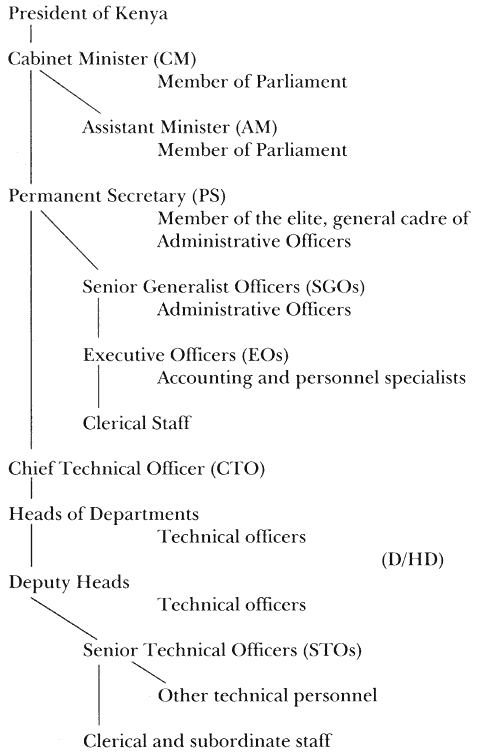
Fig. 5.1
The structure of a typical ministry headquarters
selves and their constituencies, leaving the determination of government policy to the president, his closest advisers, and civil servants. This breach of typical Commonwealth practice derives partly from the fact that many cabinet ministers (CMs) are included in the government because the president wishes to have their support, but not because he has any confidence in their decisions. More important, however, many of these ministers find little reward in policy-making because Kenyan politics is based more on patron-client networks, which distribute discrete
benefits, than it is on the interests of associational groupings, which can be served by collective policies. Thus the system works in such a way that most ministers exercise more influence on matters of patronage and the regional distribution of benefits than they do on general matters of policy in their ministries. Even there their influence, although noticeable, is modest.
Nominally the next office in the hierarchy is that of assistant minister (AM). This role has no inherent policy significance. In Great Britain the office's title was that of parliamentary secretary, and the occupant was expected to represent the ministry in the legislature when the minister was unable to do so. In Kenya the role is used much more as a political plum, with the holder receiving a better salary, more prestige, some staff support, and access to a small amount of patronage. In Kenya over half the M.P.s are either ministers or assistant ministers. They are defined as members of the government and are required to vote with it on any matters of confidence, thereby assuring the government of an automatic majority in the legislature.
A ministry's permanent secretary (PS) reports directly to his minister and will be the ministry's de facto head if the CM does not have the interest or ability to exercise policy control. Permanent secretaries (PSs) are members of the elite generalist cadre of Administrative Officers, who also staff the Provincial Administration. Most PSs have served as district commissioners (DCs) or district officers (DOs) earlier in their careers. The post of provincial commissioner (PC) ranks as the equivalent of a PS, however, and very few PCs ever become PSs. Nyachae was among the very few to have held both positions.
The appointment of PSs attracts considerable public attention in Kenya, and they are presumed to exercise considerable influence. All civil servants in a ministry are supposed to communicate with their cabinet minister only through their PS and are subject to his authority. The analysis presented in Appendix B suggests that the real influence that goes with this authority is modest. First of all, like other civil servants, PSs are able to exercise influence only if they have the support of the president. In the Kenyatta years that generally meant that they were Kikuyus. They and other powerful administrators were more extensions of the president's power than influential in their own right. Thus what appears to be administrative power in Kenya is much more the dominance of the presidency over the cabinet and legislature.
Second, PSs appear able to influence the broad policies that their ministries adopt but to have very little effect on the way in which they are administered. They can have an impact on the setting of the formulae that are used to distribute benefits, if they have the president's support and if they have sympathetic technical officers working with
them. But the evidence suggests that they have little influence beyond these broad policies, and even what they have is achieved in interaction with those above and below them in the hierarchy. Their policy role is one of transmitting presidential support to like-minded technical officers. They may be able to get little perks for their home areas, but their subordinates appear to deliver them by diverting projects from close neighbors, not by altering the broader ethnic or regional distribution of benefits. Permanent secretaries rotate too frequently between ministries and have too little command of the technical intricacies of their organizations to be able to have a deep impact. The exceptions to this general rule are PSs such as Harris Mule, who have come to their positions by rising through the technical ranks in their ministries—not those who are Administrative Officers and come from the Provincial Administration.
Next in line is the chief technical officer (CTO) of the ministry (whose specific title usually reflects the organization's professional task, e.g., chief engineer or chief medical officer). Under him are the department heads (DHs) and their deputies (DDHs), in most ministries technical officers straight down the line. The technical staff run a ministry's programs and projects, while the generalist Administrative Officers are the personnel and financial administrators and assist in policy formation. To the extent that we can speak of administrators as having real power in the ministries, it lies among the technical officers. Once again, this is a derivative form of influence; it depends on the support of the president. Again, during the Kenyatta years this generally meant being Kikuyu. In cases where broad policies are being set, this presidential backing appears most effective when it is mediated by a PS of the same ethnic group. Once we get to implementation, the relation of the technocrats (CTO, DHs, and DDHs) to the president does not seem to need an Administrative Officer as an intermediary.
In saying that the influence of the technical leadership is dependent on the president, we are speaking, of course, of positive influence. Such officers need presidential backing to accomplish something they favor. But if they are uninterested or opposed to some goal of the president's, that objective will be less well achieved than otherwise. Though dependent in their positive influence on policy and implementation, technocrats do have some independent negative influence.
The importance of the influence that the technical leadership has on public policy should not be overstated. It shares the same matajiri (well-to-do) class status of those above it and therefore can be expected to pursue economic policies that appeal to the common interests of both groups. In terms of class analysis, a role in decisions for technicians is more likely to make a difference in the style and effectiveness of policy
than in its substance. The tensions between these hierarchical levels are most likely to be visible on matters relating to the regional distribution of benefits. Nonetheless, these are highly charged issues in Kenya.
This understanding of the technical leadership's having more influence than their Administrative Officer superiors is a new insight into the workings of Commonwealth systems. Once stated, however, it becomes clear why three of our four successful administrators have been technocrats.