
9
Looking West to the East
Pel and the Asian Books
One day in the fifties, sometime after Phil Lilienthal became assistant director (later associate director) of the Press, he and I sat in my office discussing whether to make a concerted effort to build a publishing specialty in Asian books.[1] At that time we had almost nothing: a few odds and ends from the late forties and early fifties, things that had wandered in or imports offered by London publishers. Some were good books, but taken together they were odds and ends. Thus I don't remember how we got acquainted with Charles Boxer, the great and unconventional English historian, whose Christian Century in Japan, 1549–1650 we published in 1951. Perhaps through our Latin American connections.[2]
Asian studies, the province of a few before the war, were expanded quickly thereafter in the major universities, including Berkeley and to some extent our other campuses. There were set up research centers for Chinese, Japanese, South Asian, and Southeast Asian studies, bringing loosely together scholars from several departments, especially history and political science. We looked at this
[1] "Pel" to me will always mean Philip E. Lilienthal. That is how he signed his office memoranda.
[2] Boxer's chief scholarly interest was Portuguese expansion around the world. We brought out his Colonial Age of Brazil in 1962 and Four Centuries of Portuguese Expansion , in cooperation with Witwatersrand University Press, Johannesburg, in 1973. Both Boxer and his wife, the writer Emily Hahn, were prisoners of the Japanese during World War II.
growth of research interest in one of the two large cultures of the world, and thought it a ripe field for picking manuscripts. And that if we did not bestir ourselves the flying editors from Harvard, Princeton, and elsewhere would gather all the fruit. But a halfhearted move with a junior editor would not do in such a huge field; we had better make a big effort or none.
We had Phil, with his wide experience in the Asian field, if we chose to divert the larger part of his energies, and we thought we might obtain the active help of the various centers. So Phil and I sat there that day, knowing that we had to make a decision. I asked whether he wanted to throw himself into the venture—for twenty years perhaps, although we always avoided distant visions. He asked whether I wanted him to. We were not batting the ball into each other's court, as it may seem. We had the same wish, I think; each was making sure of the other. So Phil said yes, and went off to his desk and began making phone calls and writing letters—those splendid letters that became known to so many in and out of the Asian field.[3]
Although he had many other interests and an education that was broadly European, Phil was involved with Asian peoples and Asian studies for almost his entire life. After leaving Harvard in 1936 he went on a wanderjahr , or maybe two. With no knowledge of his itinerary and remembering only the occasional remarks he let fall, I believe that the greater part of his time was spent in India and Southeast Asia. Returning home to New York, he went to work for the Institute of Pacific Relations, then perhaps the primary agent of study and publication in the field of contemporary Asia. Not long thereafter William L. Holland of the institute put Phil in charge of a printing and publishing program in China, editing and producing IPR books for markets in Asia and elsewhere. Holland remembers—in a recent letter to me—that Phil found time from his frustrating struggles with
[3] When he retired a few of them were gathered up and printed in a booklet entitled Letters from Phil (1980).
Shanghai printers to join a volunteer fire-fighting brigade there. "You can imagine what an extraordinary time it was for him, especially knowing that the Japanese military were all around him waiting to pounce. By the time he came back he had acquired a remarkable knowledge of copy-editing, proof-reading, paper-purchasing, type-faces, shipping, sales promotion, currency exchange, and much more."
In Shanghai Phil became acquainted with John S. Service, an American consulate officer, who many years later, retired in Berkeley, helped us with some difficult editorial revision of Asian books. Of their Shanghai meeting more than fifty years ago, Service recalls, in another recent letter: "He was already—in his youth as well as later in life—a wonderful, kind, out-going, intelligent, imaginative, quietly impressive person."
During the war Phil worked for the Office of War Information in San Francisco as chief of the Chinese Division, supervising, among other things, shortwave radio broadcasts to Asia. Among those who worked for him then was Max Knight, né Kühnel, an Austrian refugee by way of Shanghai, who later came to the Press and served for many years as one of our senior copyeditors. In 1946 Phil returned to New York and spent several years as chief editor of Pacific Affairs , the journal of the International Secretariat of the IPR.
During the cold war hysteria the IPR was heavily attacked by the McCarthy and McCarran committees of Congress; some of its left-leaning officers were forced to leave, and financial support dwindled drastically. Of the senior officers only Holland remained, and it was he who held the organization together until it was dissolved in 1960.[4] Meanwhile, Phil, who had not been attacked, resigned and moved to California. In 1954, with an introduction from Jim Hart, then professor of English and later director of the Bancroft Library, he came to the Press, looking for work.
The only open job we had—several months later—was one that
[4] Taking Pacific Affairs with him, Holland then moved to the University of British Columbia as head of Asian studies. There I knew him in the early 1960s, when I visited Vancouver on editorial scouting trips.
he was vastly over-qualified for, writing advertising copy in the sales department. He took it willingly, with no false pride of position, and went to work with the incredible efficiency that we all came to know. But at that time the Press was expanding, and I had felt the need for someone of high ability to help me plan where to take it and how to get there. A few months of observation were enough; I asked Phil to become assistant director and wrote to President Sproul for approval. Phil himself was willing but hesitant, suggesting that Sproul might not allow me to make the appointment. Although not himself attacked during the IPR troubles, he had signed a protest against persecution of intellectuals and had got his name on a list of people acquainted with communists and possibly sympathetic to them. Phil seemed sensitive about the matter and never discussed it. I was not concerned and thought the president would pay no attention.
In this I was wrong but never knew it until recently. Papers found in the University archives show that someone called that list of names or another to the president's attention. Sproul held me up for a few days but must have found nothing of consequence because he allowed the appointment to go through.
Phil always had a strong sense of social justice and throughout his life worked in his quiet way for the American Civil Liberties Union and for other organizations whose purposes he thought worthwhile. To me he seemed one of a rare breed, the hard-headed liberal. He once told me, speaking of his work with the NAACP, that he was not about to bend over and invite kicks, as so many white liberals did in those days. And after retirement, when he did volunteer work with prisoners in the San Francisco city and county jail, he offered help but not sympathy.
When Phil accepted my offer, neither of us could have known what we were letting ourselves in for. Possibly he did and decided to gamble on me. For better or worse, and without knowing much about each other, we began a sort of working mariage de convenance that lasted for more than twenty years. It was not easy or straightforward, especially at the beginning. When a director wishes to take on
a second in command, the easy way to avoid trouble is to choose someone inferior to himself. Some executives, including a friend or two at other presses, have worked in this way, and not without success. But little venture, little gain. When one chooses an equal, or perhaps in some ways a more-than-equal, then it is a chancy business that may blow up in both their faces. But if they can synchronize their aberrations (as a friend of mine said about marriage itself), ride out the storms, and find a way of working together, then the rewards will be there.
There were difficulties, not all of them our own. The Press had just come out of—or rather, was not yet quite out of—the fight I have mentioned with the printing department and the University business office. These were the dying years of the long Sproul regime, and neither he nor anyone else would or could cut the ties that bound us, however loosely, to the printing office. We lived uneasily under the same roof, outwardly polite, inwardly thinking: "Smile when you call me that." The tension did not go away completely until we moved out of the building in 1962.
Within this tense environment we worked out our own problems. Both Phil and I were strong-minded—bull-headed, if you like. Some people have taken his modest speech at face value, but behind that almost oriental self-disparagement lay a fierce sense of pride. He knew his value and very occasionally stated it. He is one of three people I have worked with, all quite superior and all now gone, whom I used to characterize as mixtures of arrogance and humility. The words are strong, but no others will quite do. But I should add that the two qualities were so intertwined, so blended into each other, that neither ever appeared quite alone—to those who knew them well enough. It was an attractive mixture, one that I always admired.[5]
If Phil was not an easy person, neither was I. The great intra-University fight had taught me diplomacy for use where essential but
[5] The other two were Thomas J. Wilson, late director of the Harvard University Press, and Michel Loève, mathematician and member of the Editorial Committee. Other superior people did not show quite the same blend of qualities.
had also stirred up for part-time use what may be called the combative side of my nature. Both sides had been needed for survival. So neither of us was relaxed, but fortunately, we both had the good sense, or the instinct, not to throw out challenges, and the patience to ignore opportunities for trouble. There were times when Phil blew his temper at me, which may surprise those who never knew he had one, and other times when I could see him exerting control. The learning process went on tacitly, without discussion, never laid out on the table or put into words, each making his own adjustments, until we evolved or discovered a kind of harmony. We came to know what each other was thinking or was about to think, and eventually learned that we thought alike most of the time. How this happened I cannot say. Perhaps, out of some kind of instinct, we played down the ways in which we were different and made daily use of the ways in which we were much alike. Two measures of the relationship: I trusted him completely, and he turned down offers of higher-ranking jobs elsewhere.
In the later years, when this unexplained kind of understanding had worked itself into place, Phil was a great joy to me in our weekly meetings with the Berkeley sponsoring editors. By that time there were quite a number of them, all capable, some brilliant, with various backgrounds and interests. Phil was in daily charge of the editors, especially after we moved that department to a separate building, but I had begun my work at the Press with a deep concern for the kinds of books we published, a concern that might be shared but could never be given up. So the two of us, by now thinking much alike, acted jointly to exert general control over the book program and to keep it going in directions we thought best. The weekly meetings became, in part, times for the exchange of ideas, for the younger editors to try out their plans, even to challenge their elders. But in part these were also training sessions, although never called such. In our parallel Los Angeles editorial office, relations were rather different. Occasionally we all met together.
None of the Berkeley sponsors, capable as they were, had a gen-
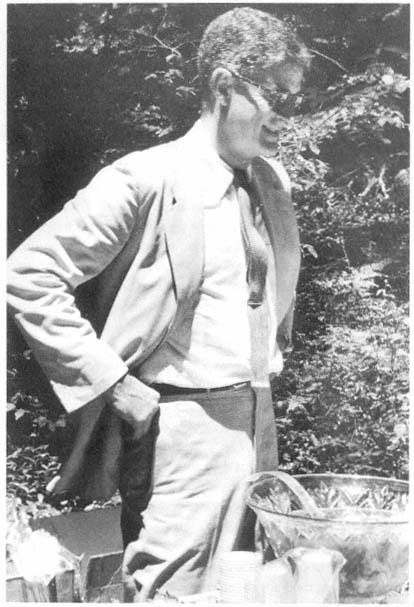
Phil Lilienthal. An informal moment.
eral education equal to Phil's or a wit as quick as his. When in the course of our discussions I might make a sidelong literary or historical reference, never explaining it, I found myself glancing around at a room of blank faces—except Phil's. Always there was a small sign, movement of an eyebrow or slight change of expression, nothing obvious, that showed he had picked up the point and understood its relevance. It was satisfying. Points missed are breath wasted; points explained go flat. What I observed had more to do, perhaps, with a generation gap or a difference in education than with anything else, but the occasions were not few and they enhanced our (or at least my) sense of being joint mentors.
Oral wit seldom reads well on paper, but one small exchange sticks in my head. A sponsor, momentarily prey to the solemnity that bites us all at times, remarked, "You may not know that I am descended from kings."
"By the back stairs, no doubt," said Phil.
There was another mixture of qualities that I do not remember seeing in anyone else: Phil was both brilliant and methodical. Ordinarily one becomes methodical to make up for lack of brilliance. Brilliance, whatever it is and however defined, leads one to work in occasional bursts, starting late and catching up. How Phil came about his great and sometimes somewhat rigid sense of discipline, I cannot say, but he could always begin at the beginning of a project and work straight through, or at the beginning of a day and never let up until evening came. In a letter to an author, he once wrote, "Placing the one foot in front of the other, and then repeating the process though not with the same foot, seems to have a certain effect, doesn't it?"
With this habit of work along with the ability to move fast without seeming to—hare and tortoise combined—Phil could handle about twice as many books as could any other sponsor. One who knew him said, and of course I have no figures, that he sponsored about a thousand books in twenty-five years at the Press, along with many other duties performed. It is the Asian books that first come to mind, but he also handled the many volumes that came from the great
Mark Twain projects, some of them involving complex relationships with another university. He also managed the huge symposia on mathematical statistics and probability—six of them, the last in six volumes—brain children of that great scholar and entrepreneur Jerzy Neyman of the Statistical Laboratory in Berkeley. And with his left hand, just as a change of pace, Phil could always put through a few literary translations, personal accounts, and the like.
In the years before retirement, when he and I and others had got the Press into pretty good shape, I began to feel—perhaps like the solemn editor mentioned above—the need to pontificate and so began writing articles on university publishing and on the relation between a press and a university.[6] Thus I came to learn something about how Phil related to his authors. I used to work my way through two or three drafts of a piece, and then, thinking it about ready to go, would write "Pel" at the top and toss it into the circulation basket. Back it would come in less time than expected and with a little note that said something like this: It is fine, it will do nicely, but—but you might want to take another look at this part or think again about that part or change an emphasis or two. Just details, one might think at first glance, but by that time I knew Phil well enough to know when to read small suggestions large. Putting paper into the typewriter, I began to see—his suggestions touching off my own propensity for revision—that the whole thing needed to be torn apart and recombined before it could make the kind of sense that he knew I had in mind. On one occasion I rewrote the entire article except for one page. And threw that page away.
Many academic authors received more drastic advice than that. To one young author he wrote, "If your academic situation permits such a course, you would almost certainly be well advised to put your manuscript on a back burner and allow it to marinate for a year or
[6] Most of them appeared in the 1970s in the journal Scholarly Publishing (Toronto).
more. . . . Time, it is said, is a great healer; the conventional wisdom fails to remark that it is also a helpful editor."
Regardless of how much he may have contributed, Phil never allowed authors to give him printed credit or thanks in their books. To Irv Scheiner, author of a book on Meiji Japan, he wrote, "For many years now I have deleted my name from the acknowledgement sections of books in which I have been interested—this for no particular reason that I can identify but simply in response to some axiom that I may have heard at one time or another." Many years later, composing an obituary, Scheiner mentioned this and added: "But none of us who worked with him will ever forget." The urge to self-effacement or the strict editorial conscience may seem excessive to some but defined one part of Phil's nature, a part that does not quite fit either of the contrasting qualities that I ascribed to him early in this chapter.
Along with critical suggestions, he could write the most graceful of compliments, as he could also say them to his friends on the right occasions. To one distant author and his wife: "This spring instead of ingesting the usual patent medicines to counteract the effects of the season, we are contenting ourselves with simply thinking of you both: the effect is immediately tonic and long-lasting."
Looking back at our old seasonal catalogues, spring and fall, I note that in the mid fifties there was only the occasional Asian book, accidentally acquired. After a few seasons of effort this part of the list can be seen gathering force, gaining numbers. By the mid or late sixties, each year saw publication of fifteen or twenty books on China, Japan, India, and Southeast Asia, and in a number of disciplines: anthropology, economics, political science, history, art. It would be foolish for me to pass judgment on our Asian list in comparison to others, but I remember how we felt about it at the time—we being the rest of us rather than Phil. By the end of the sixties we believed that our Asian books were quite equal to those of our two chief competitors, Harvard and Princeton. And I used to say that the Asian field was the
greatest of our specialties, not in sales perhaps but in richness and variety of scholarship.
Among so many good books I cannot make choices. But it may be worth noting that a number of our early titles, before we had solidified our own lines of communication, were imports from British publishers. In this way we obtained books from some of our own faculty members, such as Joseph Levenson and Wolfram Eberhard, as well as books from outsiders, including Ron Dore, of Vancouver and London, and Michael Sullivan, who was at the University of Malaya when we brought out his Chinese Art in the Twentieth Century (1959). Sullivan provides an example of what can follow the experimental importation of a distant and unknown author. There followed An Introduction to Chinese Art (1961), which later changed its title to The Arts of China and became a standard work for classes. Sullivan moved to London and then to Stanford and went on writing books. The initial volume of The Birth of Landscape Painting in China (1962) became the first title in our art history series, described in another chapter. And it was to Sullivan and his wife that Phil wrote the springtime compliment quoted above.
Among the hundreds of other titles, many by distinguished scholars from within and without our own university, most were our originals and were edited and produced by us. Although the books paralleled the work of the several centers and institutes in the University and although these gave occasional help, it was Phil Lilienthal himself who made the list into what it became. We had thought, when we began, that the centers would turn to and make common cause with us, that some of them might even bring in books for us, as John K. Fairbank was doing for the Harvard press, but it never worked out that way. If I remember correctly, Henry Rosovsky, head of the Center for Japanese and Korean Studies while he remained in Berkeley, was the only one in the 1960s to work systematically with Phil. Many other faculty members, of course, gave informal help and advice. But this great publishing list was really constructed by a single hand, and it was the finest editorial effort I have ever witnessed.