
The February Revolution
The February Revolution, which swept away the hated autocracy, let artists consider cooperation with the state honorable. On March 4, 1917, the Arts Commission (Komissiia po delam iskusstva) was established; its leading members were the renowned author Maxim Gorky and Aleksandr Benois, Nikolai Roerich, and Mstislav Dobuzhinsky, who were connected with the World of Art movement. Two days later the commission, which was a private organization, established contact with the Petrograd Workers' and Soldiers' Soviets, and, on March 13, the same group under the name Special Conference for Matters of Art (Osoboe soveshchanie po delam iskusstva) met in response to overtures from the Provisional Government. Although the group devoted some discussion to an arts program—including mass spectacles—it focused on the more pressing need to save art from the ravages of war and revolution.[10] Other artists in Petrograd banded together to form the All-Arts Union (Soiuz deiatelei vsekh iskusstv). The union, covering everything from futurism to traditional realism, proved an odd coalition. Artists were organized, if not entirely united; at least organized enough to help the government create two very different mass festivals: May Day and Liberty Bond Day (May 26).
Festivals and commemorations in autocratic Russia were a projection of power; only the tsarist state commanded the financial resources and legal authority to sponsor them. Demonstrations were illegal, and May Day observances were met by severe countermeasures. The only legal processions were funerals, which often served as pretexts for political manifestations. The prohibition was not exclusive to socialists; the radical right, even monarchists, often had their marches outlawed, despite their carrying religious and nationalistic banners and chanting antiworker slogans. Left and right shared the marching color red.[11]
Russia's first legal May Day was declared by the Provisional Government in 1917. Revolution had changed the nature of the day; it could no longer be a demonstration against the autocracy and begged a new celebratory style.[12] Planners felt May Day should celebrate the fresh revolution, and to mark its optimism and unity they suggested a great Social Mystery-Play .[13] In the end, though, a more traditional street demonstration was preferred. Social Mystery-Play, with its liturgical overtones of oneness, implied a camaraderie absent in Russian society. Workers had rid themselves of the tsars, but the factory owners and an unpopular war
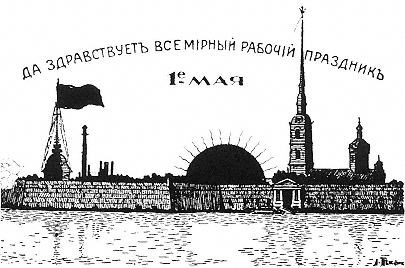
Figure 1.
L. Petukhov, poster, May Day 1917 (V. P. Lapshin, Khudozhestvennaia zhizn' Moskvy
i Petrograda v 1917 godu, Moscow, 1983).
remained. Most of the nation turned out for May Day, but it was not the hoped-for show of unity.[14] Professional artists helped with the posters and decorations (see Figure 1), but judging from the few pictures that remain, they used only simple color (red), slogans (of all variety), and allegorical figures (usually in classical dress and pose).[15] The center of the Petrograd celebration was the Field of Mars, whose most recent use had been for the imperial review of troops marching off to the front. A reviewing stand was raised and garlanded, and soldiers and workers—some armed—filed past members of the government. Who organized the event is not clear: some claim the Bolsheviks did much of the work,[16] but the municipal soviet (not Bolshevik at the time), the Provisional Government, and Gorky's commission also contributed.
The All-Arts Union likely did not take part in the celebration, even if some members did as individuals. On May 25, however, the union made its contribution to the national welfare by arranging Liberty Bond Day (Den' zaima svobody), the first mass festival in revolutionary Russia to make full use of artists' talents. The event, which included a parade, speeches, and theatrical performances, was organized by Fedor Sologub, the symbolist poet and head of the union's Curia of Verbal Art, and by two members of the Theater Curia: its director,
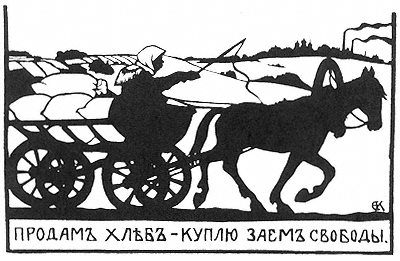
Figure 2.
E. Kruglikova, poster, Liberty Bond Campaign, May 1917 (V. P. Lapshin,
Khudozhestvennaia zhizn' Moskvy i Petrograda v 1917 godu, Moscow, 1983).
Pavel Gaideburov, and Aleksandr Mgebrov. State war coffers were seriously depleted, so the union organized a parade through town to sell bonds and collect money. Members ranging from imperial actors to futurist artists contributed to what was to be the union's sole concerted action. (Figure 2 shows a poster designed for the event.) Each group, school, or theater within the union was responsible for the adornment of a car. As cars traveled the parade route, speeches were improvised, and music, usually the Marseillaise, was played. The holiday was a rousing success, judging from accounts in the newspapers Rech' (Speech) and Russkaia volia (The Russian Will ). (The Bolsheviks had nothing to do with the war effort, and Pravda refused comment.) Copies of a one-day newspaper, Vo imia svobody (In the Name of Freedom ), featuring such unlikely comrades as Leonid Andreev, the poets Igor Severianin and Sergei Esenin, and the radical socialist Georgy Plekhanov, were snapped up in an instant.[17] The parade had a reception that bordered on hysteria:[18] spectators threw money and even jewelry to the Boy Scouts assigned to each car, who passed it on to bankers in booths set up along the route.[19]
Of greatest import for the future of revolutionary theater was a performance of Rachilde's Le vendeur de soleil by Gaideburov's Mobile-
Popular Theater, which set an example later followed by the Bolsheviks.[20] It was the first theater performed in the streets. The script hardly conformed to our modern notion of street theater, and the actors, who had no relevant experience, had to find new style almost spontaneously. They spoke of a temptation to improvise, to address the audience directly, to adapt a monumental style: broad, economic gestures, omission of details, and highlighting of essentials—all of which would have seemed artificial indoors. An anecdote that must have been striking at the time was prophetic for the future: "After the show, played directly on the pavement in the middle of a crowd of soldiers, one of them, deeply moved, approached an actor and asked: 'OK, but who should we vote for?'"
In Moscow, too, artists organized themselves into a union, the Soviet of Moscow Art Organizations, but the center of action was another group, which chose to cooperate with the government: the Arts-Educational Commission (Khudozhestvenno-prosvetitel'naia kommissiia) of the Moscow Soviet of Workers' Deputies. The commission, formed in April 1917, cut across aesthetic and political lines.[21] The other Moscow soviet, the Soviet of Soldiers' Deputies, established a parallel administration, the arts department of which included the artists Kasimir Malevich, Georgy Iakulov, and Pavel Kuznetsov. This group was not as well-funded as the commission, and, to raise money for a program of popular lectures and presentations,[22] it orchestrated a Holiday of the Revolution on July 12 at the racetrack. Sculptors and painters framed the track with posters and panels of revolutionary events; the restaurants and buffets were decorated; and artists of the theater, opera, ballet, and circus gave performances. The holiday raised the neccessary funds, but to do so tickets were sold at exorbitant prices, and it can be assumed that a proletarian or even broad public did not attend.[23] None of the celebrations arranged by artists between the two Revolutions of 1917 could or would claim to speak for a large part of the nation.