
Chapter Two—
The Deficiency of Being
Nowadays it is no longer possible to "compose" a funeral march, for it already exists, once and for all.
—Ferruccio Busoni
Three Women
One of the most unusual romances that is recorded in 1910 takes place between Scipio Slataper and his three Triestine friends remembered as Anna, Elody, and Gigetta.[1] The first friendship is erotic, the second platonic, the third leads to marriage. However, before each relationship flowers into its own particular terms, Slataper is unable to distinguish clearly between the three young women. We already sense the complexities that will attend this ambiguous situation when the twenty-one-year-old writer composes his first letter to all three women in January 1910. Addressed to none in particular, it implicates them all in the one identity that Slataper does name: his own. "Ah, you are so close to me at moments," he tells them, "that I feel I am trembling inside from joy, and then you are distant, lost in shadows that I cannot solidify into bodies. . . . Sisters of my best soul, if I doubt you I doubt myself. Who are you? At this moment I do not see you. But I write as though in an effort to take hold of my soul that flees." He cannot see these women, but writes to them in an effort to seize his fleeing soul.
[1] One side of the romance is presented in the collection of letters by Scipio Slataper, Alle tre amiche: Lettere (To His Three Women Friends; Slataper 1910–15). In his long introduction to this collection, authorized by "Gigetta" and "Elody" sixteen years after Slataper's death, the editor, Giani Stuparich, never feels the need to furnish the women's surnames. (As it turns Out Elody's maiden name is Oblath and her married name—Stuparich! She is the editor's wife.) For additional information on Slataper's relationship with the women, see Stuparich 1950. On Anna in particular see pp. 101–117. On Elody Oblath-Stuparich, see Bertacchini 1980 and Maier 1981.
In Slataper's second letter, a few weeks later, the "sisters of his soul" have become individualized, for it is addressed "Anna. Elody. Gigetta." The letter begins by singling one out: "I am thinking of you, Anna. . . . It is very strange that we used to walk together, that once I even looked you in the eyes . . . and I did not see you, nor did you see me. No woman ever saw me." After lamenting his anonymous romantic failures to Anna, he turns to Elody, revealing that the preceding words have been intended for her as well: "And I have been alone for three years, perhaps even forever, Elody." Distant though he may be in space (he is in Florence, they in Trieste), Slataper assures the women that they have been fully absorbed into his own being. "You do not truly exist for me, in lives of your own, but are in me" (Slataper 1910–15: 32, 33–34). This tendency to incorporate the identities of others into his own "best soul" (which really means the search for his soul, and through writing rather than interpersonal relations) is common to the era.
In speaking of his encompassing but solitary being, Slataper is actually making a romantic overture: "I am alone. In my whole life there have been very few times when I have felt that someone, outside me, has helped me to victory. Maybe if I could truly rest for a few minutes on the soul of a woman, who could penetrate into me, I would experience a moment of companionship." The melancholic reflection is simultaneously an appeal. "Sometimes I think with immense joy that a woman (but who?) could give me that part which I lack in the world: human maternity: that is, the most profound thing, the only truth, of life." In making his confession, Scipio alerts each of the women, who registers the message in the privacy of her own consciousness, to just how much of a sacrifice he would be required to make for an intimate bond. To cede to the joy that he wants, he would have to stop being the person he thinks they respect: "I would not be a poet, I would not be a hero, I may not even be alive ; and yet, I would rest in the fashion of a man. Do you know what it means never to be a simple man, who caresses without having a notion of a caress, who loves without knowing that he loves?" (Slataper 1910–15: 34–35).
The appeal proves irresistible. Anna becomes his lover (by the standards of the time, of course; it is unlikely that they exchanged much more than kisses). Elody becomes Scipio's traveling companion "and helps him in his work, recopying his manuscripts and correcting his proofs" (Slataper 1910–15: 19). Gigetta is wedded to him in 1913. The most interesting relationship, however, is the one with Anna, whom Slataper nicknames Gioietta (or "little joy")—not least because it comes
to a violent and inexplicable end at the very height of its promise. Without warning, on May 2, 1910, Gioietta takes her own life, leaving Slataper to play out his grief and incomprehension in a series of letters addressed to the grave.
The suicide occurs after a botched tryst between the lovers in Florence. On a visit to Trieste in April 1910, Slataper had arranged for Gioietta to travel south to see him in Florence, where he was living. She arrives on April 27, but they fail to make contact. Scipio is not even sure whether she has actually arrived. The events leading up to the communicative mishaps are recorded in a brief note by the editor Giani Stuparich:
Gioietta has indeed arrived. They are both in Florence, each expecting the other. They look for each other without success. Through a series of misunderstandings, Gioietta—who is not alone, and is thus unable to move about freely—awaits Scipio under the windows of her hotel. And Scipio awaits Gioietta in his room. Eventually, on the morning of the 28th, she decides to be driven to Scipio's residence; she sees him for an instant, the car is waiting downstairs, she barely has the time to grab the pages he has written for her and to repeat that he should meet her outside her hotel. But in his agitation and haste Scipio misunderstands; he thinks that she has promised to return and waits for her the whole afternoon of the same day to no avail. On the following day, the 29th, Gioietta returns with the same harried anxiety. Again they fail to reach a clear understanding. They see each other again on the morning of the 30th at the Exhibit of the Impressionists and Medardo Rosso, but in the company of many people. Gioietta lets Scipio know that she will be dining at the Trattoria Lapi. Even this invitation—only to see her, without being able to speak privately—confuses and mortifies Scipio, who lets his friends drag him elsewhere that night. So Gioietta departs from Florence, taking the steamboat from Venice to Trieste, and arrives at midnight of May 1st. On the morning of the 2nd she shoots herself with a revolver in front of the mirror.
Gioietta accompanies her final gesture with one last ambiguous message:
Scipio, I kiss you eternally. This will be for your work. I will expect it. Do not despair, I am convinced that you love me and will feel how determined [ferma ] I am. I give you my heart and all of me.
Do not come to see me, for I do not want them to know you. Dear Scipio.
I simply do not want them to speak to you, nor you with them. Please, please. Be always Scipio. Goodbye. I am joining you forever [Vengo da te per sempre ]. (Slataper 1910–15: 503–504)
Scipio, too, finds it easier to express himself in writing—in five long letters to Gioietta and others about her to Elody and Gigetta. One
letter responds to the suicide note directly: "Yes, Gioietta. Now I have read it, and truly feel peace, and am capable of believing that I will work. . . . Now I can really tell you: be still, Gioietta. I will write the work you expect and give it to you: to Gioietta" (Slataper 1910–15: 144). And so reads the dedication to the work to which Slataper is referring, the lyrical autobiography for which he is primarily remembered, begun before Anna's death and published in 1912 under the title Il mio Carso . But the guilt that fuels the writing cannot be erased. "I am capable of creating a work," he writes in September 1910, "but was incapable of making Gioietta live. I was the only one who could do so. And it is useless to try to escape. This is more than guilt" (Slataper 1910–15: 168–169).
Something more than guilt also accompanies the relationship between the two Hungarians Georg Lukács and Irma Seidler, one an essayist, the other a painter, and both in their twenties. Here, too, the consequences of the affair are as lethal as literary. "Does it not begin with her?" asks Lukács on the same day that Scipio and Gioietta failed to meet up in Florence. The "it" refers to his collection of essays called Soul and Form, published in Hungarian in 1910 under the title A lélek és a formák . "Does not even this journal perhaps begin with her?" (Lukács 1910–11b: 16, entry of April 27, 1910).
Lukács had met Irma Seidler nearly three years earlier, on December 18, 1907. After spending two guarded weeks together in Italy in May 1908, they correspond with each other in a series of tempestuous letters. For Lukács, however, the situation is a difficult one, especially theoretically. Among the intellectual influences that play strongly into his decisions at this moment is that of Søren Kierkegaard, the philosopher who fled from the marriage altar to pursue his unhappy existential analyses. Convinced that emotional fulfillment will obstruct the purposes of his writing, Lukács resists the temptation to join his destiny to Irma's. Instead, he writes an allegorical story of his relation to this "bella donna della mia mente" and publishes it as Soul and Form . The essay it contains on Novalis, he notes on May 20, 1910, expresses how he felt during their first encounter. Another essay hearkens back to their idyllic days in Florence and Ravenna. The essay on Theodor Storm reflects the letters he wrote Irma from Nagybánya, while the one on Sterne gives voice to the frivolous winter that followed their break in October 1908. Finally, the last essay on tragedy speaks of the engulfing reality to which it all led (Lukács 1910–11b: 16 and 23). Yet in 1910 Lukács still has no idea of how engulfing this reality would be.
On May 18, 1911, after a brief, unhappy marriage with the painter Károly Réthy and an affair with Lukács's close friend Béla Balázs, Irma leaps from a bridge in Budapest. According to his student Agnes Heller, Lukács suffers vertigo for the rest of his life. He knows that he could have saved her and in the process perhaps the better part of himself. His guilt has no bounds.
"I lay this book in your hands," he scribbles in a tentative dedication to the German edition of Soul and Form (on May 15, 1910). "For you have given me much more than it has been able to express: everything I have gained and become." Unsatisfied with this formulation, he commemorates the day they first met: "In memoriam 18 XII 1907." Memory, as Cacciari notes, is still the theme when he later singles out the place: "To the memory of my first Florentine days." Three months before she dies, he seeks Irma's permission to state merely, "Irma von Réthy-Seidler, in grateful memory." When the German translation of Soul and Form is finally published six months after her death, its epigraph reads also as her epitaph: "Dem Andenken Irma Seidlers."[2]
Two journal entries follow Irma's death in May. No others appear until Lukács's great friend, Leó Popper, the translator of Soul and Form , dies five months later. Lukács is now totally lost:
Now I am thrown back on myself again. Night and vacancy is around me. . . . I have the feeling I am being punished for my pride, for believing in my work and the labor it has taken [mein Vertrauen auf das Werk und die Arbeit daran ]. And this, too, will be taken away from me, along with life itself and the very possibility of life and everything that points to the future, in the absence of any definitive yes or no.
Negation and affirmation begin to exercise an equally powerful pull on Lukács's imagination. He finds himself in "an obscure and vacant place: nothing, no sign, no direction." Within three weeks he is on the point of taking his life, as though nonbeing were the only solution to this intolerable oscillation between negation and affirmation: "Whatever can be reached purely by means of the intellect," he remarks, "I have reached; it now turns out to consist in nothing. . . . And the more
[2] These and additional drafts of the dedication to Soul and Form can be found in Lukács 1910–11b: 22, 23, 30, 38 (journal entries of May 15, May 18, June 9, and August 3, 1910) as well as in a letter to Irma of February 2, 1911 (Lukács 1982: 198). The dedication is missing from the English translation of Soul and Form . On the relationship between Lukács and Irma and how it affects his work, see Cacciari 1983, Congdon 1983, Heller 1983, Kadarkay 1991, and Schweikert 1982. As with Slataper, the work to which Lukács aspires is antithetical to the Arbeit of concrete, historical labor, including the labor that would have been entailed by a living relationship with Irma/Gioietta.
intensely I reflect on myself, the more clearly I see that death is the only decision" (1910–11b: 42, 47, 49; entries of October 22, November 17 and 23, 1911).
Romance, suicide, and writing are entangled in their own way in the relationship between Carlo Michelstaedter and a Russian divorcée he meets in the same dubious city that hosts Slataper/Pulitzer and Lukács/Seidler. A couple of years older than Michelstaedter, Nadia Baraden becomes his pupil in Florence for private lessons in Italian at the end of 1906. An affection grows between them, and Carlo makes advances. Nadia, however, wounded by past experience, preserves an appropriate distance. Some months later, at Easter, 1907, Carlo goes home to Gorizia for the holidays and sends postcards back to Florence—not to Nadia, but to a young woman he had met more recently called Iolanda De Blasi. There is no way of telling what responsibility Michelstaedter may have borne for what followed. This much, however, is sure. He instantly returns to Florence: Nadia has committed suicide. Whether he was philandering or not, the blow to the student can be felt in countless accents of guilt and ruminations on death that come gradually to pervade his work.[3] The blow is repeated in February of 1909 when news of a "cursed misfortune" (maledetto accidente ) reaches Gorizia from New York concerning Carlo's elder brother Gino, who had emigrated to the United States in 1893 at sixteen years of age (Michelstaedter 1983: 352; letter to Gaetano Chiavacci of February 26, 1909). Michelstaedter's biographer Sergio Campailla, Daniela Bini, and the custodians of the Michelstaedter Foundation in Gorizia all believe that misfortune, cloaked by the family in silence, to have consisted in suicide.
Difficult as it is to assess the immediate effect of these deaths on Michelstaedter, they signal an intimacy with a condition he was increasingly to address in writing, indeed finally to make his own. As much as he tried to dispel the allure of this final solution, the thought of suicide revisited his mind on numerous occasions, perhaps already from the
[3] Michelstaedter's guilt in the face of Nadia is most directly expressed in a fictitious dialogue in which she accuses him not only of betraying her, but also of being incapable of love. One of the final exchanges in the dialogue begins with Carlo: "Oh I would be able to love well a person who loved me—so much do I need it.—Poor Carlo! You will never know how to do it, for no one can love who loves only the love that he needs—for if he needs it, this means that he doesn't have it. You do not have anything and cannot give anything; ever more miserable, you will always request,—for you are not and cannot love, but ask for love in order to delude yourself into thinking that you are somebody. But no one can love who is not " (Michelstaedter 1988: 98). His incapacity to love Nadia is interpreted as an incapacity to love period—because Michelstaedter is nobody, with nothing to offer.
time when he was only eight and his cousin, Ada Coen Luzzatto, poisoned herself in 1895 (Altieri 1988: 38).
Many questions are raised by these suicidal relations—the motivations of the respective women, beyond all facile speculations on the "jilted lover"; the masculine rejection of the woman on behalf of the literary work; the role that may have been played by cultural models (Anna Karenina and Hedda Gabler for the women, Werther and Weininger for the men); the uneasy, reciprocal relations between the two elements in the pair (man and woman, work and life). The acts of the women precede but also replicate the spirit of the writings they help shape. They offer irrefutably dramatic, historical "proof" of the dilemmas the men go on to discuss in theory. At the same time these replications or anticipations also vie with the work they enable, preempting it of some of its validity. They embody the "reality" about which these writings only speculate. It is, after all, a certain type of life that is preserved by such voluntary deaths—or a certain idea of life—preserved from the deadliness of the word (the theories or the work) in which the three writers believe.[4] It is the freedom and "transcendence" of the word or work, rejecting the limitations of the life, that now appears to be a tightly sealed tomb, and the death of the women that is a life. Indeed, these deaths reaffirm a principle to which the young Lukács, Michelstaedter; and Slataper are absolutely attached: the autonomy of the single self, rejecting the effacements it risks in erotic fusion. Or is it the opposite? Could it be that the erotic (or at least practical) fusion would have preempted the deadliness of this self-assertion, more related to the principle of "work" than it seems? Whatever the case, the acts of the three women offer existential correlatives of principles conceptually explored by the men, and largely in response to such acts.
A Deadly Vocation
Numerous as these questions are, they arise in the context of an uncontestable fact: 1910 witnessed a profusion of suicide among the young, especially in that Habsburg empire to which Michelstaedter, Slataper, and Lukács belonged. The successor states to this empire, Austria,
[4] Michelstaedter confirms Lukács's and Slataper's views on the opposition between work and life when he sketches the attic where he has secluded himself to write his thesis. He notes at the bottom, in Greek: "Here I live a life that cannot be lived [bionabion ], but it gives birth to a great work" (Michelstaedter 1992: 432). According to Michelstaedter's letters, the drawing is done on April 25, 1910, or two days before Gioietta arrives in Florence (Michelstaedter 1983: 438–439).
Hungary, and Czechoslovakia, have occupied top positions in world suicide rates throughout the twentieth century; more relevant, perhaps, is that suicide rose rapidly throughout the waning decades of the Austro-Hungarian empire to reach a staggering culmination in 1910.[5] Indeed, it was partially in response to this rise that on April 20, 1910, Freud's Vienna Psychoanalytical Society organized a symposium to address the phenomenon, particularly in its incidence among students.[6] Given the religious and social taboos that accompany suicide, and different methods of garnering and computing data, it is impossible to say whether the practice was more widespread in the first decade of our century than in the last (most indications point to the opposite). And yet it seems that then it was more ideological an act, more ethically respected a gesture, at least in intellectual circles; it was the mark of a passionate commitment to some principle without which life was not deemed worth living. On the heels of fin-de-siècle "decadent" culture, suicide was not only accepted among the options of those who insisted on ruling their lives; it was often viewed as the most laudable of acts.[7]
[5] For documentation and interpretation of rising suicide rates in the Habsburg empire, see János Kristóf Nyíri, "Philosophy and Suicide-Statistics in Austria-Hungary," East Central Europe 5 (1978): 69–89. In tables published annually by the World Health Organization, Hungary often holds the highest national rate of suicide in the world, Austria third place, and Czechoslovakia fourth. On the ideological motivations of suicide in different groups of people see Shneidman 1979: 143–163.
[6] Alfred Adler, chairman of the conference, traced suicide to uncompensated feelings of inferiority. Wilhelm Stekel speculated that "no one kills himself who has not wanted to kill another, or at least wished the death of another." Isidor Sadger saw it as a desire to expiate feelings of guilt. Freud, unsatisfied with these accounts, felt that no adequate explanation had been given for how the instinct for self-preservation can destroy itself. His own reflections on the issue did not appear until 1917, in his essay "Mourning and Melancholy," where he claims that in the process of depression the ego withdraws its libido from the environment and then identifies itself with all against which it has turned. On the symposium of April 20, 1910, see David Ernst Oppenheim, "Suicide in Childhood," Minutes of the Vienna Psychoanalytical Society, vol. 2: 1908–1910, ed. Herman Nunberg and Ernst Federn, trans. M. Nunberg (New York: International Universities Press, 1967): 479–497; On Suicide, with Particular Reference to Suicide Among Young Students, 1910: With Contributions by Alfred Adler and Others, ed. Paul Friedman (New York: International Universities Press, 1967); and Johnston 1972. The psychoanalytic discussion of suicide is subsequently renewed in thirteen articles in Zeitschrift für psychoanalytische Pädagogik 3 (1928–29): 333–442.
[7] It was in precisely this fin-de-siècle spirit, notes Campailla, that the eighteen-year-old Michelstaedter responded to a questionnaire circulating in the drawing rooms of Gorizia in 1905. To the question "At what age would you like to die?" he answers, "Immediately!!" (To the question "What ideal would you like to see in your wife?" he answers "That she resemble my mother.") While Michelstaedter way have well been posturing, he makes a more telling statement much earlier in his life which could hardly have been feigned. His sister Paula records it in a memoir: "When he was three, I remember it well, and I was crying in horror over the death of a young girl who had drowned in the Isonzo—death being something I had not been exposed to at all at the time—he told me in all seriousness: 'But you know, even you and I, every one of us, must die some time.' And he said it with all the seriousness of a little philosopher. I was greatly moved." The seriousness of this three-year-old on the issue of death certainly grows in the next twenty years. Paula's recollections of her brother are in Winteler 1973. The questionnaire is published in Campailla 1981: 45–49. On ideologies of death and suicide in the Austro-Hungarian empire see Johnston 1972: 247–249 and 165–180.
Five years after Irma's suicide Lukács speculates on the appeal of the act. Tellingly enough, he is not commenting on Irma, but on the fictitious scenario of Anna Karenina :
At very rare, great moments—generally they are moments of death—a reality reveals itself to a person in which he suddenly glimpses and grasps the essence that rules over him and works within him, the meaning of his life. His whole previous life vanishes into nothingness in the face of this experience; all its conflict, all the sufferings, torments and confusions caused by them, appear petty and inessential. Meaning has made its appearance and the paths into living life are open to the soul. (Lukács 1916: 149)
Among the "crucial moments of bliss," Lukács repeats (149), belong "the great moments of dying."
One might wonder how Lukács knows this revelation is experienced by the dying (instead of merely imagined by the living). One might also wonder how well the concrete experience of the woman in question (Karenina/Irma) can accommodate the intellectual projections of the abstract, theoretical man. Be that as it may, the intellectual sect to which Lukács belonged believed in such moments of clarified experience, and frequently linked them to death. Here, too, the perception is more important than the fact. At recurring moments in history, Lukács notes before Irma dies, there arises "the ideology of the beautiful death." It stems from moments when culture recognizes its own decadence, and it becomes difficult "to assess values hedonistically," or to comfort one's mind with the thought that virtue receives compensation and sin can be explained as expiation. The ideology of the beautiful death occurs when "life, by the very fact that it has become problematic, ceases to be a prime value for the ethical person." When history contests "the fundamental values of humanity, one comes to bestow validity on the person who has been, or will be, condemned to death" (1911b: 56–57).
If this sounds impossibly romantic today, it is probably because we in our age are more bent on reaping the fruits of experience then were our great-grandfathers. We have lost the metaphysical unrest of intellectuals at the beginning of the century, including their insistence
on achievements more lasting than the pleasures of the day. On the threshold of the twenty-first century, after so much has been gained in the way of material benefits, it is difficult to understand those earlier creative thinkers who felt concrete possibilities of experience were inherently deficient, and who were inspired—in their very inability to discover an overall justification for life—to engage in martyric gestures. Most important perhaps, if we tend to assume today that the cause of every empirical act—including suicide—must also be empirical, we are nevertheless mistaken to project this assumption onto an age that did not share it, to project it onto others who did not share our respect for personal experience.
To take a case we know more about than the suicides of the three women, namely, the suicide of Michelstaedter it elicits nothing but questions. Was it caused by a violent argument between himself and his mother the very same morning? Did the fact that it was her birthday play into Michelstaedter's decision, making his act a kind of retribution? A strange present indeed, transforming that day of celebration into one she would henceforth mourn. Was the suicide spurred by Michelstaedter's intolerable sense of guilt (ample evidence of which exists in his texts)—not only for what he perceived as his chronically unfilial conduct, but also for his inability to live up to his theoretical and moral demands? Or was his death really just a way to end a lethal ailment from which Michelstaedter knew he was suffering, manifested by pain in his feet, legs, and hip?[8]
Ninety years after the fact, it is difficult to understand why such a handsome, athletic, artistic, charismatic, and self-professed lover of life should have brought his life to such a fateful end. The truncation of a life as promising as his seems all but incomprehensible. If, as Giuseppe Papini wrote just two weeks after the suicide occurred, what really took place was a "metaphysical suicide"—or the consequence of a recognition of some unbearable truth or untruth of the world—then the distance between our time and theirs only grows greater.[9] Rarely do we grow so impatient as when we hear talk of "existentialism." And yet,
[8] See his own references to a crippling condition in Michelstaedter 1983: 321, 361, 364, 379, 389–390, 393. See also Campailla's introduction to Michelstaedter 1988: 18, and Bini 1992: 277 n. 60, where she wonders whether the ailment may have been a bone disease.
[9] Giovanni Papini, "Un suicidio metafisico," Il Resto del Carlino, November 5, 1910: 3; reprinted with the title "Carlo Michelstaedter" in Tutte le opere di Giovanni Papini: Filosofia e letteratura (Milan: Mondadori, 1961), 817–822.
what we often tend to forget in our postmodern content is the historical price this comfort has exacted—in the self-torment of hundreds of political leaders, in the intellectual intransigence of even more philosophers and artists, in the bloodletting of millions along our ostensible march to peace. We will never know what practical or psychological motivations Michelstaedter had for being so determined to end his life that (as one newspaper reports it) he fired not one but two shots from his revolver.[10] Perhaps the best we can do is to seek the causality of this suicide in his thinking—amply recorded in the dissertation he had just completed that morning, and addressing a world that he shared with others. Such a world is shaped not only by familial and psychological facts, by political and economic conditions, but by what gives them significance: cultural perceptions and beliefs, phobias and aspirations, forms of logic and illogic. Paradoxical as it may seem, suicide is never a personal act; it is the result of a series of tentacles in which the mind is caught, a reactive gesture or break in a system (a system, notes Shneidman [1979], that is necessarily ambivalent and dyadic, entailing not only a dialectic of self and other but also two parts of a single person). Before the Great War, suicide, pessimism, and despair were tied up with entirely different existential structures than those that surround us today, different ethical demands, different modes of significance and forms of conviction.
One of these forms of conviction held that life was not necessarily a self-legitimating process; it was not necessarily something to be preserved at all economic and cultural costs. In the prewar years thinkers tended to want to understand life "as a whole." They did not shy away from diagnosing local and universal deficiencies in conduct, often grounding their findings in physiology or metaphysics and proposing programs by which to achieve personal or social "authenticity." Death, at this moment in time, was viewed as more than an end to organic palpitation. Its negativity appeared to be inherent to life itself. What now seems to be the morbid thinking of the early twentieth century was largely the consequence of an unwillingness to acquiesce in the growing materialistic conviction that (a) all spiritual questions are foreclosed by the self-terminating flow of historical experience and (b) the human mind is accordingly well advised to limit its attention
[10] "Tentato Suicidio," Gazzettino Popolare, October 18, 1910, reprinted in Antonella Gallarotti, Il Fondo Michelstaedter della Biblioteca Civica (Gorizia: Dispensa dell'Università della Terza Età, 1990), 12.
to the furtherance of its pleasures and chores. The "morbidity" is also the consequence of confronting what so many doctrines of happiness, rights, and empowerment tend to exclude from their moralizing pictures: the irrationality of physical and psychological suffering, the ineradicability of human pettiness and rivalry, the instability of destiny and the intellectual understanding of it.
Thinkers in 1910 were less interested in denying or eradicating pain than in comprehending it, in fathoming rather than erasing concrete signs of the demonic. A person of true faith, writes Buber, "would rather renounce salvation than exclude Satan's kingdom from it" (1913a: 138).[11] "People of our time who formulate new laws of morality," adds Schoenberg, "cannot live with guilt !" To hanker after the kitsch of moral comfort, in his view, is merely to deny or displace the fundamentality of guilt.
The thinker, who keeps on searching, does the opposite. He shows that there are problems and that they are unsolved. As does Strindberg: "Life makes everything ugly." Or Maeterlinck: "Three quarters of our brothers [are] condemned to misery." Or Weininger and all others who have thought earnestly. (Schoenberg 1911a: 2)
If there is a sense of the deficiency of being at the beginning of the century, then, it grows out of an ethical and metaphysical unease that is much less common at the end of the century, or much more severely repressed (though not successfully enough to stop it from erupting in countless acts of violence which we call "isolated incidents," and which are more gruesome in nature than the suicidal violence of the earlier age). Accompanying the dozens of economic, psychological, and political reasons for the dark visions of 1910 is also a tendency to aspire to a more absolute ethic than we imagine to be within our reach today. "That there was dying in the world," says Buber's fictitious spokesman Daniel, "had become my sin, for which I had to do penance" (Buber 1913a: 133). Where our contemporary "optimistic" spirit continually risks being dismayed by all that it excludes from its vision, the earlier "pessimistic" one sought something more like what Trakl calls a "trans-
[11] Two years earlier, in a text that appears to have left its mark on Buber, the young Lukács makes a similar point. Sin, he claims, "is no antithesis to goodness." It is rather that which "convulses our true reality," making an ethical approach to experience one that accepts the "unification of temptation and the tempted, of fate and soul, of the demonic and the divine in humans" (Lukács 1911c: 374, 378, and 382). But more on this in chapter four.
formation of evil"—assimilation, rather than a negation, of destructive forces. What is "pathological" is hardly the feeling of life's deficiencies, it is rather the nosophobic refusal to acknowledge these deficiencies: the passive propagation of their morbid disguise.
In the Beginning Was the End
If death was still an exotic member of late nineteenth-century thinking, by 1910 it had received full citizens rights. The turn is marked by a short essay called "The Metaphysics of Death" (1910) by the sociologist Georg Simmel. The essay rejects the most widespread European conceptions of death in order to portray it as a principle that structures all vital acts from within. Simmel's first target is the materialistic view of death as a mere cessation of breath. His second is the religious idea that death is a transitional event, a gateway to the One True Life. Both conceptions see death as different and separate from life—as an external intrusion, a truncation of action, a severing of the historical thread. Simmel instead describes death as "tied to life from within and from the very beginning.[12]
The actions and historical possibilities of an organism, argues Simmel, are circumscribed from the start by its end. Only within the borders of a mortal span of existence, and by virtue of the practical limitations on each possible experience, does a life acquire some identity and shape. In this sense, the moment to moment behavior of every creature is an implicit response to the fact that nothing it can do will last forever, to the impending fact that it too will die and must therefore accomplish its functions within a particular space and time. The considerations and acts of each moment, writes Simmel, "would be different if this were not our fate, which influences such a moment" (Simmel 1910a: 31). If we think that death is life's "opposite condition," marking only a limit to what we can do in life (as though this life would be exactly what it is, only longer, if death did not come to interfere with it), we simply ignore what we know before we start to think.
[12] Congdon points out (1983: 36) that several of the central ideas of Simmel's essay can be found in a 1907 essay called "Death Aesthetics," dedicated to Simmel, and written by his student and Lukács's friend (and Irma Seidler's lover), Béla Balázs. Like Lukács, Balázs was studying with Simmel in Berlin in 1906–1907. For an excellent introduction to the many issues raised by the tragic philosophy of Simmel, see Alessandro Dal Lago, Il politeismo moderno (Milan: UNICOPLI, 1985).
Death rather shapes experience from the inside out, preselecting the nature of our strivings, desires, and decisions. Life has no trajectory at all except in and by means of its finitude.
Simmel's observations about the structure of organic behavior entail others about existential motivation. As he argues in his Lebensanchauung of 1918, we never act on behalf of life itself (as it is at any given moment), but always on behalf of "more life," and "more than life." We do everything we do in order to extend our possibilities beyond our actual and present conditions, to fight or flee those stand-ins for death which are obstacles, actualities, and diminutions. The greater the vitality of an organism, the greater its struggles against limitation. Even our repression of the sense of death is a surreptitious strategy to enhance our capacity to function. Thus, in general all of our
gain and pleasure, work and peace, and all of our other modes of relation . . . are an instinctive or conscious flight from death. The life we employ to draw nearer to death we employ to flee it. We are like men on a ship who walk in a direction opposite to the one in which it is going: while they proceed to the south, the deck on which they do so is carried to the north with them on board. And this double direction of their motion [Bewegtseins ] determines the position that they occupy at any moment in space. (Simmel 1910a: 32)
"With forehead bent forward, the demon of life sits at the rudder," notes Simmel's friend Buber, "and with head thrown back, the goddess of death sits in the prow" (Buber 1913a: 131).
The duplicity of the situation is more scathingly described by Michelstaedter. If he has one objection to life as it is commonly lived it is that, consciously or unconsciously, it involves precisely this flight from death, this delusory defense against the inevitable dissolution of all that we want to consider permanent. Such an ethic, if we may call it that, is just the response of an ostrich to the menace of time, a form of plastic surgery, a desperate ploy to deceive the truth. The values and meanings that we attribute to existence are in Michelstaedter's view almost invariably the fantasies of a desperate desire for stability:
being born is nothing but wanting to continue: men live . . . in order not to die . Their persuasion is fear of death ; being born is no more than shrinking from death . So that if death were ever made certain to them in a certain future—they would show themselves to be already dead in the present . Everything they do and say with firm persuasion, on behalf of a certain objective, with self-evident reasons—is nothing but fear of death. (Michelstaedter 1910: 69)
From the start, humans embark on a flight from the end—even though only this end helps us see the beginning.
We acknowledge such a beginning in Lukács's "great moments of dying." Why, he wonders, do we grieve at the death of a friend? Isn't it because this loss brings a larger set of issues to consciousness, the issue, for example, of impermanent companionship, or the impossibility of establishing absolute social bonds with our fellows? In the sudden and irrevocable termination of a friendship, claims Lukács, we face the "painful, forever fruitless question of the eternal distance, the unbridgeable void between one human being and another" (1910–11a: 107). Death is only the most dramatic instance of life's inherent disunity, the ultimate form of an alienation already embedded in its everyday processes. "The rupture caused by death, the great estrangement that falls between the dead friend and the living one, is perhaps the same as the thousand estrangements and pitfalls that may occur in any conversation between friends—only in more perceptible, more tangible form." In essence, the death of a friend is so painful because it is "a symbol of the survivor's aloneness [des Einsambleibens ]" (Lukács 1910–11a: 108–109), an aloneness predating the death but not coming to the surface until moments like that. Death reveals the separation that has underlain and made possible the joining of lives. It unmasks the mortality that fuels the unions.
More metaphysical in his analyses than Simmel, Luács goes as far as to characterize the entire fabric of such union as a tenuous and incoherent web:
Life is an anarchy of light and dark: nothing is ever completely fulfilled in life, nothing ever quite ends; new and confusing voices always mingle with the chorus of those that have been heard before. Everything flows, everything merges into another thing, and the mixture is uncontrolled and impure; everything is destroyed, everything is smashed, nothing ever flowers into real life [zum wirklichen Leben ]. To live: to be able to live something through to the end. Life : nothing is ever fully and completely lived through to the end. [DAS Leben: nie wird etwas ganz und vollkommen ausgelebt. ]
The endpoint of Lukács's argument is thus extreme: Historical existence "is the most unreal and unliving of all conceivable modes of being; one can describe it only negatively—by saying that something always comes to disturb the flow [etwas kommt immer störend dazwischen ]" (Lukács 1910–11a: 152–153). If "absolute life" can never take place in time, it is because change allows nothing to have an
essential and perduring identity. Temporal reality is ruled by a network of accidental and meaningless necessities, with no other motivation than that "of being empirically present, of being entangled by a thousand threads in a thousand accidental bonds and relationships" (Lukács 1910–11a: 157). Historical existence is not only a response to being-unto-death; it is a literal enactment of it.
Persuasion and Rhetoric had reached a comparable conclusion in its opening parable of the weight. Since the energy that moves things is generated by a condition of privation—or by a desire for what "is not"—all things, reasons Michelstaedter, are doubly nothing. Motivated by what they lack, things cannot even reconcile themselves to the emptiness that they are. And this is why people lament their solitude: "Being with themselves, they feel alone : they feel they are with nobody " (Michelstaedter 1910: 41). To engage in a "natural," everyday pursuit of historical fulfillment is to flee the nobody inside one from whom none can escape. Michelstaedter is therefore the first to agree with Lukács's belief that "real Life is always unreal, always impossible, in the midst of empirical life [für die Empirie des Lebens] " (Lukács 1910–11a: 153). That Life in which "potency and act are one" can only be an "abios bios ," a Life without life (Michelstaedter 1910: 41). "Living life is beyond forms" (Lukács 1911c: 374).
What do Michelstaedter and Lukács mean by real Life? Don't they characterize everyday existence as lifeless only because it does not incorporate what they believe that life should incorporate—namely, meaning and purpose, stability and order, permanent and unchanging identity? But these are only desires of the mind, intellectual wishes, to which experience pays no heed. Life happily ignores them in its own quest for power, security, or advancement. Is there not a "nihilism" at work in this very attack on the nothingness of the world? In this condemnation of life for not living up to requirements that philosophical elucubrations feel it should meet? In this defense of "real Life" from all "merging and smashing and flowing"? After his Marxist conversion in 1918 Lukács rereads his earlier work precisely in terms of such nihilism. And he links it to a more particular intellectual syndrome, namely, the "idealism," "subjectivism," and "expressionism" of intellectuals in an era unwilling to confront the true, material bases of their discontent. By the thirties he has singled out a spokesman for this cultural "flight from reality": the art historian Wilhelm Worringer (Lukács 1970: 33–34).
Life as Abstraction
In his major work called Abstraction and Empathy , printed as a dissertation in 1907 and published in book form in 1908, Worringer posits two different types of drives at work in artistic interpretations of life. Abstraction is one, empathy the other. Empathy is based on a "relationship of confidence between man and the phenomena of the external world," an "unproblematic sense of being at home in the world" (1908: 15). It views experience as patterned, secure, and meaningful. The artistic correlates of empathy are classicism, realism, naturalism, and other styles of representation that integrate spirit and matter. Abstraction does just the opposite. Taking root in "an awareness of temporality, contingency, and in a state of abject terror" (Waite 1981: 210), it is the "the outcome of a great inner unrest, inspired in humans by . . . an immense spiritual dread of space" (Worringer 1908: 15). Born from a "desperate psychological need for faith, repose, and stability," abstraction affords the "possibility of taking the individual thing of the external world out of its arbitrariness and seeming fortuitousness, of eternalising it by approximation to abstract forms and, in this manner, of finding a point of tranquility and a refuge from appearances" (Worringer 1908: 16).
Worringer does not locate this tendency towards abstraction in contemporary Europe until his 1911 article on modern painting. Its more obvious examples lie in Egyptian, Byzantine, and Romanesque art. While the urge to empathy finds gratification in the beauty of dynamic development, "the urge to abstraction finds its beauty in the life-denying inorganic, in the crystalline, or in general terms, in all abstract law and necessity" (Worringer 1908: 4). Abstraction offsets the horrors of realism. It endeavors
to wrest the object of the external world out of its natural context, out of the unending flux of being, to purify it of all its dependence upon life, i.e., of everything about it that was arbitrary, to render it necessary and irrefragable, to approximate it to its absolute value. (Worringer 1908: 17)
In his great manifesto for abstract painting, Vasily Kandinsky gave no sign of knowing Worringer's work (although he probably did; Abstraction and Empathy had been published in Munich three years earlier by Piper, the same press that published his On the Spiritual in Art ). Kandinsky's arguments in his manifesto and letters are similar to Worringer's. "Among us painters," he writes to Schoenberg on February 6,
1911, "it is the res which is forbidden."[13]Res , the word for thing in Latin, is the external, material dimension of things, the dimension that viewers had been accustomed to expect from painting for centuries, assuming it to be one of the immovable laws of pictorial art that it imitates the forms of nature. On the deepest level, Kandinsky's statement says that art can never convey an unmediated reality to its audience; but if that is so, then art might also embrace the absolute consequences of these expressive limitations, freeing itself from those outer forms of things which are only carcasses of intentions, values, and "being" in a more extensive sense. The historical, phenomenal res , writes Kandinsky, is the proper interest of "dull materialism," or of an art that "seeks its own substance in hard material " only because it knows nothing nobler (1909–11: 135). Kandinsky, then, is less "reactionary" in his conception of abstraction than Worringer. He sees it not first and foremost as a flight from the horrors of solid experience, but as a search for something within or beyond such experience. (It is not certain, however, whether this holds for his collaborator on The Blue Rider , Franz Marc, who confesses, "I found people 'ugly' very early on; animals seemed to me more beautiful, more pure; but even in animals I discovered much that was unfeeling and ugly, so that my pictures instinctively . . . became increasingly more schematic, more abstract" [Marc 1985: 65; letter to Maria Marc of April 12, 1915].)
With Kandinsky abstraction affects not only the manner in which art mediates the real, without naturalistic or easily accessible content, but also its position within political and historical processes. From those processes it now asserts its independence. As in Schoenberg and Michelstaedter, art occupies a space radically different from life, and even finds trouble reconnecting to it. Art speaks of an alternative order, a militantly antihistorical one, where it almost makes no difference how a composition "sounds" (or whether it caresses ears accustomed to the ostensibly harmonic orders of everyday life), how easily it is understood, or how functional it may be in practical contexts. Art now tran-
[13] Schoenberg and Kandinsky 1984: 27; letter of February 6, 1911. on the relations between Kandinsky and Worringer see Waite 1981: 203; Long 1980: 10; and Weiss 1979: 7 n. 25. Franz Marc, the co-editor of the Blue Rider , mentions Worringer to Kandinsky in a letter at the beginning of 1912 after On the Spiritual in Art is published: "I am reading Worringer's Abstraktion und Einfühlung , a good mind, whom we need very much. Marvelously disciplined thinking, concise and cool, extremely cool" (Kandinsky and Marc, eds., 1912: 30). The influence of Worringer's theories on modern art is treated in Werner Hoffmann, Grundlagen der modernen Kunst: Eine Einführung in ihre symbolischen Formen (Stuttgart: Kröner, 1966): 81–85, 109–110, and Weiss 1979: 158–159.
scribes a quest for an absolutely different type of understanding, a revision of the nature of vision, sound, and meaning.
Whether the Marxist Lukács is right or not in characterizing such abstraction as a "flight from reality," his analysis of at least one of its internal mechanisms is shared by other thinkers. The logical endpoint of all efforts to remake life in the image of abstract, metaphysical dreams, claim Nietzsche and Heidegget; is "completed nihilism": the sense that the solidities and structures by which we normally live are bridges over a gaping abyss, reassurances spurred by fear and need and spiritless survival. At the moment of completed nihilism, historical conduits of meaning grow clogged. One appears to lose access to any fundamental and substantial truth. Being, Michelstaedter confesses, remains "outside my consciousness and outside my life. I do not live the absolute, nor does my nous [intellect] know it—what I live and know with my nous is the nullity of everything that is visible and knowable" (Michelstaedter 1958: 803). "And thus the anguish," continues Giovanni Boine. The dilemma that follows such "knowledge," in ethical or behavioral terms, appears appropriately enough in a letter Boine writes on Christmas Day 1910, the anniversary of the birth of the supreme martyr:
Must I violate my moral conscience, must I restrict it and do ? Or must I withdraw into the world of purity and not do ? Action does not amplify you. It teaches you the low-lands and the impossibilities of the world, it reinforces within you the bitter pessimism of the Christian tradition. Not God but sin circulates in each thing, and envelops and penetrates it:—The things of the world smack of sin lust as sea water smacks of salt. (Boine 1983:xxxvi; letter to Casati)
If the forms of historical existence do not conform to theoretical ideals, the argument runs, they are not fully real, at least not in the traditional sense of reality as essential, sure, and lasting.
In the very years that this nihilistic idealism reaches its peak, philosophers like William James and John Dewey do everything they can to revise such a notion of reality, liberating it from ancient expectations and redefining it as a function of purely pragmatic concerns. Yet the Americans enjoy great distance from the dispiriting history of Europe, where reflections on the rift between the "is" and the "ought" are nourished by long moral, political, and philosophical practice. There are many reasons for the pessimism of Europeans in 1910, not just the assimilated clichés of nineteenth-century decadence (which weigh the negative and sickly dimensions of life more heavily than the positive
and healthy ones) or the vitalistic creeds of Schopenhauer, Darwin, and Nietzsche (attributing all organic motivation to voracious, blind struggles of instinct). At work in the nihilism of Europe in 1910 is also a worry about the potential consequences of precisely the pragmatism that James and Dewey try to make philosophical: a culture, in Kandinsky's view, where people think only of "material well-being" and can judge nothing except by its outward results. In the practical, short-sighted, positivistic, and utilitarian age of which they were getting a glimpse, people who might have once turned into spiritual leaders, writes Kandinsky, are dismissed as "abnormal" and a technical product is hailed as "a great achievement" (1909–11: 135).
The abstract canvases of Kandinsky and Marc, the tone-color music of Schoenberg, the metaphysical reflections of Lukács and Michelstaedter crave alternatives to what they themselves perceive as abstract—what they see as lifeless, despiritualized action (even when it takes solace in impressionism or aestheticism). The abstract arts and thought of 1910 rebel against an abstraction already at work in pragmatic, positivistic, and materialistic reductions of historical practice to a set of predetermined goals, if not against the limitations of practice itself, especially where this practice allows no theory to be abstracted from it. To recover such a theory (or more properly speaking, to allow one to develop) thinkers and artists begin by exposing a whole series of unsubstantiated conceptions to which the practices of their time had led. This act of exposure entails more than metaphysical critique. Ultimately both Michelstaedter and the young Lukács are more interested in sociological fact than metaphysics. They accompany their visions of "real Life" with analyses of the configurations of actual, contemporary sociohistoric experience. In the final analysis, what they decry is not experience "in the abstract" so much as particular and "unnecessary" organizations of experience.[14] The ontological conditions that Lukács and Michelstaedter condemn are the ones particularly exacerbated by the culture in which they live, governed, as it seemed to them, by a collective reign of egotism, a failure of human solidarity, and the rationalization of social processes. If anything is abstract, these latter-day humanists would argue, it is life as it is institu-
[14] See György Márkus's study of the organic relation between the young Lukács's metaphysical idealism and his later commitment to political practice (Márkus 1983). Another study examining similar issues in the broader context of Lukács's attempts to find more than an aesthetic or metaphysical solution to human isolation is that of Dennis Crow, "Form and the Unification of Aesthetics and Ethics in Lukács' Soul and Forms ," New German Critique 15 (Fall 1979): 159–177.
tionally conceived and managed at the beginning of this century. There is a "kiss of death," writes Berman, already contained in the guiding structures of twentieth-century modernity, including the idea, shared by those who love it as much as by those who hate it, that "modernity is constituted by its machines, of which modern men and women are merely mechanical reproductions" (1982: 29).[15]
Sociology of Death
Long before Lukács attributes the demise of life to capitalist economy, he operates within the parameters of a cultural sociology related to that of Simmel and Max Weber. In his History of the Development of Modern Drama (1908–1911) he distinguishes between two types of society that he later comes to describe as (a) closed/organic and (b) open/mechanistic.[16] Open, mechanistic society, claims Lukács, is enabled by modern and bourgeois forms of association. It is "open" in multiplying the opportunities for individual decision, affording its members various choices of work and lifestyle. It is "mechanistic," however, in making this individualism possible only by means of a rationalization of the concrete relations between members of the society, and by recasting these relations in the form of financial bonds. The links between people in open, mechanistic bourgeois society are more abstract than they are in "organic" society, where the relations, performances, and roles of its participants grow out of a relatively closed tradition. Different as the persons composing an open society may be on the surface, each relies first and foremost on a hierarchical system of impersonal, mechanical, and "facilitating" networks: corporations, professional "friendships," post office clerks, credits and debits.
Conditions like these have a two-pronged effect. They produce a subjectification of the psyche—commonly called introversion—forcing citizens to seek their freedom and personal gratification in private, interiorized activity. They also subject these "subjects" to an unprecedented process of objectification, transforming them into functions and elements of complex, rational institutions. While adopting a sense of
[15] The starkest articulation of this idea of life as mechanicity, published of course in 1910, is Mark Twain's dialogue What is Man ? He takes a similar position in "The Turning Point of My Life," which also appeared in 1910, the year Twain himself died.
[16] The distinction had already been drawn by Ferdinand Tönnies in Gemeinschaft und Gesellschaft (Community and Society) of 1887 and can be traced as far back as the Monologues of Friedrich Schleiermacher (1800).
abstract autonomy, a member of such a society exists "more and more only in relation to the things outside him, as the sum total of his relationships to them" (Lukács 1911a: 325).[17] Living people are mortified by the deadly complexity of socioeconomic ties.
In The Philosophy of Money (1900) Simmel had referred to the same process as spiritual objectification (Vergegenständlichung ). Lukács calls it Versachlichung (thingification). Weber speaks of it as Rationalisierung (rationalization). What is named by each thinker is a commodified life in which most actions and thoughts are subsumed, a calculative, instrumentalizing life that evaluates experience on the model of quantifiable and manipulable things. Professions grow increasingly differentiated and detached from larger contexts of interest, visibly undermining the attitude of employees. As the relationships between them become opportunistic,
an ever smaller part of the personality of the worker goes into the work and, consequently, even work requires less and less involvement of the personal capacities of the person carrying it out. Work takes on a specific and objective life of its own, over and against the individuality of the individual, so that the latter becomes forced to express himself elsewhere and not in what he does. (Lukács 1911a: 666)
Competition turns into the governing mode of human interaction, exacerbating the paradox by leading people to vie against each other in order to affirm the security and autonomy of their own identities. At the same time, however, competition makes self-assertion prey to a dialectic in which self-worth depends upon successfully opposing the will of others. In no way is it possible to affirm this new and contradictory type of personality "without suppressing the personality of others," writes Lukács in a passage describing the new way of envisioning one's colleague (especially a younger or more gifted one) as a threat, and making the others feel that they "can defend themselves only by destroying that individual" (Lukács 1911b: vol. 1, 161).
Without knowledge of Simmel, Tönnies, or other members of the German Society for Sociology (whose first meeting on October 19, 1910, took place two days too late), Michelstaedter has his own name for these reifying effects of modern society: rhetoric, the opposite of the condition in which one does what one believes to be right, even if this "right" should be based merely on an unquestioned, provincial or-
[17] For a fuller account of this process in Lukács and Simmel, see Antonio De Simone, Lukács e Simmel: II disincanto della modemità e le antinomie della ragione dialettica (Lecce: Milella, 1985).
ganic tradition. It names an "inadequate affirmation of individuality " (Michelstaedter 1910: 98). It is inadequate to the aim it pursues: self-expression, the achievement of power, the objective formation of "what one is." While Michelstaedter's terms are transposable to practically any social gathering in history, most of his examples are drawn from the society and the time in which he lived: the rhetoric of technology and progress, the rhetoric of civil rights, the rhetoric of property and work, the rhetoric of law and education. In 1910 "the rhetoric of the physical life is sport ." The "religion of the sportsman is the 'record."' The clichés about what is universally "enjoyable," coupled with the opportunities that society provides for its realization, are the "rhetoric of pleasure." Institutionally conveyed prejudice is the rhetoric of education (Michelstaedter 1910: 159, 107, 184). In modernist rhetoric, rituals "take on the name of sanctity, the manipulation of concepts the name of wisdom, imitative technique the name of art, and all virtuosity the name of a virtue ." Society provides the means for its members to "find what they need in a preestablished form" and teaches them that they have learned proper conduct "when they have learned the norms of this form" (Michelstaedter 1910: 130, 174). Michelstaedter suggests that in his time, more than ever before, the possibility of honest human relations has been vitiated by calculation, reflection, and manipulation. If his analyses are frequently assimilated to Marxist frameworks, it is because they diagnose the deadly machinations of a commodified culture where work has become "violence against nature" and property "violence against humans." The result is an unavowed ethic of mutual slavery in which the self-assertion of one person means that "the other has a truncated future . . . he is material confronting the master; he is a thing " (Michelstaedter 1910: 146–477)[18]
In the year that Michelstaedter writes Persuasion and Rhetoric , the futurist E T. Marinetti blasts the English for being so custom-bound, for their attachment to "masks and screens of every sort," for their "habitual and hypocritical formality" (Marinetti 1910: 68–69). Michelstaedter has even harsher invectives, even in his notebook sketches of
[18] Marxist readings of Michelstaedter, based largely on his compelling "Discourse to the People" ("Discorso al popolo," 1909–1910, in Michelstaedter 1958: 669–671), can be sampled in Alberto Abruzzese, Svevo , Slata per , Michelstaedter: Lo stile e ii viaggio (Venice: Marsilio, 1979); Cerruti 1967; Romano Luperini, "Carlo Michelstaedtet ovvero il coraggio della 'persuasione,"' Il Novecento , vol. 1 (Turin: Loescher, 1981): 217–223. Some limitations of these approaches are discussed by Bini 1992: 14–16.
pedants and society ladies, contrasted with other visions of noble, harmonious Florentine nudes. Towards the end of his life, his depictions grow increasingly dark, stiffening their critique of human duplicity into a meditation on grotesque and unbridgeable extremes. The gesture by which Marinetti provokes members of his audience to reflect on the difference between their inner interests and their outer, unreflective forms becomes, in Michelstaedter, a scathing denunciation of the difference itself, as though no world can be a world if it tolerates this opposition. The enemy becomes duplicity itself, the abstract, delusive shapes that distort all inner intention.
By the end of his life Michelstaedter's satiric caricatures share less with the avant-garde humorists of Milan and Paris than with the anxious expressionists of Mitteleuropa. He becomes incapable of addressing the social, political, or economic structures of everyday life without asking what principles they serve or betray. In this respect Michelstaedter's thinking follows the lines of the German Lebensphilosophie so popular in his time, which views sociohistoric phenomena as symptomatic of a greater, metaphysical complex in which they are gathered—one living or dying, constructive or destructive, true or rhetorical, cohesive or dividing. What other critics might characterize as purely local or contingent matters, perhaps only matters worthy of laughter, here assume ontological proportions. Vitalistic philosophy views them as constitutive issues, shaping the morality of the societies they mark. Here the critique of ideology, intuition, metaphysics, and sociological analysis are all interdependent. No surface remains a mere surface, no category a domain of its own. In this mixed climate it is no wonder that the richest depiction of historically reified selves in the first decade of the century occurs in a work that straddles the divide between France and Central Europe: The Notebooks of Malte Laurids Brigge (1910), a series of reflections on life in Paris of a man born in Prague.
Decrepitude in Body and Soul
"So, then people do come here in order to live," begin the Notebooks , the creation of Rainer Maria Rilke. "I would have sooner thought one died here." The speaker, Malte, is shocked by the fact that in the most vital city of the world life has been all but extinguished:
I have been out. I saw: hospitals. I saw a man who swayed and sank to the ground. People gathered round him, so I was spared the rest. I saw a pregnant woman. She was pushing herself cumbrously along a high, warm wall,
groping for it now and again as if to convince herself it was still there. . . . The street began to smell from all sides. A smell, so far as one could distinguish, of iodoform, of the grease of pommes frites, of fear. . . . And what else? A child in a standing baby-carriage. It was fat, greenish, and had a distinct eruption on its forehead. This was evidently peeling as it healed and did not hurt. The child slept, its mouth was open, breathing iodoform, pommes frites and fear. It was simply like that. The main thing was, being alive. That was the main thing. (Rilke 1910: 13)
The last two statements clinch the distasteful irony of the situation, or the deadly effects of the will to survival. Precisely in Paris, notes Rilke in his personal letters, in the city where "the drive to live is stronger than elsewhere," one senses the innumerable populations of the dead. After Michelstaedter's and Lukács's remarks on the deadliness of the unmediated will to live (or dissonant and insatiable self-interest) and the deleterious effects of the rational, metropolitan forms into which this will has been organized, is it any wonder that these armies of the dying proliferate precisely where the forms and the will are mutually corrupting? Is this "will to live" really life, asks Rilke? "No,—life is something quiet, broad, simple. The drive to live is hurry and pursuit. Drive to have life, at once, whole, in an hour. Of that Paris is so full and therefore so near to death. It is an alien, alien city" (letter to his wife, Clara, of August 31, 1902, in Rilke 1910: 219).
Where walls grow warm and babies turn green, the corrosive inversions of human vitality are already foretold: "One arrives, one finds a life, ready made, one has only to put it on" (Rilke 1910: 17). The institutionalized mortality of the metropolis suffuses itself throughout the city's inhabitants, destroying them with its gangrenous effect.[19]
[19] In 1910, and out of feelings similar to Malte's, Egon Schiele decides to move away from Vienna, where "the city is black and all is formula," to the forest (Schiele 1921: 97, and Nebehay 1980: 71; letter to Anton Peschka, dated Spring, 1910). The perspective is pervasive at the beginning of the century: "O the madness of the great city," cries Trakl, "where stunted trees / Stiffen at evening along the black wall; I The spirit of evil peers from a silver mask" (Trakl 1969: 124). "For the city," writes Martin Bube'"for the crowd, for the wretched millions my heart swells and revolts. The unreal, the wretched. . . . The city, we say, but we do not, in fact, mean its houses and its factories, it wares and its refuse; we mean, in fact, these millions of men . . . all these individual men, naked underneath their clothes, bleeding under their skin, all these whose uncovered heartbeat united would drown out the united voice of their machines. These men are wronged, . . . wronged in the right of rights, the gracious right of reality" (Buber 1913a: 76 and 75).
For depictions of the metropolis in this era see Burton Pike, The Image of the City in Modern Literature (Princeton: Princeton University Press, 1981); Reinhold Heller, "'The City is Dark': Conceptions of Urban Landscape and Life in Expressionist Painting and Architecture," in Pickar and Webb 1979: 42–57; Cacciari 1993: 3–96; Simmel 1903.
Good studies of Rilke's Notebooks or his general aesthetic include Claude David, "Rilke et l'expressionisme," Études Germaniques 17, no. 2 (April–June 1962): 144–157; Hartmut Engelhardt, ed., Materialen zu Rainer Maria Rilkes "Die Aufzeichnungen des Malte Laurids Brigge " (Frankfurt am Main: Suhrkamp, 1984); Walter FaIk, Leid und Verwandlung: Rilke , Kafka , Trakl und der Epochenstil des Impressionismus und Expressionismus (Salzburg: O. Müller, 1961); Ulrich Fülleborn, "Form und Sinn der Aufzeichnungen des Malte Laurids Brigge ," in Deutsche Romantheorien , ed. Reinhold Grimm (Frankfurt am Main: Athenäum, 1968), 251–273; Erich Heller 1975, 1981; Ernst Fëdor Hoffmann, "Zum dichterischen Verfahren in Rilkes 'Aufzeichnungen des Malte Laurids Brigge,"' in Deutsche Vierteljahrsschrift für Literaturwissenschaft und Geistesgeschichte 42 (1968): 202–230; Wilhelm Loock, Rainer Maria Rilke: "Die Aufzeichnungen des Malte Laurids Brigge " (Munich: Oldenbourg, 1971); Frances Mary Scholz, "Rilke, Rodin and the Fragmented Man," in Baron 1982: 27–44; William Small, Rilke: Kommentar zu den "Au fzeichnungen des Malte Laurids Brigge " (Chapel Hill: University of North Carolina Press, 1983); Sokel 1980.
Malte's notebooks reflect on this process as he wanders through Paris and the rooms of his memory in an effort to exorcise his own fear of death. He calls it the "Big Thing," the name he gave it when he first experienced the terrors of childhood illness:
Yes, that was what I had always called it, when they all stood around my bed and felt my pulse and asked me what had frightened me: the Big Thing. And when they got the doctor and he came and spoke to me, I begged him only to make the Big Thing go away, nothing else mattered. But he was like the rest. He could not take it away. . . . And now it was there again. (Rilke 1910: 58–59)
As Malte grew older, the phobia receded from his consciousness. But in Paris it was suddenly returning, swelling up from within him.
It grew out of me like a tumor, like a second head, and was a part of me. . . . It was there like a huge, dead beast, that had once, when it was still alive, been my hand or my arm. And my blood flowed both through me and through it, as if through one and the same body. (Rilke 1910: 59)
As the anxiety of this menace recurs, each of Malte's days becomes like "a dial without hands." His most repressed fears become magnifled by hallucination—the fear, for example,
that this little button on my night-shirt may be bigger than my head, big and heavy . . . the fear that if I fell asleep I might swallow the piece of coal lying in front of the stove . . . the fear that I may betray myself and tell all that I dread; and the fear that I might not be able to say anything, because everything is beyond utterance. (Rilke 1910: 60–61)
Finally the Big Thing turns into dread pure and simple, a faceless anxiety provoked not by anything in particular but by something "unheard-of," something which can impinge on the soul whenever it
chooses (Rilke 1910: 62). It is that new twentieth-century emotion called angst—as ancient, no doubt, as existence itself, but collectively perceptible only in the new cultural conditions. It is the shadow of nihilism, the ailment of an age that feels stripped of the purposes in which it once was clothed, left to stare at the nudity of each of its acts. A sickness with "no particular characteristics," it takes on those of the person it attacks [and I drags out of each his deepest danger and sets it before him again, quite neat; imminent" (Rilke 1910: 60).
It is a feeling or mood that arises when one grapples with that recurring problem of the Notebooks which are walls: severing one person from another, fragmenting both inner and outer experience, disconnecting lives that are motivated neither from within nor from without. One of the most remarkable pages of the Notebooks dramatizes the conflict between such lives and the pressures attempting to efface them.[20] As Malte stops on a street to observe the remnants of houses that are partially demolished, he notes that their walls, their nails, and their floorings have been unable to shake off these lives, and now show them as fossils still alive in their death:
But most unforgettable of all were the walls themselves. The stubborn life of these rooms had not let itself be trampled out. It was still there; it clung to the nails that had been left, it stood on the remaining handsbreadth of flooring, it crouched under the corner joints where there was still a little bit of interior. One could see that it was in the paint, which, year by year, it had slowly altered: blue into moldy green, green into grey, and yellow into an old, stale rotting white. But it was also in the spots that had kept fresher, behind mirrors, pictures, and wardrobes; for it had drawn and redrawn their contours, and had been with spiders and dust even in these hidden places that now lay bared. . . . And from these walls once blue and green and yellow . . . the breath of these lives stood out-the clammy, sluggish, musty breath which no wind had scattered. There stood the middays and the sicknesses and the exhaled breath and the smoke of years, and the sweat that breaks out under armpits and makes clothes heavy. . . . (Rilke 1910: 47–48)
[20] Interestingly enough it is the same page of the Notebooks that so impressed Martin Heidegger that he cited the passage in its entirety in The Basic Problems of Phenomenology , trans. Albert Hofstadter (Bloomington: Indiana University Press, 1982): 172–173. "What the exciting years between 1910 and 1914 meant for me," writes Heidegger, "cannot be adequately expressed; I can only indicate it by a selective enumeration: the second, significantly enlarged edition of Nietzsche's The Will to Power , the works of Kierkegaard and Dostoevsky in translation, the awakening of interest in Hegel and Schelling. Rilke's works and Trakl's poems, Dilthey's Collected Writings " (Heidegget 1957: 22).
And it is this life that artists like Rilke feel called on to salvage, precisely in these imaginative visions; it is the life that Michelstaedter was not able to salvage, at least not in his prose, overwhelmed as he was by the thought of its absence. His Persuasion and Rhetoric dramatizes the battle that life is losing more than the expanse of just what is lost.
"Is it possible," asks Malte, that "all realities are nothing" to the people who surround him in Paris? Is it possible that "their life is running down, unconnected with anything, like a clock in an empty room—?" "Yes," he answers, "it is possible." Is it possible that they still bandy about words like "community," "women," "children," and "boys," while it is so evident that "these words have long since had no plural, but only countless singulars? Yes, it is possible" (Rilke 1910: 29).
The animus of the contemporary metropolis destroys not only the Gemeinschaft of social relations, it also obliterates its symbols, its nourishment, and its places of dwelling. Museums, once intended as houses of tradition and communicated experience, are now structures where people go merely to "warm themselves." Malte tries to avoid these places, walking without aim: "I kept on the move incessantly. Heaven knows through how many towns, districts, cemeteries, bridges, and passage-ways" (Rilke 1910: 46). Rather than a center of habitation, the modern city is composed of cemeteries, bridges, and passage-ways: places of death and transition. The social abode has become the necropolis of what could have been. The place and the symbol with which Malte identifies the vitality of his childhood is his grandfather's house. When he tries to call it to mind he finds it "all broken up inside me . . . all dispersed within me." Even the spiral staircase, the very emblem of fluid continuity, in whose obscurity he used to move as effortlessly "as blood does in the veins," has not been spared (Rilke 1910: 30).
The syndrome is not changed by noting that Rilke's descriptions of the city are not accurate or "objective" assessments, but ghastly, distorted, and imaginative ones, saying more about Malte's frame of mind than about any truly external state of affairs. It changes nothing, for the distortion of the vision itself is already proof of the broken continuity of subjective and objective worlds. True, the subject of Malte's meditation on his grandfather's house is the disjunctiveness of subjective memory; but it is presented as the internal effect of a fragmented outer reality, the result of a contagion. The entire first part of the Notebooks is about this detachment of selves from a living, objec-
tive order. The "Big Thing" has assumed institutional power, running both cities and the organisms inhabiting them, producing a zombification that spreads from green, sick babies to speechless, clairvoyant phantoms, eternally on the lookout for characters who share their knowledge.
Malte encounters them periodically. At one moment he notices a tall, emaciated man in a dark overcoat who stumbles over something invisible. When Malte observes the situation more carefully, he sees that there is nothing there at all. This man was stumbling over nothing. "There was nothing there, absolutely nothing" (Rilke 1910: 63). And yet, this nothing has an undeniably palpable effect. The "horrible, bisyllabic hopping" with which the man walks climbs up from his legs to his neck. "From that moment," Malte thinks, "I was bound to him. I understood that this hopping impulse was wandering about his body, trying to break out here and there" (Rilke 1910: 65). It was an over-whelming, irrepressible anxiety, on the verge of taking his life.
Hard as it is to imagine grislier images of human degradation than these, they exist in great concentration at the very moment that Rilke is writing (in the visual art of Käthe Kollwitz, Alfred Kubin, the early Paul Klee, and Kokoschka). But the most striking examples may lie in the portraits of Egon Schiele, which do not belong on the cover of paperback editions of Robert Musil's The Man Without Qualities so much as on The Notebooks of Malte Laurids Brigge .
The progression in Schiele's own representations of death almost replicates his own biographical itinerary. First he shows death as creeping out of the body, later he allegorizes it as a powerful outside force. By 1918 he himself has died of the European epidemic of Spanish fevet; at age twenty-eight. Early in his career, when Schiele is still under the spell of Gustave Klimt, his human figures are coextensive with an outside space, even if this space is projected by the figure rather than existing on its own. By 1910 he places the subjects of his portraits against the background of a stark and empty void. Dramatically organic and psychosomatic, human figures have been cut off from all contexts to suffer their intrinsic decay.
In portraits of this year—of Erwin von Graff, Karl Zakovsek, Max Oppenheimer, Arthur Roessler, Eduard Kosmack, and Herbert Rainer—one is struck above all by the portrayal of the hands, the members of the body through which the subject makes contact with the external world, fastening onto things solid, grasping and taking possession of
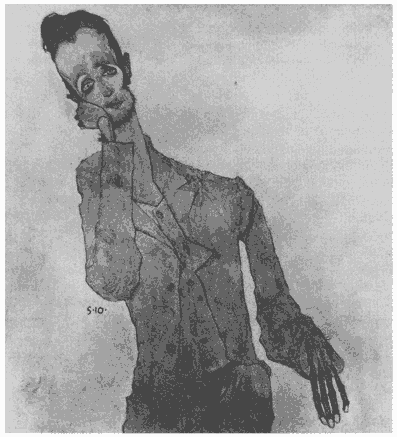
Fig. 9.
Egon Schiele, Portrait of the Painter Karl Zakovsek , 1910, oil and charcoal. Courtesy Galerie St. Etienne, New York.
objects of desire. These hands are emaciated to the bone. The flesh that clings to them has withdrawn to the point of showing the skeleton. If there is any "will to live" in these clinging instruments it is a dying proposition. With their knuckles and nails protruding, long and thin, these hands of the living are the hands of death. They are attached, in turn, to unnaturally extended arms, protruding in paralytic gestures as though the sitters were subjected to arcane rituals of punishment. The left arm of Karl Zakovsek is extended in a crablike bend, resting upon nothing. One of his shoulders is three times as broad as the other, suggesting the pressure of an invisible weight. The remain-
ing, peglike arm props up the head. More dramatic than the arms are the colors and shapes of the eyes and heads. These organs of vision are bulging, puffy, shut tight or transfixed—defiant, dejected, or forlorn. They glare at something distant, perhaps something even beyond the realm of the visible. They peer forth from bodies reclaimed by an "end" they have not yet reached, from faces cognizant of the oppression they cannot stop. The flesh is excessively pale or excessively dark, lacking blood in one case, life-moisture in another. Max Oppenheimer's face is green-yellow, like the children of Rilke's Notebooks , expanding in patches. Each of these subjects is an object, prey to an imponderably malicious, anonymous will.
In other portraits of this year, including many self-portraits, Schiele denudes the body altogether. Gesticulating, grimacing, writhing, or screaming, it seems to be acted upon by foreign and dehumanizing laws (fig. 24). Its veins and muscles burst the skin that contains them, in a manner first developed by Kokoschka. Later paintings personify the culprit, sometimes standing across or behind the main subject. In the self-portraits it tends to peer over Schiele's shoulder, claiming responsibility for the anxiety that haunts him (fig. 25). Elsewhere it embraces mothers and nuns. The children born from such unions have hollow and pallid features, with dark holes for eyes, like stillborns or puppets.
As with Rilke, Lukács, and Michelstaedter, it is difficult to sort out the difference between the psychological, metaphysical, and socio-political determinants of these depictions. Schiele focuses his art on the subjective experience of a psychosomatic deficiency abstracted from its surrounding objects and actions. As is clear, however, from his impulse to allegorize his subjects, something strangely universal is at work in this subjective experience, so universal that it cannot be separated from the objective conditions in which it is clothed. The body as it appears in Schiele is always an image of the historical res , if not of its incoherence, the image of a life riddled with forces it admits that it cannot control. Such an image is possible only after the spirit is reinscribed in the body, or subjects in objectivity, by modern philosophy, psychology, and anthropology. "Behind your thoughts and feelings, my brother, there stands a mighty ruler, an unknown sage—whose name is self. In your body he dwells; he is your body" (Nietzsche 1883–85: 146). By the beginning of the twentieth century, the spirit had been cast as libido, the instincts, or sheer will to power, bearing witness to a buried, impersonal, and autonomous self more sensitive to the creative and destructive forces of organic life than to rational purposes. By 1910
even the ostensible will to live was hardly to be separated from the body's own will to death. (The twenty-five-year-old Sabina Spielrein seems to have been the first to articulate the paradox in the context of professional psychology. Her findings, published under the title "Destruction as a Cause of Coming into Being" [1912], were presented to Freud in 1911 and shaped as early as 1910: "Secretly," she notes on October 19, 1910, "my new study, '2On the Death Instinct' is taking shape within me" [Spielrein 1909–12: 29].)[21]
The paintings of Schiele and other prewar expressionists reveal as much anxiety in the face of the deficiencies of physical reality as the writings of Michelstaedter, Simmel, Lukács, and Worringer. Schiele, too, makes occasional attempts to relate this deficiency to socioeconomics, as in the autobiographical poem "I, Eternal Child," which distinguishes the potential vitality of innermost subjectivity from the living death of commodified, institutional relations:
Some say: money is bread. Others affirm: money is a commodity. Still others: money is life.—Who, however, dares say: Money, are you?—A product? . . . Oh, the lively living thing! (Schiele 1921: 49; Nebehay 1979: 163–164)[22]
Thus philosophical speculations on the deficiencies of everyday life in 1910 find support in pictorial depictions of the sufferings, confusions,
[21] The theories of Spielrein might even help illuminate the suicides of the three women discussed at the beginning of this chapter. "A woman who abandons herself to passion," she claims "experiences all too soon its destructive aspect." There may be something in the way that women love that reveals this love to be inherently at odds with its surface interest. "One must imagine oneself as being somewhat outside bourgeois customs to understand the feeling of enormous insecurity which overtakes a person who entrusts himself or herself unconditionally to fate. To be fruitful means to destroy oneself" (Spielrein 1912: 466).
On Spielrein's anticipation of Freud's theory of the death instinct see Carotenuto 1982: 192, and Marthe Robert, The Psychoanalytic Revolution, trans. Kenneth Morgan (New York: Harcourt, Brace, and World, 1966): 330–331. On the reactions of Freud's Psychoanalytic Society to Spielrein's thesis, see Minutes of the Vienna Psychoanalytical Society , vol. 3: 1911–1918, ed. Herman Nunberg and Ernst Federn, trans. M. Nunberg (New York: International Universities Press, 1967): 330 n. 4; Sigmund Freud, Beyond the Pleasure Principle , in The Standard Edition of the Complete Psychological Works of Sigmund Freud , trans. and ed. James Strachey (London: Hogarth Press and the Institute of Psycho-Analysis, 1953–1974), vol. 18: 55; and The Freud/Jung Letters: The Correspondence Between Sigmund Freud and C. G. Jung , ed. William McGuire, trans. Ralph Manheim and R. E C. Hull. Bollingen Series XCIV (Princeton: Princeton University Press, 1974): 447.
[22] This and other selections of Schiele in English (rendered differently) are included in Egon Schiele, I, Eternal Child: Paintings and Poems , trans. Anselm Hollo (New York: Grove Press, 1985): 6–8.
and anxieties of the body, the most obvious token for the historical determination of the spirit.
Cosmic Guilt
Nowhere does this anxiety take on a broader configuration than in the poetry of Trakl, the great genius of negativity, the "seer" of the epochal, spiritual death alluded to by his contemporaries when they reflect on mortality, decay, and decline. What concerns this poet of the night is not merely the horror or decrepitude of the body, not the rhetorical evasions of mortality or the rationalized death of industrialized citizens. It is a sickness built into the very order of being. Whatever the cause of this sickness, Trakl suggests, it can hardly be cured by knowledge, institutions, or social decisions. Politics and morality can do nothing to change it; it lies in the stars, in birth, in the predatory nature of life itself. Death is no more than its mask.
This sickness is known by its symptoms, recurring in the young man's verse: the green corruption of the flesh; blood and fever; icy winds and audible walls; lepers, cripples, and whores; people not yet born or deceased too soon; evening, night, and winter. Its motifs include estrangement, murder, silence, paralysis, fear, lament, holiness, transcendence, and rebirth. The titles that name it are "Winter Twilight," "All Souls Day," "The Wanderer," "De Profundis," "Decline," "Spiritual Twilight," "The Cursed," "Amen," "Rest and Silence," "To Those Grown Mute," "The Autumn of the Lonely One," "Human Sadness," "Dream and Derangement." Wherever we turn in this poetry we find the narrative of a fall from grace, a dissolution of soul into matter, a debasement of nature and childhood. In Trakl's mythology of cosmic malignance, the sublunary world is inhabited by evil angels. Love cannot be distinguished from hate. Madness, disease, and corruption are signs of a living conspiracy from which one can be redeemed only by expiation.
"Bitter is death," writes the poet, "the fare of the guilt-laden" (Trakl 1969: 150). Death is the "fare" (Kost). the means of sustenance, of those who are culpable. And who are these guilty ones? They are all who have existed and have yet to exist, including animals, for death spares none. Death itself is not the evil, but a manifestation of the evil, a symptom as it were of the crime. "Great is the guilt of the born" (Trakl 1969: 114, 1988: 64–65). In a poem of 1909 Trakl gives a name
to this inbred existential guilt: "Blutschuld." Literally "blood-guilt," or "a crime of the blood," the title stands above lines that seem to refer so directly to Trakl's alleged incest with his sister that the editors of the first collection of his poems did not include the composition (Trakl 1969: 249). And yet it is a significance larger than "incest" in Blutschuld which resounds most strongly in Trakl's verse—the sense of Blutschuld as a criminality built into the blood from the start. Blood-guilt, Trakl's poetry reiterates, pervades the universe. This, if anything, explains the self-immolation and derangement of those few martyric figures who perceive it. Not just incest and murder, but sex and the very struggle for survival rehearse this violent depravity of organic existence.[23] Here Spielrein's "Destruction as a Cause of Coming into Being" is more explicit: "The reproductive instinct . . . is equally an instinct of birth and one of destruction" (Spielrein 1912: 503).
This sense of the violence and depravity of sex, stretching all the way up from the Christian theology of original sin to Schopenhauer's pessimistic metaphysics, reaches its culmination in Weininger's Sex and Character .[24] Weininger presents sex, or Geschlecht , as a fatality delimiting the very possibilities of spiritual achievement. In Trakl the word becomes as generic as every term he uses. Beyond the gender, sexuality, or copulative activity of creatures, it refers to their "creaturality," to their participation in the cycle of procreation. Geschlecht means the very principle at work in generation, including every "race of the begotten." Nearly everywhere the principle can be reduced to its opposite.
Trakl refers to Geschlecht five times in "Dream and Derangement," the poem equating death with the fare of the guilt-laden. The long prose poem opens with a boy, a figure for the poet, weighed down by "the curse of the degenerated race" [der Fluch des entarteten Geschlechts ]. His hard father is now an old man and his mother has turned to stone. Twice the poet remarks on the curse of Geschlecht , both times in the context of a sexual scene: "O the accursed race. When, in defiled rooms, each such destiny is accomplished, death enters with mouldering steps into the house." The second mention is at the poem's end,
[23] For an analysis of the poem "Blutshuld" see Sharp 1981: 59–62. On the associations between sin, guilt, and blood in Trakl's verse see Michel-Francois Demet, "Georg Trakl: Blood, the Mirror, the Sister," in Williams, ed., 1991: 167–190.
[24] On Trakl's reading of Weininger, see Alfred Dopplei "Georg Trakl und Otto Weininger," Peripherie und Zentrum: Studien zur österreichischen Literatur , ed. Gerlinde Weiss and Klaus Zelewitz (Salzburg: Das Bergland-Buch, 1971): 43–54, and Sharp 1981: 53.
when, battered by "stony solitude," the boy is escorted by a dead man into the "dark house" of the father. Upon the arrival of the "sister," and the hint of an incestuous act, death and voluptuousness come together, revealing their bond:
Purpurne Wolke umwölkte sein Haupt, daß er schweigend über sein eigenes Blut und Bildnis herfiel, ein mondenes Antlitz; steinern ins Leere hinsank, da in zerbrochenem Spiegel, ein sterbender Jüngling, die Schwester erschien; die Nacht das verfluchte Geschlecht verschlang.
[A crimson cloud clouded his head so that he fell silently upon his own blood and likeness, a lunar face; stonily he sank down into emptiness, when in the broken mirror, a dying youth, the sister appeared; the night devoured the accursed race.] (Trakl 1969: 150; trans. Sharp 1981: 219)
Earlier in the poem Trakl had described this degenerative Geschlecht in terms reaching back to a primordial human family: "fruit and tools fell from the horrified race. A wolf tore the firstborn to pieces and the sisters fled into dark gardens to bony old men." The poet cannot suppress his cry: "O the voluptuousness of death. O you children of a dark race" (Trakl 1969: 149; Sharp 1981: 217). The generic language of the poem makes it impossible to associate the guilt of Geschlecht with only one family or only one group of acts. Rathet it refers to the transhisorical origin of the family, even to the voluptuous death of all spiritual concerns in rapacious, beastly behavior.
Is it any surprise, then, that Trakl chooses to cultivate the myth of unbornness? He recalls the ancient Greek saying of Menander, recommending the speediest of deaths, assuming one lacks the good fortune never to have been born at all. Figures so graced do exist in Trakl's poetry, especially Elis, the legendary boy buried in a mine, and Caspar Hauser, who was alleged to have spent the first seventeen years of his life chained to the wall of a dungeon-like room, only to be murdered by a stranger soon after seeing the light of day.[25] Shortly before his suicide, Trakl is reported to have said that he was only "half-born" and did not want to see his birth completed.[26] Did he mean that the blood-guilt of the generative-degenerate Geschlecht had not possessed him fully? Or that he was only half willing to accept the horror of aging in pursuit of lust and power? His other half would then have lived among those who refused to live by such rules, and whose refusal meant
[25] The eighteenth-century mystery of Caspar Hauser was fictionalized by the Viennese novelist Jakob Wassermann in 1908.
[26] Hans Limbach, "Begegnung mit Georg Trakl," Erinnerung an Georg Trakl: Zeugnisse und Briefe (Salzburg: Otto Müller, 1966), 121–122.
death. Michelstaedter entertained a similar notion, frequently returning in his writings to the ancient Greek wisdom that the truly blessed of the gods are those who die young.
Never so much as at the beginning of the twentieth century, states Trakl's poetry, have the degenerate effects of Geschlecht been felt so starkly. It is now—and not in every possible historical world—that one hears the lament of the "solitary grandchild," the spokesman for countless generations. It is now, in the forlorn present, that the gods have been ravaged, that faces appear speechless and stones fall silent. It is in Trakl's own time that "the spirit of evil peers out of white masks" and the "self-spilt blood gushes forth from the heart" (Trakl 1969: 68, 29, 97; Sharp 1981: 212). As a "muter mankind bleeds silently," whores give birth to dead infants (Trakl 1969: 124, 1988: 81). The term Geschlecht weds Trakl's vision of ontological destitution to an indictment of that cultural history which the early twentieth century called theAbendland , the West, the land of the declining sun, playing out its twilight.
Indeed, twilight pervades the only language a poet of this era can speak. Like the boy in "Dream and Derangement," he is the voluntary victim of the epoch in which he lives. "Silvery shimmer the evil blossoms of blood on his temple, the cold moon in his shattered eyes." Thus Trakl, the child of a dark race, cannot but be a "deranged seer," announcing the "unspeakable guilt" of his own "cool grave" (Trakl 1969: 148–149; Sharp 1981: 216–217). The vision of degeneration and decline increases steadily from the idyllic struggles of Trakl's early poems to the terror and regret of the final ones. His entire poetic corpus is a "Song of the Departed One," as the title reads to the penultimate section of the last collection he composed, Sebastian im Traum (1915). The poet of Blutschuld can find no redemption except in voicing his resistance to existence.
If such an individual isolates himself in modern society, Trakl writes to a friend, it is "because he prefers to be dissolute rather than inauthentic. I anticipate world catastrophes, I take no part, I am not a revolutionary. I am the departed one, in my epoch I have no choice but that of pain" (Letter to Johannes Klein, cited by Magris 1983: vii). The present is a "bitter hour of decline, I when in black waters we gaze at a stony face" (Trakl 1969: 119). If "we" are here cast in the role of Narcissus, then the self-knowledge we obtain from our surroundings (in the image reflected by the waters) is that these surroundings have acted as Medusa, turning us to stone. Our spokesman, the poet, folds
in on himself and his participatory guilt, acquiescing in the derangement of his final Umnachtung . Nothing positive can be uttered in a night without revelation. Like Ludwig Meidner, with his Apocalyptic Landscapes of 1912–13, Trakl imagines himself to be the representative of a world at its end. His silence can speak only in the vocative mood, appealing to the consciousness of need.
Impotence
Instead of offering the metaphoric shelters of the benighted poet, Michelstaedter speaks discursively—in syllogisms and axioms, philosophically explaining the pain, sterility, and impotence expressed by Trakl. The most dauntless theoretician of the deficiency of being also reaps guilt from this deficiency, projecting it onto the cosmos. Death, for him, is not merely Simmel's prerequisite for the conduct of life. It is not Lukács's feature of actual, contemporary existence when measured by a utopian ideal, or Trakl's metaphor for spiritual corruption. It is these and more. As well as the only positive truth of life.
We have seen Michelstaedter argue that the flight from death governs the most banal, everyday decisions. He characterizes everything mortals do as a conscious repression of their itinerary toward nonbeing. By fastening their will on the "life" they lack at any particular moment, they transform their present into absence and perpetual death. This is the "continuous deficiency . . . which everything that lives is persuaded is life " (Michelstaedter 1910: 43). Vitalism, desire, or philopsychia, the love of life, becomes for Michelstaedter the very source of death. The constitutive deficiency of experience is never filled by the satisfactions and achievements to which we direct our attention. These apparent accomplishments only mask the universal and ubiquitous pain, the "dull and continuous grief [dolore ]" that "seethes beneath all things" and "unites all things that live" (Michelstaedter 1910: 55, 57, 59). The truth is experienced when the thread of one's illusory pleasures suddenly snaps:
As when, in the dimming of the light of one's room, the image of one's intimate things . . . becomes more tenuous, and the invisible grows more visible, just so, when the woof [trama ] of illusion becomes more thin, unraveled, or torn, humans, made impotent, feel themselves in the throes of what lies beyond their power, of what they do not know: they fear without knowing what they fear . (Michelstaedter 1910: 56)
Michelstaedter's dolore, like that of Malte, is an objectless anxiety: One fears without knowing what one fears. When the fabric of one's pleasures is rent (but trama also means plot, the false continuity of a life story) one cannot single out a particular thing to redress. The invisible grows more visible: Not an absence of visibility, but the absence itself comes into sight.
The pain consists in recognizing that one is prey to "what lies beyond one's power." What is it that Michelstaedter imagines to be beyond one's power? The adversity and contingency of fate? A demonic principle? Or is it the permanent possibility of impotence itself, the risk of not achieving the power one covets, as though this were the real obscurity that made all pleasure flicker? Impotence is a more primordial condition than any that occurs in historical experience. While power is necessarily limited, impotence is potentially infinite (Michelstaedter 1910: 61). Obscurity, impotence, and pain are more "positive" than any of the forces they contest, a positive negativity underlying whatever we might construct. Is this a specious argument or does Michelstaedter just take a truism to an extreme that few thinkers would be willing to accept? In essence his position radicalizes Schopenhauer's idea that we never really feel the overall health of our body (the positive), but only the spot where the shoe pinches (the negative). Suffering, not joy, is the prime mover of action. If this is so, then the only practical question is how large this negativity can loom if we fail to contain it.
Michelstaedter allows it free rein. He speaks, for example, of what happens to children when they are subject to boredom and their attention is not firmly held by outside things (the condition of noia ). They eventually "find themselves looking at the darkness with their little minds." And the darkness becomes peopled with menacing, humanoid figures, with eyes and ears, with arms that clasp at the small creatures "with a thousand hands," making them "flee madmen in terror and shriek in order to deaden their senses" (Michelstaedter 1910: 57). Given the imaginative force of this description, it will come as no surprise that Michelstaedter himself was terrified of the darkness as a child. "It was I," writes his sister Paula, "who made him overcome his instinctive fear of the darkness by closing him in a dark room, and made him overcome his fear of storms by dragging him onto the terrace during lightning and thunder" (Winteler 1973: 149). As an adult Carlo still remarks on the "threatening darkness" outside his window, explaining in a poem to his sister on her birthday, two months before his suicide,
why his sense of the negative requires the most radical transformation of life:
Paula, non ti so dir dolci parole,
cose non so che possan esser care,
poiché il muto dolore a me ha parlato
e m'ha narrato quello che ogni cuore
soffre e non sa—ché a sé non lo confessa.
Ed oltre il vetro della chiara stanza
che le consuete imagini riflette
vedo l'oscurità pur minacciosa
—e sostare non posso nel deserto.
Lasciami andare, Paula, nella notte
a crearmi la luce da me stesso,
lasciami andar oltre il deserto, al mare
perch'o ti porti il dono luminoso
. . . molto più che non credi mi sei cara.
[Paula, I have no words for you,
I know no things you could cling to,
for mute grief has spoken to me
and has told me what every heart
suffers and does not know—for it refuses to admit it.
And past the window of the bright room
which reflects the images we are accustomed to
I see the threatening darkness
—and cannot tarry in the desert.
Let me go, Paula, into the night
to create a light on my own,
Let me go past the desert, to the sea
so that I might bring you the luminous gift . . . you are much dearer to me than you imagine.]
(Michelstaedter 1987: 72)
The extreme pathos of this poem, its intense appeal, its casual identification of the room with a desert, are all keys to Persuasion and Rhetoric . What he gives us in the reasoned dissertation is no less imaginative and personal than his poetry—not "objective" descriptions of life but subjective ones, projections of a mind. And it is surprising that the nature of this rhetoric in Persuasion and Rhetoric has been analyzed by almost no reader but Garcia-Pignide.[27]
[27] In truth Garcia-Pignide is not as interested in the rhetoric of Persuasion and Rhetoric as in a psychoanalytic reading of some of its figures. Noting, for example, that Michelstaedter "generalizes death anxiety to the world," she reads the passage I comment on next as a descent into the tomb. She also analyzes the aggression, violence, and sadomasochism of Michelstaedter's sexual imagery. Lucile Garcia-Pignide, "Fantasmes et rationalisations dans l'oeuvre de C. Michelstaedter," Idéologies et politique: Contributions à l'histoire récente des intellectuels italiens (Paris: Centre de Recherche de l'Université de Paris VIII-Vincennes, 1978), 91–163. For a more philosophical reading of Michelstaedter's imaginative negativity see Bini 1992, esp. pp. 101–191. Campailla 1973 and Cacciari 1992a also have illuminating remarks on some of Michelstaedter's rhetorical choices.
In Michelstaedter's outburst about children left on their own in the darkness we are privy to that hallmark of expressionist art which Kandinsky calls an "improvisation." If impressions are concerned with "external nature," he explains, improvisations give shape to events of "internal nature," freely remaking the world even at the expense of violent and tumultuous distortion (Kandinsky 1909–11: 218). The difference is again the one between impressionism and expressionism. Michelstaedter's empathy for irrational suffering is so intense that it turns a philosophical treatise on the universal conditions of human existence into a document of imaginative externalization, ruled by an unspeakably emotional persuasion. The dissertation re-creates the cosmos from the perspective of an I, making the work as much of a soulscape as Trakl's poetry, its "allegories" about others really autobiographies.
Michelstaedter follows his depiction of the noia of children by another one on adults. Upon awakening in the middle of the night, these unidentified persons discover their tokens of identity dissolving into nothing. Throwing open their eyes in the darkness, they strike a match and are relieved to discover their peace:
alongside them lies their sweet companion—here are their clothes, imprinted by the body, here, in the portraits, are the familiar faces of their relatives—all the dear, dear familiar things. "All right, all right—What time is it? Oh my! It is late—and tomorrow I have to get up. Blasted dreams—God, what dreams! So, tomorrow . . . let's try to hurry back to sleep." And reassured, they redarken the chamber. But the images left in their eyes fall apart—the plans for tomorrow and the day after tomorrow are arrested—man, once again, finds himself without a name or surname, without a consort or relatives, with no things to do, without any clothes, alone, naked, with eyes wide open and gazing at the darkness.
As the light goes out Michelstaedter's characters find everything that they once considered real going up in smoke. Their husbands and wives vanish. They lose their name and surname. Even their clothes disappear, bearing only the impressions of the substance they lack. It is not long before infinity sucks them up and sneers, "Nothing, nothing, nothing—you are nothing, I know that you are nothing." A person, at these moments, "feels himself dissolving in the way that a corpse preserved
in an airtight place dissolves when exposed to the open" (Michelstaedter 1910: 58–59).
This final "improvisation" overturns common sense in the most unabashed of ways. It likens open-air, daylight activity to existence in an airtight coffin. What appears to be a living, historical person—the one of waking hours—is only a mummy. The real open air—from which we try to conserve our lives—is darkness, non-being, nothingness. This is the reality that threatens the corpse. Everyday zombies are thus doubly unfortunate: their empirical lives are walking deaths, while the true life they encounter in vacancy, obscurity, and dread does them in for good. The same reversals of life and death recur in Michelstaedter's poetry.
It is difficult not to read this fear of impotence of which Michelstaedter speaks in terms of fear of historical others, if not of all things outside the self-contained subject. We can recall another "improvisation," this time a parable. Hydrogen and chlorine, when they come into the proximity of each other, show an innate compulsion to join (Michelstaedter anthropomorphizes the valences of these elements, as he does the gravitation of the weight). But what happens when these elements achieve the union for which they pine? They lose their separate, independent natures, forming the noxious new compound, hydrochloric acid. The "love" by which they are moved is "a lethal embrace," a murder and suicide for the sake of a debilitating union. Just as these elements live for "death," comments Michelstaedter, "so their love is hate" (Michelstaedter 1910: 47).
The main purpose of this simile is to convey the deadly implications of a life that cannot stand on its own two feet. But why does Michelstaedter use an erotic metaphor to describe the union of chemicals? What light does this rhetoric shed on his own persuasion? The "lethal pleasure of the embrace" recurs throughout Persuasion and Rhetoric, as though Michelstaedter, like Weininger, Schiele, Freud, and Kokoschka, was unable to steer clear of the sexual unease of his age. One remembers, for example, that he personifies rhetoric as a demon of pleasure: the god of philopsychia, pandering illusory pleasures that only distance ourselves from ourselves. The cadaver that rots in the air of insecurity is the demonic result of the pleasure principle.
The identification of impotence and insecurity with the pursuit of pleasure is common to Michelstaedter's time. Just a year after the Italian's suicide, the psychoanalyst Alfred Adler breaks with Freudian doctrine on similar grounds. He rereads the "will to pleasure" not as a
primary interest, but a secondary one, a response to universal and congenital insecurity. We seek pleasure or power to compensate for conditions of incompleteness and privation from which we can never be free. And yet, for Adler as for Nietzsche before him, there is nothing intrinsically unhealthy in this primordial deficiency of being. Unhealthy are the elaborate ploys to which we resort in order to deny this privative state, whether by fleeing from the risks run in satisfying it or by cultivating illusions of self-sufficiency. In the light of Adler one is compelled to ask whether Michelstaedter, too, wants to flee from the insecurity that he spies in the everyday operations of life. The love of life, in him, is insecurity itself, and his first reaction is to battle this love. His equation of eros and impotence becomes a strategy to repress his own desire, an admission that he does not know how to establish a system of reciprocities that would enable him to overcome his alienation. The "impotence" is not the effect of the outside world; it is the effect of having no means—no language, no mode of behavior—by which to affect that outside world. The desire for bonds goes unappeased.
Both Campailla and Bini have noted that Michelstaedter's Florentine studies in the nude avoid representing the genitals. We also find sexual transpositions in his paintings, as in the watercolor of his father ascending to heaven in a feminine pose and dress (fig. 10). To illustrate the effects of philopsychia Michelstaedter calls on sexual metaphors. The word amplesso ("embrace," a euphemism for copulation) appears not only in his description of the union of hydrogen and chlorine but also in his account of the symbiosis of bee and flower: "In the bee the flower sees the propagation of its pollen, in the flower the bee sees sweet food for its larvae. In the two organisms' embrace each sees in the other's disposition 'its own self as in a mirror'" (Michelstaedter 1910: 63). What Michelstaedter finds grotesque in this "reciprocal love" is that it is merely a mask of self-interest. The situation is further complicated by the fact that this self-interest is actually an illusory one: the seeming egocentricity by which the flower or the bee says "yes" to its lover only in order to affirm itself turns out to be "ego-eccentric," for each loves the other out of desire for an offspring outside the two. And this is a rhetorical form of self-affirmation, a shirking of solitude. The "selfish" interest in propagating the species is just a knee-jerk reaction to death.
Such eros is anteros, transforming subjects into objects and ends into means (Michelstaedter 1910: 63). A participant in the erotic relation never asks whether its self-affirmation enables the self-affirmation
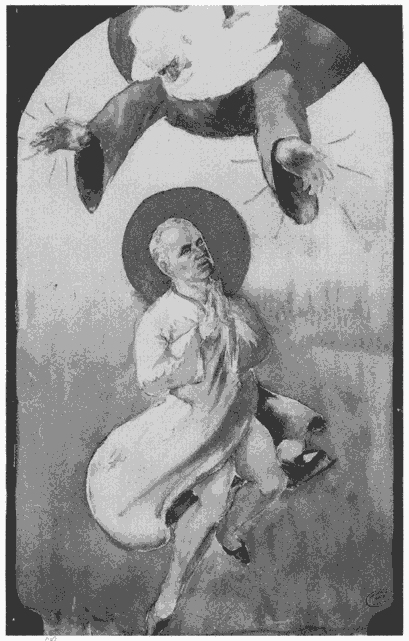
Fig. 10.
Carlo Michelstaedter, Assumption II, no date, watercolor and pencil. Courtesy Gorizia Civic Library, Gorizia.
of the other, "or whether, instead, it does not take away [the other's] future—whether it kills it. Each only knows that this [act] is good for itself, and makes use of the other as a means toward its own ends, as material for its own life, while at the same time it too is a material means to the life of the other." And so out of "reciprocal need" the affirmation of illusory individuality "takes on the appearance of love." Instead of eros "it is a travesty of neichos "—contention, strife, or battle (Michelstaedter 1910: 63).
By 1910 the association between sexuality and death had already been 2,000 years in the making. It was beginning to call for resolution. The matrix of the problem had been articulated in Schopenhauer's supplement to the Fourth Book of The World as Will and Representation, "The Metaphysics of the Loves of the Sexes" (1844), arguing that erotic attraction was the expression of a blind metaphysical compulsion towards procreation which no higher or rational force can hope to withstand. Moreover, there was no individualism in either the act of sex or the choices it made; it was merely the "genius of the species"—not of individuals—that was voicing its will in Geschlecht . But Schopenhauer himself was already elaborating on Kant, who had viewed sexual interaction as nothing more than "the reciprocal use made by one person of the sexual organs and faculties of another." Marriage is the institutionalization of this reciprocal use, a "union of two people of different sexes with a view to the mutual possession of each other's sexual attributes for the duration of their lives."[28] More recently, Michelstaedter's generation had Nietzsche's philosophy on which to base their sense of the anteros involved in eros: "Has my definition of love been heard? It is the only one worthy of a philosopher. Love—in its means, war; at bottom, the deadly hatred of the sexes" (Nietzsche 1908: 723).[29] And this notion, in turn, was linked to Richard Wagner's Liebestod and to the battle of the sexes in Bizet's Carmen, and received further elaboration in the Pre-Raphaelites, Gabriele D'An-
[28] Immanuel Kant, Metaphysik der Sitten (1797), ed. Karl Vorländer (Hamburg: Felix Meiner, 1966), 91.
[29] The most dramatic expression of the erotic antagonism occurs in Kokoschka's short play Murderer, the Hope of Women, where, upon sight, a man and a woman attack each other in a battle to the death. See Kokoschka 1907 and Bettina Knapp, "Oskar Kokoschka's Murderer, Hope of Womankind : An Apocalyptic Experience," Theatre Journal 35 (May 1983): 179–194. On the intricacies of the masculine struggle with the feminine in turn-of-the-century Europe see Bram Dijkstra, Idols of Perversity: Fantasies of Feminine Evil in Fin-de-Siècle Culture (Oxford: Oxford University Press, 1986).
nunzio, August Strindberg, Franz Wedekind, and Jugendstil art of the early twentieth century.
In the years following Jugendstil, however, this clever idea of sexual strife becomes truly tormented. In Michelstaedter, Schoenberg, Kokoschka, Trakl, and Schiele sexuality faces up to the barrage of obstacles to its expression that had been accumulated over the course of two thousand years of Christian culture. And the confrontation proved cathartic, as we know from the "roaring twenties." But the situation was hardly as easy for those who enabled the catharsis. Before sexual energy could enjoy its freedom, homosexuality, misogyny, monogamy, propriety, guilt, and repression—in short, the question of what exactly was at stake in the sexual act—first had to be understood. The first phase of such understanding saw the questions being marshaled in consciousness. The second and more difficult phase—represented by Weininger, Trakl, Schiele, Michelstaedter, and Freud—sees the ranks of the wounded. Before sexuality can doff its connotations of victimization, depravity, and abuse, its martyrs will have been even more numerous.
One of the emblems of the prewar identification of love and hate is a hand-colored lithograph of Edvard Munch. Loving Woman depicts a contemporary image of philopsychia : a voluptuous, naked, demonic female with thick wild hair, in a gesture of sensual abandon. Frenzied sperm cells climb up and down the margins of the illustration. The fruit of the sexual union, however, is not life, but an incarnation of death, a stillborn fetus in the lower left corner, doomed from the very moment of conception. Extreme desire and revulsion are mixed in this vision, bespeaking the fear of losing one's life in eros. And that fear is exorcised by means of deathly equations. Sexual catharsis will not be complete until it has exorcised such demons, haunting the freedom for which it strives.
Egon Schiele has his own images of philopsychia, some reached for directly by the hand of death (Female Nude ). But whose hand is this that reaches for the naked woman, her nose suggestive of a syphilitic infection? Is it the hand of death or is it Schiele's—which kills its object? Or is it just an image of the risks of reaching out, of the fears of doing so? "Our extremities, including our hands," writes Schoenberg, "serve to carry out our wishes, to express, to make manifest, that which does not have to remain inside. A fortunate hand operates externally, far outside our well-protected self—the farther it reaches, the farther it is from us" (Schoenberg 1988: 35; "A Lecture About Die Glückliche
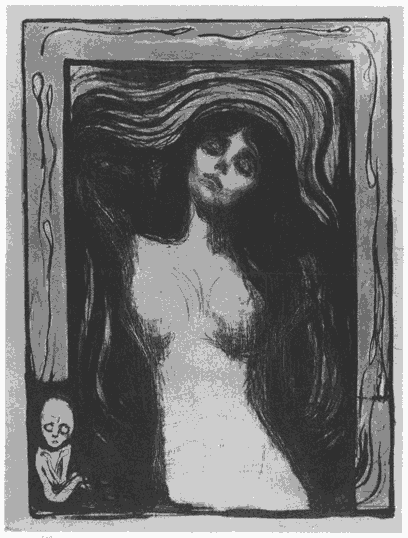
Fig. 11.
Edvard Munch, Loving Woman (Madonna), 1895–1902, lithograph. Courtesy Munch Museum, Oslo.
Hand, " 1928). The problem that is treated in Schiele's painting as in Michelstaedter's compulsively erotic rhetoric is that of bridging the gap between self and other, of possessing the nakedness of another. In most of Schiele's paintings, if not this one, the nudity is of a shocking variety, directly countering the effort to aestheticize the object of desire, frequently contrasting the overall beauty of the body with the
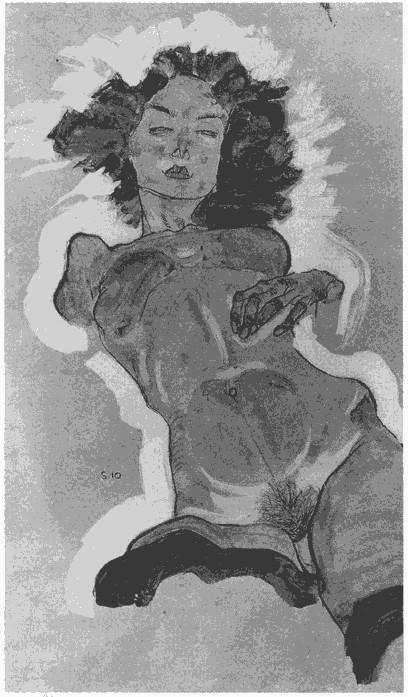
Fig. 12.
Egon Schiele, Female Nude, 1910, watercolor and charcoal. Courtesy Graphische Sammlung Albertina, Vienna.
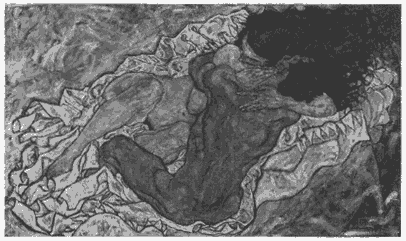
Fig. 13.
Egon Schiele, Embrace (Lovers II), 1917, oil. Courtesy Österreichische Galerie, Vienna.
coarse exposure of the pudenda. While Schiele's libidinal instincts are admittedly stronger than Michelstaedter's, their expression is stifled, nearly choked by the crudity of the pornographic. Both males and females are brutalized, their gestures and poses aggressive. When a woman does hold a man in Schiele, as in The Embrace, her deep and lyrical allegiance is contrasted by the effort of her knees and elbows to keep her lover at bay. The parts of the body one expects to see closest are the ones at furthest remove. The woman's fingers are positioned as scissors. This embrace is the desperate clasp of two suffering solitudes, each terrified of being left alone.
The couplings in Schiele are failures. Coitus (1913) shows a female posing for the viewer while her man, passive and awkward, gazes off into a distant space, unable to rise to the occasion. Vibrant as sexuality may be in Schiele, it seems rarely to know its aim, much less the steps to achieve it. In a self-portrait Schiele directly reproaches his organ for not measuring up to the dimensions of his forearm, held forward from an impossibly low joint. The axis of Schiele's neck parallels this subjugating ideal, bowed down as though for the guillotine, in a confession of impotence. The portrait is appropriately called the Preacher (1913): the spokesman for guilt. Schiele's most dramatic scenes of sexuality are accordingly onanistic, as in Seated Couple, where the woman laments the misguidance of the man whose affection she seeks. With swollen red eyes she clasps him from behind, an unwilling
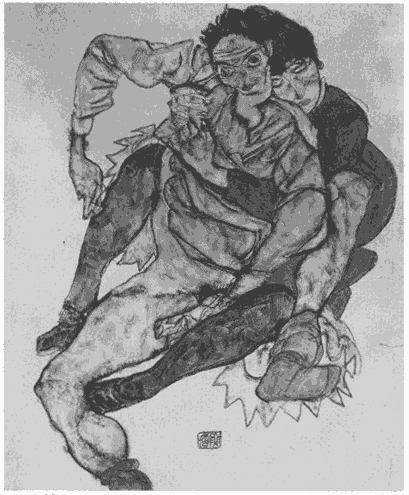
Fig. 14.
Egon Schiele, Seated Couple (Egon and Edith Schiele), 1915, gouache and pencil. Courtesy
Graphische Sammlung Albertina, Vienna.
accessory to a stubborn exhibitionist who is bent on offending public decorum. Thus the ultimate result of the libinal urge is self-absorption, the energy folded back on itself (Self-Portrait Masturbating, 1911).
Self-absorption, on a more spiritual level, is also the result of the antierotic polemic in Michelstaedter. His solution to the impossible union of blossom and bee, or man and woman, is a life of free and autonomous individuality, of pure and unadulterated self-reliance. Persons who seek themselves instead of a means to themselves require an
uncorrelative existence: Persuasion "does not live in him who does not live on himself alone " (Michelstaedter 1910: 42). Does it come as a surprise that Michelstaedter rejects actual, concrete love on the very same ground? The object of desire is Argia Cassini, in whom Carlo had invested much feeling in 1910. On one of the final days of his life, he addresses her in the most intransigent of metaphysical love poems. Its purpose: to explain why there is no reason whatsoever for him to bring his love to fruition:
Parlarti? e pria che tolta per la vita
mi sii, del tutto prenderti?—che giova?
che giova, se del tutto io t'ho perduta
quando mia tu non fosti il giorno stesso
che c'incontrammo? . . .
[Speak to you? and before you are taken from me
for life, seize you completely?—for what reason?
for what reason, if I lost you completely
when, the day we first met,
you were not mine?]
(Michelstaedter 1987: 95)
The fact that Argia was not already his on the day that they met—that she was irremediably "other"—means that she was lost to him forever (for "life": for another, not living life). At best, to seize her completely would have been an injustice, at worst, an illusion. Even if he succeeded in winning her completely, Michelstaedter continues—"by means of your will," he adds, reaffirming his phobia of hetero-determination—Argia would never be fused with his being. If "I do not know / how to create your life from within my own," the poem concludes, the enterprise is doomed to fail (Michelstaedter 1987: 95–96).[30]
The words of Rilke in The Notebooks of Malte Laurids Brigge help illuminate the syndrome of Michelstaedter: an "unspeakable fear for the liberty of the other" made him yearn "to remove from [his] love all that was transitive" (Rilke 1910: 212, 208). If love is motivated by a self-interested desire for possession, neither subject nor object of love can do themselves justice. Indeed, this motivation cannot even abolish
[30] Another poem to Argia proposes a more absolute, perhaps even literal, death over and beyond the "bitter" historical one of coupling (which provides illusory rest to those who are "dead by birth"): "the young death that smiles/to those who do not fear/death that does not separate/but unites man and woman/and does not press them with dark sorrow—/but receives them both in her womb/as a harbor of peace receives him/who was able to sail/in the stormy sea, in the deserted sea,/and did not turn to land for comfort" (Michelstaedter 1987: 88–89; trans. Bini 1992: 168).
that difference between self and other at which it aims. For eros to be eros it must resist the suicide and murder of possession. The question then becomes the one that Lukács poses in Soul and Form : "Whom can I love in such a way that the object of my love will not stand in the way of my love?" (Lukács 1910–11a: 34). This is the question that causes his separation from Irma and nourishes the "work." Slataper too accepts an irremediable distance between self and other as the prerequisite for the expression of his subjective potential. "I cannot yet rest," he states ten months after Gioietta's death, "because I have not created a book." Whatever one might achieve short of this "is not work but the restlessness of impotence" (quoted by Stuparich 1950: 115). Love not sublimated into work—"transitive" love, fastened on an object—is self-dispossessing, a desperate disguise of deficiency.
Michelslaedter, Lukács, and Slataper eventually find a way to reinvest this love with such intransitive value that no single object can exhaust its attention. In the meantime, however, like Schiele, Kokoschka, and Schoenberg, they express misgivings about its everyday forms.[31] Attachment to another, and probably even resistance to such attachment (no longer "fear for the liberty of another," but fear for the liberty of oneself), is fear of impotence. And this is no avenue to self-possession—without which a person is no more than "a son and a father, and a slave and a master, of what surrounds him" (Michelstaedter 1910: 42). We do not need Hegel's pages on the master and slave dialectic to seize Michelstaedter's meaning. In the context of his argument about treating the other as a means rather than an end, his more immediate reference is probably Weininger. When a person "can only think of things as possessions," writes Janik, paraphrasing arguments in Weininger's posthumous Ueber die letzen Dinge (On Ultimate Things, 1904), "he relates to persons as master or servant, never as comrade" (Janik 1985: 72). And this is a sure way to lose the very autonomy one thinks one has, for where "there is no Thou there is certainly no I" (Weininger 1903: 180). Unless one acknowledges the separate independence of another, one cannot even begin to affirm one's own. In the context of Michelstaedter's work, however, one can also
[31] The theme of love in a condition of solitude, of love in and despite mortality, pervades Schoenberg's work, especially Erwartung and Transfigured Night . Kokoschka's prototypical vision of distance in togetherness, which was probably the inspiration for Schiele's Embrace, is The Tempest (1914). Its real title, conceived by Trakl when, dressed in black and mourning the near death of his sister-loves, he silently watched Kokoschka complete it, is more revealing: Bride of the Wind . The phrase finds its way into Trakl's poem "The Night" (Trakl 1969: 160, 1988: 115).
turn Weininger's statement around, saying there can be no I where there is a Thou, for it is precisely this Thou that threatens the I.
Loss of Self
The recurring antagonist in these philosophical, literary, and pictorial texts is oppression, repression, limitation, and decay. Figured in various prisons of the body, historical constraint, and social convention, objectification is the final opponent, threatening that bundle of intention, feeling, and thought that we call the self. In 1910 these forces seem all to explicitly conspire against the independence of subjectivity. In early twentieth-century culture "humans have been distanced, so to speak, from themselves," writes Simmel. "Between themselves and their most authentic, essential part there has been erected an insuperable barrier of instruments, technical conquests, capacities, and commodities" (Simmel 1907: 484). The casualty of this rhetorical network is the possibility of coinciding with one's inward nature. Even that metaphysics of "vitalism" which posits an unconscious and organic becoming beneath the rhetorical rigidifications of commodified culture has an analogous effect, leaving no point of reference upon which to construct a life one can call one's own. "Impressions do not take hold in my soul," writes Michelstaedter in 1905, aware of the risks of living a pure flux of becoming. "Every instant I feel as though I were another; I have lost the sense of the continuity of my I" (Michelstaedter 1958: 418–419). No identity can be properly affirmed in empirical change, says Lukács. In Trakl the pronoun I becomes impossible to pronounce. He must scratch it out of his poems and replace it with words like the "stranger" and "the departed one." If one can speak at all of something like the soul, one must say that it is etwas Fremdes auf Erde, "something strange on earth" (Trakl 1969: 141).
As the face of the Austrian poet turns stony, that of others suffers corrosion. At the corner of Notre-Dame-des-Champs, Malte observes a woman whom an external force has made to collapse into herself. Her face remains in her hands:
I could see it lying in them, its hollow form. It cost me indescribable effort to stay with those hands and not to look at what had torn itself out of them. I shuddered to see a face from the inside, but still I was much more afraid of the naked flayed head without a face. (Rilke 1910: 16)
The objectified life of these metropolitan denizens does not merely render them faceless; it gives them faces that are not theirs, masks that are
ridden with holes, withering and peeling away. And in time, "little by little, the under layer, the no-face, comes through." The alien life implodes. Even one's death is assigned by outside forces: "Voilà votre mort, monsieur." This completion of a life, which should have grown out of it in the manner of its innermost conclusion, is now an abstract event, belonging "to the diseases and not to the people." One dies in hospitals, and from one of the deaths "attached to the institution" (Rilke 1910: 15–18).
In the pestilent atmosphere of the Notebooks as well as Persuasion and Rhetoric "one has nothing and nobody." Malte drifts through the streets like "a sheet of blank paper." The deficiency of being robs all things that are not fully objective (physical, testable, or practically useful) of language, killing the very spirit that presumably gives them life. "I sit here and am nothing," Malte remarks. And yet in his recognition of nothingness Malte "begins to think" (Rilke 1910: 24, 66, 28). This seemingly casual step—by which a nothing begins to think—is of utmost importance. It almost suggests that the inner activity one can control begins only now, that thinking is originated by this experience of lifeless negativity, by this negative life, by this perception that the structures of historical being eclipse the very consciousness they were presumably designed to serve.
And what does this nothing think? It thinks, "I have an inner self of which I was ignorant. Everything goes thither now," to that inner, but unknown realm (Rilke 1910: 14–15). If thinking has a task in the face of the deficiency of being, it consists in constructing a means of revealing this unknown self, including an idea of humanity itself, its languages and truths, its nature and measures of knowledge. Thinking, in 1910, does not come to an end with a meditation on negativity; it is there that it begins, as a search for persuasion. It seeks form for what now seems to be the only alternative to lifeless being: "something strange on earth," lacking its own manner of expression.
The moment is reached when a confrontation with this voiceless subjectivity becomes the only promising project of life, the moment when, as Michelstaedter writes beneath his final self-portrait, "man lights a light for himself in the night" (Michelstaedter 1992: 444). The investment of hope in the innerness of the human being is the logical development of the dualistic thinking of 1910, where the scientific, industrial, and technological furtherance of "life" seems to have obliterated the real "thing-in-itself" and produced only phenomenal appearances. If value cannot be located in any solid objective facts then it
would seem to reside in their opposite, or in that which this objectivity lacks: the motivations of soul, the inward interests of human beings—who rebel against their reification and strive to reestablish their autonomy, as though that were the only means of asserting a thing-in-itself. The deficiency of being reveals the need for another mode of experiencing being, and it appears to lie in self-experience. At the moment when nihilism reaches its culmination, something unprecedented happens on the plane of expression. An inner vacuum speaks out. "Let me go, Paula, into the night, to create a light for myself" (Michelstaedter 1987: 72).
The "death" haunting the characters of 1910 is thus double, beginning with the decrepit, intransigent rule of the physical and cultural body and then stifling the spirit. It is this spirit, or soul, that is done in by the zombification of rhetorical and material history. It is the soul that is trapped and silenced, recast as a function of its everyday practices. And the loss is a considerable one, for in the more than two thousand years of Western history that follow from Anaxagoras, Parmenides, and Protagoras, some principle of spirit, subjectivity, or consciousness had always been posited at the heart of being, as either its formal or final cause. Redefined at crucial periods like the Renaissance, the Enlightenment, and the age of Romanticism, this basis for Western humanism is the ultimate casualty of the ontology of death. Before it can be abandoned or reconceived, however, a concerted effort must be made to see what life, if any, it might still harbor.