
Chapter V—
Later Sixteenth-Century Royal Building
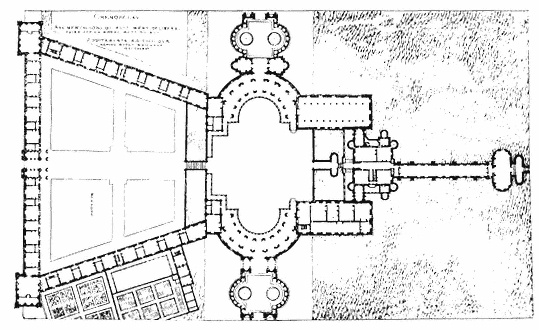
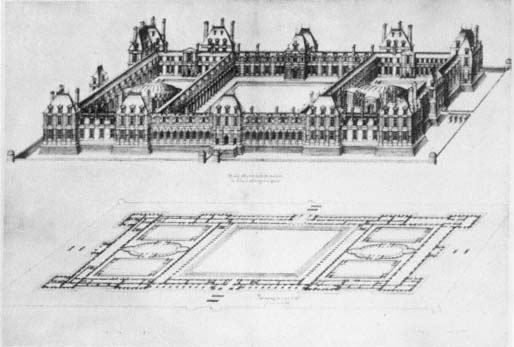
Jacques Androuet du Cerceau dedicated his Second Volume des plus excellents Bastiments de France of 1579 to Catherine de Medici, and she would have been pleased to see three of her several ambitious building projects published; Saint-Maur, as it was enlarged for her by Jean Bullant during the 1570s, a grandiose scenographic plan devised by Bullant about 1572 for the approach to Chenonceau, consisting of a large trapezoidal lower court, followed by a forecourt of large semicircular atria linked to two large rectangular halls flanking and dwarfing the original house (Fig. 122). Du Cerceau's two volumes of 1576 and 1579 are replete with royal and aristocratic houses which were barely begun or never completed owing to changed fortunes,[1] and amongst the most astonishing sights for a Frenchman and a foreigner alike in opening a new copy of the Second Volume must have been the large project for the Tuileries as recorded by du Cerceau (Fig. 123), which was the largest and most elaborate monarchical building scheme in Western Europe of the fourth quarter of the sixteenth century.
The bloody and turbulent 'Age of Catherine de Medici' from the death of Henri II in 1559 to her own death thirty years later saw the completion of the western half of the south wing of the square court of the Louvre (Fig. 128),[2] the building of the ground floor of the Petite Galerie on the western side of the Louvre garden (Figs 129–130), the building of a wing of the Tuileries, the conception of connecting the Louvre to the Tuileries with a long gallery along the north bank of the Seine,[3] and the start of work on the Pont-Neuf (Fig. 134).[4] The purpose, and the result of these massive building programmes when completed by Henri IV, was the transformation of the western end of Paris, when seen from the river, into a monumental complex without precedent in France in scale, grandeur and stylistic variety.
The Tuileries was conceived by Catherine de Medici as the royal retreat from the congested Louvre, conveniently close to it just beyond the city walls to the west, with large gardens and uninterrupted views of the river and of the countryside to the south and west. Anthony Blunt pointed out in his monograph on Philibert de l'Orme that the Tuileries as presented by du Cerceau in his drawings and engravings, as a vast palace with three courts of which the two smaller lateral courts are bisected by large oval halls, should not be taken as evidence of the house designed by de l'Orme
122
Chenonceau. Plan of the enlargements for Catherine de Medici by Jean Bullant.
Engraving from Le Second Volume des plus excellents Bastiments de France of 1579
by Androuet du Cerceau.
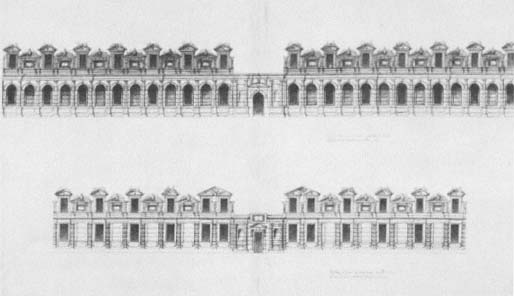
in 1564 or 1565, except for the section of the garden front actually built under his supervision before his death in 1570.[5] (Fig. 124)
In those passages of the Architecture where de l'Orme speaks of the Tuileries, he refers to only one courtyard, and to a total of sixty-four Ionic columns on the garden front. When the number of columns on the outer fronts are added up, discrepancies are found between the plans and the elevations in both du Cerceau's drawings and his engravings, and in neither are the sixty-four columns specified by de l'Orme to be seen on the garden side. After much arithmetic by sceptics, Blunt's reconstruction of the plan of the original design for the Tuileries has not been disproved (Fig. 125a); a square courtyarded house with double-angle pavilions at the north and south ends of the garden front, and single-angle pavilions on the corners of the east front, a form of plan which is a variant of de l'Orme's Château-neuf of Saint-Germain-en-Laye and his second scheme for Saint-Maur.
There can be no doubt that du Cerceau did not have access to the arrogant de l'Orme's drawings for the Tuileries, and that the scheme drawn and engraved for the Second Volume des plus excellents Bastiments de France is his own proposal, or that of his eldest son Baptiste who was the leading Court architect in 1579, and a favourite of Henri III before succeeding Lescot as the architect of the Louvre in 1578. Twice, during the course of 1578 and 1579, Henri III announced his intention of completing
123
Tuileries. Drawing of an enlarged project of 1578 to 1579 by Jacques Androuet du Cerceau.
124
Tuileries. Elevations of the de l'Orme wing. Drawing by Jacques Androuet du Cerceau.
125
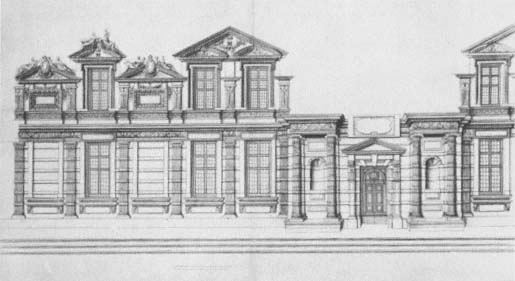
Tuileries. Detail of the elevation of the court side of the de l'Orme wing.
Drawing by Jacques Androuet du Cerceau.
the Tuileries at his own rather than at the Queen Mother's expense. The lateral courtyards added by du Cerceau are typical of many of his 'multiplied designs', or sprawling houses consisting of multiple courtyards surrounded by one- or two-storey wings with tall pavilions at each junction, which are found in his albums of drawings dateable to the 1560s and 1570s.[6] The wings around the lateral courts and the angle pavilions in du Cerceau's scheme are simpler in the design of their elevations than the richly-ornamented central wing left by de l'Orme. The oval halls in the middle of du Cerceau's lateral courtyards could have been suggested by Catherine de Medici. For two important state occasions and festivals in June 1565 and September 1581 she had built temporary oval structures to house lavishly produced entertainments, and the purpose of oval halls at the Tuileries would have been for the lengthy pageants of dance, music, theatre and oratory which have interested modern historians more than any other aspect of the artistic patronage of the last of the Valois.[7] It is most improbable that one of these halls was intended for baths and the other to house a grotto, as has been suggested in a recent study of du Cerceau's drawings and engravings of the Tuileries.[8] Work on the Tuileries had ceased in 1572, but such an ambitious scheme is in keeping with the preoccupations of Henri III and Catherine de Medici in the late 1570s and during the early and mid 1580s, when they planned numerous ruinously expensive building complexes in and around Paris designed by Baptiste Androuet du Cerceau at a time when their moral authority and political control over the nation were collapsing.[9]
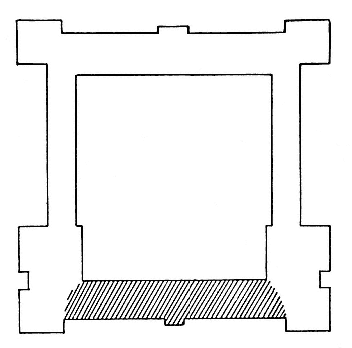
125(a)
Tuileries. Anthony Blunt's reconstruction
of the plan of de l'Orme's scheme.
The Tuileries was the most richly-ornamented building designed by de l'Orme, and in the Architecture he gave some insights into his thoughts when he had been designing this extraordinary building.
I will not go on to other matters without pointing out to you that I chose the present Ionic order, from amongst all others, in order to ornament and to give lustre to the palace, which Her Majesty the Queen, mother of the most Christian King Charles IX, today is having built at Paris . . . I wanted to make use of this order for her palace, for up to now it has been used only rarely, and still few people have set it on buildings which have columns. There have been many who have experimented adequately with it in wood for doors, but they have not yet properly understood nor reproduced it. The other reason why I wanted to use and to show the Ionic order properly, on the palace of Her Majesty the Queen, is because it is feminine and was devised according to the proportions and beauties of women and goddesses, as was the Doric to those of men, which is what the ancients have told me: for, when they decided to build a temple to a god, they used the Doric, and to a goddess, the Ionic. Yet all architects have not followed that [principle], shown in Vitruvius' text . . . accordingly I have made use, at the palace of Her Majesty the Queen, of the Ionic order, on the view that it is delicate and of greater beauty than the Doric, and more ornamented and enriched with distinctive features.[10]
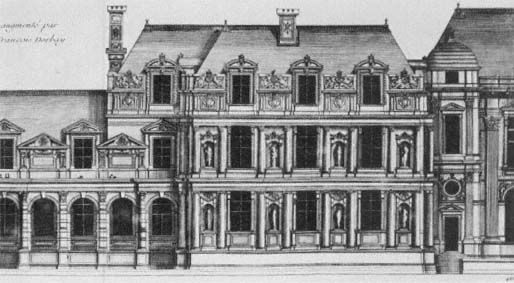
126(a)
Tuileries. 'Bullant' pavilion. Detail of an engraving from
Jacques-François Blondel: Architecture Françoise , Tome IV, 1756.
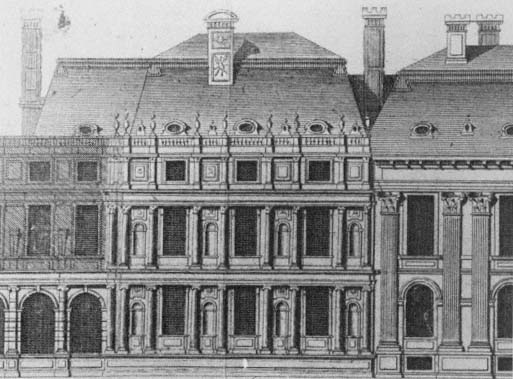
126(b)
Tuileries. 'Bullant' pavilion. Detail of an engraving from
Dom Michel Félibien: Histoire de la Ville de Paris , Tome II, 1725.
The form of the column shafts of the Tuileries, with fluted drums divided by bands each of which is decorated in a different way, was an invention by de l'Orme of which he was especially proud, and which he christened the 'ordre des colomnes Françoises'. The design, he felt, suited perfectly the stone quarried in France, where high quality hard stone or marble to make column shafts of one piece was not available. This addition to the antique repertoire of five orders of columns was intended by de l'Orme to express the view, often repeated in contemporary Court poetry, that France was the true heir, successor and rival to the cultural achievements of Antiquity. Catherine de Medici intervened with a number of decisions which greatly affected the appearance of the Tuileries; in 1565 when the first drums of some of the columns were set up, she instructed de l'Orme to have them taken down, because, according to the architect, they were not rich enough for her taste, and it was the Queen Mother who required there to be large panels between the dormers for the inscription of mottoes. These panels were framed by de l'Orme with fanciful tabernacles using a curious squat and tapered pilaster form at the sides. The surviving portions of the palace scattered between the Tuileries gardens, the courtyards of the Ecole des Beaux-Arts and the Château de la Punta in Corsica show the columns, pilasters, dormers and tabernacles of the Tuileries were the outstanding masterpieces of non-figurative French Renaissance architectural sculpture. The frames of the panels between the dormers, the friezes above and below the ground-floor cornice, and the plumper drums of the columns which alternated with the fluted drums, are all intricately carved. In the Architecture de l'Orme urged his readers to learn to draw and to experiment with decorative compositions of leaves, fruits, small animals and any other motifs which were to be gleaned from nature and the antique. He firmly believed in the thoroughly-trained architect's right to improvise, to adapt and to invigorate the classical language of architecture by using motifs in new combinations and in new contexts. The panel frames derive from the cornices of Roman temples, and the squat tapering pilasters are redrawn herm podia. The free use of various pediment forms in the attic is the most conspicuous display of de l'Orme's spirit of independence, and the aesthetic result of the twin-curved pediments capped with an enlarged triangular pediment above either side of the entrance on the courtyard front has found little understanding or favour amongst de l'Orme's seventeenth-, eighteenth- or twentieth-century admirers. The system of pilasters, and the rhythm of windows and panels of the courtyard elevation is an enriched version of Saint-Maur (Figs 79 & 125). The projecting arcade facing the garden was designed as a pleasant walkway during hot or wet weather, with uninterrupted views across the parterres of the long garden and down the river to Chaillot, where in 1583 Catherine de Medici began building 'Catherinemont' as a further suburban retreat.[11]
Slightly later than the first stages of the building of the Tuileries, work was begun on the Petite Galerie of the Louvre, which was connected by a
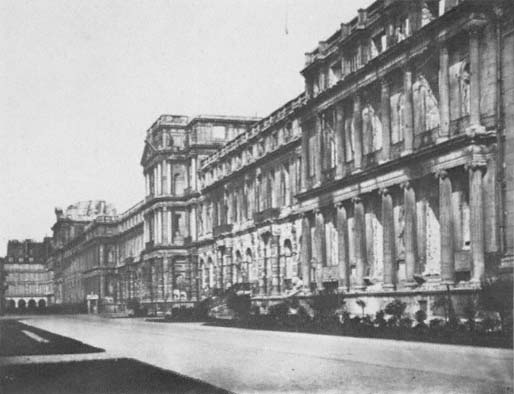
127
Tuileries. View of the de l'Orme wing and 'Bullant' pavilion, after the fire in May 1871.
tall, narrow passage to the Pavillon du Roi (Figs 128–129).[12] (Sylvestre's view of the Louvre garden gives a greatly exaggerated impression of its size.) In the 1576 volume of Les plus excellents Bastiments de France du Cerceau tells us that the Queen Mother by that date decided to connect the Louvre to the Tuileries, and intended the Petite Galerie as the first, short leg of a gallery to link the two palaces,[13] which was to be achieved by her son-in-law, Henri IV, by the building of the Grande Galerie from 1603 to 1606 (Fig. 135). Designed either by Philbert de l'Orme or by Pierre Lescot, who remained the architect of the Louvre in title, only the ground floor of the Petite Galerie was partially or wholly erected in Catherine de Medici's time, the first floor being added and most probably designed during the next reign. The reconstruction of the Petite Galerie published by Adolphe Berty in 1865 shows its condition before the fire of 1660, after which it was rebuilt in its present form with only the central seven of the original eleven ground-floor arches retained. The style of the ground-floor arcade, with its density of crisp, finely-designed decoration, is a highly-contrived mixture of the most 'delicate manner' of rustication, in the bevelled panels which
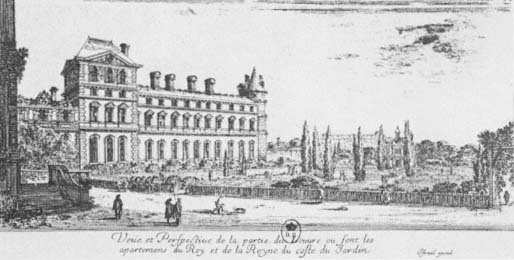
128
The Louvre. View of the garden, pavillon du roi and the south wing.
Engraving by Israel Sylvestre, c. 1650.
enrich the black marble Doric pilasters and the arches, with correct and conventional classical features in the Doric frieze of triglyphs and metopes. If Lescot was not the architect of the ground-floor arcade of the Petite Galerie, its architect made reference to Lescot's and Goujon's work on the courtyard elevation by filling the spandrels of the arches with figurative, allegorical reliefs. At the Tuileries Philibert de l'Orme's symbolism was exclusively Vitruvian in his use of the 'feminine order' with the prestige of the owner being emphasized in the complexities of the decoration of the elevations. Spandrel reliefs on antique triumphal arches only celebrated the fame and power of the victor, but on Lescot's court front and on the Petite Galerie they are used for a more subtle didactic purpose, to symbolize the cultural, moral and military prowess of a France blessed by the rule of the Valois!
The decision by the Queen Mother to connect the Louvre to the Tuileries was taken before Philibert de l'Orme's death in 1570, and the abandonment of his original scheme for the Tuileries as a free-standing square courtyarded house just after 1570 is proved by work begun on a rectangular pavilion joined to the southern end of the very incomplete de l'Orme wing, which was wholly different in style and out of keeping with the scale of de l'Orme's work (Fig. 126). De l'Orme liked to proceed with building in carefully managed stages, but Catherine de Medici was impractical or ill advised in starting another building to add to the list of her unfinished commissions. The architect who succeeded de l'Orme was Jean Bullant, and the extension of the Tuileries to the south probably was seen as a stage in extending the range of the Tuileries to the river from
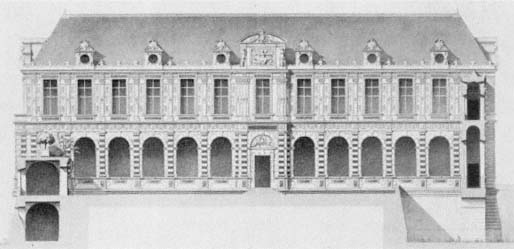
129
The Louvre. Petite Galerie. Reconstruction of the garden elevation before the fire of 1660,
from Adolphe Berty: Topographie historique du vieux Paris.
Région du Louvre et des Tuileries . Tome II, 1865.
where a gallery could be turned eastwards towards the southern end of the Petite Galerie, as was done for Henri IV. Only the height of the ground-floor Ionic order and the continuation of the frieze and cornice between the ground and the first floors across the 'Bullant' pavilion were designed to harmonize with de l'Orme's work. The Bullant pavilion was much less of an architectural experiment or adventure than the de l'Orme wing, with correctly-proportioned and conveniently-decorated Ionic and Corinthian columns. In his porticoes at Ecouen built during the 1550s and early 1560s, his design of the Valois mausoleum at Saint-Denis of 1572 to 1573 or in his book on the classical orders first published in 1564,[14] Bullant demonstrated his allegiance to attached columns as the principal regulator of an elevation's proportions and main ornament. The contrast between Bullant's academic architecture and de l'Orme's work at the Tuileries might be read as a criticism by Bullant of de l'Orme's departures from the example of the Roman monuments, which both had studied in detail.[15] The progress made on the 'Bullant' pavilion before work at the Tuileries was halted in 1572 remains to be defined, but the unconventional forms of the niches between the columns, with their collapsed triangular pediments, and the attic floor must belong to Henri IV's building campaign, when the building was signed with his monogram.[16]
There is no reason to doubt the old tradition that the reason the superstitious Queen Mother abandoned the Tuileries was an astrologer's prediction that she would die in the parish of Saint-Germain; the Tuileries stood within the parish of Saint-Germain-l'Auxerrois, and for the same
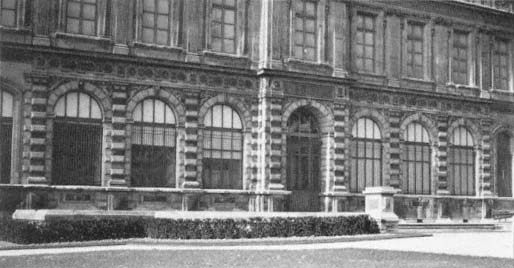
130
The Louvre. Petite Galerie. Detail of arcade.
reason she never again stayed at the château of Saint-Germain-en-Laye. In 1572 the focus of her attention turned to the building of the Hôtel de la Reine on the largest single site within the medieval walls in the north west of the city, and her architect for the first phase of the house's development was again Jean Bullant (Figs 131–133).
The two views of the house seen from the garden by Sylvestre and the late seventeenth-century plan show Catherine de Medici's hôtel with the considerable early seventeenth-century additions in the northern portion of the site, or the buildings to the left of the central wing in the plan and engravings. The parts of the house built during Catherine de Medici's lifetime are the central and right-hand sections of the garden side shown by Sylvestre. The building history of the Hôtel de la Reine is complex, with more than one major change in the overall conception of the house's plan and elevations.[17] Up to 1576 a design incorporating many features copied from the Uffizi was the approved project, before being discarded in favour of a less ambitious and costly scheme. As built the main courtyard in the southern corner of the site was a slightly irregular square of approximately 30 by 32 metres, with a central staircase in the wing opposite the main entrance on the rue des Deux-Ecus. The tall fluted Doric column, which now has the Halle au Blé for its neighbour, stood in the middle of this courtyard, and its scale in comparison to the surrounding buildings can be judged in Sylvestre's view (Fig. 133); the purpose or symbolism of this strange monument has never been satisfactorily explained. It has been suggested that it might have had some memorial purpose, that it was an
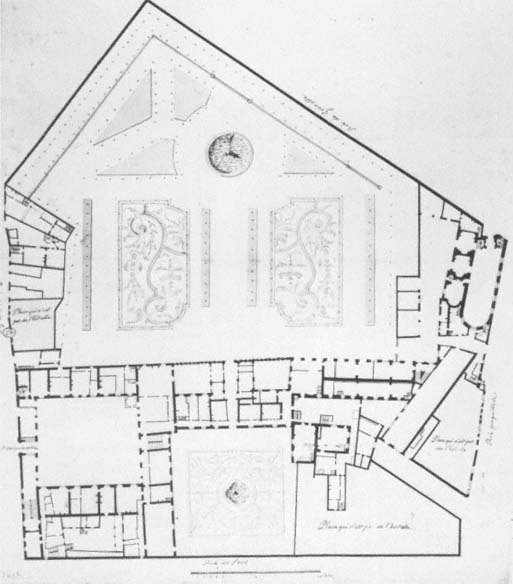
131
Hôtel de la Reine (later Hôtel de Soissons), plan of c. 1700.
observatory or served as a watch tower over the city and surrounding countryside.[18] A hall on the left of the staircase was the largest room in the house, and on its north side extended the central wing seen in the views from the garden, consisting of three large pavilions, which were probably designed by Jean Bullant, but were built after his death from 1582.[19] The central portion of this wing was an imposing composition with a large arch filling most of the width and height of the pavilion, and flanked by tall,
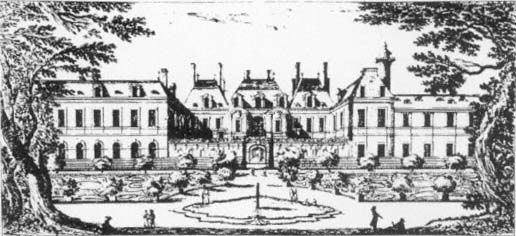
132
Hôtel de la Reine (later Hôtel de Soissons), view from the garden.
Engraving by Israel Sylvestre, c. 1650.
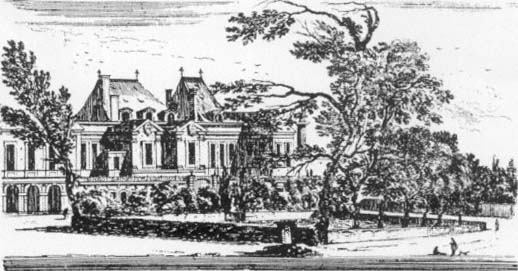
133
Hôtel de la Reine (later Hôtel de Soissons), view from the garden.
Engraving by Israel Sylvestre, c. 1650.
narrow projections of two or more storeys, decorated with pilasters. If the arch was glazed, as shown by Sylvestre, the visitor would have been impressed by the expanse of a costly material. The system of tall pitched roofs over each pavilion created an impressive silhouette for the garden front, and this feature was to be imitated a little over twenty years later in the design of the place Royale. Very few of the architectural, technical and
stylistic developments in Paris of the sixteenth or early seventeenth centuries were absorbed from outside.
Judging from the inventory made of Catherine de Medici's possessions after her death in 1589, the Hôtel de la Reine was as lavishly equipped and richly furnished as any of the palaces and châteaux belonging to the Crown.[20] Amongst the tapestries in the house were the famous Valois tapestries, now in the Uffizi, which commemorate some of the festivals and pageants of the 1560s;[21] the house of a Medici would not have been complete without at least one small room decorated in an elaborate and novel fashion, and in the inventory is found the earliest mention in France of a room with walls covered with costly mirror glass.[22] The large quantities of contracts surviving from the sixteenth and seventeenth centuries, which document the growth of the house, are a poor compensation for a fuller knowledge of the appearance of the complex,[23] which was swept away in a large-scale speculative development of the 1760s.[24] Without Sylvestre's attractive but incomplete and schematic records of the garden front, the Hôtel de la Reine could not be included in an architectural history of Paris.
The most durable benefit to the City of Paris from a Royal building initiative of the last quarter of the sixteenth century has been the Pont-Neuf. At the request of Pierre Lhuillier, the prévôt des marchands , Henri III appointed a committee of experts on the 7 November 1577 to approve a design of the bridge and to superintend its construction. An early project for the Pont-Neuf, recorded in a painting in the Musée Carnavalet, shows a scheme rejected by the committee before the end of May 1578 (Fig. 134), when the King laid the foundation stone of the bridge designed by Pierre Des Illes and Baptiste Androuet du Cerceau, with seven arches in the northern arm and four arches in the southern arm. The westernmost of Paris' bridges, the Pont-Neuf was always intended as more than a new link between the aristocratic quartier du Louvre , and the as yet little-developed western area of the Left Bank. Like the bridges of Rome built by Emperors or Popes, the Pont-Neuf was conceived as a monument of Royal and civic prestige. Neither at the first stages of planning of the Pont-Neuf, nor during the years from 1598 to 1606, when its building was completed by Henri IV, was there any question of recouping some of the cost by building houses for leasing on the bridge, despite the wishes of the City Fathers.[25] The triumphal arches, obelisks and other ornaments shown in the painting were not added to the completed bridge, for once the Pont-Neuf was in full use Henri IV's thoughts turned to a new use for the western tip of the Ile de la Cité. The building of the place Dauphine, an isosceles triangle of houses of standard plan built in brick and stone, was completed before Henri IV's assassination in 1610, and was both a profitable measure for the Crown and a practical development which started the process of transforming the western side of Paris into an haut-bourgeois area. Before the Pont-Neuf was built, the only direct way across
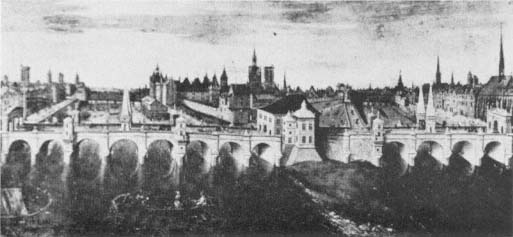
134
Pont Neuf. Painting of c. 1580, showing an unrealized project of the bridge
with triumphal arches at each end, obelisks and a large pavilion over the western
tip of the Ile de la Cité. As begun under Henri III and completed under Henri IV,
the bridge has seven arches in its north arm and five arches in its south arm.
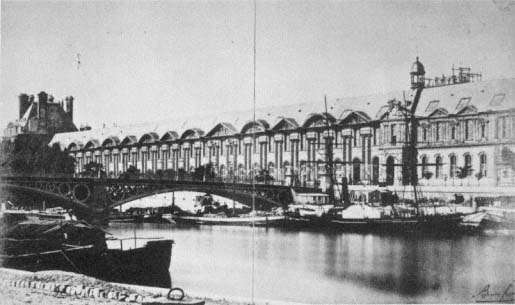
135
The Louvre. The Grande Galerie before its demolition and rebuilding during the 1860s.
the Seine from the western part of the Left Bank within the medieval walls or from the faubourg Saint-Germain-des-Prés was by one of a small number of licensed ferries for pedestrians. Before the fall of the House of Valois, the Duc de Nevers was the only aristocrat who anticipated the transformation of the area opposite the Louvre into a fashionable quarter, with especially convenient access on horseback or by carriage to the rest of the city to the east and to the north.
The status of the Louvre as the primary Royal residence in the capital, announced by François I and confirmed by his successors, and the building of the Pont-Neuf under Royal auspices, set in motion the expansion of the western side of Paris by the bourgeoisie and aristocracy, which was greater than the growth of the city in any other direction, especially during the mid seventeenth century and early eighteenth century. The last of the Valois decisively altered the social geography of Paris, and the consequences can be clearly seen in modern times.