
Dance of the Game Animals, San Felipe.
—The drama of the many horned animals includes all those who, friendly to the Indian, formerly provided him with food during the long winters. The actors are clothed to impersonate the buffalo, deer, mountain sheep or elk, and antelope,[16] as these were the principal game animals of the region surrounding the ancient Pueblo lands.
The San Felipe play begins at dawn when a lovely dark-skinned maiden runs swiftly toward the mountains behind the pueblo. She is the chosen mother of the animals, and she goes to lure them into the village. She is accompanied by young men dressed as hunters, in white buckskin garments similar to those of the Plains Indians. They carry bows and arrows and sprigs of evergreen. All the young people chosen for this part of the ceremony must be fleet and sure of foot, for their purpose is to run as fast as the beasts and drive them into the village amid the great applause of the spectators.
There follows a secret rite in one of the ceremonial chambers, and the entire group emerges to continue the action of the play and to dance ill the plaza, where small evergreen trees have been set up to suggest a forest. Each group, including a scattering of hunters, interprets the movements of the beasts they are impersonating. The Buffaloes, with black bodies, deerskin kilts, and heavy, shaggy buffalo headdress, dance with the solid weight of large and lumbering animals.[17] The Buffalo Maiden dances just behind the leader, her white dress banded at the waist by a red woven belt. On her head is a tight cap covered with iridescent black feathers and topped by the two small horns of the buffalo cow. Her legs are wrapped ill high white moccasins ending in skunk-fur heelpieces. Quantities of
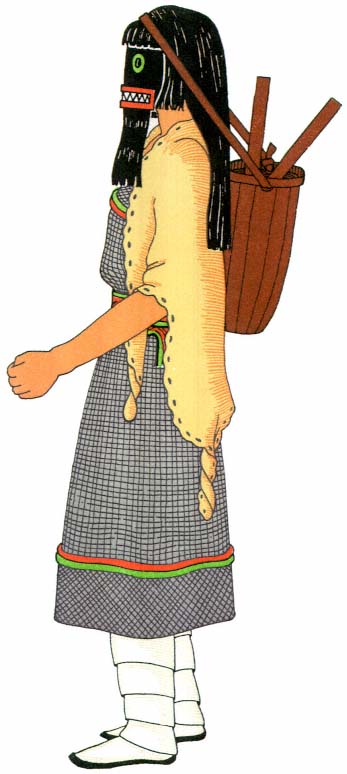
Plate 32.
Natacka Daughter, Hopi. Female deity.
turquoise and white shell beads hang around her neck. In one hand she carries a rattle wand to which are attached feathers, evergreen sprigs, and animal hoofs.
Next come the Elk, lofty and regal in their horned headdresses; and then the antlered Deer approach quickly with shy and fugitive grace. Bird down and puffs of cotton trim the prongs of horns and antlers, and from their foreheads fan-shaped visors of slender sticks rise upward and forward. A red fringe of goat's hair covers the quill ends of an eaglefeather ornament which is tied, tip downward, on the hair at the nape of the neck, and sprigs of evergreen fall over the shoulders. White shirts cover the bodies, and from waist to knee are kilts either of dark blue native stuff with a red and green strip through the middle, or of Hopiembroidered white cotton cloth. Around the waist the white plaited sashes with tasseled ends are knotted at the back to suggest the tails of the animals. White, crocheted leggings, tied at the knee with red yarns, end in low moccasins edged with black and white skunk-fur heelpieces. A light, short stick is carried, and it is decorated with a spray of evergreen which is bound to the center with cotton cord. These sticks are used to support the weight in different postures and to imitate the movement of the forefeet of the animal when running or leaping.
The Mountain Sheep appear with giant horns rising on either side of the caplike base. The Antelope wear on their bodies snug-fitting suits with the backs painted yellow and bellies white to simulate the animal's skin. On the heads are antelope horns. They frisk gaily, their feather tails bobbing up and down. The impersonators dance upright, often leaning forward to rest on the canelike props.
Interrupting the last dance, the animals break away and run for the hills. When they are 'shot down' (that is, when they are caught by townsmen or hunters) they lie inert and 'dead' while they are carried to the kiva across the hunters' backs. The successful hunter receives a spray of evergreen for his reward.