
Baudilio Sedano de la Peña and Cruz Lete
I went to see Don Baudilio in 1982 at the instance of the family with whom he had boarded at Ezkioga. A short, chubby man with a dirty worn cassock, unctuous and jovial, but with darting eyes, he was then seventy-six years old. He lived in Valladolid in a squalid apartment above a convent of Franciscan nuns, for whom he served as chaplain. As we talked, the smells of the pastries and cookies they baked drifted up from the kitchens below. I later learned of his extreme secretiveness about the large portion of time he gave to visions and visionaries and that only the name of that one Basque family (which, like many others I talked to, wishes to remain anonymous) would have got me in the door. As it was, on my repeated visits from Madrid he let me into his confidence only gradually and partially. He loaned me first some prints and then the glass plates of photographs of visionaries, but it transpired later that they were not in fact his. I never got to see his store of documents and he eventually gave me copies of the Burguera book only at exorbitant cost. Nevertheless, he did let me look at a typewritten memoir of his involvement with the Ezkioga visionaries and Padre Burguera.[40]
On 5 August 1969 Lourdes Rodes recorded Sedano's reminiscences in Barcelona; hereafter: Sedano tape.
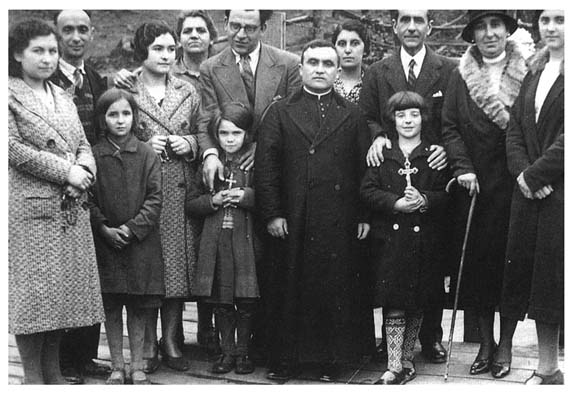
Baudilio Sedano de la Peña and Vidal Castillo (wearing glasses) with seers and believers,
including a stockbroker and his wife from Bilbao, winter 1931–1932. Photo by José Martínez
Sedano was born in a village of the province of Burgos in 1906 and trained as a priest and a contralto for cathedral choirs. His first post was in Sigüenza and his second was in the cathedral of Valladolid, where he was also chaplain of the convent. In 1931 he read newspaper reports of the visions. With money he had won after buying a lottery ticket with Ezkioga in mind, he went there at the end of July.
Like Burguera, he felt he had particular proof that the apparitions were true. He saw Benita Aguirre after a vision run down the hill, pick a man out of the crowd, and give him a private message. Sedano kept an eye on the man, who prayed on the hillside with tears streaming down his face. When Sedano approached him, the man said he was from Tenerife and that there was no way Benita could have known him, yet she had revealed secrets about the state of his soul. For the first year or so Sedano went to Ezkioga every two weeks and stayed about four days. He did so with utmost discretion, fearing reprisals from his diocese or protests from the priests at Ezkioga. He took down María Recalde's messages as early as September and arranged for her to save them for him. María's son remembers that he came to Durango about once a month.[41]
Sedano told me that the archbishop of Valladolid, Remigio Gandásegui, was curious about the visions and told him to take notes. Gandásegui, from Baracaldo, was the Spanish bishop who had gone most often to Limpias and he was also a Lourdes enthusiast. After a near-fatal heart attack in 1932 he summered at the Ordizia estate of the doctor Benigno Oreja, himself an Ezkioga sympathizer. Sometime after the Vatican closed the book on the case, Sedano was forced to proclaim his submission.
Sedano also provided Burguera with the messages from the seer many people considered the most convincing, Cruz Lete Sarasola of Itsasondo. Lete studied first at a grammar school in Ordizia and then at a normal school in Pamplona. He was thus one of the most educated seers, and the solid reputation of his family enhanced his credibility. When he was home in the summer or fall of 1931, he went to the apparition site out of curiosity and began to have visions. He told Sedano that the Virgin instructed him not to resume his studies in Pamplona and above all not to return to the apartment of the freethinking family where he had been boarding. At the insistence of his parents, he did go back to Pamplona, but when he was going up to the flat, the Virgin appeared to him and he fell down the stairs. When he tried to study, he found that all he could see in his books was blank pages. He said that in his first vision at Ezkioga after his return, the Virgin asked him jokingly, "Did you study a lot?"
Tall, thin, and austere, Lete was a striking seer. Many of his visions were of Christ and he often settled into Christlike stances. A Catalan referred to him in vision as having "an angelic tenderness." And Sedano said that "just hearing him pray the seven Hail Marys of the Sorrows of the Holy Virgin gave you such a feeling of sadness that it was obvious that it did not come from him but that he was seeing something extraordinary that could only be the Holy Virgin." Like others, Lete said the Virgin had told him that he would die soon. A Basque sheepman recalled Lete's private messages from the Virgin to those around him: "Some people would laugh, but he got them serious and weeping."[42]
ARB 12-13; Sedano tape, 11-12; elderly sheepman, Ikastegieta, 4 April 1983. On 15 December 1931 Lete predicted his own death (Gratacós, "Lo de Esquioga"). He said the Virgin confirmed to him Ramona's divine wounds, Evarista's ribbon from heaven, and Rigné's second marriage. I have texts of visions from 25 October 1931 until 8 February 1932. He dictated others to Ramona's friend, the Bilbao artist José de Lecue: Lecue to Cardús, Bilbao, 20 February 1934. According to Lecue's niece in 1984, Lecue eventually gave all his records to the diocese.
In the fall of 1931 Lete had a vision of the Virgin in which she pointed out a heavenly friar as Juan de Dios, the founder of the Brothers Hospitallers, and asked Lete whether he wanted to join the order. He did, and she instructed him to write the superior of the house in Ciempozuelos near Madrid. Lete and some of his friends were admitted. They are said to have participated in spiritual exercises with the Jesuits at Loyola before leaving. Lete's last vision at Ezkioga, of Roman soldiers crucifying him, may reflect the visual imagination of the exercises (see text in appendix).[43]
SC E 278; vision declaration signed in Ezkioga 8 February 1932 by Cruz de Lete, 2 sides, private collection.
Sedano had been taking down Lete's visions and was present at this one. He accompanied Lete as far as Valladolid, where he put him up for a night. In Sedano's chapel Lete said in vision that many who believed in the apparitions would later disavow them. He went on to Madrid, reappearing in the Ezkioga story only a year and a half later when his edifying death (he died confidently singing a hymn) provided the believers with their first saint.[44]
Sedano tape, 13-16.
Burguera was frustrated in his attempts to gain documents from other seers, including some of the most famous ones. Their refusal placed him in a quandary—how could those who saw the Virgin not cooperate with someone the Virgin herself had chosen? Ramona Olazábal's spiritual director was the curate of Beizama, Francisco Otaño, and he retained her vision texts in case there was an official inquiry. Allegedly on the Virgin's orders, Ramona kept Otaño's role
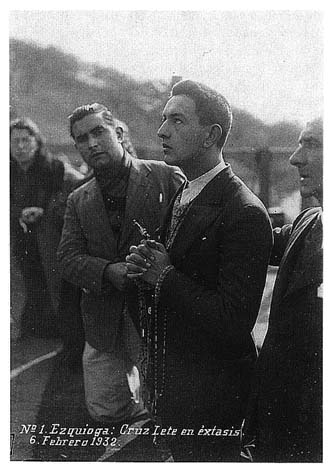
Cruz Lete in vision, 6 February 1932. Photo by Joaquín Sicart
secret and gave messages to no one else. Because she would not cooperate with him, Burguera judged her visions diabolical. But he left her the option of changing her mind.[45]
His verdict alienated him from Lecue and Cardús, but they did not publicly challenge him, R 65; SC E 481/ 25-26 and 35-37; Cardús to Ayerbe, 15 January 1934. Francisco Otaño Odriozola was born in Zizurkil in 1883 and became coadjutor of Beizama in 1910. After Laburu's lecture he forbade Ramona to go to Ezkioga. He soon relented, but Ramona's visions ended anyway on 15 August 1932. He wrote Cardús about twenty letters from October 1932 to December 1935. In late 1933 he was reputedly composing Ramona's biography.
In the summer and fall of 1932 most of the believers recognized Burguera as their expert defender. Free from the supervision of a religious order and without a fixed post in Valencia, he was less vulnerable than other believing priests. Thus he was active in the planning of the chapel at the vision site and he contacted the sculptor who made the image of the Virgin. With the chapel complete and the arrival of the image imminent, the spirits of the believers revived. In honor of the Virgin's birthday, a female seer claimed that the Virgin wanted Burguera to run a kind of festive contest of three theological questions. The Virgin would provide a prize. On September 4, after all had performed the stations of the cross, Burguera read out the questions to about three hundred persons on the vision
deck. Four days later three thousand persons came to hear the replies. For three hours seers and believers proposed their answers. No one guessed what the seer wanted to hear, so, she said, the prize was hers. This strange episode exemplifies Burguera's two sides: on the one hand, the authoritarian leader of thousands of docile believers, a master of sacred ceremonies; on the other, an innocent subject to the most flimsy of visionary claims.[46]
B 42; for sculptor, Burguera, Compendio, 294; for contest, ARB 98-102: "What was the first miracle wrought by God?" "What is the place on earth that is above heaven?" "What is the distance from heaven to hell?" Answers: "The creation"; "The place where the Virgin Mary is to be found in body and soul"; and "Only the fallen angels know this [distance], for only they have traveled it."
Burguera and Rigné were similar in a number of ways. Both wrote and paid to publish numerous books. Both had independent wealth, although Rigné seems to have started out with more. Both sought in vain recognition and respect. Both had been to Lourdes and had a great openness toward extraordinary manifestations of the supernatural. And both were about to come head to head with church and state.
But there were contrasts as well. Rigné was an advocate for chaste nudity, while Burguera considered nudism the ultimate sign of Satan's dominion. While both were the stuff of heretics, Burguera, like Calvin, also was the stuff of the inquisitor general. Both were constitutionally incapable of taking orders, but in Burguera's case it was because he preferred to give them, whereas Rigné was too playful or obstreperous for hierarchy in any form. Burguera saw himself as a grand spiritual director who distinguished the good from the bad, the sacred from the profane, the just from the unjust. Rigné was constantly challenging these categories and taking pokes at the classifiers.
Like the other patrons, Rigné and Burguera were in such close symbiosis with seers that without them some seers would not have maintained—in some cases would not have gained—their fame. And wittingly or not, each guided the seers into pronouncements of a certain nature and away from other themes and other directions. They connected the rural seers to the wider literate society. But they filtered and bent the light that passed through them. This distortion became especially evident as the diocese closed in on seers and patrons alike.