
Decline of Incomes and Wage Rates with Age
Part of the explanation for the downward occupational mobility revealed by the surveys of industrial workers is suggested by the earnings profiles we have derived from these data. Figure 11.3 presents the income profiles from eight of the data sets. Each distribution shows a hump-shaped pattern, with a tendency for annual incomes to fall markedly at older ages.[16] If this cross-sectional view can be taken as a reflection of the actual or expected experience of a worker as he aged, then the declining returns from industrial employment may well have helped induce an occupational change. There is only very limited longitudinal evidence available to test whether or not we
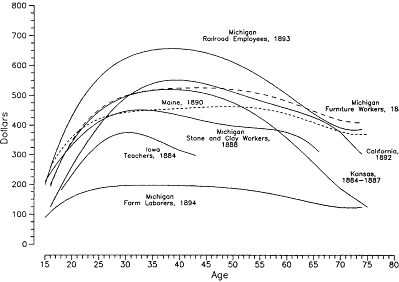
Fig. 11.3.
Age profile of annual earnings: Eight state surveys.
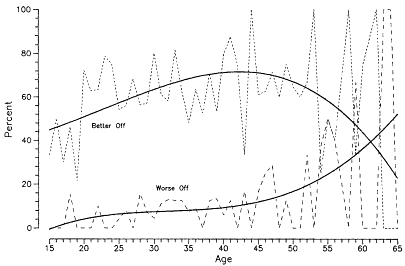
Fig. 11.4.
Perception of current economic well-being relative to five years earlier, Michigan stone and clay workers, 1888.
may safely infer this impact of aging from cross-sectional data. However, two of the surveys, the Michigan stone and clay workers in 1888 and the Michigan survey of railroad employees in 1893, did ask workers whether they were better or worse off (in economic terms) in the year of the survey than they had been five years earlier. The proportion of negative answers for the stonecutters is plotted by age in figure 11.4. After about age 45, the proportion of negative answers rises sharply, suggesting that a substantial fraction of the older workers in this industry had indeed experienced a recent decline in their annual earnings. The proportion of workers reporting no change falls continuously. The data for the Michigan railroad workers, which is a much larger sample published five years later, is presented in figure 11.5. The pattern is similar to that of the stonecutters, although economic conditions had clearly deteriorated.[17] If anything, figure 11.5 suggests that declining income for railroad workers began even before the age of 40, confirming the impression given by the cross-sectional data of figure 11.3.
The decline in earnings as workers aged was produced through the combination of two separate phenomena. First, daily wage rates fell with age after reaching a peak that occurred in some occupations as early as when the workers reached their late 20s. Second, the number of days workers worked for pay during the year fell as workers aged. We first turn our attention to the cross sections of wage rates revealed in our data sets. Figure 11.6 presents the age profiles of daily wage rates reported by the workers in the sep-
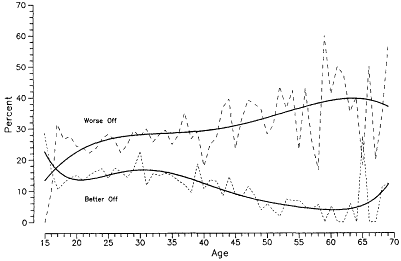
Fig. 11.5.
Perception of current economic well-being relative to
five years earlier, Michigan railroad employees, 1893.
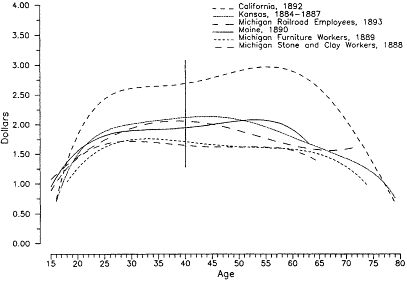
Fig. 11.6.
Age profile of daily wage rates: Six state surveys.
arate surveys. If we assume that these labor markets were largely free from the long-term implicit contracts that characterize modern labor markets, then an obvious reason for older workers to be paid less than younger workers is that their physical productivity was lower. Many of these jobs required physical strength, agility, good eyesight, and other attributes that in many workers would deteriorate with advancing age. Thus, employers were likely either to reduce the daily wage without changing the worker's occupation or to move workers to less demanding but also lower-paid jobs.
The decline in income and wages evident in figures 11.3 and 11.6 could not have been wholly unanticipated by the workers. The demands of industrial jobs were such that most men could foresee the time when they would no longer have the strength, endurance, or agility to maintain the level of productivity consistent with the standard wage. This being the case, some sort of "strategy" had to be devised to meet the challenge of economic insecurity that faces older wage earners.[18]
A novel investigation into the duration of the "trade life" of working men conducted in New Jersey between 1888 and 1890 by that state's Bureau of Statistics of Labor and Industries provides striking evidence that this was so. The investigation was predicated on the assumption that after working at a given occupation for a number of years, the worker would begin to "decline" at his job. To ascertain the effect of occupation on the length of a man's working life, the New Jersey bureau conducted a survey of journeymen asking for their age and occupation, the age they began to work at their pre-
sent trade, and (if they had reached it) the age when they began to decline. All together the bureau surveyed nearly thirteen thousand employed men over the age of 20 in six industries. The surveys were tabulated and the results published in three successive volumes of the bureau's Annual Report (New Jersey 1889, 1890, 1891).
In four industries (glassmaking, pottery, hat making, and iron mining) workers were apparently identified by their employers and were approached by bureau agents who administered the questionnaire. For the building trades and printing, workers were identified in a house-to-house canvass conducted during the early hours of the evening in the county of Essex and in the cities of Trenton, Elizabeth, Paterson, and Jersey City (New Jersey 1891:173). Table 11.2 gives the distribution of those sampled by occupation and estimates the survey coverage. Although tabulations were presented in
TABLE 11.2 | |||||
Occupation | Number Surveyed | 1890 U.S. Census Enumeration | Percentage Coverage | ||
Building tradesa | |||||
Carpenters | 2,732 | 21,191 | 12.9 | ||
Painters | 1,235 | 9,439 | 13.1 | ||
Bricklayers and masons | 1,022 | 6,767 | 15.1 | ||
Plumbers | 661 | 3,085 | 21.4 | ||
Hat makers | 2,577 | 6,137 | 42.0 | ||
Miners of iron oreb | 1,269 | 1,380 | 92.0 | ||
Potters | 1,122 | 3,801 | 29.5 | ||
Glassmakers | 1,040 | 4,298 | 24.2 | ||
Printers | 462 | 3,375 | 13.7 | ||
Total | 12,120 | 61,075 | 19.8 | ||
SOURCES : New Jersey 1891; 178; U.S. Census 1890, vol. 1, pt. II: 324-332, table 79; U.S. Census 1890, vol. 7, Mineral Industries : 17. | |||||
a Stonecutters were also included in the New Jersey investigation (701 were surveyed). However, no data were reported on the age stonecutters began to decline. We assume that for some reason these data were not tabulated. Given the way the reports are presented, an alternative interpretation is that none of the stonecutters had yet begun to decline (New Jersey 1891: 192). Including, rather than excluding, stonecutters would make little difference to the overall results. | |||||
b The 1,269 miners "embrace all the workmen engaged in the mining of iron ore in the State, but do not include engineers, blacksmiths, common laborers, or those employed about the mines in handling the ore" (New Jersey 1890: 359). The U.S. Census of Mineral Industries distinguishes between employees of iron mines "above ground" (492) and those "below ground" (1,380). Only the belowground employees are included in the comparison made here. The census figures are higher than the N.J. Bureau of Statistics enumeration. Possibly this is because the census figures include all workers, while the New Jersey survey included only males aged 21 and over; also, the New Jersey figures probably exclude miners engaged in "prospecting" (New Jersey 1890: 360), while the census figures presumably do not exclude them. | |||||
TABLE 11.3 | ||||
Occupation | Percent Aged 60+ | Percent Beginning to Decline | Average Age of Decline | |
Building trades | 0.8 | 9.5 | 39.8 | |
Hat makers | 2.0 | 14.7 | 36.6 | |
Miners of iron ore | 3.1 | 7.1 | 44.6 | |
Potters | 0.6 | 8.6 | 38.3 | |
Glassmakers | 0.9 | 24.7 | 39.8 | |
Printers | 0.4 | 21.2 | 36.6 | |
Total | 1.4 | 12.0 | 38.9 | |
SOURCES : New Jersey, 1889: 114-115, table 3 summary; New Jersey 1890: 380, table 2; New Jersey 1891: 178; 199-200, table 2; 201, table 3. | ||||
exhaustive detail, no clear summary statement was provided by the New Jersey officials. Two statistics calculated in the reports, the percentage of workers beginning to decline and the average age reported for the onset of decline, are given in table 11.3.
The relatively low percentage of journeymen who were still working at these skilled jobs at age 60 or over suggests that many workers left these occupations before reaching 60. It is not possible from these data alone to determine the reason older workers left their trade. Among the possible causes are retirement (including retirement due to disability or illness), downward occupational mobility, or death.
The percentage of workers who reported that they had begun to decline at their trade is remarkably high. For glassmakers, it was one quarter of all workers. Those who felt they had already begun to decline were asked to report the age at which they first noticed their difficulties. The average response is given in the table. For the entire sample, it was 38.9 years. This measure, however, will be biased downward as a measure of the typical age of peak productivity because it includes only workers who have already begun to decline. Other things equal, a worker prone to an early age of decline will be more likely to have passed this climacteric at the time of the New Jersey canvass than a worker prone to a late decline. As a result there will have been an oversampling of journeymen who began to decline at young ages and an undersampling of the age of decline of the hardy. Another possible objection to the average age of decline reported in the table is that it is based on the recollection of the worker. Such retrospective dating is notoriously inaccurate.
Several measures that eliminate both the type of downward bias mentioned above and the problems associated with the retrospective question are presented as an alternative in table 11.4. All these measures rely on the
TABLE 11.4 | ||||||
Percentage in Decline | ||||||
Occupation | By Age 56 | By Age 60 | By Age 66 | Singulate Mean | Half- Life | |
Carpenters | 33.0 | 51.9 | 70.8 | 56.8 | 59.0 | |
Painters | 54.1 | 67.1 | 80.0 | 50.9 | 53.4 | |
Bricklayers and masons | 37.0 | 49.8 | 62.5 | 55.9 | 59.6 | |
Plumbers | 26.7 | a | a | a | b | |
Printers | 64.3 | a | a | 49.6 | 51.9 | |
Glassmakers | 74.2 | 81.5 | 88.9 | 45.9 | 45.2 | |
Hat makers | 49.2 | a | a | 48.9 | b | |
Miners of iron ore | 48.1 | 61.2 | 74.4 | 55.1 | 55.2 | |
Potters | 77.4 | a | a | 46.7 | 45.2 | |
Unweighted Total | 47.5 | 55.9 | 64.2 | 52.7 | 56.0 | |
NOTE : a indicates that sample size was too small for reliable estimate, b that proportion in decline was less than 50 percent. | ||||||
notion of a synthetic cohort that experiences at each age demographic events at the same rate that workers of that age reported in the cross-section sample. Thus the only information used is the response (yes or no) to the question, "Have you begun to decline at your trade?" The first three columns of the table report the percentage of workers who had already entered their decline by various ages. Column 4 presents the singulate mean age of decline calculated using the synthetic cohort method of John Hajnal (1953). The last column gives the cohort's "half-life," the age at which one-half of the members of the synthetic cohort have begun to decline. Table 11.4 suggests that the typical age for the onset of decline would be in a man's early 50s.
The measures in table 11.4, however, would be unbiased estimates only if the mortality experience of those who began their decline was the same as for those who had not. In this case, "mortality" refers to any reason to cease work, including retirement and job changes as well as death. However, it is quite likely that workers who had begun to decline at their trade were more likely to leave their job than those who had not. The impact of this effect on the synthetic cohort measures will be to bias them upward. Thus we can conjecture that the "true" age of decline lies somewhere between the lower-bound estimates of table 11.3 and the upper-bound estimates of table 11.4. Since the impact of differential mortality will also bias the figures of table 11.3, the truth probably lies closer to the figures in that table where the two biases work to offset each other. The value of the New Jersey data lies not so much in our ability to use it to precisely measure the age at which
industrial productivity peaked for a late-nineteenth-century worker as in the fact that it stands as strong evidence that young workers actually anticipated a decline in their vitality, productivity, and income in late life.