
3
The King Cross-Dressed
Power and Force in Royal Ballets
Mark Franko
Gender studies frequently identify travesti with deviations from patriarchal dominance in Western society or as a form of masculine anxiety. It is thus surprising to encounter cross-dressing as a spectacular element in the theatrics of French patriarchal rule, indeed even as a royal performance practice. Considering the period just prior to and including the first decade of Louis XIV's personal reign, one may wonder why the monarch played an impressive number of burlesque and, particularly, cross-dressed roles between 1651 and 1668.[1] To what purpose—strategic, semiotic, ideological—could his theatrical androgyny correspond in productions containing but shadows of burlesque indeterminacy and no apparent satire? More pressing still, to what end—sociosexual, anthropological, iconographic—could the absolute monarch be said to appropriate burlesque cross-dressing in the light of his implicit yet irrevocable interdiction of burlesque ballets in his founding doctrine of dance pedagogy, the Letters Patent?[2] To begin to answer some of these questions, I situate
[1] For a general discussion of the roles played by Louis XIV in court ballets, see Philippe Hourcade, "Louis XIV travesti," Cahiers de littérature du XVIIe siècle 6 (1984): 257–71. The author views the evidence as inconclusive and partial but notes that the king's cross-dressed roles included a Bacchante, a Muse, an Hour, a Fury, a Dryad, Jupiter disguised as Diane, Ceres, a village girl, and a nymph on two separate occasions. For an overview of Louis's dancing career, see Régine Astier, "Louis XIV, 'Premier Danseur,'" in Sun King: The Ascendeney of French Culture During the Reign of Louis XIV , ed. David Lee Rubin (Washington: Folger Shakespeare Library, 1992), 73–102.
[2] The original text of the Letters Patent and an English translation can be found in Mark Franko, Dance as Text: Ideologies of the Baroque Body (Cambridge: Cambridge University Press, 1993), app. 3, pp. 166–85.
royal cross-dressing in the larger historical context of French court ballet. I ask what political goals cross-dressing may have served under Louis XIII, and then compare those earlier examples with later instances of Louis XIV's cross-dressing.
Given the central place of ballet in ancien régime cultural politics, one might assume dance historians to be among those most likely to formulate challenging approaches to "performing the body" in seventeenth-century French culture. That this has not been the case is due in part to absorption in preliminary work by a myriad of details that yield little cohesiveness. Moreover, further facts may still emerge. But there is no reason to forestall interpretation indefinitely. Traditionally, dance scholarship has restricted its efforts to the compiling and collating of evidence as if the supposed sensory status of this evidence were sufficient for dance. This was merely a way to postpone the encounter of dance and critical theory. I do not shun the facts I can muster, but they frequently have to be wrested from a dense yet fragmentary textual network. That is, they are in part based on the evidence organized by earlier scholarship, and in part the effect of a process of reading. The ensuing discussion of cross-dressing will draw on bits of information and innuendo culled from ballet libretti, costume drawings, and scripted dance scenes (entrées ) for which there is little corroborative choreographic or performative data. I examine these fragments of evidence, however, not only to engage with the historical density of their factual status, but also to ask how royal performance and royal ideology fashioned one another. This relationship is intrinsic to dance studies in that what was performed was chosen equally for ideological and aesthetic reasons. Above all, an understanding of royal cross-dressing is vital to any reassessment of power and representation in the seventeenth century, if only because of its problematic relationship to propaganda.[3]
One cannot place the issues raised by royal cross-dressing in the perspective of power and representation without invoking the ground-breaking work of Louis Marin and Jean-Marie Apostolidès[4] . Both historian/theorists deemphasized personal agency (the king's or anyone else's) to focus on the ideologies subtending royal representations. Instead they
[3] The relationship of performance to power was a central theme to emerge in the conference "Performing the Body" and remains preponderant in the present volume.
[4] See Louis Marin, Le Portrait du roi (Paris: Editions de Minuit, 1981), translated as Portrait of the King by Martha M. Houle (Minneapolis: University of Minnesota Press, 1988); and Jean-Marie Apostolidès, Le Roi-mahine: Spectacle et politique au temps de Louis XIV (Paris: Editions de Minuit, 1981).
privileged the behind-the-scenes calculations by which the king's image was fashioned. The monarch's appearances or representations were thus studied as the outcome of others' calculations rather than as the personal expression of his own political acumen. Agency, in other words, becomes an effect of representation, and power is a term for disembodied agency exerted by representations of the king.
In Marin's account, power exerts a certain performativity: its skillful representation makes us mindful of power's presence to itself, of a self-consciousness with regard to its potential, and, thus, of an ability to predict its effects on the unsuspecting spectator. The representation of power brings with it a certain self-assurance. For a representation to be of power , it must simulate power's own effects in the viewer. It achieves this by causing itself to be doubly felt, as if self-confirming. Marin deduced this seventeenth-century strategy from analyses of maps, medals, portraits, and historical narratives. More precisely, all such media employed in the seventeenth century to disseminate the king's prestige presuppose that the visible is governed by a reading and, reciprocally, that what is read produces an image.[5] The supplementary text brought to mind by the image—or image brought to mind by the text—constitutes simulated reception, or what he calls the "presencing effect" (effet de présence ). In Marin's terms, absolutism is a semiotic system in which the visible and the legible become each other's confirming context. Through such incursions of the descriptive into the narrative and of the narrative into the descriptive, reception becomes predetermined, if not overdetermined. In other words, a kind of agency is lent to represcntation.[6]
This aesthetic of self-confirmation could be applied equally well to the king's roles in court ballets and their accompanying verse, which, spoken to the action, serves as "legend" to the performance's "image."[7] When it comes to the king's cross-dressed roles, however, there is a problem. Ironies between the visible and the verbal in travesti roles are not self-confirming. When a role ironizes on its verse text, mutual reinforcement is stymied. Alternatively, if there indeed is a presencing effect, it acts to impose a multiple and decentered royal subject. That is, it confirms only the simulacral part of Marin's formula: power is (only) representation,
[5] Marin, Portrait du roi , 231.
[6] "Power is, first, to have the ability to exert an action on something or someone, not to act or to do but to have the potential of doing so, to have the force to do or to act" (ibid., 6).
[7] The texts of libretti are made up chiefly of such verse, more rarely of notations of the physical action. Consequently, cues as to action must be surmised from the verse itself, unless one derives help from costume or scene sketches.
where the emphasis is on effect and not on presence. In all the other official arts, the king's body is portrayed—made present—as the "presencing effect," but in burlesque style self-confirmation is troubled.
Despite the most specialized skills, performance always entails physical risks that place the perfect symmetry of power and representation at risk. Dance in particular is founded on an inherently fallible, even if dependably virtuosic, human performance before onlookers. When it comes down to the body, court ballet offers resistances to the larger project of royal portraiture. How, for example, does a body mythically identified with the state—at its center, so to speak—represent power while remaining perpetually at risk and in danger of losing face? If dancing in royal ballets constitutes the property and propriety of the king's physical performance—the aesthetic glue of the body natural to the body politic—how is the ideology of absolutism furthered in the transgression of its aesthetics of reception by the cross-dressed king?[8]
The Dance-Historical Context
Cross-dressing was a regular feature of burlesque ballets, a court ballet genre that contested monarchical power by satirizing its most political performances. Burlesque works, especially between 1624 and 1627, were formally self-conscious, structurally open ended, and politically allusive, and, as such, they disrupted prior court ballet traditions such as the centrality of a spoken or sung text, the human figure's recognizably noble status, and its erect and staid dancerly demeanor, all of which had characterized composite spectacle.[9] Yet the burlesque moment was short lived. The most virulent burlesque works of the 1620s satirized the melodramatic ballets sponsored by Richelieu to glorify Louis XIII. At the time of Louis XIV's productions, there were no longer any obviously burlesque ballets, only scattered burlesque roles. A muted burlesque survived into
[8] The terms body politic and body natural are central to Kantorowicz's study of kingship as political theology, and will be referred to later in this discussion. See Ernst H. Kantorowicz, The King's Two Bodies: A Study in Mediaeval Political Theology (Princeton: Princeton University Press, 1957).
[9] Composite spectacle was so called because it blended a variety of genres into one totality: dance, music, song, stage design. See Franko, Dance as Text , 32–51. The stated goal of such performances was frequently the harmonization of the genres whose most patent demonstration occurred in the geometrical dance itself.
the 1630s, whereas only stylistic remnants of it endured in Benserade's ballets of the 1650s.
In 1662, Louis XIV founded the Royal Dance Academy with the Lettres patentes du roy pour l'etablissement de l'Academie royale de danse en la ville de Paris . This document reveals how the monarch proposed to and did extend his control over oppositional choreographic initiatives by usurping and regulating dance pedagogy. The Letters Patent do not treat the creation of ballets, addressing instead the more fundamental pedagogical issue of how people should be trained to move. They undergird the institution of dance as an art under royal surveillance. I interpret the institutionalization of dance as a preventive measure, as insurance against the unsettling return of burlesque performance.[10] A structural comparison between geometrical or horizontal dance prevalent in composite spectacles of the Valois court (1573–82) with burlesque ballets of the 1620s and 1630s will permit us to ascertain the key aesthetic components of the burlesque trend within which cross-dressing emerged as a theatrical activity.[11]
In geometrical dance, bodies were given over to the strategic project of royal self-representation, their movements organized to spell the monarch's name or visually to symbolize his presence. Such "figures" were composed by group patterns within which the body lost its distinctively individual traits. Dancers performed geopolitical configurations of the king's space—the provinces, for example, whose cooperative spatial arrangement produced the nation. Composite spectacle was thus a spectacle of the power in the spatial coordination of bodies, and geometrical dance was its choreographic realization.[12] The dancers' discipline addressed a highly coordinated "division of the terrain" according to which certain points in space were to be marked and occupied with an acute awareness of proportionate spatial relationships and the timing necessary to assure each figure's visual coherence.
Approximately thirty years after the cultural dominant of composite spectacle, but within a still-evolving ballet culture, burlesque works challenged the structural, kinesthetic, and generic expectations of what court
[10] Ibid., 109–12.
[11] For an extended study of these contrasts, see ibid., 15–31, 63–107.
[12] The performance of geometrical dance was an analog for the performance of social and political harmony, furthered by state-sponsored spectacle. Composite spectacle was dominated by the workings of proportion, generically, musically, and spatially. Although he did not specifically address performance, Michel Foucault's comment on the role of geometry in absolutism seems uncannily apt in this context: "Geometry belongs to oligarchy since it demonstrates proportion through inequality" (L'Ordre du discours [Parts: Gallimard, 1971], 20; my translation).
ballet had until then been. In the face of ballet's hegemonic image as an official celebration of monarchical legitimacy and might, translated into terms of overwhelming aesthetic opulence, burlesque works must have appeared outwardly transgressive, from both the aesthetic and the political perspectives, although burlesque works were also, in their own way, quite opulent.[13]
By displacing previous emphasis on spatial patterning, this new burlesque genre appears to have contradicted the venerable choreographic tradition of geometrical dance. Frequently grotesque individuals or groups drew attention to their own peculiarities in costume and movement. Burlesque works were not populated by delicately suspended and uncannily immobilized dancers tacitly complying with one another's mapping of a harmonious state. Rather, burlesque figures danced unpredictable gestures, their bodies writhing and twisting downward or propelled precipitously into the air. These were certainly not "noble" figures in ways earlier defined, and their choreography was not the measured and expansive one of courtly social dance, as adapted for geometrical patterning. Burlesque bodies assumed singular if fanciful attributes, angular attitudes, abruptness of attack, and postural contortions, as we can surmise from extant illustrations. These initiatives, although not fully without precedent, were potentially experimental and surely broadened the choreographic lexicon, especially with regard to airborne steps. Burlesque dancing also heralded the beginning of a theatrical dance of character that was to develop in the eighteenth century.
Excursus on Time and Space
This paradigm shift in choreographic values could be summed up by proposing that an art of spatial arrangement and coordination for large groups presided over by the king had given way to an art of physiognomy and time in which the king himself performed. The lack of pattern in burlesque-style works necessarily introduced time as a new dimension within which danced ideas evolved. This new dimension lack-
[13] Their opulence is much more related to the individually costumed figure than to the organization of space, the ornamentation of the spatial surround, or the machinic animation of decor. See Margaret M. McGowan, The Court Ballet of Louis XIII: A Collection of Working Designs for Costumes, 1615–33 (London: Victoria & Albert Museum, 1986).
ing tested formal structures to justify it must have destabilized the old cohesion of aesthetics and ideology in pattern making. Following upon a diminution of hieratic visual effects, the new sensation of time connoted a new sensibility with respect to duration. Burlesque works may even have induced some visual fatigue for the sensation they permitted of letting time drag on. This is less an indication of poor craftsmanship than the inevitable consequence of a new choreographic premise: to allow moving bodies to define space in terms of what they do and who they pretend to be.
The older understanding of spatial arrangement as constitutive of choreographic structure was connected to the expression of political theology. Bodies expressed grace (a power not directly their own) through their physical alignment with spatial pattern. Ernst Kantorowicz reminds us that divine grace and human nature were unified only in potestas .[14] The doctrine of the king's two bodies otherwise held them distinct, as a godly but incorporeal and a natural because corporeal presence. In its performative union of the corporeal and the incorporeal, power was potentially unlimited. Thus the juridical necessity for a two-body doctrine, both to ensure royal succession and to circumscribe the power accruing to an individual as ruler. The abandonment of spatial aesthetics for the exploration of individual languages of character—among them the king's character—heralded a different orientation to the ritualizing of potestas by bodies. The new emphasis on the time taken to perform individual actions rather than on the measured time of spectacular patterning suggests a potential splintering of grace and nature. Spectacular bodies, the king's body being no exception, were becoming "real" in the sense intended by Kantorowicz's term nature . They were being placed within a mortal and fallible frame inhabited equally by the king and his subjects. Time, as Kantorowicz also reminds us, falls outside of eternity.[15] Time is the dimension not of power (a union of grace and nature), but of human mortality. Yet it is equally a dimension of wild power, that is, of force. Dancing bodies governed only by their own character(s) suggests the raw physical potential of force.
In composite spectacle of the late sixteenth century, the monarch presided over the ballet from his conspicuous position in the audience. By the early decades of the seventeenth century, however, the king's own physical movement was staged within the spectacle. The decision that the
[14] Kantorowicz, King's Two Bodies , 4–8.
[15] Ibid., 49.
king himself perform as a solo figure was not due entirely to the emergence of burlesque trends. An intervening form of ballet, called melodramatic by dance historian Margaret M. McGowan, also staged the king as a dramatic figure in an allegorical plot.[16] My point, however, is that with the burlesque focus on bodies rather than on patterns or narratives as a structural rationale, a brave new world of theatrical risk-taking unknown to earlier decades emerged. The sorts of risks involved in performances of character—wherein the king was no longer a prominent spectator but a player—was in some perplexing ways the very antithesis of contemporaneous royal image management. It was within this context that the cross-dressed king initially appeared.
Does choreographic logic help us to perceive how differential emphases on space and time can alter the relationship of dance to power? Yes, but even so, aesthetics do not transparently reveal what has been added to, what subtracted from, an ideological imperative. Military theory can help elucidate dance theory at this juncture.
The switch from space to time is one from a choreographically centered practice to a dance-technical practice. Choreography, in other words, as exemplified by pattern making, is a plan or a strategy. Dance itself, when considered in isolation from the dictates of choreography, is more intrinsically burlesque in its tactical skirmishes with choreography's plan, its attempts to realize, approximate, or ironize choreography. Military theorist Carl von Clausewitz's concept of strategy seems applicable to baroque geometrical dance where the unified body of the group is deployed simultaneously in a project aiming for maximum spatial impact: "Strategy," notes Clausewitz, "knows only the simultaneous use of force." For Clausewitz, space is the most rational of physical coordinates, whereas time is the most aleatory. He associates tactics with time because their duration is unpredictable. Tactics call for the pragmatic and "successive use of force" over time, the use of forces in "disarray and weakness" rather than as planned and concentrated. Tactics, in short, imply "strategic uncertainty."[17] They are not a project but a resistance to failure, a way to re-
[16] See Margaret M. McGowan, L'Art du ballet de cour en France, 1581–1643 (Paris: CNRS, 1963), 72. McGowan situates melodramatic ballets predominantly between 1610 and 1620. For a discussion of gender ambiguities in melodramatic ballet, see my "Jouer avec le feu: la subjectivité du roi dans La Déliverance de Renault, " in Gestes d'amour et de guerre: "La Jérusalem délivrée" du Tasse , ed. Giovanni Careri (Paris: Editions du Louvre, forthcoming).
[17] Carl von Clausewitz, On War , ed. and trans. Michael Howard and Peter Paret (Princeton: Princeton University Press, 1984), 206, 210–11. For further elaboration on strategy and tactics, see Michel de Certeau, The Practice of Everyday Life , trans. Steven F. Rendall (Berkeley: University of California Press, 1984), 34–39.
coup failed strategy. Burlesque dance was tactical, whereas composite spectacle was strategic. We are able to grasp this distinction based on a merging of aesthetic and ideological criteria only thanks to the preceding critical analysis of space and time in these two performance genres.
We should not limit our consideration of this new performative body natural of burlesque to the risks it runs of confirming its own mortality. In the ritual context of ballet, the king's sexual ambiguity was doubtless performed to reassert agency as a personal trait. In its very ambiguity or doubleness this personal trait can reestablish a sensation of what Victor Turner called "communitas with one's peers." "Communitas," notes Turner, "is a relationship between concrete, historical, idiosyncratic individuals."[18] The king's cross-dressing thus opens up the realms of his physical and sexual force, even potential violence. Being performative and only "of the now" (antistructural in Turner's sense) makes royal cross-dressing all the more terrible in that it announces the threat of a return to structure. I will develop these ideas later with particular reference to Marin's distinction between power and force. Let us turn now, however, to that apparently paradoxical situation in which the king's connection to androgynous theatrical traits enhances aspects of his institutional strength.
Androgyny and Succession
Consider first an example of balletic androgyny prior to the reign of Louis XIV in Le Ballet de Madame (1615), an unusual work in several respects. Although occasioned to celebrate the marriage of Elizabeth, daughter of Marie de Médicis, with a Spanish prince—and therefore a controversial union between France and Spain—it also necessarily commemorated the recent assassination of Henri IV and the succession of his son, Louis XIII. Although the main focus of the ballet is Elizabeth, "Madame," who also plays Minerva, the ballet celebrates the project of a controversial political alliance contravening the wishes of the late king. Thus, in an atmosphere of controversy, it could not but refer to succession. And although it performs the political aspirations of the Bourbon dynasty, it does so without the composite spectacle format. Stylistically, Le Ballet de Madame is a transitional work in which allegory is no longer
[18] Victor Turner, The Ritual Process: Structure and Anti-Structure (New York: Walter de Gruyter, 1995), 131.
supported by narrative but appears instead embedded in a series of apparently disconnected tableaux suggesting the expansion of the interlude typical of later burlesque works.[19] In a section of Le Ballet de Madame entitled "Ballet des Androgynes," the body politic under Louis XIII was portrayed by male nobles as androgynous, that is, as sexually ambiguous or doubled. The libretto's verse for this ballet announces the ritual of royal succession and continuity from Henri IV to Louis XIII as one in which the people of France are "celestes Androgynes."
Puis, comme si un noeud les mariast ensemble,
A mesme temps ce zele en un corps les assemble
Pres le Ciel ou souloit luire son beau Soleil.
La, chacune, à l'envi, promptement se vient rendre,
Pour garder le phenix qu'avoit produit sa cendre
En courage à son pere, et en vertus pareil.[20]
Then, as if drawn together in one knot [erection],
This zeal unites them in a single body
Near the heaven where his Sun was wont to shine.
Each hastened there to see
This phoenix rising from its ashes
Equal in courage and virtue to his father.
In this reference to succession from Henri IV to Louis XIII when the monarchical phoenix is reborn from it ashes, warrior nobles personify the nation as a multiplicitous body unified in its love of Louis ("this zeal unites them in one body"). The noeud (knot) that draws them together is also the seventeenth-century French term for the erect male member. The nation is a troop of androgynes receiving and multiplying "his happy seed" (son heureuse semence ). They do this among themselves, as per their verses, as they swarm about Louis like bees, watch him like sentinels, nurture the flame of love in their hearts, and spread his seed with their hands.[21]
A clear distinction between the androgyne's sexual indeterminacy and the hermaphrodite's sexual doubleness does not appear operative in seventeenth-century French usage. Furetièe, for example, defines the
[19] Le Ballet de Madame is also unusual because a separate publication exists to explain its allegorical intricacies. See McGowan, L'Art du ballet , 85–99; and Elie Garel, Les Oracles françois, ou explication allegorique du Balet de madame, soeur aisnee du roy (Paris: P. Chevalier, 1615).
[20] Paul Lacroix, Ballets et mascarades de cour de Henri III à Louis XIV (1581–1662) , 6 vols. (Geneva: Slatkine, 1968), 2:83; the translation that follows is mine.
[21] Ibid., 82–83.
term androgyne as "Hermaphrodite qui a les deux natures, qui est masle et femelle tout ensemble."[22] Being "both together" is being both indeterminate (ambiguous) and overdetermined (double). It would therefore seem that the king's body politic is drawn into such a hermaphroditic union with the nation, with royal succession being staged by the ballet as sexual submissiveness of the people and hermaphroditic reproduction of the body politic. Inasmuch as the nation is represented by the king's immediate male entourage, there is also the implication of same-sex object choice. Although we could imagine some reference to the sexual preferences of Louis XIII in Le Ballet de Madame , he was only nine years old at the time of its performance. The hermaphrodite's ability to reproduce itself, however, may be a way to allay anxieties about a succession to which policy changes offensive to the memory of the father are attached. A rapprochement with Spain, signified by a marriage that is in turn fêted by a ballet during a time of mourning, might well necessitate a self-sufficient image of royal succession, one insulated from both political and sexual conventions. Nevertheless, this succession is performed as male parthenogenesis.
The mystical distinction between the king's mortal and immortal body (the "body natural" and the "body politic" in Kantorowicz's terms) has sometimes taken the form of a horizontal anatomical split.[23] In iconography of the High Middle Ages the king's material body—especially his feet and lower body—could emblematize the bodies of his subjects as the nation, whereas his head figured the body politic. In Le Ballet de Madame , it is as though the nation's cohesiveness—its willingness to "band together" (bander also being a possible contemporary French pun on noeud ) and assure royal succession—constitutes his erection as well as their "knot," their allegorical and performative togetherness. In the verse just cited, the (male) nation gathers at the site of the king's sexual organ in order to demonstrate the monarchy's self-procreating power. The non-reproductive aspects of this political sex are in their turn textually desexualized, or at least attenuated in that the androgynes are called "celestial." The ballet's verses present many production possibilities, none of which can be historically documented in the work's mise-en-scène except inasmuch as their recitation suggested unrealizable images a public could
[22] Antoine Furetière, Dictionnaire universel (Rotterdam, 1690), s.v. "androgyne."
[23] This iconography is proper to the "God-man" or liturgical version of kingship in which the monarch is an impersonator of Christ or "christomimetes." See Kantorowicz, King's Two Bodies , 61–78.
nonetheless not disregard. They remain, however, a commentary whose ironic collision or collusion with the actual event is more certain than the form of that event itself.
The anthropological concept of ritual, particularly Victor Turner's use of liminality as a ritual phase, offers further interpretive nuance to this situation. According to Turner, who bases his thinking on van Gennep's notion of rites of passage, any change of status or transition from one state to another is necessarily accompanied by a ritual period of withdrawal whose characteristics are ambiguous. The ritual subject "passes through a cultural realm that has few or none of the attributes of the past or coming state."[24] The plausibility of Turner's liminality resides for me in his view that all status quo reversals of this sort are temporary and tend on the whole to reinforce structure. There are other manifestations of cross-dressing in court ballets, however, that are less reassuring with regard to structure.
Androgyny and Discord
The figure of the androgyne populates burlesque ballets as well, although there cross-dressing bears none of the sexual-political links that enable it to speak for royal legitimacy in official contexts. In burlesque, the androgyne appears frequently in the locus of, or even as a substitute for, vanquished or deprecated and colonized peoples, particularly Africans and native Americans. For example, in the noted burlesque work Le Grand Bal de la douairière de Billebahaut (1626), androgynes appear in America following a scene that caricatures that land's native inhabitants.[25] Even in Le Ballet de Madame , the same "Machlyenes" who portrayed the androgynous nation in the entrée discussed above appear also as female companions of a girl dressed "à l'antique Africaine" and serenading attending royalty.[26] Burlesque androgyny is not figured in a horizontal, but rather in a vertical split (fig. 3.1). This is consonant with Aristophanes' speech in Plato's Symposium on androgynes as split entities seeking their other halves. Androgynous figures, however, are also implied in the frequent mise-en-scène of individuals mirroring one another, and who are frequently
[24] Turner, Ritual Process , 94.
[25] For more details on this work, see Franko, Dance as Text , 186–90.
[26] Lacroix, Ballets et mascarades , 2:65.
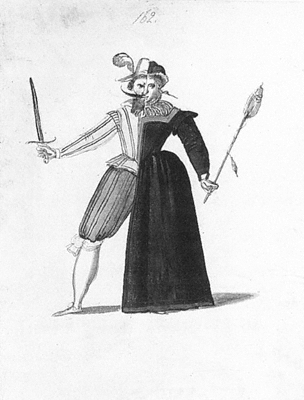
Figure 3.1
Androgynous figure from Le Grand Bal de la
douairière de Billebahaut , 1626. Courtesy of the Board of
Trustees of the Victoria and Albert Museum.
"doubled" by apes or bears. Such scenes are always related to either status reversals or racial depictions of Moors, Jews, Amerindians, and other reviled outsiders.
The impact of these figures is tied to their critical import, which is evanescent by design. Burlesque techniques included verbal opacity through punning and burlesque verse, constructed shapes in costuming, and physical twisting on the ground as well as experimentation with aerial virtuosity, all of which were, as previously stated, programmatic critiques of composite spectacle. Along with an increased range of movement vocabulary, burlesque works employed carnivalesque techniques of character reversal, obscenity, and sexual, racial, or class cross-dressing, the most emblematic figure of which was the androgyne. Thus, as I have ar-
gued elsewhere, an economically and politically besieged nobility placed the monarchy in symbolic jeopardy by creating and performing "burla" (mystifications) in which nobles identified themselves with persecuted groups. The motif of androgyny as employed in many burlesque ballets no longer conveyed assurances of political stability and continuity but presaged instead veiled threats of discontinuity or radical change.[27]
Given this state of affairs, the androgyne is paradigmatic for its indeterminacy. Despite the suggestions of cross-dressing, the cross is always ambiguous, or rather, it is anchored in the action of the crossing itself. The intermediary status of the androgyne thus becomes emblematic of an enterprise whose criticism is liminoid in Victor Turner's sense. "Liminoid phenomena," remarks Turner, "develop apart from the central economic and political processes, along the margins, in the interfaces and interstices of central and servicing institutions—they are plural, fragmentary, and experimental in character."[28] Thus, burlesque androgyny implies a more disturbing dislocation of masculine heterosexual identity, a rendering liminoid of royal ritual. Liminoid phenomena derive from individuals, have commodity value, and enable social critique.
What this explanation of the political tendencies of the burlesque enables us to understand is the historical significance of its disappearance. Thirty years after the fact, memory of the burlesque was still sufficiently threatening for Louis XIV to interdict its performance in his Letters Patent , a document that simultaneously founded the Royal Dance Academy.
The Return of Force: Toward a Performative Two-Body Theory
It should be clear by now that we are talking about the king's two bodies in a very performative sense. But the ramifications of Kantorowicz's dyad in such fully material terms need further clarification.[29] The king's body politic is performed via Apollo or the sun, his
[27] See Franko, Dance as Text , 63–107.
[28] Victor Turner, "Liminal to Liminoid," in From Ritual to Theatre: The Human Seriousness of Play (New York: PAJ, 1982), 54. I would argue that burlesque ballet, although clearly marginal, occurs remarkably close to the economic and political center, frequently even with the king's personal participation.
[29] The two-body doctrine is one of juridical separation, making it particularly applicable to the English monarchy. As Thomas Hobbes stated: "In a Body Politique, if the Representative be one man, whatever he does in the person of the Body, which is not warranted in his Latters, nor by the Lawes, is his own act, and not the act of the Body, nor of any other Member thereof besides himselfe" (Leviathan [1651; New York: Washington Square Press, 1964], 159). Regarding the place of kingship in French culture, Roger Chartier has discussed the merging of the two bodies into one as initiated by Louis XIII and sustained by Louis XIV; see his Cultural Origins of the French Revolution , trans. Lydia G. Cochrane (Durham: Duke University Press, 1991), 124–25.
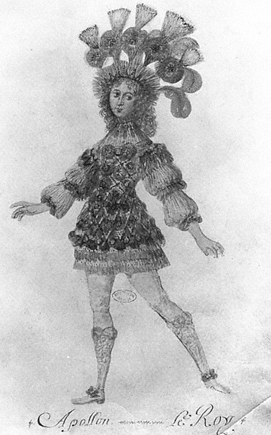
Figure 3.2
Louis XIV as Apollo in Les Noces de Pelée et
de Thétis , 1654. Reproduced by permission.
body natural via a fury. What does this mean for our understanding of power and representation in royal spectacle? Are they both equally powerful representations? How can we apprehend them in their hypothetical complementarity?
Let us consider for a moment Marin's analysis of sacrament and its
links to the power of representations. He gives as an example the body of Christ, present yet, in the language of the sacrament, invisible ("This is my body"); absent despite its symbolic visibility in the wafer whose materiality is consumed to produce presence as an idea (properly, to represent presence).[30] By extension, when Louis XIV performs the role of rising sun in Ballet de la nuit (1653), his natural body offers itself for visual consumption in a political sacrament of monarchical power as illuminating, but also blinding, radiance. The role of rising sun is, like the wafer, the visible talisman of an absence (a sign) producing the idea (representation) of body politic in the mind. When Louis XIV dances Apollo, there is royal sacrament. His glorious roles evidence the transubstantiation of body natural into body politic. Yet, what ramifications ensue for the two-body theory when he dances a coquette, a nymph, or a fury?
If an androgynous appearance marked the self-sufficiency of rulership in balletic terms, it is not surprising that Louis XIV should have presented a feminized appearance in his 1654 performance of Apollo, for it was as Apollo that he symbolized most unambiguously his rulership (fig. 3.2). Nevertheless, this monarch said to be enamored of ballet inherited androgyny stemming from two divergent courtly traditions: the official and the burlesque. The performance of androgyny had one leg, so to speak, in legitimacy and the other in irony or resistance. How did Louis XIV negotiate the cultural memory of this dual performance tradition in roles not otherwise associated with his ceremonious royal identity?
Consider his role as a Fury in Les Noces de Pelée et Thétis (1654).[31] In this work, as in many other ballets, the king plays more than one role. He first appears, in fact, as Apollo surrounded by his Muses. In the third scene, however, he plays one of nine furies of jealousy vomited from a sea monster's mouth. The monster has been called forth by Juno to prevent
[30] Louis Marin, La Critique du discours: Sur la "Logique de Port-Royal" et les "Pensées" de Pascal (Paris: Editions de Minuit, 1975), 254–55.
[31] The libretto, originally printed by Robert Ballard, has not been reprinted in any collection. The text is at the Bibliothèque Nationale [hereafter cited as BN]: In-8 BN Rés Yf 1460. Ballard also published a synopsis of the ballet, reprinted in Marie Françose Christout, Le Ballet de cour de Louis XIV, 1643–1672 (Paris: A. & J. Picard, 1967), 205–11. Some of the costume studies for Les Noces are housed in the Musée Carnavalet; see Laurence Guilmard-Geddes, "'Les Noces de Pélée et Thétis': Costumes de Ballet," in Dons et achats récents: Bulletin du Musée Carnavalet 30, no. 2 (1977): 5–9. See also Marie-Françoise Christout, "'Les Noces de Pelée et Thétis': Comédie italienne en musique entremêlée d'un ballet dansé par le roi (1654)," Baroque 5 (1972): 55–62; Charles I. Silin, Benserade and His Ballets de Cour (Baltimore: Johns Hopkins University Press, 1940), 232–38; and Christout, Ballet de cour de Louis XIV , 72–77.
Jupiter's abduction of Thetis. The king's presence in this entrée might seem unremarkable in that he is one among nine other performers. Special verses that single him out are, however, attributed to the king as Fury.
Et suis si tu peux cette jeune Furie,
Espagne, dont l'orgueil est trop long-temps debout,
Elle te va dompter d'une force aguerrie,
Et la torche à la main s'en va de bout en bout
Mettre le feu par tout.
Elle suit les meschans, les presse, les opprime,
Leur fait dans ses regards lire un sanglant decret,
Et dans le mesme instant qu'ils commettent le crime
Leur glisse dans le coeur un eternel regret,
Comme un serpent secret.
Que je voy de Beautez dont la rigueur extresme
A plus de mille Amans a causé le trepas,
Qui voudroient tout le jour, et toute la nuict mesme
Avoir cette Furie attachée à leurs pas,
Et qui ne l'auront pas.[32]
And follow if you can this young Fury,
Spain, whose pride has been too long afoot,
She will tame you with a warrior's seasoned force,
And torch in hand she will pass from end to end,
Setting fire everywhere.
She pursues the wicked, presses and oppresses them,
Has them read in her expression a bloody decree,
And in the very moment they commit their crime
Slips into their heart an eternal regret,
Like a secret serpent.
How many beauties I see whose extreme rigor
Caused the death of a thousand lovers,
Who would like to have all day, and all night,
This Fury behind them,
But who won't have her.
The king's verse introduces a triple scenario in which the Fury's pursuit of Jupiter, who is himself in pursuit of Thetis, is manipulated in several disconcerting ways. First, the political context of Spain in its relationship to France is foregrounded when the audience is asked to reposition the cross-dressed king ("that young Fury") as ostensible prey of
[32] Ballard, Les Noces , 21 (In-8 BN Rés. Yf 1460).
the Spanish. Yet the Fury is herself in pursuit of all evil forces, acting on them with terrible incendiary and bloody violence. By the third stanza, in typically burlesque fashion, the cross-dressed king is said to exert a sexual appeal on otherwise forbidding female spectators who presumably regret they will not themselves be persecuted by her. Thus, his violence is transformed into a sexually appealing quality. There are three levels at which the cross-dressed king interacts with his public: at the narrative level, the most straightforward, in which he plays a fury pursuing Jupiter; at the level of contradictory commentaries that introduce secondary allegorical senses with both political and sexual motifs; and finally, at the level of physical performance, wherein, it seems, the king's actual presence is called on either to unite these disparate interpretations or to succumb to their competing meanings. Here, the anomaly is less the cross-dressed king per se then the different interpretive claims being made for his energy and presence. To be pursued, as it were, by such competing texts would also be, for the Fury, necessarily to remarshal them in the name of her own violence or unlimited force—which is named as sex, violence, and magic. But s/he is caught up in a wider web that includes all facets of the performance tradition under study: legitimacy, resistance, and seduction (fig. 3.3).
Hermaphroditism, which has been shown to underwrite the ritual significance of royal succession in Le Ballet de Madame , underwrites in Les Noces the exceeding of power by force, of attraction by magic. Hermaphroditism, initially a balletic icon of royal succession, later a tool of dissident critique, finally became with Louis XIV the balletic sign of unpredictable royal agency. We could refer to it in general terms as seduction. At this juncture, let us note how dance studies induce a return to the issue of agency without discarding ideological critique.
Appropriative Cross-Dressing and Force
When Louis XIV performs a cross-dressed role one can assume the intersection of several appropriations. He references the earlier burlesque style by appropriating it; but he also asserts the "double body" doctrine: he performs his own mortality as the weaker part of a corporation sole . In this assertion of mortality, however, the "body politic" is manifested as the invisible presence of a missing (male) sex. It is engendered by the possibility of seduction. Although we know full well that the king performs, we are also confronted with his insistently travestied presence.
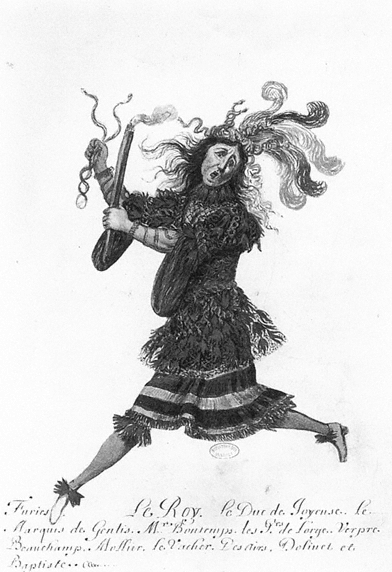
Figure 3.3
Louis XIV as a fury in Les Noces de Pelée et de Thétis , 1654.
Reproduced by permission.
His body as present and coded female presents the king's "body natural"—the "weaker" and therefore "mortal" (feminine) sex of the hermaphrodite. In other words, unlike the wafer, cross-dressing is harder to swallow because it activates no transubstantiation, whether theological or political. It does present, however, his agency, and where it does not, the performance risks becoming anomalous. So, for example, the king's role as Coquette in Les Festes de Bacchus (1651) was cut, presumably because it did not activate the proper images of terrifying agency.[33]
How are we to understand this deployment of balletic force in the light of the much elaborated collusion of power and representation in seventeenth-century royal iconography? Is it a cul-de-sac of the balletic form itself? Or does it add a dimension to ideological calculations in their representational effects that actually exceed the logic of representational strategies? Is there a logic of presence as seduction? It might be useful to close this discussion by recalling the ultimate rationale of representation as power.
Every institution in Marin's reading of Pascal is founded on an originary or mythical deployment of force (a fight to the death) in which the stronger triumphs.[34] Institutions become established to obviate reenactments of this founding force. Such institutions—the monarchy, for example—are founded in and through symbols that effectively place their force in reserve and defer any desire to repeat the battle to the death, to reenact violence as an absolute of force. Thus the complicity of representation and power. Representations of power defer the necessity for force to display its absolute. But by the same token, power itself becomes an effect of representation, a force that is reconfigured by means other than its initial violence, by artistic means. Power, in other words, is necessarily flawed, because it exists only as a representation. Thus Marin's definition of power as "force in mourning."[35]
My point is that the cross-dressed king is not powerful in the con-
[33] This entrée became known to dance historians as the "Entrée supprimé" (suppressed entrée) because it was never performed and was only printed as an appendix to the original libretto. Lacroix declined to reprint it in his republication of ballet libretti for its "lack of nobility and seemliness," even though, as he remarks as well, the king played the role of a thief in the same ballet (Ballets et mascarades , 6:304). The libretto for Le Ballet du roy des Festes de Bacchus , published by Robert Ballard in 1651, is housed at the Bibliothèque Nationale, In-40 BN Yf Rés 1210. The Bibliothèque Nationale also holds sixty-nine original watercolor costume and set drawings for this work by Henry de Gissey or his atelier; a facsimile album exists in the Dance Collection of the New York Public Library ( MGZEB 87–264).
[34] See Marin, Portrait du roi , 11–13, as well as his "La Raison du plus fort est toujours la meilleure," in Aims and Prospects of Semiotics: Essays in Honor of A. J. Greimas , ed. H. Parret and H. G. Ruprecht (Amsterdam: John Benjamins, 1985), 726–47; republished in La parole mangée et autres essais théologico-politiques (Paris: Meridiens Klincksieck, 1986), 61–88.
[35] Marin, Portrait du roi , 138.
ventional sense, because s/he is not a representation. In fact, s/he contradicts power's representations: s/he re-presents force. Her performance, oddly lacking as an incarnation of the monarchical institution, replays the force at that institution's origin and thus performs the basis of theatrical doubling itself, the founding violence at the origin of institutions that enable the "inscription of morality as style."[36] Cross-dressing is the inscription of force as style, violence as style, the amorality at the origin of theatrically stylized behavior. Modes of surrogation constituting period style project ideologies not only forward in time (fodder for reconstructions) but also, as it were, backward toward an uncoded energetics, figures of desire, bodies as empty spaces inhabited by an unpredictable and seductive energy.[37] In the area of historical dance reconstruction, such figures that themselves remember in lieu of bestowing memory upon us, who account for their own form as the disruptive necessity to reenact the origin of their own institutionalization, are in need of theatrical construction. They would bring a new and compelling sense of agency to the convention-bound reenactments of history.
The king's body of force, feminized as mortal but present nonetheless as the king—this king—does not offer herself up to symbolic consumption but stands instead as a figure of desire, an empty space that his public can fill only with what they fear to be her own agency, her force beyond representation, her sexuality, her body natural. After all, he herself performed these roles, and made them known as extensions of his own physicality, unique moments in her own life in which physical means and performative intention took the center of attention. What I am claiming to have been witnessed in Louis XIV's cross-dressed roles is not court ballet's imaginary, but its real; not its power, but its force: its figuration of agency, neither role as thing-prop nor ideas as presenced effect. Furthermore, the cross-dressed king deconstructs the system of flattery haunting the traditional exaltation and consumption of the royal person. In the irony between her transgressive appearance and his glorious reality, the king risks the stability of his power by presenting her mortal body, but also asserts a terrifying and sexualized agency, by taking it, so to speak, out of its representational mourning and putting it into presence.[38]
[36] Joseph R. Roach, "Power's Body: The Inscription of Morality as Style," in Interpreting the Theatrical Past: Essays in the Historiography of Performance , ed. Thomas Postlewait and Bruce A. McConachie (Iowa City: University of Iowa Press, 1989), 109.
[37] And this is precisely the sense in which Pascal critiqued the Port-Royalist theory of language and revealed that the nonadequation of rationality and power allowed for the return of force in the figure. See Marin, La Critique du discours , 273.
[38] This conclusion invites further exploration of the relationship between agency, force, and femininity, an exploration that is beyond the immediate scope of this essay.