
"The Right Thing in the Right Place"
P. H. Emerson and the Picturesque Photograph
Jennifer M. Green
Unlike the work of the early great Victorian landscape photographers, Peter Henry Emerson's late-nineteenth-century visions of rural southeast England offer no startling geometries or precocious angles. Scenes more reminiscent of Impressionist paintings than of anything in photography's own short history, they illustrate their author's early claims for photography as a naturalistic art. Life and Landscape on the Norfolk Broads (1886), Emerson's first published photographic book, was in fact a practical account of his theories, with its own labors of picture making and writing neatly divided: where the photographs provided "art for lovers of art," the accompanying text was to be "illustrative of and somewhat complementary to them . . . depicting in words, surroundings and effects which cannot be expressed by pictorial art."[1]
The book appears aptly named, with its equal emphasis on representing human and animal life in its surrounds of marsh, fenlands, and coastal waters. Further, in its deliberate efforts to counter the studied theatricality of photographs such as those by Henry Peach Robinson, Emerson's experiments in naturalism succeed: the pictures are, for the most part, unposed, and there is a freedom, as critics have noted, from artificiality and sentimentality.[2] Emerson's aim was to use the camera impressionistically, to record neither the literal facts of the self-conscious documentary nor the simulated events of Robinson's studio, but rather to create a sense of human vision—to work, in other words, against the notion of the camera as a tool of perfect record and to claim it instead as an agent in naturalistic and aesthetic creation.
Yet the relation between life and landscape on the Norfolk Broads is one not of aesthetics but of labor; and labor provides the true subject
of these pictures. Between Emerson's theories of photography and his conceptions of landscape, however, that subject vanishes into the picturesque, the laborers themselves reduced to mythical, powerless creatures, faceless models of charming work. Further, despite Emerson's interest in the conditions of the rural poor, any vestiges of social commentary that might be offered by the camera are denied by the accompanying text, which invites a generalized aesthetic response to the photographs. In later books, such as Pictures of East Anglian Life (1888), the text forgoes aesthetic considerations, documenting, instead, the frequently grim details of working life on the Broads; but in a striking imbalance, the accompanying photographs in this and other books by Emerson present increasingly romanticized and abstracted views of life in rural Norfolk and Suffolk.
The tension that complicates our response to Emerson's work can be traced to the divisions and shifts in his own attitudes toward photography. His book of theory, Naturalistic Photography for Students of the Art (1889), made the claim that "All good art has its scientific basis";[3] the same year Emerson argued before the Camera Club for the importance of distinguishing art from science, for art "differs from science fundamentally."[4] More dramatically, Emerson was to renounce altogether his views on photography's position among the fine arts, recanting in January 1891 in a black-edged pamphlet that announced "The Death of Naturalistic Photography" and modifying his earlier theories so drastically, with a new chapter entitled "Photography—Not Art" in a later, much revised, edition of Naturalistic Photography, as to almost invalidate his own original claims.[5] Much of what one can say about Emerson's photographic theories during the late nineteenth century, then, can be refuted by his own words, in which he engaged in a continual assessment and reassessment of photography's status with regard to other art forms. It is possible to trace the development of those theories, but my emphasis here will instead be on a particular element of his photographs that appears to remain constant.
After briefly considering how Emerson's photographs chart the theories he laid out in the early editions of Naturalistic Photography, I argue that the text accompanying the early pictures subverts their subject matter by focusing attention on aesthetics and urges a reading of the photographs that overlooks the human labor at their center. Emerson in his first book "frames" life on the Norfolk Broads—invests it, in other words, with arguably false significance. But I also make the more far-reaching argument that the tension in Emerson's works between text and photographs that shaped all his books and indeed his entire photo-
graphic career is in fact an inevitable and necessary element of the picturesque; Emerson's work offers its own explanation for the appeal of this kind of photography to the late-Victorian imagination.
Life and Landscape on the Norfolk Broads was printed on white vellum, and bound in green morocco—"a thick, handsome volume, which any person of artistic taste may feel proud to own," observed the Photographic News .[6] It contained forty platinum prints, interspersed with lengthy commentary on individual photographs, related events, or more general subjects, and concluded with an essay on landscape art by the landscape painter T. F. Goodall, Emerson's friend and companion on the Broads. The albums, available in standard and deluxe editions, were issued in limited printings; the negatives and printing plates were destroyed by arrangement with the publishers.[7] The work was a collector's item, available to a select few.
For the most part, the prints map out the theories later expressed in Naturalistic Photography . According to this work, the fundamental purpose of artistic photography is to reveal the inner reality of its subjects, a revelation made possible by the photographer's intimacy with the subject. Predictably, Emerson scorned the creations of weekend photographers who roamed the countryside in search of views: "The student who would become a landscape photographer," he writes, "must go to the country and live there for long periods; for in no other way can he get any insight into the mystery of nature" (Naturalistic Photography 1890, 245). The photographer must, in fact, aspire to a Wordsworthian relationship with nature, which requires both appreciation and inner discipline: "You must . . . train your feelings," he instructs, "for, as John Constable said, 'the art of feeling nature is a thing almost as much to be cultivated as the art of reading the Egyptian hieroglyphics'" (1890, 250).
The art of feeling nature does not preclude some interference on the part of the photographer representing it; on the contrary: "The objects must be arranged so that the thing expressed is told clearly and directly" (1890, 248). Thus the search for a view becomes the search for potential, a potential recognizable only by one versed in the "mystery of nature." As for the subject itself, it must fulfill three requirements before it merits being photographed: "The subject must have pictorial qualities, it must be typical, and must give aesthetic pleasure" (1890, 250). While together these three will ensure truthfulness in representation, such representation has nothing to do with the world of facts: "the fewer facts we record in Art, and yet express the subject so that it cannot be better expressed, the better" (1890, 298).
Essentially, then, Emerson advocates both an intuitive and a familiar knowledge of the subject that will enable the photographer to decide what is typical and what, therefore, may be deemed truthful (truth being construed here as the consequence of repetition); he recommends an attention to the pictorial that is based on the understanding that the best pictures are the most beautiful; and he calls for a Keatsian leap in which the photographer assumes that what is beautiful is most true. As Goodall puts it in the closing essay to Life and Landscape, "beauty consists in appropriateness; the right thing in the right place is the beautiful thing. Truth is beauty" (77).
Artistically, Emerson holds that truths are best conveyed with a minimum of detail. And in his photographs there is indeed less rustic paraphernalia than we see in Robinson's work. Excess is, instead, provided by the prose, which in certain places overwhelms the reader. Here is Emerson, to use his own criterion, at his most "typical":
Perhaps the great charm to be felt in this country is the ever-changing aspect of the landscape. One tide gives us the peculiar heavily clouded sky so often depicted by Gainsborough, with here and there a glint of sunlight shimmering on the high line of the full river, and on the innumerable small repetitions of the surrounding dikes . . . Every day, and many times a day, the picture changes. One moment the commons seem desolate and deserted by all life; the next they are beautiful, as if clothed by magic with varied tints of sunlighted gorse and spring flowers; while horses, magnificent in their freedom, career over hill and dale . . . scattering by their wild ungoverned paces the gentler herds of kine. At another moment, a fierce rainstorm sweeps down and seems to wash all brightness away. Yet another day. . . The river is there flowing high in the middle distance; the dikes are full, but there is no silver in the landscape today; the soft gradations are all in dainty greys, and russet browns, and sober greens. (quoted in Newhall, 32)
Two things are worth noting here. First, his highly visual response to the scene. The countryside to Emerson is already "landscape," pictorial, two-dimensional. "Landscape" is a loaded term, of course: "the perception or poetic re-creation of landscape," Carole Fabricant writes, "is always inextricably bound up with broadly political considerations, whether or not they are openly acknowledged."[8] As John Barrell notes, "we can speak of the 'landscape' of a country, but in doing so we introduce, whether we want to or not, notions of value and form which relate, not just to seeing the land, but to seeing it in a certain way—pictorially."[9] Landscape as a way of seeing depends upon the taming or controlling of the wild: the act of depiction in pictures or words or both is one of simultaneous domestication. For Emerson at the close of the
nineteenth century, the landscape of the Broads is both wild (there are horses) and cultivated (there are cows). It is also continually changing, an idea to which I return later.
In its tribute to what is essentially an already painted scene, the passage raises a question pertinent to the photographs in Life and Landscape: what is their intended relationship, not only to nature, but to art? Was it Emerson's intention to render photographically what eighteenth- and early-nineteenth-century painters such as Gainsborough and Constable had accomplished on canvas (thus rendering incidental the relationship of his photographs to nature)? Was he trying to reconceive his own relationship to nature through the very different medium of the camera? That question is best answered, I think, by considering the human figures in his landscapes that frequently provide the subject of his work. The first plate of Life and Landscape, "Coming Home from the Marshes," shows four laborers apparently returning after a day's work (Fig. 36). To explain the photograph, Emerson writes:
To the left stretch masses of golden-ochred rush, to the right the rich greens of the marshes, and throughout winds the river, a vein of the deepest cobalt, while overhead roll masses of snow-white cumuli flying before the wild west wind. Along the marsh wall comes a group of labourers returning from their short day's work. Typical specimens these of the Norfolk peasant,—wiry in body, pleasant in manner, intelligent in mind. Their lot, though hard, is not unpleasant. . . . They have just returned from cutting the reed. Protected by their long marsh-boots, they may be classified as "waders," for they spend much of their time standing in water up to their boot-tops. Nevertheless they are happy and healthy. (10)
Emerson the naturalist thus classifies the specimen for the field observer. Both the appearance and the behavior of the human subjects of Life and Landscape (a "healthy, merry crew") are described: "Shy of strangers at first, they improve on acquaintance. . . . 'It is a sweet and civil country'" (10). The laborers are, it seems, representatives of a type whose very existence guarantees the health of England. But they are also, inescapably, part of the landscape Emerson describes, along with the marshes, rushes, river, and clouds, and despite their central position in the photograph, they are no more important than these. One obvious difference, of course, is that Emerson required the cooperation of his human subjects in making this photograph and presumably set up his camera shot before the subjects were permitted to walk toward him.
"By far the most difficult branch of photography," wrote Emerson, "is that in which figures occur in landscapes" (1890, 251). The conflict between the desire to control figures in a landscape and the wish to
represent them truthfully was much debated by photographers during the 1880s; numerous articles on the subject in photographic journals attest to the relevance of Emerson's concern. Part of the difficulty, according to one way of thinking, was the urge to include human life at all: People cannot take a river view, complained one reviewer of landscape photographs in the British Journal of Photography, "without giving an offensive prominence to the inevitable fisherman, rod in hand." The better option is to get the angler "to retire beyond the grasp of the lens, leaving the rod and basket on the bank to represent him." The journal advises that figures "occupy the least important and weakest part of the subject as regards its interest; let them be placed on different levels if possible and in various and contrasting positions, and let them be subordinate to and aid the general sentiment of the landscape."[10] Andrew Pringle, a member of the Photographic Society of London, wrote that "If figures are to be in a landscape they must be . . . 'of the picture, and not merely in it.' . . . The figures must be useful to the landscape in some way."[11]
Photographers who think this way select figures carefully for their service to the landscape as well as for their visual charm. Such figures were not always easy to find. In his book on landscape photography, Robinson writes of
a picturesque model caught wild, but too stupid to be of any use. Naturally she had a delightful smile, and although I tried all I knew for a fortnight to overcome her timidity—mixed her with tame models, as they train wild elephants—she remained camera-shy, and I could do nothing with her. I did the next best thing. I bought her clothes.[12]
What Robinson means here is not that he purchased clothes for her, but rather that he paid her for her outfit, with which he could then equip someone of his own class exported to the scene. By using the term "tame models" (albeit in jest), he implies that the "wild" (original) subject is only an amateur, whom the "tame" professional can represent with greater authority. Robinson preferred to use models—upper-middle-class women or even paid professionals who were pleased to play shepherdess for a day. Their clothes had to be genuine and could be "obtained at first hand from the original wearers" (1896, 98). The original wearers, though, rarely feature in Robinson's pictures, since "it is not easy to explain what you want to a fresh caught peasant" (98). On the other hand, "With a well-trained model," he notes, "you can get nearer to nature than nature herself " (98).
This was precisely Emerson's desire. In Naturalistic Photography he
urges students, "never forget . . . the type; you must choose your models most carefully, and they must without fail be picturesque and typical. The student should feel that there never was such a fisherman, or such a ploughman, or such a poacher, or such an old man, or such a beautiful girl, as he is picturing" (1890, 251). Despite the urge to outdo nature, however, Emerson photographed only persons wearing their own clothes, in surroundings familiar to them. And in Life and Landscape he shows his subjects at work, catching eels, mowing the hay, cutting reeds. Whatever the activity, the labor provides at least the titular subject of the photographs: "Taking Up the Eel Net," "Quanting the Marsh Hay," "Poling the Marsh Hay," and so on.
In thus representing rural life, Emerson seems to have been following what Barrell claims was an established notion in both literature and the visual arts of the late nineteenth century, that "the actuality of the life of the poor could be represented only by images of them at work and that to depict the poor at rest was to sentimentalise or to pastoralise them."[13] Barrell finds this notion
a prescriptive, not a descriptive, constraint: it is not so much that the poor always do, but that they always should, work; and its survival into the late nineteenth and twentieth centuries, as a check against sentimentality, has meant that it has also become a barrier between seeing the poor as simply workers with no other identity, and the possibility of seeing them as men with their own choices to make, and a disposition to do other things than the toil they were born to perform. (92)
In Emerson's efforts to portray a world of georgic labor rather than idyllic repose the individual laborer is invariably sacrificed to the generalized image of work. While the photographer, as Barrell suggests, avoids the charge of sentimentality, his pictures invite a consideration of the subjects that has little or nothing to do with the conditions within which they labor. In almost all the photographs they have their faces turned down or away from the camera; or they are in shadow, or far enough away so that we cannot see their faces. The majority of Emerson's photographs thus show labor not in individual but in abstract terms: the workers are a part, not a distinct feature, of the landscape. Instead of standing out as individuals, they blend into their surroundings.
"Rowing Home the Schoof-Stuff," in Life and Landscape, shows a figure in a rowboat against a tranquil evening sky, his oars appearing to rest upon solid water (Fig. 37). Two-thirds of the picture in fact consists of water, brighter than the evening sky, which gives back the clear and
empty gleam of a mirror. In comparison with this expanse, the dim cottages and trees at the water's edge seem small, nested like birds in the marshes. The Broadsman is placed almost exactly at the center of the photograph, the perfection of his shadow in the water suggesting immobility rather than the homeward motion of the title. As still as the reeds over which he gazes, he bisects the horizon, joining sky and water, while his resting oars take the eye to right and left of the boat, to reeds and houses and again back to his dark mass at the center. The identity of the man himself remains, meanwhile, in the context of the photograph, not so much a mystery as an irrelevance.
Later works, such as Pictures from Life in Field and Fen (1887), aestheticize labor to such a degree that not only the identity of the workers is obscured but also the precise nature of their work. "The Mangold Harvest" is such a study, in which the bent backs of the workers and their occupied hands are sufficiently distanced to allow an impression of harmony rather than muscular discomfort (Fig. 38). In this book, with its epigraph from Millet, Emerson's text is concerned wholly with art and photography, while the pictures must speak for themselves. "Art is a language," he writes, "and pictorial art is the expression by means of pictures of that which man considers beautiful in the world around him" (9).
It seems highly likely that artistic aspirations played a part in displacing labor from the center of Emerson's photographs.[14] Nevertheless, social as well as aesthetic theory required the distancing of the reality of labor from the images of the land. As Aaron Scharf observes, the photographs of Life and Landscape show "honest folk content with their lot—a confirmation of Victorian values. Indeed," he adds, "the figures in the silvery, dreamlike landscapes are so much at one with nature that they appear physically to grow out of the earth itself."[15] Like Hardy's Tess, whose spirit rises within her as "automatically as the sap in the twigs," there is no boundary between workers and the terrain they inhabit.[16] Hardy might indeed be writing of Emerson's photographs when in that novel he describes how "a field-woman is a portion of the field; she has somehow lost her own margin, imbibed the essence of her surrounding, and assimilated herself with it" (137–38). Of no more consequence than a marsh heron, an eel, a cottage, yet as necessary to the elements of the picturesque as all of these, the figures in Emerson's landscapes, like Hardy's women, have had their individuality sacrificed to their aesthetic appeal as types.
The text of Life and Landscape participates by directing the eye toward generalities rather than specifics, toward adulation rather than consider-
ation. One such example is "Poling the Marsh Hay," which is striking for its central figure of a woman who pauses in her work of bearing away some hay (Fig. 39). The impact of the picture, which is unusual in that the woman directly faces the camera (although her glance is directed away), grows out of the forbidding darkness of the sky and the gloom of the surrounds, the indistinct figures behind the woman, and her temporary pause against a threatening sky.[17] Goodall's accompanying essays "Marsh Hay," however, bears little relation to the image and not only omits any mention of the woman but also emphasizes the picturesque qualities of the summertime laborers at the expense of the difficulties of the work:
Splendid the mowers look, as they sweep down the tall rank herbage; their loose shirts, of white or blue cotton, with sleeves turned back to the elbow, gleam in the sunshine; their legs are encased in the tall marsh boots, without which they could not work in comfort on the swampy soil. Strapped to their backs are their hones; wide, soft felt hats cover their heads, picturesquely shadowing their faces. Superb is the action of the men as they bend to the heavy work, or, standing with booted legs wide apart, hone their scythes, or wipe the gathered moisture from their faces. (45)
"Poling the Marsh Hay" has become one of Emerson's better-known pictures, but for reasons that have little to do with the images created here by Goodall of a freshly laundered and sunny peasantry sweeping through the grass. The text refers to a generalized image of work not merely overridden by the photograph but emphatically negated by it. By way of explaining the bleakness of this particular photographic version of his rural idyll, Goodall explains:
On a dull November day some poor peasants are bringing home the remnants of their crop, which, left too late, has been caught by the autumnal flood, and lain for weeks soaking in the water. When the water fell, the sodden heaps were moved, and placed on the marsh wall to dry, and they are now poling them away to the litter stack. (46)
This, then, is the year's end, a somber final image of the cycle of seasons that can be most pleasingly recalled, not in the photograph, but rather in the text; not, in other words, through visually documented details but rather through generalities that invite the reader to dwell on the picturesque qualities of imaginary work.
Hard as it is to determine the extent to which a text directs a reading of an image, there is obvious tension here between words and picture, as well as evidence of the continual struggle between Emerson's efforts to represent visually the truth of the thing and his subsequent denials
that the truth is to be sought in the accumulation of empirical detail. In later works, such as Pictures of East Anglian Life, the imbalance between text and image of "Poling the Marsh Hay" seems, though preserved, to be reversed, as the landscapes tend toward impressionism and away from the detail of Life and Landscape . Figures are further marginalized or absent altogether, while the much lengthier and more detailed prose, through its heightened attention to the harshness of rural existence ("from our point of view," writes Emerson, the peasant's life is "fearful"), implies a documentary responsibility on the part of the photographer and an intention that is largely unrealized by his photographs. In other words, Emerson's books demonstrate progressively a split between notions of what photography ought to do and what might actually be done with it.
Despite the divergence of pictures from texts, Emerson's books fuse the duty of photography—which was, Elizabeth Eastlake claimed in 1857, "to give evidence of facts, as minutely and as impartially as, to our shame, only an unreasoning machine can give"[18] —with its artistic potential, through their appeal to the picturesque. What is picturesque, of course, may not always be true; that is to say, a picturesque object or moment does not necessarily represent a general state of affairs. Emerson's desire for a subject that is both "picturesque and typical" thus pulls two ways, since the picturesque may resemble, not the everyday instance, but something outside nature; its point of reference is art, and its relation to beauty accidental. For while beauty aspires, as Wolfgang Kemp has written, to the "smooth, bright, symmetrical, new, whole, and strong," the picturesque—that which is picture-worthy—is in the province of time and thus by its very essence associated with decay, age, and mutability. "According to this [late-seventeenth- and early-eighteenth-century] system of classification," Kemp claims, "whatever was in the process of decay was potentially picturesque, because one could detect in it more, and more obvious, signs of wear and irregularity."[19]
Emerson's affection for the picturesque was inevitably shaped by his eighteenth-century models, whose landscapes reflect the lists of picturesque objects compiled by contemporary aestheticians who praise "Gothic cathedrals and old mills, gnarled oaks and shaggy goats, decayed cart horses and wandering gypsies."[20] The "Willows, old rotten planks, slimy posts, and brickwork" that Constable claimed to love are represented in the slippery walkways, stagnant waters, shabby thatch of the cottages, and aging hulls of boats in Emerson's photographs.[21]
ruined water mill provided him with the perfect instance of the picturesque: a useless and decaying link with the past made interesting by its patterns and shadows to the reader who knows nothing of its former function (Fig. 40). Goodall writes appreciatively in Life and Landscape of an old boat, "bleached, blistered, . . . worm-eaten, [and] neglected," (37) while Emerson describes (admittedly ironically) "a picturesque cottage with rotten and leaky roof and dripping walls—a damp fever den."[22]
Clearly, rotten planks, decayed cart horses and ruined water mills have little utilitarian merit. The picturesque, however, requires that even that vestige of utility be denied. Thus it make sense that labor in Emerson's photographs is valued for its aesthetic properties, not for the work itself. In fact, the job itself is abstracted to type, so that the eel catcher or hay poler becomes a mythological worker, defined by the work and undifferentiated from it. As Ruskin observes, for the creator of the picturesque, utilitarian associations are both a distraction and an irrelevance. Whatever the lifelong hardships of a particular human subject, to the "heartless" trafficker in the picturesque he "has at last accomplished his destiny, and filled the corner of a sketch, where something of an unshapely nature was wanting."[23]
Thus Emerson's photographs, ostensively preoccupied with work, are largely emptied of their social and economic significance. But they also meet the requirements of the picturesque in the more general sense that they record the decay of a way of life and of a social order. Paradoxically the pictorial photograph works aqainst the dynamism of decay, enforcing stasis onto the mutability of the picturesque and framing it with nostalgia. Photography arrests decay, in a static, suspended moment. By virtue of its very medium, the poignancy of whose images lies in their relationship to time, picturesque photography figures the always already lost; for Emerson, what was lost was a particular social system, the right thing in the right place, a certain symmetry that heralded art and ordered the landscape and, not coincidentally, assigned different functions to words and pictures.
Despite their mutual unease, the text and the photographs of Life and Landscape are assigned roles of equal importance: the labor, as Ellen Handy has observed, is divided equally between them (183). After Life and Landscape, however, we witness a gradual peeling away of language from image, a widening gap between the aesthetic and utilitarian functions of Emerson's books. In his later works—particularly Marsh Leaves (1895)—the photographs make no pretense at recording the working lives of laborers or the conditions of the rural poor. They offer instead
images abstract to the point of impressionism, whose preoccupation is with light, shade, shape, and distance, but rarely with human existence (Fig. 41). Indeed, these pictures are startlingly beautiful in part because they reveal a nature isolated, silent, kaleidoscopic in its range of shapes and largely untouched by human interference. By contrast, Emerson's later writings increasingly recognize the lives lived out within the frame of his photographs. His apparent goal at times is to deny or adjust a reader's response to the fragile beauty of the images. The divergence of text from image makes the effect of Emerson's later work ultimately Ironic, for in this divergence his photographs figure the very modernism whose rising tide they try to stem.
By contrast with much domestic photography of mid-century, and in keeping with the tradition of the picturesque, Emerson's fin-de-siècle pictures emphasize, not acquisition, but loss. The photographs of his early books, like the writings of the later, claim to record work, to image an era but ultimately do neither so much as they display the uses of naturalism in the service of nostalgia. His increasingly apparent failure to connect words to his pictures, or pictures to the words, suggests a perceived fracturing of word from thing and of word from representation—the demise of naturalism, in short, and the advent of modernity.
Life and Landscape on the Norfolk Broads received good reviews. The Photographic News praised Emerson for "endeavouring to form a real and truthful school of photographic representation."[24] The Amateur Photographer heralded its publication: "the issue of this book marks an epoch in the history of book-making. . . . such perfection of photography, such perfection of reproduction processes, and such perfection of artistic feeling have never before been brought together."[25] Ultimately, of course, one must follow Barrell's directive and ask what is being claimed in these pictures about the rural poor. If the reviewer for the Photographic News thought the pictures "truthful," what was it about life that the pictures confirmed? If the Amateur Photographer found perfection in the feeling, what was the name of that perfect feeling?
The truthfulness of Emerson's photographs depends upon the desire of those who view them for a world in which it is only natural that certain people work on the land—natural, because these people are as much a part of the land as the trees. Emerson's landscapes counter social instability with images of stasis like those of Gainsborough and Constable. But because of his medium, Emerson's version of rural life at the close of the century had greater potential for verisimilitude: his deliberately pictorial photographs denied that photography must be used in
the service of documentary while it used its documentary resonance in the service of the photographer's own mythology.
From its beginnings, photography had figured in the debate between what we may loosely term the schools of realism and romanticism. Indeed, the power of a photograph as a text lay precisely in its potential to be identified either as proof of the nature of the world's existence, which is nothing beyond what we see, or as proof that the world cannot be so represented —that its true nature must somehow be absent from any representation. For its first fifty years the art-science debate had defined photography variously as descriptive or interpretive, expressive or prescriptive, romantic or realist, scientific or artistic. Instead of resolving those issues, the end of the century argued them more vigorously, in part because of an increased and mutual influence of photography and other art forms. "It is quite probable," the reviewer of Life and Landscape for the Photographic News wrote, "that the historian of fifty years to come may set down the present time as that period at which the artist and the photographer began to considerably influence each other."[26]
That influence had been at work since the invention of photography and had always been controversial. Robinson in his memoirs refers to the 1860s, however, as a time when "the opposition to art in photography was at its fiercest."[27] The objections raised to applying artistic principles to photography suggest genuine concern about what photography ought to be permitted to do. Its foremost duty, according to one school, was to represent truth in its entirety. But as early as 1853 photographers eager that photography rise above mere mechanical production challenged that duty, while journals frequently debated questions of technique as a pretext for examining more fundamental disagreements about the role of photography in art. "I do not consider it necessary that the whole of the subject should be what is called in focus, " wrote one practitioner; "on the contrary, I have found in many instances that the object is better obtained by the whole subject being a little out of focus, thereby giving a greater breadth of effect, and consequently more suggestive of the true character of nature."[28] These comments caused, as Eastlake describes it, "no little scandal" (460).
"Hitherto the chief aim of the photographer seems to have been a biting sharpness of detail in the negative," wrote Goodall in Life and Landscape, but this "is generally quite fatal to the result from an artistic point of view" (79). O. G. Rejlander defended his practice of playing with focus by observing that a photograph was a representation, and not the thing itself: "If the old masters had finished the skin up to the 'focus,' they would have literally reproduced a model instead of pre-
senting to our imaginations a Madonna."[29] The debate over focus articulated a philosophical divide between those who would see the world as the camera could show it and those who held that the full truth about the world must be sought beyond its surface. Moreover, the play of the artist's imagination was impeded by the prolific details made possible by photography; such details, wrote one contributor to the Journal of the Photographic Society, were not pleasing:
they rather excite wonder as optical curiosities. The chemical and optical means of producing photographic images have in fact been brought to greater perfection than the artist requires for the production of effect by means of those broad masses of arranged and contrasted light and shade which, under proper management, indicate character sufficiently, and leave the imagination to fill up deficiencies.[30]
The American Journal of Photography went so far as to claim not only that it was acceptable to remove the distraction of unnecessary details in photography, but also that an absence of such details was in fact proof of artistic worth: "sacrifice of detail in the unessential parts of a picture, is always evidence of artistic feeling."[31] Artistic feeling itself was inspired by the attempt to photograph truthfully—to photograph what people saw, rather than what was really there. "All at once the fundamental distinction between Science and Art dawns upon us," stated Emerson. "We cannot record too many facts in Science; the fewer facts we record in Art, and yet express the subject so that it cannot be better expressed, the better."[32] "If photography is to be art," wrote John Bartlett, it "must represent nature as it is presented to our senses, not as things actually are. . . . The law of the persistence of vision must not be violated."[33]
Although Emerson's use of and theories on soft focus varied considerably during his photographic career, his work was generally in accordance with Bartlett's view His photographic theory was based upon Helmholtz's optical theory as well as his own observations that "the eye sees most sharply in the center of the field of vision" and "nothing in nature has a sharp outline";[34] his aesthetic was thus fed both by science and by his faith that truthfulness is best served by an attention to feeling at the expense of detail. But because for Emerson the truthful image was invariably the most beautiful, his photographs make beautiful—and hail as picturesque—that which represents the truth as he sees it; and he sees it in the preservation and the framing of a serene and stable agrarian order. The picturesque, which is transitory and mutable, is, ironically, used by the photographer to preserve and stabilize and fix the right thing in the right place.
To observe the conundrum of Emerson's vision is to claim no new insights into the workings of pictorial photography, a reactionary genre that has fallen into disrepute for the essentially political reasons I have described. Emerson's photographs, however, do more than chart the uses of the picturesque in the services of mythmaking. The tensions surrounding photography throughout the nineteenth century made of it a site for debating the very nature of representation. The inconsistencies of Emerson's work illuminate some of the issues at stake in this debate. The images themselves, however, suggest neither unrest nor dissent, and affirm only an orderly, harmonious, and ultimately even ethereal vision of English rural life.
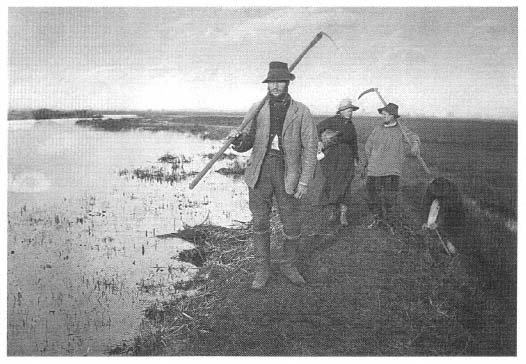
Fig. 36.
P. H. Emerson, "Coming Home from the Marshes." Platinotype. 1886. From Life and Landscape on the
Norfolk Broads, plate 1. Collection of the J. Paul Getty Museum, Malibu, California.
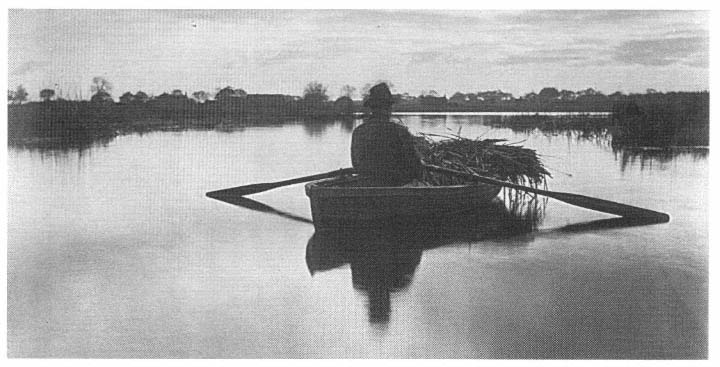
Fig. 37.
P. H. Emerson, "Rowing Home the Schoof-Stuff." Platinotype, 1886. From Life and Landscape on the Norfolk Broads,
plate 21. Collection of the J. Paul Getty Museum, Malibu, California.
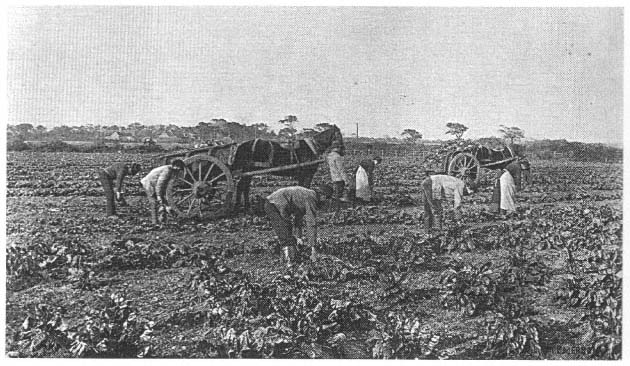
Fig. 38.
P. H. Emerson, "The Mangold Harvest." Photogravure, 1887. From Pictures from Life in Field and Fen, plate 4.
Collection of the J. Paul Getty Museum, Malibu, California.
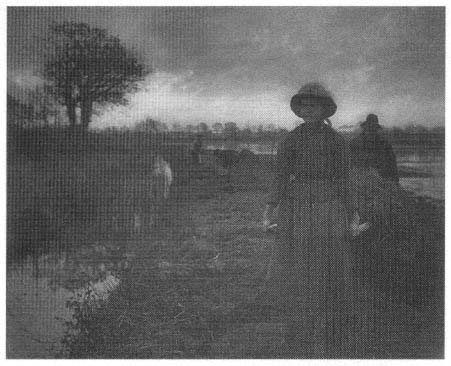
Fig. 39.
P. H. Emerson, "Poling the Marsh Hay." Platinotype, 1886. From Life and Landscape
on the Norfolk Broads, plate 17. Collection of the J. Paul Getty Museum, Malibu, California.
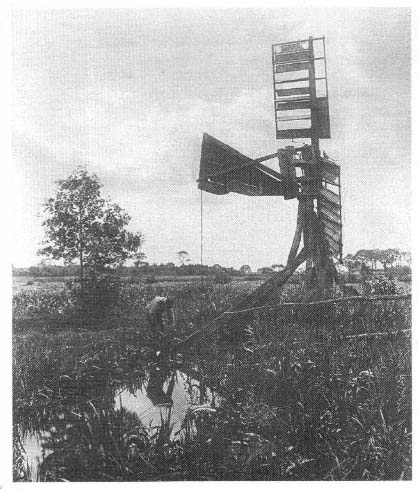
Fig. 40.
P. H. Emerson, "A Ruined Water Mill." Platinotype, 1886. From Life and Landscape
on the Norfolk Broads, plate 11. Collection of the J. Paul Getty Museum, Malibu, California.
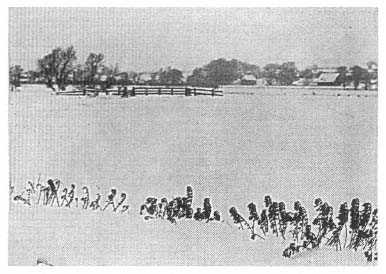
Fig. 41.
P. H. Emerson, "Marsh Weeds." Photogravure, 1895. From Marsh Leaves,
plate 6. Collection of the J. Paul Getty Museum, Malibu, California.