
Varieties of Influence: A Further Look
The attentive reader will have noticed that Robert Wood's discussion of influence and our continuum both involve two variables—the impact of governmental action on urban development, and the independence of governmental action (particularly in relation to "private economic forces"). In the discussion above, these two variables have not been considered separately. Because of the interrelationships among social-political-economic factors, it is empirically difficult to sort out the "independence" variable. Also, our analysis in the following chapters devotes substantial attention to governmental activities that rank highly in both impact and independence, since these activities provide the clearest evidence with which to challenge the Wood-Vernon position.
Nevertheless, the chapters below do discuss some governmental units and activities—such as general governmental units in older cities—whose ranking in terms of the two variables may be quite disparate. In any event, exploring the relationship between "independence" and "impact" may help improve analytical clarity.
Our first step is to express each variable in terms of a continuum. Taking the Wood-Vernon perspective as a starting point, relative "dependence " of a governmental unit is measured by the extent to which the unit's actions are determined by (previous) actions taken by businesses, households, and other "economic units." This step is shown in Figure 2. Relative impact on urban development is measured by the extent to which the actions of any governmental unit shape the distribution of jobs, residences, and transportation facilities in the region, as shown in Figure 3.
[27] Charles Abrams, The City Is the Frontier (New York: Harper and Row, 1965), p. 17.
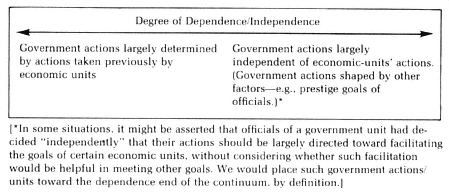
Figure 2

Figure 3
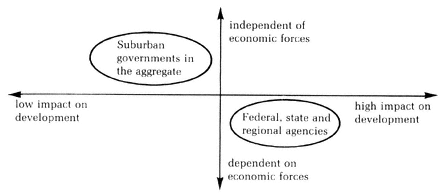
Figure 4
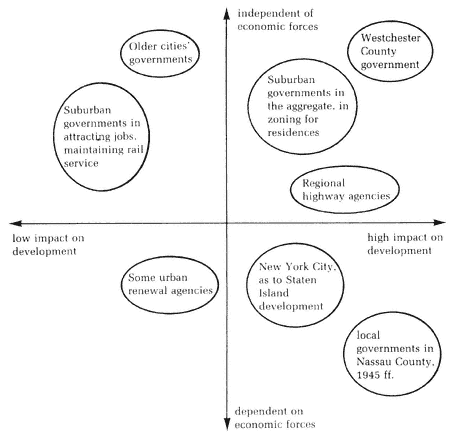
Figure 5
If the two continua are combined to form a matrix, Wood's conclusions regarding government units can be shown, as in Figure 4. That is, suburban governments act independently of the economic forces in the New York region, but their efforts "tend to cancel one another out," giving them little net impact on development. On the other hand, regional agencies do shape development in Wood's view, but only as responsive handmaidens to the "economic forces already at work."
Our contrasting conclusions, suggested in this chapter and amplified in later chapters, can be approximated in the same matrix, shown as Figure 5.
As visual representations of the differences between our conclusions and those of Vernon and Wood, these last two figures may be helpful. But the two variables can also be viewed as representing two different steps in the same causal chain. To take an example to be considered in a later chapter, the construction of the Narrows Bridge greatly increased the rate of population growth on Staten Island. Therefore, the actions of the two governmental agencies that planned and constructed the bridge (Triborough and the Port
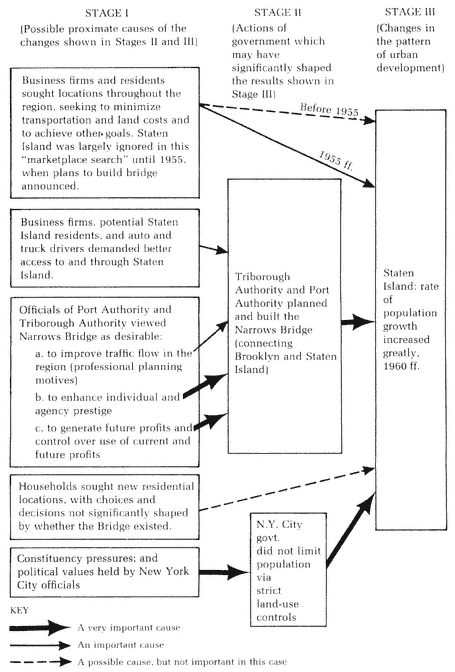
Figure 6
Authority) had an impact on development in a major sector of the New York region. The next step is to determine whether those governmental actions were taken primarily in response to economic forces, i.e., to determine the degree of independence of the two agencies in deciding to build the bridge. The proximate causal relationships are shown in Figure 6. The independence of various governmental units is suggested by the relative importance of the several arrows between Stage I and Stage II. The impact of various governments and other factors is suggested by the relative importance of various arrows entering Stage III.
The role of governmental action in shaping development is clearly significant in the Narrows Bridge case. The more difficult empirical problem is to determine the relative importance of the several causes (arrows) entering Stage II, i.e., to determine the degree of governmental independence of external economic forces. In other cases—for example, in analyzing the relative roles of suburban governments and of market forces in constraining housing choices in the suburbs—the main focus of the empirical problem shifts. The relative independence of local governmental action on land-use policies in many suburbs is fairly readily established, as we show in Chapter Three. Therefore, the main problem is to determine the importance of various factors in shaping housing choices and patterns (i.e., the relative strength of various causes or arrows entering Stage III).
The complexity of the causal linkages shown in Figure 6 underscores the point made earlier in the chapter—that the economic, governmental and other forces shaping urban development are closely intertwined, making it difficult to sort out the most important causes of urban change. As one conference of scholars concluded: "It is always difficult and frequently impossible to isolate cause and effect relationships in any kind of social science research, and policy impact studies pose many particularly difficult, perhaps insoluble, methodological problems."[28]
Despite these difficulties, some headway can be made. The first step, suggested by the Narrows Bridge example, is to state the interconnections among governmental and private economic units in ways that indicate their possible causal relationships.[29] Many (but not all) of the connections suggested by the Narrows Bridge illustration are power relationships. Consequently, we should briefly explore the problem of defining and measuring "power" or "influence." In his early, seminal essay on this problem, Herbert Simon defined the exercise of power as "affecting policies of others than the self."[30] That is, A has power or influence over B when B's choice among alternative behaviors is modified by the communicated preference of A. Building on Simon's approach, Jack Nagel provides a more rigorous and empiri-
[28] Austin Ranney, "Studying the Impacts of Public Policies," Social Science Research Council Items, March 1972, p. 4. Cf. Paul Samuelson, "Some Notions on Causality and Teleology in Economics," in Daniel Lerner, ed., Cause and Effect (New York: Free Press, 1965), pp. 99 ff.
[29] For a more detailed discussion of the issues surrounding the measurement of power and other forms of causation in urban affairs, see Jameson W. Doig and Michael N. Danielson, "From the Firm Ground of Result and Fact to the Tossing Sea of Cause and Theory: the Role of Government in Urban Development," Policy Studies Journal 8 (Summer 1980), pp. 852–861.
[30] Herbert A. Simon, Models of Man: Social and Rational (New York: Wiley, 1957), p. 65. The terms power and influence will be used interchangeably in this volume, as they are in Simon's analysis.
cally more useful definition than previous studies: "A power relation . . . [is a] causal relation between the preferences of an actor regarding an outcome and the outcome itself."[31] This definition ensures that the search for power relationships will include both (1) situations in which A, acting on his or her own preferences, caused B to respond as A wished, and (2) those in which B anticipated that A would prefer B to do X (although A took no action) and B therefore did X.[32]
In some studies, various statistical techniques may be used to measure influence.[33] In assessing the pattern of power relationships in urban development, however, statistical methods do not appear to be very useful because there is little appropriate data in quantified form. For example, we have not found it useful to employ the quantitative approach developed by Thomas Dye and others in assessing the relative influence of various factors in shaping government action. The emphasis in these studies has been on statistical correlations among "economic development variables," political system characteristics, and quantifiable policy measures (such as annual expenditures for highways or education).[34] For some variables that are crucial to understanding urban development, such data are not available, or the available data provide a tenuous basis for analyzing the relevant actions of public or private institutions.[35]
Moreover, these studies have generally disregarded the complex arrangements through which various economic and political "inputs" are converted to "policy outputs"; as Douglas Arnold comments in a critical review, "nowhere is there a sense of the policy-making process at work."[36] If these political arrangements had no significant influence in determining which in-
[31] Jack H. Nagel, The Descriptive Analysis of Power (New Haven: Yale University Press, 1975), p. 29; emphasis added. On the significance of Nagel's contribution, see R. Douglas Arnold, Congress and the Bureaucracy: A Theory of Influence (New Haven: Yale University Press, 1979), pp. 72–73, and Dahl, Modern Political Analysis, p. 30.
[32] See Nagel, The Descriptive Analysis of Power, pp. 27 ff.
[33] On the use of path analysis, see Nagel (ibid.), pp. 54 ff.; on probit analysis, see Arnold, Congress and the Bureaucracy, pp. 78 ff.
[34] For example, Dye analyzed the relationships among four economic development variables (urbanization, industrialization, wealth and education), four political system characteristics (level of voter participation, degree of malapportionment, party control of state government, and level of interparty competition), and policy measures in health, welfare, highways and other areas. See Thomas R. Dye, Politics, Economics, and the Public: Policy Outcomes in the American States (Chicago: Rand McNally, 1966). For other examples of this approach, see Richard Dawson and James A. Robinson, "Inter-Party Competition, Economic Variables, and Welfare Policies in the American States", Journal of Politics 25 (May 1963), pp. 265–289; Ira Sharkansky and Richard Hofferbert, "Dimensions of State Politics, Economics, and Public Policy," American Political Science Review 63 (September 1969), 867–879; Virginia Gray, "Models of Comparative State Politics: A Comparison of Cross-Sectional and Time Series Analyses," American Journal of Political Science 20 (May 1976), pp. 235–256.
[35] Robert Eyestone attempts, for example, to utilize quantitative analysis to examine planning and zoning policies in the San Francisco area, by using planning expeditures as the measure of policy output. Expenditure patterns, however, are a weak proxy for local land-use policies and for their impact on municipal development as it is shaped by these ordinances. See Robert Eyestone, The Threads of Public Policy: A Study in Policy Leadership (Indianapolis: Bobbs-Merrill, 1971), pp. 84 ff., 137 ff., and the review of Eyestone's volume by Michael N. Danielson in Journal of Politics 34 (May 1972), pp. 669–670.
[36] Arnold, Congress and the Bureaucracy, p. 222. See also the review by David Cameron in Policy Analysis 5 (Summer 1979), pp. 405–407.
puts were used and how public powers were employed, such an omission might be pardonable. Even then the best way to determine which variables are influential would seem to be through analyzing actual causal patterns—as we attempt to do in the chapters below—rather than through the use of statistical correlations of inputs and outputs. In fact, some scholars who have emphasized the use of correlations have recently shown an interest in more direct measures of causation. Thus Thomas Dye and Virginia Gray urge that social scientists "move away from the associational reasoning" approach and devise causal models which "portray developmental and sequential ideas about how environmental and political forces and public policies interact." In their joint article Dye and Gray refer to the important role of politics in "the making of economic decisions which have enormous long-run consequences," and to the central role of such officials as Robert Moses in shaping American cities.[37]
In our own attempts to sort out the complex causal linkages involved in urban development, we have found two approaches to be particularly fruitful, and both are employed in the following chapters. The first is to identify cases, or preferably clusters of cases, where there is considerable evidence that identified governmental units and economic units prefer different outcomes, and act accordingly. Or, to state essentially the same point in a different way, one identifies situations in which the desires and actions of specified governmental units directly conflict with those of specified economic units. The outcome should indicate fairly clearly which set of units had more influence (in our study, more influence over the distribution of residences, job locations, and transportation facilities).[38] The analysis of suburban zoning in Chapter Three illustrates this approach.
Often, however, the preferences of important clusters of economic units and governmental agencies are not in conflict. Instead, they are directed toward actions that are similar or mutually reinforcing in shaping the urban region. In situations where such mutual efforts affect urban development, the question is whether the governmental role is merely to "abet the economic forces already at work"—which would imply that economic units are the initiating causes, operating directly, and also indirectly through the public agencies, as suggested by Figure 7.
In order to determine whether governmental units have more than a "merely facilitating" role, another approach can be used. The motives and perceptions of the relevant governmental officials are explored to determine what factors shape their decisions. Where other aims than that of facilitating
[37] Thomas R. Dye and Virginia Gray, "Determinants of Public Policy: Cities, States, Nations," Policy Studies Journal 6 (Autumn 1977), pp. 86, 89. In a recent essay, Gray also suggests that we "move beyond" the previous efforts in order to examine "how the political system converts the demands of the population," and that we look for "determinants of public policy which can be manipulated by policymakers." She finds patterns of "substate delegation" of power and other organizational factors especially promising as explanatory variables. Virginia Gray, "The Determinants of Public Policy: A Reappraisal," in Thomas R. Dye and Virginia Gray, eds., The Determinants of Public Policy (Lexington, Mass.: Lexington-Heath, 1980), pp. 216–217, 220.
[38] This research strategy is suggested by Max Weber's comment: "'Power' (Macht) is the probability that one actor within a social relationship will be in a position to carry out his own will despite resistance . . . " (quoted in Robert A. Dahl, "Power," in David Sills, ed., International Encyclopedia of the Social Sciences, vol. 12 (New York: Free Press, 1968), pp. 405 ff.; emphasis added).

Figure 7
the goals of economic units become salient, one can speak with greater confidence of the "independent" initiating role of governmental action in shaping development. This approach is suggested in Figure 6 and used, for example, in analyzing highway decisions in the New York region in Chapter Six.