
PART 1
WORK AND FAMILY STRUCTURE
1
Labor and Family among Artisan Workers, 1815–1840
In 1807, Jean-François Richard-Chambovet, a prominent ribbon merchant in Saint Chamond, traveled to Paris, a journey few Saint-Chamonais of the nineteenth century ever made. He certainly had the leisure to travel during this year, for revolution and war had nearly decimated his business. While wandering about Paris trying to distract himself from commercial troubles, Richard-Chambovet came upon a shop of antiques and used goods. There a curiosity caught his eye: a loom with thirteen spindles. How strange this mechanism appeared to him, for it was completely unlike the ribbon looms with which he had great familiarity. The shop had three of these looms; Richard-Chambovet purchased them all, for the hefty sum of 390 francs apiece, and brought them back to Saint Chamond.[1]
Little did this ribbon merchant know that his simple purchase would eventually reshape the economy of his native town and, indeed, change the direction of its history. These looms braided threads rather than weaving them. Their arrival coincided with the introduction of steam power. Much less delicate than ribbon looms, braid mechanisms adapted well to steam. By 1820, Richard-Chambovet had a factory with 298 braid looms. A decade later, steam powered 4,000 spindles in Saint Chamond, and by 1860 this number had multiplied by no less than one hundred. Mechanically produced braids did not replace the shinier and more delicate woven ribbons. Indeed, the Restoration brought a return to fancier tastes, and the ribbon industry experienced a golden age between 1815 and 1825. But by the 1840s factory-produced braids replaced ribbons as the primary textile industry of Saint Chamond.[2]
The Saint Chamond economy simultaneously expanded in the metallurgical sector. The extensive coal deposits of the Stéphanois region attracted entrepreneurs who introduced blast furnaces and
rolling mills in the 1820s and 1830s. They built English forges in Saint Chamond and the surrounding communes of Terrenoire, Lorette, Izieux, Saint-Julien-en-Jarrez, and Saint-Paul-en-Jarrez. By 1831, large-scale industry in two sectors vital to the French economy, textiles and metal, had been installed in Saint Chamond. Meanwhile, the two traditional craft industries that had established Saint Chamond as a commercial town, nail making and ribbon weaving, had all but disappeared by 1850.[3]
During the first half of the nineteenth century the basis of the Saint Chamond economy thus became transformed from domestic production to large-scale factory production. Capital and labor were transferred from craft to mechanized industries. In this complex process, the choices, activities, and capital of Saint Chamond's merchants and entrepreneurs played a decisive role. The transfer of labor, however, required a distinctly human shift and thus entailed the decisions, choices, and will of workers in Saint Chamond as well. Industrialists certainly felt pleased with this town's technological transformation; but how did workers experience it?
In some other parts of France where industrial capitalism similarly transformed industries and local economies, artisans resisted change and retarded its effects by maintaining control over their own labor. Although the Le Chapelier Law of 1791 was intended to abolish guilds and other worker associations, many persisted. Craft guilds, confraternities, compagnonnages , and other quasi-religious associations helped artisans extend their work identity to a sense of fellowship with other members of their trade. Associations enabled them to maintain some control over their work by regulating entry into the craft through apprenticeships and by regulating standards of production.[4]
In other cases, however, economic development alone undermined the power of worker associations to preserve their way of life. In Saint Chamond, for example, merchants controlled raw materials, imposed standards of work, and monopolized the sale of finished products. Confréries persisted throughout the nineteenth century, but they came to be dominated by employers and confined themselves primarily to religious functions.[5] As associations weakened, the family assumed more significance as a repository for culture centered around work, and particularly as a main source for apprenticeships. Consciously or not, it developed into the primary
theater in which tactics for preserving a way of life became formulated; equally, it became the arena in which workers relinquished their way of life. How they responded to economic change in large part depended on the degree to which the family operated as a production unit and on the extent of their success in passing skills on to new generations.
While during the course of the nineteenth century industrialization reshaped family life, what happened within the family also largely determined the fate of domestic industries. In Saint Chamond, the majority of men and women devoted themselves to some stage in the production of nails, ribbons, and the processing of silk. Most work took place in the home, and in both silk processing and iron working, parents passed skills on to their children. Each craft, however, responded to economic change in Saint Chamond very differently. Despite a decline in the ribbon industry, weavers clung to their trade and persisted in passing it on to their children. Nail makers and their sons more readily abandoned their craft.
One reason for the divergent patterns in these responses stems from the nature of the work itself. In the end products as well as in the labor that created them, these two crafts could not have differed more. Ribbon weavers turned organic material into beautiful luxury items that had little utilitarian purpose beyond the satisfaction of consumer vanity. Their value was subject to the whims of constantly changing fashion. At the same time, their production required lengthy apprenticeship, highly developed skills, dexterity, patience, and, for the best ribbons, a true artistic talent. Nail makers turned inorganic material into an exclusively utilitarian object with little aesthetic value. Only seasoned nail makers appreciated aesthetic qualities in details of difference among the thousand or so varieties. Their indispensability insured more consistent employment. The creation of nails, however, required more practice than training, more brute force than talent.
Ribbon weavers indeed felt more pride in their work, which partly explains their greater attachment to it. But this attachment did not stem from the nature of the work alone. The relationship between family and work among both nail makers and ribbon weavers provides insight into cultural approaches that informed their behavior. A key difference between the two crafts helps to
explain their divergent responses to economic change: though both industries took place in the home, ribbon weaving depended upon the family as a unit, while nail making relied primarily on adult male labor. To survive in the face of technological change and loss of control over various stages of production, ribbon weavers drew more heavily on the productive capacities of their wives and children. Nail makers, on the other hand, turned outward from the family and tended to seek opportunities that were less domestically oriented.
From the preparation of raw materials to the marketing of the final product, ribbon production had a complex organization, of which weaving constituted but one stage. It was this stage, however, that involved the family most completely as a work unit. A master weaver usually owned three to six looms on which he, his family, and his journeymen worked. His wife and children provided invaluable assistance in auxiliary tasks such as winding bobbins. Wives also supplemented the family income by spinning or warping silk for merchants.[6] As heads of a family enterprise, weavers exercised considerable independence.
Yet because weaving was only one stage in ribbon production and, indeed, dependent upon the other stages, weavers could not enjoy complete autonomy. All phases of ribbon production were seasonal, contingent on the silk harvest between May and July as well as on orders from fashion houses in London, Paris, and New York. Silk preparation lasted from three to six months, and looms operated for about eight months of the year. It was in silk preparation and marketing that merchants had gained considerable control by the end of the eighteenth century. Called maîtres faiseur fabricant —they put others to work, or they "put work out"—they had come to direct the bulk of the Saint Chamond labor force that worked in silk. The fabricant experimented with patterns, textures, and colors and decided which ones he would have produced for firms in Paris, London, and New York. He then had raw silk prepared and dyed according to the specifications of the pattern and hired a weaver to produce it. The leading ribbon fabricants of Saint Chamond—especially the Dugas brothers, Dugas-Vialis and Co., Bancel, Gillier and Sons, and David-Dubouchet—were the wealthiest and most important in France.[7]
After purchasing the silk cocoons, the fabricant hired young girls
to unravel their single threads and wind them onto skeins. This work lasted approximately three months after the cocoon harvest and was the most distasteful in the silk preparation process. The worker first had to find the end of the single strand that composed the cocoon. She took about six cocoons at once and plunged them in extremely hot water to loosen the gum. She next unraveled all six cocoons while twisting the strands together and then placed them on a skein.[8]
Workers could perform this task in their own homes, but increasingly fabricants employed them in workshops. By the 1830s skeining workshops were equipped with motorized spools and furnaces for centralized heating of water basins. This job especially relied upon migrant labor—young girls who usually returned to their rural villages after the season. As such, skeiners "belonged to the poorest class" and suffered the most miserable conditions. The stench of cocoons permeated the workshop and penetrated their clothing. The constant submersion of their hands into nearly boiling water caused chronic pain. Soaking them in red wine and cold water during breaks and after work provided meager relief. Skeiners earned 60 to 90 centimes for their sixteen-hour workday. Fabricants usually lodged them, but under conditions Villermé described as miserable. They slept two together in beds of straw and ate meals consisting of "weak bouillon, legumes, potatoes, potherbs, a few milk products and sometimes a little codfish."[9]
After having the silk skeined, the fabricant then sent it to a miller. Silk millers exercised a profession in their own right, but they too came under the direction of fabricants —they worked as jobbers, fulfilling precise orders. Millers "threw" silk for merchants in Lyon and Saint Etienne as well as for those in Saint Chamond. They too relied on a female labor force, most of whom worked under their supervision in a workshop. Workers placed the skeined strands of silk on a mill consisting of rotating vertical spindles and bobbins. The mill twisted each thread in one of two directions to form the warp and weft, respectively. The tightness of the twist depended on the kind of thread required for the weave of a particular design.[10]
Water powered the spindles that twisted the silk, so the millers clustered along the Gier River, where they employed and lodged in workshops at least eight to ten workers, and sometimes as many
as thirty or forty, who each supervised up to sixteen spindles. The women who worked for silk millers suffered conditions not much better than those of the skeiners. They too labored a sixteen-hour day for 90 centimes. Their employment lasted about six months.[11]
Once the miller completed the job he sent the silk back to the fabricant , who in turn sent it out to a dyer. After scouring, cleaning, and dyeing the silk, the dyer returned it, still on skeins, to the fabricant . There the warp thread underwent one further stage of twisting on wooden spindles. Finally, warpers (ourdisseuses ) performed the delicate task of placing all the strands in a parallel fashion and stretching them with equal tension. Spinners and warpers worked either in their own homes, on the premises of the fabricant , or in the workshops of headmistresses. These processes too became increasingly centralized in the first decades of the nineteenth century. Because their work required skill, practice, and patience, warpers fared somewhat better than skeiners, mill workers, and spinners. They earned 1f40 per day, and some of the older, more experienced women were permitted to work in their own homes. Their work also lasted only six months.[12]
After warping, the fabricant finally sold both the warp and the weft to the weaver. The weaver wove the silk into ribbons which he sold back to the fabricant , who then again employed a female labor force to perform the finishing, including folding and packaging the ribbons for marketing.
With the exception of the weaving and dyeing, this industry from start to finish relied upon an extensive, protean female labor force drawn from both town and country. The women could perform almost all these preparatory processes in their homes, provided they could obtain the proper materials and equipment. But in the first half of the nineteenth century, fabricants and silk millers increasingly organized these workers into workshops. A number of factors made centralization more practical. Most important, fabricants could better supervise the workers as well as the silk itself. In addition, silk could not tolerate changes in temperature or humidity, and keeping the raw materials under the fabricant's supervision assured proper treatment. The concentration of workers in shops also helped prevent the theft of silk and its waste products.[13]
The government inquiry of 1848 reported, not surprisingly, very poor conditions among the mill workers, skeiners, and spinners
who labored in workshops. Respondents complained of overly strict supervision, stomach ailments, and leg varices induced by having to stand for long periods of time or by pumping the spinning-wheel pedal. Because silk could not tolerate atmospheric variations, these women suffered winter cold, summer heat, and high levels of humidity and breathed foul air because windows and doors had to be kept closed. Silk particles caused serious chest irritation. Long hours and workshop discipline surely made conditions there worse than those in workers' own homes.[14]
The history of family and occupational life in Saint Chamond can be retrieved from marriage records, especially when used in conjunction with birth and death records for the purpose of reconstituting families. Records from couples who married between 1816 and 1825 and proceeded to have families in Saint Chamond through the first half of the century provide insight into the relationship between work and family life and into family responses to the technological change that took place during these years. Of the 539 women who married in Saint Chamond between 1816 and 1825, nearly 50 percent declared their occupation as silk workers of some kind (Table 1). Of those, 20 percent wove silk and the remainder declared jobs as silk worker, warper, skeiner, or spinner. Forty-one percent had fathers who wove ribbons.[15] It is impossible to know how many of these women worked in their own homes and how many in workshops; no doubt those who came from ribbon-weaving families assisted their parents when they were needed and worked outside the home during various periods as well.
Whether these women wove ribbons in their own homes or skeined silk in the workshops of fabricants , or both, they could bring valuable knowledge and experience into a marriage with a ribbon weaver. The assistance of a weaver's wife and children played a particularly important role in his productivity. Once the fabricant sold the prepared weft and warp to the weaver, the family had to operate as a tightly coordinated unit. Fabricants habitually gave weavers last-minute rush orders and ruthlessly demanded that deadlines be met. The weaver first had to "mount" the loom according to the pattern and type of ribbon specified in the order. This process took anywhere from one day to more than a week, depending on whether plain or patterned ribbons had been ordered. The task was accordingly painstaking.[16]
| ||||||||||||||||||||||||||||||||||||||||||||||||||||||||||||||||||||||||||||||||||||||||||||||||||||||
In addition to weaving, wives assisted their husbands in a number of other indispensable ways. As the weaver set up the loom, his wife worked over a canetière , a mechanism that passed the weft thread from the bobbin onto canettes , smaller bobbins that fit into the interior of the loom shuttle. Once her husband finished a ribbon, she picked floss and impurities from it (émouchetage ). Throughout the ribbon production process, she also ran important errands. She often obtained the thread and other materials from the fabricant and did the negotiating with him over prices of materials and labor. Here she could draw on her own experience, either from having grown up in a ribbon-weaving family or from having previously worked under a fabricant . Nearly 60 percent of the ribbon weavers who married between 1816 and 1825 chose brides who had already worked with silk; nearly 40 percent married the daughters of ribbon weavers. The importance of a wife's skills in this trade is even reflected in the literacy rates: 40.2 percent of ribbon weavers' wives were able to sign their marriage records, a rate more than twice as high as that of nail makers' wives. Ribbon weavers themselves were more literate than other types of workers,
because of the accounts they had to keep; it helped if their wives also had such skills.[17] Indeed, marriage served as the point of departure for a family enterprise, for ribbon production depended heavily on the participation of all family members.
If marriage served to consolidate skills, family formation perpetuated them. Of all the ribbon weavers in the older generation present at the weddings celebrated between 1816 and 1825, 83 percent had passed their skills onto a new generation. More than two-thirds of them had daughters who declared occupations in the silk industry. Of ribbon-weaving grooms whose fathers declared professions, 65 percent also wove ribbons.[18] Although the information about fathers' occupations remains incomplete, it does indicate a strong degree of occupational inheritance. As these figures suggest, apprenticeship almost always took place within the family. It began at about age fifteen or sixteen and lasted two to five years. Each of the specialties—plain ribbons, patterned or velvet ribbons, and, later, elastic—required a separate apprenticeship. Though training usually prepared the young weaver to be a journeyman before he reached age twenty, according to one observer it often took three generations to produce an able ribbon-weaver. The ability to weave the fanciest ribbons depended not just on skills learned from one's father but on inborn artistic talent. Occupational inheritance served as the wellspring for each generation of weavers. It also helped shape the industry. In his 1929 thesis on the silk ribbon production Henri Guitton attributed loom innovations to "modest workers who watched looms working under the hands of their fathers, and who, remaining the rest of their lives in their presence … felt the perfection that technology demanded as a function of the needs and possibilities of the moment."[19]
If occupational inheritance helped weavers become inventors and entrepreneurs, innovations in this industry in turn, ironically, made it more difficult for weavers to become masters and to pass skills on to their sons. Although some workers exploited new opportunities and attained a higher status, innovations during the first three decades of the nineteenth century had some negative consequences for the average weaver: looms became less affordable, their greater complexity made the traditional apprenticeship insufficient, and the weaver lost further control over the production
process to an increasing number of middlemen. While ribbon production remained a family enterprise, survival became more difficult and fewer sons carried on the trade.
The first major technological change that ultimately began to proletarianize the weaver came with the Zurich or high warp loom, which brothers Jean-Baptiste and Jacques Dugas first introduced to Saint Chamond in 1765. This loom made possible the simultaneous production of thirty-two ribbons. A single bar in the front that the weaver raised and pushed moved its numerous shuttles. This new loom held such importance for the industry that Louis XVI ennobled the Dugas brothers and the government granted premiums of 70 francs annually for eight years to anyone who would obtain one. By 1777, Saint Chamond's fabricants supplied silk to 2,400 Zurich looms in and around the town.[20]
Their size and complexity made Zurich looms much more expensive than the low warp or tambour looms. Moreover, the simpler looms continued to operate because the shuttles of the Zurich could not produce the same variety in size and patterns. Jacquard originally designed his mechanism for the looms in Lyon that wove single pieces of fabric. Its adaptation to the Zurich took several years, but it ultimately improved the versatility. Weavers in the Stéphanois began using the Jacquard with a single shuttle for simple designs in 1824. The same loom with several shuttles for large designs and brocades became standard throughout the region within the next eight years (see figure 3).[21]
As a result of the Jacquard, the situation of ribbon weavers became worse in some respects than that of silk weavers in Lyon. By the 1850s, looms in Lyon cost 250 or 300 francs. But in Saint Chamond and Saint Etienne, because of the adaptations made in order to produce numerous ribbons simultaneously, the Zurich and Jacquard looms cost 1,000 francs. Those made of walnut or mahogany sold for 2,000 to 3,000 francs. Such enormous capital outlay began as early as the French Revolution to restrict the number of loom owners, especially since government premiums had ceased by this time.[22]
In addition to raising the price of looms, the Jacquard mechanism made them much more complex. Its main innovative characteristic was that it reproduced patterns automatically. Two specialized workers, a sketcher (dessinateur ) and reader (liseur ) performed
the preliminary work to set up the mechanism. Their task bore similarity to that of a modern computer programmer. The sketcher drew the design on graph paper with conventional symbols to indicate how the weft thread would produce the pattern. Using a mechanical language, the reader punched into cardboard the intended movement of the warp threads during the passage of the loom shuttle. He then placed this program on a cylinder in the loom, and the pattern reproduced itself automatically as the weaver moved the shuttle. This job required more skill than that of the sketcher and at least three years of apprenticeship—as much training as most weavers required.[23]
The Jacquard mechanism thus removed from weavers one of the stages in ribbon production: implementation of the designs. As one observer put it, with the Jacquard "the ribbon weaver has no need to know how to read the cardboard designs in order to reproduce them. He is no longer anything but a simple agent who executes an operation."[24] Instead, the sketcher and reader took over this task in the fabrication of patterned ribbons. They too were hired by the fabricant . The reader in particular became a key intermediary between the fabricant and the weaver, for he installed the punched cardboard for the latter. This mechanism also made the job of mounting looms far more painstaking, because the weaver had to avoid damaging the punched cardboard and the cylinder. Fabricants imposed stiff financial penalties if any damage did occur.[25]
Though weavers continued to work in small family workshops, these technical advances divided the labor by gender and by geography. Women mostly wove on the low warp and tambour looms, which produced plain ribbons. Looms fit for patterned ribbons became increasingly difficult for them to operate because decorative and metallic thread made the shuttles weigh at least 130 pounds. In addition to becoming male-dominated, the production of patterned ribbons became urban-centered. Their delicacy required closer supervision both in their production and in regulation of the patterns themselves—in the hilly and mountainous countryside within a radius of five or six kilometers from Saint Chamond, weavers tended to plagiarize designs. Thus advances in loom mechanisms during the first thirty years of the nineteenth century were concentrated in towns and cities; weaving in some of
the rural areas outside Saint Chamond became exclusively a female occupation, while in the city itself it became predominantly male.[26]
From about 1830, when the Jacquard loom became standard in Saint Chamond, the multiplication of processes carried out by others complicated the weaver's task and denied him access to some of the specializations. Once he had received an order, for example, he had to make as many as twenty errands to the fabricant 's shop to obtain the necessary silk and loom pieces. Often he would be promised silk in the morning and then waste an entire day standing at the shop's door waiting for it. Sometimes it took ten to fifteen days to collect all the necessary prepared pieces just to begin weaving. As respondents to the government inquiry of 1848 put it, the time a weaver spent running errands and waiting cut into his work, "his only property."[27]
The ribbon weaver was held fully responsible for the quality of the finished ribbon. If the dyer, sketcher, reader, or warper had made mistakes, the weaver had to correct them or see that they were corrected, which stole more time from his weaving. His wife's contribution toward these time-consuming chores, particularly the running of errands, became ever more important as the fabrique grew more complex.
The increased need to supervise the production of patterned ribbons led to the introduction of a third middle person between the weaver and fabricant : the commis de barre , who took over functions the weaver had once performed himself. Barre referred to the bar on the front of the loom that moved the numerous shuttles. The commis found "bars"—weavers—to carry out the orders for the fabricants . In addition to scouting for weavers, the commis negotiated prices, surveyed the work, and regulated disputes on behalf of the fabricant . Most often the commis had been a ribbon weaver himself and continued to oversee a workshop. He might own three or four looms worked by his family and journeymen. His own experience as a weaver had taught him the commercial side of the industry. He had learned to negotiate shrewdly with fabricants and commis and had acquired a business sense about the prices of raw materials and the market for finished products.[28]
The increased reliance on commis caused considerable vexation. They received 5 percent of the price the fabricant paid the weaver for ribbons, further cutting into the weaver's wages. More complaints
had to do with the humiliation to which commis subjected weavers. It was the commis who often demanded the order be filled within an unreasonably short period of time so that he could then extract more from the weaver's pay as a fine. Under pressure from the fabricant , the commis also went out of his way to detect imperfections in the ribbon. He frequently cheated the weaver by finding fault with the ribbon's color, texture, or pattern and holding him responsible for mistakes the sketcher, reader, dyer, or warper had made. Most often the weaver would not risk going before the Conseil des Prud'hommes to complain, for fear that the fabricant or commis would stop giving him orders. Although weavers worked successively for several fabricants , they could not afford to alienate any of them for fear that they would not be chosen to work during the commercial slowdowns that came so frequently in the ribbon industry.[29]
The higher prices of looms, the increased subdivision of work into specialties, and the greater reliance on commis began to influence the ribbon industry most profoundly after the Jacquard loom became a mainstay in the Stéphanois region during the 1820s and early 1830s. Responses to the government inquiry of 1848 reflect their impact. Most complaints referred to the cheating commis . Saint-Chamonais described the relationship between weavers and commis as "feudalistic": weavers received "protection" if they were family members of the commis or if they had provided certain "services" to the commis or fabricant , particularly sexual favors from their wives or daughters.[30]
Weavers also expressed deep concern about their loss of control over specializations and their decreasing ability to equip their children with the skills necessary to operate the more complex looms. They deplored the traditional methods of apprenticeship for their arbitrariness. In other words, inheriting skills from a family did not adequately equip a young weaver for the new technology. A father's knowledge and experience no longer sufficed. They called for a professional school that would provide theoretical as well as practical instruction in all types of looms, in punching cards for the Jacquard (mise en carte ), in designing patterns, and in loom mechanics.[31]
Respondents to the government inquiry also complained bitterly about the occupational hazards of ribbon weaving, some of which
had always plagued weavers, others of which intensified with technological change. Silk work rendered homes extremely insalubrious. Workers lived in tall, narrow apartments, built to accommodate looms rather than people. Just as in silk workshops, doors and windows had to be kept closed to maintain an even temperature and level of humidity and to shut out the pervasive dirt and ash from the increasing number of forges in the town. Inside, silk dust thickened the air and depleted it of oxygen. Journeymen and children slept on soupentes , platforms suspended from the walls near the ceiling. Though this arrangement well suited the operation of looms, it placed those who slept on soupentes in even greater jeopardy. Warm air rose and brought with it more of the deadly silk particles. Weavers contracted a number of degenerative illnesses from these conditions. Most common was the disease whose symptoms modern medicine now recognizes as those of tuberculosis.[32]
Operating Zurich and Jacquard looms entailed new physical hardships for the weaver. To the government inquiry, Saint Chamond's ribbon weavers reported that for the production of the fanciest ribbons, they had to manipulate up to 650 pounds of silk when lifting and pushing the wooden bar in front of these looms. At the same time they had to move it evenly and continuously without becoming winded. "A large number of workers do not have enough strength for this," the report stated, "and when they do, they can only do it for three or four years." To move the bar even with threads that weighed much less, workers had to lean on it with their stomachs and do this constantly over a period of several days at a time. Mounting the looms and tying broken threads also compressed the stomach. Such constant pressure caused internal membranes to thicken and become cancerous.[33]
Weavers risked other hazards as well, such as varices in their limbs and scrotum, especially when they began work at too young an age. Production of the fancier ribbons ruined the eyesight. The delicate silk threads often broke, and the weaver had to reattach the broken ones to those of matching color, grouped together in a large bundle. The government inquiry noted that "To this rude labor the worker is in some way attached like a best of burden, which ruins temperaments and decimates a good number of individuals
in the flower of their age. Usually by 48 or 50, a man can no longer work in this state, whether by weakness of temperament or by failing eyesight that prevents him from functioning properly."[34]
Ribbon weavers in Saint Chamond faced a further dilemma which those in the rest of the Stéphanois basin suffered only much later: the local decline of the industry itself. Fierce rivalry between Saint Chamond and Saint Etienne began in the second half of the eighteenth century and intensified after the Revolution, to Saint Chamond's disadvantage. One of the most frequently cited reasons for the lead Saint Etienne took in this competition is that the ribbon industry in Saint Chamond continued to respect guild regulations while Saint Etienne's did not, and wages and prices in Saint Etienne responded more effectively to the market. As the capital of ribbon weaving long before Saint Etienne started producing ribbons, traditions in the small town had become more firmly imbedded. By 1813, the Consultative Chamber of Arts and Manufactures in Saint Chamond requested that the prefect enforce regulations in the Saint Etienne ribbon industry. They bitterly referred to their Stéphanois counterparts as "oppressors" who engaged in a "war of ribbons" that threatened "1,200 fathers of families." The competition developed beyond wages and prices, for manufacturers in Saint Etienne made a practice of stealing some of the designs made in Saint Chamond.[35] Other factors further weakened the Saint Chamond ribbon industry. One local historian thought the building of the railway between Lyon and Saint Etienne in 1827 enabled buyers to ignore the small town. Another suggested that they purposely avoided Saint Chamond because its hotels did not offer enough luxury and because Saint Etienne had a more centrally located and convenient train station.[36]
By 1840, ribbon production in Saint Chamond had declined to one-tenth the size of the trade in Saint Etienne. A military officer sent to report on the region in 1843 noted that the "population of Saint Chamond had been diminishing appreciably for a dozen years because of the almost complete ruin of its ribbon trade." It lost a fifth of its population, which fell from 10,000 inhabitants to 8,000. Many ribbon manufacturers simply liquidated their businesses; some changed over to new industries, particularly the
mechanical production of braids and cords. By 1848, only eight ribbon-manufacturing firms, fewer than half of what had existed in the 1830s, remained in Saint Chamond.[37]
The ribbon weavers who married between 1816 and 1825 began their conjugal lives at a time of relative prosperity and promise but bore and raised many of their children when the Jacquard loom and industrial capitalism began to have their most intensive effects. The greater obstacles to buying looms and mastering necessary skills, the loss of control over production, and the shrinking of the industry itself challenged not only the traditional organization of work but the very basis of family life among weavers and silk workers.
What strategies did they adopt to meet these challenges? Surprisingly few took the apparently logical step of leaving the town or changing professions. Only 8 percent of the ribbon weavers who married failed to start having families in Saint Chamond, and at least 43 per cent of them showed evidence of their presence in 1850 or later. Among those who started families in Saint Chamond, only eight of them, or 17.5 percent, met the new challenges of the industry by assuming seventeen other occupations: baker, schoolteacher, publican, grocer, café keeper, gardener, nail maker, mattress maker, carter, charcoal merchant, mason, iron worker, day laborer, dyer, wood mechanic, braid maker, and braid tagger. The last four occupations derived from their experience in the ribbon industry. Menuisier, menuisier-mécanicien , and mécanicien sur bois referred to the job of loom mechanic, an occupation that grew more specialized and important as looms became more complex. Although ribbon looms began to decrease in Saint Chamond, the number of braid looms multiplied rapidly. Since weavers had to become masters of their looms, specializing as a loom mechanic even for the braid industry exhibited a continuity in their occupational history.[38]
Among the few who did change occupations, about half alternated their jobs with ribbon weaving. Michel Bonnard, for example, declared his occupation as ribbon weaver at the time of his marriage in 1819. Ten years later he worked as a tavernkeeper, then as a schoolteacher. Through 1838 he alternately declared these two occupations. In 1839 he worked as a grocer and once again declared himself a ribbon weaver in 1841. His occupation appeared upon the registration of his death in 1844 as "former teacher and tavernkeeper."
A ribbon weaver at the time of his marriage in 1820, Claude Marie Labeaune declared himself to be a joiner (menuisier ) two years later and in 1828 again referred to himself as a ribbon weaver. From 1833 to 1869 he alternately listed his occupation as joiner, as mechanic, and, finally, as ex-menuisier-sur-bois .[39]
Given the increased hardships in the profession of ribbon weaving, that more did not abandon it is remarkable, especially since the expansion in the braid and metallurgical industries provided new employment opportunities. Assuming that they were highly motivated to remain in their craft, what made it possible for weavers to do so? Apart from the increased cost of looms and loss of control over several stages of production, the specific changes ribbon weavers faced in their industry entailed an increase in the time spent mounting looms and in the number of troublesome errands and negotiations. These latter chores were activities that the wife could perform in addition to the auxiliary tasks she had always done for her husband. Thus ribbon weavers increased the efficiency of their production by relying more on their wives. Their family structure suggests that such was the case. In comparison with the rest of the Saint-Chamonais, ribbon-weaving couples had fewer children, spaced them more deliberately, and tended to send more of them to wet nurses. Mothers thus limited their reproductive obligations so that they could devote more attention to productive responsibilities.[40]
A continued high rate of occupational inheritance in the second generation, remarkable in itself, further indicates that ribbon production persisted by virtue of that fact that it remained family-intensive. Offspring of the generation who married between 1816 and 1825 grew to adulthood in the 1830s, 1840s, and 1850s. Only 20 percent of all male children, regardless of father's occupation, married in Saint Chamond. Despite the hardships of their local trade, a surprisingly higher proportion of ribbon weavers' sons (23 percent) married in town.[41] Of 38 sons who married, more than half declared their occupations as ribbon weaver. Others declared closely related activities: reader, braid tagger, dyer. Even joiners and mechanics performed work related to passementerie, because they worked on wooden looms. Workers and employees in rubber manufacturing performed tasks related to the weaving of elastic—an extension of ribbon weaving. If these related jobs are included
as an indirect form of inheritance, 75 percent of these sons in some manner carried on skills to which their fathers had exposed them. Conspicuously absent is any entry into metal working, small or large; this absence is noteworthy because heavy metallurgy, like loom construction and elastic production, had begun to expand by this point. One exception stands out. Jean Marie Chavanne wed a second time in 1865, at which point he stated his occupation as "ex-ribbon weaver, turner at the Petin forges." His first wife had died in Bourg Argental, which suggests that he had married and settled in that town as a ribbon weaver. After his wife's death, he returned to Saint Chamond where metal work, at this point, offered the only opportunity for employment.[42]
Daughters born to the cohort of couples who married between 1816 and 1825, regardless of father's occupation, wed in Saint Chamond at a rate of 21.4 percent, slightly higher than that of sons. But only 19 percent of the ribbon weavers' daughters married there, a percentage lower than that of their brothers. Many of the daughters who did marry in their native town, like their brothers and fathers, adhered to the craft traditions originating with the family. Forty-three percent of them married ribbon weavers or workers with associated skills. Many of the others married men in petit-bourgeois or even middle-class occupations, suggesting a measure of upward mobility.[43]
If the power of family resources and work traditions made it possible for ribbon weavers to continue practicing their craft in Saint Chamond, one must still ask what motivated them to become masters in the face of so many obstacles and to withstand numerous hardships after attaining that status. What, indeed, made so many ribbon weavers and their sons stay in Saint Chamond, "attached to this rude labor like beasts of burden"? Ribbon weavers lived in a paradoxical world. They could command among the highest of wages, yet because they produced luxury items the work available to them fluctuated with the whims of fashion. A sudden downturn in commerce could wipe out the money they had saved to buy looms and homes. In the middle of the century, weavers received about 13 centimes per meter of patterned ribbon or 8 centimes for plain ribbon. They could produce about sixty meters of plain ribbon and only about thirty-six meters of patterned ribbon in one day. For both, wages per day of work thus ranged from
about 4f70 to 4f80. Since ribbon weavers worked only eight months out of the year, this wage averaged about 3f60 a day overall unless they took on other jobs in the off season.[44]
However, particularly skillful and efficient ribbon weavers could weave more and acquire more work. Herein lay the source of their pride: the ambition to do well at their craft, if not to perfect it. They lived in the constant hope that their superior talents would bring them work even during hard times. Inheritance of tools as well as skills could also place them in an advantageous position, as could extensive assistance from their wives and children.
Ribbon weavers' pride in their work and the commitment to stay with it derived from the looms, the training, and the traditions they had inherited from their fathers, grandfathers, and great-grandfathers. Young weavers in Saint Chamond after 1830 would not have tried to establish themselves as masters if their own fathers had not already encouraged their talents, instilling a respect for the work they performed and an appreciation of its beauty. They spoke of their products with a language of love: "rich and sumptuous brocades, the most iridescent satins, taffetas of delicate tones."[45] They took pride in making twills and satins for epaulets, gold braid for hats, velvet ribbons with fine gold for church ornaments; they were proud that their products found use in haute couture.
Silk working and its products posed a curious and problematic juxtaposition to the other major industry of Saint Chamond, metal working. Travelers through the Stéphanois region continually expressed shock to find "workshops of silk ribbons and laces … where so many forges fed by coal continually pour black and dirty smoke into the atmosphere." Silk working in Saint Chamond and Saint Etienne had to locate itself as far as possible from "smoky places where metal is cast."[46] Even the small domestic forges posed difficulties over the centuries during which these two industries cohabited, and the introduction of large forges in the nineteenth century brought new dimensions to their conflict. As one "Monsieur Capnophobe" protested to a newspaper in 1854, fabricants did not want to give orders to ribbon weavers living in any proximity to the forges, when a "gaping mouth will at every instant vomit smoke and soot on their dwellings, and [ruin] the delicate colors of rose, white, lilac, that require so much care and precaution to conserve
their beautiful and pleasant brightness which delights the elegant Parisians."[47]
Bitter controversies between the two industries led to somewhat unfair characterizations about the life-styles and personalities of those who worked with metal and silk. Early in the nineteenth century, Duplessy declared the silk worker as "more gentle, more disciplined than the iron worker. He shows more thought, invention, and intelligence. Maker of delicate fabrics, he carries this work to a high degree of perfection, while the works of ironmongery … remain imperfect and unfinished; the men who occupy themselves with this work earn little and hardly dream of perfecting it, a type of carelessness which seems to reflect these words of Holy Writ: 'He who works iron, sits near the anvil and gazes upon the fire that he works up; the fumes from the fire parch his flesh and nevertheless he delights in the intense heat of the oven.'"[48] Others noted that iron workers behaved in a "coarse and noisy manner," while ribbon weavers had expensive habits and a "pronounced taste for all that shines."[49] Iron workers crowded into "low and humid places on clayish soil," where they "breathed" iron; ribbon weavers worked in clean and well-lit apartments and touched only silk, "whose emanations are not harmful."[50]
As late as 1871, in his travels through Saint Chamond and the Stéphanois valley Louis Reybaud associated silk working with the family and metal working exclusively with men: "Family life is often identified with [the work of the] weaver; women and children become involved with it and find in the works of detail a use for their time and the opportunity for a little profit. But the iron industry is more harsh and less accessible. It hardly ever admits anyone but men built for services which demand … strong arms."[51]
These characterizations contain no small amount of caricature. Duplessy's description almost suggests that iron workers felt attracted to hell. Some ribbon weavers' apartments may have been well lit, but none were clean. And the "emanations" from silk certainly harmed their occupants. These observers no doubt nostalgically romanticized silk working for its juxtaposition to the more palpably industrial craft. Distortions aside, nail makers did have a relationship with their work that was different from that of ribbon weavers in at least two ways: their work did not organize itself as much around family life, and they manifested a much weaker attachment
to their craft. The particular nature of their work-family relationship also shaped their response to the industrialization of Saint Chamond in a manner distinct from that of ribbon weavers.
Insofar as nail making was a putting-out industry, it bore some resemblance to ribbon weaving in its organization. Nail merchants—fabricants —received orders for nails from retailers in the bourgs and villages of the Massif Central and from Lyon. They bought iron from the Bourgogne or Dauphiné and had it split into bars or fine rods in splitting mills. These splitting mills, equipped with a tilt-hammer and usually operated by water, employed five to ten workers each. In 1818, eleven such mills operated in the arrondissement of Saint Etienne. Two prominent Saint-Chamonais families, Neyrand and Thiollière, were among the owners of these mills and as fabricants also sold the split iron to nail makers.[52]
Like ribbon fabricants in Saint Chamond, nail fabricants employed workers in the countryside as well as in the town. Geographical dispersion did not, however, produce a division of labor as it did in the ribbon industry. Instead, the amount of time devoted to forging distinguished country from city. Overpopulation in the countryside pressed peasant cultivators into supplementing their income with nail forging during winter and in the evenings. But in Saint Chamond itself, most nail makers devoted full time to their task.[53] Nail making employed the second largest proportion—19 percent—of the men who married between 1816 and 1825 (see Table 1).
Typically, the nail maker bought about twenty-five kilos of iron, which he then carried to his workplace, a home and workshop combined. Often a forge occupied the first floor of his home, and the family cooked and slept upstairs. Over the forge, the worker first heated the nail blank and hammered it out to a thin strip. He sharpened the four edges of the stem, shortened it to its required length by breaking it off, and then hammered the head onto it.[54]
The energy required to forge nails depended on their type. They were manufactured in hundreds of different forms for uses ranging from shoes, horseshoes, and bellows to ships, roofs, and floors. Those more difficult to shape brought better wages. Some workers did develop their own specializations, but the types of nails workers produced depended largely on what merchants ordered. In Saint Chamond, most forgers made nails for shipbuilding. The
work required little skill, but it did demand enormous strength and a good deal of patience and attention. Once the forger had heated the iron he had to work it continuously or it would cool and turn brittle. The hammer weighed nearly five pounds, making it difficult to strike the metal smoothly and evenly. Though nail-making tools did not compare in their complexity or technology with Jacquard looms, they required constant conditioning: the worker had to tighten the nail anvil about every two weeks but avoid adjusting it to the point that it would dent and twist the nail stem.
Like their counterparts in ribbon production, nail fabricants held forgers responsible for all imperfections. They added to nail makers' frustrations by providing poor-quality split iron that required great delicacy in handling. At the same time, they paid less for damaged nails and expected orders to be filled with precision. Nail making paid poorly. Estimates of wages between 1815 and 1855 ranged from 1 to 2 francs per day, depending on the amount of time workers devoted to the forge. Nail makers in Saint Chamond earned slightly more since they spent full time at it, but they earned only half to two-thirds the wages of ribbon weavers and suffered a lower standard of living. Their conditions also depended on the extent to which they could control their own work. Like ribbon weaving, nail making required capital investment. Nail makers had to buy hammers, files, anvils, and bellows, as well as fish oil to grease the bellows and seven to eight kilos of coal for each day's work. They also had to have enough capital to purchase the iron.[55]
As in ribbon weaving, workers' status ranged from that of the chef d'atelier who employed his own family and other workers to the day laborer who only made nails at someone else's forge when he could find no other work. Even for those who acquired the proper tools, the investment necessary for buying the iron generally exceeded their means. Most nail makers had to make their purchases from day to day or buy on credit, which cost them an additional 10 percent of their wages.[56]
Although the work depleted strength and the workday sometimes lasted from 5 A.M. to 10 P.M. , forgers did not labor under the pressures endured by ribbon weavers. Testimony from former nail makers suggests that most of those who practiced the trade resigned
themselves to permanent low wages. Unlike ribbon weaving, this craft offered no room for improvement either in the nails or in the tools that produced them. Indeed, Duplessy and others condemned nail makers for their unwillingness to "perfect" their work. What attracted nail makers to their craft was the relative freedom it provided. They could work when and for how long they pleased. And although they put in long, exhausting days, especially when they relied on forging full time as they did in Saint Chamond, the forge became a fulcrum of sociability. Men would drink wine and gossip as they made nails and then together celebrate at taverns after having delivered the nails. This sociability in turn produced marriages built around nail making. Forty-five percent of the nail makers' daughters who married between 1816 and 1825 married nail makers, a proportion higher than that of the ribbon weavers' daughters who married into their father's profession.[57]
The social life built around nail making thus provided a basis for family formation. Moreover, forging took place in the home and often grouped the entire family around it. Adolescents and children placed rods in the fire, operated the bellows, and recharged the coal furnace. Wives, just like those of ribbon weavers, often ran errands such as delivering nails and negotiating with merchants.[58]
The work of nail makers, however, did not build upon marriage and family life in the same manner that it did among ribbon weavers. Only very rarely did women do any forging and hammering themselves. In fact, in Saint Chamond the bulk of their contribution to the family income came from silk production. Wives and daughters worked seasonally in the silk-milling, skeining, spinning, and warping workshops. Well over half of the nail-making fathers between 1816 and 1825 had daughters who worked in the textile industry. Sixty-five percent of the nail makers who married between 1816 and 1825 wedded silk workers, and many of these women continued working with silk after their weddings. Local testimony even confirms that women spun silk on the second stories of houses in which forging took place on the first, despite problems of dust and ash dirtying the silk.[59] Although wives contributed to the family income through silk work in the home or in workshops and although they helped to perform the tasks involved in nail making, they did not assist their husbands with the same
intensity as did ribbon weavers' wives. Marriage did not combine skills in the same manner it did among silk workers and ribbon weavers.[60]
The family nonetheless remained the single most important vehicle through which skills passed from one generation to another. No formal apprenticeship existed in nail making; it was the older who taught the young, and most usually fathers taught sons. Nail making was not difficult to learn, but it required strength, endurance, and many hours of practice in hammering steadily and regularly. Boys usually took up the hammer only in late adolescence after having spent years watching their fathers closely. Among fathers present at the marriages between 1816 and 1825, 71 percent of those who declared their occupation as nail maker passed their skills on to their sons. Fifty-six percent of the nail makers who married had inherited skills from their fathers. These rates fall below those of ribbon weavers but clearly highlight the predominance of occupational inheritance in this industry.[61]
The generation of nail makers who married between 1816 and 1825 and started families in Saint Chamond did not face the same structural transformations in their craft as did ribbon weavers. The organization of their work remained constant and they had no need to acquire new skills. Lower wages made living conditions more miserable for nail makers, but they did not suffer the same pressures ribbon weavers faced from commercial fluctuations due to changes in fashion, increasingly expensive looms, more specialized technology, and a larger number of middlemen who put a tighter squeeze on their wages.
In a structural sense, therefore, the craft of nail making remained more stable than that of ribbon weaving. In the latter craft, technological change and local commercial decline forced many weavers to take their skills to Saint Etienne, Lyon, or Paris. Less skilled, and less attached to their skills, nail makers had a greater tendency to remain in Saint Chamond but changed jobs more frequently. Ninety-three percent of those who married remained in Saint Chamond to begin families. At least 61 percent, in contrast to the ribbon weavers' 43 percent, showed evidence of their presence in Saint Chamond in 1850 or later.[62] The willingness to change occupations made this geographical stability possible. Unlike ribbon
weavers, who remained doggedly attached to their craft despite its decline, nail makers responded to the expanding and diversifying economy of Saint Chamond by changing their jobs more frequently. Of the eighty who left ample evidence of their occupational histories in the état civil (through births, deaths, and marriages of their children or through their own deaths in the town), 54 percent—a proportion more than three times as great as that of ribbon weavers—changed occupations. This pattern bears a remarkable similarity to that in another community of artisans, Salem, Massachusetts. Artisans who engaged in crafts requiring lesser skills had a lower tendency to pass those skills on to their children and also had less impetus to leave the community.[63]
Like the ribbon weavers who did change occupations, many Saint-Chamonais nail makers continued to alternate their original craft with other work, especially as day laborers in a wide assortment of jobs. Of the seventy-four who changed jobs, only fourteen moved into other types of metal work. Excluding those who declared themselves to be day laborers, forty-two nail makers registered thirty different occupations unrelated to metal. Rather than entering the new metal and braid industries, nail makers revealed an attachment to jobs in traditional economic sectors. Examples from reconstituted families illustrate the variety of their paths. Over a forty-two-year period, Claude Journoud listed his occupation as nail maker, stonecutter, charcoal burner, and then, finally, scraper at the steel plant. He alternated among these occupations and mentioned nail making until 1843. Other nail makers clearly moved upward in abandoning their craft. Jean Marie Preynat became a master mason and tavernkeeper. Less than ten years after his marriage, Etienne Preynat became a dyer. Jacques Monnier became a municipal employee and then a police inspector. Between his marriage in 1816 and his death in 1869, Michel Virieux listed his profession as tavernkeeper (1830), café keeper (1843), and exnail merchant (1861). Significantly, in their choice of jobs these individuals tended to stay in trades and occupations untouched by technological change. The expanding heavy metallurgical and braid industries accounted for only 21 percent of the jobs they listed.[64]
Sons as well as fathers exhibited geographical stability. Of those born to couples married between 1816 and 1825, 27.8 percent married
in Saint Chamond, 5 percent more than the sons of ribbon weavers. Fewer of these sons, however—only 20 percent—inherited their father's craft.
According to nail makers' testimonies, low wages, the coercive nature of their relationship with merchants, and the tediousness of the work itself ultimately tempted younger nail makers or sons of nail makers into factory work. Nail production as a handicraft began to decline, not when nails came to be produced mechanically, at the end of the century, but when heavy metallurgy started to develop in the Stéphanois region after 1815. Regular and salaried work, according to these testimonies, apparently held more appeal for many of the younger workers than did nail making. They preferred the rigidity of impersonal factory labor to the repetition and strain of hammering. The factory alternative seemed to make the young less patient with artisanal nail making and all the difficulties it entailed. Fabricants shared these perceptions. As early as 1825, they complained that "the workers are becoming more and more rare, the large industrial establishments which are forming in the arrondissement [of Saint Etienne] are employing the best among them and few new nail makers are being trained."[65]
Contrary to this testimony, however, not many sons of nail makers actually entered modern metallurgy. Occupations recorded for those who married, died, or served as witnesses to the registration of births, deaths, and marriages indicate a remarkable tenacity in traditional jobs. Large-scale metallurgy did lure more nail makers' sons away from their fathers' craft than ribbon weavers and their sons, but the former entered new plants at the same low rate as did their fathers: only 21 percent took work in heavy metallurgy. The vast majority in both generations assumed any of a large array of jobs in the traditional sectors.[66]
Though nail makers and their sons did not flock to the new industries, neither did they manifest the same kind of attachment to their craft as ribbon weavers. Nail making also ceased to bring couples together in the second generation. Fewer daughters of nail makers (24.4 percent) remained in Saint Chamond to marry than did their brothers. The number of those who married nail makers dropped from 45 percent in their mothers' generation to 34 percent. The distribution of occupations among the men they married
repeated that of their husbands and fathers: only 23 percent entered the new metal industries, and the remainder practiced a variety of occupations in the traditional sectors.[67]
Nail makers and their sons willingly abandoned their craft but, contrary to contemporary perceptions, not as a direct result of large-scale metal production. The labor force for the new industries came not from native Saint-Chamonais but from migrants to the city. The resulting population growth after 1840 helped to expand traditional sectors of the economy such as building, carting, stone-cutting, tavern- and cafe-keeping. It was for these occupations that workers deserted the domestic forge.
The logic behind decisions or the circumstances surrounding them are not always immediately discernible to the historian. Surely economic need and economic opportunity narrowed the workers' realm of choices and often dictated those choices. But work-associated traditions also affected them. Family life composed a major part of these traditions because work frequently took place in or around the home and families often worked as a unit. Family structure served as a natural basis for work organization. For most families in any trade, domestic production took precedence over work outside the home. When wives and children were needed for domestic production, they were available. Demand for labor was often seasonal, and family members left the home only when their labor could not be used there.
No industry illustrates the importance of family-related work traditions better than ribbon production. Weaving relied on the family as a work unit, on the cooperation of men, women, and children, and especially on the teamwork between wife and husband. Work traditions contributed to family formation, and family formation in turn reinforced work traditions. Passing the craft from generation to generation, the family provided a physical as well as psychological space in which men, women, and children labored. A man's sense of identity as a ribbon weaver developed more intensely if he had learned the craft from his father and grandfather beginning in his early childhood. As an adult, his identification with ribbon weaving grew stronger if his wife had come from the same environment and if she participated in creating the same product through silk throwing, spinning, warping, or weaving.
The artisan had a further stake in his skills if he expected them to provide a source of livelihood for his children as well. Skills constituted a form of family property unlike money or land. Rather than being divided through inheritance, skills became more consolidated, and because they had a nonmaterial base, they fostered strong familial bonds and solidarity.[68] Family life consisted of parents not simply reproducing and raising children but reproducing and cultivating skills and traditions as well.
The importance of work traditions rooted in family life varied considerably by craft. Apart from the raw materials and end products which so distinguished the iron and silk industries, a key difference set them apart: nail production did not involve as much family cooperation as silk work. Though production took place in a domestic context and required the assistance of family members, women and children devoted themselves primarily to tasks unrelated to the nail maker's work. Social relationships formed around the forge, but marriage and family formation did not reinforce work organization.
Varying degrees of family involvement influenced workers' attachment to their craft and in turn informed their responses to economic change. Within Saint Chamond's very mixed environment, ribbon weavers and nail makers responded in distinctly different patterns. In greater numbers than did their nail-making counter-parts, weavers and their children left Saint Chamond so that they could continue to exercise their skills. But the majority remained, and did so in the face of numerous obstacles. When conditions grew worse for ribbon weavers in Saint Chamond, family-related work traditions informed their manner of coping with crisis. Drawing further on labor resources of the family provided not only a more logical but an easier alternative to leaving the town or changing occupations.
Nail makers and their children more frequently remained in Saint Chamond, but they readily deserted their craft, whose perpetuation, like that of ribbon weaving, depended on the transmission of skills through the family. By leaving nail production, they contributed to its decline. About one out of five entered the new metallurgical plants and in so doing at least continued a tradition of working with metal. But the majority assumed different skilled
or unskilled jobs in the traditional sector, some of which moved them upward in social and economic status. Nail makers and their offspring thus met economic challenges in Saint Chamond not only in leaving their trade more readily but in pursuing opportunities outside the realm of family-oriented production. It is noteworthy that both older and younger generations in silk and metal mostly shunned the new metallurgical industries that offered steadier employment.
The economic history of Saint Chamond illustrates concretely a process central to European industrialization: the transfer of raw materials, capital, and labor power from domestic craft to large-scale mechanized production. It also affords the opportunity to compare this process in two very different industries, textiles and metal. One salient point that emerges from the occupational histories of metal and textile workers is the flexibility and variability in survival strategies. The skilled or unskilled occupation with which an individual entered adulthood did not in any strict manner define or determine his or her future. The mixed nature of the Saint Chamond economy—iron and silk, domestic and factory industries—permitted and in many instances forced workers to change or to alternate occupations frequently, sometimes to practice crafts of contrasting or even opposite natures, such as nail making and ribbon weaving.
The strength or weakness in work-related family traditions at least in part explains why workers in these industries took divergent paths in their response to the economic transformation of Saint Chamond. The differences in their work organization and their work-family relationships suggest, furthermore, that pre-industrial and proto-industrial artisans had a wide variety of experiences with family and work even as they became proletarianized. In Saint Chamond, as in most of France, industrialization did not assume revolutionary forms. Instead, it consisted of numerous families taking relatively small steps to adjust to new economic situations. In some cases, against all odds, families remained attached to the old craft industries. They did not make decisions based on the logic of economic gain but, rather, on the logic of work organized around family life and structure. In other cases, workers willingly left old industries for the new ones, perceiving opportunities
for employment or for a better life. Whatever their response to Saint Chamond's changing economy, the relationship between work and family and the traditions that this relationship cultivated informed their choices. So too, as the next chapter will show, did it shape the very structures of their families: the number of children they had, when they had them, and the chances their children had for survival into adulthood.
2
Family Formation, 1816–1840
The development of industries in Saint Chamond during the first half of the nineteenth century involved a complex interaction between work and family. The participation of wife and children in the father's work, the transference of skills from father to son, and marriages between men and women who shared a common work background demonstrate how tightly work and family were inter-woven. Ribbon weavers in particular manifested this interdependence, especially as they faced dramatic changes in the nature of their craft. Nail makers generally lived in miserable circumstances, and in their greater degree of proletarianization they more frequently changed occupation than did those who worked with silk. They too, however, labored in a domestic setting where family activities and work regularly intermixed.
The situation of silk and iron workers in Saint Chamond can in many respects be considered "proto-industrial." This newly coined and somewhat controversial term refers, in its strictest sense, to the process by which merchants came to dominate and control much of the production process and, most important, to expand it into the countryside. The more capital they accumulated, the more raw materials they could put out to the countryside, where peasants needed to supplement food cultivation with industrial production in order to survive. In so doing, merchants bypassed guild restrictions and paid cottage workers less than urban artisans, thus multiplying their profits.[1]
A looser application of this term applies to urban artisans who did not supplement their wages with cultivation.[2] Capital accumulation empowered merchants to win control over urban crafts by subdividing stages of production, especially those dealing with the preparation of raw materials and the marketing of finished goods. Proto-industrialization in towns and rural areas thus transformed the workers' relationship to the means of production long before
factory work did. This process, furthermore, made the family an agent of economic development. In both the rural context and that of the small town, output expanded through the multiplication of production units—families—rather than through mechanized tools of production. The family's role in this expansion also had a profound impact on its structure. Wage labor encouraged workers to marry relatively early, because husband and wife could combine their wage-earning capacities. The fact that children could begin contributing to the family income at a very young age permitted couples to have large families and may even have made numerous children necessary for long-term economic survival.[3]
At first sight, economic and demographic development in the region around Saint Chamond attests to the association between work and large families. In a period when birth rates in France had begun to decline, the department of the Loire continued to manifest high fertility. Until 1831, crude birthrates there remained among the highest in France.[4] Widespread devotion to Catholicism in the region partly accounts for high fertility. But according to at least one historian, proto-industrial development provided the crucial mechanism for growth: "multiple sources of revenue and the fact that children became profitable at an early age encouraged marriage and large families both in the town and in the countryside. … The silk and metallurgical industries not only sustained a large population, but also encouraged people to breed overlarge families in a desperate attempt to survive on the minimal earnings of several children."[5]
Recent scholarship has demonstrated that proto-industrialization helped promote what might be termed a demographic counter-revolution, by encouraging large families.[6] While couples in late-eighteenth-century peasant, middle, and upper classes began to have smaller families, workers married younger and had numerous children. Lack of property or patrimony meant that they did not have to delay marriage for an inheritance. Wage labor encouraged earlier marriage because the wages of a wife and children could increase chances for survival or for a higher standard of living. With no contraception, marriage to young brides meant large families. This was precisely the situation against which Thomas Malthus railed in 1798. Many workers indeed became caught in the Malthusian dilemma. Families with numerous children could survive
during periods of full employment, but crisis years, which came so frequently in the first half of the nineteenth century—1816–1817, 1826–1827, 1840–1841, 1846–1847—could turn children into an insupportable burden.
Most of the empirical investigations supporting the hypothesis that proto-industrialization promoted high fertility among workers have been conducted in a rural context. Some contemporary observers and historians have suggested that wage labor in urban, industrial settings also promoted high fertility among workers. In 1841, for example, Louis Blanc pointed to the "incontrovertible" fact that "population grows far faster in the poor class than in the rich class," noting that in Paris, births were "1/32nd of the population in well-to-do districts, and 1/26th in others."[7]
Modern methods for analyzing fertility and family size have certainly grown more sophisticated than those of the 1830s and 1840s. Recent work has suggested that city dwellers, including workers, began to exercise fertility control before the end of the eighteenth century. If urban workers did indeed limit or at least try to limit the number of children they had, it would certainly lend irony to the observations and value judgments derived from the crude statistics upon which Louis Blanc and others relied. It would demonstrate that workers appeared to have many children only because numerous families were crowded together in slums. It would also suggest that workers indeed tried to exert some control over their lives and that their poverty resulted from factors other than their own improvidence. A more precise picture of working-class family structure, whatever form that structure took, will also provide a fuller context for understanding industrialization and the lives of workers.
Between 1816 and 1850 the population of Saint Chamond ranged in size from 6,000 to 9,000 inhabitants, technically making the town "urban," according to administrative definitions. But while Saint Chamond attracted migrants from the countryside and grew in size, urbanization hardly fostered the conditions normally associated with environments in cities such as Saint Etienne, Lyon, Paris, or Rouen. An analysis of Saint Chamond's demographic profile will test whether urbanization can be associated with family limitation. Of greater concern here, however, is determining the influence that work itself exercised on family structure. An analysis of the respective
| ||||||||||||||||||||||||||||||||||||||||||||||||||||||||||||||||||||||||||||||||||||||||||||||||||||||||||||||||||||||||||||||||||||||||||||||||||||||||
family structures among nail makers and ribbon weavers will expose ways work and economic conditions mediated family formation.
To examine family structure among the population of Saint Chamond during the nineteenth century, I have employed the technique of family reconstitution. The procedure consists of linking birth, death, and marriage records in order to reconstruct the vital histories of individual families. Dates of the vital events of each family member provide data for the measurement of fertility and mortality.[8] The reconstitution of families in Saint Chamond begins with marriages that took place between 1816 and 1825. During this ten-year period an average of about one hundred marriages took place each year. Table 2 breaks down the marriages by age and by occupation.
The bride's age had the greatest importance for family size, since it determined the number of childbearing years. In Saint Chamond
women married for the first time at an average age of 24.2, nearly two years earlier than women of rural parishes in other parts of France during roughly the same period. They married four years younger than had their counterparts in Lyon during the previous century. Ages did not vary much by husband's occupation, except in those categories, such as mining, with numbers too small to have statistical significance. Men married more than a year younger than the national average of 28.[9] These comparatively young married workers apparently lacked the "moral restraint" Malthus urged of their generation.
Beyond its demographic meaning, age at first marriage can be an important index of social, cultural, and economic norms that regulate family life in any community. A drop in marriage age suggests the presence of new incentives to marry young. Historians have argued that it also hints at a greater freedom from community or family controls, and particularly from any economic restrictions patrimony may have imposed.[10] The early marriages of nail makers and ribbon weavers contrast only slightly with those of retail and wholesale merchants but do suggest that wage labor may have influenced the timing of their weddings. Early marriages also signify a reversal in the relationship between family and work: masterships among artisans had at one time been a requirement for marriage, but with the spread of wage labor, the economic partnership of marriage became necessary to attain masterships.[11]
Because family and household organization remained inextricably bound to work, the decision to marry did not occur independently of parents and siblings. Throughout the nineteenth century, even with wage labor adult children continued to view themselves as part of a family economy.[12] When they married often depended on their particular economic role in the family, their birth order, and their gender. Many young people married only after one or both of their parents had died; parental death not only released patrimony, it released young people from the need for parental consent. In Saint Chamond between 1816 and 1825, the fathers of more than 50 percent of the grooms and the mothers of 39 percent had died by the time the sons married. A smaller proportion of brides' parents—the fathers of 44 percent and the mothers of 36 percent—were deceased.[13]
What happened between couples prior to their weddings provides
further clues to the timing and meaning of their marriages. The social and economic changes that led to earlier marriage sometimes resulted in more frequent premarital sexual activity and thus in higher illegitimacy. Just as industrial capitalism weakened patriarchal community norms regulating marriage, so did it release workers from some traditional norms regulating courtship. Illegitimacy rates increased dramatically after 1750.[14] In France prior to 1750, for every 100 births there were 3 illegitimate births. This rate rose to 4.7 between 1780 and 1820.[15] These rates reflect regional averages that include rural areas; rates in cities were much higher. In Saint Chamond, the number of illegitimate births per 100 births reached a relatively high average of 5.8 between 1824 and 1830, but it was less than half the rate in nearby Lyon. The illegitimacy rate in Saint Chamond approximated those of rural areas, whose populations remained more traditional.[16]
Sexual relations during courtship among proletarian couples had long been common in France, as in much of Western Europe. But as a part of courtship, such behavior anticipated marriage and indeed often precipitated the wedding. Data available from various parts of France indicate that 13.2 percent of all firstborn children between 1780 and 1820 had been conceived prior to marriage. The average in Saint Chamond fell near that level. Birth records subsequent to marriages that took place between 1816 and 1825 indicate that 12.6 percent of the brides came to the altar with child, a rate similar to that of other towns with 5,000 to 10,000 inhabitants.[17] Thus, in Saint Chamond, while proto-industrialization did permit earlier marriage it did not foster an especially high level of sexual activity outside wedlock. No doubt the strong Catholicism in this city, combined with its small size, helped reinforce cultural norms that economic change would otherwise have threatened. More than 50 percent of the men and women who married between 1816 and 1825 had been born in Saint Chamond and did not experience the sense of anonymity or uprootedness often associated with high levels of illegitimacy in urban areas.[18]
The relative restraint or precaution Saint-Chamonais couples practiced prior to their weddings carried over to their married lives. Though on the average they had large families, many did exhibit signs of pursuing a deliberate family formation strategy
Table 3. Age-Specific Marital Fertility Rates of Women Married 1816–1825
| |||||||||||||||||||||||||||||||||||||||||||||||||||||||||||||||||||||||||||||
within marriage. Family reconstitution provides data for the calculation of several rates that indicate not only the overall level of fertility but the pacing and possible planning of childbearing.
The age-specific marital fertility rate (Table 3) is based on the number of children married women bore according to the number of years they remained married in each of the five-year age groups.[19] The index of marital fertility measures the sharpness with which fertility declined through the woman's childbearing years. In populations exercising no control, demographers expect the level of fertility to remain constant throughout most of the childbearing period. The "total marital fertility rate" is the sum of age-specific rates multiplied by five, the number of years in each of the age groups. This rate estimates the number of children each woman would have if her marriage lasted through her childbearing years and thus gives a figure larger than the actual average family
size. As a measure, however, the total marital fertility rate is much more accurate than actual average family size, because it takes into account the duration of marriage.
Two other sets of family reconstitution data from France are presented in the far right-hand columns of this table. They are not strictly comparable to the data from Saint Chamond, because they have not been modified to account for prenuptial conceptions, they apply to an earlier generation, and they come from rural France. These factors would lead us to expect somewhat lower rates in Saint Chamond. The comparative fertility decline becomes most apparent after age thirty-five.
The population of Saint Chamond clearly followed the trend throughout France as a whole. During the eighteenth century, total marital fertility in France declined from about 9 to around 7 births per family. Age-specific and total marital fertility rates demonstrate that the population of Saint Chamond, despite its largely proletarian composition, joined with the bulk of France in practicing some sort of family limitation. Finally, a standardized measure of fertility control, m , clearly establishes that this population systematically limited family size.[20] Any value of m greater than o indicates deviation from natural fertility; the closer it approaches 1, the more closely it approaches fertility schedules from the 1960s. The measure of m in Table 3, .337803, demonstrates clearly that Saint-Chamonais couples had consciously begun to limit family size.[21]
Breaking down these families by age at marriage demonstrates a further degree of family limitation. Contrary to Malthusian fears that earlier marriages among the lower classes would result in larger families, some demographers have found that the younger women were when they married, the sooner they stopped having children.[22] This tendency apparently increased through the eighteenth century. The majority of women in Saint Chamond married under age twenty-five. Table 4 provides marital fertility rates for women married under twenty-five for the entire cohort, as well as for those whose husbands belonged to the most largely represented occupational categories. Levels of fertility declined sharply among women in the entire cohort as they grew older, and particularly after age twenty-nine.
A lower rate of childbearing later in a marriage, particularly among women who married young, could result from temporary
| |||||||||||||||||||||||||||||||||||||||||||||||||||||||||||||||||||||||||||||||||||||||||||||||||||||||||||||||||||||||||||||||||||||||||||||||||||||||||||||||||||||||||||||||
sterility, a decline in fecundity, or less frequent intercourse. But the fact remains that these women, regardless of age at marriage, were having fewer children than their predecessors in the same age group.[23] In the absence of any reason to believe that health declined or conjugal relations changed, the increase in this trend during the early nineteenth century suggests that the lower fertility later in marriage resulted from a conscious effort to limit family size.
Of particular interest here are occupational differences. Not surprisingly, shopkeepers' and wholesale merchants' wives exhibit a more abrupt drop in their fertility than any of the other groups.[24] But the ribbon weavers stand out for the few children they had after their wives reached age thirty-four. They joined merchant families in their relatively high fertility early in marriage, followed by a sudden end to childbearing. This pattern resulted in a total marital fertility rate lower than both that of nail makers and that of the cohort average.
David Levine discovered this same pattern among workers in Shepshed during the second quarter of the nineteenth century. He suggests that it signifies a conscious desire to pass quickly over the "dependency hump" in which couples had several children in rapid succession and then stopped or, more accurately, tried to stop. For workers, this pattern formed part of a family formation strategy in which the period of child dependency on parents would pass quickly and children would soon be able to contribute their labor to the family wage-earning effort.[25]
Second-to-last and last intervals between births, along with the mother's mean age at the last child's birth, constitute two further standard measures for detecting efforts to limit family size and for analyzing family formation strategies. When these later intervals are substantially longer than others, it indicates a deliberate effort to avoid pregnancy. Table 5 provides these measures and compares them with data from other parts of France. In contrast to birth intervals from families in eighteenth-century France, as well as from those contemporary to this cohort, parents in Saint Chamond separated the births of their last two children by a relatively long period. Ribbon weavers particularly distinguished themselves in this regard, as they did in the young age at which their wives stopped having children.
Available data indicate that French women between 1780 and
| |||||||||||||||||||||||||||||||||||||||||||||||||||||||||||||||||||||||||||||
1820 may have shortened their childbearing by as much as 5.8 years. Prior to 1750, women spent about 15.8 years bearing children; data from reconstitution studies show that women in the later period spent an average of only ten years bearing children. But such data vary considerably by region. David Weir found that by the first decade of the nineteenth century, women who married between ages 20 and 24 stopped having children after age 36.8, and the childbearing period lasted 14.8 years.[26] Women in Saint Chamond who married at all ages demonstrated clear signs of fertility control in a mean age of 37 at the births of their last children and an average childbearing period of 12 years. Yet ribbon weavers' and nail makers' wives diverged in interesting ways: the former stopped bearing children after an average of only 11 years, while the latter spent 14.4 years giving birth, a period closer to that of the rural women Weir analyzed.[27]
Intermediate intervals between births present more interpretive difficulty, and an attempt to analyze their significance touches on the uncertain territory of demographic debate. In pretransition populations, the practice of breast-feeding spaced births naturally. By prolonging postpartum amenorrhea, breast-feeding made mothers infertile for about six months to a year after the birth of a
child, depending on when it was weaned. But even when mothers once again became fertile, taboos against intercourse during breast-feeding or the conscious awareness that another pregnancy would threaten the health of both infant and mother discouraged sexual intercourse. In many regions breast-feeding lasted two years or longer. Other external factors independent of conscious fertility control could lengthen birth intervals as well: poor economic conditions, disease, and other circumstances reduced sexual appetite, and seasonal migration interfered with conjugal relations.[28]
Two other factors operated to shorten intervals between births: infant deaths, and the practice of sending children to wet nurses. An infant death increased the chances of another conception by putting a sudden end to breast-feeding. Thus high fertility occurred in populations with high infant mortality. Sending children to wet nurses would have the same effect. French women, especially the bourgeoisie and wage earners, made use of wet nurses far more frequently than other European women.[29]
In the discourse on the fertility transition, the spacing of children and its meaning continue to be debated. Demographers regard fertility as "natural" if intervals between births lengthened because of breast-feeding, poor economic conditions, disease, or temporary migration. The couples' behavior in such circumstances had nothing to do with the conscious desire to limit the ultimate number of children they bore. The basic distinction between natural and controlled fertility thus rests on the couple's intentions. But inferring intentions from statistics on historical populations poses obvious problems. The conscious attempt to limit family size may indeed have assumed the form of having children at more widely spaced intervals as well as stopping after a certain point.[30]
Demographers have tried to solve this problem by devising statistical means of distinguishing between the physiological effects of infant mortality, mentioned above, and "replacement" effects. Mortality could also lead to higher fertility, if parents tried to replace infants and children who died. Such a reaction to death would make most sense if parents had in mind a certain target number of children and thus did make efforts to shape their family structures, either by trying to conceive or by trying to avoid conception. However they responded to infant and child deaths, working-class families suffered them frequently in the nineteenth
| ||||||||||||||||||||||||||||||||
century, and demographers are developing new tools for examining how mortality may have influenced family strategies. Apart from measuring how intervals of births after infant deaths diverged from the average length, they have sought to determine whether couples proceeded to have another child after any of their children died, not just the infant preceding a short birth interval.[31]
If fertility rates for Saint Chamond did not demonstrate so clearly that couples had deviated from natural fertility, the relatively long intervals between births would suggest that mothers breast-fed their infants for at least a year, that infant mortality, in part because of this breast-feeding, would be low, and that these mothers did not send their children to wet nurses. At first glance, the mortality rates presented in Table 6 support these hypotheses.
These rates confirm that a strong relationship between fertility and mortality existed in Saint Chamond. At 71 deaths per 1,000 live births, the mortality rate among ribbon weavers' infants fell below that of the whole cohort, just as did their fertility, while that of nail makers' rose far above it. The birth interval after an infant death fell four months below the average length, a difference that also had statistical significance.[32] Clearly, mortality influenced family strategies among these workers; since a significant number of couples in this population did exercise fertility control, it is reasonable to conclude that some families did indeed replace infants and children who had died.
Unfortunately, it is not possible to establish "replacement" with any further precision in this case because death registrations for
| ||||||||||||||||||||||||||||||||||||||||||||||||||||||||||||||||||||||||||||||||||||||||||||||||||||||||||||
these families were not complete. The most remarkable feature about Table 6 is how low the rates are for the entire cohort and for ribbon weavers. Although ribbon weavers earned wages higher than those of nail makers, they suffered more from unemployment. The majority of them certainly did not enjoy a degree of prosperity that could justify the miraculous picture of health their infant deathrates suggest. Saint Chamond's rates as calculated here stood far below those of other parishes throughout France, as well as throughout the Loire. In 1819, J. Duplessy noted that one-fifth of all children born in the Loire died before they reached their first birthday, and only about 60.6 percent of all male children reached twenty years of age.[33] But in Saint Chamond, according to Table 6, fewer than 10 percent of the infants died within the first year of life. The toll rises to 12.2 percent if we include stillbirths in the numbers of births and deaths, which demographers normally avoid in their calculation of infant mortality rates. Not only does this deathrate fall far below what Duplessy found for the entire department, but it is also low in comparison with the findings of other reconstitution studies. In the eighteenth-century rural villages Henry studied, infant mortality ranged from 210 to 286 per 1,000. The Saint Chamond rate is also much lower than the weighted means Michael Flinn calculated for parishes throughout
France, shown in Table 6.[34] The relatively low fertility in Saint Chamond leads us to expect low infant mortality as well. These rates are too low, however, not to give rise to the suspicion that a significant portion of infant death records never found their way to the commune's état civil .
Table 7 breaks down mortality rates by sex. Here another statistic startles the eye: not only were infant deathrates low, but they were much lower among boys than girls, a result which goes against the grain of recorded demographic history. For this table, life tables were also used to estimate what infant mortality should have been. Ideally, child mortality rates from Saint Chamond should be used to estimate infant mortality. For reasons that will become apparent below, the registration of child deaths was far more accurate. But if infant deaths were under-registered, the child mortality rate would be underestimated as well, because children who in fact had died in infancy would have been included in the denominator for its calculation. The use of life expectancy, which averaged 36.5 years for women in the Loire between 1816 and 1835, should thus provide us with a closer approximation of what infant deathrates actually were. Based on life expectancy, the table indicates that deaths in Saint Chamond may be under-registered by as much as 44 percent for girls and 64 percent for boys.[35]
On the one hand, the under-reporting of infant deaths and the impossibility of determining the degree of inaccuracy place unfortunate limits on the demographic analysis of these reconstituted families.[36] On the other hand, gaps themselves actually become a source of information. The low infant deathrates provide compelling evidence that a significant proportion of infants in this cohort, particularly those in ribbon-weaving families, died outside Saint Chamond in the care (or lack thereof) of wet nurses.
Women in the Stéphanois region commonly resorted to wet nurses, and for good reason mothers in ribbon-weaving families did so far more frequently than mothers in nail-making families. In his study of Lyon in the eighteenth century, Maurice Garden pointed to two criteria that determined whether parents sent their children to wet nurses: their wealth, and the wife's economic activity. Women in occupations most directly associated with the work of their husbands sent their infants out to be nursed. Garden found the practice particularly pronounced among those who
worked on looms beside their husbands and those in the food trades, where traditionally the wife ran the shop.[37]
Study of the wet-nursing business on the receiving end further confirms that silk workers sent the largest number of children to wet nurses. More than 43.5 percent of the nurslings sent to Marlhes, a village above the Stéphanois valley (nineteen kilometers from Saint Etienne and thirty-one kilometers from Saint Chamond), between 1841 and 1865 were the children of ribbon weavers.[38] This percentage reflects Saint Etienne's occupational structure, for 44.7 percent of the population worked in the ribbon industry. But in Saint Chamond, evidence strongly suggests that silk weavers relied on wet nurses more than did metal workers, because their wives provided them with indispensable assistance such as running errands, winding weft threads onto spools, mounting the loom, and removing impurities from the silk ribbon once the weaving was completed. Because weavers had to fill orders at very short notice, the work required such intensity that it could not tolerate the interruptions of infant care. Infants interfered with production far more in these families than they did with the work of nail makers, which afforded fewer opportunities for wives' assistance. The women certainly ran errands such as carrying nails to merchants and negotiating with them, but could provide little help in the actual forging and finishing of nails. Their tasks were less urgent, more flexible, and more compatible with breast-feeding and other demands of infant care. Moreover, nail makers could ill afford the services of a wet nurse even if their wives wanted to avoid breast-feeding.
Garden similarly found a low deathrate among silk workers' infants in Lyon because so many of them had been sent to wet nurses and died in the countryside instead of the city. Sending infants to wet nurses doubled their chances of dying. If they did not fall off the wagon on the bumpy road and get crushed under its wheels on their way to the countryside, the wet nurse's avarice, negligence, or need frequently killed them. To earn more income, she would often take on other nurslings who competed for her meager milk; or she would simply feed them unpasturized cow's or goat's milk, which would result in their illness or death. Even if they survived the wet nurse, returning to the city at the age of eighteen months or two years was frequently more than these poor creatures
could bear: "Victims of a change of life, of air, of conditions: the city … killed a part of those who survived conditions in the country during their nursing."[39] Barely defined as urban, Saint Chamond did not provide a healthy environment, for children there died at a high rate. But deaths that occurred in the countryside surely accounted for the low deathrate calculated among infants. Mortality rates in Saint Chamond were higher than they are represented here and, since wet nursing was common, may have even exceeded the averages found in other parts of France.
The skewed figures in Table 7 invite further speculation. If indeed these low apparent deathrates resulted from under-registration due to rural wet nursing, the extraordinarily low deathrate among boys and its underestimation by as much as 64 percent suggest that parents sent boys to wet nurses more frequently than they sent girls. We can only guess at why this may have been the case. Girls apparently contributed more to the family economy and for a longer period of time after they started earning wages than boys did. Louise Tilly and Joan Scott have pointed out that "daughters were especially desired for they were useful as spinners and family production needed more spinners than weavers." One daughter "wove at home until her fortieth year, putting all her earnings into the common pot."[40] If it was primarily the mother's decision to send a child to a wet nurse, and it probably was, she may have given priority to girls for other reasons as well. Wives tended to outlive their husbands, and female offspring may have offered more support to a widow than male offspring. If indeed mothers gave preference to the survival of female children, they may have been linking their own futures to those of their daughters.
In the analysis of birth and death patterns, it is the job of statistical averages to focus attention away from individual variation. Though no single family conformed perfectly to the average pattern, a closer look at individual cases illustrates more vividly the differences between the two most important occupational groups in Saint Chamond, nail makers and ribbon weavers. The lives of real human beings provide richer flavor than do numbers, and in them can be found evidence for why family structure varied by occupation even though the actual number of children born into these families did not differ significantly.
In 1817, when he was twenty years old, ribbon weaver François
Boissonna married Catherine Rey, a twenty-one-year-old silk spinner. Between 1818 and 1834, Catherine gave birth to five girls and one boy. The first child, born only seven months after the wedding, had been conceived prenuptially. The pregnancy had no doubt pressed this couple into marriage at the groom's very young age. The second child came only fourteen months later, and the third child fifteen months after the second. These short intervals suggest that Catherine sent her first two babies to a wet nurse, which quickly renewed her fertility but freed her to assist her husband with ribbon weaving.
After having had these three children, Catherine and François avoided having more children for five years. They then had a fourth and, two years later, a fifth child. Seven more years passed before Catherine bore her sixth and last child. She was thirty-eight years old when she ended sixteen years of childbearing.
It is not possible to determine from this pattern Catherine and François's intentions in this manner of spacing their children, but it is possible to guess. Deliberately postponing the births of the fourth and fifth children until the first three were old enough to care for them and participate in domestic production would have made good sense. The last child more than likely resulted from a failed effort at contraception. The pattern in this family clearly suggests that Catherine and François tried to control births both through spacing and by limiting the ultimate family size.
Nail maker Bartholomy Gautier and his wife Margery Vaganay exhibited a strategy very different from that of Catherine and François. They married in 1822 when Margery, a silk worker, was eighteen and Bartholomy was twenty-four. In the next twenty-three years, they had nine children. They not only had more children than the ribbon weaver's family, but the births were spaced very differently. Margery bore the first child nine months after the wedding. Their next two children were born over a period of more than five years; the births of the five subsequent children took place with more regularity than those of the Boissonna family. No two births were separated by as much as four years, and only three years passed between the births of the penultimate and the last child. Moreover, at age forty-one Margery was three years older than Catherine had been when she gave birth to her last child.[41]
These family formation strategies differed in at least two ways.
First, nail maker Gautier and his wife apparently did not attempt to limit the number of children they had, while François Boissonna and his wife stopped having children twice during their childbearing period. Second, two of Gautier's children died in infancy, one at age six months and the other at nine months, while Boissonna registered no infant or child death in Saint Chamond. The infant deaths in the nail maker's family influenced subsequent births, and most likely for physiological reasons. Spacing between births, especially the first few, suggests that Margery was nursing her babies, particularly since the intervals after the infant deaths, seventeen and eleven months, were significantly shorter than the others. The termination of breast-feeding quickly made her fertile again.
Intervals between births in the Boissonna family suggest that Catherine did not breast-feed her first two children but instead sent them to a wet nurse. The first long interval, five years, came after the birth of their first son. Perhaps a combination of breast-feeding and deliberate contraception lengthened this interval. But suspecting that the Boissonnas sent their infants to a wet nurse also means that some of their children may well have died without record in the Saint Chamond état civil . We know that their first and third children survived; they married in Saint Chamond in 1836 and 1850, respectively. But the others left no record of their fate. Thus it is possible that they had a fifth child only two years after the fourth because the fourth had died in the countryside and they wished to "replace" her.
Educated guesses cannot fill archival gaps, but they do help account for the stop-and-go pattern in the Boissonna family and enhance the meaning of statistical averages in these two groups of workers. While silk and iron workers married at basically the same mean age, and their wives' ages were about the same, the way they proceeded to form their families diverged. Age-specific fertility rates among the wives of ribbon weavers were higher until they reached age thirty, and mean and median birth intervals were shorter than those in nail-making families. Wives of ribbon weavers stopped having children at a remarkably young age and bore them for a much shorter period of time than did wives of nail makers. In their family formation strategies, ribbon weavers and their wives exhibited a pattern closer to that of commercial families than to that of their fellow proto-industrial workers. In both commerce and
silk, husbands depended on their wives' assistance. The role of women in small shopkeeping and even in some wholesale commerce has been well documented.[42] Both groups relied on wet nurses and tried to limit the size of their families. Because the work of nail makers' wives was more flexible and because they were poorer, they used the services of wet nurses less frequently. Breast-feeding helped lengthen birth intervals throughout their marriages, but they bore children for a longer period of time and ultimately had more of them.
Regardless of varying approaches to family formation, a large portion of families suffered infant or child deaths in Saint Chamond. Nearly one in two families (49.3 percent) registered at least one death of a child under five years old. Interestingly, though nail makers suffered a higher rate of mortality among their children, deaths were not evenly distributed; only 34 percent of their families registered the death of a child, while 52.2 percent of the ribbon weavers' families did. The concentration of multiple deaths in nail makers' families and a higher child—as opposed to infant—deathrate in ribbon weavers' families account for this difference.
Death pervaded these workers' lives. The picture of death not only indicates a low and precarious standard of living but points to the unpredictability entailed in any effort to try to plan a particular family size. Workers in all occupations suffered uncertainty of prolonged illness or sudden deaths in their families. Patterns in age-specific fertility rates and average birth intervals resulted from different responses to death, stemming from different family strategies. The patterns of births and deaths also provide evidence of how these strategies were linked to the work, not just of ribbon weavers and nail makers, but of their wives.
During the period when ribbon weavers in this cohort were having children, they also faced gradual proletarianization. Not only did they suffer the usual cyclical unemployment characteristic of industries based on the whims of fashion, but technological change further divided labor, made looms increasingly expensive, and gave merchants more control over work. And in the space of a single generation—their generation—the bulk of the industry exited from Saint Chamond. Weavers survived by taking on other types of work in addition to ribbon weaving, but rarely did they abandon their craft completely. Instead, family cooperation intensified
and wives and children helped absorb many of these pressures. The pride weavers showed in their work and the steadfastness with which they clung to it in the decline of the industry compare with that of handloom weavers in England. These qualities also distinguished a later generation of ribbon weavers in Saint Etienne during the most severe and fatal crisis in the industry, at the end of the nineteenth century.
Between 1816 and 1850, proletarianization and weavers' attachment to their craft influenced the structures their families assumed. Their family formation strategies conformed to the logic of their work situation. Since a wife and children could provide indispensable aid to the ribbon weaver, it made sense to have children early in a marriage and in quick succession so that the period of dependency would pass quickly. But because the wife's aid was so crucial, some of these children were sent to wet nurses. Like other proto-industrial families that have been studied, it appears that ribbon weavers and their wives tried to have enough children to assure the survival of at least two or three into adulthood. From the vantage point of a ribbon weaver, the earlier his children reached adulthood the better, for he would not be able to work much past forty years of age. Ending childbearing early in marriage would assure that very young children would not strain the family budget at a point when the ribbon weaver's work would become less efficient; it would also increase the weaver's chances of relying on the support of his adult children in his early, involuntary retirement.
Nail makers faced a different situation. As a group they suffered a lower standard of living. Few ever tried to leave the status of worker. Their product left little opportunity for improvement or entrepreneurial innovation. Even though many of them owned their own tools, they exercised less skill in their work and thus less control over it than silk workers. In their behavior nail makers exhibited much less attachment to their craft than weavers did to theirs. Their work afforded less opportunity for pride. Their lifestyle, however, appeared more relaxed. Their oral history refers to an important and colorful sociability that developed around their work.[43]
The most important difference between these occupational groups is that iron production was not oriented around the family to the degree and with the intricacy that ribbon production was.
Women and children participated regularly in auxiliary tasks, but not nearly as intensely as they did in ribbon-weaving families. They could supplement the family income with casual jobs associated with the silk industry, which they performed in their own homes or in small workshops when they had time to do so. They did not suffer the same external pressures during the high season and had less incentive as well as fewer funds available to send their children to wet nurses.
Herein lay the key to their respective family formation strategies. It may seem ironic that the occupation that could make most use of children's labor had fewer children. But a child's usefulness had limits: it depended on his or her age and on the number of siblings. It also fluctuated with time. It was women's labor, not children's, that had the decisive impact on family strategy. Nail makers and their wives exhibited fertility that approached the natural level not because they wanted to exploit their children's labor or because they lacked control over their instincts, but simply because the nature of their labor did not demand that they restrict the number of children they had. They exhibited evidence of family limitation only late in their marriages, after they already had large families. It was far from unusual for women who had begun childbearing earlier than age 25 to stop having children later in their marriages.
Ribbon weavers also evinced traits indirectly related to their work that family historians commonly associate with fertility decline: literacy, a propensity to save, and self-discipline. Although using signatures on marriage records as an indication of literacy is problematic, the variation in ability to sign, according to occupation, does reflect cultural differences. Among all couples who married between 1816 and 1825, 65 percent of the men and 45 percent of the women signed their names. Ribbon weavers more frequently acquired some education, because they had to keep records. A marked difference indeed existed between occupations: 85 percent of the ribbon weavers signed their marriage records, while only 29 percent of the nail makers did. Just as interesting is the variation that appeared among the women they married. Ribbon weavers' brides signed their names at a rate (40.2 percent) more than twice as high as that of nail makers' brides (18.2 percent), further reflecting differences in background and in the nature of the wives' contribution to work.[44]
In addition to having a higher rate of literacy, ribbon weavers tried to save money in order to buy looms.[45] This ability obviously varied from family to family, and as looms increased in expense the goal grew less attainable. But more ribbon weavers than any other occupational group had savings accounts. Demographers have associated the ability to save with fertility control, because of the need to plan for the future and to postpone certain forms of gratification. Contemporary observers also noted other values ribbon weavers embraced that might be compared with middle-class values: a desire to own property, an attachment to their families, and a sense of individualism. Finally, the craft of ribbon weaving required great discipline. Not only did setting up a loom and weaving itself demand patience and precision, but cycles of underemployment or unemployment meant that weavers had to work in great bursts, not only to earn enough income, but to meet the deadlines of unrelenting fabricants . In short, certain cultural elements associated with the craft of ribbon weaving better equipped these workers to exercise some control over their fertility.[46]
Most of the cultural traits associated with fertility decline are also associated with the urban environment. Indeed, decline that took place prior to the Revolution appears to be closely associated with urbanization. Jean-Pierre Bardet analyzes this trend for eighteenth-century Rouen in exhaustive and fascinating detail. Many of his results agree with suggestions of other studies that the middle and upper classes manifested most extensive fertility control; they are followed by artisans and then by unskilled workers. He posits that fertility decline is a function not just of urbanization but of the degree of urbanization and the values of individualism that it fostered. The comparison of Saint Chamond with Rouen can only be a rough one. The population of Rouen grew from 63,904 in 1700 to 80,000 in 1800.[47] As of 1851, Saint Chamond remained fairly small, with a population of only 8,887. Though it had grown by nearly 50 percent since the 1816–1825 cohort married, it was hardly a Rouen. And yet the artisans and proletariat of Saint Chamond had families slightly smaller than the Rouennais had between 1760 and 1792.
On a broad level, to be sure, workers experienced urban conditions often associated with lower fertility. But when the couples who married between 1816 and 1825 began building their families,
Saint Chamond still had many rural qualities. Urbanization alone cannot explain fertility control. Workers in this town shared something far more specific than values with the urban, upper-class leaders of fertility decline: they shared the practice of sending their babies to wet nurses. Upper-class women began taking contraceptive measures precisely because sending their children to wet nurses instead of breast-feeding meant that they quickly became fertile after each birth. Fertility control among the group in Saint Chamond who most obviously sent their children to wet nurses supports this thesis. But this mutual experience is in part mere coincidence, because workers resorted to wet nurses for reasons very different from those of the middle classes. The conflicting demands of wife- and motherhood prevented working-class women from breast-feeding and also motivated them to try to have fewer children. Family formation among workers reflected and contributed to a distinct culture of their own. How they formed their families conformed to the demands of their work lives and pivoted especially on the activities of women.
More compelling than the diffusion downward of upper-class values as a motive for fertility control among workers were the dictates of their own culture. In a system of domestic production in which most workers did not own or have access to land for the production of food, skills themselves became a type of property; in many cases they assumed a role similar to that of property with regard to people's perceptions of their futures and the family formation strategies they adopted. Participation in a craft from an early age—the acquisition of delicate ribbon-weaving skills or the more physically demanding skills of nail making—in principle shaped a child's future in much the same way as the inheritance of landed property. A particular skill eventually influenced the choice of a marriage partner and permitted the establishment of a new household. The ability to transmit skills easily from one generation to another and the opportunity for husbands, wives, and children to pool their efforts toward a common goal made early marriage and high fertility a possibility, if not a necessity. But unlike landed property, the skills parents could pass on to their children did not diminish in inverse proportion to the number of children they had. Only technological or economic change would modify the value of any particular skill.
Workers' family lives supplied traditions, values, and ideas; they provided a context within which workers experienced productive relationships. French workers on the average continued to bear more children than many peasants or the middle class, but when they did so, data here suggest it was because they had no reason not to do so. When they had smaller families, as did ribbon weavers, they tried to stop conceiving at least in part because the logic of their work lives required it of them.
For the upper classes, peasants, rural artisans, and urban workers, fertility control afforded more individual control over personal and family lives. Commercial and industrial capitalism helped foster the mentality necessary for fertility control, which the scientific revolution and the Enlightenment in turn sanctioned. Capitalism did not develop in a linear fashion, and so its impacts could not be linear. But where it did transform economic activity, it also helped promote the individualism Bardet associates with urbanization. Industrial capitalism affected the upper and the lower classes very differently; among the latter, it often promoted collective strategies for survival. Some workers also adopted a deliberate family strategy, which implies individual action as well as logic and intent. The specific circumstances that pressed workers into contraceptive practices differed from those of their predecessors and, no doubt, from their rural contemporaries as well. But some cultural and psychological factors that provided it as an option—particularly relative liberation from ecclesiastical control and the accompanying notion that one could empower oneself in this life—may have been the same.
Nowhere was secular fertility decline mechanistic. Many ribbon weavers, middle-class merchants, and notables in Saint Chamond had large families between 1816 and 1850, while some nail makers had small families. Moreover, even for those who did try deliberately to shape their families, mortality and unintended births too often made a mockery of planning. But evidence in this small, industrializing city does demonstrate that, for whatever reason, the bulk of residents, including workers, limited family size.
When in 1798 Malthus published his famous treatise on population, upper- and middle-class parents throughout France, and particularly urban France, had been practicing contraception for nearly a century. They adopted this practice, which Malthus himself
condemned, as they began to cherish the child and center their lives around it. As they kept their own families smaller than those of earlier generations, they wondered all the more why those who could ill afford it would bear many children. In this regard, the nineteenth century marked a time when middle-class family goals and values diverged completely from those of the working class. Workers could not center their lives on the child, for labor itself continued to dominate as the organizing principle of family life. Though much of the working class did attempt to shape the structure of their families, the premature death of a parent or a fundamental shift in the local economy could easily throw a family over the threshold to poverty, where the middle class viewed them as irrational and animalistic for the apparently numerous children they brought to life in crowded urban slums.[48]
Although middle-class perceptions of high fertility among workers remained constant through the nineteenth century, the conditions surrounding that fertility changed in fundamental ways. Fullscale industrialization would transform the logic behind workers' survival strategies and force workers to restructure their families around new forms of work. For families in Saint Chamond, industrialization, more than early industrial capitalism, created new imperatives for limiting reproduction.
3
Mechanization and the Reorganization of Work, 1840–1895
As the generation who married in Saint Chamond between 1816 and 1825 bore and raised children and entered middle and old age, most of them continued to work in traditional occupations even when they changed jobs. The continuity they exhibited belies several dramatic changes that occurred prior to the end of their lives. From the 1830s and 1840s, the development of braid production and large-scale metallurgy began to reshape the economy and labor force of Saint Chamond. Nail making and ribbon weaving declined and domestic industry began to disappear. Work that had once been performed in the home either left Saint Chamond or became mechanized. By the 1860s, most of the workers in Saint Chamond—both men and women—had to leave their homes and go into factories in order to earn wages. While this new labor force included some artisans and their offspring from the earlier generation, its largest constituency had migrated from the countryside. In its conversion from small shop and domestic production to mechanized factory labor and in its urbanization, Saint Chamond offers a classic example of industrialization.
Recent literature has emphasized the continuities rather than the changes that industrialization brought to the everyday lives of workers, particularly the ability of families to adjust to new work structures and to the effects of migration. In some respects the experience of workers in Saint Chamond suggests that they did not suffer severe disruption from industrialization. For many native Saint-Chamonais and migrants alike, economic development and the new organization of work offered new opportunities. Gabriel Fond and his family offer one example of how workers at once became absorbed into the new economic structure and yet retained many of their traditional skills. The son, the husband, and the father of silk-ribbon weavers, Gabriel Fond had become a master in
his craft and a property owner by 1856, when, at age fifty-eight, twenty years of life remained for him. Four of his eight children settled in Saint Chamond with occupations that bridged the artisan and factory worlds. Two of them became highly skilled readers who punched designs in cardboard for the Jacquard looms. One daughter became a warehouse girl in a braid factory. Fond's eldest son abandoned the silk trade for locksmithing. He later used his metallurgical and mechanical skills to become a braid tagger (ferreur de lacets ). He began his own business making metal ferrules—bands for the ends of braided cords—and employed other workers, including his brother-in-law.[1]
The Fond family thus demonstrated at once a remarkable continuity in adhering to their traditional trade and a capacity for acquiring new skills necessary to stay within the textile industry. Fond enjoyed his success in large part because his wife also wove ribbons. Despite the difficulties of learning new technologies, two of his sons mastered the innovations of the Jacquard loom. Yet another carved out a profitable niche for himself in the new braid industry.
But most families in Saint Chamond did not survive technological change with such apparent ease. Fewer than 21 percent of the children born to couples married between 1816 and 1825 remained in Saint Chamond long enough to marry there. At least 46 percent had not even survived to adulthood; despite the demand for labor new industries brought to Saint Chamond, the remainder chose to leave.[2] A detailed look at the family economy among those who remained in or migrated to Saint Chamond suggests that industrialization forced workers to restructure their family lives in ways more fundamental than the recent scholarship has argued.
The key change came with the removal of work from the home and its reorganization outside the context of the family. Industrialization posed the greatest challenges to working women, for it made coordinating productive and reproductive activities in traditional ways impossible. Except among the most highly skilled workers, men were not able to support their families, and married women had to earn wages. But work that could be performed in the home, and particularly work that commanded a sufficient wage, became rare. Many married women had no choice but to leave home for the braid factories.
While factory work had its most obvious impacts on women's roles, it changed men's relationship to the family in fundamental ways as well. Women had always assumed more responsibility for raising children, but men played an important role, not only by their very presence in the home but in the training they provided their children. Factory work for the most part eliminated that element of parent-child relations and thus eliminated one of the foundations of working-class culture.
Finally, while migration patterns to Saint Chamond manifested many of the continuities historians have uncovered in other industrializing towns, a close examination of marriage records reveals that the move to the city nonetheless placed stress on family life and contributed to its redefinition. Migrants in the 1860s came from slightly further distances than they had in the past, and frequently from farming rather than industrial backgrounds. Although they followed fellow villagers to Saint Chamond, it is clear that stressful situations pushed them there. In general, migrants had fewer resources than natives and their social networks could not always meet the challenges posed by the new urban life.
The fundamental transformation in Saint Chamond's economy rested on the transfer of capital resources from domestic, small-shop production to large-scale, mechanized factory production. This transfer first occurred in the textile industry, and the story of how it happened is classic. Saint Chamond's ribbon industry had suffered from the Revolution and from imperial wars, in part because of sudden fashion changes. In the effort to recover from the period of crisis, ribbon fabricants sought to make production more efficient and less expensive. The ribbon industry had not succeeded in adapting the production of galons (gold braids) to the Zurich loom. When Jean-François Richard-Chambovet brought his three braid looms back from Paris in 1807, he hoped to use them to manufacture galons more cheaply and efficiently. The mechanisms had spindles that braided threads by twisting them back and forth, eliminating the warp and weft that constituted weaving. They thus fabricated a material far sturdier than ribbons.[3]
Though the looms could not produce the fancy galons , they did make lacets : products ranging from simple shoelaces to flat and round cords, ornamental ribbons, yarn for imitation lace, metallic thread, and decorative borders for men's and women's clothing.
Herein lay a key to this industry's success: the production of ordinary as well as fancy objects enabled it to survive the sudden fashion changes that plagued the ribbon industry. Unlike delicate ribbon looms, braid mechanisms adapted well to steam. Steam-run looms, of course, encouraged manufacturers to organize braid production in factories rather than relying on traditional home production. Richard-Chambovet became the first entrepreneur in the Loire to use a steam engine outside of the mining industry. By 1817, 300 looms brought fortune to six fabricants . These looms also lent themselves to new products. In 1843 they produced the first forms of elastic, braiding "rubber covered with silk fabric."[4]
Braid production expanded rapidly in Saint Chamond, in part as a result of the exodus of the ribbon industry to Paris and Saint Etienne. Its decline left available "an abundant labor force, above all female, careful and rendered capable by long tradition," which in turn attracted more fabricants .[5] Descendants of the original houses developed the industry through the century. Richard-Chambovet's grandsons carried on the pioneer firm as Richard Frères. The Balas firm became established in 1830 and later became Balas Frères. Irenée Brun founded his firm in 1841. Many ribbon merchants also contributed to the growth of braids by choosing to remain in Saint Chamond, transferring their capital, and converting their workshops to braid production. As early as 1843, the Bottin of Saint Chamond listed thirteen braid fabricants ; even during the harsh years of the 1840s, this number grew threefold. In 1854, Benoît Oriol, a "simple builder of looms," began manufacturing braids. Emile Alamagny joined him shortly thereafter and they quickly became Saint Chamond's largest and most famous firm (see figures 4 and 5).[6]
In 1860 Saint Chamond had twenty-five braid firms, making the city the most important braid producer in France. Its houses monopolized 90 percent of the national and international markets. Braids from Saint Chamond found their way to North and South America, Italy, Spain, England, and even Germany, the home of their stiffest competition. Not only did each of these manufacturers become extraordinarily successful in his own right, but most of them and some of their descendants became major figures in the paternalistic and Catholic community of Saint Chamond. They also played a large role in local politics. Brun, Bergé, and Reymond all
served on the municipal council; Benoît Oriol fils took over his father's firm and served as mayor; at one time or another, almost all these manufacturers served on the powerful administrative commission of the Saint Chamond hospice. The Balas brothers and two other braid manufacturers, François Gillet and Ivan Grangier, were numbered among the founders of the the Association of Catholic Employers, which grew to over 100 members.[7]
Braid factories housed anywhere from 20 to 300 looms and employed 25 to 600 workers each. Production involved three general steps similar to ribbon fabrication. The first operation consisted of preparing the silk or, increasingly often, the cotton, wool, mohair, and linen. Depending on the material, preparation entailed skeining, milling, and doubling threads and winding them onto bobbins and spools, just as women had done in their own homes and workshops during the first half of the century. Braiding, the second stage, simply required that workers supervise machines. Each laceteuse walked up and down rows of ten or fifteen mechanically operated looms. She reattached broken threads and replaced empty bobbins with full ones (see figure 6). The third stage of production involved finishing the braids: removing knots, correcting unevenness, placing metal bands on the ends of the cords, folding them, and packaging them. Altogether, the production of silk braids required twenty-two different operations. Three-fourths of the factory labor force devoted itself to preparatory and finishing stages.[8]
Some braiding continued to rely on domestic labor. When J. Valserres studied the industry in the early 1860s, domestic handlooms produced almost half the braids for the firms of Saint Chamond. He pointed out, however, that
since the equipment in the large factories is better perfected, and since the looms operate with steam and the supervision is more intimate, it appears that they are preferred. One is assured that the products are better made. … The family workshops will not be able to stand against the vast factories run with steam. With the competition that they have between them, the industries seem destined to abandon the putting-out form that still distinguishes them today and to become concentrated in the vast factories.[9]
Valserre's prediction proved accurate: by 1872 the family workshop had completely disappeared.[10]
Manufacturers had good reason to concentrate production in
factories: one steam-powered loom could produce 150 meters of braid in twelve hours. In the best-run factories, a single worker supervising eight looms, with one hundred spindles, could oversee the production of 1,200 meters of braid each day. Steam-run looms not only produced braids more efficiently but gave them a higher quality. The cost of braid looms to workers, 500 francs, became prohibitive and helped end home production.
The Chevalier-Cobden Treaty of 1860 provided a great impetus to braid production in Saint Chamond, which in turn pressed manufacturers into further modernization. Prior to the treaty, manufacturers could only import spun and polished wool from England with a stiff tariff of 8 francs per kilogram, while it entered Prussia at a cost of only 75 centimes per kilogram. After the treaty, large amounts of English wool and linen—already prepared—poured into Saint Chamond. At the same time the manufacturers received spun cotton from Rouen and linen from Lille. These prepared materials replaced some of the home-prepared silk that had been used for braids, thus further reducing domestic industry. The production of ordinary, factory-prepared goods expanded.[11]
The ribbon fabrique had provided a convenient prototype for the organization of work in braiding, but braid manufacturers took centralization much further. Like their predecessors, they increasingly brought the processes of reeling and warping into their own workshops, especially as these steps of production became mechanized. Cotton, linen, and wool not only required less preparation than silk prior to braiding, but since they were also less delicate, they were more easily prepared by steam-run machines. Even some stages of silk preparation became mechanized. In the past, silk millers had worked as jobbers for ribbon fabricants ; the braid industry, with steam-powered silk mills, transferred even this process to its own factories (see figures 7, 8). Already by about 1860 three steam engines in the factories of Oriol and Alamagny powered the silk mills as well as the looms. The finishing stages—picking out knots and impurities (émouchetage ), folding, pressing, and packaging—also took place in the braid workshops (see figure 9). The market for braids increased sharply in 1873 and 1874, which further necessitated more efficient production and increased the demand for female factory workers.[12]
Similar to its predecessor but on a far more massive scale, the
braid industry relied on young women who migrated from the surrounding countryside. Nineteenth-century observers offered contradictory testimony about whether the new work organization constituted an improvement or a deterioration in the conditions to which women workers were subjected. On the one hand, Valserres, for example, lamented the disappearance of the home-based industry in Saint Chamond: "Putting-out [morcellement ] has its advantages: first, it does not pile workers on top of one another in the often narrow factories; it makes braids a family industry. Under the double viewpoint of hygiene and morals, the division of looms merits recommendation."[13] Entrepreneurs and apologists for large-scale industry, on the other hand, hailed the braid factories as offering the perfect kind of employment for young women. Audiganne contrasted it with the physically debilitating ribbon work. He noted how "the ingenious apparatuses assume all the difficult part of the labor and leave to women only the [tasks] that are not tiring, either for their eyes or their arms."[14] Employers and their publicists also described pristine, well lit, and well ventilated factories, as they are portrayed with neat geometrical lines in figures 6–9. Employers assumed the role of fathers to the young women who left families behind in the countryside to come and work in the factories.[15]
Before a commission of inquiry in 1869, Ennemond Richard, grandson of Richard-Chambovet, described ideal living conditions and the "perfect morality" among the young women in this industry. They had iron beds with mattresses, feather pillows, and linen sheets, as well as running water. The dorms were well protected from "the public," meaning young male workers in the steel industry. Three times a day the employers provided workers with bouillon with butter and seasonal vegetables. According to Richard's account, the young women returned to their families in nearby villages on Saturday evenings and then came back to the city with four days' supply of food. Their mothers would give them additional food on Thursdays when they came to town for the market. Each worker had her own cabinet to store food, and kitchens provided ample space for cooking.[16]
The factory system did offer some advantages to women. It put an end to their exploitation by fathers and husbands, offered more regular and steady employment, and in some ways indeed demanded
less physical exertion. Although most women turned their wages over to their families, for others factory labor offered new opportunities for material and psychological independence.[17] But in other respects, the factory system made new demands on workers. When emphasizing how well machine-tending suited women because it did not require physical exertion, employers thought nothing of the twelve-hour work shifts they imposed. Since 1831 when gas lighting first made night work possible, braid factories operated twenty-four hours per day. Until 1893, when legislation forced a reduction in the number of hours women could work, the majority of braid workers had shifts from noon to midnight and from midnight until noon.[18]
In his study of Loire industries published in 1862, J. Valserres offered an analysis more balanced than those of the braid industry's publicists. He noted the obvious: "the loom does not require much force; but over the long run [the work] must be tiring because the workers remain standing continually." Contrary to what Turgan later wrote, Valserres found the factories very poorly ventilated.[19] Until 1869, the workers ate standing up while supervising their looms; they had no breaks during the twelve hours. After 1869 they had two breaks of one-half hour each in order to eat, and they were then forbidden from taking food with them onto the floor of the factory. The duration of the work itself was reduced by one-half hour, but this schedule still meant that workers had to remain in the factory for twelve and one-half hours each day.[20] Finally, while artisans in their own homes had frequently worked for sixteen hours at a time, they could interrupt their own work at will and intersperse it with meals, child care, and housekeeping chores. For both married and single women, factory labor made family responsibilities more difficult to meet.
Author M. Fournier witnessed life in Saint Chamond in the late nineteenth century as a schoolteacher. A self-appointed spokesperson for workers, he also supplied a picture of the braid industry that contrasted sharply with that of its apologists.[21] The braid workers inspired in him a profound pity that pervaded his works. In the introduction to La vallée ardente , he addressed himself to the "poor girls" whose workshops and dormitories he had visited. The freezing, humid dorms "choked the flight of dreams and left shadows over their minds." Loom spindles "danced an infernal saraband,"
and oil left workers' clothing blotted and soiled. The humid factories enclosed poisonous air and mildew covered their walls.
Fournier's characterization of Mélanie Crozier merits quotation: she and her companions were
linked … to these tireless machines, in an eternal servitude. She had suffered the lowest wages, having lived for a long time on three soups per day. … The roses of her cheeks, brought fresh from her village, had become discolored, withered. Strand after strand had fallen from her opulent head of hair. The skin of her face, satin and soft, had precociously been invaded with wrinkles. Under the poisonous oil of the machines, her chest had collapsed. Her arms, made to cradle a child or satisfy a husband, were now scrawny, angular and hard.[22]
For Fournier, Mélanie Crozier served as the archetypal laceteuse . She arrived young and innocent from a mountain village and sacrificed her youth and beauty at the hands of the exploitative braid industrialists. Unlike the image Richard Ennemond presented of braid workers' relations with their rural parents, Mélanie's mother never came to town with extra food from nearby La Valla; and when Mélanie returned there during periods of unemployment, her parents greedily supervised every crumb she ate. She never married but, like other laceteuses , lost her virginity in an ephemeral liaison with a metal worker.[23] Though this testimony lacks the detachment necessary for complete objectivity, it offers another eyewitness account that contradicts Turgan's and Audiganne's descriptions. Factory inspection reports, moreover, lend more credibility to Fournier's descriptions than to those of the other observers.[24]
Despite the advantages of the factory system, conditions there were miserable, both in the physical environment and in the strict supervision that prohibited personal freedom. Contemporary observers and historians alike have played down these disadvantages by emphasizing that the women who worked there did so only for a few years prior to marriage and childbearing, after which either they found some form of productive labor that they could perform in the home or their husbands' wages could support them. Fournier, for example, portrayed braid workers in one of two ways: either as young and sexually vulnerable or as old, barren, and withered. The "little old ladies, twisted and pale," "dressed in black, broken down, all wrinkled [and] tottering," pervade his works.[25] Young or old, these women were unmarried. The image stemmed
in part from the sexual imbalance the braid industry had created in Saint Chamond. Census reports indicate that the number of women exceeded that of men throughout the last half of the century. In 1876, for example, single or widowed females outnumbered single or widowed males by 1,580.[26] Unmarried girls and women worked in braid factories because they needed the wages and because their relative freedom from familial responsibilities made them available for labor outside the home.
Other factors helped create the image of braid makers as unmarried. Public opinion frowned on female factory labor, particularly that of wives and mothers. Manufacturers' reports thus usually stressed that most braid workers were young, single girls who came to Saint Chamond from the countryside and lived safely in factory dormitories. According to employers' reports, they stopped working after getting married, usually in their early twenties.[27] In practice, however, braid manufacturers encouraged women to stay on the job as long and as continuously as possible. Oriol and Alamagny, owners of the largest braid factory, offered annual cash bonuses, graduated according to workers' seniority. One year on the job awarded a worker ten francs, while five or more years brought annual bonuses of fifty francs, increasing the yearly wage by 14 percent. The employers recognized this practice as a "good way to attach the personnel to the company, to keep them as long as possible and consequently to make them familiar with the firm's concerns and desires."[28]
Married women and mothers participated extensively in this labor force. By 1885, the braid industry in Saint Chamond employed 1,866 women over age twenty-one, 1,253 between sixteen and twenty years old, and 658 girls between twelve and sixteen.[29] Women over twenty-one constituted nearly 50 percent of the factory labor force. No available record provides precise ages or marital status, but one report estimated that "after age twenty-one, three-fourths to nine-tenths of women workers are married."[30] The law of 1874, ironically, encouraged more extensive employment of married women and mothers by forbidding women under twenty-one from working at night. This law provoked a twenty-year battle between the braid manufacturers of Saint Chamond and the government. Some factory owners circumvented the problem by continuing the twenty-four-hour shifts, but rescheduling them from
6 A.M. to 6 P.M. and from 6 P.M. to 6 A.M. and confining women under twenty-one to the former. Most employers kept the half-day and half-night shifts, believing that all-night work "exceeded female strength."[31] Since factory inspections took place during the day, many manufacturers ignored the law, and did so blatantly.[32] Nonetheless, the legislation eventually forced employers to substitute older women for younger ones. By 1890, the proportion of women over twenty-one exceeded 60 percent.[33]
The law of 1892 finally prohibited the employment of any women at night; braid employers' battle over this new regulation pointed to the important place married women held in their labor force. One manufacturer's report implied that their "half day and half night" shifts had been organized precisely for the benefit of married women and mothers, so that they "could tend to household chores, especially the mid-day meal, as well as contribute to the family income."[34] Although manufacturers put them up to it, women signed and submitted a petition similarly conveying how these shifts accommodated the conflicting demands on their time: "Married women take the night shift so that they can do housework at home in the morning, take care of their children, prepare food at noon for the whole family, and then … earn a salary."[35] Saint Chamond's braid employers complied with the 1892 law; they reduced the length of shifts and reorganized them from 4 A.M. to 1 P.M. and from 1 P.M. to 10 P.M. , with married women concentrated in the latter so they could coordinate their household chores with wage earning.[36]
Their own testimony thus reveals that many women did not stop working in braid factories once they began raising families. These women also found their way into Saint Chamond's literary legacy. Local poet Antoine Roule earnestly described a warper racing to deliver her cartons to the folding mistress so that she could rush home to feed her husband and children, "feeling fortunate that the grocer always had cooked vegetables."[37]
If during their years of bearing and raising children women worked only sporadically, widowhood forced them back to the factory. They continued to work well into their seventies and eighties, or until they died. Twenty-two of the women who married between 1816 and 1825, and who survived past age fifty and died in Saint Chamond, expired as silk or braid workers. Their ages ranged from
fifty-two to eighty years old, with almost half of them in their mid-seventies.[38] As in Fournier's portrayals, the ubiquitous vieilleuse was, in Saint Chamond, the old braid maker.
Although the decline in ribbon production and the growth in braid production resulted in a textile-labor force that was mostly female, not all work in the braid industry could rely on the hands of women. The use of steam engines required machinists; the thousands of braid looms also demanded more loom mechanics, a job most suitable for ex–ribbon weavers. Men thus composed 5 to 13 percent of the work force in braid production. Elastic production, moreover, became the only factory-based textile industry that employed more men than women in mechanical weaving.[39]
The production of cords and shoelaces also created a new specialty for men: ferrage , the placing of metal bands on the cut ends. Braid manufacturer M. Simon invented four small machines to perform this operation. The first machine cut the brass into tiny pieces, the second placed it on the cord, the third cut off the frayed ends, and the fourth rounded out and pointed the metal. Tagging cords, the trade Gabriel Fond's eldest son adopted, became an enterprise unto itself. Manufacturers employed a small team of workers that included ten- to fourteen-year-old children who operated the machines with foot pedals, pumping them forty times a minute.[40]
Through its growth alone, the braid industry caused considerable expansion in the dye works, especially after 1860. New chemicals, moreover, increased the amount of silk from Lyon dyed in Saint Chamond, because they required purer water which the Gier River alone could supply. By the 1880s, 1,000 people worked in the Saint Chamond dye industry; one of the dyeworks employed more than 300. The industry hired men primarily, but women assumed unskilled positions in it as well. In 1890, for example, Gillet and Sons employed 295 men, 46 women, and 12 girls between sixteen and twenty-one years old.[41]
Modernization in metallurgy, however, changed the work of men far more than did textiles. It also provided the primary magnet for young male migrants. As in the braid industry, mechanization in metallurgy began in the early nineteenth century. Rolling mills and English forges were installed in Saint Chamond between 1815 and 1825. Hippolyte Petin and Jean Gaudet started the making of
their fortunes with the establishment of a machine construction workshop in Rive-de-Gier in 1839. In 1840, Petin acquired a steam hammer from Le Creusot and became the first in France to put it to use. Between 1840 and 1842, the steam hammer completed the revolution that the rolling mill had begun. Henceforth, wrought iron could replace cast iron in the fabrication of large pieces.[42]
The economic and political turmoil in the late 1840s cut off orders and forced Petin and Gaudet to look for new market outlets. They began to make iron cannons for the navy, and then armor plating for warships. The government recognized their accomplishments in 1852 by awarding them the medal of the Legion of Honor. Their armor plating first appeared in 1853 for warships destined to attack Kinburn during the Crimean War. Shortly thereafter they applied the rolling mill to thicken and enlarge armor plating.[43]
Petin and Gaudet manifested an even stronger entrepreneurial spirit than the braid manufacturers did. They ceaselessly and successfully sought ways to improve armor plating in the 1850s and 1860s. They also contributed inventions which improved the puddling process, resulting in seamless railroad wheels and frettes , or gun tubes, to reinforce artillery pieces. Added to the cannons and armor plating, these products soon brought Petin and Gaudet to the head of the French metallurgical industry. In 1854 they formed an association with the Jackson Brothers, sons of the James Jackson who had first introduced English metallurgical methods to the Loire. They also joined with Parent, Shaken, and Goldsmith and Company of Paris and bought the forges of Neyrand, Thiollière, and Bergeron and Company—all long-established forge masters and nail fabricants in Saint Chamond. Petin and Gaudet thus assumed direction of the new Compagnie des Hauts Fourneaux, Forges et Aciéries de la Marine et des Chemins de Fer. The company, which came to be known as Petin and Gaudet, owned four factories in the Loire, blast furnaces in Corsica and Berry, and a factory in Persans. By 1862, it employed 8,000 workers, half of whom labored in factories. The remainder extracted and shipped iron minerals and shipped finished goods. Three of the company forges operated in the Gier valley—in Saint Chamond, Rive-de-Gier, and Assaily—employing 6,000 workers.[44]
The forges in Saint Chamond were for a time the most important in the industrial basin, enjoying a monopoly in the production of
cannons, frettes , and armor plating. In 1856, a year of crisis, Petin and Gaudet employed 600 workers in Saint Chamond. By 1862, this number had nearly tripled, to 1,600. The Petin-Gaudet forges alone took up an entire faubourg (see figures 10 and 11). In addition to unskilled laborers with no specialties (manoeuvres ), they employed forty-two different categories of workers distributed throughout eight different workshops: one each for armor plating, seamless wheels, puddling, rails, and sketching, two for adjusting, and one for maintenance and construction. Each category of work included a foreman, journeymen, and helpers. Similar to the braid industry, shifts ran on a twelve-hour basis, from 6 P.M. to 6 A.M. and from 6 A.M. to 6 P.M. [45]
In addition to the Petin and Gaudet forges, Saint Chamond had another large forge owned by Dubouchet, and a number of smaller ones that produced hardware. After selling their forges to the Petin and Gaudet company, Neyrand and Thiollière specialized in the production of very thin nails (pointes ) and other forms of hardware. By 1858, Saint Chamond also had three machine construction workshops.[46]
Marriage records from weddings celebrated between 1861 and 1870 bear the mark of the profound change that had occurred since the days of the generation who married between 1816 and 1825. As Table 8 shows, occupations for both men and women reflect the nearly complete shift from domestic industry to large-scale manufacture. The proportion of men who worked in textiles declined precipitously. Of those who did declare occupations in this sector, only 25 percent wove ribbons; one-third were dyers, and the remainder performed skilled and unskilled work in various branches of the braid industry. The largest number of men in this cohort worked in heavy metallurgy. Indeed, their proportion multiplied eight times over that in the first cohort. Despite the diversification of labor, the overall occupational distribution among men became more concentrated in the metal industry than it had been in the past.
Women's occupations also reveal striking changes. In the first group of marriages, 69 percent of the brides declared occupations; between 1861 and 1870, this proportion rose to 83 percent. Of those who worked, the same proportion of women declared occupations in textiles as they had in the past, but the vast majority of those in
| ||||||||||||||||||||||||||||||||||||||||||||||||||||||||||||||||||||||||||||||||||||||||||||||||||||||||||||||||||||||||||||||||||||||||
the later generation worked in braid factories rather than in their own homes or in small workshops. Industrialization had expanded opportunities for women in the clothing industry and the service sector: their proportion more than doubled.
Thus work organization in both metal and textiles became fundamentally restructured after 1840. The removal of the work from the home, separating it from the family, is perhaps the most important change that occurred in Saint Chamond in the nineteenth century. Two interrelated issues demand careful consideration in this regard: the capacity of male wages to support a family, and the degree to which productive labor really did leave the home.
Determining the buying power of wages among workers during the second half of the nineteenth century is exceedingly difficult and remains a subject of debate. Prices and wages varied by region; only a few workers' budgets exist, and their reliability is questionable. The family needs of a dyeworker were estimated in 1872 at 1,780 francs per year if he had a wife and two children.[47] Full-time
employment at an average daily wage of 4f50 would yield an annual income almost 400 francs short of this budget. An analysis of the budgets further indicates that workers continued to spend up to 60 percent of their income on food, a sign that their overall standard of living remained mediocre.[48] Even Louis Reybaud's own estimates suggest a picture more humble than the one he portrayed. In 1874, a family with two adults and two children in the Gier valley, he said, required 584 francs per year for food alone. This figure did not include meat or wine. Rents in Saint Chamond amounted to about 120 francs per year. Clothing, mutual assistance, laundry, and heating expenses, as well as a family size that usually exceeded four, amounted to a yearly budget greater than most male wages could cover.[49] Lequin concluded that wages in the Lyonnais region rose, but so did the price of food. Wages in metallurgy increased 20 percent, while the price of bread rose 30 percent. The condition of the worker from the Second Republic to the Great Depression, he notes, was no longer one of permanent poverty, but it "remained precarious and occasionally miserable."[50]
Reports on wages vary by year and by source, but they clearly indicate that the average male wage in all occupations could not support a family. Skilled positions in metallurgy were certainly known for their high wages, and it was indeed the promise of these high wages that drew so many migrants to Saint Chamond. But the reality did not fulfill this promise. Between 1860 and 1865, daily wages for metal workers averaged 3f43 per day, or just under 900 francs a year if they worked the average 260 days. In 1874, annual earnings ranged from 800 francs for beginners to 1,200 francs for skilled workers. Depending on the quality and quantity of their work, puddlers could earn up to 12 francs per day. Some workers in the fitting shops earned that much as well, but most remained at wages of 4 or 5 francs per day. Those who worked rolling mills and steam hammers needed less skill, since machines performed most of the labor. Workers in these shops earned 3 francs to 3f50 per day.[51]
In 1880, salaries in the nine foundries, forges, and steelworks of Saint Chamond amounted to a maximum of 6 francs and a minimum of 3 francs per day. In 1881, maximum and minimum wages in steel were 10 francs and 2f75, respectively; in adjusting, 6f50 and 3 francs; in the foundries, 5f75 and 2f75; and in the forges, 10 francs
and 2f75. Children's wages ranged from 1 to 2 francs. Throughout the second half of the century, the majority of those who worked in metal averaged wages closer to the lower end of the scale, usually about 900 to 1,000 francs per year.[52]
Of the 414 metal workers who married between 1861 and 1870, only 5.8 percent held skilled positions at the time of their marriages.[53] Starting out in an unskilled or semiskilled position did not mean that the worker would always remain at that level; but the opportunity to earn higher wages declined with technological change that eliminated skilled positions, especially after 1880.[54] The occupational histories in reconstituted families indicate that only a minority obtained skilled positions. For the majority, wages in metal could adequately support a single man, but not a family with two or more children.
Male textile work was not as skilled as the most demanding of the positions in metallurgy, but more workers in textiles performed labor that demanded expertise than did those in metal. Dyeing, especially silk dyeing, required considerable proficiency. Mixing precise measures of dyes and chemicals and knowing the exact moment to remove materials from the chemical baths called for concentration and practice. Dyers, weavers, elastic makers, and loom mechanics earned an average of 4 to 5 francs in the 1860s and 1870s.[55] Elastic workers in Saint Etienne, who had a growing number of counterparts in Saint Chamond, earned an average of 4 francs per day in the early 1870s. They testified that workers with two children could barely survive if the mother could not earn wages. The only possible way to save any money was to have the wife working.[56]
Even if real wages did rise, cyclical unemployment remained a problem. Crises continued to occur frequently in the silk industry: in 1861, 1866, 1867, between 1877 and 1879, and again in the early 1890s. In the crisis year of 1894, dyers and male braid workers only earned an average of 3f50, a 12 to 30 percent reduction from what they had earned in the 1860s and 1870s.[57] Metal workers suffered a similar cut, earning an average of only 3f97. Layoffs in metal production occurred in 1871, 1872, 1874, and in the early 1880s and 1890s.[58]
Cyclical unemployment, coupled with the coexistence of two very different industries, resulted in another phenomenon that
further complicates the task of interpreting living standards: workers changed jobs frequently. Of the metal workers married between 1861 and 1866, fifty-five, or 34.4 percent, left metal working and declared seventy-seven different professions. Of those who changed, twenty-three assumed occupations in textiles: braids, passementerie, elastic, ribbon weaving, dyeing. Some continued to perform the same tasks they had in metallurgy, such as work as a stoker in a dyeworks. Other jobs ranged from miner, nail maker, or gardener to entrepreneur or merchant of ovens, grain, or coal.[59] In the considerable variety they demonstrated, many took unexpected paths in their search for different livelihoods. Jean Marie S., a machinist at the Petin forges in 1856, was selling food (marchand de comestibles ) in 1872 and became an itinerant porcelain merchant five years later. Bartholomy P., a shearer's assistant (aide cisailleur ) in the Petin forges in 1863, worked as a weaver in an elastic fabric factory by 1867 and called himself a master passementier . François F., a "furnace boy" at the forges in 1866, worked as a carpenter sixteen years later. After taking on a variety of unskilled jobs at the Petin forges over a period of twelve years, Jean G. had become a gardener by 1880. Skilled and unskilled workers alike sought escape from metallurgy.[60]
That so many men left metallurgy for work in textiles certainly suggests that the process of choosing jobs did not end with entry into adulthood. But it was not just cyclical unemployment or dissatisfaction with wages that inspired metal workers to leave their jobs. The work was taxing—especially the better-paid work. When Louis Reybaud's inquiry into the "moral, intellectual, and material condition" of workers in the metal industry brought him to Saint Chamond in the early 1860s, he noted that the father "sends the most robust [of his sons] to work in the foundry and rolling mills; the others continue to make braids and passementerie with the girls and the mother."[61] Reybaud did note that puddling "alters the organs and shortens life," but he characteristically understated the amount of endurance metallurgy required and its long-term insalubrious effects on workers.[62] Health risks and injury had even more influence on occupational changes among the most highly skilled workers. Pierre Perrin and his son-in-law, for example, each abandoned puddling for shopkeeping, illustrating the common tendency among puddlers to leave the industry as soon as they had
enough savings to start their own businesses. Many, however, could not wait for that point and abandoned puddling for lower-paying jobs. Puddlers did not suffer alone. In 1884, in response to a parliamentary inquiry, molders in Saint Etienne complained of frequent rheumatism. They stated, no doubt with some exaggeration, that their average life span was only thirty-three to thirty-five years, and if they survived beyond that point, few remained capable of working after age forty-five. Accidents in the foundries, especially burns, occurred frequently.[63]
Whether or not workers suffered periodic unemployment or frequent job changes, few could support a family without the help of their wives and children. Only the more skilled metallurgists, earning 12 francs per day, could support a family of four—provided that unemployment, injury, or sickness did not interrupt their work. A woman working in braids could contribute about 350 francs per year to the family economy, if she worked all year. Without the help of children, this contribution could bring the average family income to about 1,350 francs per year, if men averaged the standard 260 workdays per year.[64] Even this combined income stood 430 francs below the estimated necessary family budget for four in 1872.
Working-class families, unable to live on the adult male wage alone, became caught in an ever-tightening vise of decline in domestic work available to women and stiffer regulation of children's labor. Laws regulating child labor excluded them from factories. With the exception of one step in braid production—tagging cords, which employed children as young as ten—the employer class in Saint Chamond generally respected laws prohibiting children under the age of twelve from working in factories. Their commitment to education motivated them to respect the law, and an adequate labor force of adult females and adolescents between twelve and sixteen enabled them to do so. But in 1874, the French government placed further restrictions on employing those under age sixteen. The law prohibited them from working at night and limited the total number of hours they could work to six per day unless they had a livret or a certificate of primary education.[65] Given the demand for the labor of adolescents, as well as the working-class family's need for their wages, employers, with the cooperation of the mayor, often shut their eyes to the latter two requirements.[66]
Nonetheless, few children contributed to the family income prior to age twelve, a practice which broke with the past.
Mechanization and laws regulating the factory labor that it created generally extended by six years the period during which children consumed family resources without producing any. Compulsory education further strained the family because it made older children unavailable for the care of younger siblings in the mother's absence. The arrival of children in the families of even the more prosperous workers could upset family budgets by at once creating new costs and removing the mother from the labor force. Once children started working, however, they could sometimes earn as much as their mothers did. In the 1870s, they were paid from 1 to 2 francs in metallurgy, and from 80 centimes to 1f70 in silk.[67] But the extended period during which young people could not work made most working-class families more dependent, at least for part of the family life cycle, on the work of the mothers.
The extent to which married women worked for wages during the last century has become notoriously difficult to determine. For tax purposes and other reasons not entirely understood, women or their husbands commonly did not report their occupations to census takers or to officers of the état civil . The situation in Saint Chamond clearly indicates that for the majority of the working class, the adult male's wages could not support the family. Either wives and mothers had to contribute to the family income, or the family had to rely on charity. Many families did adopt the latter solution.[68] Most women, however, must have worked, at least sporadically, throughout their lives. But the facility with which they did so depended on the availability of domestic labor. Certainly some garment making took place in the home. Laundering employed many women in Saint Chamond, but even this very demanding and time-consuming occupation brought them out of the home to the riverbanks. The standard textile-related home industries declined in Saint Chamond during the second half of the century, but just how much industry remained in the home is unclear. The hand production of passementerie, mainly gold braid, persisted through the 1860s. Ribbon weavers continued to produce these novelties—elastic fabric, galloons, and special fabrics for buttons—on Zurich looms equipped with Jacquard mechanisms. Little by little, however, the looms "followed the exodus to Saint Etienne" and by the 1890s they had all but disappeared.[69]
Available evidence suggests that to some extent the preparation of raw materials and of finished products for marketing continued to take place in the home. In the 1880s and 1890s fabricants claimed that one-third to one-fourth of their labor force consisted of mothers at home reeling silk, doubling threads, winding bobbins, and picking knots out of finished braids.[70] After 1872, however, manufacturers had good reason to exaggerate the number of workers they employed outside their factories. In their petitions opposing the laws regulating women's work, they resorted to questionable arguments. They claimed, for example, that night work benefited women under twenty-one because it reduced illegitimacy. But the manufacturers also pointed to the unemployment that the suppression of night work would cause for nonfactory as well as factory workers. They argued that to eliminate the night shift in braid factories would so reduce production that mothers at home would be thrown out of work and hundreds of families would be unable to make ends meet.[71]
The government so distrusted manufacturers' claims regarding the number of home workers they employed that it requested proof in the form of receipts for wages that had been paid. Unfortunately, braid employers' petitions to the government seem to be the only source for these figures. Home workers were never counted or surveyed by inspectors. Even if the numbers are accurate, they refer to workers employed in the braid industry throughout the Gier valley and not just in Saint Chamond. Most of the domestic workers were employed in the rural areas surrounding Saint Chamond, since in the city itself auxiliary tasks could be performed more efficiently in the factories.
Workers themselves testified that most work for married women lay outside the home. Respondents to the government inquiry of 1884 stated that almost all women were employed in textiles. "Many women are employed in their own homes, but the largest number work in the factories as warpers, doublers or bobbin winders, and those who have no one at home during the hours of work, prepare meals in the morning for the entire day." Further evidence that mothers worked in factories can be found in their complaints about the insufficient numbers of crèches in a questionnaire of 1884.[72]
No doubt some women were able to continue to work in their own homes, picking floss from braids and folding them. In his
novels Fournier portrayed these tasks as the type that aged spinsters and widows performed. Because inspection reports concerned themselves with factory labor, we have no information about the wages this work brought to the family economy or believable figures about the actual number of women, particularly in the city itself, who had access to such work. Surely it paid very poorly: Fournier noted a daily income from this labor of only 15 to 20 centimes—a small fraction of the 1f20 or 2f wages women earned in twelve-hour factory shifts.[73] Moreover, even to earn that meager amount would require that a woman put in a full workday, uninterrupted by attention to children and household chores.
The importance that factory work held for married women and employers became articulated in protests against the laws regulating their work. Braid fabricants noted in 1886 that since the metallurgical crisis had begun in 1882, a "large number of households with metal workers, dyers, and miners had no other resource than women's labor, that is, the labor of our [factory] workers." In another petition the following year they stated:
The effects of this crisis have been to reduce a large number of households to destitution bordering on misery; to attenuate the sad consequences, many wives of workers have not hesitated to solicit night work, an option that is better paid and that their age permits. We have thus often seen the singular spectacle of the woman working outside in order to bring in some small resources for the household while the husband, confined to the house by lack of work, is occupied in the preparation of food and child care.[74]
The workers themselves sadly echoed this statement again in 1893 when they protested the 1892 law that reduced their workday to eight hours and eliminated night work for all women. They stressed the importance of their work outside the home, especially during their husbands' unemployment.[75]
Employer and worker protests against legislation came at a time when high unemployment coincided with more efficient factory work inspection. But in fact married women had worked in braid factories since the earliest days of the industry. As domestic industry disappeared, they had to rely increasingly on factory work. Family survival came to depend on wives' and mothers' wages; yet, to earn those wages in Saint Chamond, they had to work outside the home.
Unfortunately, apart from petitions reacting to legislation regulating
factory labor, workers in Saint Chamond left no record of a direct verbal response to changes in the organization of work, and particularly its removal from the home. However, workers outside Saint Chamond who experienced similar changes did leave a record. In the series of annual workers' congresses that began in 1876, "women's work" always assumed a high place on the agenda. Men and women delegates commented extensively on the ways factory labor had interfered with family life. Mothers did indeed leave the home to work, depriving their children of a proper moral and physical upbringing and subjecting themselves to the unhealthy conditions in factories. Since pregnant women worked until they gave birth and then resumed work shortly thereafter, workers blamed factory labor for the high rate of maternal and infant mortality. Men also expressed concern that their wives and daughters were subjected to immoral conditions in factories, which suggests that the departure of women from the home threatened their own power of patriarchy. The domestic labor that remained available did not pay adequate wages and yet required that women devote full time to it. While never questioning the need or right of women to earn wages, the debates make it clear that women earning wages outside the home had a demoralizing impact on the working class.[76]
The new work organization in Saint Chamond not only removed work from the home, segregated it by gender, and organized it into twelve-hour shifts, but required a much larger labor force—one that exceeded what Saint Chamond's population could, or would, provide. The new industries brought to Saint Chamond a new population. This migrant population, with its more shallow social, familial, and economic roots, stood at a distinct disadvantage in dealing with the new organization of work. The success of Gabriel Fond's family, mentioned above, resulted largely from the fact that his wife was also a weaver and they were able to pass valuable skills on to their children. In establishing their own occupations and families as adults, their children relied on stable family resources. Migrants to the city did not enjoy such advantages.
Marriage records in the Saint Chamond état civil between 1861 and 1870 supply far more information about the wedding celebrants than do earlier ones. Although the added detail does not permit further comparison with the earlier cohort, it does make
possible a richer examination of those who experienced industrialization most directly, and marks the 1860s as a period of decisive cultural and social change. It is not surprising that of those who married in Saint Chamond during the 1860s, few had been born there. Only 25 percent of the men and 29 percent of the women declared themselves to be natives. These figures contrast with the 51 percent and 47 percent, respectively, of those who married between 1816 and 1825. Even in the 1850s, 30 percent of the men and 38 percent of the women who married had been born in the city. The male and female migrants to Saint Chamond arrived from sixty-seven departments, several French colonies, and more than eight foreign countries.
For the most part, the geographical origins of these migrants replicated those of their predecessors in the 1850s: most of them came from the Gier valley and adjacent departments. But in the 1860s, more migrants came from greater distances. As Table 9 indicates, proportionately fewer men came from the Loire and more came from other neighboring departments, especially the Rhône and the Ardèche. A larger proportion came from the more distant departments. The proportions of men and women who came from the Gier valley dropped, respectively, from 35 and 39 percent to 26 and 27.6 percent.[77]
That most of the migrants came from the same regions as their predecessors confirms what Lequin and other researchers have established about "chain migration." Residents of a single village or commune, decade after decade, followed their predecessors to the same town.[78] Departments primarily to the east and south, the Puy-de-Dôme and the Haute-Loire, favored Saint Chamond. The Puy-de-Dôme continued to send the largest numbers. Migrants came from fifty-nine communes in this department, and nearly 40 percent of them came from only three villages. The canton of Saint-Amand-Roche-Savine alone sent twenty-nine men and women to Saint Chamond. Those from more distant departments, however, tended to come alone.[79]
As this clustering suggests, even if people did not migrate as a family unit, sisters, brothers, and cousins, friends and neighbors followed one another. Chain migration provided networks for many new to the city. Jean Faure and Antoinette Goutebessis, for example, were born in the same commune in the Puy-de-Dôme.
| ||||||||||||||||||||||||||||||||||||||||||||||||||||||||||||||||||||||||||||||||||||||||||||||||||||||||||||||||||||||||||||||||||
When Jean moved to Saint Chamond, he lived with Antoinette's brother. Antoinette arrived six years later, and they married two years after her arrival. Louis Fournioux, also from the Puy-de-Dôme, had a married sister in Saint Chamond with whom he lived until his marriage. Jean Antoine Caillet joined his older brother in Saint Chamond when he moved north from the Ardèche. His brother lodged in the home of Sophie Rouchouse, whom Jean Antoine eventually married. Though she, too, had come from the countryside, Sophie had two married sisters with whom she lived. She and Jean Antoine continued to share a residence with her sisters and brothers-in-law until their first child was born.[80]
Though networks of family and friends clearly eased the stress of migration, we must not lose sight of two important points: first, not all migrants—especially not those who came from greater distances—had access to such networks. Marriage records rarely yield evidence of such extensive contacts. Second, disruption, if not trauma, often precipitated a move to the city. Many migrated as a result of broken families and lacked resources in the city. Information
in the marriage records suggests that a death often precipitated a migration. For example, when Marie Vallet's husband died in 1847, she was living in Rive-de-Gier. A mining and glassmaking town, Rive-de-Gier offered little or no work for women. Shortly after the death, she and her four-year-old daughter moved to Saint Chamond, where Vallet found work in a braid factory. Similarly, Marie Valla and her mother arrived in Saint Chamond five years after her father had died, when she was just old enough to work in a braid factory. They moved from Chambon, a village in the Haute-Loire. Marie became a skeiner and her mother continued work as a lace maker. Many other young women came to Saint Chamond alone. Jenny Dufour left Saint Etienne at age thirteen, when her father died. In Saint Chamond she labored in a silk mill and lived in a factory dormitory, while her mother remained in Saint Etienne. Françoise Tiodet migrated from a small village in the Puy-de-Dôme at age sixteen, just after her mother died; her father had abandoned the family eight years earlier.[81] Such examples are repeated frequently among male and female migrants; death clearly placed families under new economic pressures and hence forced people to seek opportunities elsewhere.
These impressionistic patterns gleaned from the marriage records are confirmed in a statistical analysis of parental death among migrants and natives. As Table 10 indicates, many more migrants than natives had suffered the death of a parent. Local sons and daughters enjoyed the advantage of having a larger number of parents alive when they married. Among the parents who were still alive, the poor, propertyless, or ill certainly imposed extra burdens on their children. But the older generation in town had often been able to accumulate resources in contacts if not in property. Just as parental death sometimes provoked migration, it also could deprive young couples in an urban, industrial situation of support—such as housing and child care—that their peers could not provide.
Whether they came from remote mountain villages in adjacent departments or from the neighboring industrial towns of Rive-de-Gier and Saint Etienne, migrants faced a severe housing problem. Between 1851 and 1856, the population of Saint Chamond grew by more than 30 percent, from 8,897 inhabitants to 11,626. During the following two decades it grew by another 20 percent, to 13,713.
| ||||||||||||||||||||||||||||||||||||||||||||||||||||||||||||||||||||||||||||||||||||||||||||||||||||||||||||||
Housing became inadequate in the 1850s and remained so through the end of the century. Since many of the houses in Saint Chamond had been built to accommodate tall ribbon looms, they had very high ceilings. Their large size made them too expensive for workers to buy. The narrowness of the Gier valley limited expansion in Saint Chamond; lack of space prevented the building of new, inexpensive lodgings for workers. In the 1860s and 1870s, on the average each house contained more than three households and more than thirteen people. To keep rents affordable for workers, landlords crowded as many as ten into each room. In 1858, one investigator found twelve beds in a single room, "touching each other and destined to receive two men each."[82]
As in any city with housing shortages, family and friends gained great importance in the search for a place to live. Living arrangements among those who married between 1861 and 1870 speak to the value of having family members in town. The above examples of Jean Faure, Antoinette Goutebessis, Louis Fournioux, Jean Antoine Caillet, and Sophie Rouchouse illustrate the role that village networks could play here. But natives enjoyed a clear advantage. Some examples among offspring from the first sample of marriages illustrate this point. Originally a forge worker when he married in 1825, Pierre Perrin became a puddler, then a wine merchant by the 1850s. He owned a house on the place Notre Dame. His sons became shoemakers, dye workers, and shopkeepers, and relied extensively on one another for employment and housing. Joseph, the oldest, employed his younger brother Jean Benoît in his dyeworks. After his marriage in 1856, Jean Benoît continued to live in his deceased parents' house, sharing it with his sister Marie Gabrielle and her husband, Jean François Fayolle. Fayolle, like his father-in-law Perrin, abandoned puddling and became a grocer. He took over his father-in-law's wine business after the latter died. He and Marie Gabrielle continued to live in the Perrin house, but Jean Benoît and his wife eventually moved, into the same house Fayolle and his parents had lived in prior to Fayolle's marriage.[83]
Family and friends often facilitated residence changes. Jean Baptiste D.'s pattern appeared frequently: over a period of twenty years (1861–1881), his family moved at least four times. One of the houses they inhabited belonged to a friend who had been a witness at Jean Baptiste's wedding; a witness to the birth of his child later
moved into Jean Baptiste's former residence. Jean Baptiste's brother lived in yet another house that he had vacated.[84]
No matter how many links in the chain migrants could boast, natives enjoyed the advantage of more extensive family and friendship networks. Of both men and women native to Saint Chamond, 96 percent had at least one parent living in the city. In contrast, only 25 percent of the migrant men and 46 percent of the migrant women did. The importance of having parents live in the city becomes apparent in living arrangements: 70 percent of the native men and women lived with parents or another relative, while only 27 percent of the migrant men and women did. Newly married couples who did have family in town typically lived with either the husband's or the wife's parents or in the home of a brother or sister during at least the first year of marriage, and frequently much longer.[85]
That more men and women born in Saint Chamond had parents living there and indeed tended more often to live with their parents is hardly surprising. These data do show, however, that the vast majority of migrant workers had to survive independently of close family ties. Residing apart from parents and family did not signify independence or relative affluence. Workers without families lived in overcrowded apartments and factory dorms.
Migrants, not surprisingly, also concentrated in Saint Chamond's newest industries, adding to the geographical break with their pasts a cultural one. For example, less than one-fourth of men in heavy metallurgy and only 28 percent of women in braid production had been born in Saint Chamond or had lived there for twenty years prior to marriage, while more than half the men working in textiles were natives or long-term residents. Fewer male metal workers (29.5 percent) lived with their parents in Saint Chamond than male textile workers (43.8 percent).[86] Despite the fact that so many of them had migrated, 41 percent of the braid workers lived with their fathers or mothers, and only 17 percent lived in factory dorms prior to their marriages.[87] The effects of migration also appear in what little traces remain of the social relations these workers developed. Textile workers had a greater tendency to include family members as witnesses to births, marriages, and deaths, and a relatively high proportion also asked neighbors to assist them. The pattern among metal workers reflects not just the uprootedness
of migration but the greater concentration of workers in factories: they relied more heavily on friendships developed on the job. Construction workers, in contrast, exhibited much deeper geographical roots than metal workers but used fewer family members as witnesses and relied on neighbors more frequently.[88]
Although migrants concentrated in Saint Chamond's new industries, the majority of all its inhabitants labored in factories and thus experienced a generation gap. Data about occupational inheritance, more dramatically than any other, point to the 1860s as a watershed for the way industrialization transformed family life. Among all the men who married between 1816 and 1825, more than half followed their father's profession. Data from marriages in the 1850s suggest that occupational inheritance generally remained steady: more than 50 percent of marrying couples in all occupations inherited their father's profession, and approximately one-third of them had fathers-in-law who shared the same profession.[89] But among the men who married between 1861 and 1870, occupational inheritance fell by about half (Table 11). In the 1860s, only 26 percent practiced the same occupation as their father did, and only 18 percent shared an occupation with their father-in-law.[90] Moreover, as many as 30 percent had fathers in agriculture, a sharp increase from the 18 percent in the cohort that married between 1816 and 1825.[91] Though the geographical origins of migrants had not changed much over the century, their occupational roots had changed: the pressures to leave the land and the demand for urban labor had extended beyond rural industrial workers and dipped into the pool of families devoted more exclusively to farming.
Measures of occupational inheritance and occupational endogamy indicate a distinctly weakened capacity for marriage and family formation to reinforce occupational identity. Conversely, the influence occupation exercised on marriage and family formation grew weaker. Among all workers, generational disparity in choice of occupation weakened the bonds of shared experience between parents and children. Where workers did inherit their occupations, inheritance usually had a meaning different from that which it had had in the first half of the nineteenth century, especially among metal workers. Beyond the raw materials, nail making and other forms of traditional metal working had little in common with heavy metallurgy. Fathers who did work in the latter most often did not
| ||||||||||||||||||||||||||||||||||||||||||||||||||||||||||||
have skills to pass on to their sons. Transmission of skills from father to son played a minor role in the 1860s, if it played one at all.
Certainly fathers and sons did sometimes work together in the same plant. Pierre Duc from Vienne (Isère), Pierre Dubost from Roanne (Loire), and Maurice Antoine Baujolin from Saint-Heand (Loire) all worked as turners at the Petin forges and also had fathers there who worked as turners. Denis Giron, a puddler in the Petin forges, had a son who worked there as an assistant puddler. Maritte Aurore and his father worked as stokers in the Thiollière pointe factory.[92] These examples, however, constitute only a handful of the 414 metal workers who married between 1861 and 1870. The few others who exhibited occupational inheritance either worked in a different plant from that of their father or worked at different, unrelated, unskilled tasks. Jean Benoît Peyrieux was an apprentice brazier when his sixty-four-year-old father was simply a manoeuvre . Etienne Belland, a puddler's assistant, and Jean Antoine Berne, a "taker" (preneur ), also had fathers who declared their occupation as manoeuvre in the Petin forges.[93]
In some cases, sons clearly had developed more skill than their fathers. Jean Fayolle was a puddler in the Petin forges, while his father worked there as a weigher. Master puddler Jean Claude Desmartin's father worked as a boiler feeder (alimenteur de chaudière ).[94]
Though it would be misleading to assume that fathers and sons who worked in metal during the century shared no experiences or values, they did lack the traditions that had previously served as an important bond between generations. As metallurgy expanded, becoming more mechanized and less skilled, it drew men of all ages and all occupational and geographical backgrounds. Fathers who were weavers, dyers, and builders saw almost as many of their sons go into metal work as into their own professions.[95]
To try to analyze direct occupational endogamy—the rate at which men married women in their own professions—would be pointless for the 1860s. As work became more gender-segregated, the context of direct endogamy changed; even if a husband and wife both worked in textiles, they did so outside the home, apart from one another, and their respective activities differed considerably. Rates of female occupational inheritance do, however, reveal interesting and significant changes through the nineteenth century: the proportion of women textile workers whose fathers also worked in textiles dropped from 41 to 10 percent; at the same time, the proportion who had fathers working in agriculture more than tripled, to 31.6 percent.[96] Work bonds between men and women—daughters and fathers as well as wives and husbands—broke apart in the course of the century.
In their geographical origins, their cultural inheritance, the separation of work and family, and the segregation of work by gender, couples in the 1860s differed markedly from those in the first quarter of the century and even from those who had married in Saint Chamond in just the preceding decade. This break in tradition influenced their everyday lives. Other historians have documented the separation artisans felt from factory workers, as well as the difficulty of organizing newcomers into mutual aid societies, political clubs, and other worker associations. Community ties served as a prerequisite for the development of worker associations.[97]
Workers' reticence to associate stemmed from more than the simple fact of migration or the new experience of factory work. It also resulted from the cultural disruption that both migration and factory work produced. Transmission of skills through the family had always been the source of pride in work. It had also defined standards. When young men took on jobs with which their parents were so unfamiliar, they had no standards against which to compare
work conditions or rates and methods of pay. Old definitions did not fit new situations. Several historians have suggested that occupational inheritance provided workers with a basis for independence, self-discipline, and resistance to demands of industrial employers. Removal of control over skills in Saint Chamond is symbolized by the creation of a school for apprenticeship in October 1889 that was run by the Association of Catholic Employers. Its purpose was to form "intelligent workers who could later become foremen."[98] With the creation of institutions such as this, workers further lost collective control over labor. The geographical separation and the sharp decline in occupational inheritance created a gap between generations whose implications have barely been explored.
The cultural break with the past certainly did not make adjustment to the new family economy in this later generation any easier. The need to work outside the home created conflicts with other household responsibilities, particularly that of childrearing. Migration had reduced the number of relatives, especially those in the older generation, who might have assisted with child care. Yet, as workers testified, if the woman did remain in the home to meet household needs, her family could not survive. The greater difficulty in combining household responsibilities with wage earning constituted a further hardship for the generation of workers in the new industries. Certainly artisans in the past had suffered periods of unemployment. But by working together, as the Fond and Perrin families illustrate, the family could pool its resources more effectively. The geographical and cultural dispersion of families in the second half of the century made meeting these needs more difficult. The mechanized labor these workers performed imposed new rhythms on their everyday lives; it ruptured the link between home life and work life that had been so fundamental among artisan workers. By removing work from the home, industrialization further segregated it according to age and gender and made it impossible for family members to work together. Wage earning, which had previously been a family enterprise, instead came into conflict with family needs. The new industrial workers—and the families they began to form—placed artisans such as the Fonds well in the background of the urban tableau.
Most workers in Saint Chamond survived. The combination of textiles and metallurgy—whose respective crises usually did not
coincide—made it easier for men and women to alternate jobs and for married women especially to work sporadically. Those who could not earn a sufficient wage to support their families—either because they fell ill or because wages simply could not meet their needs—received charity from numerous Saint-Chamonais institutions.[99] Men's wages became family wages only among a minority of skilled and talented workers who knew not just how to command a high wage but how to spend it and save it as well. Women thus continued to do what they had always done: to supplement their husband's wages in whatever manner they could with extremely meager compensation. What changed from the past was not simply the removal of most work from the home but the fact that women could no longer contribute to the family income by assisting their husbands. The reduction in the contribution that children could make placed further pressure on mothers. Simultaneously, the removal of work from the home made it impossible for men to contribute to household and childrearing tasks during their twelve-hour shifts, placing still greater burdens on women.
The decades between 1860 and 1890 marked a turning point in the formation of the working class in Saint Chamond. Some disruptive tendencies continued past the turn of the century. Saint Chamond continued to be a city of newcomers. Between 1902 and 1911 only about 25 percent of the men who married in the city had been born there. This rate contrasts sharply with those of Lyon, Givors, Vienne, and Saint Etienne, where up to 42 percent of the grooms married in their native towns.[100]
Significantly, however, the generation of males born to workers married between 1861 and 1866 began as adults to restore some cultural and family continuity. Of the fifty-two sons of metal workers whose occupations appeared in birth, marriage, or death registers, twenty-five (48 percent) worked in metallurgy. This second-generation sample is, of course, biased toward those who also manifested geographical stability by remaining in Saint Chamond. But this trend is a noteworthy one. Molders in Saint Etienne responding to the parliamentary inquiry of 1884 noted that they had learned their skills from their fathers. About thirty years later the Compagnie des Forges et Aciéries de la Marine of Saint Chamond boasted of multiple generations working in their factories just after the turn of the century.[101] Data from marriages between 1902 and
1911 confirm this trend: instead of trailing behind the other cities as it did in native marriages, Saint Chamond's rate of occupational inheritance excelled: more than 50 percent of all workers who married inherited their father's profession. Metal workers, notably, shared their father's profession at an even higher rate than other workers—nearly three out of five.[102]
In rates of occupational inheritance, the population of Saint Chamond thus came full circle from 1816 to 1911. Work did reenter family relationships, or at least those between fathers and sons. But by no stretch of the imagination did occupational inheritance in the large-scale industrial context assume the meaning it had in the artisanal world. Even when fathers and sons worked in the same trade they did not necessarily work together, and parents certainly had fewer opportunities to train their children, especially since the technology continually changed. Among artisans, the passing on of skills constituted a family experience that combined apprenticeship with childrearing. Parents trained their children in discipline and morality as well as in skills. Not only did industrialization remove this process from the home, but it removed from working-class parents a measure of authority and control over their children and placed it in the hands of the manufacturers.
The historian can imagine either of two divergent developments resulting from this change. On the one hand, the working-class family became less patriarchal as fathers exercised less control over sons and as wives and daughters worked more frequently outside the home. As work and social traditions ceased to center in the home, they became based more in the community, in such locations as cafés and factories. The loss of the father's authority, in addition to new forms of sociability, may have encouraged young workers to develop lateral forms of solidarity with fellow workers in the community rather than vertical solidarity within the family. Occupational differences in witnesses to marriages suggest that this was the case: textile workers exhibited much stronger family bonds, while metal workers developed social relations with coworkers. In other words, the separation of work from family life may have helped to promote class consciousness and class solidarity. On the other hand, certain forms of authority clearly became transferred from parents to manufacturers. The paternalism of factory owners, particularly as exhibited through such institutions
as schools of apprenticeship, replaced family patriarchy in a manner that reinforced hierarchical relationships outside the family. Community relations and class consciousness in Saint Chamond, as we will see, reflected both tendencies in complex ways.
Before they could benefit from any roots the second generation of workers may have reestablished in Saint Chamond, they first had to survive—a task more difficult than it had been for the proto-industrial generation. A comparison of data from the 1850s and from the first decade of the twentieth century suggests continuity. But the simultaneous mechanization in textiles and metallurgy during the 1860s, combined with the stress of migration, forced the working-class family to reorganize in fundamental ways. This reorganization left its mark on the Saint Chamond working class socially, politically, and demographically. Nowhere is the traumatic side of industrialization more apparent than in its effect on family structure.
4
Family Formation, 1861–1895
The reproductive behavior of ribbon weavers and nail makers in Saint Chamond during the first half of the nineteenth century demonstrates that the organization of artisanal work strongly influenced family structure itself: the demands of ribbon production, coupled with the professional aspirations of ribbon weavers and their wives, led them to exercise considerable control over the number of children they had and when they had them. Nail-making skills required less family cooperation and did not shape family structure as much as textile skills did. Nail makers' wives did not need to resort to wet nurses and could not easily afford them anyway. They thus had more "natural" spacing between the births of their children and exercised deliberate control only later in their lives. While textile and metal workers exhibited different patterns in the formation of their families, in both cases domestic work organization clearly influenced those patterns.
The removal of work from the home during the course of the nineteenth century dramatically transformed the relationship between the family and wage-earning activities. It put women in a particularly difficult bind because they could not combine household responsibilities with wage earning in the same manner as they had in the past. Even if they continued to perform productive labor in the home, this labor brought such meager compensation that they had to work longer hours. Men's absence from the home, furthermore, meant that fathers had a much reduced role in the socialization of their children, particularly with regard to passing on work skills and work-related values. Finally, the removal of work from the home also transformed the roles of children. They too had less opportunity to contribute to the family income, especially once legislation barred them from factories and compelled them to attend school until the age of twelve.
The dissolution of the traditional relationship between productive labor and family life among workers inevitably influenced the
structure of their families. Indeed, the removal of young children from the labor force, the greater difficulties women met in bearing and rearing children and earning wages, and the inadequacy of the male wage for supporting a family provided compelling reasons for workers to limit family size with a new deliberateness. Interestingly, however, contemporary observers and historians alike have frequently pointed to the large number of children workers continued to have during the period of industrialization.[1] This perception has helped build the case for continuity in working-class family life from the proto-industrial era and implies that industrialization did not transform family structure. It has also promoted an image of workers hopelessly doing themselves in by producing more children than they could afford to support and keeping themselves bound to a precarious standard of living.
But while working-class families remained large in comparison to those of other classes, workers actually began to have fewer children, a fact that contemporaries and historians have largely ignored. So too have they ignored the implications of fertility decline among workers. Did families become smaller as a result of ill health or mortality? Or did they shrink because workers, like the bourgeoisie, resorted to contraception? If the latter was the case, did deliberate fertility control mean that workers had begun to adopt bourgeois family values? Or did it mean that workers began to limit family size for reasons of their own, and particularly as a means of reclaiming a measure of control over their own lives that they had lost with industrialization? Did smaller families help workers adjust to industrialization?
Family formation during the period of industrialization has not received the kind of detailed attention demographers have devoted to preindustrial and proto-industrial populations. Specifically, urban industrial populations have not been the subject of the precise analysis afforded by the technique of family reconstitution. Applying this technique to the population of Saint Chamond in the second half of the nineteenth century confirms that industrialization marked a break with the working-class past: it unmistakably inspired new family formation strategies among workers in Saint Chamond.
The first visible indication that workers adopted new behavior and attitudes toward the family appears in the circumstances surrounding
| ||||||||||||||||||||||||||||||||||||||||||||||||||||||||||||||||||||||||||||||||||||||||||||||||||||||||||||||||||||||||||||||||||||||||||||||||||||||||||||||||||||||||
marriage. Average age at first marriage suggests that couples in this generation of the 1860s faced more complex if not more difficult social, economic, and cultural conditions than did their proto-industrial predecessors. A comparison of Tables 12 and 2 shows that the mean age at first marriage rose by 1.3 years and the median age by 2.6 years for the entire cohort of men. By demographic standards, this rise is a significant one. Moreover, age differences between the artisan workers in the early-nineteenth-century cohort and new metal workers between 1861 and 1866 extended to about two years. Wage labor in an industrial context thus did not promote earlier marriages as it had among proto-industrial workers.[2]
Migration was no doubt primarily responsible for delaying marriage during the 1860s. Three-quarters of the men who married in
Saint Chamond had not been born there. Metal workers manifested even less stability; only one groom out of five was native to the city. Migration made amassing the minimum economic resources necessary for marriage more difficult for men. Among those born in Saint Chamond, 70 percent married at age thirty or below; only 45 percent of the nonnatives were wedded that young.
The disappearance of domestic industry and, with it, the ability of men and women to combine skills fruitfully may also have caused men to postpone marriage, since they could not as readily rely on women's assistance to meet family needs.[3] But migration and industrial reorganization apparently did not force women to postpone weddings, for age at first marriage differed minimally from that of women earlier in the century. According to manufacturers' claims, factory work enabled young women to build dowries more readily than in traditional industries.[4]
Illegitimacy and premarital pregnancies provide a further index of increasing social hardship since the first half of the century. The rise in illegitimacy rates throughout Western Europe during the course of the nineteenth century, as well as the urbanization of Saint Chamond, would lead us to expect more illegitimate births. In addition, the population structure of Saint Chamond should have helped promote premarital activity and its unfortunate consequences. Though new industries attracted migrants of both sexes, the braid industry created a "surplus" of women in the second half of the nineteenth century. In 1876, for example, single and widowed women outnumbered single and widowed men by a ratio of 1.25 to 1. The braid industry produced a "marriage squeeze" by attracting so many young women to Saint Chamond, and many remained unmarried. The local bourgeoisie blamed this sexual imbalance for what they perceived as loose behavior. Braid workers' morality became the focus of poets, employers, and the republican press. Characterizations ranged from immodesty to outright licentiousness.[5]
Ironically, these women did not merit their unfortunate reputation. Braid industrialists noted that between 1869 and 1871 their workers had sixty-three illegitimate babies. Based on rough estimates of the number of unmarried women they employed, those who gave birth out of wedlock constituted no more than about 5 percent of their labor force. Among all Saint-Chamonaises, crude
illegitimacy rates rose from an average of 5.8 per 100 births between 1824 and 1830 to 8.1 between 1861 and 1870. During roughly the same period, rates of illegitimacy reached 21 per 100 births in Strasbourg and 18 in Mulhouse.[6] Given its large migrant population and the imbalanced sex ratio, that the Saint Chamond rate remained as low as it did is surprising. The Saint-Chamonaises indeed exercised relative prudence.
Prenuptial conceptions, however, did rise dramatically. More than one in five of the women who married between 1861 and 1866 were pregnant on the day of their wedding. Nearly one-fourth of the metal workers' brides gave birth within the first eight months of their marriage, a fraction twice as large as that of their counterparts earlier in the century.[7] The fact that rates of prenuptial conception rose so much more than crude illegitimacy rates underscores the relatively conservative nature of this apparent "sexual revolution": sexual relations clearly anticipated marriage. That pregnancy preceded a wedding more often than it had in the past suggests that courtship customs had become more lax; but it also indicates that once courtship began, marriage came less readily to these wage earners than to proto-industrial wage earners. Either the acceptability of premarital intimacy slowed their way to the altar, or economic conditions obstructed it.[8]
Couples who conceived or bore children prior to marriage defy generalization, but many cases suggest that insufficient resources had forced them to postpone marriage. Jeanne Ogier, a braid worker, had lived in Saint Chamond with her parents for four years when she became pregnant at age twenty-one. She married Jacques Bruyas, a twenty-year-old assistant laminator at the Petin forges, eight months after becoming pregnant. Unable to set up their own household, they lived with Jeanne's parents for the first two or three years of their marriage. Jeanne Marie Rosalie Doitrand gave birth to an illegitimate child at age twenty-five, seven years after moving to Saint Chamond from a village in the Loire. The child's father, Michel Louis Badard, a machinist in the Petin forges, was only twenty-one and living with his parents. They did not marry until their baby was seven months old and Rosalie was two months pregnant with their second child. They finally had their own household by the time their second child was born.[9]
Some examples of illegitimacy fit the stereotype of young, naive
girls coming from the countryside or from families broken by death, and falling victim to urban morals. Jeanne Marie Doitrand, mentioned above, came to Saint Chamond at age eighteen with no family or relatives. Her father had died when she was three, and her mother died just prior to Jeanne's departure from her village in the Loire. Josephine Samuel had come to Saint Chamond from a rural commune near Rive-de-Gier in 1865 to work in one of the Alamagny silk mills when she was seventeen. Both her parents had died when she was very young, and her grandmother, a wool spinner, had raised her. She became pregnant within only a few months of her arrival in Saint Chamond and married four months before the birth of her child. Like numerous other silk workers, Jeanne Dupouhait had left her farmer parents and come to Saint Chamond from the mountain town of Tours (Puy-de-Dôme) when she was about nineteen. She gave birth to her illegitimate daughter when she was about to turn twenty-three and married when she was twenty-five.[10]
In several cases it is not at all clear that the groom had fathered the child he legitimized at the wedding. François Charles Barbeaux gave his name to Jeanne Chambe's eleven-month-old baby when they married in August 1862, but the child had been born three months prior to his arrival in Saint Chamond, where he moved from the Vosges. Jeanne had lived in Saint Chamond all her life. When they married in 1865, Joseph Marie Barles, an adjuster at the Petin forges, declared Jeanne Dupouhait's two-and-one-half-year-old child to be his own. Yet Joseph had still been married to his first wife at the time of this child's birth, and he did not marry Jeanne until two years after his wife had died.[11]
According to addresses recorded in the marriage registers, none of the couples mentioned above lived together at the time of their wedding. But nearly 20 percent of all brides and grooms who married between 1861 and 1870 gave the same address. A larger proportion of metal workers—23.8 percent—shared the address of their bride. Living in the same house, however, did not necessarily mean these couples cohabited, for an average of 3.5 households shared each building in Saint Chamond. Common addresses also indicate the role residential proximity played in the choice of marriage partners—a factor more important for metal workers, who had fewer roots in the city. Among those couples who clearly did
cohabit were Jeanne Marie Milliat, a twenty-four-year-old widow with one child, and Jean Claude Bailly, aged twenty-three. The two had come from the same village in the Isère, and both were pork butchers. Jeanne Marie had lived in Saint Chamond for five and one-half years, and Jean Claude for two years, when they married. Jean Claude arrived in Saint Chamond around the time that Jeanne Marie's first husband died; it is impossible to know whether he arrived in response to her being widowed. But it is clear that he assumed his predecessor's place in more than the pork butchery business. When they married in 1864, Jeanne Marie was six months pregnant.[12]
Untimely pregnancies and births came to a large variety of men and women in Saint Chamond during the 1860s. Some were young, recently arrived rural migrants; others were more mature and had well-established roots in the city. Many pregnancies did not result from the stable relationships that cohabitation would imply. In most cases, the little information available about these men's and women's lives indicates instead that family life had at some point, in some manner, been disrupted—either through the death of a parent or a spouse or through migration. The conception or arrival of children, if marriage followed, began family life anew.
If these couples demonstrated a lack of restraint prior to their wedding, many of them manifested considerable control as they proceeded to build their families. Couples who married in the 1860s contrast even more with those who married between 1816 and 1825 in their postwedding behavior than in their premarital activity. As Table 13 indicates, fertility rates dropped significantly from the first half of the century to the second. The decline in fertility appears most obviously in the total marital fertility rates, which measure the number of children women would have had if their marriages lasted throughout their childbearing years.
Fertility rates fell at all ages, but particularly in the twenty-five to twenty-nine age group and after age thirty-five. Women who married at age twenty-five or younger exerted more control over their fertility than either the cohort as a whole or their counterparts in the first half of the century. Regardless of age at marriage, family size dropped by two through the course of the century. The value of m from this table provides a standardized measure for comparison of the two cohorts as well as for comparison with the results
| ||||||||||||||||||||||||||||||||||||||||||||||||||||||||||||||||||||||||||||||||||||||||||||||||||||||||||||||||||
from other studies of fertility decline. This value rose from .3378 to .4578, demonstrating a clear trend of increased fertility control over the first half of the nineteenth century (see also Tables 3 and 4).
Given the facts that Saint-Chamonais couples had begun limiting family size in the first half of the nineteenth century and that most of France had made the transition to lower fertility by the middle of the century, it is not surprising that the Saint Chamond population manifested a further decline in the number of children produced between 1861 and 1890. But two characteristics of this population make the decline noteworthy: first, close to 75 percent of the men and women who married in Saint Chamond in the 1860s had migrated. Among those migrants, the majority came from rural villages in the Loire or neighboring departments, where families
continued to lag behind most of France in the transition to lower fertility. Between 1851 and 1891, most villages in the region shifted from uncontrolled to controlled fertility, though the shift was anything but simultaneous. Certain villages such as Marlhes, studied by James Lehning, continued to produce large families. Fertility remained especially high in the southern part of the Loire, where Saint Chamond is located.[13] Indeed, the calculation of total marital fertility rates according to the parents' geographical origin does result in higher rates among those who came from rural areas: parents from rural areas had a rate of 5.5, while those who had urban origins had only a rate of 4.5.[14] But even though men and women of rural origin had on the average larger families, they too exercised fertility control in the city and thus diverged from the broader regional pattern.
The second characteristic that makes low fertility in Saint Chamond noteworthy is the occupational composition of its population. Workers in heavy metallurgy constituted 49 percent of this cohort. Other studies have stressed metal workers' propensity to have large families.[15] Crude birthrates in the French metallurgical centers of Alsace, Creusot, Decazeville, Guérigny, Hayange, and Commentry rose substantially after 1851, while those for France declined. Rates in these areas ranged from thirty-three to fifty-two births per 1,000 inhabitants in 1861 and averaged forty-one. Between 1851 and 1855, the crude birthrate in Le Creusot more than doubled the national average of twenty-five. Crude birthrates must, however, be interpreted with caution, since they do not take into account the age structure of the population; it is likely that these industrial centers had a high concentration of young couples who were starting families. Yet studies using more accurate measures have come to similar conclusions; one, for example, has shown that as late as 1911, iron and steel workers had about 20 percent more children than the French national average.[16]
The analysis of reconstituted families from Saint Chamond offers a distinctly different portrayal of fertility among metal workers, and one that should be more accurate. While total marital fertility rates yield numbers larger than the actual births per family, they measure fertility more accurately than census data and crude birthrates because they take into account marriage duration and the total number of children born. Census data can only measure the
| ||||||||||||||||||||||||||||||||||||||||||||||||||||||||||||
number of children living with their parents at the time of the enumeration. Table 14 supplies age-specific marital fertility rates of metal workers' wives married below age 25. In only two age groups are the rates higher than that of the whole cohort, and in the rest they are lower, resulting in the same total marital fertility rate. Occupational groups other than metallurgy are too small to analyze with statistical confidence, particularly when fertility rates are broken down by age. Total marital fertility rates do, however, reveal interesting differences (see Table 15). Metal workers did have higher fertility than some of the other occupational groups, particularly shopkeepers and textile workers. The most significant point here, however, is not that they had slightly larger families but that the total marital fertility rate of 4.9 for women who married under age 25 clearly indicates that they exercised control over their reproduction.
The lengths of the intervals between births and the mother's age at the birth of her last child provide further means of detecting deliberate fertility control.[17] Table 16 supplies these measures for the entire cohort, as well as for the wives of metal workers. A comparison with the first cohort in Table 5 shows that mothers' average age at the last birth dropped by more than two years, clearly indicating that these women tried to avoid further pregnancies at an earlier point than their predecessors had. Metal workers' wives stopped having children almost three years earlier than the previous generation had. The average length of penultimate intervals
| |||||||||||||||||||||||||||||||||||||||||||||
| ||||||||||||||||||||||||||||||||||
further confirms this tendency. These last intervals were often the longest precisely because women were trying to avoid pregnancy, and they grew longer in the second half of the century.
Intermediate intervals over the two cohorts also lengthened. This slower pacing of births further suggests an effort to avoid pregnancies. Yet another, more traditional factor may have lengthened intervals as well: a return to breast-feeding. Women who migrated from the countryside most likely brought with them more traditional practices which they continued in the city. Their breast-feeding would have delayed the return of ovulation after birth and
| |||||||||||||||||||||||||||||||||||||||||||||
thus have helped lengthen the intervals between births. The removal of work from the home might also have made a return to breast-feeding more possible for all women, regardless of their geographical origins. The supposition that women did breast-feed more than their early-nineteenth-century counterparts also implies either that they did not work or that the work they performed did not conflict with the demands of motherhood. As Table 17 shows, women with rural origins actually had shorter intervals between births than women native to cities. Their intervals, in fact, are similar to those in the first cohort, suggesting a more traditional approach to family formation yet also indicating some presence of fertility control even if they were breast-feeding.
Fertility rates, birth intervals, and the termination of childbearing at a younger age all demonstrate that the working-class population of Saint Chamond, including metal workers and their wives, deliberately attempted to have fewer children by the 1860s and 1870s. While family size remained relatively large when compared with that of the bourgeoisie, it clearly shrank, and it did so during the period of intensive industrialization and migration. The concurrence of economic and demographic change does not, of course, automatically imply cause and effect. Such explanations are the bane of demographic historians. At the same time that
working-class fertility declined, peasant and middle-class fertility also declined, not only in France but throughout Europe. Such a general decline suggests that these diverse social and national groups may have been responding uniformly to some broader phenomenon or set of phenomena, ranging from concrete demographic factors such as a drop in infant mortality to opaque cultural constructs such as an increased sense of individualism, the development of a consumer economy, or new attitudes toward children and family life.
But the detailed information from family reconstitution clearly argues that workers responded to a set of circumstances specific to the logic of their own lives. Workers did not begin to have smaller families because they shared values of individualism and domesticity with the middle classes—they could hardly afford to adopt these values, particularly in the last third of the nineteenth century. Nor had the family economy among these workers become a consumer economy, as is typically associated with fertility decline. Wage and budget estimates indicate that most workers continued to spend the major portion of their income on food and shelter, not on consumer items that would suggest an improvement in their standard of living.[18]
It was because of their own material situation and the values they associated with it that workers began to limit the number of children they had. The mothers in this later generation of Saint-Chamonaises faced a situation similar to that of the ribbon weavers' wives earlier in the century who sent their babies to wet nurses: work and child care conflicted. But women's work had changed by the 1860s. No longer did wives assist their husbands at home. Not only had men left the home to work, but the whole array of auxiliary tasks women had performed for the textile industry had become mechanized. Even productive labor that women could continue to perform in the home presented obstacles to household responsibilities that their early-nineteenth-century counterparts had not experienced: the work was so poorly paid that to earn any meaningful income required longer hours. At the same time, most men were not paid wages that could support a wife and children. The disappearance of the ribbon industry, and along with it most lucrative employment that could be performed in the home, forced married women and mothers to leave the home to work in braid factories. Women's work after marriage continued to play a crucial
role in the working-class family economy, even though their employment may have been sporadic.[19]
The decline in the availability of lucrative wage labor that could be performed in the home undermined the ability of wives and children to contribute to the family economy. The departure of men from the household increased the childrearing burdens on women. Moreover, children who consumed without producing strained family budgets. In this situation children could easily become a liability, threatening family survival. Family limitation among workers thus developed as a response to the contradictions and conflicts between work and family life stemming from the separation between the two. Mechanization further undermined workers' control over the work process and their self-determination in family life. Unable to change or control work organization, women attempted to reduce the responsibilities surrounding their reproductive roles.
An examination of mortality rates further suggests that industrial conditions forced changes in family structure among the working class. Deathrates in Saint Chamond tellingly defy the standard demographic explanation that fertility declined when infants and children had greater chances of surviving. Table 18 shows measures of infant and child mortality that indicate a substantial rise in deaths over the course of the century. We must recall, however, that rates in the first cohort were underestimated because so many deaths occurred outside Saint Chamond. If deathrates in the second cohort cannot establish a rise in mortality, the figures of 149 infant deaths and 130 child deaths per 1,000 births nonetheless portray a bleak state of health.
At the same time, mortality rates in this second cohort do fall below those in other industrial cities. Abbé Cetty, for example, cited infant deathrates in Mulhouse between 1861 and 1870 as 330 per 1,000 legitimate births, and 450 per 1,000 illegitimate births.[20] Mulhouse, of course, was a much larger city than Saint Chamond and harbored worse conditions. But this disparity does not necessarily result from better health among the population of Saint Chamond. Once again, as in the first cohort of families, infant deaths in the second were under-registered or misregistered. Some miscarriages and many live births were incorrectly reported as stillbirths.[21] Mortality rates here are also underestimated because
| ||||||||||||||||||||||||||||||||||||||||||
mothers in Saint Chamond, like their predecessors and their counterparts in other industrial cities, continued in the second half of the century to send their infants to wet nurses.[22] Many of these infants died in the countryside, and their deaths went unrecorded in Saint Chamond.
An 1874 hygiene report on the arrondissement commented on the frequency of this practice in the Stéphanois region. Women continued to rely heavily on wet-nursing through the 1880s. In 1887–1888, 47.9 percent of the babies in Lyon and 24.1 percent of those in Saint Etienne were sent to wet nurses outside the city. Figures are not available for Saint Chamond, but they no doubt fell somewhere in this range. The hygiene report lamented that "at the end of five or six months [infants] would be returned in a deplorable state of health and their parents would only find out … too late to remedy it."[23] Surely some of the babies from Saint Chamond died before their parents could retrieve them from the countryside. As Table 19 shows, the differences between Saint Chamond's deathrates and death probabilities from life tables (values of 1 q0 ) suggest that the infant deaths may be off by as much as 19 percent for girls and 25 percent for boys. That these rates are more accurate in the second half of the century than in the first nonetheless suggests that the practice of wet-nursing was declining.
In addition to causing higher mortality and reducing the accuracy of deathrate figures for Saint Chamond, the practice of wet-nursing
| ||||||||||||||||||||||||||||||||||||||||||||||||||||||||||||||||||||||||||||||||
tells us something about working-class life-style, just as it did for ribbon-weaving families in the first half of the century. Though the practice did begin to decline, the alternative to wet-nursing unfortunately did not offer a happy solution. The 1874 report on public health for the arrondissement remarked that women in Saint Chamond and other industrial cities, in order to "return to lucrative occupations" which were "incompatible with nursing," weaned their infants prematurely.[24] Mothers who worked outside the home had their children bottle-fed with unpasturized cow's and goat's milk. From the age of two or three months, they fed them paps and bread soups. The effects of early weaning left their mark on seasonal mortality. Artificial feeding became particularly lethal during the summer months, when warm weather fostered bacteria associated with intestinal disorders.[25] The graph of infant mortality (opposite) demonstrates that infant deaths rose during the summer months more dramatically in the second cohort than in the first, suggesting that toward the end of the century, mothers more frequently weaned their children prematurely. The need to earn wages, inside or outside the home, competed with infant care and contributed to high deathrates.
The examination of birth intervals establishes a link between fertility and mortality: women conceived an average of eleven months earlier following an infant death than they did if the infant survived. Mortality also tended to concentrate in families with a larger
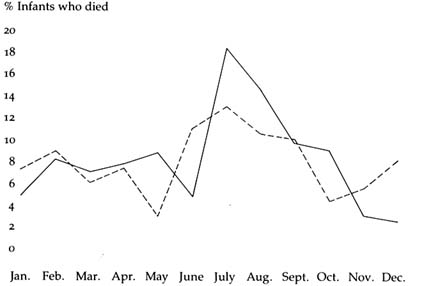
Dotted line represents infant deaths from cohort married 1816–1825.
Solid line represents infant deaths from cohort married 1861–1866.
number of births, but this concentration may simply have resulted from that fact that larger families had a greater statistical probability of suffering more deaths.[26]
Significantly, as Table 20 indicates, later-born children ran greater chances of early death, perhaps because their arrival stretched family resources beyond the threshold necessary for survival. We must keep in mind, however, that a number of infants died outside Saint Chamond, leaving no clue to their birth order. Evidence regarding which children parents sent to wet nurses is lacking, but it would seem logical that they sent the earlier-born more frequently than the later-born, since older siblings could bottle-feed their younger brothers and sisters. If children in earlier ranks did go to wet nurses more frequently, this practice would have artificially lowered their mortality rates, since a larger portion of their deaths would have gone unrecorded in Saint Chamond. Breaking down mortality by birth rank, as in Table 20, in fact suggests that earlier-born
| ||||||||||||||||||||
children may have been sent to wet nurses more readily, since rates in the later birth ranks approach those more typical of other industrial cities.
Infant ill-health and deaths in and around Saint Chamond caused deep consternation among middle-class observers. In 1872, one Dr. Fredet formed a "Société Protectrice de l'Enfance" modeled on similar societies in Paris and Lyon. Its purpose was to encourage maternal nursing among working-class women, to prevent premature weaning, to regulate wet-nursing, and to protect children from the negligence of wet nurses. The society was short-lived and never functioned effectively because "it was welcomed by the population with indifference," no doubt reflecting the impossibility of resolving the conflict between wage earning and infant care.[27] The problem remained an acute one as late as 1907, when the Union of Mutual Aid Societies in the Loire blamed working-class women for 75 percent of all infant deaths. "Rather than quit their jobs," mothers either sent their infants to wet nurses or made them "the victims of poor feeding and … deprivation of mother's milk. The dangers of bottle-feeding are … the worst during the first months of life."[28] But while these reports legitimately linked work outside the household, wet-nursing, artificial feeding, and infant mortality, a middle-class perspective prevented their authors from making a distinction between symptoms and causes. They did not understand, nor would they have accepted, that women simply continued to do what they had in the past—contribute to the family economy—only this contribution took a more exacting toll than it had in the context of domestic industries such as ribbon production.
Beyond feeding practices, we need not look far for the causes of infant mortality. With stillbirths included, nearly 58.5 percent of infant deaths recorded in Saint Chamond from the second cohort
were endogenous, that is, they occurred within the first month of life, which suggests that they resulted from the mother's poor health or complications from pregnancy. Endogenous deaths among these infants remained high at a time when they were declining in France; from 1855 to 1913, they declined nationwide from 50 percent to 21 percent.[29] Maternal mortality—the number of mothers who died within a month after the birth of a child—more than doubled in Saint Chamond through the nineteenth century, rising from 7.4 maternal deaths per 1,000 births to 16.2.[30]
A number of factors new to Saint Chamond between 1850 and 1890 contributed to the poor health of its population. Close to half of the women who married after 1860 worked in braid production. Although women only supervised looms or performed other supposedly effortless tasks, attendance to braid-making, reeling, and spinning machines required that workers stand for at least four hours at a time with no break; until 1869, braid workers in the Oriol and Alamagny factory worked for twelve hours with no break and ate their meals while standing up and supervising looms. In 1878 workers complained of a thirteen-and-one-half-hour day with no rest or interruption.[31] Particularly when combined with poor nutrition, this work was harmful for pregnant women who, if they followed the same practice as their counterparts in other textile cities, worked until shortly before giving birth and often returned to work soon afterward.[32]
The work shifts in braid factories, moreover, always included night work. When employers changed the length of the workday, they eliminated the hours from midnight to 4 A.M. , but many women, especially married women, continued to work during the night hours. Wages for night work were somewhat higher and, more important, the night shifts made it easier for married women to coordinate wage earning with household responsibilities. Legislation barring women under age twenty-one from night work also inadvertently forced more married women into these shifts. A report on the effects of night work based on workers' testimonies indicated that it caused fatigue, headaches, eye strain, and, because it made workers lose their appetites, serious nutritional problems. One twenty-five-year-old woman had to stop working because she could no longer eat. The author of this report stated that the effects of night work came on very gradually but concluded that it "causes
serious problems with nutrition," resulting in "a weakening of the race."[33] In 1886, 415 workers signed seven petitions requesting an end to night work because it was "very demanding, very toilsome, it hinders the development of their physical forces, impairs their vision and does considerable harm to their overall health."[34]
The large proportion of endogenous infant deaths, the rise in maternal mortality, and the high rates of infant and child mortality bear testimony to the more brutal conditions industrialization brought to these workers' lives. Though records in the état civil do not list causes of death, the description of women's work conditions suggests that they contributed to a decline in health. Hygiene reports generated by middle-class observers were not the only source to link women's industrial work with their poor health and infant mortality. In this same period, working-class women and men throughout the industrial centers of France themselves complained bitterly that industrial work ruined women's health, that it caused increased miscarriages and stillbirths, and that their infants were dying because mothers could not breast-feed them.[35]
Mothers, infants, and children were not the only victims of industrialization. Adults of both sexes in the second cohort died earlier than those who married between 1816 and 1825. Among the latter, 8.7 percent of all first marriages ended before the tenth anniversary; 14.5 percent of those celebrated between 1861 and 1866 ended that early.[36] Other ailments associated with industrializing and urbanizing society—hazardous work conditions, pollution, and diseases such as tuberculosis—further debilitated workers and contributed to their mortality.
The issue of hazardous work conditions merits attention because so often a relatively high pay rate among skilled workers is taken to suggest that standards of living rose with industrialization. Dye-workers, for example, frequently became afflicted with stomach ailments, convulsive coughing, and spitting up blood as a result of breathing the sulfuric acid gas used for dyes. Many of the dye-works in Saint Chamond specialized in dyeing silk black, the process that required the largest number of chemical substances. Direct contact with chemical solutions also ate away at the skin, injured cuticles, and dried up nails.[37]
Metal production took place in an even more hazardous environment; its accident rate ranked among the highest of all occupations
in France.[38] Working with masses of molten iron and steel and using machinery that weighed up to 12,000 tons necessitated a high level of organization, discipline, coordination, and alertness. Operation of the steam hammer, for example, required that forty workers act as a single man. A few seconds' lapse of attention could and did cause fatal accidents and major catastrophes.[39] More minor mishaps occurred regularly. A glance at hospital records in the 1860s rivets attention on the influence of industrial accidents: burns, abscesses, fractures, dislocations, and amputations filled the "surgical category." In 1864, 104 men entered the hospital to be treated for injuries resulting from accidents. This category accounted for more than 25 percent of the male patients.[40]
Outside their places of work, the working-class population of Saint Chamond risked illness on the streets and inside their homes from conditions typical of all rapidly growing and industrializing cities. As migrants poured into the valley after 1850, rents rose and lodgings frequently became overcrowded. Inspectors had noted the problem by the late 1850s: "ground floors [of houses] are true cesspools … insufficient air and light penetrate rooms. Almost every staircase is indescribably filthy and poisoned by [the] stench of cesspools with which they are always in direct communication: hallways have neither tiles nor boards, and their [dirt floors] are soaked with rain and household waters filled with debris of all kinds that [residents] throw out."[41] Their valley setting made lodgings extremely damp: waters drained from the hillside and accumulated on the ground floors. The wetness and humidity exacerbated the rheumatism that so often crippled workers. Overcrowding further aggravated problems of filth and dampness. One investigator discovered a room in which each tenant had four cubic meters of air instead of the legally required twelve to fourteen. These conditions fostered the spread of tuberculosis and other contagious diseases.[42]
Industrial pollution also threatened workers' health. As early as 1841, inhabitants complained of black smoke from the coal and steam engines that permeated the city. They claimed it inhibited the growth of vegetation and caused "serious illness" in people.[43] The amount of smoke increased with the growth of the braid industry and metallurgy through the 1860s and 1870s. So too did another type of pollution. The number of dyeworks in the city increased
as a result of the braid industry's growth. Dependent on water for washing silks, cottons, and other textiles, dyeworks by 1865 stretched along the riverbanks of the Gier for a distance of two kilometers. The river became a receptacle for dye solution wastes: pewter salts, iron sulfate, and sulfuric acid poisoned its waters. An engineer's report expressed fear that the water feeding the entire city would soon be poisoned. As middle- and upper-class residents of the city had access to public baths and washhouses, this pollution affected the working class most immediately. The report stressed that "the dyeworks industry … has for the working class intolerable inconveniences, to the point of making it almost impossible to do their laundry and satisfy the most urgent needs of domestic life."[44] Mayor Jules Duclos expressed sympathy for the material conditions workers suffered when he wrote to the prefect in 1865 of their special burden: "Having fewer clothes and jobs that soil their clothes, they have more need to wash." Washing became impossible during the day; workers had to wait until nightfall, after some of the chemicals had washed away, to use the river.[45] Elsewhere, use of similarly polluted waters was thought to have effects far more serious than laundry problems. A medical report in 1877 attributed infant deaths in Condrieu, along the Rhône River, to chemical pollution.[46]
Between 1867 and 1876, the quantity of textiles processed through the Saint Chamond dyeworks multiplied fifteen to sixteen times as more extensive mechanization increased braid production. The water of the Gier was compared with that of the Seine and the Thames, having been transformed into a main sewer. The construction of a dam, completed in 1870, was meant to improve the situation, and the municipality backed off. But unfortunately the new dam made little difference. The river had become so polluted by 1879 that the inhabitants of Saint-Julien-en-Jarrez, the commune just downriver from Saint Chamond, complained they could no longer use the water even for their meadows or animals.[47]
An engineer's report in 1884 admitted that during periods of good business a single dyeworks could dump as much as 1,000 kilograms of chemical substances into the river per day. In this year of economic crisis, the dye industry as a whole dumped 11,000 kilograms of chemicals daily—a quantity well below that of normal times. But the report pointed out that other industries polluted the
river as well. Manufacturers of pointes dumped sulfuric acid in the river. In addition, twenty washhouses discharged soap, and three manufacturers of gallic acid sent their wash waters into the river. Mines contributed their share of the pollution with acid water. In addition to industrial pollutants, the engineer reminded his readers, raw sewage from Saint Chamond, Izieux, Saint Julien, and Rive-de-Gier also found its way to the river. Amazingly, he concluded that chemicals from the dyeworks operated as disinfectants and actually helped purify the water.[48]
The effects of occupational hazards, poor housing, and industrial pollutants were reflected in Saint Chamond's hospital records. In the second half of the nineteenth century, 500 to 600 men, women, and children entered the hospital annually. Diseases listed in the records do not perfectly reflect their incidence in the community, but they do provide a sense of what ailed the Saint-Chamonais. Bronchial and pulmonary catarrh and phthisis—which the medical profession later learned to recognize as stages of tuberculosis—as well as recognized consumption accounted for nearly one-third of the adult diseases. Typhoid and rheumatism also numbered among the most common illnesses. Other serious ailments that struck the Saint-Chamonais did not always send them to the hospital. One doctor commented that the most frequent afflictions in Saint Chamond were contagious eye infections—scrophulous ophthalmia—from which children as well as adults suffered.[49]
Industrial, urban conditions and hospital records offer only an indirect and imperfect explanation for the mortality rates in Saint Chamond. Rates alone, however, complete the demographic profile of Saint Chamond's workers and, sad to say, demonstrate that middle-class values such as a new devotion to motherhood and "modern" concerns for the health and well-being of women or a decline in infant and child mortality could not have been responsible for the pronounced decline in family size.
Mortality rates also further enhance our understanding of fertility, for they suggest that breast-feeding—a factor that not only would have helped lengthen birth intervals but would have preserved infant health—was not widely practiced. Indeed, birth intervals lengthened in the second half of the century despite continued high infant mortality; infant deaths in a traditional population
would have caused shorter birth intervals. Although mortality concentrated in families with higher fertility, infant and child death pervaded family life in Saint Chamond: more than one out of every two families (52 percent) suffered at least one child's death.[50]
Fertility and mortality patterns in this cohort point clearly to the large number of couples who did not "replace" infants and children who died or who "replaced" them very slowly. Antoine Marie R. and Margaret C. had a third child only three years after their first two had died. Marie P., married to a metal worker, waited five years before giving birth to her third child after the second had died at the age of fourteen months. Others simply stopped having children despite child deaths and small family size. Françoise G. and shoemaker Jean Baptiste L. had only one child who survived to adulthood. Their second child was stillborn and the third died at ten months. Though Françoise was only twenty-eight when their last child died, she had no more pregnancies.[51]
Given the relatively low rates of fertility and high rates of infant death, women clearly used artificial means to space births or try to stop them. But decline in family size did not result from contraceptive efforts alone. Recent studies have argued convincingly that women in the second half of the nineteenth century resorted far more frequently to abortion than has previously been suspected. Married working-class women, moreover, may have been most responsible for the increase. But since it was criminal and therefore practiced surreptitiously, the extent of abortion as a form of limiting family size remains largely undocumented. A recent study of crime during the nineteenth century in the arrondissement of Saint Etienne suggests that the urban proletariat frequently resorted to abortion, but the guilty knew how to hide their crime. One known case occurred in Saint Chamond: in 1861, a widow died in the hospice from an abortion performed, using poultry feathers, by a forty-one-year-old silk reeler, mother of four, born and residing in Saint Chamond. Other Saint-Chamonaises no doubt went to Lyon, a relatively easy train ride, to have their pregnancies terminated. This city reportedly had 10,000 abortions to 9,000 births in 1906.[52]
In his study of working-class fertility in France, Angus McLaren has made several observations about the absence of abortion as a consideration in demographic history, as well as the role it played in working-class women's lives. In addition to the fact that the
prevalence of abortion cannot be measured, historians may have ignored it because it assigns to women the initiative for fertility control. McLaren argues, first, that the apparently increased incidence of abortion suggests that in fact fertility decline among the working classes resulted from female rather than male motivation.[53]
Second, McLaren links abortion to specific conditions in urban industrial society and particularly to the nature of women's work. More women in cities worked outside the home. The option for abortion derived from the same mentality as did the option of sending infants to wet nurses: pregnancy threatened to deprive the family of the woman's income. McLaren notes: "It is likely that those working-class husbands who supported their wives' decision to abort did so for the same reason they accepted the putting out of their babies to nurse in the country—so as not to lose the wife's contribution to the family income or her participation in the small family enterprise so characteristic of French capitalism."[54] Factory work also provided a network for information about the means to terminate pregnancies. It is quite likely that many women resorted to abortion with neither the support nor the knowledge of their husbands.
The apparent frequency with which working-class women, particularly in an urban industrial context, resorted to abortion leads to a reassessment of family limitation in Saint Chamond. Terminated pregnancies would have had a statistical impact on measures of fertility control, for they would have lengthened the intervals between births. Nor, unfortunately, can we dismiss the practice of infanticide. The Ministry of Justice noted and deplored a sharp rise in infanticides between 1855 and 1860.[55] Abbé Cetty cited twenty-two infanticides in Alsace-Lorraine. He also referred to a report published in England in the late 1870s stating that many infants declared as stillborn had actually been slain.[56] Similarly, a medical report to the French Ministry of the Interior in 1877 noted an alarming rate of one "stillbirth" out of every seven illegitimate births in Marseille and suggested that one cause for these deaths was infanticide.[57]
The pervasiveness of death and illness in Saint Chamond would make it foolish to assume that smaller family size resulted from voluntary control alone. Increased numbers of stillbirths, miscarriages, and temporary sterility also prolonged the intervals between
births. Poor diet and overcrowded and unsanitary housing that spread diseases such as tuberculosis caused chronic ill health in parents and children.[58] Stress, fatigue, and conflicting work schedules interfered with conjugal relations. A report on night work in another city applies to many Saint-Chamonaises. It describes the life of a plasterer and his wife. The couple had only one child, and the wife specifically requested night work in order to be able to care for him. Her husband would return home from work after his wife left for the factory. "She literally sees [her husband] only on Sunday, and from Sunday to Monday," the report states.[59] To attribute low fertility in Saint Chamond to the effects of night work would be extreme, but it surely did interfere with conjugal relations among a large number of workers. Metal workers, it must be recalled, also worked at night and alternated day and night shifts every two weeks. The work both women and men performed depleted their energy. In seeking reasons to explain overall population decline in France, one medical report cited "weakness of constitution" among couples resulting from their life-style, as well as the "genital inertia" that derived from it.[60]
The demographic profile of Saint Chamond provides two contradictory images of the working-class family. On the one hand, a logical family formation strategy of voluntary fertility control—whether through coitus interruptus, abstinence, or abortion—enabled the working class, and particularly working-class women, to cope with the new organization of work which had decidedly usurped from them a degree of power they had once exercised. Important here was not just the space in which they performed work, but the regulation of its hours. The introduction of inanimate sources of energy clinched the separation of work and family, home and factory, for which proto-industry had set the stage. To regain some control over their lives, workers adjusted their family strategies. Since children could earn wages only after some years of dependency and their care interfered with the mother's ability to contribute to the family income, fewer children posed less of a relative burden. These workers did not simply try to stop having children after their families had reached some sort of "target size." They also had children far more slowly than had workers in the past.
On the other hand, these workers' demographic profile also
presents quite an opposite image. Work schedules interfered with conjugal relations and proper feeding practices, poor diets and disease inhibited fertility and caused infant and child deaths, and early adult deaths put an abrupt end to family formation. This profile hardly affords an image of more freedom or control in family life. Among these workers, low fertility was involuntary. Small families in Saint Chamond resulted from some couples consciously limiting births, as well as from other couples suffering ill health—and some may have fitted into both categories. In any case, having smaller families preceded having healthier children.
Not all couples who married between 1861 and 1866 exhibited control over their lives by having fewer children. Some had very large families. Just as in the first cohort, certain individuals in the second did not show any sign of pursuing a strategy of family limitation. But male occupations had no apparent influence on family size. Nothing about occupation per se motivated these workers to have large families, nor did it motivate them to have small families, as it had for ribbon weavers. Family formation ceased having anything to do with occupation. Workers in Saint Chamond, and no doubt in other industrial cities as well, began to produce fewer children as a response to an environment that threatened the survival of their families. In this respect the way their pattern of family formation differed from that of ribbon weavers has particular significance: rather than limiting births after attaining a certain family size later in marriage, metal workers and their wives hesitated to have children even at the outset of the marriage.
For most workers in Saint Chamond, restrictions on children's labor and the competition between household responsibilities and employment for women outside the household provided sufficient motivation to delay having children or to have them more slowly. The disruption of the family wage economy, rather than the desire to consume more goods or to preserve a way of life centered on the relationship between family and work, drove couples to have fewer children in whatever manner they could. A key element in this behavioral change was the transformation of female and child labor. The economy in Saint Chamond had depended on the nimble fingers of women and children since the introduction of silk milling in the sixteenth century. Although child labor came to be restricted in the second half of the nineteenth century, the braid industry was
built upon female labor and continued to depend upon it. The role of women's labor in the local economy no doubt helped prevent most male wages from becoming "family wages." At the same time, mechanization changed the relationship between women's labor and family life. Women in the second half of the century experienced greater difficulty earning wages inside or outside the home, and they had to cope with the absence of their husbands from the household. Smaller family size, whether it was due to deliberate effort or to ill health and death, reflected an adjustment to the new relationship between family and work.
Testimony from worker congresses in the 1870s and later indicates that industrialization had similar effects in other working-class communities, and it required some form of family adjustment. Beyond male occupations, numerous factors contributed to the logic of a family economy and family formation strategies, or lack thereof, among workers: most important, perhaps, is the nature of a local economy and the specific ways men's and women's work complemented or competed with family life. The effects of mechanization in Saint Chamond were particularly intense because in addition to eliminating most domestic industry, mechanization simultaneously transformed two major sectors, textiles and metal, and thus restructured the work of men, women, and children all at once. Finally, this examination of urban demography, in support of others that have preceded it, suggests that beyond work, less tangible factors associated with urban living—such as miserable living conditions and disease—discouraged large families. Just as with the first cohort, the logic of any strategy could become useless in the face of death, disease, and economic fluctuations—experiences far more familiar to industrial workers after 1860 than to their proto-industrial predecessors.