
4
Knowledge, Power, and Personal Misfortune
'Ala'u'd-din [the Sultan of Melaka from about 1477 to 1488] died in the prime of life, probably before the age of thirty, and it was soon rumoured among his subjects that he had been poisoned. This was the normal assumption in the Malay world when a man died young. The pious might say that an allotted span in the Book of Life had been rubbed out, but the common man tended to be more concerned with the instrument of fate, and in the absence of keris or spear, could only assume poison.
Paul Wheatley, Impressions of the Malay Peninsula in Ancient Times (1964)
A person entering a Malay house is generally presented with a green cocoa-nut and a little coarse sugar.... The young cocoa-nut is opened with the ever ready parang , always in the presence of the person to whom it is offered, to ensure its juice not having been poisoned or charmed.
T. J. Newbold, Political and Statistical Accounts of the British Settlements in the Straits of Malacca (1839)
A Kedah lady the other day, eulogising the advantage of possessing a familiar spirit [pelisit ], ... said that amongst other things it gave her absolute control over her husband and the power of annoying people who offended her... . One is not surprised to hear that everyone in Kedah, who is anybody, keeps a pel[i]sit .
Sir Frank Swettenham, Malay Sketches (1895)
The native of the [Malay] Peninsula believes that an esoteric knowledge of the origin of any being gives the possessor of that knowledge an extraordinary power. A sorcerer who wishes to force some man or woman to do his will has only to refer to the mysterious elements which go to make up the human embryo; if he wishes to control a demon, he alludes to the theory of its generation from the placenta and other concomitants of childbirth.... [More generally,] special forms of knowledge give supernatural power.... Knowledge is in itself a power since it enables man to avail himself of the forces of nature or of the unseen world.
R. J. Wilkinson, Malay Beliefs (1906)
Ilmu is a central concept in Malay culture that refers to knowledge, especially esoteric or systematic knowledge, science, higher education, and intelligence. The term is most commonly used to denote esoteric religious knowledge concerning the manipulation of spirits and the unseen forces of the natural world. This chapter deals with the distribution of ilmu in local society, its acquisition, the uses to which it is put, and some of the ways one goes about counteracting the ilmu of those bent on causing one harm. The larger issues include: the gendered dimensions of ilmu ; the relationship in local culture between knowledge and power; how knowledge and power figure in accounts of personal misfortune; and recent historical changes in the sources and meanings of marginality, uncertainty, and danger, particularly as they relate to gender. The case studies presented in the latter sections of the chapter also help illustrate my more general arguments that femininity and masculinity can only be understood if they are viewed in relation to one another; that cultural knowledge is contextually grounded and deeply perspectival; and that our ethnographic descriptions and interpretations must therefore attend both to polyvocality and to the political economy of contested symbols and meanings.
Knowledge and Power
The possession of ilmu is a virtue (though it is sometimes used in unvirtuous ways), and can in fact be seen as a sort of summarizing virtue or "metavirtue" in the system of moral evaluation as a whole. As might be expected, ilmu is concentrated among ritual specialists and religious teachers, but it is also widely distributed throughout society. In its concentrated forms, it occurs most commonly among men, for the majority of ritual experts (e.g., healers and shamanic specialists)—and all local and itinerant Islamic teachers—are men. In Bogang, for example, there were ten male healers and shamanic specialists in 1980, but only one woman. That a woman became a healer, and a very successful one at that, is not so much a violation of a largely implicit conceptual linkage between males and ilmu (and the strong semangat , or "life force," with which both are associated), as testimony to her having "beaten the odds," to borrow the phrase Atkinson (1990:83) employs to describe a similar situation among the Wana of eastern Indonesia.
I have noted that ilmu is also widely distributed throughout local society. Indeed, most men and women over sixty years of age seem to know a bit of ilmu , which they have acquired either through study or medita-
tion with a knowledgeable elder, or through dreaming, illness, or trance. This broad relatively ungendered distribution of elementary forms of ilmu serves to deemphasize the conceptual link between ilmu and maleness (and strong semangat ). So, too, does the fact that men and women alike deploy ilmu against both same-sex and cross-sex individuals toward whom they harbor envy, jealousy, or malice.
The deployment of ilmu outside of—and even within—healing rituals is not an easy subject to investigate, for villagers tend not to talk openly or casually about ilmu (to do so is, among other things, not only dangerous but also a sign that one does not really have [much of] it). And villagers are understandably sensitive to the charges of extralocal reformers that many local forms of ilmu are not grounded in the Koran or other religious texts and are therefore "survivals of pre-Islamic days of ignorance"[1] —the traffic in which is gravely sinful. There are, moreover, deep-rooted and pervasive concerns that those who possess ilmu can and frequently do use it not only in socially acceptable ways (to cure illness, to find lost or stolen money or other objects, to help mend strained relations), but also in socially unacceptable ways (to cause illness or death, to make money or other valuables disappear, to engender alienation between spouses and others). As I discuss later on, many of these ambivalences about ilmu are, at base, ambivalences about human nature and the local system of social relations. Social constraints on the public airing of such ambivalent sentiments serve as a further constraint on the open or casual discussion of ilmu .
In private conversations, people in Bogang are quick to point to kinsmen, neighbors, and other community residents who use ilmu to gain control of the affections and loyalties of—or otherwise influence—fellow villagers; but direct accusations of the use of ilmu in socially unacceptable ways are extremely rare (and, as I discuss in a moment, villagers do not usually acknowledge that they themselves have ever used ilmu in non-therapeutic settings, let alone socially unacceptable ways). A few examples of the use of ilmu in non-therapeutic contexts will be useful here, particularly since they will help convey a sense of the local social landscape.
Haji Baharuddin, a wealthy pensioner (former school teacher and headmaster) who is widely despised, has run up enormous debts throughout the village and beyond. Though he is not a ritual specialist, he is widely assumed to use ilmu to get people to lend him money and/or extend his credit, and to keep his creditors at bay. That he is always in need of pocket money is also partly a function of ilmu , for, as I was told on many occasions, his wife (not a ritual specialist) relied on ilmu to help make sure
that he turned over his monthly pension to her as soon as it arrived at the local post office. (She also accompanied him to the post office to help guarantee that her will prevailed.)
Lebai Ismail, another male elder, is an extremely successful entrepreneur and a local "big man" (orang besar ) in the dual sense of being able to "get things done" and enjoying many followers who will do his political and other bidding for him. He is the de facto leader of the opposition party (PAS), and also heads the lineage (perut tengah ) which has been at odds with the wealthiest and most prestigious lineage in the village (perut darat ) for quite some time. His successes in attracting and retaining loyal followers are due to his being pandai cakap , literally, "clever at talking/ speaking," which, in turn, is a function of his knowledge and deployment of ilmu .
Datuk (Haji) Latiff was, until his death in 1981, one of Bogang's oldest and most feared dukun . He was widely believed to be responsible for the mystically induced death of Kakak Z's young child. He caused the child's death, it was said, because he was incensed that his request for some of the bananas that one of the child's male relatives carried by his house one day was rejected or simply ignored.
Mak Shamsiah and Maimunah have been subject to spirit possession for decades now. Possession by spirits is due, in Mak Shamsiah's case (at least in the official household and lineage version of her illness) to the ilmu of an amorous dukun whose advances to her she quickly rebuffed; it is due in Maimunah's case to the use of ilmu on the part of a man (not a ritual specialist) she ran out on in the midst of their wedding. Maimunah's mother, for her part, relies on ilmu "all the time" to help find a mate for Maimunah, and most certainly did so (so I was told) as part of her overall strategy to get me to marry her (see chap. 1).
Though most villagers disavow the use of ilmu in non-therapeutic settings, some villagers do acknowledge the deployment of ilmu in such contexts. Thus Mak Lang told me that she used ilmu on her husband to help make sure that he would always find her attractive and remain faithful to her. And she confided that she brought ilmu to bear on her grandson to help ensure that he would study diligently and do well in school. (In the former instance she was successful; not so in the latter.) Such admissions, though rare, are significant, for men and women alike contend that women are more inclined than men to use ilmu pengasih , which is often translated as "love magic" but is more appropriately glossed "affection magic." Women's greater reliance on such magic may be due to their greater insecurity in conjugal and other relationships, though as Lambek
(1988:725) has argued for the somewhat similar situation in Mayotte (Comoro Islands), it is more likely a function of their more pronounced concerns with "maintaining peace and order" within their households and kin groups, "articulating social relations," and "looking after reproduction in both the social and biological senses."
Fears and anxieties relating to being victimized by ilmu , and by poisoning and spirit possession more generally, seem to be more or less equally distributed among men and women (though this is difficult to gauge with any degree of precision). So, too, are real and imagined illnesses brought about by manipulation of ilmu . These points merit emphasis since much of the recent literature concerning mystical attacks among Malays (e.g., Kessler 1977; Ong 1987, 1988, 1990a) focuses on the prevalence of women as victims of highly dramatic forms of spirit possession and effectively glosses over or ignores the prevalence of men as victims of poisoning and sorcery that do not involve possession by spirits taking control of their hosts in dramatic episodes of hysteria. This focus on women's afflictions to the relative exclusion of men's leads to an unjustifiably dichotomized treatment of the roles and meanings of male and female both in "traditional" Malay culture and in the rapidly changing world of contemporary Malaysia. When one examines the major varieties of mystical attack, and not just spirit possession, one gets a more complete picture of Malay understandings and representations of gender, and of marginality, uncertainty, and danger, one that differs in important ways from those in the literature. I will return to this point later on.
Just as men and women are affected by the malevolent uses of ilmu in different ways—with men more likely to experience slow wasting away, and women highly dramatic forms of spirit possession—so, too, is there gender-based variation both in modes of acquisition of ilmu , and in its deployment in healing rituals. This will be clear from a brief comparison between Pak Daud, my father, and Mak Ijah, Bogang's only female healer.
Pak Daud and Mak Ijah
Pak Daud is a renowned healer specializing in treating victims of poisoning and sorcery who was fifty-six years old when I first met him (1978). He began curing people around 1946, which is when he moved to Bogang and took up residence with his new bride (a cross-cousin, to whom he is still married), and he served as the village headman (ketua kampung ) from 1962 to 1987. Pak Daud treated victims of poisoning and sorcery—the majority of whom were male—on almost every night of the more
than sixteen months that I spent in Bogang during my first period of research, and I had the good fortune of being able to observe many of the healing rituals he performed.
I have commented on Pak Daud's curing sessions elsewhere (Peletz 1988a, 1993a [see also below]), and will simply note here that they are rather matter-of-fact and thoroughly undramatic; for example, unlike Mak Ijah, he does not light candles or burn incense, don special attire, or go into trance during the rites he performs. The ilmu Pak Daud deploys in such sessions derives in large part from his father and his father-in-law, both of whom were ritual specialists in their own right. More generally, Pak Daud's apprenticeship entailed lengthy periods of fasting and prayer, submission to numerous food and other prohibitions, and battling with spirits over whom he was learning to gain a measure of control. In the course of his apprenticeship, Pak Daud refined his powers of concentration and prayer, and otherwise developed control over his inner self, the latter being a goal of all dukun , and to a lesser extent of all other Malays as well (cf. Anderson 1972:8–13).
Compared to most other villagers, Pak Daud spends a good deal of time in the forest—hunting game animals of various kinds and harvesting petai and other forest products—and is thus associated in many villagers' eyes both with the forest (and the malevolent spirits who live there) and with the forest-dwelling aborigines, who are believed to have extremely dangerous (partly because non-Islamic) forms of ilmu . This conceptual link enhances villagers' views of his ilmu , as does the fact that Pak Daud was forcibly taken to Thailand by the Japanese during their occupation of the Peninsula from 1942 to 1945, and is believed by some villagers to have acquired at least some of his ilmu from his journeys among Thais and others living north of the Malaysian-Thai border.
The majority of Pak Daud's patients are from other villages (as are most of Mak Ijah's), but this is a common pattern both in Bogang and elsewhere in Negeri Sembilan (Swift 1965:164), and among Javanese (Geertz 1960:90) and others. As Obeyesekere (1969:180) suggests, it is probably related to the fact that it "facilitates the performance of the priest role by creating a social distance between priest and audience."
Pak Daud is an extremely charismatic individual, but he seldom speaks and is in this regard quintessentially male. Partly because of his taciturn nature, I was less successful than I would have liked in getting him to talk about ilmu and healing rituals, and about most other things. Some of his reluctance to talk about ilmu and healing rituals was no doubt related to his concern that I might share his secrets with others, for as another of
Bogang's dukun once told me, "This ilmu is my capital (modal ), and I can't afford to spread it around and lose it." Perhaps more relevant, though, is that to talk casually or excessively about ilmu —either one's own or someone else's—is a sign that one lacks ilmu . More generally, in many contexts talking indexes a lack of rationality (akal ), and since most men, particularly the ritual specialists among them, go to great lengths to assert their rationality (though obviously not always successfully), they do not usually talk much about ilmu —or anything else of substance.
In this connection, Siegel's (1978:20–21) observations concerning the culturally similar Acehnese are especially interesting:
Men seldom speak. This is not because they value silence, but because they think they should speak only when they have something of significance to say. Their speech expresses their rationality; it must therefore be substantive. The result is that it is usually portentous in tone but banal or absurd in content. Limiting oneself to saying only what is so limits one to the obvious or nearly obvious. Conversations with men tend to be confined to subjects such as what bus passed by, prices of various commodities, and other matters of fact. When they speak to their wives men are freed from the constraints of experience, which does nothing to lighten their tone but rather allows them to utter an order for duck for dinner or to have a child washed up and make it sound highly important.
Women, on the other hand, chatter continuously. Their activities are always filled with sounds,' illustrating the [Malay-] Indonesian concept of ramai —or noise-making activity. What they say is occasionally outrageous, but they feel, nonetheless, that they can say anything. Unlike men, they feel no constraint to be rational, but neither do they conceive of themselves as irrational. Rather their speech to them has authority which comes from a different source. In their struggle with their husbands they win not simply by subverting men's belief in themselves as rational, but by feeling no hesitation to speak. It is my contention that they find a source analogous to the Koran for the resultant authoritative tone in curing rites and dreams.
The situation described (and clearly oversimplified) for Aceh differs in some important ways from that of Negeri Sembilan—for example, in Aceh all healers are women, whereas in Negeri Sembilan and among Malays generally, most are men; and Acehnese women's culturally elaborated concerns with dreaming have no Malay counterpart. Even so, Siegel's observations help us understand some of the differences between Pak Daud and Mak Ijah (aged sixty-seven), who is Bogang's only female healer, and between (Malay) men and women generally.[2]
Mak Ijah is the granddaughter of a Chinese woman who was born in Singapore and adopted while quite young by the nineteenth-century Hill
lineage luminary who became Undang . Mak Ijah has been married five times and lives in a house set off from all others in the village. Her parents and collateral ascendants are all dead, and she has neither siblings nor any natural children. For these and other reasons, Mak Ijah views herself as having no kin either within the village or outside. In this regard she is extremely atypical; all the more so since she adopted a former neighbor's daughter and reared her as her own for a number of years.
Unlike Pak Daud, Mak Ijah is ver-y expressive and dramatic, extremely high-strung, and quite marginal in the community. And although she is a very successful dukun who is able to cure, as she put it, "everything from injured bones to spirit possession except diabetes, high blood pressure, and heart disease," she is viewed with considerable ambivalence and skepticism by many members of the community. There are at least three reasons for this. First, unlike most (if not all) other healers in Bogang, Mak Ijah goes into trance (terun-menerun ) in the course of her healing rituals. Trance states brought about by spirit possession were long regarded—and to some extent still are—as legitimate sources of authority, much like dreams; but like dreams, they have come to be increasingly delegitimized as authoritative sources for speech and other behavior due to religious and other (e.g., political) changes of the past century that have encouraged the rationalization of village religion, and in particular the demise of most forms of shamanism and spirit cults. All things—and people—associated with trance states, shamanism, and spirit cults are thus viewed by villagers with ever increasing ambivalence and skepticism.
Second, Mak Ijah financed her pilgrimage to Mecca with money obtained from patients, whom she is widely believed to have exploited. Though concerns that dukun exploit their patients are widespread, they are especially pronounced when dukun appear to profit handsomely from the ritual services they provide (as Mak Ijah has done).
The third reason Mak Ijah is viewed with much ambivalence and skepticism is that she is anomalous since, as a female, she beat the odds by becoming a dukun . The anomaly lies not so much in the fact that females are not supposed to be ritual specialists or repositories of ilmu . For until quite recently, midwives, the vast majority of whom were female, drew upon ilmu in the course of delivering babies and providing both prenatal and postnatal care, and otherwise plied their trade widely.[3] (One of Bogang's last shamanic specialists [pawang ], moreover, was a female.) Rather it is that to become a dukun or a "big person" (orang besar ) of any sort presupposes the development and refinement of qualities such as rationality, which are most commonly realized in inner tranquillity/se-
renity and outward restraint, and which are more strongly associated (at least in official discourse) with males than with females. There is, moreover, the issue of leadership and dependency relations. Traditional leaders' efficacy and spiritual potency were gauged in no small measure by the number of supporters or retainers they could muster, and this is true of contemporary leaders as well. Those who have benefited from a dukun 's services are his/her anak ubat (literally, "medicine children," children through curing"), and in theory at least they are forever indebted to the dukun for restoring their health. The hierarchical/asymmetric component of this relationship is not particularly problematic when the leaders are men; but when they are women and have many male supporters, they are in certain respects out of keeping with the usual state of affairs. This is all the more true now that there are no more traditional midwives and no more female (or male) pawang .
Just as Mak Ijah is viewed with more ambivalence and skepticism than Pak Daud, so, too, did she acquire her ilmu in more dramatic fashion: she was chanting and fighting off delirium-inducing fever (and perhaps death itself) brought about by her adoptive daughter's attempt to murder her and her husband through sorcery. Mak Ijah's highly charged, near hysterical account of the circumstances leading up to this attack, and of the attack itself—which entailed the mystical injection of needles and stones into their bodies—and its outcome, would easily fill a book. Suffice it to say that her adoptive daughter was furious with her because Mak Ijah refused to agree to transfer some of her land to her, or simply enter the adoptive daughter's name on the back of the land grant so that the land would pass to her when Mak Ijah died. The incensed woman thus contacted both a locally resident Javanese man who (like all other Javanese) is believed to have dangerous forms of ilmu ("he has tattoos all over his arms," Mak Ijah confided in me) and local aborigines in the hope that they could provide her with ilmu to kill Mak Ijah and her husband. The fee for this service, Mak Ijah told me on a number of occasions, was well over M$700! "How could she do this to me when I raised her as my own for so many years?"
Mak Ijah is far more talkative than other dukun , and is in many respects a caricature of female styles of speech and comportment. She talked continuously, and at a feverish pitch; and much of what she said struck me—and my (male) research assistant—as outrageous.[4] She was, nonetheless, an excellent informant, for in our conversations she seemed altogether indifferent to status considerations and to whether or not she appeared rational. Moreover, both she and her husband (who was often
present when I spoke with her) were in my experience uncharacteristically forthcoming about the quality of social relations in the village and among Malays in general. In their view, fellow villagers (and most other Malays) know very little about Islam and are consumed by passions of greed, envy, and malice; these, along with obsessive concerns with face and honor, are responsible for the "treachery" (khianat ) that suffuses local social relations. Not surprisingly, Mak Ijah's husband would rather have his two acres of rubber trees go untapped than have them worked by someone who might possibly cheat him of his rightful share (50% of the tapper's yield), even though this results in the land lying unworked and hence in a substantially reduced household income. Summing up his experience with tenant tappers in metaphors of food and eating, he said "the [tenant] tapper gets all of the meat, while the owner is left with the sauce" (orang potong dapat daging, orang punya dapat kwa saja ). On another occasion he characterized his overall experiences with local reciprocity by saying "you give flowers and get shit in return" (kasih bungga, balas tahi ).
These sentiments, shared by Mak Ijah, highlight profound ambivalences concerning human nature and social relations. They also illustrate some of the ways in which breaches of the social order are cast in the imagery of food and eating. When speaking of adultery and of men involved in the offense of sororal polygyny, for example, villagers use expressions indicating that the offender "was given one but ate two" (diberi satu, makan dua ). Similarly, villagers liken the crime of incest to cannibalism insofar as they sometimes compare the behavior of individuals involved in incestuous unions with the habits of domesticated chickens who consume scraps of cooked food thrown to them at the end of meals, including the flesh/meat of other chickens with whom they share biogenetic substance (macam ayam makan daging sendiri ). We have seen, too, that in local mythology the primordial act of brother-sister incest was followed both by the brother lapping up the discharge that flowed from his sister's vagina as she gave birth, and by brother and sister alike being transformed into pelisit , which, as noted earlier, thrive off the blood they suck from pregnant and postpartum women as well as newborn children. Interestingly, the most detailed version of this myth that I encountered in the field came from Mak Ijah. Of perhaps greater interest is that the concerns realized in the myth (the inversion of proper kin relations, failed biological and social reproduction) are highly congruent with the themes accorded primacy in Mak Ijah's account of her relationship with her adoptive daughter and her acquisition of ilmu more generally.
A brief summary of some of the similarities and differences between Pak Daud and Mak Ijah may be useful here. First the similarities: Pak Daud and Mak Ijah are about the same age, and are associated (albeit in different ways: Pak Daud through marriage, Mak Ijah through adoption and satellite status) both with the same gentry clan (Lelahmaharaja) and with its wealthiest and most powerful and prestigious lineage (perut darat ). They treat many of the same forms of illness, and both of them acquired their ilmu as a result of association with same-sex kin.
As for the differences: Pak Daud acquired his ilmu through prayer, observance of food and other prohibitions, and meditation and study with elder kinsmen—all of which required active mastery of Koranic texts (the Word of God) as well as studied control and refinement of his various senses and inner being. Mak Ijah, in contrast, obtained her ilmu as a result of near fatal illness (including delirium-inducing fever), trance, and spirit possession brought on by a younger kinswomen's (her adoptive daughter's) attempt to murder her through sorcery—all of which entailed loss of control and lack of agency. Mak Ijah thus calls upon different sources to lend authority to her speech and comportment (trance, possession by spirits, rather than Koranic texts), invokes different intergenerational links in her account of how she acquired ilmu (links with the descending, rather than ascending, generation), and is, more generally, more attuned to the future (social and biological reproduction) than the past.
Differences in the quality of—and degree of elaboration concerning—the social relations directly or indirectly implicated in the acquisition of ilmu in the two cases are also quite striking: Pak Daud obviously had a high degree of rapport with the male elders from whom he acquired his ilmu , though, significantly, he did not comment on this; Mak Ijah's relation with her adoptive daughter, on the other hand, was both treacherous and the subject of extremely detailed, near hysterical elaboration. Some broad inferences can be drawn from these latter differences, but it would be erroneous to conclude that women's relationships are problematic whereas men's are not. The more accurate generalization is that, compared to men, women are more concerned with the tenor of social relations (e.g., maintaining peace and order) within their households and kin groups, and with looking after social and biological reproduction. (Men's moral concerns complement those of women and are, in any event, realized in different contexts. Note, for example, that Pak Daud is able to articulate his moral concerns in his roles as village headman and member of the various village councils that nowadays constitute the principal or-
gans of local government and administration.) Case studies presented in subsequent sections of the chapter illustrate how these concerns are realized in spirit possession and other forms of mystical attack.
Finally, a few comments concerning Mak Ijah and spirit possession among women generally. Mak Ijah's first experience with possession occurred when she was about thirty-five years of age. In this respect (as with many other features of her life) she is highly unusual, for most women who are subject to possession by spirits have their first experience with possession during their late teens or early twenties. This pattern seems always to have obtained. So, too, does the general principle that once a woman is possessed she tends to have recurring bouts of possession throughout her life: "Once possessed, always possessed," as Boddy (1989:177) puts it writing about possession among women in the Sudan. It is difficult to say with certainty why possession should first afflict women during their late teens or early twenties, but I suspect it is because this is when their sexuality and fertility are activated and publicly marked. These developments involve profoundly important psychological and social transformations which serve to impress upon young women both how central they are with respect to the honor, prestige, and reproduction of their households, kin groups, and society at large, and how threatening their activated sexualities, along with their bodily fluids and orifices, can be to themselves and others. The fact that the spirits that possess females are drawn to fertile women, and to their activated sexualities, bodily fluids, and orifices in particular, is also relevant here, as is the fact that many of these spirits are believed to be sent by male suitors, who as a group are altogether uninterested in prepubescent (and postmenopausal) females.[5]
The case studies presented below provide a closer look at spirit possession in Bogang. They suggest, among other things, that possession provides women with a morally authoritative source to express and dramatize their most pressing social concerns, and thus serves some of the same purposes as women's curing rites and dreaming among the Acehnese.
Spirit Possession Observed: The Case of Maimunah
It was a Friday (February 1979), shortly before noon, and I was participating in a small feast at Mak Rahmah's home. Just after the start of the meal there was a blood-curdling scream from next door. Everyone present seemed to recognize the scream as coming from Mak Rahmah's sister's daughter, Maimunah, who was about twenty-eight years old and worked as a secretary/clerk in a Chinese-run bus company whose offices were
located in a small town about eight miles from Bogang. From the very start, Mak Rahmah's son and Maimunah's elder (and only) brother—who had returned home on one of his rare visits—knew that Maimunah was experiencing kena hantu (spirit possession). Mak Rahmah and her sister (Maimunah's mother) rushed over to the house, as did most of the others. A few moments later I followed suit.
When I arrived, Maimunah was slouching in a chair in the front room, being restrained by her brother and Mak Rahmah's son. She was struggling with all of her might to be free of their hold, but to little avail; her eyes were glassy and her stare vacant, and she was sweating profusely and weeping as if in great pain. Amidst her sobs Maimunah told Mak Rahmah—whom she dislikes intensely—that she (Mak Rahmah) was sombong (arrogant, haughty, conceited, unresponsive to social expectations); Maimunah leveled a similar charge at her elder sister, who was also present. She went on to make a disparaging remark about Mak Rahmah having made the pilgrimage to Mecca, and complained about not having received some cakes she had wanted, which ended up going to someone else close at hand. Neither Mak Rahmah nor the sister seemed upset by these insulting remarks; they claimed it was not Maimunah speaking but the spirit (pelisit, hantu ) who had temporarily taken control of her.
While Maimunah continued groaning, weeping, and screaming, she was brought into the central room of the house by those who had come to her aid. The latter placed themselves around her and someone fetched some water to be used as the base of a home remedy. Small bits of chili, pepper, and red onion were mixed in with the water, which was then rubbed on her head, arms, feet, chest and legs. Incense was lit and the fumes were blown over her face. Maimunah's sister gathered some of the smoke in her cupped hands and placed her hands firmly over Maimunah's mouth, during which time Maimunah screamed and tried to escape with all her force. Mak Rahmah began reciting Koranic passages and blowing them over Maimunah's body as she rubbed the medicine she had prepared on Maimunah's temple and face, and on other parts of her body.
At this point and for the next ten or fifteen minutes, those present addressed the spirit and asked it how long it had been bothering Maimunah and why it was disturbing her. They screamed at the spirit and commanded it to return whence it had come, adding that it had no right to bother people there, that no one had disturbed it, and so on. This was met with a response, said to be from the spirit, that it had been there "for more than a month." Those present continued to shout at and insult the spirit, calling it stupid (bodoh ) and stubborn (degil ) for not leaving Mai-
munah alone. Maimunah, for her part, complained that her stomach and head hurt, and lapsed into fits of wailing and mournful crying; she was still sweating profusely and looking quite anguished. The reciting of Koranic passages continued for another ten or so minutes, during which time the others laughed at some of Maimunah's (the spirit's) comments, screamed at the spirit to leave Maimunah alone, and made small talk.
It was about this time that someone either asked Maimunah if she wanted the help of a dukun , or simply mentioned the name of Pak Daud. I am not certain what was said, but Maimunah (or the spirit) replied that she (it) was frightened of Pak Daud. It was then decided that someone should call Pak Daud to help her through the attack. Pak Daud, who was praying at the mosque, was summoned and soon appeared on the scene.
Pak Daud's arrival was greeted with little ceremony or exchange of information. This is partly because Pak Daud is closely related to Maimunah (he is her adoptive father and mother's sister's husband), and has treated Maimunah for spirit possession on many occasions. Pak Daud was informed that Maimunah was not conscious (tak sedar ), and he proceeded to recite largely inaudible incantations over a glass of water, which he gave Maimunah to drink. Maimunah drank the water without much difficulty and was later instructed not to eat meat of any variety. Since spirits of the sort afflicting her are thought to like meat, she could encourage the spirit's departure from her body by refraining from consuming its favorite foods.
Pak Daud's other major tack involved the use of a small, thin section of bamboo, about six or eight inches in length, which had a closed safety pin fastened at one end of it. Pak Daud placed the stick between Maimunah's fingers, near where they joined the palm of the hand. With a good deal of force, he then squeezed her fingers together, thus evoking cries of pain from Maimunah (the spirit). This went on for five or ten minutes and was done in the belief that spirits of the sort afflicting Maimunah frequently reside in (or simply linger about) these areas of the body, or in the neck or groin area. The idea is to place strong pressure on such spots so as to make the spirit uncomfortable and therefore much more likely to leave the body of its host.
Pak Daud left Maimunah's house before she regained consciousness, but he did so with the knowledge that the worst of the attack was over. At the same time, he knew that such attacks would most likely recur, partly because Maimunah is notoriously uncooperative when it comes to following his advice concerning food prohibitions and other restrictions. Despite Pak Daud's admonitions not to eat meat, for example, Maimunah
proceeded to eat meat the very next day (which she later denied to Pak Daud). Maimunah also refused to have anything to do with the amulet (tangkal ) that Pak Daud (or another dukun ) had previously prepared for her, the wearing of which is thought to speed recovery and/or to induce the offending spirit to leave and stay away. More important, though, is that Maimunah is believed to have an especially weak semangat and is thus held to be particularly susceptible to spirit possession and emotional breakdown. Owing to her weak semangat —this being a condition that is said to prevail to one degree or another among all women (and thus to work against, though not preclude, their attainment of ilmu )—Maimunah should not have attended the funeral feast held for her adoptive brother's father-in-law, who died a few days before the attack. She went ahead and attended the feast, however, although (to no one's surprise) she was forced to leave early due to the severity of her headaches, dizziness, and weakness.
Interestingly, Maimunah complained of these same symptoms a few hours before the attack described above, and was taken to one of the local clinics or hospitals for treatment both immediately before the onset of the attack and on the following day. On the latter occasion she was given tranquilizers or sleeping pills and was instructed "not to worry so much." On that same day Maimunah told me that it is "bad" if she gets overly worked up (emotionally). Her mother reiterated the theme when she explained to me that Maimunah's older brother—of whom Maimunah was very fond—had recently returned home on one of his rare visits, and that Maimunah often got very upset on such occasions, since he had never brought his wife (of many years) home to meet his family, and in other ways generally refused to acknowledge his familial ties and obligations. The brother's behavior was a source of considerable pain and embarrassment for Maimunah and other members of her household. So, too, was the fact that shortly after her wedding (which occurred some years before my fieldwork), Maimunah decided that she did not want to have anything to do with the husband who had been chosen for her. Inter alia, this rejection brought great embarrassment and shame to the husband (and his kin), and may well have led him to contemplate or actually engage in sorcery. It is significant, in any case, that the spirit that had repeatedly attacked Maimunah was widely held to be doing the bidding of a rejected suitor, whom no one felt inclined to name.
Before turning to a brief discussion of this case, a few comments of a "follow up" nature may be in order. I saw Maimunah on many occasions in the months following the attack described here, although when Ellen
arrived in the village (June 1979) my relationships with Maimunah and other members of her household deteriorated (see chap. 1). (By the time I returned to the field with Ellen, Maimunah had in fact moved out of the village, though she frequently returned for short visits.) In March 1980 Maimunah married a young man (Hamzah) who worked as a warden in the prison in the state capital. Some scandal surrounded the wedding, for before they had gotten married Maimunah and Hamzah had apparently spent some time together unchaperoned, and were thus guilty of khalwat . Though not formally regarded as a "shotgun wedding" (bidan terjun ), Maimunah and Hamzah's wedding was perforce a rather hastily arranged and anxiety laden affair.
When I returned to the field in 1987, I assumed that Maimunah and her husband would have at least two or three children, but this was not their fate, for they experienced fertility problems and had also been unsuccessful in their attempts to adopt a child (see chap. 5). Maimunah, who bore her ill fate rather well, was nonetheless widely pitied on account of her childlessness. She also continued to be plagued by spirits of the sort described above.
Discussion
Viewed from a cross-cultural perspective, the healing ritual outlined here is of interest both for its constituent elements and for what it did not include. Despite the initial, ultimately rather cursory, efforts made to ascertain the identity of the spirit afflicting Maimunah, for example, there was, overall, relatively little interest in identifying the spirit (or its master), or finding out why it had attacked Maimunah. Similarly, no one mentioned any possible transgressions that Maimunah or other members of her household or lineage might have committed in the distant or recent past; and there was little if any stated concern with relationships among her relatives that might have been strained, alienated, or otherwise problematic. And no one paid much attention to the words or other sounds that issued forth from Maimunah (or the spirit); for example, no one seemed to take such words or sounds as signs of how best to deal with Maimunah or the spirit either during the episode of possession or in the future.
Nor, for that matter, was there much concern with Pak Daud's incantations. Recall here that Pak Daud's chanting was barely audible and was altogether unintelligible to everyone present, though it was presumed to derive from or at least to include incantations from the Koran. As I have
discussed elsewhere (Peletz 1988a, 1993a), circumstances such as these render analyses of the sort provided by Lévi-Strauss (1963) in his classic study of Cuna Indian cures altogether untenable. Lévi-Strauss argues that the statements made by healers provide a (verbal) language in the form of a myth whose enactment enables the afflicted individual (and others present) to make sense of otherwise meaningless and existentially intolerable illness. This is not the case in Bogang. Rather, in Bogang—and in many other societies, like Tengger (Hefner 1985) and Wana (Atkinson 1987, 1990)—healers typically confirm what patients already know through consultation with relatives and others, though they do of course ritually validate their self-diagnoses and thus vest them with a broader legitimacy and simultaneously help reconstitute and reinvigorate the patients' senses of self, social life, and the cosmos.
In terms of what the ritual did include, it is significant that, prior to Pak Daud's arrival, the females present (Maimunah's sister, mother, and mother's sister) played a far more active role in Maimunah's treatment than did the males present (Maimunah's brother, and her mother's sister's husband and son). This changed dramatically once Pak Daud appeared on the scene, for he is a specialist in the treatment of spirit possession, and everyone present, except of course Maimunah and the spirit afflicting her, deferred to him once he arrived. Indeed, when he arrived he "stole the show," effectively denying or at least eclipsing the role of the women who had been managing Maimunah and her illness before he showed up. In this regard Pak Daud's activities constitute a structural parallel to the roles of titled men who formally officiate at engagements and weddings; for while women do most of the work in arranging and maintaining marriage and affinal relations, it is titled men who monopolize the ritual validation of such ceremonies, thus denying or eclipsing the role of women (and of untitled males) in marriage and affinal relations and in social reproduction as a whole.
The comments made by Maimunah (the spirit) during the episode of possession seem not to have been regarded as particularly significant by those present, but they are of analytic interest nonetheless. Recall that they included criticism of Maimunah's sister and her sister's mother for being sombong , as well as disparaging remarks about Mak Rahmah having made the pilgrimage to Mecca, and complaints about not getting a cake that most likely went to another female relative. These remarks might be seen as evidence of status rivalries and competition among female members of the lineage—and among women generally. They might be seen instead—or in addition—as a form of protest against Maimunah's subor-
dinate status vis-à-vis her (female) elders (both her sister and her mother's sister); or, more broadly, as protest against a social system in which elders and males are accorded greater prestige and status than their juniors and females, respectively. In a similar vein, one could perhaps suggest that the struggle between Maimunah (the spirit) and Pak Daud entailed a symbolic protest against Pak Daud—who is not only a renowned healer and the village headman, but also Maimunah's adoptive father and uncle (mother's sister's husband)—and against males overall.
Interpretations along these lines have a long history in the literature on spirit possession (see Lewis [1971] for the locus classicus of such interpretations; see also Lambek [1981:56–69] and Boddy [1989:139–45, 278–79] for well-argued critiques of these views). However plausible they may appear at first glance, they seem to me to be wide of the mark. My understanding of Maimunah's afflictions—and of women's predominance in spirit possession more generally—builds primarily on Siegel's previously cited (1978) work on Aceh, and on recent research on spirit possession in Africa (e.g., Lambek 1981, 1988; Boddy 1989) which suggests that possession is a means of asserting household and kin group identity and one's own relevance in its ongoing reproduction (see also Ong 1987, 1988, 1990a [discussed below]). As Lambek (1988:725–26) argues for Mayotte (Comoro Islands) and beyond, spirit possession "gives women greater scope and authority in activities in which they have always taken an interest: ... maintaining peace and order" and otherwise "articulating social relations" within their households and kin groups, and "looking after reproduction in both the social and biological senses"; more broadly, through spirit possession women not only "positively articulate kinship ties," but also "exercise their general moral concerns."
Bear in mind here that Maimunah's possession occurred very shortly after two profoundly disconcerting events, both of which served to foreground moral/existential dilemmas inherent in social reproduction and all social relations. The first of these events was the death of her adoptive brother's father-in-law, an event which was very disturbing to Maimunah and other members of her kin group and neighborhood, partly because (like all deaths) it made it painfully clear that one's abilities to control one's own life and others—in short, one's autonomy and social control—are ultimately quite limited. (Recall also that Maimunah had been instructed not to attend the funeral.) More generally, this death (like all others) served as a distressing reminder that total control over others is never really assured since everyone (each and every other) is endowed with some measure of autonomy and ultimately dies, and that there is,
therefore, an inherent threat of danger and rejection in all social relations (cf. Weiner 1976).
The second disconcerting event was the apparently unexpected ("surprise") return home of Maimunah's elder brother, who had "married badly," had never introduced his wife and children to his parents or siblings, and, to make matters worse, rarely visited his parents or other relatives. The brother's return home highlighted the fragility of social (most notably familial) relations, particularly since it could not help but focus attention on his inappropriately long absences from his natal household and village which, along with the rest of his behavior, clearly entailed an inversion of the behavior expected of him as a son, brother, and kinsmen more generally. (It might have also sparked remembrance of Maimunah's abortive marriage.) Maimunah's possession might be seen in part as the lodging of a moral claim on her brother, who should have been her moral guardian but obviously abandoned her, especially since, as Maimunah's mother told me (and as her brother undoubtedly knows), "Maimunah gets possessed when she gets extremely upset, and she gets upset whenever her brother comes home." At the same time, whatever the factors "motivating" Maimunah's episode, her possession distracted attention away from her brother's return home, and from his inappropriate behavior as a whole, and thus served both to maintain peace and order within, and to unite (if only temporarily) her household and kin group. If only on this latter account, Maimunah's possession enabled her to assert her relevance with respect to the positive articulation of kinship ties.
Let us now reconsider the comments made by Maimunah (the spirit) during the episode of possession. Rather than view them as evidence of status rivalries among female kin (or women generally), or as a protest against Maimunah's subordinate status vis-à-vis elders and men, I would suggest that they should be interpreted as ritual dramatization of moral concerns with the tenor of social relations within households and lineages, and, more specifically, with the importance within those relations of equality and reciprocity. Maimunah and her mother's sister, of course, belong to the same lineage, and they are next door neighbors linked through co-heirship since the land on which their houses are located was originally a single plot owned by the woman who was the mother both of Maimunah's mother and the latter's sister. Despite the equality and reciprocity that should prevail among members (particularly same-sex individuals) of the same lineage, especially those linked through co-heirship, there are marked disjunctions between the economic and prestige standing of the two households; to wit, Mak Rahmah's household is extremely
wealthy and prestigious by any local criteria, whereas Maimunah's is quite poor and enjoys very little prestige. Maimunah and other members of her household have long felt slighted by Mak Rahmah and others of her household, and have felt, more generally, that they are not treated as equals. The critical remarks made by Maimunah (the spirit) during the episode of possession may thus be seen as the lodging of a moral claim on Mak Rahmah's household to toe the line in this regard; and, more broadly, as a moral reminder that Maimunah and her mother (Mak Rahmah's sister) are of the same lineage as Mak Rahmah, and thus share lineage identity. Maimunah's (the spirit's) remark about her elder sister being sombong may be interpreted in similar terms; for while they are sisters and therefore equal in many respects, Maimunah's sister is older and consequently enjoys many prerogatives not extended to Maimunah.
Themes of reciprocity and failed reproduction are also evident in the implicit understanding that Maimunah's spirit master is a rejected suitor, which, in turn, can be read as a clear symbolic—and counter-hegemonic—statement that suitors/spouses, and men especially, sow dissension among natal kin, particularly women, despite their obviously being necessary for reproduction in all senses of the term. Such themes also appear both in the beliefs that the type of spirit afflicting Maimunah (the pelisit ) was born of a primordial incestuous union between brother and sister that entailed a form of cannibalism and failed reproduction (the child born of the union would never have been able to marry or have [legitimate] children), and in the belief that such spirits feed off the blood of, and thus pose potentially fatal threats to, both pregnant and postpartum women as well as newborn children. Similar themes dominate Mak Ijah's narrative of the circumstances leading to her acquisition of ilmu (and her comments on local sociality); they also suffuse the contrasting accounts of Mak Shamsiah's illness and misfortune, which I discuss below.
This is not to suggest that only women attend to these matters. Men are involved with such themes as well, though the arenas (and idioms) in which they express them differ. Men are allowed and expected to display their moral concerns in the more universalistic arenas provided by Islam and formal politics, both of which have become increasingly disassociated from spirit possession (cf. Lambek 1988:725–26). Men also exercise such concerns in illness brought about by poisoning and forms of sorcery that do not usually involve dramatic possession of the sort described here, but rather slow wasting away. That men's moral interests are displayed in this way, rather than through possession by spirits which suddenly take control of, talk through, and otherwise merge and identify with them, is
undoubtedly related to the fact that gradual wasting away is far less of a threat to their masculinity than is the dramatic loss of control entailed in spirit possession. Also relevant is that the socialization process leaves men with ego and body boundaries that are more rigid and less flexible and permeable than those of women (cf. Chodorow 1978:169). Though villagers do not employ (psychoanalytic) terminology of this sort when discussing gender differences (or anything else), their interpretations of why men are less prone to spirit possession than women do resonate with psychoanalytic perspectives insofar as they place considerable emphasis on the fact that, compared to women, men are less easily "poked," "pierced," "invaded," and "taken over" by spirits; and that they "worry far less" and are "far less easily upset/traumatized" by death, poverty, and other (especially domestic) hardship. The death and household hardship to which villagers refer in these interpretations are not abstractions but actual death and hardship within one's own household, particularly the death of one's own children. This is to say that men are viewed in local culture as (self-)identifying less with their children and with others in their social universe, and with social and biological reproduction as a whole.
Interestingly, these views of the differences between men and women also find expression in villagers' interpretations of latah —a behavioral complex involving echolalia, echopraxia, and other forms of "pathomimetic" behavior which is extremely widespread in the Malay-Indonesian world, and which is a cultural elaboration of the startle reflex found among all humans. There is a vast (and rather clichéd) literature on latah which need not concern us here.[6] Suffice it to say that latah is very common in Bogang and usually involves middle-aged and elderly women who are rather poor, destitute, and marginalized; that it often entails scatological humor that is harnessed to counter-hegemonic critiques of the social order; and that it bears a family resemblance to spirit possession inasmuch as it provides women a means through which they can articulate and dramatize their moral concerns. Most relevant in the present context is that when villagers are queried on the subject of why latah occurs primarily among women, they respond that it does so because women are more easily startled, have weaker semangat , and are, more generally, more inclined to lose control (give in to their fears and anxieties, indulge their "passions") than men. They also cite circumstances of poverty or the loss of a child as factors which induce latah in otherwise non-latah women, such as Mak Zuraini, who was never subject to latah until she experienced the deaths of two of her children. As my mother put it: "Sometimes latah
occurs as a result of keturunan (one's ancestry), but sometimes it is because of susah (worry). Women worry more than men, are more anxious, or at least are quicker to verbalize their worries and anxieties." To help illustrate the broader point about male-female differences, she gave the telling example of her son's upcoming wedding, commenting that while she was extremely anxious about it, her husband wasn't really worried at all. He had confidence that they would have enough money to "pull it off," and that "everything would work out."
Some observers have suggested that latah might well have originated during the early years of Malays' experiences of European domination and colonial rule, for the earliest written accounts of the complex come from Europeans who employed Malay servants in their homes and observed the complex among them. Michael Kenny (1990), however, argues convincingly that in all likelihood the latah complex is of much greater antiquity. So, too, does Leonard Andaya, who has made the important observation that in various parts of the pre-modern Malay world, latah was attributed to possession by spirits (Leonard Andaya, personal communication, 1991; see also Kenny 1990: 132–33). The fact that latah is no longer viewed in relation to the world of spirits or anything else bearing on the realm of the sacred is yet another manifestation of the secularization and rationalization process discussed in this and earlier chapters (see also Peletz 1988a, 1988b, 1993a, 1993b).
Many of the themes taken up in the preceding pages are addressed (albeit from different perspectives) in the case studies of Mak Shamsiah and Rashid presented below, which also highlight the fundamental point that we need to attend to female and male afflictions if we hope to understand gender among Malays in Negeri Sembilan or other parts of the Peninsula. These case studies are in some ways richer than that of Maimunah, however, for I encountered contrasting interpretations of the illnesses and misfortunes at issue. These contrasting accounts indicate that cultural knowledge is deeply perspectival; that cultural phenomena lend themselves to many different readings; and that, as such, our ethnographic descriptions and interpretations need to make full provision for polyvocality and the political economy of contested symbols and meanings.
Mak Shamsiah and her Demons
Mak Shamsiah was born in Bogang in about 1935 and was thus about forty-three when I first met her in 1978. The youngest of six children,
she belongs to one of the village's gentry clans (Lelahmaharaja), and is, like Maimunah, a member of the clan's wealthiest and most prestigious and powerful lineage (perut darat , the "upland lineage"). Unlike Maimunah, however, Mak Shamsiah's immediate kin include the former governor of a neighboring state (her mother's brother, now deceased) as well as a highly placed national-level politician (her older brother). Another of Mak Shamsiah's brothers holds the title of clan subchief (buapak ), and is thus the highest ranking adat figure in the village. Mak Shamsiah's sisters, I might add, are also quite wealthy, and both of them have made the pilgrimage to Mecca (one went twice). Mak Shamsiah and her husband, who are very well off as well, were scheduled to make the pilgrimage in 1980, but due to the severity of Mak Shamsiah's illness, her husband felt it best to postpone the trip. They finally went to Mecca in 1985.
During my first fieldwork I saw Mak Shamsiah on many occasions since she lived in the house next door, but I didn't get to know her all that well because she was severely depressed and often seemed extremely disoriented and altogether incapable of any form of verbal communication. One of my main recollections of her from the first fieldwork was seeing her sitting in the corner of her sister's kitchen, looking anxiously about, while a group of lineage sisters and other women prepared food for a feast. I remember, too, being warned by women and others present not to walk or stand behind her lest she get startled and "have an attack." I did get to know her husband, however, who discussed many of his domestic and other concerns with me, including his wife's illness. And I had a number of conversations with Mak Shamsiah's widowed mother (Wan), who lived with Mak Shamsiah and her husband and young son. I also spent a fair amount of time with Mak Shamsiah's nine-year-old son, Hassan, who was my companion and buddy until I got married (at which point he became "too shy" to hang around the house) and her nineteen-year-old son, Kadir (described briefly in the discussion of pondan in chap. 3), who had moved to Kuala Lumpur but frequently visited Bogang on weekends. I did, moreover, spend a good deal of time with Mak Shamsiah's brother and two sisters (and their families). During the first fieldwork, then, most of what I knew of Mak Shamsiah came from her relatives and neighbors, and not from Mak Shamsiah herself.
In 1952, when Mak Shamsiah was about seventeen years old, she married a cross-cousin (Pakcik Hamid) from a neighboring village, who was chosen for her by her relatives. Pakcik Hamid worked as a policeman in the predominantly Chinese city of Singapore, and shortly after the marriage Mak Shamsiah joined him there, where they took up residence in
the local police barracks. In the years that followed her move to Singapore, Mak Shamsiah gave birth to six children (three boys, three girls), one of whom (a boy) was severely deformed and died shortly after being born. She knew during her pregnancy with this child that something was wrong, for she felt unusually sick, not just dizzy or tired, and her belly quickly grew very large. When the baby was born it made one small noise and just stopped breathing. It had no cranium and its arms and legs were curved inwards at strange angles and could not be straightened out. When the imam came to read prayers (baca doa ) and prepare for the funeral, he told Mak Shamsiah and her husband that they were fortunate that the baby was taken back by God so quickly. Otherwise, he said, life for the family would have been very difficult, as the child never would have had a normal life. He comforted them with words to this effect, reassuring them it was better this way.
After moving to Singapore, Mak Shamsiah became quite ill, though it is not clear when her illness began. By her own account, the onset of her illness dated from shortly after her move to Singapore, though before she had any children, hence sometime around 1953. This was before her husband settled down to the idea of marriage and stopped staying out late at night. He had been very handsome as a young man, Mak Shamsiah told me, and was "dark and good looking, like a Hindustani." He had a roving eye, however, and before their marriage he had seriously considered marrying a Chinese woman, a plan which was foiled by the latter's relatives, who refused to entertain the idea of her converting to Islam. In any event, during my first period of research from 1978 to 1980, Mak Shamsiah was still debilitated, though living back in Bogang with her husband and children. In 1987 she seemed much better, though I was informed that she still experienced bouts of severe illness.
Mak Shamsiah's illness and misfortune have manifested themselves in various ways: the previously noted birth of a deformed child who died immediately after being born; a lack of interest in caring for one of her other children when it was born; her refusal to greet people and perform basic chores and responsibilities seen as central to her role as a married woman (such as cooking rice and washing clothes); and her dancing at night by herself. During the first period of fieldwork, Mak Shamsiah seemed to spend much of the time sleeping, and her husband and mother took over many of her chores. When she did appear outside the house, she seemed extremely disoriented and depressed.
The first and seemingly most widespread account of Mak Shamsiah's problems (the "official" household and lineage version) refers back to the
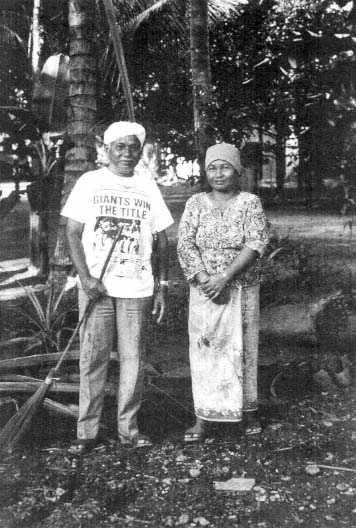
Figure 15.
Mak Shamsiah with Pakcik Hamid
time when she and her husband lived in Singapore. One day while Mak Shamsiah's husband was away at work, a Malay dukun from Negeri Sembilan who Mak Shamsiah or her husband had sought out on a previous occasion came to the house and proclaimed his romantic interest in her. Mak Shamsiah reportedly attacked him with a broom and/or slammed the door in his face. The amorous dukun was gravely incensed by this rejec-
tion, and he cast a spell on her, which affects her to this day: Whenever he thinks of her, for example, she thinks of him; she also hears voices (including the dukun 's?) that tell her to dance, not to work or cook rice, and so on.
The second explanation of Mak Shamsiah's personal misfortune comes from Mak Rahmah, a relatively wealthy cousin who belongs to Mak Shamsiah's "lineage branch" (pangkal ), and who is also one of her immediate neighbors. Though Mak Rahmah knows and apparently believes the story of Mak Shamsiah's encounter with the amorous dukun in Singapore, she also holds that Mak Shamsiah's illness is at least partly a result of Mak Shamsiah's throwing her trash over her fence into the vacant lot next door. This disturbs and insults the spirits (jinn ) residing there, and they have taken their vengeance on her either by helping bring about her illness in the first place or by prolonging it. Mak Rahmah also told me that because Mak Shamsiah does not pray much, she has not gotten better, although she (Mak Rahmah) also realizes that the illness is responsible for her lack of prayer.
The third explanation of Mak Shamsiah's illness comes from Mak Zaini, a relatively poor clan sister who lives on the other side of the village and who belongs to a lineage with which Mak Shamsiah's lineage has been at odds for quite some time. Interestingly, two of the principal actors in the feud involving the two lineages are Mak Shamsiah's older brother—the highest ranked adat figure in the village—and Mak Zaini's older brother, who has also held clan titles in the past and is, independently of his titles, a local "big man" with a reputation for "getting things done" and for using ilmu to attract followers and supporters and enhance his prestige. The details of the feud need not concern us. What is important here is that Mak Zaini's explanation of Mak Shamsiah's illness focuses on a grave offense against "ancestral property" (harta pesaka ) and the traditions of the ancestors that was committed, she says, by Mak Shamsiah's mother's brother, Datuk Abdul Ghani. The offense involved a gold keris and other gold jewelry or ornaments that one of Mak Zaini's relatives had asked Datuk Abdul Ghani to store in his house for safekeeping. Mak Zaini's ancestors owned this ancestral property, but they were poor and lived in a dilapidated, bamboo-slat house, and they thought it wise to have someone else keep it for them. Datuk Abdul Ghani's crime is that he later turned around and sold it, and kept the proceeds. And this offense is what caused Mak Shamsiah's illness. It was wrong (and dangerous) because the property did not belong to Datuk Abdul Ghani (he had no right to sell it) and because ancestral property like this should
not be sold (or mortgaged) since it is sacred and reminds villagers of their parents, grandparents, and great-grandparents. Mak Zaini reassured me that she would never have the courage to sell any such property, even if adat allowed her to. She added that those who sell ancestral property are likely to become gila (crazy, insane) and even die. It is thus "natural," "only to be expected," Mak Zaini told me in 1980, that Mak Shamsiah cannot get out of bed, sleeps much of the day, and is otherwise unable to function. If Datuk Abdul Ghani escaped unharmed or somehow avoided the repercussions of his actions, his children and other descendants would surely suffer one way or the other.
The fourth explanation of Mak Shamsiah's illness comes from her son, Kadir, who works and lives in the largely Chinese city of Kuala Lumpur, where he has spent most of his time since leaving school. Kadir and I spoke about his mother's situation in 1979, when Kadir was about nineteen years old. He told me that he did not accept the conventional wisdom concerning his mother's disorders, which holds that her problems stem from the amorous dukun casting a spell on her. He believes that his mother is simply a very anxious person; she worries too much about her children, Kadir explained, and she fears they will consort with drug addicts and other types of "bad people" (orang jehat ) in the city. She probably worries that he has a girlfriend, Kadir added, and that the girlfriend is not the "right type." (On this count some of her fears seem well grounded, for as Kadir pointed out, he does have a girlfriend, and she is half-Indian and half-Chinese; the girlfriend enjoys going to discos, as does Kadir, spending money, and having a good time; on top of all this, she doesn't have any interest in cooking and other household chores.) Putting his comments in a larger context, Kadir went on to say that he doesn't believe in ghosts and spirits, and that he views the village's sacred shrines (keramat ) and the various rituals associated with them—along with ritual feasts at the graveyard—as against the teachings of Islam. All such things are tied up with "superstition," and reflect a lack of formal education and a relatively shallow understanding of Islam.
These, then, are the four different interpretations of Mak Shamsiah's illness that I encountered in Bogang. Despite the underlying structural similarities in these accounts (about which more in a moment) there are important differences. Contrasting features of the four accounts include, most obviously, the types of relationships held to be at the heart of the problem (which involve suitors, spirits, clansmen, and children); the types of emotions assumed to have engendered Mak Shamsiah's illness (unrequited love, feelings of rejection, loss of face); proprietary anger and be-
trayal (on the part of local spirits and clansmen alike); and parental anxiety.
Other contrasts involve the issue of mystical agency. In the first account, mystical agency manipulated through the ilmu of a rejected suitor cum dukun is responsible for Mak Shamsiah's afflictions. In the second account, mystical agency is realized in the actions of spirits, who are held to be at least partly responsible for these afflictions. The third account makes reference to mystical agency as well, but does not specify the medium or channel through which this agency comes into play. And in the fourth account there is no reference to mystical agency.
The fourth account, it will be recalled, comes from Mak Shamsiah's son, Kadir, who works and lives in Kuala Lumpur, and is in many ways far less "traditional" than the majority of Bogang's full-time residents. We could perhaps generalize here and conclude that Kadir's disinclination to invoke mystical agency and any type of human malevolence in his account of his mother's illness reflects the experiences and perspectives of Malays in urban areas, and of "modern" Malays in general. There are no solid grounds for this conclusion, however, even though some of Kadir's experiences and comments obviously resonate with the more cosmopolitan orientations found among many urban and "modern" Malays. In fact, as Provencher (1979:48) discovered on the basis of his research among Malays in the Kuala Lumpur area, "most urban Malays who become ill suspect that they have been poisoned"; more importantly, as I discuss below, "the fear of [poisoning and] sorcery is greater ... in urban communities than in rural villages" (emphasis added).
As for the underlying structural similarities, all four accounts interpret Mak Shamsiah's illness both relationally (in terms of Mak Shamsiah's social relations with others) and in a moral framework. These generalizations hold even for Kadir's interpretation of Mak Shamsiah's illness, which focuses on her anxiety concerning her children, the urban, primarily non-Malay, social fields in which they find themselves, and their prospective spouses and mates. In addition, all four accounts speak to social relations that are strained, alienated, or otherwise disordered, and that are fraught with ambivalent and/or contradictory sentiments and behavior (e.g., the suitor who turns on and harms the object of his affection, the normally quiescent spirit who attacks). Other similarities include actual or potential breakdown or failure in reciprocity, reproduction, or both; and loss of autonomy and social control due to actions of people (suitors, relatives, or others) or spirits (or both) who (mis)appropriate power for their own individualistic and otherwise socially divisive ends.
Seven Years Later
During my second period of fieldwork I spent a great deal of time with Mak Shamsiah, for by this time her illness had abated somewhat and she was quite outgoing and communicative, though still very moody and given to episodes of screaming and occasional frenzy. The house we lived in during the second fieldwork was next door to Mak Shamsiah's (as the first had been), and its location was highly conducive to our interaction with her since, unlike our first house, it was not separated from Mak Shamsiah's by a small ravine and wire fences. It wasn't simply the location of our house, however, that led us to seek out Mak Shamsiah (and vice versa); for she was extremely friendly and warm to us (e.g., she took an instant liking to Zachary, and was forever treating him to sweet cakes, fruits, and other local delicacies), and we thoroughly enjoyed her company. Because Mak Shamsiah and Kak Suzaini (the woman who cooked for us and became one of our dearest friends) were so close, we had additional reason to spend time with her.
Though she now was "much better," both she and her husband told me (as did others) that she was not altogether cured. As she put it on one occasion when I asked her if we could discuss various aspects of gender, "Why do you want to ask me all sorts of questions when my mind [still] isn't right?" I do not have any detailed information about the timing of Mak Shamsiah's partial recovery; the only explanation I heard was that the amorous dukun in Singapore had died, and that, being dead, he could no longer exert any control over Mak Shamsiah. (I would have liked to know more about the timing of the onset of Mak Shamsiah's mother's senility; e.g., if it helped "jar" her into good health, or, alternatively, served to prolong her illness, but I have no accurate information on this.)
I never asked Mak Shamsiah about the cause(s) of her misfortune(s), for it seemed too delicate a subject, especially since she still experienced bouts of severe illness, and I feared that questions on the topic might conjure up unpleasant and painful associations and thus "set her off." She brought up the subject on a few occasions, however, remarking, for example, that the onset of her illness began before her husband had settled down to the idea of marriage. She mentioned as well that during the early part of her marriage he frequently berated (and sometimes struck) her, and that there were many pantang (taboos) that she failed to observe. She also recounted that earlier in her marriage she "worried a lot" about Pakcik Hamid and Kak Suzaini. Kak Suzaini had a habit of coming to the house in the evening with her children, ostensibly to watch television, but
she was frequently wearing makeup, along with sleeveless and rather low-cut, revealing blouses. Pakcik Hamid and Kak Suzaini would laugh and laugh until late in the evening—long after Mak Shamsiah had gone to bed—and though she brought her children with her, they often fell asleep on the verandah and thus could not serve as chaperones or obstacles to any form of intimate behavior. Mak Shamsiah informed Pakcik Hamid she didn't like this type of behavior, and he stopped. She also told him, half-jokingly, that while she wouldn't mind if he took another wife after she died (she was convinced that he would outlive her), she would "slit his throat" if he did so while she was still alive.
In other conversations, which focused largely on gender, Mak Shamsiah told me that women are more susceptible to spirit possession than men because, compared to men, women have "less" or "weaker" semangat . Similarly, women are more prone to latah because they "worry" (susah hati ) more than men and are more easily "startled" (runsing ). More generally, whereas women and men have the same "rationality" (akal ), women's "passion" (nafsu ) is stronger than men's. God made them this way; and this is why they have a stronger sense of "shame" (malu ). If they didn't have stronger "shame," their "passion" would be even more obvious than it already is, and they would be more "ferocious" and "wild" (ganas ) than men are. She mentioned, too, that women are often more "fierce" (garang ) than their husbands.
While in previous years Mak Shamsiah had obviously been quite anxious about her relationship with her husband—and perhaps especially concerned that difficulties in their marriage could lead to its dissolution and thus call into question her own relevance to the ongoing reproduction of her household and lineage—she was no longer. In fact, one of the more unusual things about her during the second period of fieldwork was how communicative she was about her husband, her positive feelings for him, and her apparent security in the relationship. I remember seeing her wearing her husband's sarong on various occasions, and when I asked her if it was his she replied yes and then explained that she "missed him" when he spent much of the day out of the village at his garden (kebun ), and that wearing the sarong helped remind her of him. Such admissions of positive affection and intimacy between husband and wife are, in my experience, relatively unusual. Moreover, she sometimes commented on what a "good man" he was, how kind he had been to her during all the years that she was ill, and that he could have abandoned her, as many of his friends and relatives apparently told him to do, especially since he had
a salary/pension, an automobile, and was otherwise highly desirable and thus could have easily found another wife.
Mak Shamsiah's relationship with her husband was no longer a major source of anxiety or concern, but she was very much preoccupied with the circumstances and relational dilemmas of other members of her household, such as her son Kadir, who, as noted earlier, had a non-Malay, "mixed-race" and (by local standards) otherwise extremely inappropriate girlfriend, and expressed no interest in getting married. Her main problem, though, was her eighty-six-year-old mother, Wan, who had become quite senile, and was subject to recurring hallucinations and nightmares. Wan, who was exceedingly thin and commonly refused to eat, spent much of her time hunched over in the compound, picking weeds (and occasionally eating rotten fruit that had fallen from rambutan and other fruit trees), but she was also given to wandering around the village in a daze, especially in the late afternoon and early evening hours. During these forays Wan often invited relatives and neighbors to imagined feasts, thus recalling both the grandeur of her healthier days and the time when her husband was still alive. These invitations were received good-naturedly, and Wan was in fact humored in many situations. For the most part, however, Wan was regarded as a terrible nuisance, and was the object of much ridicule and scorn. Some of her closest relatives locked their doors and the gates surrounding their wells when she appeared in their compounds, drove her away, and otherwise treated her "like dirt." This upset Mak Shamsiah tremendously, particularly since, as Mak Shamsiah pointed out to me on numerous occasions, many of these same people had frequently partaken of Wan's generosity when she was still healthy. In some ways more distressing, though, was Mak Shamsiah's fear/premonition that Wan would get run over and killed by the train which passed through the village. Mak Shamsiah had forbade Wan to cross the railroad tracks, but Wan didn't listen—or simply forgot—particularly since she needed to cross the tracks to get to the kedai one of her daughters operated, and to attend the mosque.
Wan's behavior created problems in Mak Shamsiah's relationship with her husband. Her hallucinations and nightmares made it extremely difficult for Mak Shamsiah and her husband to get a good night's sleep. And Wan claimed that Pakcik Hamid was "always hitting her" and "wanted to kill her." This was most likely an exaggeration, though on one occasion, when Wan was tearing down clean laundry that had just been hung out to dry, I did see him strike her with a long bamboo pole. More generally,
both Mak Shamsiah and her husband mentioned that their lives were not at all "their own" since they had to watch Wan all of the time. They couldn't even go to Singapore to visit their daughter and grandchildren, particularly since doing so would require taking Wan with them (an impossibility) or leaving her behind (also impossible, because "there was no one to care for her" [even though three of her other children lived in the village]).
Wan's behavior also exacerbated tensions in Mak Shamsiah's relations with her brothers and sisters (though the fact that Wan was alive also kept some of these tensions in check [see below]). This was because Mak Shamsiah shouldered virtually all of the responsibility for looking after Wan, even though she was one of six children. When Wan could still cook and work, everyone used to welcome and love her; now that she had "lost her mind" and "reverted to childhood," she couldn't do any of these things anymore, and no one wanted to look after her. To make matters worse, Wan wouldn't let anyone else take care of (even bathe) her, even though she spoke fondly of her son Haji H., claiming (falsely) that he gave her money and other presents, and was otherwise very good to her. But Haji H. wouldn't even come to "look at her face" or visit her, even though he came to this part of the village (e.g., to talk with the anthropologist) now and then. Mak Shamsiah's two sisters (Wan's other daughters), for that matter, didn't do anything except help give her a bath once in a while. Mak Shamsiah went on to say that she didn't want to speak ill of her brothers and sisters (literally: cause them to stink or rot [busukkan saudara ]), but they just didn't do anything for Wan, even though she was mother to all of them.
Mak Shamsiah frequently told me—and anyone else who cared to listen—that she didn't know what she was going to do if Wan "lives to be one hundred." The problems would only get worse, she lamented, with much frustration—and desperation—in her voice.
Wan's advanced senility, which in many respects (e.g., its debilitating effects) paralleled the earlier (more severe) forms of Mak Shamsiah's illness, brought into painfully sharp focus what many villagers saw as the uncertainties and dangers inherent in aging and social reproduction. To wit, that once they ceased to be (re)productive and thus of value to their kin and society at large, they would be cast aside and otherwise mistreated and abused, and would thus experience rather severe (if not complete) loss of autonomy and social control. Such treatment entailed the most heinous violation of norms informing relationships between children and their parents, yet it was a common theme in the everyday discourse of villagers,
particularly women. So, too, was the theme of ambivalence, alienation, and tension among siblings, which also figured into Mak Shamsiah's account of her dilemmas with Wan. Interestingly, however, while Mak Shamsiah cited the problems Wan's behavior created with her (Mak Shamsiah's) siblings, she made no reference to the fact that the problems would most likely become far more pronounced after Wan's death. Such a scenario was highly probable since Wan would no longer be around to mediate petty disputes and everyday tensions and antagonisms—and otherwise articulate social relations—among her children. Nor would she be able to serve as a palpable symbol of their common interests and identities. There was, moreover, the issue of the land and other property owned by Wan that would have to be divided among her children after she died. This was potentially a source of great tension and strain, even though the land (especially residential and rice land) has relatively little monetary value in today's economy.
The concerns—with articulating social relations, preserving peace and order within the family, and looking after reproduction in both the social and biological senses of the term—that surface in Mak Shamsiah's account of her problems with Wan resonate deeply with the common themes underlying the various interpretations of Mak Shamsiah's illness that I discussed earlier. Such concerns are, to reiterate my earlier point, quintessentially (though by no means exclusively) female. Men's concerns with the articulation of social relations, peace, order, and reproduction are in many respects both parallel and complementary to those of women, though they tend to be cast in terms of more expansive social units (lineage, clan, village, religious community, and ethnic/racial grouping) and in different idioms (political, religious, ethnic/racial). They are, moreover, frequently expressed in different, more public arenas (village councils, local political party organizations and activities, prayer houses and mosques) that have long been associated with maleness.
It would be a mistake to overvalorize these contrasts, however. For men no less than women are susceptible to, and victimized by, mystical attack (though this is commonly glossed over in the literature). And while the forms of mystical attack vary (with women being more subject to dramatic episodes of possession by spirits, and men more likely to be afflicted by slow wasting away), the attacks on men and women alike are experienced—and interpreted by others—as testimony to the dilemmas inherent in reciprocity and reproduction. The following case study will serve to illustrate the point.
The Case of Rashid
Rashid was born in Bogang in about 1957. He is a member of the same clan (Lelahmaharaja) and lineage (darat ) as Mak Shamsiah, and is her sister's son. Rashid's household is without question the wealthiest household in the village. This is largely because of the economic successes of his late father, Haji Yahya, who died in December 1986. Despite his lack of formal education, Haji Yahya was a very clever and resourceful businessman who engaged in various sorts of entrepreneurial activities. He had a hand in the financing and construction of the village mosque, and was involved in other construction both locally and in other states. Perhaps most important, though, is the lumber company he set up and operated, apparently with the help of his wife's brother (a high ranking official in the Ministry of Forests) and some Chinese businessmen. His sons, including Rashid, are involved in the family business and are all doing extremely well financially.
Rashid fell sick about a month after his father died. The first time I saw him during my second period of research was when I encountered him at the local provision shop (kedai ) that his mother runs. I expected the worst from the stories I had heard, but still was not prepared for what I saw. Rashid was lying in a chaise lounge that had been covered with a blanket and was propped up behind one of the tables placed in the front of the kedai . His head appeared freakishly large since the rest of his body was emaciated and withered. He looked all skin and bones, and his feet were covered with flaking skin and a red substance that I initially mistook for blood (it turned out to be medicine). Rashid greeted me by saying that I looked well and fat, and that he was sick and thin. He had been very ill, he explained; this was his fate (nasib ), so what could be done? He claimed that he was much better now (at least now he had an appetite and could sleep) and not nearly as thin as before. For the longest time he had no appetite, and could only sleep an hour or so a night; and any wind or clothes that touched his skin caused excruciating pain. Though he still could not walk, he was no longer paralyzed and had feeling in his legs, for which he was extremely thankful.
The first account of Rashid's illness comes from Mak Zaini, the relatively poor woman I referred to earlier as having provided one of the accounts (the third) of Mak Shamsiah's misfortune. Her story of Rashid's illness is basically the same as her account of Mak Shamsiah's afflictions: that it reflects mystical retribution for offenses against "ancestral" property that were committed by Datuk Abdul Ghani, the man who was
both Mak Shamsiah's mother's brother and Rashid's mother's mother's brother.
The second account of Rashid's illness comes from Datuk Hamzah, who at eighty-nine years of age was one of the oldest residents of Bogang. Datuk Hamzah was sitting at the kedai when I spoke with Rashid, and he said that non-Muslim aborigines (orang asli ) were responsible for Rashid's afflictions. It was not clear if Datuk Hamzah felt that the orang asli did this to Rashid "on purpose" or "accidentally." But he implied that it might not have been done with Rashid in mind. On this point Rashid disagreed (see below). According to Datuk Hamzah, the poison entered Rashid's body through his feet, having been spat on the ground by one or more orang asli . He explained to me that the saliva or spit of orang asli is poisonous (bisa ) and that any area spat upon by orang asli will become poisonous, even if the spit has long since dried up. Hence you can't step or walk on such spots, or on orang asli graves. Datuk Hamzah added that Rashid worked with a lumber firm, was always going into the forest, and might have tread on areas, long since overgrown, that had once been spat upon by orang asli . This type of work carried certain dangers.
The third account of Rashid's illness comes from Rashid himself and was recounted in bits and fragments as we sat at the kedai . Rashid told me that his sickness began about a month after his father died. He was living on the east coast of the Peninsula at the time, working for his family's lumber company. Someone made him ill, he said, and it was intentional. He was fairly certain that it was one of his business friends or associates (kawan ), someone he worked with, though he didn't know for sure which one. He attributed it to envy (dengki ) but did not elaborate on any of these points. Rashid also said that he had gone to "forty or fifty" dukun for a cure and had undergone all sorts of tests and treatments, but to no avail. He had tried Malay dukun , Chinese healers and acupuncturists, Thai ritual specialists, and Western-oriented medical experts, but with no results. At least one dukun told Rashid that his illness "isn't in his [the dukun 's] book," hence he could not treat him. At the time of our conversation, Rashid's case was in the hands of a Thai healer, who, as Rashid told me, was not a Muslim. But that's okay, he reassured me, adding that he had also spent about two weeks sleeping in a Chinese temple in the Kuantan area, in hopes that that would help cure him.
The three accounts of Rashid's illness that I encountered bear certain similarities, but they also diverge in important respects. The similarities include both the relational interpretations of Rashid's illness, and the belief that Rashid's problems stem ultimately from human malevolence—
or the automatic activation of mystical agency—triggered by Rashid's or his mother's mother's brother's violation of unspoken codes of propriety (concerning the integrity of ancestral property, territorial domains, and relative equality, respectively).
The contrasts are in some ways more significant. One contrast turns on the nature of the agency believed to have caused Rashid's illness: Mak Zaini's account refers to the automatic activation of mystical agency; Datuk Hamzah's account refers to mystical agency controlled by non-Muslim aborigines, which is automatically activated once a taboo (pantang ) has been violated, and which may cause harm somewhat indiscriminately; Rashid's account makes no reference to notions of taboo, but refers simply to human envy and malevolence, which were focused on Rashid and intentionally caused him harm. Another salient difference involves the source and meaning of danger and the context in which it occurred. In Mak Zaini's account, the source of danger is not clearly specified though the context is without question the handling, transfer, and safekeeping of ancestral property; in Datuk Hamzah's account, the source of danger is the forest and the non-Muslim aborigines who reside there and have long controlled its resources, power, and secrets; the context of danger is also the forest (or an area once cleared that has long since overgrown). In Rashid's account, on the other hand, the danger emanates from his business friends and associates, their social relations with him, and the envy that suffuses these relations owing (presumably) to Rashid's relative economic success. The context of danger, in turn, is the lumber industry and the highly competitive world of modern capitalist business and trade relations, Rashid's involvement in which enabled him to live exceedingly well for a while, but also nearly cost him his life.
Before turning to a discussion of Rashid's case in relation to the illnesses and misfortunes experienced by Mak Shamsiah, Maimunah, and others in Bogang and beyond, I would like to reiterate that Rashid is but one of dozens of men in Bogang who believe themselves (and are thought by others) to have been poisoned or sorcerized. Facts such as these are of considerable significance for, as noted earlier, some of the most insightful and frequently cited literature on Malaysia focuses on women in highly dramatic episodes of spirit possession, and makes little if any mention of the prevalence of men as victims of poisoning and sorcery that involve gradual wasting away as opposed to dramatic possession by spirits. The more general point is that data from Bogang—and elsewhere in Malaysia—indicate that men are just as likely as women to experience mystical attack.[7] I will return to this theme in due course.
Commentary
The case material and other data presented here testify to the prevalence of the ambivalence, alienation, and tension that exist in Bogang and in other Malay communities in Malaysia. The ambivalence, alienation, and tension to which I refer emerge clearly from the comments of dukun such as Mak Ijah, who insists that she was sorcerized by her adopted daughter, and who (along with her husband) has decidedly negative views of human nature and local social relations, especially the role of reciprocity in those relations. Her husband, it will be recalled, summed up his experiences and views concerning reciprocity in social relations in the pithy phrase "you give flowers and get shit in return." These ambivalences and tensions surface in other contexts, as well: for example, in villagers' views of Datuk Latiff, who is believed to use his ilmu not only to cure people and mend broken or strained relationships, but also to cause illness, other forms of suffering, and death. There is also the amorous dukun in Singapore who is widely held to be responsible for the illness and misfortune that have plagued Mak Shamsiah for more than thirty years.
These ambivalences are but one manifestation and condensed expression of the more general and diffuse ambivalence with which villagers view and approach all social ties, including—indeed, especially—those with neighbors and kin. Most relationships in the community are cast in idioms of kinship (particularly siblingship), which continue to have heavy moral and economic entailments, and even when such relationships are not conceptualized in terms of kinship, they come with potentially burdensome moral obligations. The expectations associated with these obligations can be extremely difficult to fulfill; and in many cases, even when they are fulfilled, they are not reciprocated. Further aggravating problems such as these is villagers' heavy reliance on cash-cropping, and their incorporation into the world market economy more generally, which have resulted not only in the erosion and demise of many traditional, reciprocity-based relations of production and proprietorship, but also in the proliferation of individualistic behavior, non-redistributive institutions, and various forms of inequality and socioeconomic stratification. These and other changes have created new (and intensified preexisting) uncertainties and dangers in villages like Bogang, and are partly responsible for the fact that most relationships in the community are conducive to the realization of ambivalence.
This ambivalence is fueled by villagers' suspicions that fellow Malays are frequently motivated by greed, envy, and malice, and are forever try-
ing to get the better of one another through displays of status and prestige, and by attempting to gain control over one another's resources, loyalties, and affections. These suspicions are not expressed openly, however; nor are personal desires and individual intentions (cf. Weiner 1976:213; Dentan 1988:859, 869). The formal rules of social interaction prohibit such behavior, just as they proscribe many forms of direct speech that could possibly enable people to better read what is on the minds of others. Villagers are quick to point out that one's inner spirit or soul (batin, roh ) is invisible, concealed beneath the physical body (badan ), and that one's real intentions, motivations, likes, and dislikes are similarly shielded from view, and typically unknown. Outward behavior is no indication of what is on someone's mind or "in one's liver" (dalam hati ), for outward behavior is not only constrained by generally restricted speech codes, in which most utterances are "pressed into service to affirm the social order" (Douglas 1970:22); it also intentionally disguises inner realities. These themes are highlighted in various local expressions, such as ya mogun , which refers to a "yes" that really means "no"; janji Melayu ("a Malay promise"), which is sometimes used to convey similar meaning; cakap manis, tapi hati lain , which can be translated as "sweet words or talk, but a different [not-so-sweet] liver"; and mulut manis, tapi hati busuk , which refers to "a sweet mouth but a stinking, rotten liver."
This is the ideal climate for ilmu and is, in the local view, where ilmu comes into the picture: Villagers assume—and fear—that many people in their social universe rely on ilmu to achieve what they are prevented by the formal rules of social interaction from accomplishing (or even setting out to accomplish). These and attendant assumptions help explain why the institution of dukun continues to flourish despite the decline of traditional midwifery and most forms of shamanism and spirit cults. In sum, although certain dukun (e.g., Mak Ijah, Datuk Latiff) are suspected of trafficking in evil spirits, engaging in sorcery, and otherwise misappropriating the power of the Word, and although the entire institution has come under increasingly heavy fire from Islamic resurgents (orang dakwa ) and critics of disparate persuasion, dukun are still very much needed to protect villagers (and their urban counterparts) from the dangers in their social universe, including, in particular, the veiled aggression of fellow Malays.
Fellow Malays are not the only source of uncertainty and danger, however. We have seen that non-Muslim aborigines are perceived to be especially threatening. So, too, are various types of spirits in the demonological system, only some of which are controlled by human agency. Of particular interest in this connection are "epidemics" of spirit possession
("mass hysteria") among young Malay women working in factories in Negeri Sembilan, Selangor, Melaka, Singapore, and elsewhere, which is a recent, much publicized phenomenon that has attracted the attention of anthropologists, among others. Ong (1987, 1988) notes that such cases typically involve spirits that are "wild" or "untamed," as opposed to "domesticated" or "tamed" by human masters. She also demonstrates that epidemics of spirit possession among female factory workers, and "the intensified social and bodily vigilance" with which they are associated, reflect heightened moral concerns and anxieties about the Malay social order, about the dangers of stepping outside it, and about the more encompassing body politic (Ong 1988:32). The contexts in which these epidemics occur—the shop floors of modern factories, especially multinationals in "free trade zones"—provide clear evidence of new (and incipient shifts in) sources of marginality, uncertainty, danger, and power. More generally, such cases (along with material presented earlier) indicate that Malays see themselves as threatened, if not marginalized and victimized, not only by their own neighbors and kin, but also by largely Western-oriented state policies and institutions, and by the state-sponsored nexus of capitalism introduced during the British colonial period, which continues to undermine and otherwise transform rural culture and social relations (cf. Taussig 1980; Zelenietz and Lindenbaum 1981). Evidence of these same shifts appears in the data from Bogang, even though most dangers and tensions still have a decidedly local face; for example, Rashid attributing his illness to the envy and sorcery of a "business friend" from the east coast whom he encountered in the course of his work for a modern capitalist enterprise (as opposed to the sorcery of forest-dwelling non-Muslim aborigines); and Kadir's account of his mother's illness, which focuses on her anxiety concerning her children mixing with, and perhaps mating with and marrying, the "wrong types" in the predominantly Chinese city of Kuala Lumpur (as opposed to sorcery, spirits, or other mystical agency). These cases indicate, among other things, that processes involving the "disenchantment of the world," which Weber analyzed so incisively at times, are far less automatic, mechanical, and uniform than is widely assumed (see Peletz 1988a, 1993a, 1993b).
It is no small irony that the very same historical forces which have exacerbated rural and urban Malays' moral concerns, fears, and anxieties pertaining to poisoning, sorcery, and spirit possession—and which have thus ensured continued demand for certain services of dukun —have also rendered superfluous many of the traditional services dukun once provided (dealing with fractured and broken bones, other simple physical
complaints) and have, at the same time, helped undermine the legitimacy of the institution in its entirety. Most of Bogang's dukun are in their sixties or seventies, and to the best of my knowledge there are no young people in the village or outside of it who have expressed strong interest in learning their ilmu and replacing them when they retire or die. These and other forms of local knowledge and power obtained through illness, dreams, chanting, trancing, and possession by spirits may thus be lost forever, despite the locally experienced and culturally elaborated need for their deployment. Such a loss may well engender feelings of disempowerment throughout Malay society, even among those who, like Kadir, appear to put relatively little stock in ilmu and mystical agency and have yet to experience serious illness or other personal misfortune.
These feelings of loss and disempowerment may well be felt most strongly by women. This is not only because women are increasingly less likely to have other avenues of knowledge and power available to them both in rural and urban contexts (e.g., modern secular education and religious instruction, meaningful on-the-job training and employment opportunities), but also because women have long been more susceptible to spirit possession (which is apparently less responsive to Western medical treatment than other forms of mystical attack), and likewise more dependent on (or at least more inclined to use) ilmu to help ensure the affections and loyalties of spouses and children. As growing numbers of village youth turn their backs on the prospective marriage partners their mothers and other female relatives have chosen for them in favor of spouses of their own choosing—which behavior is often taken as a sign of their being under the influence of the latter's ilmu —their mothers and other female kin will feel ever more powerless to realize the quintessentially female role of articulating social relations and looking after reproduction in both the social and biological senses. Moreover, as Islamic resurgents, national politicians, and others in largely extralocal quarters place greater emphasis and restrictions on women's attire, sexuality, and bodily functions in their projects to reinvigorate and reconstitute Malay society, rural women will come under intensifying pressure to conform to gender roles of others' choosing. Developments such as these—coupled as they are with the decline of subsistence agriculture (long a female domain) and female labor exchange in the agricultural sector, and various state-sponsored changes in land tenure and inheritance that have undermined many of women's "traditional" prerogatives—will undoubtedly witness the further erosion of women's autonomy and social control, just as they will entail the heightened segregation and dichotomization of male and female spheres.
The most likely result: Women will become increasingly identified with and, to a lesser extent, confined to, the ever more atomized, isolated, and isolating domains of hearth and household, yet will be ritually ill-equipped (except as victims of increasingly delegitimized spirit possession and latah ) to deal with the vicissitudes of their relational dilemmas and to exercise their more general moral concerns.
Spirits of Resistance Revisited
The analyses presented here build on Aihwa Ong's extremely insightful (1987, 1988, 1990a) work on spirit possession in contemporary Malaysia, but they do so rather selectively. In the interest of encouraging further research and debate on the issues at hand, it may be useful to make explicit some of our areas of disagreement, though I hasten to add that this is not the place to provide an extended discussion of Ong's important contributions to the literature.
Ong argues that prior to the 1970s, spirit possession among Malay women entailed (though is not reducible to) symbolic protest against women's subordinate status vis-à-vis men as well as ritual dramatization of the stresses women experienced in their roles as wives, mothers, and divorcées. With urbanization and industrialization beginning in the 1970s, however, there was a dramatic shift in the locus of possession. In Ong's (1988:29) words: "Before the current wave of industrial employment for young single women, spirit possession was mainly manifested by married women, given the particular stresses of being wives, mothers, widows, and divorcées .... With urbanization and industrialization, spirit possession became overnight the affliction of young unmarried women placed in modern organizations " (emphasis added). Possession in contemporary contexts such as these, in Ong's view, is best interpreted as both a protest against, and a form of resistance to, capitalist "labor discipline and male control in the modern industrial situation" (Ong 1987:207).
There are, in my view, three problems with these arguments. First, the way in which Ong portrays the purportedly dramatic shift in the locus of possession (at least or especially in her 1987 monograph) makes little provision for the multitudes of rural and urban Malay women—married and unmarried, old and young alike—who have no direct or indirect experience in the modern factory settings on which Ong focuses her discussion, yet who are still subject to possession by spirits.[8] More generally, while possession certainly does occur among some, but by no means the majority of, female factory workers, and, as widely reported both in the
media and in the literature, among female dormitory residents and rural-dwelling schoolgirls involved in sports meets, drama programs, and public-sector work projects (Ackerman 1988:218), there is no evidence to suggest—and no reason to believe—that possession is more common among factory workers than among those who have no work experience in factory settings. Thus, it strikes me as rather misleading for Ong to state that possession became "overnight" the affliction of "young unmarried women ... in modern organizations"—the larger issue being that there are few solid grounds (and not all that many data) on which to base assertions that possession in these or other contexts informed by urban or industrial influences is best interpreted as a protest against, and a form of resistance to, "[capitalist] labor discipline and male control in the modern industrial situation." I certainly agree with Ong, however, that the demise of reciprocity and redistribution brought about in part by transnational capitalism is conducive to the intensification of moral concerns, fears, and anxieties of the sort realized in possession, though I would add that they are likewise conducive to the amplification of moral concerns, fears, and anxieties realized in other (i.e., "male") forms of mystical attack. More broadly, while I concur with Ong that the symbols, idioms, and overall language of spirit possession in capitalist contexts can and frequently do entail critiques of new ways of being for women and men alike, I would attach somewhat more importance to the fact that possession and other mystically induced forms of misfortune in more "traditional" settings are equally likely to embody critiques of prevailing or emergent social arrangements and institutions (gendered and otherwise), and, in this sense, have always had strong counter-hegemonic potential.
Second, the purported age shift in the locus of possession to which Ong refers (from "wives, mothers, widows, and divorcées" to "young unmarried women") is more apparent than real, insofar as it is a function of the rise in age at first marriage. Prior to the 1930s, for example, females in Bogang were, on average, about fifteen years old (though in some specific cases much younger) at the time of their first marriage (see also Newbold 1839 I:244; Reid 1988:158–59, 160). Note, however, that the mean age at first marriage for females had increased to about nineteen by the end of the 1960s, and was about twenty-one to twenty-two (or slightly higher) by the end of the 1970s (see Peletz 1988:233, table 15). Similar increases in age at first marriage have been reported for other parts of the Peninsula, including Selangor, where Ong worked (see, e.g., Jones 1980, 1981; Hirschmann 1986). Hence it is not necessarily the case that possession is afflicting younger women. The difference is simply that, due to the rise
in mean age at first marriage, when women first experience possession they are much less likely to be married (or widowed or divorced) than in times past.
And third, Ong's discussions of mystical affliction focus almost entirely on spirit possession, and effectively ignore those forms of mystical attack (such as poisoning and forms of sorcery that do not involve dramatic episodes of hysteria in which spirits take control of, and otherwise possess, their victims) that predominate among males. This focus follows from the main—and very important—question to which Ong directed her research (how to account for spirit possession among female factory workers), and, as such, is thoroughly justifiable. On the other hand, it gives the erroneous impression that women are far more susceptible to mystical affliction than men, and otherwise entails an unjustifiably dichotomized treatment of the roles and meanings of male and female in both "traditional" and contemporary culture. It also leaves unanswered some very significant questions: Why has poisoning and sorcery since the late 1400s been the "normal assumption in the Malay world when a man [or woman?] died young" (Wheatley 1964:151; cf. Reid 1988:56–57)? And why do fears and anxieties about being poisoned, sorcerized, or otherwise mystically attacked appear to be more or less evenly distributed among men and women?
The analytic framework developed in this chapter is, I believe, more appropriate to the data than Ong's, though I should perhaps reiterate that various commonalities underlie our different perspectives, and that, in any case, many questions and lines of inquiry remain to be pursued. Suffice it to restate my most general position that spirit possession is but one form of mystical attack, and that mystical attack is most profitably approached from a broad perspective which not only deals squarely with femininity and masculinity, but which is also attuned to long-term historical developments (e.g., the gendered skewing of ritual activities and women's spiritual disempowerment) over the course of the past few centuries.
In the latter connection we might recall the previously noted point that during the early part of the period 1450–1680, women were extremely active in communal rituals throughout much of Southeast Asia due to the fact that their reproductive and regenerative capacities gave them "magical and ritual powers which it was difficult for men to match" (Reid 1988:146; Andaya and Ishii 1992). This had changed by the latter part of this period, however, owing to the development in Southeast Asia of Islam and other Great Religions (especially Buddhism and Christianity), which provide no textual legitimacy for women's active participation in the high-
est or most prestigious rituals of the land. Specifically, during the latter part of the period in question, the most prestigious ritual positions in societies under the influence of Great Religious—ulama , magistrates, and mosque officials in the case of Islamic societies—came to be reserved for males, who thus found themselves in the historically unprecedented position of presiding over communal rituals. Women's public ritual roles became progressively less apparent, and they were increasingly relegated to shamanism, spirit propitiation, and the like, which, along with latah , came to be disassociated from the more universalistic arenas defined in terms of the Great Religions, formal politics, and men (Andaya and Ishii 1992). In the process, the status of shaman (both female and transvestite) declined, and women became the principal practitioners of ritual activities keyed to relatively parochial concerns, such as localized ancestral spirits and healing.
Clear evidence of this gendered encompassment exists in nineteenth-and twentieth-century Malay society. In the late nineteenth century, as Swettenham ([1895] 1984:194) pointed out, the "native doctors" responsible for treating "convulsions, unconsciousness, and delirium" were typically women , "usually ... ancient female[s]."[9] Note, though, that the "native doctor's" diagnosis was typically "confirmed by some independent person[s] of authority," namely pawang "skilled in dealing with wizards," who were "usually men " (Swettenham [1895] 1984:194–95; Skeat [1900] 1967:322–23). Since Swettenham's time, there has been a progressive restriction in women's ritual roles. The eleven healers practicing in Bogang during the period-1978–80, for example, included only one woman (Mak Ijah), and, in a parallel development, the roles of female midwives have been rendered more or less superfluous by male obstetricians. When Mak Ijah dies, the gendered skewing of ritual roles and activities and of professional concentrations of virtues such as ilmu may well be complete, assuming, as seems to be justified, that no females step forward to replace her. The more general point is twofold. First, women will find themselves with increasingly delegitimized forms of spirit possession and latah as the primary if not sole ritual contexts to dramatize their most basic and pressing moral concerns. And second, the ritual articulation of these concerns will necessarily further reinforce the official/hegemonic view that women have weaker "life force" or semangat as well as less "reason" and more "passion" than men. To put the latter point differently, even when women's ritual dramatization of their most basic and pressing moral concerns embodies counter-hegemonic critiques of prevail-
ing social arrangements and institutions, their articulation in the context of possession and latah will necessarily have ironic and unintended consequences. To wit, they will bolster the hegemony which legitimizes the gendered distribution of power and prestige in its entirety, and which also defines women as lacking in the moral qualities or virtues that are associated both with maleness and with humanity as a whole.